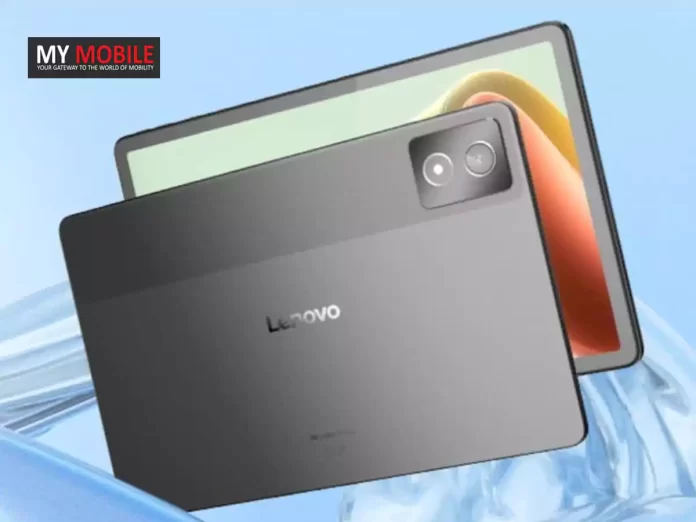
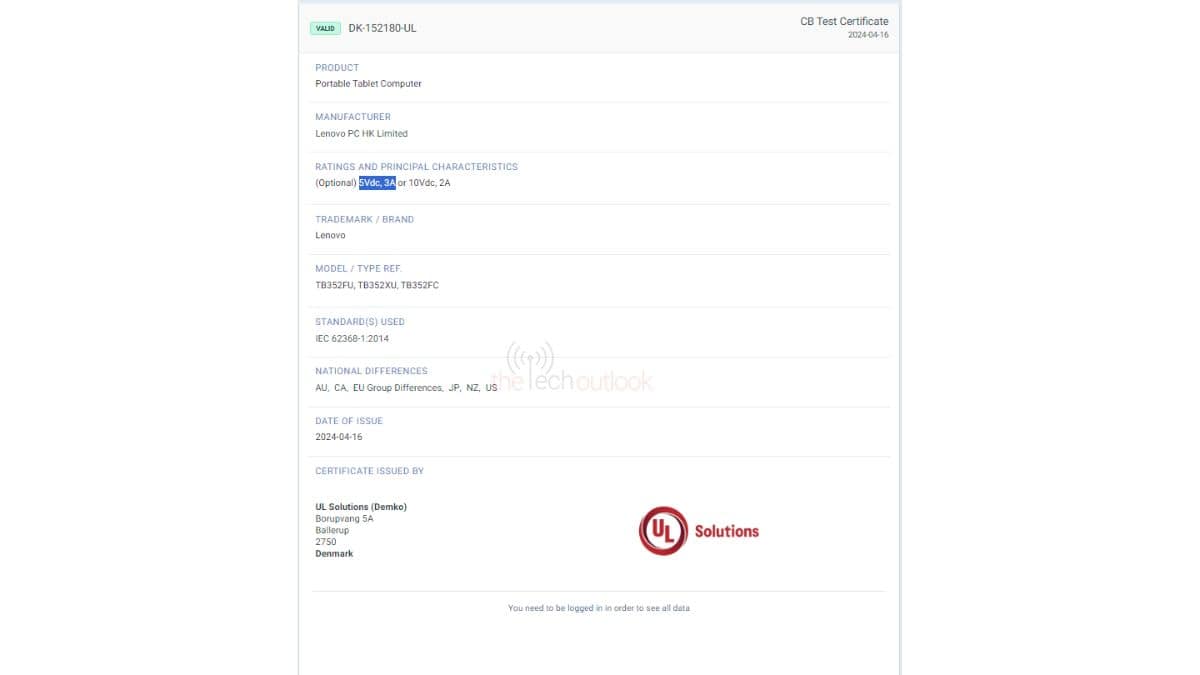
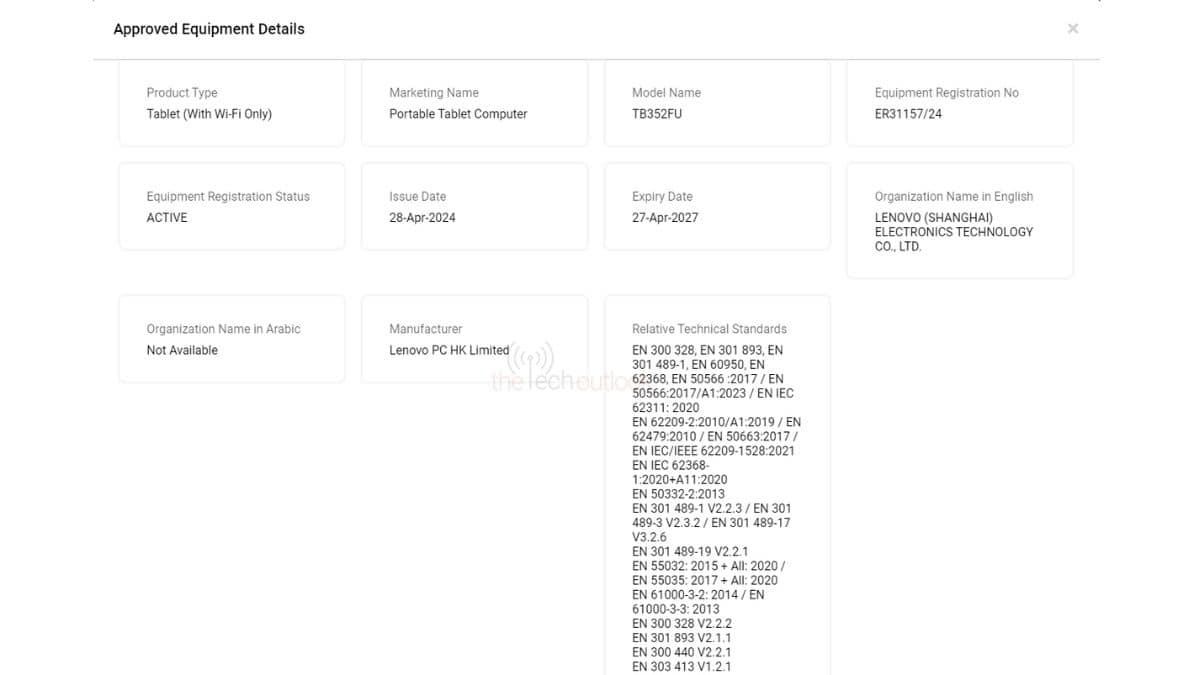
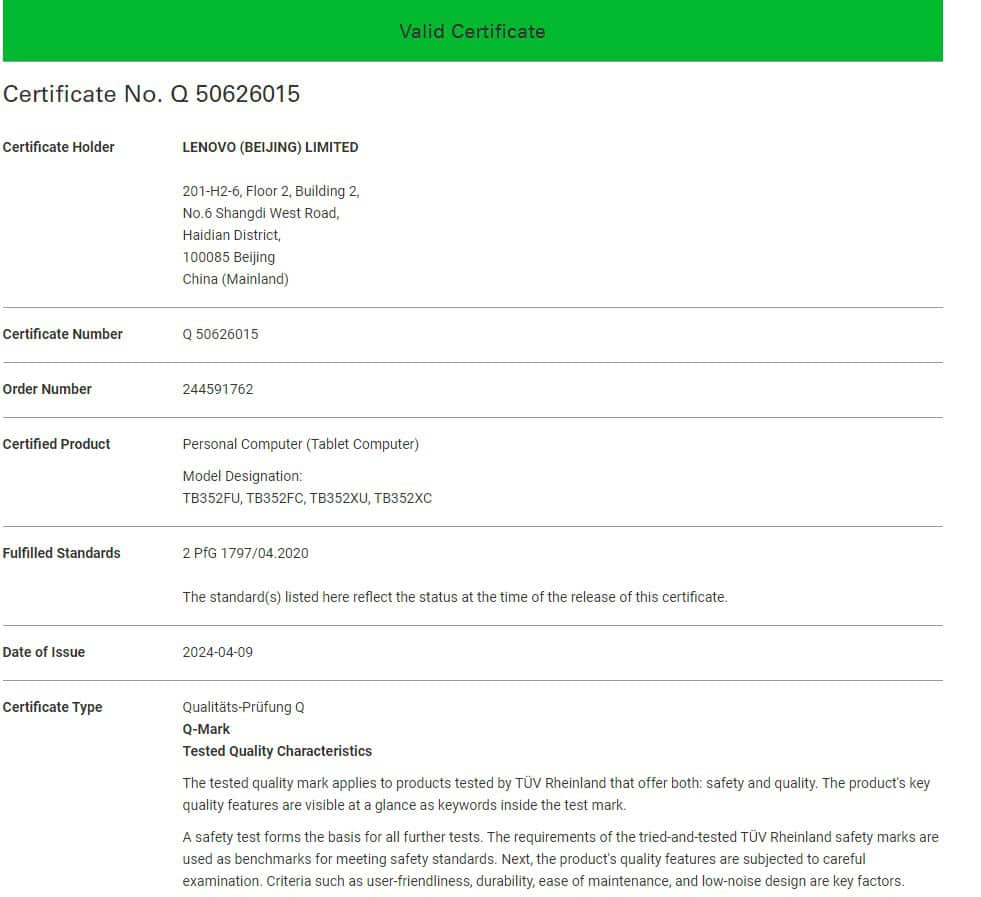
According to a report from Tech Outlook, the Lenovo Tab K11 Plus bearing model numbers TB352FU and TB352XU has landed listings on the TDRA, UL Demko, and TUV certification databases.
Lenovo Tab K11 Plus spotted on multiple certification websites
The TB352FU variant is tipped to be the Wi-Fi-only model, while the TB352XU represents the Wi-Fi + LTE option.
Since the Tab K11 Plus is expected to be a rebranded global version of the Zhaoyang K11, the core specs are likely to remain identical across the Chinese and international models.
Lenovo Zhaoyang K11 / Tab K11 Plus Specs
Lenovo Tab K11 Plus bearing model numbers TB352FU and TB352XU has landed listings on the TDRA
The Zhaoyang K11 that launched in China features an 11.5-inch IPS display with a 2K resolution, 400 nits brightness, and a 90Hz refresh rate.
Lenovo likely wants to get all the clearances out of the way before formally announcing release details.
With its large high-res display, robust specs, and productivity features like a keyboard attachment, the Lenovo Tab K11 Plus could shape up as an affordable tablet option for students, mobile professionals, and general entertainment consumption when it arrives.
FAQs
What are the key features of the Lenovo Tab K11 Plus?
The Lenovo Tab K11 Plus boasts an 11.5-inch IPS display with a 2K resolution, Snapdragon 680 chipset, up to 8GB of RAM, and 256GB of storage.
It also features quad speakers and dual microphones for enhanced audio and communication.
What are the camera specifications of the Lenovo Tab K11 Plus?
The tablet is equipped with a 13MP rear camera and an 8MP front-facing camera, catering to photography and video calling needs.
What battery capacity and charging support does the Lenovo Tab K11 Plus have?
The Lenovo Tab K11 Plus is powered by an 8,600mAh battery with 20W fast charging capability, providing long-lasting battery life and quick recharge times.
What operating system does the Lenovo Tab K11 Plus run?
It runs on ZUI 16, which is based on Android 14, offering a user-friendly interface and access to the latest software features.
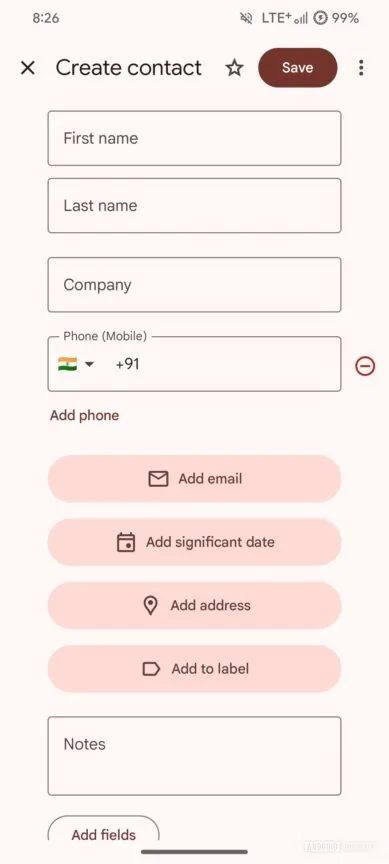
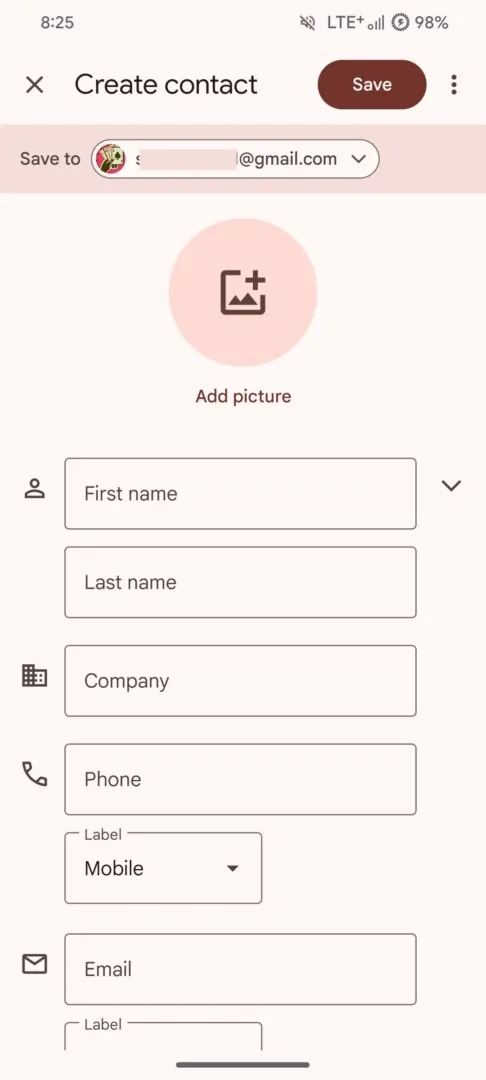
An unreleased version, spotted by Android Authority contributor Assemble Debug, has revealed an updated “create” page that streamlines the process with some convenient changes.
However, the upcoming revamp aims to put all the crucial information fields front-and-center from the start.
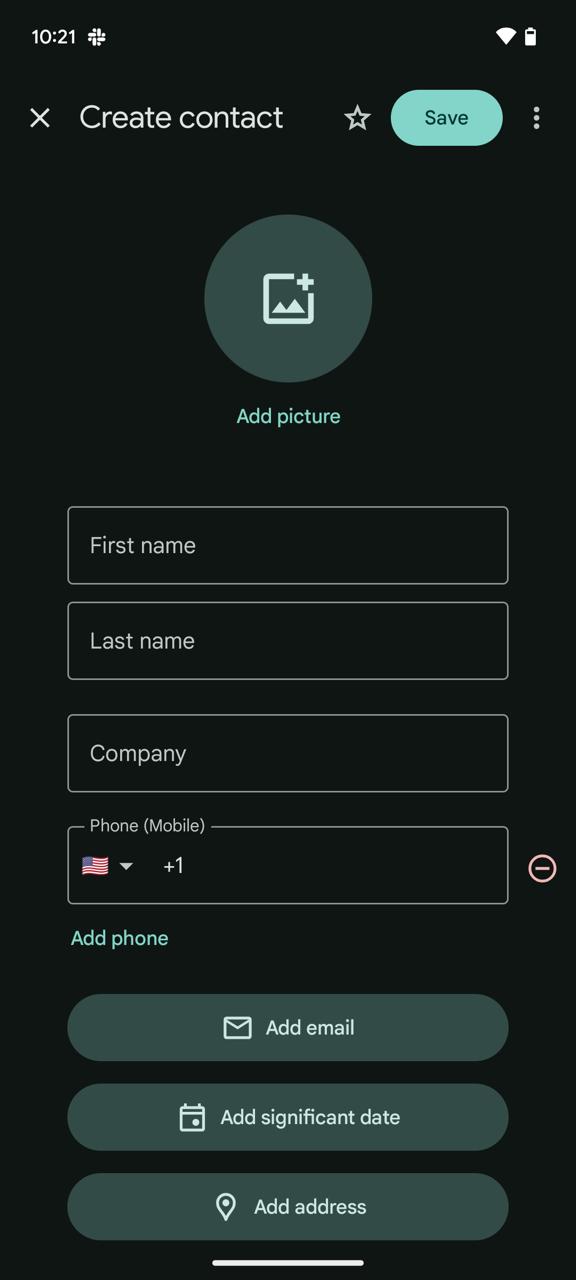
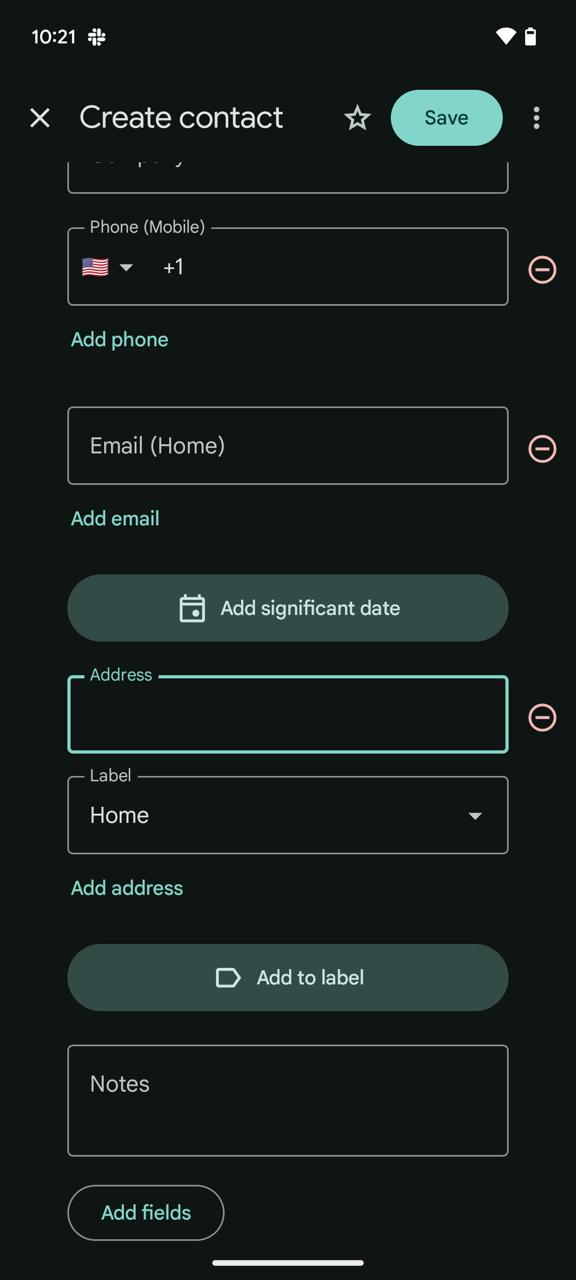
As discovered by Android Authority, the new create page will present input boxes for first name, last name, company and phone number immediately under the photo section.
Streamlined Data Entry
New “create” page for easier contact entry in the Google Contacts app
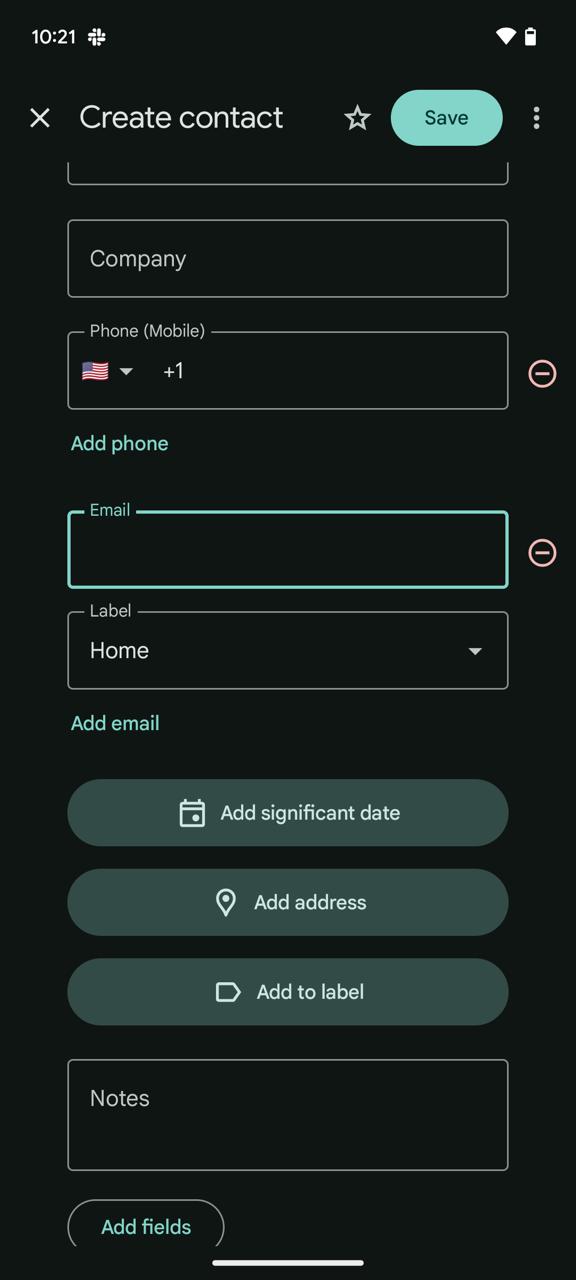
Rather than having to continuously scroll and expand additional fields, Google’s new approach shows us a set of pill-shaped buttons to quickly jump to other common contact details like email, birthday, address, and notes.
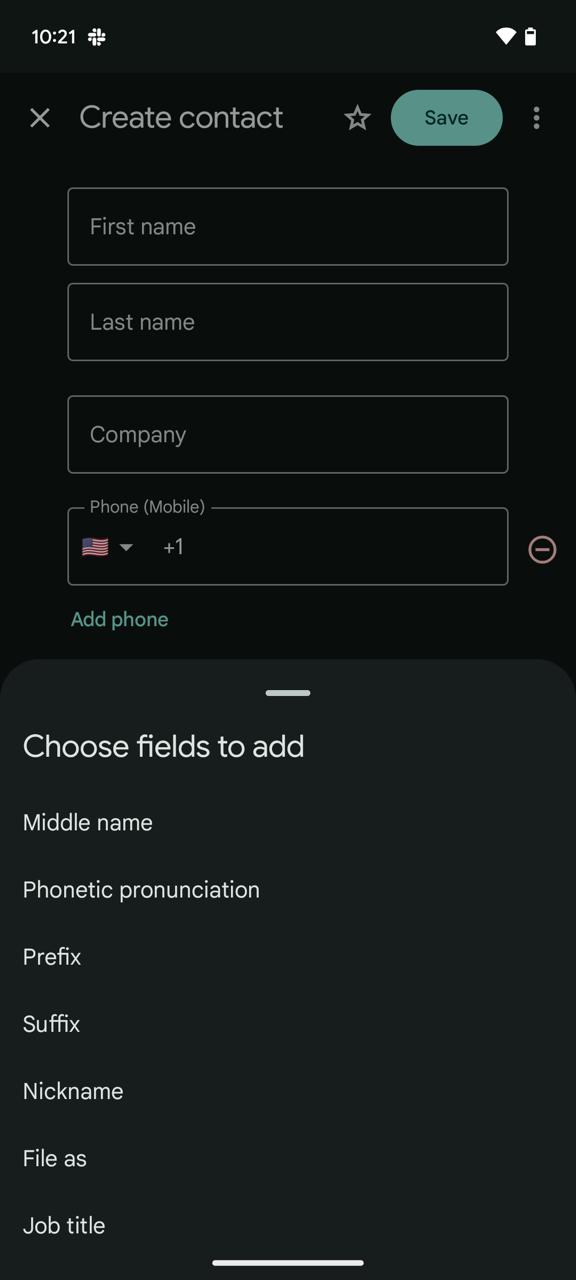
For more advanced details like middle name, pronunciation, job title, and so on, Google has tucked those options behind an overflow menu accessed by tapping one of the pill buttons.
Not Rolling Out Yet
Advanced contact fields now hidden behind an overflow menu for simplicity
While the refinements promise to make adding new contacts more efficient, the new create page experience isn’t rolling out quite yet.
It was spotted after Assemble Debug managed to sideload an unreleased version of the Contacts app.
There’s no official word from Google on when the updated UI will graduate to the stable release.
As a core utility app, even seemingly minor upgrades to Contacts can go a long way in enhancing the experience of managing your contacts list and details on Android devices.
FAQs
What changes has Google made to the Contacts app on Android?
Google is updating the Contacts app with a more streamlined “create” page that allows for easier entry of essential information, such as name and phone number, right at the top of the page, with quick access buttons for additional details.
How will the new Google Contacts app improve user experience?
The updated app simplifies data entry by reducing the need to scroll through multiple fields, making it faster to enter and organize contact information on Android devices.
What new features are included in the updated Google Contacts app?
Features include pill-shaped quick access buttons for secondary contact details and a more organized approach to entering primary information like first and last names and phone numbers.
When can users expect the new Contacts app update to be available?
While there’s no official release date yet, the update is likely to roll out in the coming weeks or months through the Google Play Store as it moves from its current unreleased version to a stable release.
* Redmi Note 13 Series Crosses 15-Million Sales Milestone Worldwide. * Redmi Note 13 Series Is Now Available at a never-seen-before price of INR 15,499. * Xiaomi is celebrating its 10th anniversary in India. * The Redmi Note 13 Pro+ World Champions Edition is developed with the Argentine Football Association. * The new special Edition will only be available in the 12GB + 512GB storage tier. * The phone will be available via Flipkart, Amazon, Mi.com, and Xiaomi retail stores.
Xiaomi, is on the brink of celebrating its illustrious 10th anniversary in India.
This launch follows Xiaomi’s remarkable achievement of exceeding 15 million Redmi Note 13 Series units sold worldwide, a testament to the Note Series’ unwavering popularity and the trust it commands among consumers.
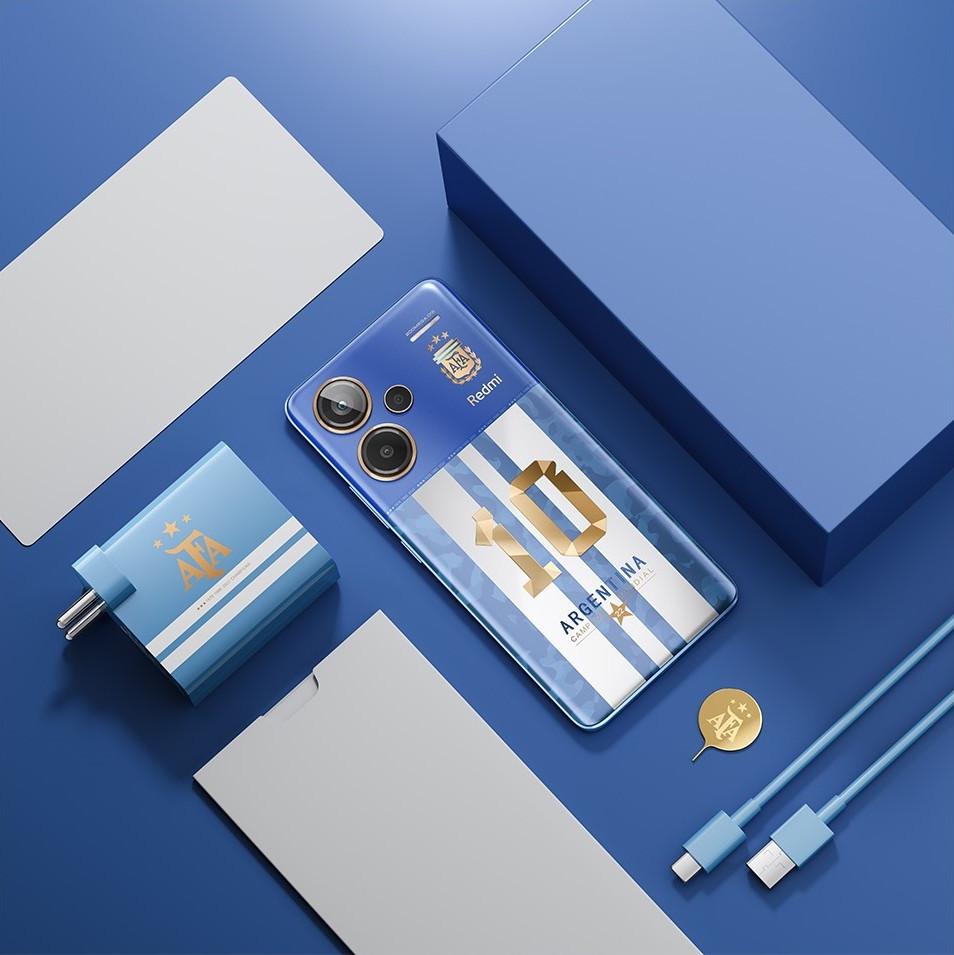
Introducing the World Champions Edition of #RedmiNote13 Pro+ 5G, marking 10 years of innovation.
This G.O.A.T collab with Argentine Football Association shows our commitment to pushing boundaries. Launching 30th April.
📍 @AFASeleccionEN @afa pic.twitter.com/UPJ5jeBfqG
— Redmi India (@RedmiIndia) April 26, 2024
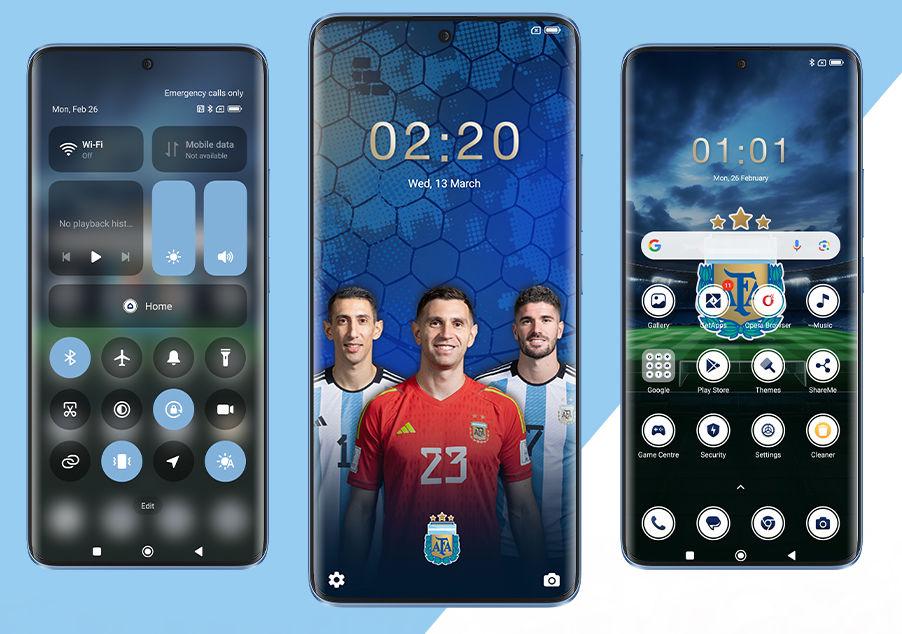
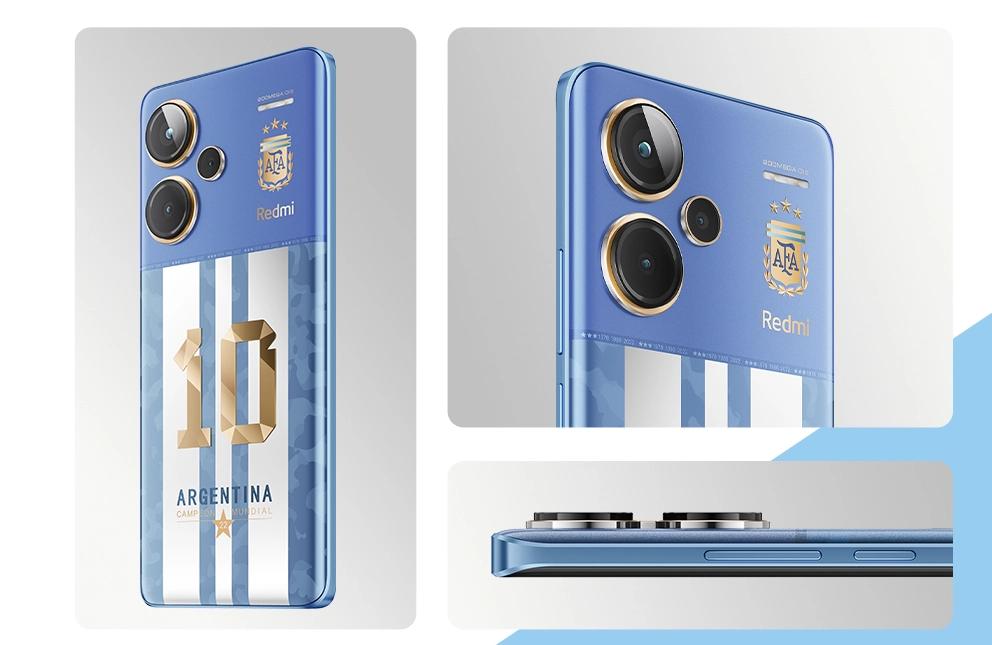
Inspired by the vibrant blue and white stripes, rich heritage, and the symbolic number 10, every aspect of this World Champions Edition smartphone has been thoughtfully designed to win the hearts of passionate football fans in India.
From the striking hues of the AFA jersey to the subtle incorporation of the iconic three shining stars representing their victories, every element of the exudes a sense of respect and authenticity.
Xiaomi India Unveils AFA Exclusive Redmi Note 13 Pro+ 5G World Champions Edition
“As we celebrate 10 momentous years in India, we are delighted to unveil the Redmi Note 13 Pro+ 5G World Champions Edition, a tribute to the passion of football fans. This collaboration with AFA signifies our commitment to delivering unique experiences tailored to the preferences of our diverse consumer base,” said Anuj Sharma, Chief Marketing Officer at Xiaomi India.
“The Redmi Note series has been nothing short of amazing, and this special edition launch is a testament to its unparalleled success. We are immensely proud to announce that we have achieved a monumental milestone of 15 million Redmi Note 13 Series units sold globally.”
Leandro Petersen, Chief Commercial and Marketing Officer of AFA, also expressed his enthusiasm about the collaboration, stating: “Partnering with Xiaomi India for the launch of the Redmi Note 13 Pro+ 5G World Champions Edition marks a significant milestone for AFA.
This special edition not only strengthens our partnership, which began last year but also paves the way for exciting new experiences for users. It reinforces our presence and influence in the Asian continent, especially in India. Congratulations to Xiaomi on their outstanding achievements, and we look forward to further enhancing fan engagement in India through this iconic series.”
Redmi Note 13 Series Crosses 15-Million Sales Milestone Worldwide
The box’s elegant interiors are accentuated by bold splashes of color, echoing the energy and dynamism of the football field.
Furthermore, included in the box is a card that honors the esteemed players who have achieved victory on the global stage during the 2022 World Cup, thereby enriching the celebratory experience for enthusiasts.
Xiaomi is celebrating its 10th anniversary in India
It also includes a fully customized AFA edition 120W HyperCharger, colour co-ordinated USB Type-C cable and a football-inspired sim ejector pin.
Price for Redmi Note 13 Pro+ 5G World Champion Edition
Price for Redmi Note 13 Pro+ 5G World Champion Edition
Join Xiaomi in celebrating a decade of innovation and success in India with the Redmi Note 13 Pro+ 5G World Champion Edition.
Packed with top-of-the-line features, including IP68 protection for dust and water resistance, a true 200 Megapixel camera, and a 3D Curved AMOLED display protected by Corning® Gorilla® Glass Victus®, the smartphone is available at a price of INR 34,999* for the 12GB+512GB variant.
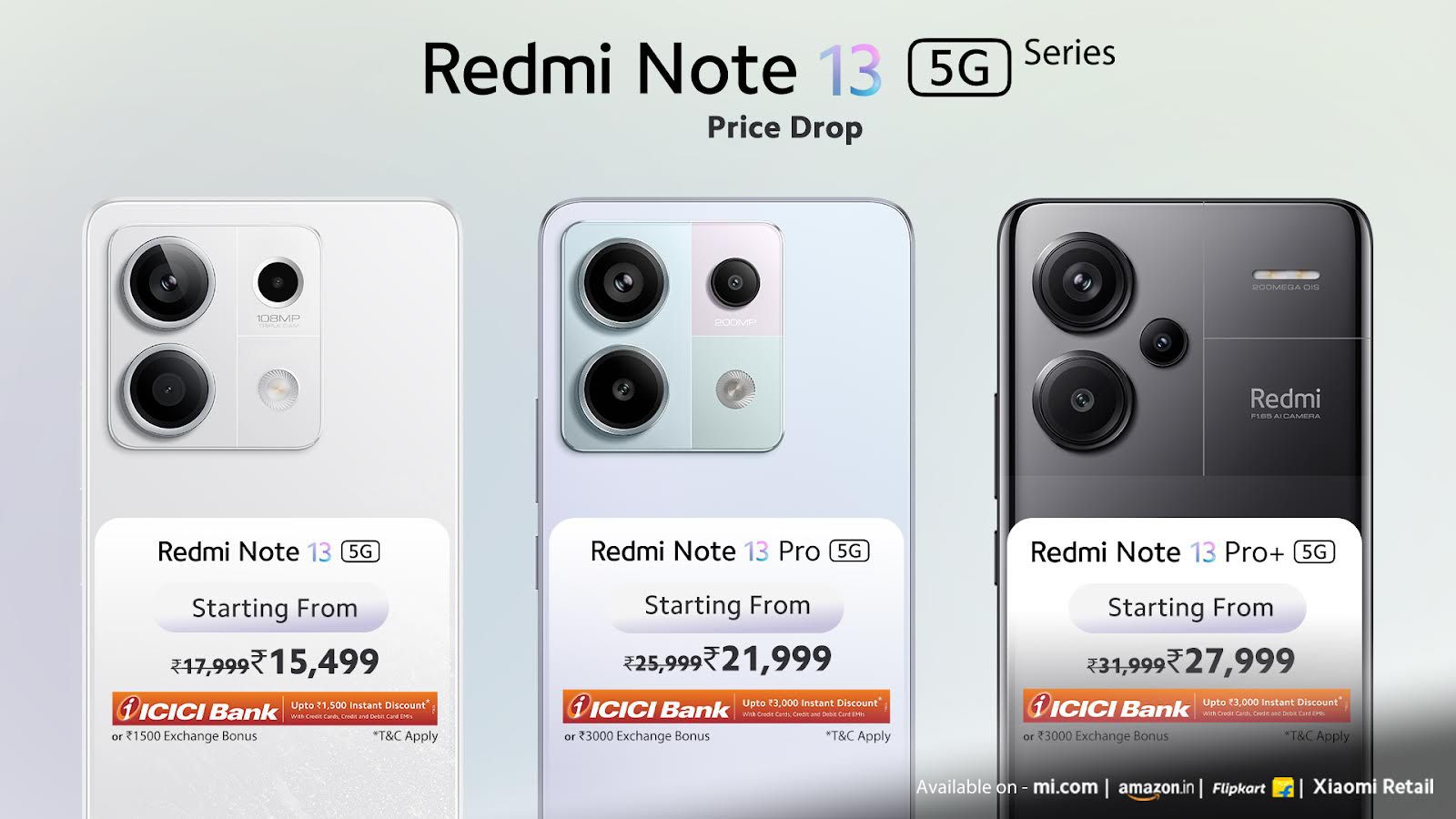
Never Seen Before Prices on Existing Redmi Note 13 Series 5G:
Redmi Note 13 Series Is Now Available at a never-seen-before price of INR 15,499
* Redmi Note 13 5G will now be available at a net effective price of INR 15,499 6GB+128GB, INR 17,499 for 8GB+256 GB and INR 19,499 for 12GB+256GB,, inclusive of offers.
* Redmi Note 13 Pro 5G will now be available at a net effective price of INR 21,999 for 8GB+128GB, 8GB+256GB for INR 23,999 and INR 25,999 for 12GB+256GB, inclusive of offers.
* Redmi Note 13 Pro+ 5G will now be available at a net effective price of INR 27,999 8GB+256GB, INR 29,999 for 12GB+256GB and INR 31,999 for 12GB+512GB inclusive of offers.
* Available across Mi.com, Amazon, Flipkart, Xiaomi Home & Xiaomi Retail.
* Net effective price, inclusive of bank offers
Redmi Note 13 Pro+ WC Edition specifications
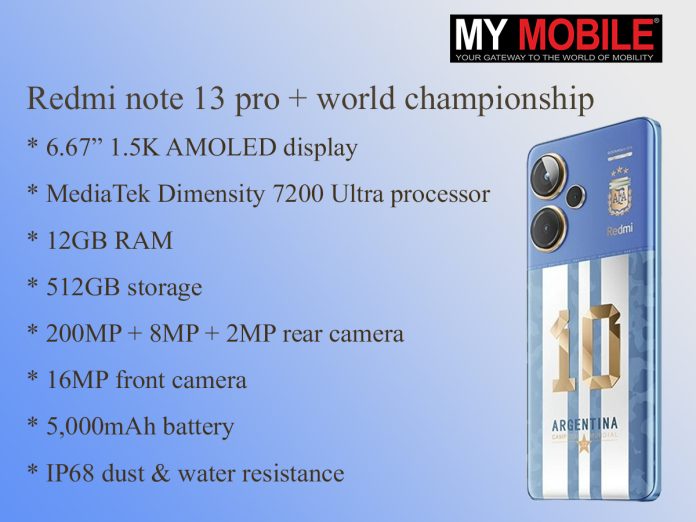
Redmi Note 13 Pro+ WC Edition specifications
The Redmi Note 13 Pro+ WC edition has the same 6.67-inch 1.5K AMOLED display with 2712 x 1220 pixels resolution, a 120Hz refresh rate, Corning Gorilla Glass Victus and a punch-hole cutout.
What is the price of Redmi Note 13 Pro + World Champions Edition ?
The Redmi Note 13 Pro+ World Champions Edition has a 12GB + 512GB configuration option and is priced at Rs 37,999.
What is the launch offer of Redmi Note 13 Pro + World Champions Edition ?
As a launch offer, the company provides buyers with an option to avail up to Rs 3,000 discount with ICICI Bank Credit and Debit Card transactions.
Xiaomi is also offering a Rs 3,000 exchange bonus on the purchase of the limited edition handset, but it can not be combined with the ICICI card offer.
What is the availability of Redmi Note 13 Pro + World Champions Edition ?
The limited edition handset will go on sale starting May 15 exclusively via Amazon, Flipkart, mi.com, and Xiaomi retail stores.
However, not everyone is happy with how Apple has implemented this change required by the EU.
The Browser Choice Option
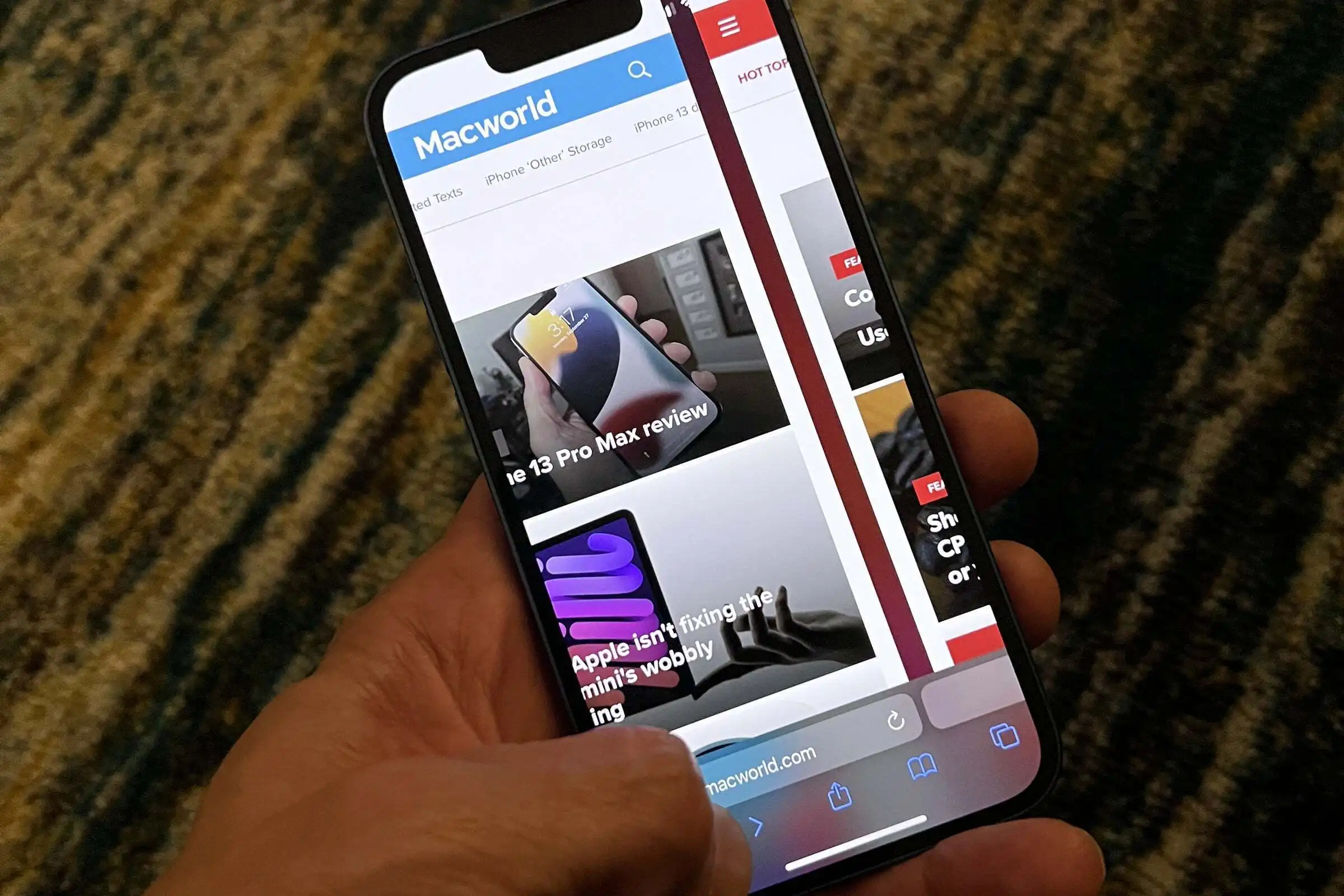
iPhone users in Europe now have a browser choice prompt due to EU regulations
While iPhone owners could theoretically choose a different web browser before, Apple, in its most Apple way, made the option to change painstakingly hard.
Safari is pre-installed as the default, and users had to manually install and set another browser as the default themselves.
However, the developers identified two problems with Apple’s browser choice:
1) Users aren’t asked during initial iPhone setup, only when first opening Safari – which reinforces Safari as the default.
2) No information is given about each browser, only the name – making it hard for non-tech savvy users to differentiate options.
Developers suggest either prompting during setup like Google does on Android or allowing a short description of each browser’s key benefit.
While the enforced browser choice has boosted usage of alternatives like Firefox and Vivaldi in Europe, companies like Mozilla feel Apple could go further to create a truly level playing field.
Whether Apple will truly do something is a question for another day but at least the EU is holding Apple accountable, which is a start.
FAQs
What change did Apple make for iPhone users in Europe regarding web browsers?
Apple introduced a browser choice prompt for European iPhone users in response to EU competition regulations.
This allows users to select their preferred web browser instead of defaulting to Safari upon first use.
Why are some developers unhappy with Apple’s implementation of the browser choice?
Developers criticize the implementation because the prompt only appears when a user first opens Safari, not during the initial setup of the iPhone.
This default setup could reinforce Safari’s use before alternatives are considered.
What suggestions have developers made to improve the browser choice feature on iPhones?
Developers suggest that Apple should include the browser choice prompt during the iPhone’s initial setup process and provide a short description of each browser to help users make more informed decisions.
How has the browser choice affected the usage of alternative browsers in Europe?
Since the implementation of the browser choice, alternative browsers like Firefox and Vivaldi have seen increased usage among European iPhone users, indicating that the feature has had some positive impact.
What sets OneAiChat apart is its unique “Focus Categories” feature, allowing users to delve into category-specific queries and uncover tailored, multi-modal solutions.
From health and audio/music to faith, marketing, video, art & design, and mathematics, this versatile platform promises to cater to a wide range of needs.
The founder, brimming with excitement, exclaimed, “We’re thrilled to unveil OneAiChat, the culmination of our team’s passion and dedication to democratizing AI accessibility. Our primary objective is to transform the AI landscape into an inclusive and user-friendly environment, empowering individuals and businesses alike to effortlessly harness cutting-edge AI technologies.”
Developed by a passionate team of developers, our platform offers a comprehensive suite of multi-modal features, focus categories, and paid versions of leading Generative AI platforms, including GPT-4, Claude 3, Gemini, Mistral, Stable Diffusion, DALL-E, and Cohere.
AI chat experience that breaks new ground in communication, connection, and creativity
Focus Categories:Our unique “Focus Categories” feature allows users to discover multi-modal solutions tailored to their needs across diverse areas like health, audio/music, faith, marketing, video, art & design, and mathematics.
This enhances the platform’s versatility and utility.
We continuously improve, push boundaries, and reimagine possibilities to create an AI chat experience that breaks new ground in communication, connection, and creativity.
Content Generation:OneAIChat streamlines content creation by generating high-quality assets like blog articles, product listings, social media posts, vivid images, engaging videos, informative audio clips, professional documents, and personalized music – all within seconds.
Multimedia Generation: With OneAIChat, users can create visuals, videos, and documentation effortlessly. The AI understands ideas and brings them to life visually and audibly, ensuring engagement and connection.
Disciplined Focus: Our platform offers curated categories and services like ChatGPT, Claude, Gemini, Mistral, Somebody, enabling users to focus and streamline their content creation process effectively.
Faqs
What is OneAIChat ?
OneAIChat, a multi-modal AI aggregator based in Mangalore, India, is revolutionizing the landscape of artificial intelligence and communication.
Developed by a passionate team of developers, our platform offers a comprehensive suite of multi-modal features, focus categories, and paid versions of leading Generative AI platforms, including GPT-4, Claude 3, Gemini, Mistral, Stable Diffusion, DALL-E, and Cohere.
These features are seamlessly integrated into a single, accessible global platform, accessible through a single subscription.
What are Key Features of OneAIChat ?
Focus Categories: Our unique “Focus Categories” feature allows users to discover multi-modal solutions tailored to their needs across diverse areas like health, audio/music, faith, marketing, video, art & design, and mathematics.
This enhances the platform’s versatility and utility. At OneAIChat, we are committed to delivering an unparalleled AI experience that elevates online interactions.
Our relentless pursuit of excellence drives us to leverage advanced technologies, methodologies, and user-centric designs.
We continuously improve, push boundaries, and reimagine possibilities to create an AI chat experience that breaks new ground in communication, connection, and creativity.
Content Generation: OneAIChat streamlines content creation by generating high-quality assets like blog articles, product listings, social media posts, vivid images, engaging videos, informative audio clips, professional documents, and personalized music – all within seconds.
Multimedia Generation: With OneAIChat, users can create visuals, videos, and documentation effortlessly. The AI understands ideas and brings them to life visually and audibly, ensuring engagement and connection.
Disciplined Focus: Our platform offers curated categories and services like ChatGPT, Claude, Gemini, Mistral, Somebody, enabling users to focus and streamline their content creation process effectively.
“Operating profit increased to KRW 6.61 trillion ($4.85 billion) as the Memory Business returned to profit by addressing demand for high value-added products,” it said in a statement.
Strong smartphone sales, higher prices for semiconductors plus a focus on high-value-added products including HBM — the high-bandwidth memory used in AI hardware — were key to the strong performance, it said.
“Looking ahead to the second quarter, the industry is expected to remain solid, led mainly by demand for generative AI,” the company added.
Sales were up 12.8 percent on-year to 71.9 trillion won, the company said.
“Demand for on device AIs and high resolution features continues to drive our production,” said Tommy Kwon, vice president of Samsung’s system LSI business, on an earnings conference call.
The weakness of the Korean won — down nearly seven percent against the US dollar so far this year — “resulted in a positive impact on company-wide operating profit of about KRW 0.3 trillion compared to the previous quarter,” Samsung added.
Samsung’s “overall outlook is secured by a resurgence in the smartphone market, escalating DRAM prices, and a modest decline in Fed interest rates,” Brady Wang, associate director of market research firm Counterpoint, told AFP.
“Samsung is strategically positioned to thrive amidst the evolving market conditions.”
But to maintain its momentum, the tech giant needs to “focus on accelerating development in emerging areas like high bandwidth memory, crucial for AI and high-performance computing,” he said.
Samsung had a “surprise” on its earnings thanks to “the recovery in memory demand”, said Tom Kang, research director of Counterpoint.
“The market environment is becoming more favorable to Samsung. Recovery in the smartphone market is also going to be tailwinds, combined with the rebound in memory prices.”
Read on to find out how the company made this turnaround.
Smartphone Sales Rebound
Samsung Reports Tenfold Increase in Q1 Operating Profits for 2024
While overall demand for premium and mid-range phones declined as expected due to typical seasonality, Samsung’s flagship Galaxy S24 lineup proved to be a solid hit.
A significant rebound in pricing for NAND, DRAM, and other crucial memory chips fueled by strategic stockpiling bolstered the component division’s performance.
Looking ahead, Samsung said it needs to “accelerate development in emerging areas like high bandwidth memory” which is critical for AI systems and high-performance computing workloads.
What contributed to Samsung’s substantial increase in operating profits for Q1 2024?
Samsung’s operating profits for the first quarter of 2024 saw a dramatic increase, largely due to strong sales from the Galaxy S24 series and a significant rebound in the semiconductor market, particularly in memory chips.
How did the Galaxy S24 series impact Samsung’s profits?
Despite a general decline in demand for smartphones, the Galaxy S24 series experienced solid sales, bolstered by innovative AI features and optimization efforts, contributing to double-digit profitability for this segment.
What was the role of the semiconductor division in Samsung’s Q1 earnings?
The semiconductor division played a crucial role in boosting Samsung’s profits, with increased pricing and demand for NAND and DRAM chips. Strategic stockpiling by clients also contributed to this success.
What future plans does Samsung have for its semiconductor business?
Samsung plans to accelerate the development of high bandwidth memory, which is vital for advanced computing and AI technologies, indicating a strategic pivot towards supporting high-performance computing needs.
How did currency factors affect Samsung’s financial performance?
The depreciation of the Korean won provided an additional boost to Samsung’s operating profits, adding about KRW 0.3 trillion to the company’s earnings, illustrating the impact of exchange rate fluctuations on global businesses.
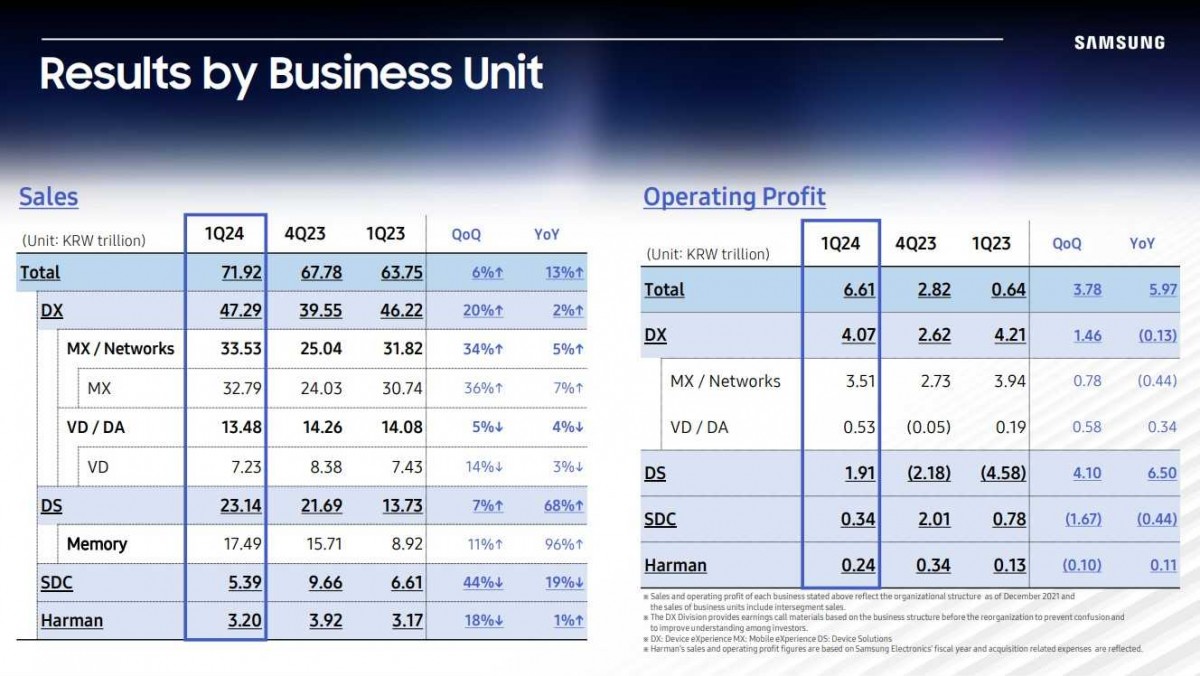
Samsung Electronics reported financial results for the first quarter ended March 31, 2024. All Details?
The Company posted KRW 71.92 trillion in consolidated revenue on the back of strong sales of flagship Galaxy S24 smartphones and higher prices for memory semiconductors.
Operating profit increased to KRW 6.61 trillion as the Memory Business returned to profit by addressing demand for high value-added products.
The Mobile eXperience (MX) Business posted higher earnings and the Visual Display and Digital Appliances businesses also recorded increased profitability.
The weakness of the Korean won against major currencies resulted in a positive impact on company-wide operating profit of about KRW 0.3 trillion compared to the previous quarter.
The Company’s total capital expenditures in the first quarter stood at KRW 11.3 trillion, including KRW 9.7 trillion for the Device Solutions (DS) Division and KRW 1.1 trillion on Samsung Display Corporation (SDC).
Spending on memory was focused on facilities and packaging technologies to address demand for High Bandwidth Memory (HBM), DDR5 and other advanced products, while foundry investments were concentrated on establishing infrastructure to meet medium- to long-term demand.
Display investments were mainly made in IT OLED products and flexible display technologies.
Has Memory Business Returns to Profit for Samsung ? Is Second Quarter Expected to Remain Solid on AI Demand?
The DS Division posted KRW 23.14 trillion in consolidated revenue and KRW 1.91 trillion in operating profit for the first quarter.
For servers and storage, demand for generative AI showed solid trends, while demand for DDR5 and high-density SSDs remained strong.
For PCs and mobile overall, content-per-box continued to grow for both DRAM and NAND, and demand remained robust on the back of active sell-in driven primarily by Chinese mobile OEM customers.
The Memory Business returned to profit as it achieved qualitative growth by addressing the demand across servers, storage, PC and mobile, focusing on high-value-added products such as HBM, DDR5, server SSDs and UFS 4.0., along with the increase in ASP.
Looking ahead to the second quarter, the industry is expected to remain solid, led mainly by demand for generative AI.
For servers and storage, the continuous increase in the supply of AI servers and subsequent expansion of associated cloud services will increase demand not only for HBM but also for conventional servers and storage solutions.
Demand for mobile is expected to be stable in the quarter, while PC customers are predicted to be affected by slow seasonality, making them likely to adjust their inventories ahead of new product launches in the second half of the year.
The Company started mass production of HBM3E 8H this month and plans to mass produce HBM3E 12H products and a 128GB product based on 1b nanometer1 (nm) 32Gb DDR5 within the second quarter.
The Company also started mass production of V9 NAND for the first time in the industry this month.
In the second half of 2024, business conditions are expected to remain positive with demand — mainly around generative AI — holding strong, despite continued volatility relating to macroeconomic trends and geopolitical issues.
For HBM, the Company will continue to increase supply in order to respond to growing demand for generative AI. In DRAM, the Company plans to accelerate 1b nanometer-based 32Gb DDR5 supply with faster ramp-up speeds and further strengthen its competitiveness in the high-density DDR5 module market.
For NAND, the Company plans to enhance technology leadership by mass producing quad-level cell (QLC) for V9 in the third quarter.
The System LSI Business increased the supply of systems on chips (SoCs) and sensors for major customers’ new products, but earnings improvements have taken longer than anticipated as Display Driver IC2 (DDI) sales were impacted by slowing panel demand.
With smartphone sell-out likely to show signs of recovery after a slow start, the System LSI Business will focus on providing a stable supply of flagship SoCs and sensors and is also preparing to ship products based on advanced technologies for new wearables.
For mobile sensors, the utilization rate is expected to remain high, including the mass production of 50MP products for global customers. For DDIs, sales are expected to continue expanding to meet demand from a major customer for new IT/TV products.
Amid a likely intensified pressure for component pricing, the System LSI Business will proactively adjust its product mix to navigate these challenges effectively.
The Foundry Business saw a delay in sales improvement due to weak market demand and continued inventory adjustments. Still, efficiency efforts in fab operations became more visible, which allowed it to narrow losses slightly.
The development of advanced 3nm and 2nm technologies is progressing smoothly, and 4nm technology yields have stabilized. This improvement in advanced technology competitiveness helped the Foundry Business achieve its highest ever order backlog in the first quarter.
Amid a likely gradual recovery in market conditions, second-quarter revenue is expected to rebound and reach double-digit quarter-on-quarter growth after bottoming in the first quarter.
The Foundry Business plans to complete the development of 2nm design infrastructure and prepare 4nm technology applicable to 3D IC. For mature technologies like 14nm and 8nm, it plans to prepare infrastructure for multiple applications.
In the second half of 2024, the foundry market is expected to see limited growth as uncertainties are likely to persist.
However, the Foundry Business expects to outpace the market growth rate in annual sales thanks to increased sales of leading-edge technologies of 5nm and below.
It will start mass production of Gate-All-Around (GAA) 3nm second-generation technology and improve the maturity of 2nm technology to focus on high-growth applications like AI and high-performance computing (HPC).
Is SDC Planning To Focus on Flexible Displays and IT/Automotive ? Does it Aim for Sales Growth in Large Panels?
SDC posted KRW 5.39 trillion in consolidated revenue and KRW 0.34 trillion in operating profit for the first quarter.
In the mobile display business, while intensifying competition led to a decline in earnings from the previous quarter, SDC ensured the timely supply of flexible displays for a major customer’s high-end smartphones and improved the utilization rate for rigid displays.
For the large display business, SDC narrowed losses on the back of new QD-OLED monitor products and a stronger customer base, despite an ongoing curb in demand.
While SDC expects sales to increase in mobile displays with the launch of new foldable phones from a major customer and stronger demand for IT products in the second quarter, earnings growth is likely to be impacted by intensifying competition.
As for large displays, SDC plans to address demand for TV panels for a major customer and seeks to expand sales of premium monitors.
In the second half of the year, SDC will focus on maintaining competitiveness by expanding the sales of flexible displays with low power consumption and improved durability while also continuing to replace LCD displays in smartphones with rigid display products.
Furthermore, SDC plans to boost its IT and automotive businesses in order to diversify its business portfolio.
SDC aims to increase large display sales from the previous year by improving the production efficiency of QD-OLED displays and enhancing the product mix, focusing on high-valued-added offerings.
Does MX Business Post Revenue Growth Amid Market Decline ? Do they Plan Continued Investment in AI ?
The MX and Networks businesses posted KRW 33.53 trillion in consolidated revenue and KRW 3.51 trillion in operating profit for the first quarter.
Market demand for premium and mid-range smartphone segments decreased sequentially in volume and value as the smartphone market entered the seasonally slower first quarter.
However, the MX Business achieved revenue and operating profit growth due to strong sales of the Galaxy S24 series and maintained solid double-digit profitability through continued efforts in resource optimization.
In particular, Galaxy AI features on the S24, such as Circle to Search, continued to see high usage rates and contributed to sales growth.
In the second quarter, overall demand for smartphones is expected to decline sequentially due to seasonality. Accordingly, the MX Business expects smartphone shipments to decline and tablet shipments to remain consistent sequentially.
The MX Business will maintain its flagship-oriented sales approach in the second quarter by applying the Galaxy S24’s AI experience to other flagship models and maximizing product competitiveness.
Additionally, the MX Business will aim to secure solid profitability by continuing to streamline operations in light of continued geopolitical instability and likely increases in the cost of key components.
At the same time, the MX Business will remain committed to investing in R&D, including in AI, despite a challenging environment.
In the second half of the year, the smartphone market is expected to rebound due to stabilizing consumer sentiment, the expansion of AI products and services and economic growth in emerging markets.
The MX Business will seek annual growth in smartphone sales and aims to maintain sales momentum through the expansion of Galaxy AI to existing and new flagship products across foldable devices and tablets.
For wearables, it will strengthen the Galaxy ecosystem experience through the expansion of new models and form factors like the Galaxy Ring.
For smartwatches, the MX Business will strive to meet demand for upgrades through the launch of new premium models.
Additionally, the MX Business will continue to seek operational efficiencies to counter rising component costs to ensure solid annual profitability, and it will continue to invest in research and development to further expand and refine Galaxy AI.
Do Visual Display and Digital Appliances To Continue Breaking New Ground in the AI Era?
The Visual Display and Digital Appliances businesses posted KRW 13.48 trillion in consolidated revenue and KRW 0.53 trillion in operating profit in the first quarter.
The Visual Display Business posted higher quarter-on-quarter profitability even as the overall market demand decreased by concentrating on premium products, such as Neo QLEDs, OLEDs and TVs above 75″.
However, profitability declined year-on-year due to stagnant TV market demand and increased costs amid intensifying market competition.
In the second quarter, overall market demand is expected to remain weak due to declining TV demand in emerging markets, but major global sporting events may lead to opportunities to increase sales.
The Visual Display Business will focus on securing profitability, enhancing sales of strategic products and strengthening operations management in each business segment.
In the second half of 2024, overall TV demand is expected to recover gradually amid an uncertain macroeconomic and geopolitical environment.
The Visual Display Business will address diverse consumer needs while promoting “AI Screen Leadership,” driven by innovative premium TVs and Lifestyle screens.
Additionally, it will provide differentiated customer experiences through connected devices and drive market growth by promoting advanced features based on security and sustainability, as well as boosting competitiveness in service businesses such as Samsung TV Plus.
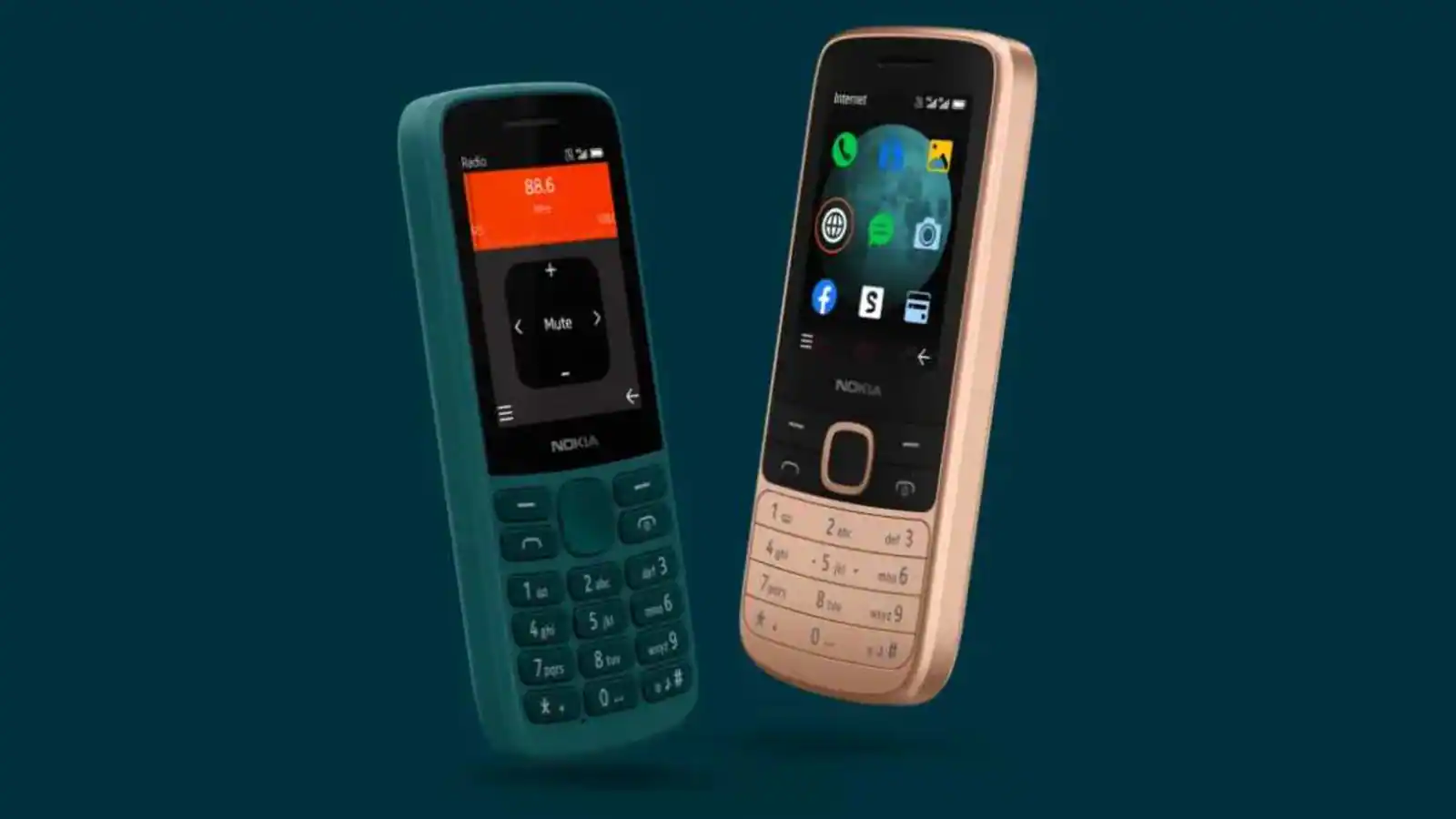
This model appears to be the one recreating the classic Nokia 3210 form factor from renders that surfaced recently.
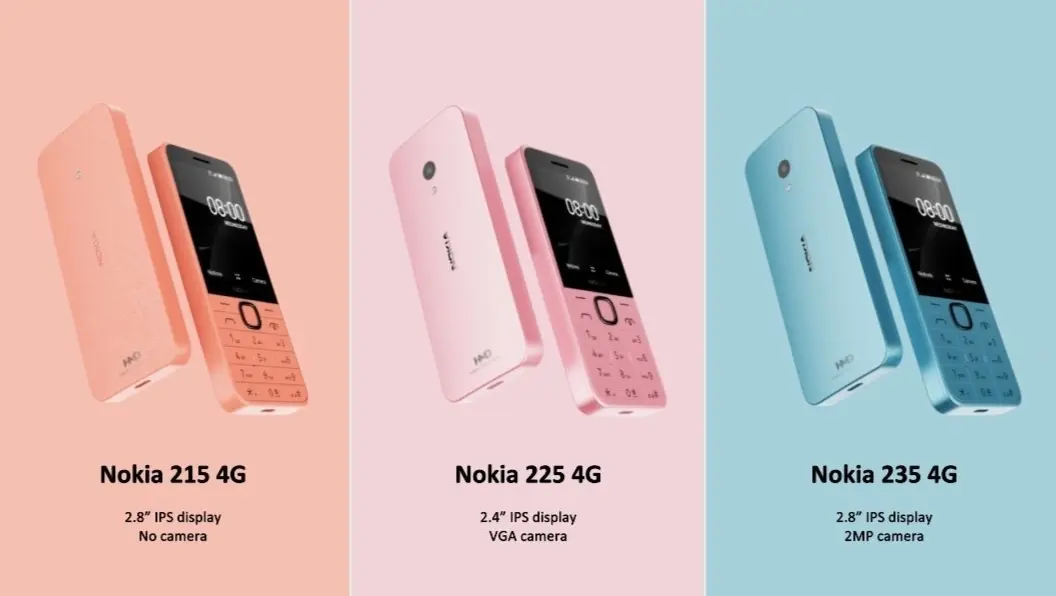
The top-end Nokia 235 4G matches the 215’s larger 2.8-inch display but outguns the 225 with an improved camera system, though specifics remain unclear.
Iconic Meets Modern
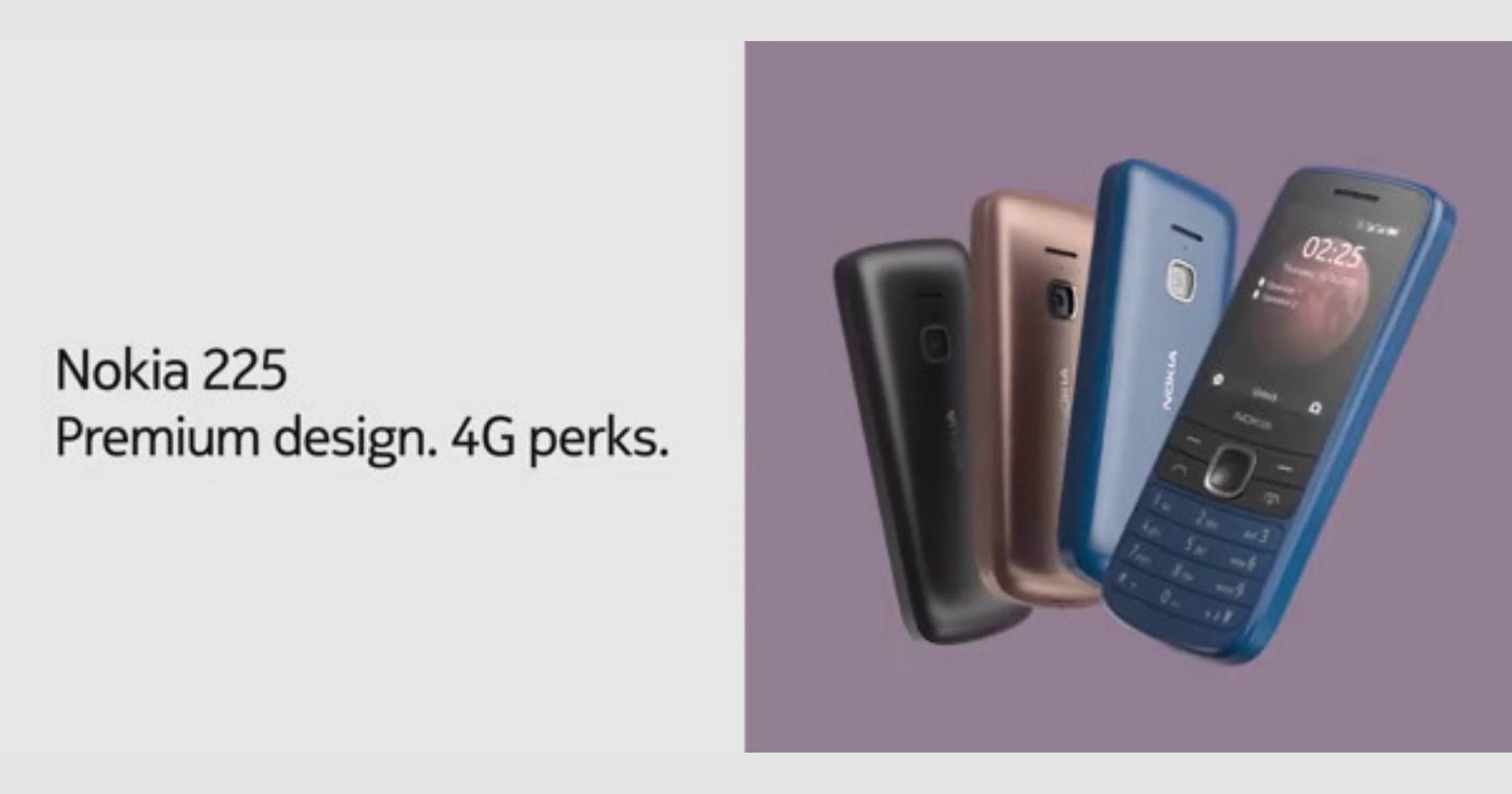
All models include physical T9 keyboards and USB-C ports
Despite their varied specs, the trio seem to share several commonalities beyond their nostalgic Nokia designs.
While internal specs and pricing are still unknown, HMD Global’s new 4G-enabled feature phone trio looks positioned to deliver a modernized take on vintage Nokia charm and simplicity when they arrive on store shelves.
Release Timing a Mystery
Nokia 225 4G features a smaller 2.4-inch screen with a camera
Unfortunately, concrete details on when exactly the Nokia 215 4G, 225 4G, and 235 4G will formally debut remain a mystery for now.
However, the abundance of leaks suggests official unveilings could be right around the corner.
What are the differences among the new Nokia 4G feature phones?
The Nokia 215 4G is the simplest, with no camera and a 2.8-inch screen.
The 225 4G has a 2.4-inch screen with a camera, while the 235 4G offers an advanced camera with the same larger screen as the 215.
What features do the new Nokia feature phones share?
Despite differing in cameras and screen sizes, all three models—215, 225, and 235—feature physical T9 keyboards, USB-C ports, and 4G LTE connectivity.
When will the new Nokia feature phones be available?
The release date for the Nokia 215 4G, 225 4G, and 235 4G remains unclear, but the frequency of leaks suggests they may be announced soon.
Will there be a Nokia 3210 revival?
Rumors suggest that HMD Global may be planning to revive the Nokia 3210 in 2024, capitalizing on the nostalgia associated with the original model.
How do the new Nokia phones fit into the current smartphone market?
These new models are designed for users looking for simplicity and the nostalgia of classic Nokia phones, equipped with modern features like 4G connectivity and USB-C ports.
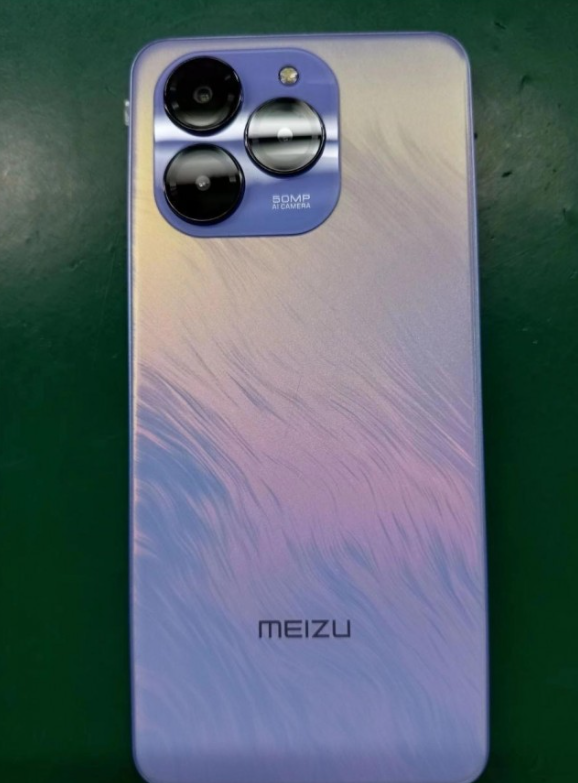
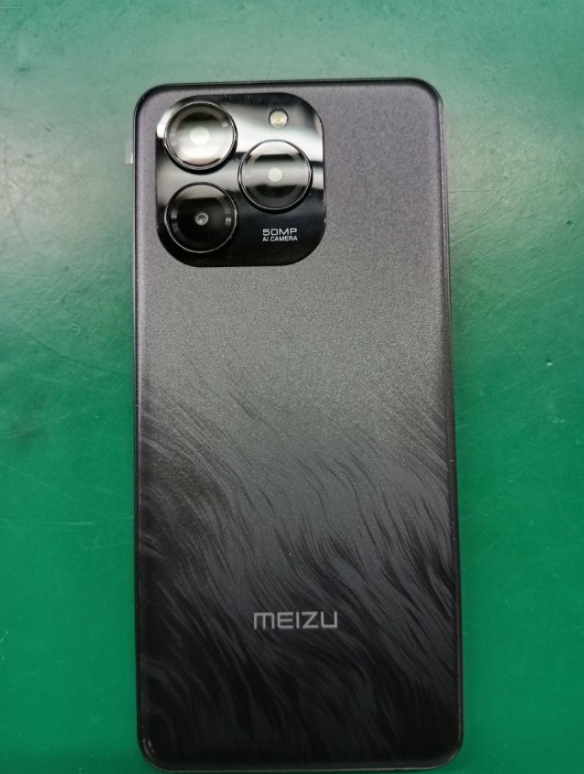
Leaked live images have emerged offering our first look at the unannounced phone’s design.
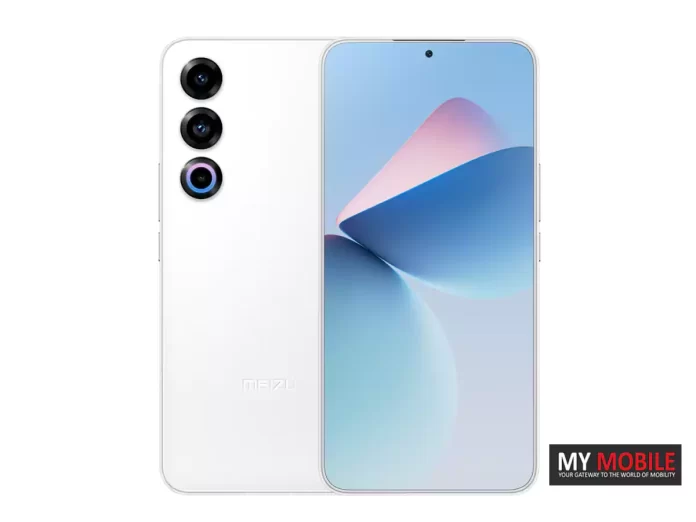
The photos depict the Meizu 21 Note rocking a triple rear camera setup enclosed in a triangular camera island.
One of the sensors is tipped to be a 50MP primary camera.
The back panel also seems to feature a wavy, etched pattern similar to the previously leaked Meizu 21 series models.
This layout with a protruding camera module represents a departure from Meizu’s typical design language.
It marks the first time the company has used a camera island instead of directly housing the lenses on the back panel.
Reviving the ‘Note’ Lineup
Spotted in Leaked Images, Set to Revive the Popular Smartphone Series Image Credit: weibo.com
More interestingly, these leaks signal the potential revival of Meizu’s once popular ‘Note’ lineup of big-screen phones after a hiatus of several years.
However, with display sizes having increased across the board, the 21 Note will likely need to differentiate itself in other ways.
Despite the impending exit from smartphones, Meizu still seems intent on releasing new mobile hardware – at least in the short term.
Previous leaks pointed to the 21 Note packing a large 5,500mAh battery with 66W fast charging support.
The Meizu 21 Note introduces a triangular camera island, a first for Meizu, deviating from its traditional camera placement. This new design features a wavy, etched pattern on the back panel.
What are the key specifications of the Meizu 21 Note?
The Meizu 21 Note is expected to have a 50MP primary camera, a large 5,500mAh battery with 66W fast charging, and be powered by a Snapdragon 8 Gen 2 chipset.
Is the Meizu 21 Note reviving an old Meizu lineup?
Yes, the 21 Note marks the revival of Meizu’s ‘Note’ series, which was known for big-screen phones.
This comeback includes modern updates to fit current market trends.
What does Meizu’s exit from the smartphone market mean for the 21 Note?
Despite announcing plans to exit the smartphone industry, Meizu is reportedly still launching the 21 Note.
This could be one of the last new devices as the company shifts focus towards AI development.
Will the Meizu 21 Note run Flyme OS?
It remains uncertain if the new Meizu 21 Note will continue using Meizu’s Flyme OS, especially with the company’s shifting focus towards AI products and services.
According to well-connected Bloomberg journalist Mark Gurman, the tech giant is not expected to launch a new version of its high-end headset until the end of 2026 – over two years after the original’s debut.
He suggests Apple may have misjudged mainstream consumer appetite for such an expensive luxury device.
“I think they’ve really fallen victim to their own financial successes and don’t understand how average consumers think about cost-value propositions,” Gurman writes, referencing the Vision Pro’s eye-watering $3,499 starting price.
Long Road to Vision Pro 2
Apple Reportedly Delays Next Vision Pro Mixed Reality Headset Until 2026
If Gurman’s claims are accurate, Apple finds itself around 18 months away from shipping a true “Vision Pro 2” successor based on its current product roadmap.
An imminent China launch could help open up a massive new market, for example. Nothing is guaranteed to that effect of course, but a wider user base equals more sales.
Competitor Landscape Evolving
Apple to focus on expanding market reach before next release
While Apple sits on its hands for the Vision Pro sequel, there is opportunity for competitors like Samsung and Meta to potentially gain ground.
The rumour mill has constantly been churning reports of Samsung working on its own premium mixed reality headset with specs like micro-OLED displays and powerful chipsets.
Meta, already the biggest player currently in the AR/VR space, has shifted to an open ecosystem approach by allowing other hardware makers to build for its Horizon VR platform.
Why is Apple delaying the launch of the next Vision Pro?
According to Mark Gurman from Bloomberg, Apple may not launch the next version of the Vision Pro until late 2026, suggesting production and market strategy adjustments due to the original’s lukewarm reception.
What issues are affecting the current Vision Pro’s market performance?
The high price point of $3,499 is seen as a major barrier, potentially misjudging the mainstream market’s readiness for such an expensive device, alongside noted production cuts and leadership changes.
What are Apple’s plans for the current Vision Pro model?
Despite the slow start, Apple is rumoured to be focusing on expanding the availability of the Vision Pro, possibly including new markets like China, to bolster its user base.
How are competitors responding to Apple’s slow update cycle?
Competitors such as Samsung and Meta are rapidly innovating, with Meta adopting an open ecosystem for its VR platform and Samsung reportedly developing a premium mixed reality headset.
What is Apple’s long-term goal with the Vision Pro?
Apple views the Vision Pro as more than just a product; it is intended to be a transformative computing platform, suggesting a strategic focus on foundational technology rather than frequent updates.
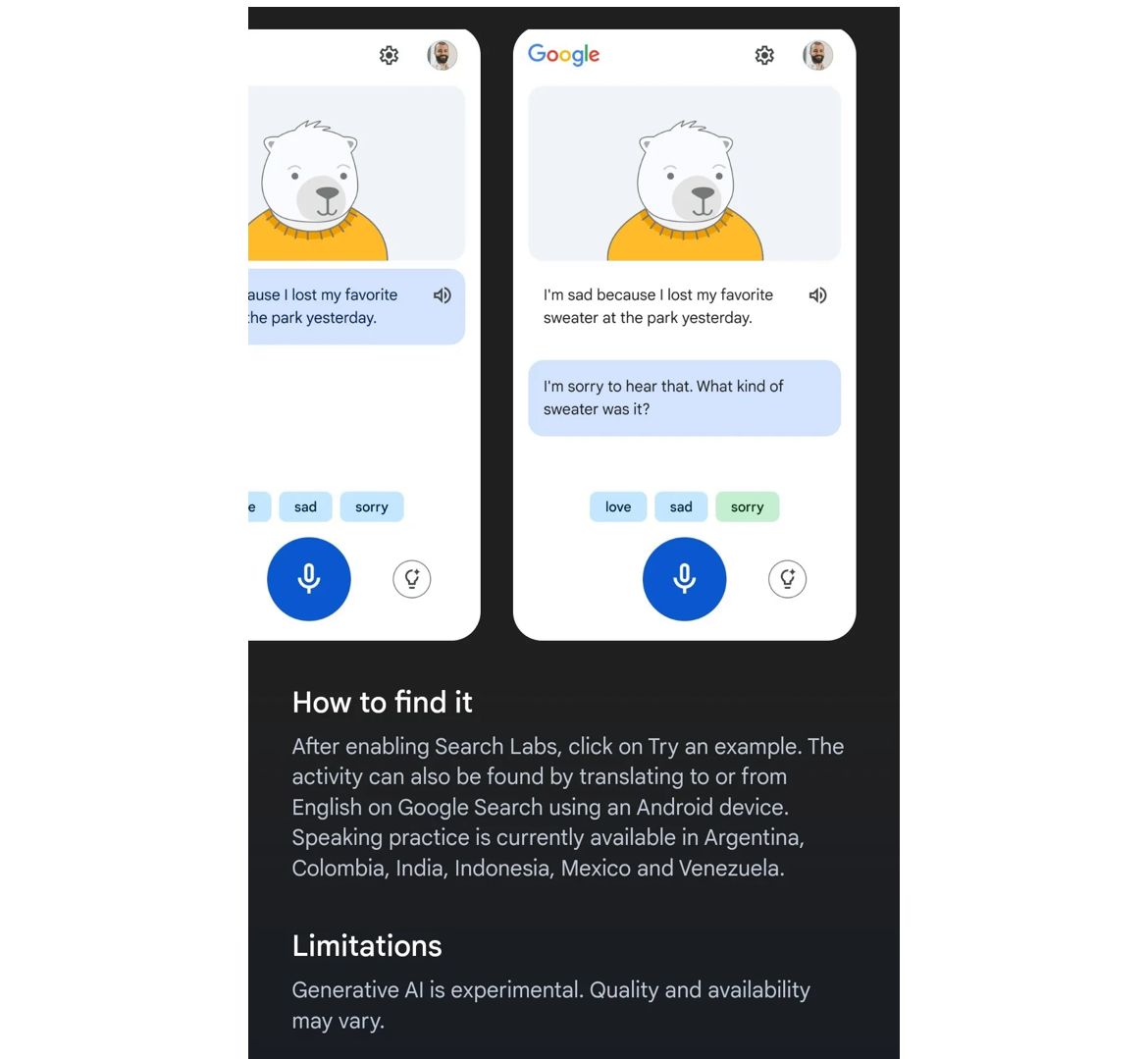
Speaking practice —new AI experiment on Google’s Search Labs! pic.twitter.com/ZqzyvgXNUZ
— ㆅ (@howfxr) April 25, 2024
For instance, one example provided by Google asks the user to incorporate the words “love,” “sad,” and “sorry” in a spoken reply to the situation: “I’m sad because I lost my favorite sweater at the park yesterday.”
Google says that the core idea is to help individuals learning English practice holding natural conversations while reinforcing proper usage of vocabulary in context.
AI tool aids English learners with conversational practice
For the time being, access to the “speaking practice” tool is fairly restricted.
Google has confirmed that it is currently only available to English learners in Argentina, Colombia, India, Indonesia, Mexico, and Venezuela who have joined the company’s Search Labs program.
Those with access can find the “speaking practice” option either by looking for it directly in Search or after translating text to or from English using an Android device.
Building on Previous English Learning Tools
Continues evolution of Google’s English learning tools
In late 2023, the company introduced a similar tool specifically designed to help English learners improve their spoken skills through interactions.
However, the newly spotted “speaking practice” tool appears to incorporate more realistic conversational prompts and scenarios compared to that previous effort.
Google hasn’t provided details on if or when it may expand availability to more countries and languages.
Google Explains
Google’s new ‘Speaking practice’ feature uses AI to help users improve their English skills
What is the new AI-driven feature introduced by Google?
Google has launched a “speaking practice” tool within Google Search to help English language learners improve their speaking skills through AI-powered conversational scenarios.
How does the Google AI speaking practice tool work?
The tool prompts users to respond verbally to scenarios using specific words, enhancing their ability to use vocabulary in context and hold natural conversations.
In which countries is the speaking practice tool available?
Currently, the tool is available to users in Argentina, Colombia, India, Indonesia, Mexico, and Venezuela who are part of Google’s Search Labs program.
Can anyone access Google’s speaking practice tool?
No, access is limited to English learners who have joined the Search Labs program and are located in one of the select countries where the tool is being piloted.
Will Google expand the availability of the speaking practice tool to more countries?
Google has not confirmed plans for expanding the tool’s availability to more countries or languages yet, but such expansions are typical for successful experiments.