There are several impressive Canva alternative that offers background removal and unrestricted access to millions copyright free photos
Adobe Express, upgraded from Adobe Spark, is a highly efficient tool that offers “quick action” buttons for easy editing and a wide array of templates to kickstart your projects.
Beyond the usual design features, Visme stands out with its ability to add interactivity and animation to your content.
Stencil can be termed a time-saving tool that allows you to create and share social media graphics quickly and offers the ability to save and reuse your favourite images and templates.
Canva is a tool is admired by both businesses and individuals alike. The application offers a wealth of creative options that makes it a useful tool for crafting social media templates, creatives for your articles and more.
Despite its popularity, however, Canva is not completely free. Many of its more utility-driven features are masked behind a payment gateway. As such many users have been seeking free alternatives to Canva.
Reasons for this shift include concerns over the print quality and the overuse of Canva’s templates, which have seemingly become ubiquitous.
For users to unlock resources which include the likes of Brand Kit, Magic Resize, Background Remover, and of course the nearly 100 million stock photos, users need to subscribe to Canva Pro.
If you desire a Canva-like experience but without feeling the need to pay for and are seeking to avoid the overused templates, we’ve got some solutions lined up for you!
Read on to find a comprehensive list of free alternatives that offer high-quality design capabilities.
Adobe Express
Adobe Express, which was earlier named as Adobe Spark, is an excellent Canva-alternative with a suite of features geared towards creative output.
Particularly noteworthy is the removal of the Adobe watermark in the free version, a feature that used to be accessible only through a paid plan with Spark.
Adobe Express presents a collection of “quick action” buttons that simplify editing of images, videos, and even PDF files. The application also allows a lot of flexibility to embark on a brand new project from scratch by using Adobe’s numerous pre-existing templates for a head start.
This improved toolset has certainly elevated Adobe Express as a strong contender in the design tool arena.
Of course, Adobe also has a paid tier which lets you access nearly 160 million stock photos, up to 20,000 Adobe fonts and more.
Visme
As a Canva alternative, Visme shines with its comprehensive and user-friendly design platform.
Like with other applications mentioned in this list, Visme also makes its mark by offering an impressive range of professionally designed templates for various forms of content, including infographics, presentations, social media graphics, and more.
Visme’s utility lies in its simplicity with functions like an intuitive drag-and-drop editor which enables users of all skill levels to add, adjust, and stylise elements with ease.
As per usual, you can choose from a wide selection of fonts, apply custom colours, and insert graphics to fine-tune your designs to your exact specifications.
It also offers a broad array of charts, graphs, and maps, making it an excellent tool for creating informative and visually compelling infographics
Like Adobe Express, Visme’s capabilities exceed that of Canva’s free version by providing a set of advanced features such as the ability to add interactivity and animation to your content.
This flexibility allows you to create dynamic, engaging designs that capture and hold your audience’s attention.
However, as is the case with any service, a paid version of Visme will add new functionality that will definitely help users more.
Stencil
Stencil stands out as an alternative to Canva with its fast, efficient, and easy-to-navigate interface, making it ideal for quick design tasks.
The application is centred around convenience, and it enables you to create and share social media graphics in a matter of minutes.
Just like Canva, Stencil also grants users access to an extensive array of icons and graphics that are royalty-free. This wealth of resources allows you to add a creative touch and unique flair to your visual designs.
Even in its free tier, Stencil offers up to 1,350 premium templates and up to 5 million photos that can be used without any copyright infringement.
Apart from that other unique features of Stencil include the ability to save and reuse your favourite images and templates, a quotes feature which provides access to a collection of ready-to-use quotes, and a WordPress plugin which integrates the service seamlessly to your websiteor blog.
Desygner
Offering a competitive edge, Desygner’s free plan surpasses Canva by providing perks like background removal and unrestricted access to a staggering 150 million Shutterstock photos.
Moreover, Desygner caters to a wide variety of design needs, boasting an extensive collection of free templates. Whether it’s whipping up eye-catching flyers or crafting an impressive new logo, Desygner makes it all possible in a snap.
This platform consolidates all the essential features users need for quick content creation, sharing, and printing, streamlining the entire design process.
Apart from just the free version, Desygner also offers Pro+, business and enterprise versions that add a host of new features to explore.
Snappa
Snappa is another powerful alternative to Canva, specifically designed to help users who may not have extensive graphic design experience.
The platform is also characterised by its straightforward, intuitive interface. Snappa also facilitates quick creation of graphics for social media posts, blogs, ads, and more, thanks to its pre-sized templates for various platforms and purposes.
This eliminates the need to manually adjust the dimensions of your designs for different platforms.
Snappa’s library contains millions of high-resolution, royalty-free stock photos, along with a vast selection of fonts, shapes, and graphics.
A standout feature of Snappa is its ability to schedule and share graphics directly to social media platforms, a feature not present in all design tools.
While Snappa may not have as many advanced features as Canva, its simplicity and ease of use, combined with its built-in social media sharing capabilities, make it a compelling choice for users looking to quickly create and distribute attractive graphics.
FAQs
Ques. What are some free alternatives to Canva?
Ans) Alternatives to Canva include Desygner, Adobe Express, Visme, Stencil, and Snappa.
Ques. Is Desygner free to use?
Ans) Desygner offers a free plan that surpasses Canva by providing perks like background removal and unrestricted access to 150 million Shutterstock photos. It also offers Pro+, business, and enterprise versions for additional features.
Ques. How is Adobe Express different from Canva?
Ans) Adobe Express, an upgrade from Adobe Spark, offers a suite of features including “quick action” buttons that simplify editing of images, videos, and PDF files. It also offers a vast array of templates for a head start on your projects.
Ques. Does Visme offer interactive features?
Ans) Yes, Visme offers advanced features, including the ability to add interactivity and animation to your content, making it a powerful tool for creating engaging and dynamic designs.
Ques. What unique features does Stencil offer?
Ans) Stencil offers features such as the ability to save and reuse your favourite images and templates, a quotes feature with a collection of ready-to-use quotes, and a WordPress plugin for seamless integration into your website or blog.
The Nothing Phone 2 has been recently unveiled at a starting price of Rs 44,999 in India for the base variant.
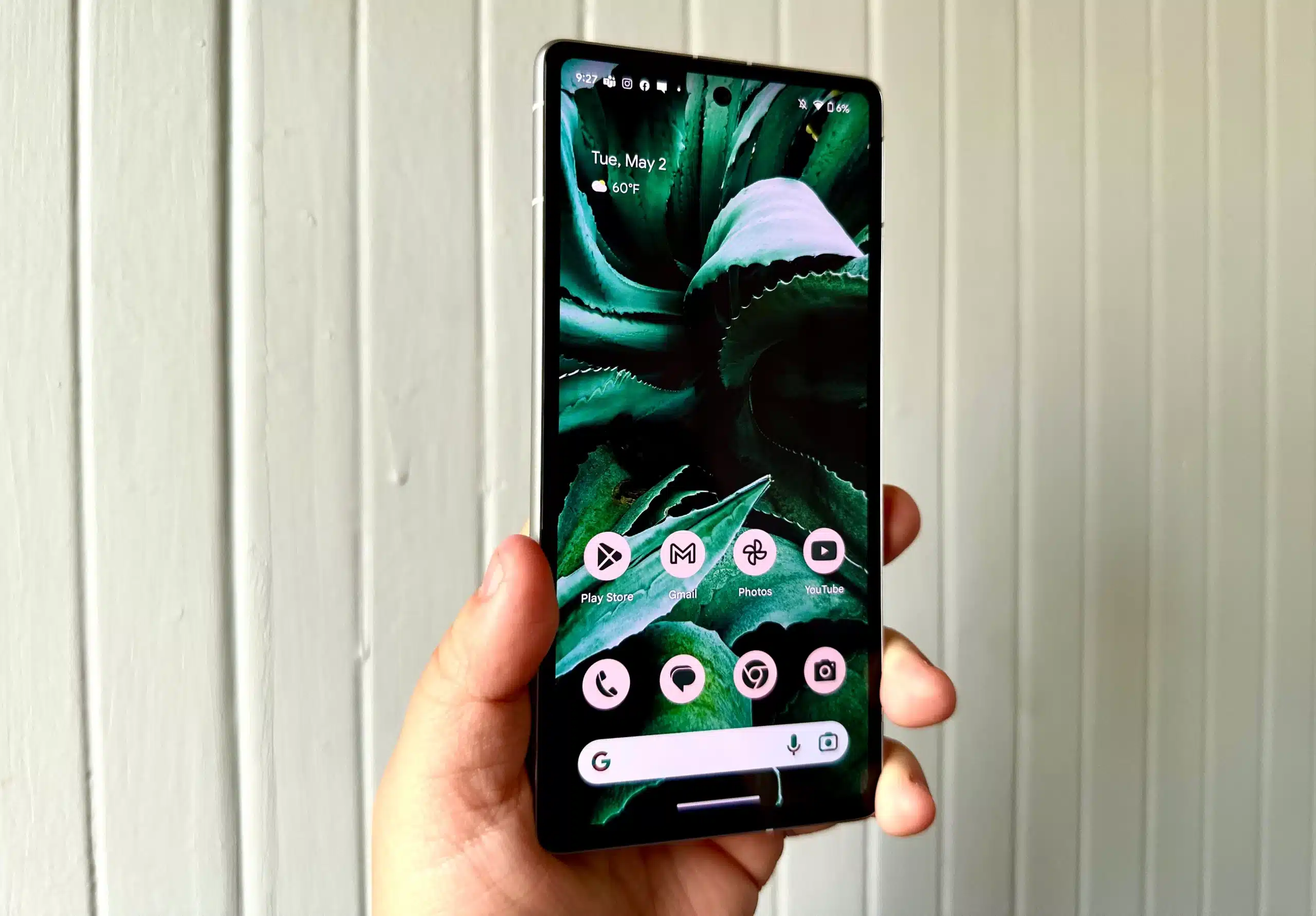
Google Pixel 7a is currently available in India at Rs 43,999 for the base variant with 8GB + 128GB configuration.
In this blog, we delve into these two smartphones to help you compare and contrast them to understand which one is right for you.
One of the most hyped smartphones of the year, Nothing Phone 2 has finally arrived in the middle of excitement among tech experts and smartphone enthusiasts.
Considering all the hype, a comparison of Phone 2 with other Android smartphones in the segment is inevitable.
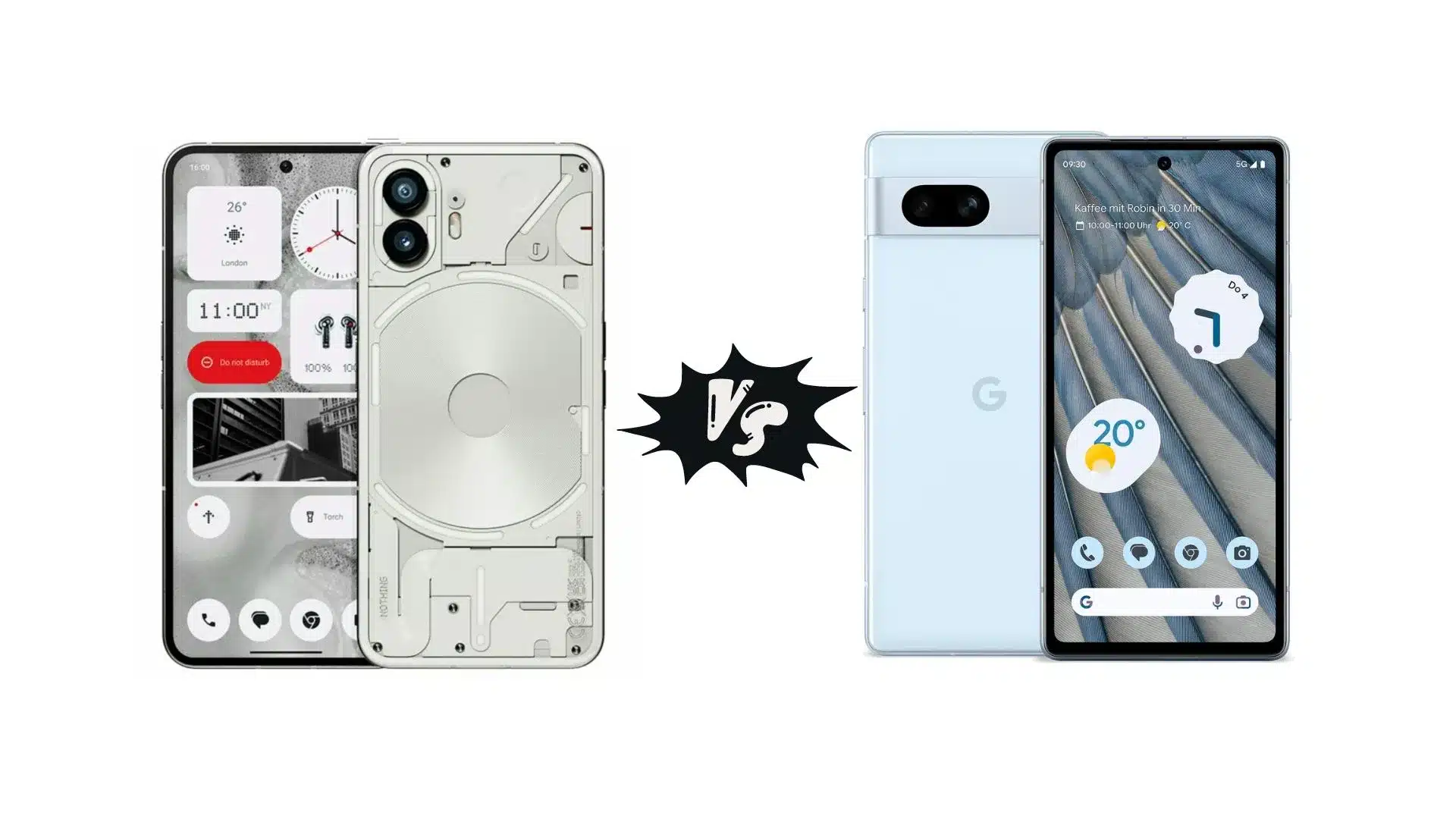
One of the leading competitors of Phone 2 is Google Pixel 7a. And in this blog, we are delving into these two smartphones to help you compare and contrast them to understand which one is right for you.
Google Pixel 7a was launched earlier this year and is one of Google’s best mid-tier flagship phones.
Following the legacy of the Pixel line-up, Pixel 7a comes with several upgrades over its predecessor thanks to theTensor G2 SoC, which is also found in Google’s premium flagships.
The story of Nothing Phone 2 is similar too as the brand has been constantly claiming that Phone 2 is the more refined and polished version of the previous Nothing phone.
So, as Nothing Phone 2 enters the market with unprecedented hype, let’s try to find out an answer to Nothing Phone 2 Vs Google Pixel 7a – Which One You Should Buy?
First of all, here’s a quick look at the positives of both devices.
Nothing Phone 2
Google Pixel 7a
● Design Novelty
● Decent cameras
● Glyph Interface improvements and innovations
● An Improved Nothing OS 2.0
● Customisation options
● As fast as the Pixel 7 Pro
● Great Tensor G2-powered features
● Best-in-class camera
● Strong performance
Flagship Challengers: Nothing Phone 2 vs. Google Pixel 7a – Which Deserves Your Attention?
Nothing Phone 2 vs Google Pixel 7a – Design and Durability
When it comes to design, Nothing Phone 2 stands out in almost every aspect because of its unique design approach compared to other smartphones available in the market. Google Pixel, on the other hand, has the regular design pattern that you have seen in other Pixel phones.
However, we wouldn’t say it is a one-sided battle because design at the end of the day is subjective and Google Pixel definitely has qualities where Phone 2 seems to be falling short.
From a distance, both devices sport distinct designs that are easily recognizable. The Nothing Phone impresses with its Glyph interface on the rear, introducing new functionalities, while the Pixel 7 showcases its signature metal camera bar.
The Nothing Phone 2 stands taller, wider, and slightly heavier than the Pixel 7, with a comparable thickness.
While both devices feature an aluminium frame, the Pixel 7 boasts the added strength of Gorilla Glass Victus on its front and back, whereas the Nothing Phone incorporates a less robust variant.
In terms of durability, the Pixel 7 takes the lead with its IP68 rating, offering superior ingress protection compared to the IP54 rating of Nothing Phone 2.
Both devices incorporate an optical fingerprint sensor and omit the traditional headphone jack.
The Pixel 7 offers a choice of three attractive colourways: Obsidian, Snow, and Lemongrass. Meanwhile, the Nothing Phone (2) is available in two elegant colours, white and grey.
Nothing Phone 2 vs. Google Pixel 7a – Which Offers More Value for Your Buck?
Nothing Phone 2 vs Google Pixel 7a – Display
When it comes to display features, the Nothing Phone 2 and the Google Pixel 7a offer distinct offerings.
The Nothing Phone 2 boasts a 6.7-inch LTPO OLEDdisplay with a resolution of 2,412 x 1,080 pixels. It features a flat Gorilla Glass 5 cover for durability.
The display supports a 120Hz variable refresh rate, providing smooth scrolling and animations, with the ability to go as low as 1Hz to save battery. It also offers a high touch sampling rate of 240Hz, ensuring responsive touch interactions.
With a peak brightness of 1,600 nits and HDR10+ support, the display delivers vibrant colours, deep blacks, and enhanced dynamic range. The 10-bit colour depth enhances colour accuracy and richness.
On the hand, we have the Google Pixel 7a sporting a 6.1-inch OLED display with an FHD+ resolution of 2,400 x 1,080 pixels, resulting in a pixel density of 429ppi. It features a 20:9 aspect ratio, providing a taller viewing experience.
The display offers a 90Hz refresh rate, delivering smoother scrolling and animations compared to standard 60Hz displays. With HDR support and Gorilla Glass 3 cover, the display provides improved contrast and protection against scratches.
Both devices offer excellent display performance, but there are some notable differences. The Nothing Phone 2’s LTPO OLED display with a variable refresh rate provides a seamless viewing experience with smooth animations and reduced power consumption.
Its high touch sampling rate ensures accurate and responsive touch interactions, enhancing usability.
On the other hand, the Google Pixel 7a’s OLED display with a 90Hz refresh rate delivers a smoother visual experience compared to traditional 60Hz displays.
While it may not match the higher refresh rate of the Nothing Phone 2, it still provides a noticeable improvement in fluidity and responsiveness.
The Ultimate Face-Off: Nothing Phone 2 vs. Google Pixel 7a
Nothing Phone 2 vs Google Pixel 7a – Hardware and Performance
Let’s talk about the hardware.
The Nothing Phone 2 is equipped with the Qualcomm Snapdragon 8 Plus Gen 1 chipset. This powerful processor ensures smooth multitasking, fast app launches, and efficient overall performance. It delivers robust processing power, allowing users to handle demanding tasks with ease.
And then we have the Google Pixel 7a which features the Tensor G2 chipset, designed specifically for Google’s Pixel devices.
With its focus on AI and machine learning capabilities, the Tensor G2 delivers enhanced performance and improved AI-driven features. It provides optimized performance for a seamless user experience.
Both devices offer solid performance, but there are differences based on their respective hardware and optimizations. Google Pixel 7A has an overall AnTuTu score of 687,738. In contrast, Phone 2 scored around 1145797 on the AnTuTu benchmark app.
The Nothing Phone 2’s Qualcomm Snapdragon 8 Plus Gen 1 chipsetdelivers excellent performance, enabling fast app launches, smooth navigation, and efficient multitasking. With ample RAM options, it can handle resource-intensive tasks with ease.
As for Google Pixel 7a, the Tensor G2 chipset used with 8GB LPDDR5 RAM, offers optimized performance and AI capabilities.
It delivers smooth and responsive performance, with AI-driven features that enhance user experience, including advanced computational photography and real-time language translation.
Nothing Phone 2 and Google Pixel 7a – A Deep Dive into Flagship Prowess
Nothing Phone 2 vs Google Pixel 7a – Camera Setup
Now, coming to one of the most important aspects of smartphones in the current ear – the camera. A good camera is a make-or-break deal for many users and with the growing use of social media, having a good camera on your phone is a must.
Comparing the cameras of both phones, it is not difficult to say which is better when one is known for thecamera performance.
Both phones come with dual read camera system with Pixel 7a sporting a 64MP wide primary sensor + 13MP ultrawide configuration as compared to Phone 2’s 50MP + 50 MP rear setup.
There’s no denying the exceptional camera prowess of the Pixel lineup, which played a significant role in its rise to fame.
What truly sets it apart from other Android phones, beyond its impressive image quality, is the array of useful Pixel camera features like Magic Eraser, Photo Unblur, Real Tone, and Motion Mode.
However, this doesn’t mean that Nothing falls short in terms of image quality. In fact, the Nothing Phone 2 offers one of the best cameras in its price range, capturing realistic colours and abundant detail.
The low-light camera performance in the last year’s released Phone 1 left room for improvement. However, with the introduction of the new Sony IMX890 sensor, Nothing aims to address this limitation in Phone 2, so it’s worth exploring camera comparisons to gauge its progress.
While the Nothing Phone 2 allows for higher resolution selfies compared to the Pixel 7, it lacks the ability to record 4K selfie videos. Taking everything into consideration, if you prioritize the best possible camera experience on an Android device, the Pixel remains the top choice.
Nothing Phone 2 Camera Samples
Google Pixel 7a Camera Samples
Nothing Phone 2 vs Google Pixel 7a – Battery
In terms of battery, again both Nothing Phone 2 and Google Pixel 7a have similar hardware on paper even though overall performance largely depends on the type of user you are.
However, Nothing Phone 2 seems to have a slight edge over Pixel 7a because of the combination of camera hardware, system processor and display feature.
With a slightly larger 4700mAh battery, a more energy-efficient 4nm processor, and the LTPO display, the Nothing Phone 2 is expected to provide longer battery life compared to the Pixel 7a.
Nevertheless, the Pixel 7a also offers a decent 4,385mAh battery and can easily last a full day with moderate use, it is unlikely to match the endurance of its rival.
In terms of charging capabilities, the Nothing Phone 2 takes the lead with faster wiredcharging speedsof 45W, surpassing the Pixel 7a’s 18W limit. However, the Nothing Phone 2 has slightly slower wireless charging speeds of 15W as compared to Pixel 7a’s 18W wireless charging.
Both devices support reverse wireless charging, enabling you to power your accessories such as smartwatches or earbuds wirelessly.
Nothing Phone 2 Vs Google Pixel 7a – Price
Between Nothing Phone 2 and Google Pixel 7a, the latter is the cheaper device with competitive premium features.
For the base variant 8 GB RAM and 128 GB Storage,Google Pixel 7a price in India is Rs 43,999 at the moment. Whereas, the Nothing Phone 2 with the same RAM and storage configuration is available for Rs 44,999.
Verdict
Nothing Phone 2 Vs Google Pixel 7a
In the comparison between the Nothing Phone 2 and the Google Pixel 7a, both smartphones have their own strengths and appeal. If we keep the subjectivity of design aside, Nothing Phone 2 does seem to be leading when it comes to design novelty.
As for displays, both Nothing Phone 2 and the Google Pixel 7a offer impressive display features. The Nothing Phone 2 excels with its larger LTPO OLED display, higher refresh rate, higher peak brightness,HDR10+ support, and 10-bit colour depth.
On the other hand, the Google Pixel 7a’s OLED display provides a smooth 90Hz refresh rate and HDR support.
Moreover, both the Nothing Phone 2 and the Google Pixel 7a offer strong hardware and camera components that contribute to efficient performance.
All in all, the answer to which one between Phone 2 and Pixel 7a you should buy is largely dependent on individual preference and we hope the above analysis is helpful in giving a fair idea of both devices.
Nothing Phone 2 vs Google Pixel 7a – Specification Comparison
Overview
Nothing Phone 2
Google Pixel 7a
Display
6.7-inch LTPO OLED display
6.1-inch FHD+ OLED display
Display Features
Flat Gorilla Glass 5 cover
2,412 x 1,080 resolution
120Hz variable refresh rate (as low as 1Hz)
240Hz touch sampling rate
1,600 nits peak pixel brightness
HDR10+ support
10-bit colour depth
2,400 x 1,080 resolution
20:9 aspect ratio
90Hz refresh rate
429ppi
HDR support
Gorilla Glass 3 cover
Processor
Qualcomm Snapdragon 8 Plus Gen 1
Tensor G2, Titan M2 coprocessor
RAM
8 or 12GB LPDDR5
8GB LPDDR5 RAM
Storage
128, 256, or 512GB
UFS 3.1
128GB UFS 3.1
Rear Camer
50MP wide Sony IMX890 sensor with OIS, EIS, HDR)
+ 50MP ultrawide Samsung JN1 sensor with EIS, HDR)
Answer. Nothing Phone 2 comes with a 6.7-inch LTPO OLED display that has the following additional features –
Flat Gorilla Glass 5 cover
2,412 x 1,080 resolution
120Hz variable refresh rate (as low as 1Hz)
240Hz touch sampling rate
1,600 nits peak pixel brightness
HDR10+ support
10-bit colour depth
Q2. What processor is in the Google Pixel 7a?
Answer. In the Google Pixel 7a’s internal componentry, we’re getting Google’s Tensor G2 chipset this year. This is a 5nm octa-core part, with a clock speed of 2.85GHz and is the same processor found inside the rest of this year’s Pixels. It also has the same 8GB of RAM and 128GB of storage but lacks the Pixel 7’s 256GB option.
Q3. Is Pixel 7a better than Pixel 6a?
Answer. The Pixel 7a is a significant upgrade over the Pixel 6a. It has a faster processor, more RAM, a better camera system, and wireless charging support. The handset also runs the latest version of Android. The only downside is that it is also more expensive, with a difference of more than Rs 10,000 at current prices
Q4. Is Google Pixel 7a waterproof?
Answer. The Google Pixel 7a is water-resistant with an IP67 rating. This means it can handle water up to one meter in depth for 30 minutes.
Q5. How is the Glyph interface of Nothing Phone 2?
Answer. With Nothing Phone 2, the company has upped its game in terms of Glyph lights. Nothing has revamped the Glyph Interface along the back side with 11 separate LED strips. And along with the visual improvements, Nothing has added several new functionalities to use the glyph LEDs onboard. You now get more customisation options along with features such as third-party integration, Glyph timer, Glyph composer and more to have optimum utilisation of this unique backlight feature.
Vivo is a leading smartphone brand known for its innovation and sleek designs in the mobile industry, garnering the trust of millions of users worldwide.
The under 20,000 smartphone segment has gained significance for budget-conscious users seeking exceptional features.
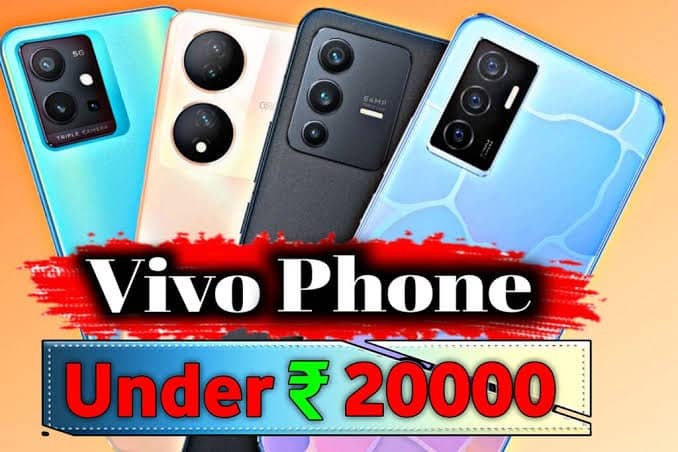
This blog post explores the top Vivo mobile phones priced under 20,000, combining performance and affordability.
As a prominent player in the smartphone industry, Vivoas a brand has managed to strike the perfect balance between performance and affordability.
Through its range of affordable yet feature-rich smartphones, it has successfully made advanced smartphones accessible to a wide range of users.
In this blog post, we are exploring the best Vivo mobile phones that fit snugly into the under 20,000 price segment, proving that innovation doesn’t always come with a hefty price tag.
In recent years, the under 20,000 smartphone segment has garnered immense significance in the smartphone market.
It has emerged as the sweet spot for a large demographic of consumers who seek exceptional features without burning a bigger hole in their pockets.
Best Vivo Mobile Phones Under 20,000
With the growing demand for smartphones that offer great value at affordable prices, brands such as Vivo have responded with lineups of mid-range devices that are tailor-made to meet the diverse needs of budget-conscious users.
Vivo today has earned the trust and loyalty of millions of users by consistently pushing the boundaries of what budget to mid-range smartphones can offer.
In the following section, we are sharing our curated list of the best Vivo mobile phones that shine in the under 20,000 price bracket.
We will discuss the smartphones in detail showcasing their key features along with pros & cons. You will also get to know the price and availability of each of these Vivo mobile phones.
So, without further ado, let’s check out which are the best Vivo smartphone under 20000.
Vivo T2 5G
The Vivo T2 5G comes with a 6.38-inch touchscreen display with a 90 Hz refresh rate and a resolution of 1080×2400 pixels.
This smartphone is powered by an octa-core Qualcomm Snapdragon 695 processor. It comes in 6GB and 8GB of RAM variants.
The Vivo T2 5G runs Android 13and is powered by a 4500mAh battery. The Vivo T2 5G supports proprietary fast charging.
As far as the cameras are concerned, the Vivo T2 5G on the rear packs a dual camera setup featuring a 64-megapixel primary camera, and a 2-megapixel camera. The rear camera setup has autofocus.
It has a single front camera setup for selfies, featuring a 16-megapixel sensor on the front.
Connectivity options on the Vivo T2 5G include Wi-Fi, GPS, NFC, USB Type-C, 3G, 4G (with support for Band 40 used by some LTE networks in India), and 5G.
Vivo T2 – Key Features
38 inches AMOLED Display
Qualcomm Snapdragon 695 Processor
6 GB RAM
128 GB Storage
64 MP + 2 MP Dual Rear Camera
16 MP Front Camera
4500 mAh Battery
Android v13 OS
Vivo T2 – Pros & Cons
Vivo T2 – Pros
Vivo T2 – Cons
● Good battery life
● Capable cameras in daylight
● Decent performance
● Stunning AMOLED display
● Great 44W fast charging
● Lightweight design
● No stereo speakers
● Bloatware and push notifications
Vivo T2 – Price and Availability
Vivo T2 – Price and Availability
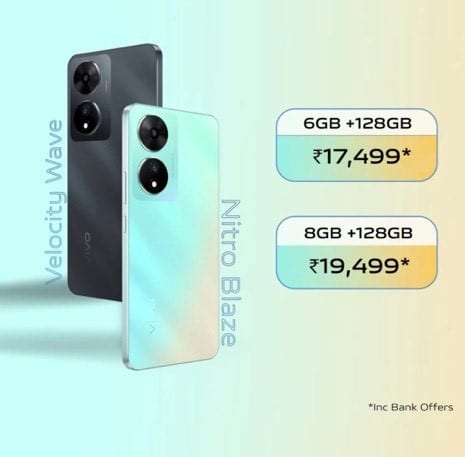
Vivo T2 price in India starts from Rs. 18,999. This is the 6 GB RAM and 128 GB internal storage variant.
The device is available in Nitro Blaze and Velocity Wave colour variants.
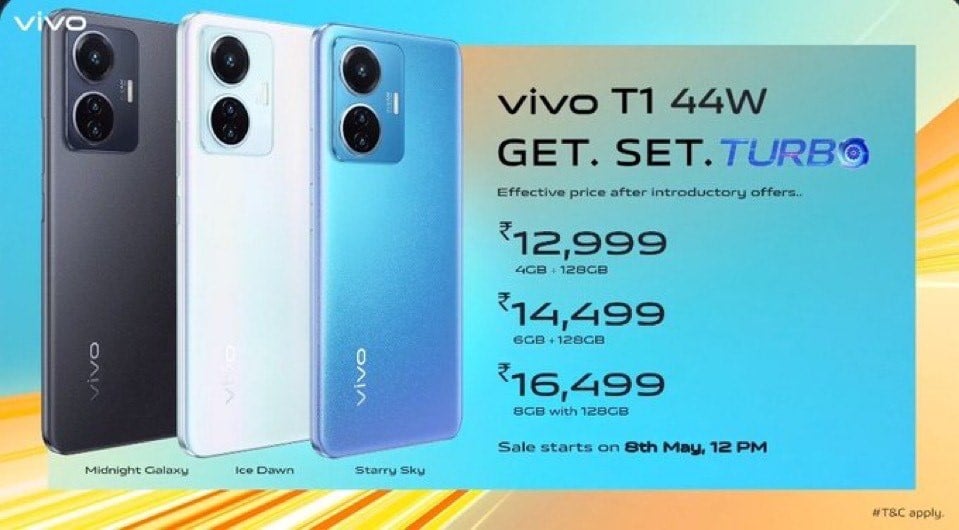
Vivo T1 44W
Vivo T1 44W comes with a 6.44-inch touchscreen display offering a resolution of 1080×2400 pixels (FHD+) at a pixel density of 408 pixels per inch (ppi) and a 60 Hz refresh rate.
This smartphone is powered by an octa-core Qualcomm Snapdragon 680 processor. It comes with 4GB, 6GB, and 8GB of RAM variants. The Vivo T1 44W runs Android 12 and is powered by a 5000mAh battery.
As far as the cameras are concerned, the Vivo T1 44W on the rear packs a triple camera setup featuring a 50-megapixel (f/1.8) primary camera; a 2-megapixel (f/2.4) camera, and a 2-megapixel (f/2.4) camera.
The rear camera setup has autofocus. It has a single front camera setup for selfies, featuring a 16-megapixel front sensor with an f/2.0 aperture.
Connectivity options on the Vivo T1 44W include Wi-Fi 802.11 a/b/g/n/ac, GPS, Bluetooth v5.10, USB Type-C, 3G, and 4G (with support for Band 40 used by some LTE networks in India).
Vivo T1 – Key Features
44 inches AMOLED Display
Qualcomm Snapdragon 680 Processor
4 GB RAM
128 GB Storage
50 MP + 2 MP + 2 MP Triple Rear Camera
16 MP Front Camera
5000 mAh Battery
Android v12 OS
Vivo T1 – Pros & Cons
Vivo T1 – Pros
Vivo T1 – Cons
● Good battery life
● Charges quickly
● Decent performance
● Full HD+ AMOLED display
● 50MP rear cameras
● No stereo speakers
● No 5G support
Vivo T1 – Price and Availability
Vivo T1 – Price and Availability
Vivo T1 44W price in India starts from Rs. 18,990. This is the 4 GB RAM and 128 GB internal storage variant.
The device with 44W Vivo FlashCharge technology is available in Ice Dawn, Starry Sky, and Midnight Galaxy colour variants.
Vivo S1 Pro
In Vivo S1 Pro, you get a 6.38-inch Super AMOLED display with a full-HD+ resolution. There’s also an in-display fingerprint sensor.
It’s powered by aSnapdragon 665 octa-core SoC,8GB of RAM and 128GB of storage. For software, you get Funtouch OS 9.2, based on Android 9 Pie.
Battery life is good as the 4,500mAh battery easily lasts for a day and a half of use.
You get a quad camera setup featuring a primary 48-megapixel camera with an f/1.8 aperture.
Apart from this, there is an 8-megapixel + 2-megapixel + 2-megapixel sensor setup to enhance your overall photography experience.
Image quality is decent under good light but average in low light. There is also a massive 32 MP selfie camera that is very good for the segment.
Connectivity options on the Vivo S1 Pro include Wi-Fi 802.11 a/b/g/n/ac, GPS, Bluetooth v5, USB Type-C, 3G, and 4G (with support for Band 40 used by some LTE networks in India).
Vivo S1 Pro – Key Features
38 inches Super AMOLED Display
Qualcomm Snapdragon 665 Processor
8 GB RAM
128 GB Storage
48 MP + 8 MP + 2 MP + 2 MP Quad Rear Camera
32 MP Front Camera
4500 mAh Battery
Android v9.0 (Pie) OS
Vivo S1 Pro – Pros & Cons
Vivo S1 Pro – Pros
Vivo S1 Pro – Cons
● Great Quad Rear Camera Setup
● Great 32MP Front Camera
● Good processor
● 8 GB RAM perfect for multitasking
● AMOLED display with Full HD+ resolution
● Decent battery capacity
● 18W fast charging
● Mediocre FunTouch OS
Vivo S1 Pro – Price and Availability
Vivo S1 Pro – Price and Availability
Vivo S1 Pro price in India starts from Rs. 18,999. This is the 8 GB RAM and 128 GB internal storage base variant.
S1 Pro is available in Dreamy White, Jazzy Blue, and Mystic Black colour variants.
Vivo Y73 (2021)
The Vivo Y73 (version 2021) comes with a 6.44-inch touchscreen display offering a resolution of 1080×2400 pixels. Vivo Y73 is powered by an octa-core MediaTek Helio G95 processor.
It comes with 8GB of RAM. The Vivo Y73 runs Android 11 and is powered by a 4000mAh battery.
As far as the cameras are concerned, the Vivo Y73 on the rear packs a triple camera setup featuring a 64-megapixel (f/1.79) primary camera; a 2-megapixel (f/2.4) camera, and a 2-megapixel (f/2.4) camera.
The rear camera setup has autofocus. It has a single front camera setup for selfies, featuring a 16-megapixel sensor with an f/2.0 aperture.
Connectivity options on the Vivo Y73 include Wi-Fi 802.11 ac, GPS, Bluetooth v5.00, USB Type-C, 3G, 4G, and 5G with active 4G on both SIM cards.
Vivo Y73 – Key Features
44 inches AMOLED Display
MediaTek Helio G95 Processor
8 GB RAM
128 GB Storage
64 MP + 2 MP + 2 MP Triple Rear Camera
16 MP Front Camera
4000 mAh Battery
Android v11 OS
Vivo Y73 – Pros & Cons
Vivo Y73 – Pros
Vivo Y73 – Cons
● Decent hardware performer
● Good Camera performance
● 33W fast charging
● Stunning AMOLED Display
● Battery capacity could have been better
Vivo Y73 – Price and Availability
Vivo Y73 – Price and Availability
Vivo Y73 2021 price in Indiastarts from Rs. 17,800. This is the 8 GB RAM and 128 GB internal storage base variant.
Available both online and offline stores, Y73 2021 is available in Diamond Flare and Roman Black colour variants.
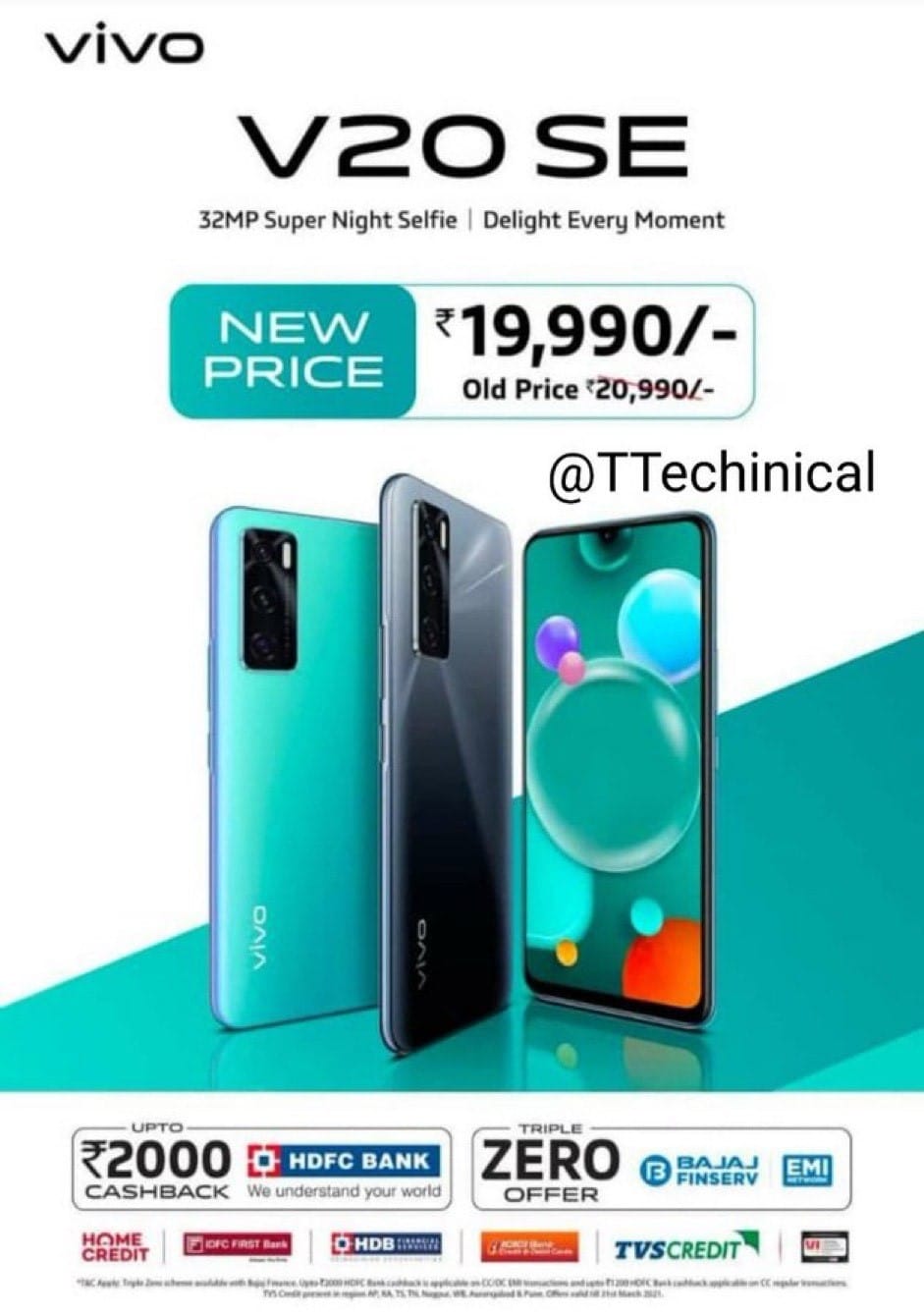
Vivo V20 SE
The Vivo V20 SE has a 6.44-inch AMOLED display with a dewdrop notch at the top. The display has good viewing angles and also houses an in-display fingerprint scanner.
In terms of looks, the V20 SE is tall and slim. It further packs in a 4100mAh battery and comes with a 33W fast charger in the box.
Vivo has equipped the Qualcomm Snapdragon 665 SoC in V20 SE and paired it with 8GB of RAM and 128GB of storage.
This chipset isn’t the most powerful in this price segment. Vivo ships the V20 SE with Funtouch OS 11 on top of Android 10. The UI is customisable and you get a few preinstalled apps on the device.
For your photography needs, the V20 SE sports a triple camera setup comprising of a 48-megapixel primary camera, an 8-megapixel ultra-wide angle camera also capable of macro photography and a 2-megapixel bokeh camera.
Connectivity options on the Vivo V20 SE include Wi-Fi 802.11 ac, GPS, Bluetooth v5.00, USB Type-C, 3G, 4G, and 5G with active 4G on both SIM cards.
Vivo V20 SE – Key Features
44 inches AMOLED Display
Qualcomm Snapdragon 665 Processor
8 GB RAM
128 GB Storage
48 MP + 8 MP + 2 MP Triple Rear Camera
32 MP Front Camera
4100 mAh Battery
Android v10 (Q) OS
Vivo V20 SE – Pros & Cons
Vivo V20 SE – Pros
Vivo V20 SE – Cons
● Stunning AMOLED display
● Expandable storage of up to1TB
● Good rear camera setup
● Great 32MP Front Camera
● 8GB RAM great for multitasking
● Great processor
● Average battery capacity
● No Gorilla Glass Protection
Vivo V20 SE – Price and Availability
Vivo V20 SE – Price and Availability
Vivo V20 SE price in India starts from Rs. 19,600. This is the 8 GB RAM and 128 GB internal storage base variant.
Vivo V20 SE is currently available in Gravity Black and Aquamarine Green colour variants.
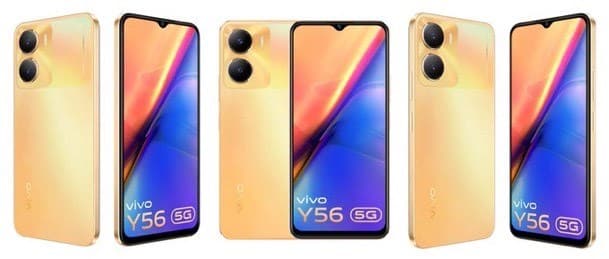
Vivo Y56 5G
The Vivo Y56 comes with a 6.58-inch display offering a resolution of 1080×2408 pixels (FHD+).
Powered byMediaTek Dimensity 700 MT6833 Processor, it has coupled with 8GB of RAM. The Vivo Y56 5G runs Android 13 and is powered by a 5000mAh battery. The Vivo Y56 5G supports proprietary fast charging.
As far as the cameras are concerned, the Vivo Y56 5G on the rear packs a dual camera setup featuring a 50-megapixel primary camera, and a 2-megapixel camera. It has a single front camera setup for selfies, featuring a 16-megapixel front sensor.
The Vivo Y56 5G runs Funtouch OS 13 is based on Android 13 and packs 128GB of inbuilt storage. The Vivo Y56 5G is a dual-SIM mobile that accepts Nano-SIM and Nano-SIM cards.
The Vivo Y56 5G measures 164.50 x 75.60 x 8.15mm (height x width x thickness) and weighs 184.00 grams. It was launched in Orange Shimmer and Black Engine colours. It bears a plastic body.
Connectivity options on the Vivo Y56 5G include Wi-Fi, GPS, Bluetooth v5.10, NFC, USB OTG, USB Type-C, Micro-USB, FM radio, 4G (with support for Band 40 used by some LTE networks in India), and 5G support.
Vivo Y56 – Key Features
58 inches IPS LCD Display
MediaTek Dimensity 700 MT6833 Processor
8 GB RAM
128 GB Storage
50 MP + 2 MP Dual Rear Camera
16 MP Front Camera
5000 mAh Battery
Android v13 OS
Vivo Y56 – Pros & Cons
Vivo Y56 – Pros
Vivo Y56 – Cons
● Good Design
● Good Performance
● 128GB of internal storage
● Massive 5000mAh Battery
● Attractive Design
● No IP rating
● Too much bloatware
Vivo Y56 – Price and Availability
Vivo Y56 – Price and Availability
Vivo Y56 price in India starts from Rs. 18,999. This is the 8 GB RAM and 128 GB internal storage base variant.
Vivo Y56 is currently available in Orange Shimmer and Black Engine colour variants.
Vivo Y50
The Vivo Y50 comes with a 6.53-inch touchscreen display offering a resolution of 1080×2340 pixels and an aspect ratio of 19.5:9.
Powered by a Qualcomm Snapdragon 665 Processor, it packs a solid 8GB of RAM to facilitate multitasking. The Vivo Y50 runs Android v10 OS and is powered by a 5000mAh non-removable battery.
As far as the cameras are concerned, the Vivo Y50 on the rear packs a solid quad rear camera setup featuring a 13-megapixel primary camera; an 8-megapixel camera; a 2-megapixel camera, and a 2-megapixel camera.
The rear camera setup has autofocus. It sports a 16-megapixel front camera on the front for selfies.
The Vivo Y50 runs FuntouchOS 10 is based on Android and packs 128GB of inbuilt storage that can be expanded via microSD card (up to 256GB) with a dedicated slot.
The Vivo Y50 is a dual-SIM (GSM and GSM) mobile that accepts Nano-SIM and Nano-SIM cards.
The Vivo Y50 measures 162.04 x 76.46 x 9.11mm (height x width x thickness) and weighs 197.00 grams. It was launched in Iris Blue and Pearl White colours.
Connectivity options on the Vivo Y50 include Wi-Fi, GPS, USB Type-C, FM radio, 3G, and 4G (with support for Band 40 used by some LTE networks in India) with active 4G on both SIM cards.
Vivo Y50 – Key Features
53 inches IPS LCD Display
Qualcomm Snapdragon 665 Processor
8 GB RAM
128 GB Storage
13 MP + 8 MP + 2 MP + 2 MP Quad Rear Camera
16 MP Front Camera
5000 mAh Battery
Android v10 (Q) OS
Vivo Y50 – Pros & Cons
Vivo Y50 – Pros
Vivo Y50 – Cons
● 8GB RAM
● Large 5000mAh battery
● Good Processor
● Best-in-class gaming and multitasking experience
● Plastic body
● Feels heavy in the hand
Vivo Y50 – Price and Availability
Vivo Y50 – Price and Availability
Vivo Y50 price in India starts from Rs. 19,000. This is the 8 GB RAM and 128 GB internal storage base variant.
Vivo Y50 is currently available in Starry Black, Iris Blue and Pearl White colour variants.
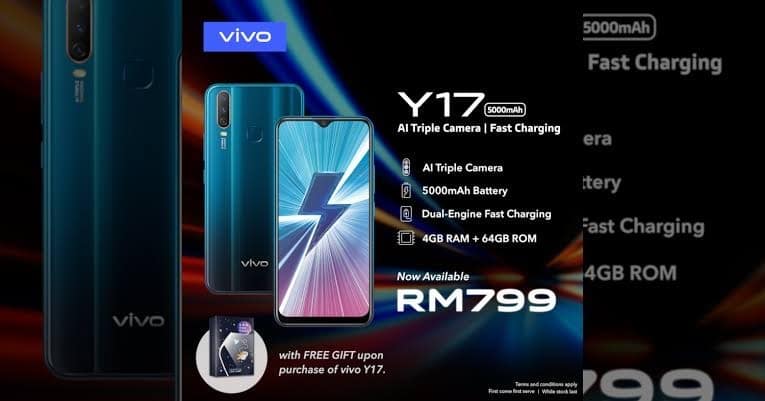
Vivo Y17
The Vivo Y17 comes with a 6.35 inches IPS LCD display that has a resolution of 720 x 1544 pixels offering immersive and comfortable viewing.
It houses a 5000 mAh Li-ion battery that offers you long-lasting entertainment without worrying about battery drainage.
The phone comes with 4 GB of RAM and 128 GB of internal storage so that you can store all your songs, videos, games, and other stuff with the utmost convenience.
In addition to this, you can play games, listen to music, multitask, and stream content smoothly as the phone is powered with an Octa-core, 2.3 GHz, Cortex A53 MediaTek Helio P35 processor.
The camera specifications of the mobile are really impressive. On the rear, the mobile comes with a triple camera setup, which features 13 MP + 8 MP + 2 MP cameras.
Features on the rear camera setup include Digital Zoom, Auto Flash, Face detection, and Touch to focus. On the front, the mobile features a 20 MP camera for clicking beautiful selfies and making video calls.
Various connectivity options on the Vivo Y17 include WiFi – Yes Wi-Fi 802.11, b/g/n/n 5GHz, Mobile Hotspot, Bluetooth – Yes v5.0, and 4G (supports Indian bands), 3G, 2G.
Vivo Y17 – Key Features
35 inches IPS LCD Display
MediaTek Helio P35 Processor
4 GB RAM
128 GB Storage
13 MP + 8 MP + 2 MP Triple Rear Camera
20 MP Front Camera
5000 mAh Battery
Android v9.0 (Pie) OS
Vivo Y17 – Pros & Cons
Vivo Y17 – Pros
Vivo Y17 – Cons
● massive 5000mAh battery
● supports fast charging via the 18W charger
● Great triple camera setup on the rear
● Extraordinary 20MP selfie camera captures
● Decent Display
● Good performance
● Mediocre chipset
● Outdated OS
Vivo Y17 – Price and Availability
Vivo Y17 – Price and Availability
Vivo Y17 price in India starts from Rs. 19,500. This is the 4 GB RAM and 128 GB internal storage base variant.
Vivo Y17 is currently available in Mineral Blue and Mystic Purple colour variants.
Q1. What is the full charging time of the Vivo S1 Pro?
Answer. Vivo S1 Pro comes with a non-removable 4,500 mAh battery along with an 18W charger and fast charging support. While testing, it took 1 hour and 58 min to refill the battery from 0% to 100%.
Q2. How long can vivo phone battery last?
Answer. The battery life of vivo phones is 2~3 years. As the full discharge cycle increases, its chemical performance will be reduced.
Q3. Does Vivo T1 5G have a cooling system?
Answer. Our tablet-standard cooling system intelligently reduces the core temperature so the only heat you feel is from your intensive gaming experience.
Q4. Does Vivo T2 support 4k video?
Answer. Vivo T2 5G features a 64 MP OIS Anti-Shake main camera and comes with a 16 MP HD front camera. The device supports 4K video recording. Vivo T2X 5G sports 50MP Super Night main camera along with 8MP front camera.
Q5. What are the camera features of the Vivo Y50?
Answer. Following are the camera features of Vivo Y50 –
Answer. Vivo Y56 is powered by a massive 5000mAh Battery capacity. Power can be quickly replenished in a flash. MediaTek 5G UltraSave power saving technology keeps the power abundant all day so that you are always online12.
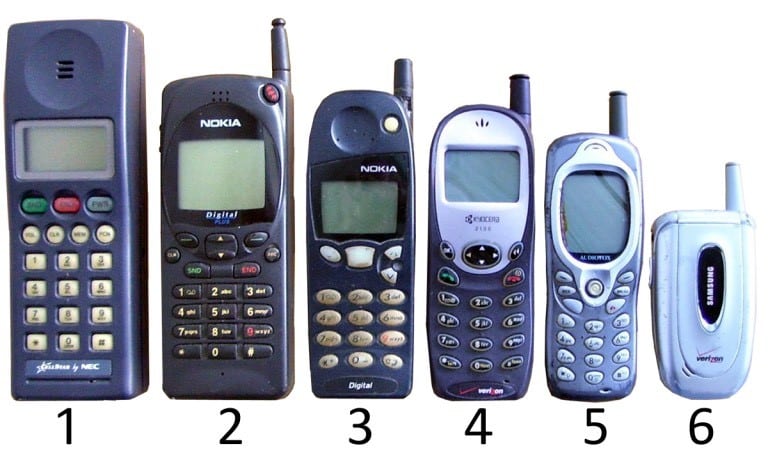
Mobile phones in the ’90s were bulky and expensive, mainly used for voice communication only.
The era marked the foundation of the mobile phone industry, leading to the modern-day telecommunication boom.
Mobile phone technology has significantly advanced since the ’90s, giving rise to sleek and feature-rich smartphones.
Top Throwback Phones From the 90s
Best phones from the 1990s – A look back to the exciting mobile phone industry
Top Throwback Phones From the 90s
Mobile phones in the 90s were nothing like the current sleek and powerful smartphones with large touch displays that we all use today. The change from the 90s mobile phones to now is not limited to design philosophy though.
In fact, the whole purpose of having a mobile phone has been through drastic changes in the past three decades.
In this blog, we are taking a walk through memory lane and looking at throwback mobile phones from the 90s era.
Mobile Revolution
Mobile phones actually existed before the 1990s as well. However, they were primarily bulky and expensive devices used only for voice communication.
Moreover, the technology was inaccessible to the general public till the late 1980s and early 1990s.
The ’90s were essentially the foundational period for the mobile phone industry. It was the time when the stage for the mobile revolution was crafted and what followed was a boom of modern-day telecommunication.
Best phones from the 1990s
Since then, mobile phone technology has only continued to advance and paved the way for more sophisticated and feature-rich devices of today.
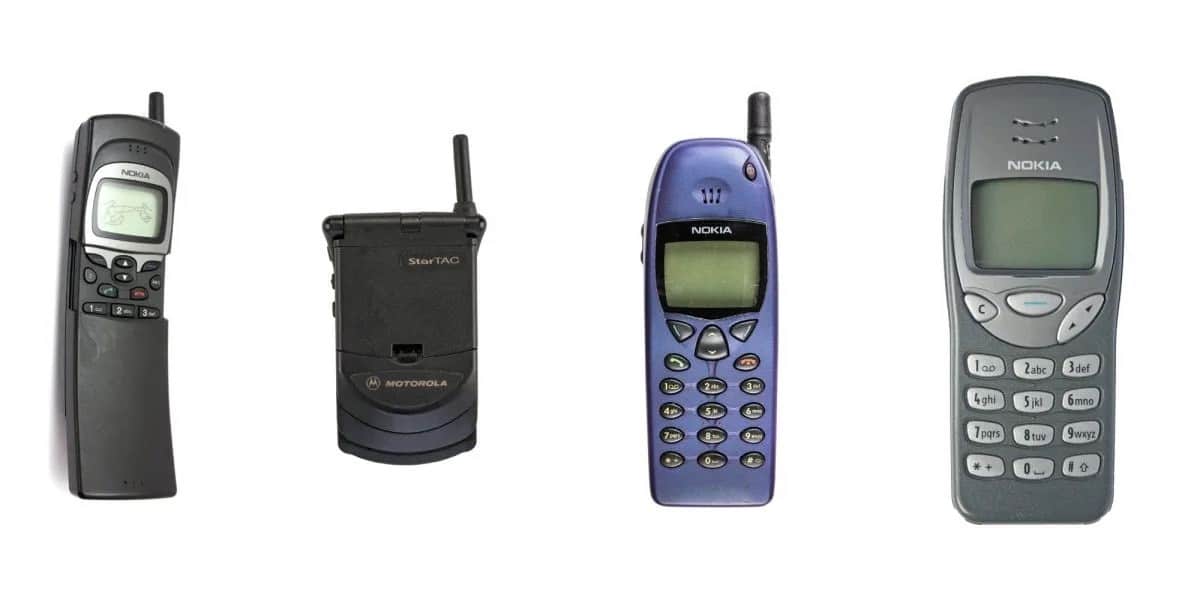
Some of the popular phones from the 90s include the Motorola StarTAC. Introduced in 1996, StarTAC was one of the earliest flip phones and a fashion statement of its time.
Ericsson GH 337, known for its sleek design, was released in 1997 and was appreciated for its user-friendly interface.
The Nokia 8110, famously featured in the movie “The Matrix,” boasted a unique sliding cover design.
Before we explore more about the mobile phones from the 90s, let’s try to understand how mobile phones of that era were different from today’s smartphones.
The Evolution of Cell Phone ( History of Cell Phone)
How Were Mobiles Phones from the 90s Different from Today’s Smartphones?
The Evolution of Cell Phone ( History of Cell Phone)
So, what was different about mobile phones from the 90s?
How was the mobile phone technology different from what you and I are using today?
Let’s find out.
Following are points of difference between today’s smartphones and the mobile phone landscape of the 90s –
Mobile Phone Brands: In the 1990s, several companies were prominent in the mobile phone market. Nokia, Motorola, Ericsson (later Sony Ericsson), and Siemens were some of the leading players.
Nokia, in particular, gained popularity with its durable and user-friendly phones. Compared to this, the mobile phone industry today is brimming with international brands manufacturing devices to cater for a larger consumer base.
How Were Mobiles Phones from the 90s Different from Today’s Smartphones?
Size and Design – Mobile phones of the ’90s were large and heavy. They were commonly referred to as “brick phones” due to their size and shape. Today, the phone design philosophy is ruled by portability.
Antennas – Most mobile phones in the ’90s had external antennas. Users had to pull out manually to improve reception. Antennas seem like an alien concept with respect to today’s smartphones.
Networks – Analog cellular networks were prevalent during the early ’90s, but they gradually transitioned to digital networks like GSM (Global System for Mobile Communications) and CDMA (Code Division Multiple Access). The digital networks that we use today allowed for improved call quality and better battery life.
Battery Life – The battery life of ’90s mobile phones was relatively short compared to today’s standards. Users had to charge their phones frequently.
Mobile Phone Features – The primary function of mobile phones in the ’90s was voice calls, though they did have basic text messaging capabilities. The functionality was limited compared to what all today’s smartphones have to offer.
Limited Coverage – The coverage of mobile networks was not as widespread as it is today. Rural areas in particular had no network coverage during those days.
Cost – Mobile phones in the ‘90s were quite expensive. It was, in fact, a luxury item for most of the general public. The cost of both the handset and the service plans largely became accessible to a significant portion of the population only in the 2010s.
Best Mobile Phones from The 90s
Best Mobile Phones from The 90s
Speaking of mobile phones from the 90s, we have curated a list of the best mobile phonesfrom the 90s.
These mobile phones from the 1990s left a lasting impact on the mobile industry and paved the way for the technological advancements that continue to shape our modern-day smartphones.
So, let’s get into it.
Motorola StarTAC
Introduced in 1996, the Motorola StarTAC was revolutionary as one of the earliest clamshell (flip) phones.
It set a trend for stylish, compact devices. The StarTAC was significantly smaller and more portable than its predecessors, featuring a monochromatic external display and an internal keypad.
It offered voice dialling and a phonebook. The phone’s foldable designmade it a status symbol, and it became popular among professionals and celebrities. Its innovative form factor and functionality paved the way for future flip phones.
Ericsson GH 337
Introduced in 1997, the Ericsson GH 337 stood out for its sleek and compact design. The phone featured an eye-catching chrome finish and an external monochromatic display that showed incoming calls and messages.
It had a user-friendly interface and an extendable antenna for improved signal reception. The GH 337 was praised for its clear voice quality and ergonomic keypad layout.
While not as ubiquitous as some other models, it garnered a dedicated following for its aesthetics and functional simplicity.
Nokia 5110
Released in 1998, the Nokia 5110 was a game-changer with its customizable Xpress-On covers, allowing users to personalize their phones. It featured a clear monochromatic display and an intuitive menu system.
The phone was known for its reliability and extended battery life. The built-in antenna improved portability, and the phone also introduced the game “Snake II.” Its popularity extended globally, making it one of Nokia’s best-selling modelsof the ’90s.
Nokia 8110
Known as the “banana phone,” the Nokia 8110 gained fame after appearing in the movie“The Matrix” in 1999. It had a unique sliding cover design, which exposed the keypad when opened.
The phone featured a monochromatic display and allowed basic text messaging and call functions.
While not as feature-rich as other models, its appearance in the blockbuster movie “The Matrix” propelled it to pop culture stardom.
Its distinctive design and cult status make it a notable and memorable device from the ’90s.
Alcatel One Touch 511
Released in 1998, the Alcatel One Touch 511 was a budget-friendly mobile phone that became popular for its affordability and reliability. The candy-bar phone had a clear monochromatic display and an easy-to-navigate menu.
It offered essential calling and messaging features and also included some basic games for entertainment.
The Alcatel One Touch 511 found success in the mid-range market segment, appealing to users seeking a simple and functional mobile device.
Siemens S10
Launched in 1998, the Siemens S10 was a notable contender in the ’90s mobile phone market. It boasted a slim and modern design, making it stand out from its bulkier counterparts.
The phone featured a monochromatic display and had a user-friendly menu system. It offered basic calling and messaging functionalities along with a WAP browser for mobile internet access.
The Siemens S10 gained popularity for its compact form factor and technological capabilities.
Nokia 1011
Introduced in 1992, the Nokia 1011 holds a significant place in mobile phone history as Nokia’s first mass-produced GSM phone. As one of the pioneers in the digital mobile revolution, the Nokia 1011 marked a crucial shift from analogue to digital technology.
Sporting a sleek and ergonomic design, it featured a monochromatic LCD screen and a numeric keypad. The phone allowed users to send and receive text messages, a novel feature at the time.
Despite its basic functionalities, the Nokia 1011 represented a monumental leap in mobile communication and set the stage for Nokia’s dominance in the industry in the years to come.
Motorola Timeport
Introduced in the late 1990s, Timeport was a groundbreaking mobile phone that combined innovative features for its time. It was one of the first mobiles to integrate GSM capabilities with a built-in dual-band modem, enabling seamless data access and mobile internet connectivity.
The Timeport featured a compact and stylish flip-phone design, equipped with a monochromatic display and a user-friendly interface.
It offered basic calling and messaging functionalities alongside email and internet browsing capabilities.
This fusion of communication and data access made the Motorola Timeport a sought-after device, contributing to the evolution of mobile technology and shaping the future of smartphones.
Throwback to the Mobile Phones from the 90s
Things You’ll Only Know If You Had A Mobile In The ’90s
FAQs
Q1. What was the first phone in the 90s?
Answer. The world’s first mass-produced phone that used the new GSM digital standard, the Nokia 1011 was ‘available in any colour, as long as it was black.
Q2. When was Motorola Dynatac 8000X released?
Answer. Known in the industry as “the brick” and visible in many scenes of the 1987 movie Wall Street, the Motorola Dynatac 800X was released in the 1980s. It was the first handheld mobile phone and loudly announced the beginning of a new era.
Q3. What were some common features of mobile phones in the 90s?
Answer. Mobile phones in the 90s primarily focused on voice calls and basic text messaging. They had monochromatic displays, external antennas, and physical keypads. Some models offered rudimentary games and limited organizer functions.
Q4. Which were the most popular mobile phone brands in the 90s?
Answer. Nokia, Motorola, Ericsson (later Sony Ericsson), and Siemens were among the most popular mobile phone brands in the 90s. Nokia, in particular, gained widespread recognition for its durable and user-friendly handsets.
Q5. How did the design of mobile phones in the 90s differ from today’s smartphones?
Answer. Mobile phones in the 90s were notably bulkier and heavier, often referred to as “brick phones.” They featured external antennas and smaller monochromatic displays, lacking the large touchscreens and sleek designs of modern smartphones.
Q6. Were mobile phones in the 90s affordable for everyone?
Answer. No, mobile phones in the 90s were relatively expensive, making them a luxury item for many people. Both the cost of the handset and the service plans were significant barriers to accessibility for a considerable portion of the population.
Q7. What was the significance of the Nokia 3310 in the 90s mobile phone market?
Answer. The Nokia 3310, launched in 2000 but with a lasting impact throughout the 90s, became an iconic mobile phone due to its legendary durability and exceptional battery life. It featured basic functions like voice calls and text messaging, as well as the popular game “Snake,” solidifying its position as one of the most beloved and recognizable phones of that era.
8) Top five throwback phones from the 90s.Details?
Ans) Mobile phones have come a long way, here’s a throwback to the best and most innovative phones of the 90s.
That phone you’re holding in your hand right now to read this article, is a ridiculously powerful super computer. If we threw a Samsung Galaxy S7 or even Apple’s original iPhone from 2008, into a time machine and sent it to the Johnson Space Center in 1965. We probably would never have heard the iconic, heart stopping phrase: “Houston, we’ve had a problem” from the Apollo 13 space crew (often misquoted as “Houston, we have a problem” because of the movie).
The processing power of the computers used for mankind’s first landing on the moon (Apollo 11) are laughable at today’s standard. The Apollo Guidance Computer enabled astronauts to enter simple commands in verbs and nouns to control their spacecraft. It ran approximately with 64Kbyte of memory and operated at 0.043 MHz. For comparison the S7 has 4GB of memory and a processing power of 2.3 Ghz.
We take a look at devices from the 90s, when smartphones started to gravitate towards more slim line designs, with affordable prices. Nostalgia, prepare for it.
Motorola StarTAC (1996)
Inspired by Captain Kirk and his crew on the Enterprise, the Motorola StarTAC saw great sales despite a massive price tag of £1400. Add inflation on top and it actually works out to be around £2400 today, brand new. Those who bought it loved the flip lid and it’s ergonomic design. Motorola reportedly sold about 60 million units of the StarTac.
Nokia 8110 (1996)
To most people this beauty is known as “the banana phone.” For millennials it’s the “Matrix phone.” Sadly you can’t actually go into the Matrix with the 8110 and learn Kung Fu. But you could carry it around for days as it was one of the lightest phones at the time weighing in at 145g. It was also the first Nokia device with a clear monochrome graphic LCD display.
Nokia 6110 (1997)
This ladies and gentleman is the first device to run the legendary Snake. It was from the 6110’s popularity, that Nokia decided to include Snake in the majority of their phones and future sequels of Snake. The 6110 improved on the Nokia 2110 with a smaller size and improved talk time. Another first; it was the first phone to use an ARM processor.
Siemens S10 (1998)
The S10 wowed the world as it was the first ever device with a colour screen. Capable of displaying red, green, blue and white. Unfortunately the amazement was short lived as consumers didn’t care about the innovation as Siemens would hope. The S10 is still worth a mention for the innovation and it inspired the creation of the popular sliding Siemens SL10.
Nokia 8210 (1999).
You weren’t cool unless you were holding Nokia’s slim line beauty at the time. It’s legacy lives on as the 8210 is now popular among drug dealers. We spoke to a dealer known as Sonny, who expressed his love for the 8210. “It’s small, peng (beautiful) and lasts for days. Best thing though, the Popo (police) can’t track it, bare apps on phones nowadays get you caught.” The 8210 does not have GPRS, NFC, WiFi or even Bluetooth. Making it harder for authorities to track down dealers.
9) What is the Evolution of the Cell Phone.Details?
Ans) The cellphone turns 40 this month, and it has come a long way from the enormous $3,995 brick that creator Martin Cooper first used walking along the streets of New York City in 1973 to call Joel Engel, the head of research at his rival company Bell Labs.
Let’s take a look back at the evolution of the omnipresent mobile phone.
1973 – The first cell phone
The phone Martin Cooper designed for Motorola weighed 2.5 pounds and had a battery life of 20 minutes.
1983 – Motorola DynaTAC 8000X
The Motorola DynaTAC 8000X was used by Gordon Gecko in the 1987 film Wall Street and was nicknamed ‘The Brick,’ for obvious reasons. Given its huge price tag (roughly $9,400 in 2013 dollars), it is not surprising that only Wall Street Masters of the Universe like Gecko could afford it.
1984 – The Nokia Mobira Talkman
The lunchbox-sized Nokia Mobira Talkman might have been a nightmare to carry around, but it had longer battery life than the sturdy ‘Brick.’
1995 – The Motorola StarTAC
The first flip phone, the Motorola StarTAC (seen here in Clueless), was becoming commonplace in the mid-’90s. Finally phones were approaching a reasonable size.
1996 – The Nokia 8110
The ‘banana’ phone, the Nokia 8110, was also Neo’s phone in The Matrix (1999) – and was the first example of the sliding form factor.
1998 – The Nokia 5110
Who didn’t play endless games of Snake on their Nokia 5110? A generation was introduced to cellphones and texting with this little creation.
2004 – Motorola Razr
The Motorola Razr was best known for being ultra-thin and for having a seven-hour battery life.
2007 – The iPhone
And then came the game changer – the Apple iPhone reshaped the mobile phone industry.
10) Phones from 90s to 2022 that changed the camera game for users.Details?
Ans) Kyocera VP-210: First phone to come with camera
This idea of a phone camera started with the Kyocera VP-210. Launched in 1999, it is the world’s first camera phone. The phone packed a 0.11MP sensor and it was capable of capturing up to 20 pictures.
Audiovox PM8920: Started the ‘megapixel concept’ in phones
Audiovox PM8920 was the first phone to feature a megapixel-resolution camera. It basically pioneered the idea of megapixels in phones. The phones came with a 1.3MP sensor with an LED flash and macro mode. The phone was launched back in 2004.
Nokia N90: Made video recording mainstream in phones
Nokia N90’s rotatable display design that made this phone transform into a camcorder made video recording easier for users and also conceptualized the idea of serious video recording feature on phones. It came with a 2MP Carl Ziess lens and was capable of recording video with audio.
Sony Ericsson cybershot K800i: Pioneered the high-res camera concept with modern features like auto-focus, image stabilisation and more
Sony Ericsson’s cyber shot series was among the most renowned camera phones back in the 1990s. There have been many cyber shot phones, but the K800i brought the high-res camera along with features like auto-focus, image stabilisation and more which are still relevant with modern smartphone cameras.
Nokia N95: The first 5MP camera phone
Launched in 2007, the dual side slider Nokia N95 can easily be considered as the most advanced camera phone of that time. The phone has everything from a high-resolution 5MP sensor, auto focus, video recording capabilities and it also came with a composite cable to view them on TV.
Samsung i8510, Samsung Pixon 12, Nokia N8 and Sony Ericsson S006: The megapixel race started with these phones
The Samsung i8510 came with an 8MP sensor, the Samsung Pixon 12 featured a 12MP sensor, Nokia N8 was also a 12MP phone and Sony Ericsson S006 was a 16MP phone. These phones actually brought the megapixel race to limelight which is still continuing.
Google Pixel: introduced Night Mode, still offers one of the best
The iconic camera phone list is incomplete without Google Pixel as the smartphone pioneered the AI and machine learning based image processing especially with Night mode and portrait mode. The night mode in Google Pixel phones are among the best in the market .
iPhone 13 series: Cinematic mode for ‘pro’ level videos
Apple has refined the camera experience on the iPhone over the years, so much so that it is perhaps the most consistent smartphone camera around. With the iPhone 13 series, Apple introduced Cinematic mode, which can record videos with a shallow depth of field, which really gives it a cinema-like feel. If you haven’t used it, then think of it as a portrait mode for videos, something that looks really cool.
* The Tecno Pova 5 Pro launching next month with RGB lights. * It borrows the concept of Nothing phone, but features a different design. * The new Tecno phone seems to have a dual camera setup at the back. * Tecno Pova 5 was launched earlier this year in June * The phone packs a 6,000mAh battery with 45W fast charging support * Tecno Pova 5 Pro may have a 7,000mAh battery with 68W fast charging
Nothing Phone (1) started the trend of fancy LED lights at the rear end of the smartphone and the Carl Pei led UK-based firm improvised the design with Nothing Phone (2).
The Nothing Phone (1) is the best-seller in its segment and Phone (2) was also ‘sold out’ on Flipkart ahead of launch.
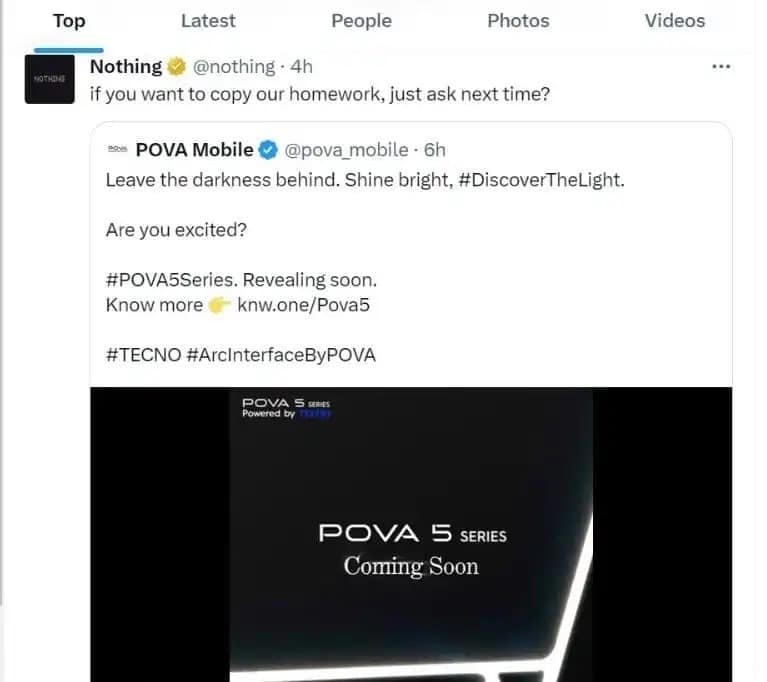
Now trying to ride on Nothing’s wave. Tecno has dropped a teaser of its upcoming phone that comes with multi-coloured LED light back panel. The Tecno Pova 5 Pro 5G support RGB colours at the back.
It’s almost been two weeks with brands revealing their upcoming phone flaunting LED light design patterns over social media. That has stirred quite a discussion around who’s doing better?
TECNO too caught the attention of the consumers when it dropped its latest teaser for the POVA 5 Pro 5G donning a multi-coloured LED light back panel and is set to give a tough competition to Nothing Phone (2).
Nothing Phone (2).
Even though the light design resembles to the Nothing Phone, TECNOhas an advantage over here as, unlike Nothing’s single white LED light, POVA 5 Pro seems to support RGB colours at the back.
As per the teasers circulated on the internet, the brand has named light design as Arc interface and the same offers multiple functionalities with respect to incoming calls, music, and more.
Earlier in June 2022, the company launched POVA 3 with a single RGB LED light strip at the back panel, which received much praise among users.
Taking the innovation one step ahead, the company is ready to announce its POVA 5 Pro 5G with the Arc Interface multi-coloured back panel, expected to launch in August 2023 on Amazon.
Pova Series Smartphone
TECNO is known for launching best-in-segment features at competitive pricing. Considering the disruptive pricing of its Phantom V Fold, making it the most affordable fold phone in India, it is expected that POVA 5 Pro 5G will be launched at an aggressive pricing too.
Looking at the teasers, POVA 5 Pro 5G seems to be positioned towards fuelling the aspirations of GenZ and seeing the consistent innovation from TECNO, the smartphone likely feature some best-in-segment attributes coupled with a premium 3D textured design.
TECNO POVA 5 PRO SPECS
The exact specs are not known as of now but considering the specs of the previous POVA series smartphone, it is expected that the phone will boast a powerful processor, a big battery, and fast charging speed.
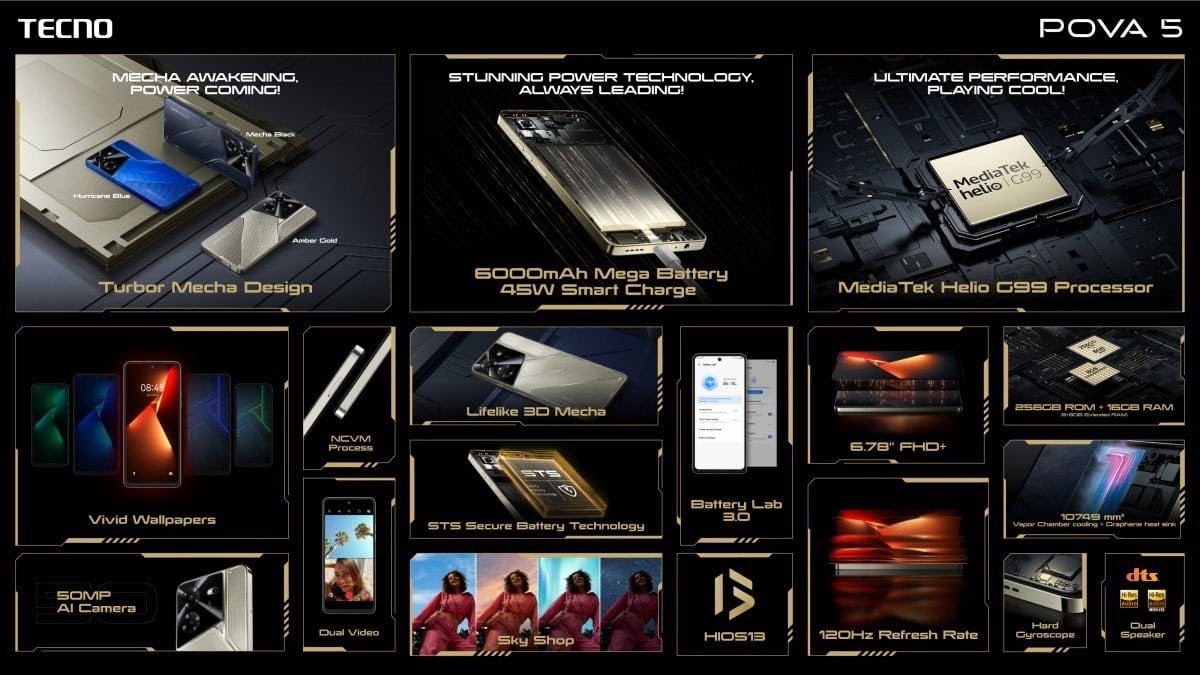
The Tecno Pova 5 is offered in Amber Gold, Hurricane Blue, and Mecha Black colour options and has a robot mecha-inspired design.
It has been unveiled in certain markets in Southeast Asia, the Middle East, and Latin America.
1) Upcoming Tecno POVA Will Feature A Unique LED Light Strip On The Back Panel.Details?
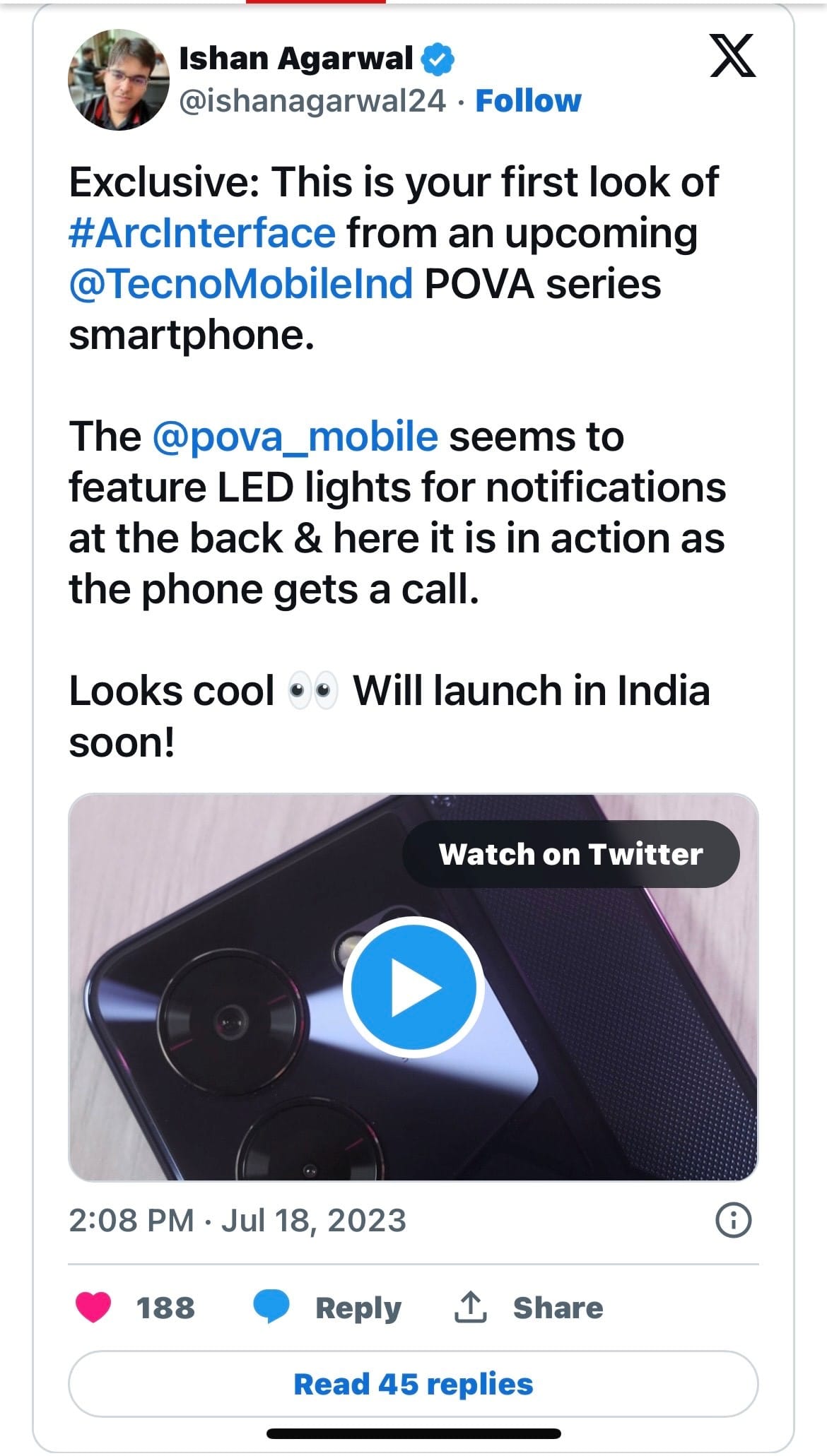
Ans) An upcoming Tecno POVA smartphone has been spotted in a video clip. It has been shared by tipster Ishan Agarwal. The clip gives us a glimpse at the upcoming offering. However, the exact name and launch timeline of the forthcoming Tecno POVA remains a mystery.
As seen in the video, the upcoming Tecno POVA phone will feature an LED light strip on the back panel around the camera module. Ishan says that the new functionality will be called ‘Arc Interface’ and the LED strip will light up on receiving notifications. The lights can also be seen in various colors.
The functionality looks quite cool, however, it’s not the first time we’ve spotted it on a Tecno phone. Last year’s Tecno POVA 3 also had a vertical light strip on the back panel. The upcoming POVA phone has a glossy finish camera module with two sensors and an LED flash unit. The right side of the back panel seems to have a carbon-fiber-like pattern.
Tecno already launched the POVA 5 in the global markets last month and the brand is teasing the POVA Neo 3. However, it remains to be seen which device will feature the LED light strip. Notably, both phones have the same back panel design, however, the POVA 5 does not have any LED strip.
2) Video shows Tecno Pova’s new Arc Interface with RGB lights on the back.Details?
Ans) Tecno is apparently working on something called the Arc Interface – RGB lights on the back of the phone that light up for new notifications. Here “the phone” appears to be the Tecno Pova 5, although there is a chance that it is a different device instead.
Here is a demo of Arc by Ishan Agarwal, which shows the light strips blink into life for an incoming call:
Judging by the demo clip, the lights lack the fine-grained control that the Nothing Phone (2) has, but the Pova 5 is a lower end device. A more elaborate version could be created for more premium Tecnos.
The Pova 5 has a 6.78” 120Hz IPS LCD (FHD+) and is powered by a Helio G99 chipset (up to 8/256GB memory) and a large 6,000mAh battery with 45W wired-only charging. This design is called “Turbo Mecha”.
By the way, the upcoming Tecno Pova Neo 3 also uses the Mecha design, but we don’t know whether this will include the lights or not (note: the Neo 3 design doesn’t include the dotted pattern next to the camera island, that’s why we think this is the Pova 5). The Pova 5 will be released later this month.
3) What are Quick Specifications of Tecno Pova 5 Pro ?
Ans) * Display: 6.78-inch FHD+ display with 120Hz refresh rate, and 240Hz touch sampling rate.
* Processor: Mediatek Helio G99 SoC.
* RAM and Storage: 8GB + 256GB with up to additional 8GB virtual memory.
* Battery, charging: 6,000mAh battery, 45W fast charging, and 10W reverse wired charging.
* Cameras: 50MP + depth sensor, 8MP front camera.
4) Tecno POVA 5 Pro India Launch.Details?
Ans) Tecno POVA 5 Pro will be available in India via Amazon. The launch date hasn’t been revealed yet but it should be debuting very soon. Tecno POVA 5 Pro will debut the company’s ‘Arc’ interface which are basically LED lights on the phone.
The microsite on Amazon shows a silhouette of the phone’s design, and the LED lights are three strips meeting at one point.
Based on the image teaser, the LED lights are going to be colourful unlike the Glyph Interface on the Nothing Phone (2). The design is also different than the one on the Phone (2). But it looks like LED lights are the latest inspiration for smartphone brands.
Infinix is also preparing to launch the GT 10 Pro that has a rear design like the Phone (2).
Other than the LED lights, there isn’t much that the Tecno POVA 5 Pro teaser reveals about the phone’s design. In terms of specifications, the Tecno POVA 5 Pro is expected to come with a 7,000mAh battery and 68W fast charging support.
The Tecno Pova 5 is offered in Amber Gold, Hurricane Blue, and Mecha Black colour options and has a robot mecha-inspired design.
It has been unveiled in certain markets in Southeast Asia, the Middle East, and Latin America.
Tecno hasn’t confirmed yet but it’s expected to bring the POVA 5 smartphone to India as well.
The Nothing Phone 2 has been unveiled creating anticipation with its innovative approach, and unique design.
It faces competition from the iPhone 13, a mid-tier flagship offering from Apple, despite being in different price brackets.
The Nothing Phone 2 starts at a lower price point in India, while the iPhone 13 offers advancements like the A15 Bionic chip and enhanced camera capabilities.
In this blog, a detailed comparison will determine which device suits individual preferences in terms of specifications, performance, camera capabilities, and battery life.
The Nothing Phone 2, backed by its innovative approach and refined technology, has managed to create a sense of anticipation like no other smartphone in recent times.
With its unique design, impressive camera system, and powerful hardware, it aims to set a new benchmark for what a smartphone can be.
However, whenever a piece of tech arrives, it faces fierce competition from seasoned players in the industry. One such competition to Nothing Phone 2 is Apple’s mid-tier flagship offering – the iPhone 13, even though both fall in different price brackets.
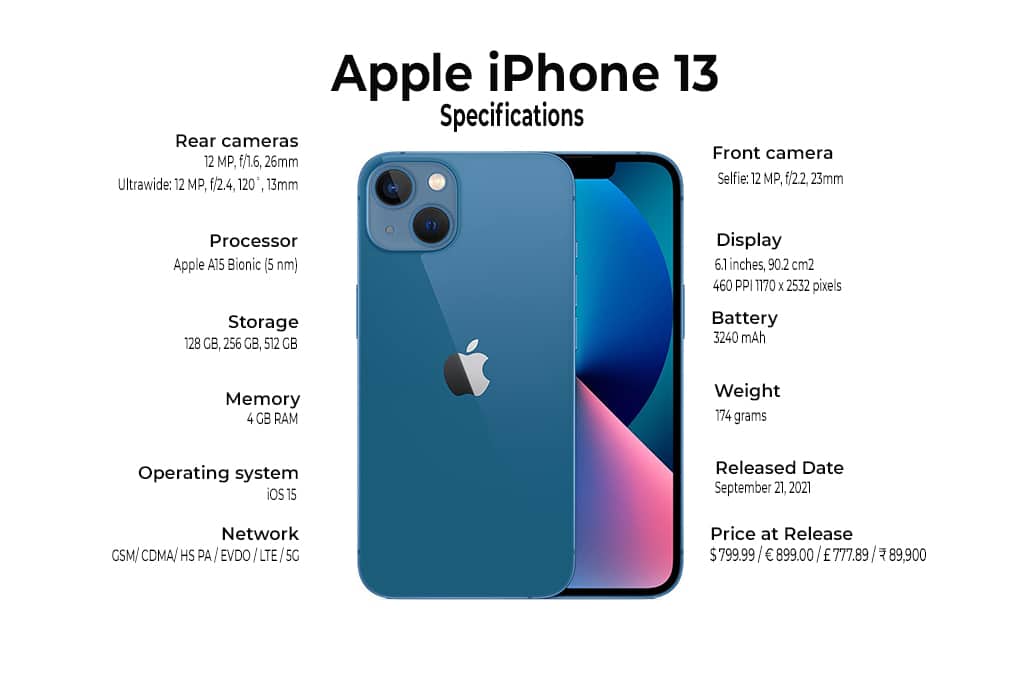
The Nothing Phone 2 price in India starts at ₹ 44,999 for the base variant with 8GB RAM + 128 GB storage configuration. Whereas, iPhone 13 price starts at ₹ 62,990 for the 4 GB + 128 GB variant.
Although expensive as compared to the Nothing Phone 2, iPhone 13 boasts its own set of advancements, including the powerful A15 Bionic chip, enhanced camera capabilities, and a seamless iOS experience. To know which of the two is more up your alley, a detailed comparison is needed.
In this blog, we delve deep into the realms of technology and design to shed light on the key differences and similarities between the Nothing Phone 2 and the iPhone 13. We explore their specifications, performance, camera capabilities, battery life, and more
Let’s start with taking a quick look at the USPs of both devices –
Nothing Phone 2 – USPs
iPhone 13 – USPs
● Design Novelty
● Decent cameras
● Glyph Interface improvements and innovations
● An Improved Nothing OS 2.0
● Customisation options
● Strong battery life
● Class-leading performance
● Excellent cameras
● Increased base storage
Upbeat Innovation Vs Priceless Luxury – Let’s Find Out in Our Showdown of Nothing Phone 2 vs. iPhone 13
Nothing Phone 2 vs iPhone 13 – Design
If one thing is common between Nothing Phone 2 and iPhone 13 is that both devices or rather we should say both brands are known for their design novelty.
The Nothing Phone 2 embraces a modern design language, aiming to stand out from the crowd. With its flat edges and curved corners, it exudes a sense of elegance and sophistication.
The device features a premium build quality, with Corning Gorilla Glass adorning both the front and back, enhancing durability and protection against scratches.
The minimalistic approach continues with a clear-backed design, showcasing the inner workings of the device and the Glyph interface adds to the overall appeal.
The Nothing Phone 2’s attention to detail and commitment to a unique design philosophy set it apart in a sea of smartphones.
Apple’s iPhone 13, on the other hand, follows a more recognizable design language, carrying forward the iconic aesthetic that Apple is renowned for. It maintains a sleek and seamless construction, featuring a glass back and aluminium frame.
iPhone 13 boasts precision-milled flat edges that blend seamlessly into the front and back, creating a harmonious and refined look. As with previous iterations, the iPhone 13 focuses on achieving a balance between form and function, ensuring a comfortable grip and ease of use.
Ultimately, the choice between the Nothing Phone 2 and the iPhone 13 in terms of design will come down to personal preference.
The Quest for Premium Excellence – Nothing Phone 2 vs. iPhone 13
Nothing Phone 2 vs iPhone 13 – Display
The Nothing Phone 2 boasts a larger 6.7-inch OLED display, providing users with a spacious screen that immerses them in their content. With a resolution of 1080 x 2412 pixels, the Nothing Phone 2 delivers sharp and detailed visuals, ensuring a vibrant and engaging viewing experience.
On the other hand, the iPhone 13 features a slightly smaller 6.1-inch OLED display, striking a good balance between screen size and overall device dimensions.
With a resolution of 1170 x 2532 pixels, the iPhone 13 delivers crisp and clear images with excellent detail and clarity.
Additionally, the display of Phone 2 supports HDR 10+ technology, enhancing the dynamic range of colours and contrast, resulting in more lifelike and immersive visuals.
And similar to the Nothing Phone 2, the iPhone 13 also supports HDR 10+ technology,enabling vibrant and true-to-life colours with improved contrast and detail in supported HDR content.
The Nothing Phone 2’s display also stands out with an impressive peak brightness of 1600 nits, ensuring excellent visibility even in bright outdoor conditions.
Whereas, the iPhone 13’s display falls short on paper with a peak brightness of 800 nits even though it ensures good visibility in most lighting conditions.
To safeguard the display, Corning Gorilla Glass is employed on both the front and back of Phone 2, offering durability and protection against scratches. iPhone 13, on the other hand, features an oleophobic coating, which helps repel fingerprints and smudges, keeping the display cleaner and clearer.
The iPhone 13 incorporates Super Retina XDR display technology, further enhancing the overall visual experience with its advanced capabilities.
In summary, both the Nothing Phone 2 and the iPhone 13 offer impressive displays with OLED technology and HDR support. The Nothing Phone 2 excels in terms of size, resolution, and peak brightness, providing users with a large, sharp, and vibrant viewing experience.
On the other hand, the iPhone 13 offersa slightly smaller display but still delivers excellent visual quality with its high resolution and HDR capabilities.
Ultimately, the choice between the two will depend on individual preferences and priorities regarding display size, resolution, and overall viewing experience.
Nothing Phone 2 and iPhone 13 – The Battle for Android Realms
Nothing Phone 2 Vs iPhone 13 – Hardware and Performance
So, this is where we are actually comparing the brands, Nothing vs Apple. While Apple’s Bionic chip is one of the most sophisticated techs out there, Nothing has also packed a powerful processor to ensure a premium smartphone experience.
The Nothing Phone 2 is equipped with the Qualcomm Snapdragon 8 Plus Gen 1 chipset, which offers powerful performance capabilities. This chipset ensures fast and efficient processing, enabling smooth multitasking, seamless app navigation, and the ability to handle demanding tasks with ease.
The Snapdragon 8 Plus Gen 1 combines a high-performance CPU and GPU, providing a smooth and responsive user experience.
With 8 GB of RAM, the Nothing Phone 2 has sufficient memory to support multitasking and run multiple apps simultaneously, ensuring smooth performance even under heavy usage scenarios.
On the other hand, the iPhone 13 features Apple’s highly regarded A15 Bionic chip. This custom-designed processor delivers impressive performance, specifically optimized for iOS devices.
The A15 Bionic chipset excels in both CPU and GPU performance, providing snappy responsiveness and smooth operation.
With its advanced architecture and efficient power management, the A15 Bionic chip ensures that the iPhone 13 delivers superior performance across various tasks, from gaming to productivity.
Despite having 4 GB of RAM, Apple’s optimized software and hardware integration ensure efficient memory management, allowing for smooth multitasking and a seamless user experience.
Overall, when it comes to hardware and performance, iPhone 13 is definitely the winner. It is a well-developed and designed hardware complemented with perfectly optimised software. Nothing Phone 2 does have a powerful system in place but to truly compete with iPhone, it has a long way to go.
Nothing Phone 2 Vs iPhone 13 – Premiumness or Innovation, What Do You Prefer?
Nothing Phone 2 Vs iPhone 13 – Camera
When it comes to camera hardware and performance, both Nothing Phone 2 and iPhone 13 give you great results. Although Phone2 hardware looks way more impressive on paper, both devices work almost equally well in practical experience.
The Nothing Phone 2 boasts a powerful dual rear camera setup, consisting of two 50 MP sensors. These sensors utilize Exmor-RS CMOS technology, renowned for its exceptional image quality and low-light performance.
With dual 50 MP cameras, the Nothing Phone 2 delivers impressive photographic capabilities, enabling users to capture detailed and vibrant photos. The combination of high resolution and advanced sensor technology ensures rich colours, sharp details, and excellent dynamic range in various lighting conditions.
On the other hand, the iPhone 13 features a dual rear camera setup with two 12 MP sensors. The sensors are accompanied by Sensor-shift Image Stabilization technology, which helps counteract motion and produce sharper images.
While the iPhone 13’s camera setup may have a lower megapixel count compared to the Nothing Phone 2, Apple’s optimized image processing algorithms and computational photography techniques contribute to excellent image quality.
The iPhone 13’s camera system excels in capturing well-balanced and natural-looking photos with accurate colours and good dynamic range.
As for the front camera setup, the Nothing Phone 2 impresses with its front camera, which boasts a high-resolution 32 MP sensor.
Whereas, the iPhone 13 features a 12 MP front camera. While the resolution may be lower than that of the Nothing Phone 2, Apple’s image processing algorithms and advanced TrueDepth technology make the most of the available megapixels.
The front camera of the iPhone 13 delivers excellent selfie performance, with accurate colours, good dynamic range, and the ability to create stunning Portrait mode shots with depth-of-field effects.
Nothing Phone 2 Camera Samples
iPhone 13 Camera Samples
The Battle of Android Vs iOS
Nothing Phone 2 Vs iPhone 13 – Battery
The Nothing Phone 2 is equipped with a larger 4,700mAh battery, offering a generous capacity that can easily last a full day with moderate to heavy usage. The substantial battery capacity ensures extended usage time and reduces the need for frequent recharging.
On the other hand, the iPhone 13 features a slightly smaller 3,227mAh battery.
Although it has a smaller capacity compared to the Nothing Phone 2, Apple’s optimization of hardware and software ensures efficient power management, allowing the iPhone 13 to deliver impressive battery life.
The Nothing Phone 2 supports fast charging with a 45W charger, allowing users to recharge the device quickly. According to the brand’s claims, the Nothing Phone 2 can charge up to 100% in just 55 minutes, enabling users to get back to using their devices rapidly.
In contrast, the iPhone 13 supports fast charging with a 20W charger, providing a relatively faster charging experience. According to Apple’s claims, the iPhone 13 can reach a 50% charge in approximately 30 minutes, allowing users to quickly top up their device’s battery level.
Both the Nothing Phone 2 and the iPhone 13 support wireless charging, providing convenient options for recharging without the need for cables. Wireless charging allows users to simply place their device on a compatible charging pad or dock to initiate the charging process.
Verdict
In conclusion, the Nothing Phone 2 and the iPhone 13 present distinctive design approaches, each with its own charm.
As for performance, Nothing Phone 2 with Qualcomm Snapdragon 8 Plus Gen 1 chipset, delivers fast and efficient processing. And the iPhone 13 boasts the Apple A15 Bionic chip, renowned for its optimized performance on iOS devices.
Both the Nothing Phone 2 and the iPhone 13 offer impressive camera capabilities.
Ultimately, the choice between the Nothing Phone 2 and the iPhone 13 will come down to personal preference keeping multiple factors such as design, performance and price in mind.
Whichever device you choose, rest assured that both smartphones have been crafted with a focus on aesthetics and usability, ensuring a visually pleasing and ergonomic experience.
Nothing Phone 2 Vs iPhone 13 – Full Specification Comparison
Overview
Nothing Phone 2
iPhone 13
Display
6.7 inches OLED Display
6.1 inches OLED display
Display Features
HDR 10+ support, 1080 x 2412 pixels resolution, 1600nits brightness, Corning Gorilla Glass at the front and back, 1B Colours
HDR 10+, HDR Display, Oleophobic coating, Super Retina XDR display, 1170 x 2532 pixels resolution, 800 nits brightness, 16M Colors
Processor
Qualcomm Snapdragon 8 Plus Gen 1
Apple A15 Bionic
RAM
8 GB
4 GB
Rear Camera
Dual 50 MP + 50 MP with Exmor-RS CMOS Sensor
Dual 12 MP + 12 MP with Sensor-shift Image Stabilization
Answer. None of the iPhones are fully Waterproof. They are water resistant. The iPhone 13 is water resistant with an IP68 rating, which means it can survive submersion in water for up to 30 minutes if the water is less than 6 meters (19.6 feet) deep.
Q2. What processor does the iPhone 13 have?
Answer. Each new chipset created by Apple finds a way to blow our minds with innovation and improvements in technology. The A15 Bionic chip includes a 6-core CPU with 2 performance cores and 4 for efficiency. It also has a 4-core GPU and a 16-core Neural Engine.
Imagine completing 15.8 trillion tasks per second. Well, the A15 Bionic can do that! The A15 Bionic is powered by 15 billion transistors which power the iPhone 13 every second of the day. This is up from 11.4 billion in the iPhone 12, making the 13 the fastest and smartest iPhone ever. The chip also has an image signal processor for performing background tasks that you wouldn’t even know are happening such as reducing photo noise.
Q3. How much iPhone 13 RAM is?
Answer. 4GB
Q4. What processor does Nothing Phone 2 use?
Answer. A significant improvement that Nothing has made to the Phone 2 is the upgraded processor and storage space. The Phone 2 now comes with a powerful Snapdragon 8+ Gen 1 processor, which is a major upgrade from the Snapdragon 7 series processor in the first-generation Phone 1.
Q5. What is Nothing OS 2.0?
Answer. The Nothing Phone 2 is not just a new and improved smartphone, but it also comes with a redesigned operating system – the Nothing OS 2.0. This new version of the operating system is designed to promote intentional smartphone use and reduce distractions, delivering a fast and efficient user experience with a focus on Nothing’s design aesthetics.
1. The Honor Pad X9 features a 11.5-inch display with a 2K resolution. 2. The tablet runs on Android 13 software &comes with a six-speaker setup as well. 3. Honor has unveiled the Pad X9 as its new budget Android tablet. 4. Honor’s new budget tablet under Rs 15,000 is a successor to the Pad X8. 5. The Pad X9 has a 5MP rear camera and a 5MP front camera.
Honor, one of the leading Chinese consumer electronics manufacturers, has finally launched its latest tablet device, the Honor Pad X9 in India. The device previously had its launch in other global markets including the countries of UK and Europe.
Let’s take a look at the Honor Pad X9 price in India, specifications, features and other details.
Honor’s Pad X9 tablet is powered by the Snapdragon 685 chipsetand has a primary clock speed of 2.8GHz. It runs on the Android 13-based MagicOS 7.1 custom UI and has the Adreno 610 GPU.
The device for its display features a TFT LCD display panel with a screen size of 11.5 inches and a screen resolution of 1200 x 2000 pixels along with a refresh rate of 120Hz.
The Honor tablet also has six inbuilt speakers and two 5MP cameras each at its rear and front. It is also backed by a 7,250 mAh battery.
The latest Honor Pad X9 tablet is available only in one storage option – 4GB/128 and comes in a Space Gray color.
The device in India can now be pre-ordered via the Amazon shopping website at a price of Rs. 14,999, a 44% discount on its initial list price of Rs. 25,999.
An exchange benefit of upto Rs. 13,700 and, no cost and standard EMI options along with various bank offers are also available with the device.
Honor Pad X9: Price in India and Specifications
Honor Pad X9: Price in India
The Honor Pad X9 is a new Android tabletunder Rs 15,000 in India. The company has launched the tablet with a single storage configuration.
The Pad X9 has been launched in India with 4GB of RAM and 128GB of internal storage. It is priced at Rs 14,499 in India.
The tablet will be available in a single Space Grey colour. It will be available for purchase from August 2.
Customers can currently pre-order the Pad X9 on Amazon India.
In terms of hardware, the Pad X9 features a metal unibody design.
The tablet has a curved surface design and is also quite thin. It measures about 6.9mm in terms of thickness and weighs about 495 grams.
On the front, there is a massive 11.5-inch display with a 2K resolution of 2000 x 1200 pixels and support for a 120Hz refresh rate. The screen has fairly thin bezels for an Android tablet.
Honor Pad X9
Honor claims that the device offers an 86 per cent screen-to-body ratio.
The tablet’s display offers 400 nits of peak brightness and 100% sRGB colours.
It has a front camera at the top centre of the longer bezel, which makes it ideal for video calls.
Honor tablet features six speakers. It comes with a Qualcomm Snapdragon 685 SoC with an Adreno 610 GPU. The tablet also offers up to 128GB of internal storage with 4GB of RAM as a sole option.
There is support for virtual RAM up to 3GB as well. The Pad X9 has a 5MP rear camera and a 5MP front camera.
It runs on the latest Android 13 software and has MagicUI 7.1 on top.
There is also support for Google Kids Space. In terms of battery, Honor has packed a beefy 7250mAh cell.
There is no information on any fast charging support.
The tablet has a USB Type-C port, support for Bluetooth, Wi-Fi, etc.
HONOR PAD X9 KEY SPECIFICATIONS
General
Launch Date
August 1, 2023 (Expected)
Brand
Honor
Model
Pad X9
Operating System
Android v13
Custom UI
Magic UI
Network
5G: Not Supported in India,
4G: Not Available,
3G: Not Available
1) Honor Pad X9 Specifications and Features Of Indian Variant.Details?
Ans) The Honor Pad X9 is listed on Amazon India and Honor India’s website. The tablet appears to be identical to the one that went official globally earlier this month.
Its teaser pages for the Indian market have highlighted eight specifications and features of what appears to be a mid-range Android 13 tablet.
The Honor Pad X9 features an 11.5-inch 2K Honor FullView Display with 2000 x 1200 pixels resolution and a 120Hz refresh rate. Honor claims the tablet has 86% screen-to-body ratio, supports 100% sRGB color gamut support, and has a peak brightness of 400 nits.
Honor has encased the Honor pd X9 in a premium metal unibody design featuring aluminum alloy. It packs six surround speakers. The tablet weighs 499 grams and is just 6.9mm thick.
The Honor Pad X9 is powered by a Qualcomm Snapdragon 685 SoC clocked at 2.8GHz, and an Adreno 610 GPU clocked at 1.26GHz. The tablet will be available in a single configuration of 4GB RAM and 128GB onboard storage.
The upcoming Honor tablet has the Honor OS Turbo feature which essentially adds 3GB of extended or virtual RAM. With multi-window support, users can use up to four apps simultaneously.
The Honor Pad X9 has a single 5MP rear camera with f/2.2 aperture and a 5MP front-facing camera with f/2.2 aperture. Needless to say, this tablet isn’t meant for taking photos but video-calling should work well.
The Honor Pad X9 boots MagicOS, which is based on Android 13 out of the tablet. It will come pre-installed with Google Kids Space, which is a section dedicated to kids with apps, books, and videos.
The Honor tablet packs a 7,250mAh battery. Honor claims the battery, at full charge, can deliver up to 13 hours of local video playback.
2) Honor Pad X9 Launch, Price, And Availability In India.Details?
Ans) The Amazon India listing of the Honor Pad X9 tablet confirms it will ship with a free Honor flip cover. The brand hasn’t confirmed if the cover is intended for all buyers or if only the first few buyers will get the same complimentary with their purchase.
Honor is expected to start selling the Honor Pad X9 in September 2023. Incidentally, even the mid-range Honor 90 Android 13 smartphone should be available during the same time.
The listing for the Honor Pad X9 tablet doesn’t confirm the actual sale price. However, given the specifications, and hardware, the Honor tablet may be priced between ₹20,000 and ₹25,000. In the UK, the Honor Pad X9 is priced at £189.
* The Infinix GT 10 Pro series will be launched in India on August 3 * The series will feature Nothing Phone-like design. * Customers can get up to Rs 2,000 additional discounts. * The company has revealed some key specifications and its tipped to come under a sub-Rs 20,000 price tag. * Thr smartphone will feature a 120Hz AMOLED display, a 108MP triple camera setup, and LED lighting in the back panel.
Infinix is all set to launch the Infinix GT 10 Pro smartphone in India on August 3rd, 2023, and has now revealed vital specifications and pricing details.
The phone’s back panel design harks back to the Glyph Interface from the Nothing Phone (2). Infinix is also expected to launch the Infinix GT 10 Pro+ smartphone sometime later. The company will also bundle the first 5,000 buyers with pre-bookings with a gaming kit.
The upcoming Infinix GT 10 Pro will feature a Cyber Mecha design with a transparent photo chromatic rear panel design and there is also an adaptive LED interface, which is similar to the Nothing Phone.
Ahead of the launch of the GT 10 Pro series in India, Flipkart has revealed the launch offers and also some specifications of the device.
Infinix Gt 10 Pro is confirmed to launch soon in India. The brand has started teasing its arrival. The upcoming device is confirmed to be available from Flipkart.
The smartphone has already been spotted in leaked renders. Now the brand has revealed some key details of the upcoming GT series phone.
Infinix GT 10 Pro All Set to Redefine Smartphone Gaming Experience with A Slew of Innovations; To Be Priced Under INR 20,000
Infinix is gearing up to make waves in the Indian smartphone market with its upcoming offering, the Infinix GT 10 Pro slated to launch on 3rd August. While the full details are yet to be unveiled, some exciting features have been leaked.
Infinix GT 10 Series Modern Design
The smartphone is expected to sport an AMOLED display with a 120Hz refresh rate,promising smooth and vibrant visuals.
On the rear, a powerful triple camera setup awaits, boasting of a 108-megapixel primary sensor and two 8-megapixel cameras with stunning photography capabilities.
The design seems to follow the trend of Android phones, featuring a punch-hole display on the front.
The device offers easy access through the in-display fingerprint sensor.
This choice not only enhances the user experience but also adds to the overall aesthetic appeal of the device.
The Infinix GT 10 Pro is likely to come with an innovative twist – the box itself is customizable and can be transformed into a speaker, offering users a unique audio experience.
On the launch day, GT 10 Pro will be available for pre-booking where first 5,000 customers will get a chance to avail a special pro gaming kit, perfectly in line with the phone’s highly anticipated gaming-focused attributes.
Furthermore, Infinix has teamed up with Axis Bank to provide easy finance options, making its cutting-edge smartphone more accessible to a broader audience.
With Infinix’s track record of delivering feature-rich devices at competitive prices, anticipation is high for this upcoming device in the smartphone arena.
Infinix GT 10 Pro India price range and availability
Infinix GT 10 Pro Leaks
Infinix GT 10 Pro smartphone is set for launch on August 3rd, 2023.
The company has hinted at the pricing of the smartphone which will be under Rs 20,000.
Infinix is making the deal for early birds even more exciting with Axis Bank offers and also bundles of additional accessories.
Offers will include instant discounts and benefits on exchanges worth up to Rs 2,000. An option for no-cost EMI will also be available. The device will be in two colour options.
The smartphone will be available for purchase on Flipkart.
Infinix GT 10 Pro Pre-order Offers on Flipkart
Infinix GT 10 Pro Pre Orders Begins Aug 3rd in India
The Infinix GT 10 Pro will be available for pre-order on August 3, 2023, in India, which also happens to be the launch day of the phone.
The company is offering some exciting offers on the phone for those who pre-order. Here is what the pre-order benefits look like.
The first 5,000 customers get Pro Gaming Kit (universal shoulder triggers, gaming finger sleeves, carbon box).
Customers can get Rs 2,000 instant bank discount or an additional Rs 2,000 off on exchange.
No cost EMI on all banks, up to 6 months for both credit card and debit card users.
Infinix GT 10 Pro: Leaked Specs, Features
Infinix GT 10 Series Game-Changing Phone in India
The device will offer 256GB of storage, and 16GB of RAM. It is likely to be powered by a MediaTek Dimensity 8050 chipset, as per leaks. Under the hood, a recent leak claimed that there could be a massive 7,000mAh battery.
Though, some of the reports are now claiming that a 5,000mAh unit will be incorporated internally. We will get more clarity on this when the Infinix GT series launches in India. The company might offer support for either 160W or 260W fast charging tech.
The brand is expected to bundle the fast charger in the retail box of the smartphone, considering it hasn’t yet stopped offering one for any of its devices.
The new Infinix GT 10 Pro smartphoneis expected to pack an AMOLED display with a typical 120Hz refresh rate. The exact display is yet to be revealed.
We could also see a triple camera setup at the back, including a 108-megapixel primarysensor and two 8-megapixel cameras. The rest of the details are still unknown.
The new Infinix phone will likely feature a punch-hole display design on the front, as this is something that we have been seeing on Android phones for a long time now.
Infinix GT 10 Pro India Launch
Infinix GT 10 Series India Launch
According to a new report by GSMArena, the vanilla model in the new series, the Infinix GT 10 Pro is coming to India in the month of August, and then release elsewhere. It is expected to provide “high gaming features” at an “affordable price.”
The report also revealed some official images of the phone showcasing its semi-transparent design in two colour options. However, the GT 10 Pro does seem to lack LED strips though, so it may not light up like the Phone (2) after all.
As per the report, the phone is tipped to house a MediaTek Dimensity series chipset. It will feature a triple camera setup with 108MP main camera and a ring-like flashlight design.
Infinix has also optimized this phone for popular games such as PUBG, MLBB, and Free Fire for a better gaming experience.
When it comes to the software, the phone will come with Android 13-based XOS 13 and receive just one Android upgrade and two years of security patches.
Interestingly, the box of the phone will transform into an eco-friendly amplifier for Infinix GT 10 Pro’s in-built speaker.
We reported on the device’s existence back in March and it was expected to be a flagship model in the brand’s range however that does not seem to be the case anymore.
Infinix GT 10 Series Quick Specifications (Expected)
1) What are Infinix GT 10 Pro: Features and Specifications?
Ans) Flipkart has also confirmed some of the key specifications of the device. The Infinix GT 10 Pro series will come with 8GB LPDDR4X RAM and 8GB of Virtual RAM. The phone will feature 256GB UFS 3.1 storage. Under the hood, the Infinix device will be powered by Dimensity 8050 processor. In terms of visuals, the phone will pack in a large 6.67-inch 10-bit AMOLED screen with a 120Hz screen refresh rate.
Other features include Hi-Res audio, dts audio, and game engine. Further, the company has also confirmed that the phone will feature a bloat-free Android experience. From the images, the device will feature a semi-transparent design at the rear which will also house mini LEDs similar to the Nothing Phone 2.
2) Infinix GT 10 Pro price in India revealed! Launch date confirmed for August 3.Details?
Ans) In the ever-evolving Indian smartphone market, Infinix is set to stir things up with its soon-to-launch device, the Infinix GT 10 Pro. With the Infinix GT 10 Pro launch date set for the 3rd of August, and a price tag rumored to be under Rs 20,000, the Infinix GT 10 Pro price in India seems poised to deliver value for money. While all the specifics are yet to be made public, several tantalizing Infinix GT 10 Pro features have been confirmed.
Infinix GT 10 Pro Design inspired by Nothing Phone 2
The Infinix GT 10 Pro doesn’t shy away from borrowing concepts. Much like the Nothing Phone 2, the design philosophy involves a Cyber mecha aesthetic. It’s all about vibrant color with the Cyber black variant sporting bright orange accents, and the Mirage Silver variant boasting a UV-responsive back panel that changes color.
Transformative Packaging with a Twist
Creativity with the Infinix GT 10 Pro isn’t limited to the device itself. The packaging is an innovative surprise – the box can be repurposed into a speaker. This novel feature provides a unique audio experience for users right out of the box.
Gaming-focused Add-ons and Accessible Finance Options
On the day of the launch, the Infinix GT 10 Pro will open for pre-booking. The first 5,000 customers will get a chance to receive a special pro gaming kit, which aligns perfectly with the smartphone’s gaming-oriented functionalities.
To make this latest entrant in the Infinix GT series more affordable to a wider audience, Infinix has joined forces with Axis Bank to offer easy financing options. Given Infinix’s history of launching feature-packed smartphones at competitive prices, expectations are running high for this new addition to the Infinix GT series.
Confirmed Specifications
As for the Infinix GT 10 Pro specifications, the smartphone is slated to offer an AMOLED display with a 120Hz refresh rate, which is sure to deliver smooth, dynamic visuals. The back of the device houses a powerful triple camera setup with a 108-megapixel primary sensor and two additional 8-megapixel cameras for excellent photo capturing abilities.
The design appears to follow the popular trend of Android phones, with a punch-hole display on the front. Access to the device is conveniently achieved through an in-display fingerprint sensor, enhancing both user experience and the device’s aesthetic appeal.
Leaked Specifications
Rumor has it that the Infinix GT 10 Pro will be powered by a MediaTek Dimensity 8050 chipset. Speculation also surrounds the size of the device’s battery. While some leaks suggest a massive 7,000mAh battery, other reports claim a 5,000mAh unit will be included.
The truth will be revealed once the Infinix GT series officially launches in India. There are also murmurs about the inclusion of either a 160W or a 260W fast charging tech.
3) Is Infinix GT 10 Pro Plus a Stunning Device with Unique Cyber Mecha Design?
Ans) With Infinix GT 10 series, the Infinix GT 10 Pro Plus promises to be a showstopper. Boasting a nothing-else-like-it concept and an eye-catching Cyber Mecha design, this phone comes in two captivating colour options.
The Cyber Black variant exudes brightness with its orange accents, while the Mirage Silver variant flaunts a back panel that mesmerizingly changes colour under UV light.
4) What are Infinix GT 10 Pro Specs and Features, Leaks and Rumours Unveiled till date ?
Ans) Speculations about the Inpinix GT 10 Pro have been running wild.
The phone is rumoured to offer spacious 256GB storage coupled with a powerful 16GB RAM.
Powered by a MediaTek Dimension 8050 chipset, the device is expected to pack a massive 7,000mAh battery, ensuring prolonged usage.
Additionally, there are whispers about 160W or 260W fast charging support, with the possibility of a fast charger included in the smartphone’s retail box.
5) How is the battery & charging of upcoming infinix Gt 10 pro ?
Ans) Massive Battery and Fast Charging: Powering Up for Uninterrupted Usage
The Infinix GT 10 Pro is anticipated to boast a high-refresh-rate AMOLED display, guaranteeing smooth visuals. Although specific details about the display are yet to be revealed, the phone’s punch-hole design on the front side adds a modern touch. The rear camera setup may include a 108MP primary sensor and two 8MP cameras, providing users with an excellent photography experience.
The OnePlus Nord 3, iQOO Neo 7 Pro, and Poco F5 offer compelling features at competitive prices in the Indian mid-tier premium smartphone market.
The Nord 3 leads with display brightness and premium design, while the Neo 7 Pro excels in fast charging and boasts a robust Snapdragon chipset.
The Poco F5, on the other hand, offers Dolby Vision support, a superior primary camera, and the advantage of being lightweight and slim.
The high-end midrange smartphone market in India is brimming with activity. OnePlus announced Nord 3 5G earlier this month for a price of Rs 33,999.
Former Vivo sub-brand iQOO also launched the Neo 7 Pro 5G last month. Additionally, there is also the Poco’s F5 5G, priced just under Rs 30,000, which is turning a few heads as well.
All three devices, with their compelling hardware packaged in appealing bodies, are poised to make waves in the market thanks to their unbeatable value. However, it is prudent to know which of these devices is good for your needs.
Each handset carries a unique selling point that differentiates it from the others and all three are strong contenders for the title of the best mid-tier premium smartphones in the market.
We are going to compare these three phones head-to-head to evaluate their merits. So, let’s begin.
Display
The OnePlus Nord 3 sports a 6.74-inch AMOLED display with an FHD+ resolution and a refresh rate that can reach up to 120Hz. The panel can hit a brightness of 1,450 nits and is HDR10+ compatible. It also comes equipped with robust Dragontrail glass protection.
Following the Nord 3, the iQOO Neo 7 Pro offers a slightly larger 6.78-inch AMOLED display which is also FHD+ and can refresh at 120Hz. The phone has up to 1,300 nits of brightness and has HDR10+ certification.
Finally you have the Poco F5 which features a 6.67-inch pOLED display with 1080p resolution, offering up to 120Hz refresh rate and 240Hz touch sampling.
The panel can reach a maximum brightness that is lower than the other two at 1,000 nits but it does support HDR10+ and also Dolby Vision playback.
Verdict: All three phones offer remarkable displays, but Nord 3 leads with brightness, Neo 7 Pro boasts a slightly larger screen, while Poco F5 excels with its Dolby Vision support.
Design
In terms of the design, OnePlus Nord 3 tips the scales at 194g while the iQOO Neo 7 Pro is about the same. The POCO F5, however, is about 13g lighter in weight and also a shade thinner.
Apart from that both the iQOO Neo 7 Pro and POCO F5 have some kind of IP rating to protect it against accidental splashes.
However, there is no such rating on the OnePlus Nord 3. As for the backpanel, while the OnePlus Nord 3 offers Gorilla Glass for a more premium look, the POCO F5 and Neo 7 Pro both have a plastic back.
Verdict: All three smartphones have their unique strengths: Nord 3’s premium Gorilla Glass back, Neo 7 Pro and Poco F5’s splash resistance, and Poco F5’s advantage of being lighter and slimmer. The choice ultimately depends on the users’ individual design preferences.
Performance
The OnePlus Nord 3 is powered by the MediaTek Dimensity 9000 chipset, a flagship SoC from a year ago, promising a blend of performance and power efficiency, both of which are optimal for rigorous tasks.
The Poco F5, on the other hand, employs the Qualcomm Snapdragon 7 Plus Gen 2 chip, delivering adequate performance for daily usage and moderate gaming.
The iQOO Neo 7 Pro is also equipped with a flagship offering from last year in the form of the Snapdragon 8+ Gen 1, making it an ideal choice for intensive applications and high-end gaming.
Storage for all three smartphones can reach up to 256GB, but the OnePlus Nord 3 has the maximum amount of RAM on offer at 16GB.
Verdict: The choice among these phones would depend on users’ performance needs. For casual users or those on a budget, the Poco F5 could be a great choice, while power users and gamers might lean more towards the iQOO Neo 7 Pro or the OnePlus Nord 3.
Cameras
The OnePlus Nord 3 offers a triple-camera system which features the primary 50MP Sony IMX890 sensor with OIS, 8MP ultrawide shooter and a 2MP macro lens. It can record 4K videos at 60fps and has a 16MP front camera.
The iQOO Neo 7 Pro’s camera setup is quite similar, with a 50MP main sensor although instead of Sony it’s a Samsung ISOCELL GN5 instead.
Both the 8MP ultrawide and 2MP macro lenses remain the same and it also features a 16MP front camera. Video recording capabilities are also the same at 4K 60fps.
Meanwhile, the Poco F5 boasts a higher resolution 64MP Samsung ISOCELL sensor accompanied by the standard 8MP ultrawide and 2MP macro lenses, and a 16MP selfie shooter.
It can also shoot a maximum of 4K resolution videos at 60fps.
Verdict: While the OnePlus Nord 3 and iQOO Neo 7 Pro have comparable camera setups with different 50MP main sensors, the Poco F5 distinguishes itself with a higher-resolution 64MP primary camera.
Battery and Charging
All three smartphones, OnePlus Nord 3, iQOO Neo 7 Pro, and Poco F5, have robust 5,000mAh batteries.
However, their fast-charging capabilitiesdiffer. The iQOO Neo 7 Pro leads with a massive 120W fast charging, followed by the Nord 3 with 80W, and the Poco F5 supporting up to 67W.
This implies quicker recharge times, particularly for the iQOO Neo 7 Pro.
Verdict
The iQOO Neo 7 Pro is a clear winner here thanks to its superior charging speeds.
Final verdict
POCO F5
After a quick glance at the specs offered on three devices it is clear that each of them is a strong contenders in the mid-tier premium smartphone segment.
The OnePlus Nord 3 leads in terms of display brightness and uses a premium Gorilla Glass back while offering solid performance with its MediaTek Dimensity 9000 chipset.
The iQOO Neo 7 Pro, on the other hand, stands out with the fastest charging speed at 120W and has a better flagship SoC, making it an ideal choice for power users and gaming enthusiasts.
The Poco F5, while being the most economical, doesn’t compromise on quality, boasting a superior 64MP primary camera, Dolby Vision support for its display, and the added benefit of being lighter and slimmer.
Ultimately, the choice will depend on individual user preferences and specific needs, but rest assured, all three options provide excellent value for the price.
Ques. Which smartphone has the best display among the OnePlus Nord 3, iQOO Neo 7 Pro, and Poco F5?
Ans) While all three offer high-quality displays, the OnePlus Nord 3 leads in brightness, the Neo 7 Pro has a slightly larger screen, and the Poco F5 supports Dolby Vision and offers a higher touch response.
Ques. Which of the three smartphones provides the fastest charging?
Ans) The iQOO Neo 7 Pro leads in fast charging with a whopping 120W speed, followed by the OnePlus Nord 3 with 80W, and the Poco F5 supporting up to 67W.
Ques. Which smartphone has the best camera setup?
Ans) While the OnePlus Nord 3 and iQOO Neo 7 Pro have similar setups with different 50MP main sensors, the Poco F5 distinguishes itself with a higher-resolution 64MP primary camera.
* Fire-Boltt Gladiator Plus smartwatch has launched in India. * The watch features an AMOLED display, rectangular design and more. * The product is available in Amazon.in and Fire-Boltt.com.
Fire-Boltt has launched Gladiator Plus Bluetooth calling smartwatch. This comes after the launch of Cyclone that was announced last week.
This is a square dial smartwatch that has a metallic frame with a functional crown and comes with nylon, metallic, and silicon strap options.
The smartwatch has a large 1.96-inch AMOLED screen with a resolution of 410 x 502 pixels. It has an in-built microphone and speaker, it supports Bluetooth calling, voice assistants, and other features.
The smartwatch also offers wellness features under Fire-Boltt Health Suite, including heart rate monitoring, SpO2 tracking, sleep monitoring, and Women’s health tracking.
It has IP67 rating, 115+ sports mode and can last for up to 7 days in normal use.
Fire-Boltt Gladiator Plus: Pricing, Availability
Fire-Boltt Gladiator Plus: Pricing
Fire-Boltt has launched the Fire-Boltt Gladiator Plus smartwatch in metal, standard silicon, silicon with holes and nylon strap variants.
The metal strap variantsare available in Steel Black, Blue, Grey, Silver and Rose Gold colour options.
The standard silicon strap variant is available in the Black colour option.
The silicon strap with holes is available in Ocean Black, Orange, and Ocean Blue colour options.
The nylon variant is available in Beige, Green, and Orange colour options.
Fire-Boltt Gladiator
The home-grown brand has launched the smartwatch with an introductory pricing of Rs 2,999 for the silicon and nylon strap variants.
The watch with a metal strap has an introductory pricing of Rs 3,499.
Fire-Boltt reveals that the watch will be available for purchase from 12 PM, July 29. The product will be available on Amazon.in and Fire-Boltt’s eStore.
Fire-Boltt Gladiator Plus Quick Specifications
Fire-Boltt Gladiator Plus Quick Specifications
* 1.96″ (410 x 502 pixels) AMOLED screen, always-on display, 60Hz refresh rate, 600 nits brightness * Multiple watch faces * Full metallic crack resistant body * Bluetooth Calling, Call history, Quick dial pad, Sync contacts * Inbuilt Mic and Speaker * 1 crown and 1 quick access button * 115+ Sports modes * Voice Assistant support * Dust and Water-resistant (IP67) * Health monitoring: Sleep, SpO2 and Heart rate tracking, Women’s health * Drink water and sedentary remainder * Smart Notifications, Weather update, Inbuilt games, music and camera control * up to 7 days battery life in Classic Mode, up to 20 days in Standby mode
Fire-Boltt Gladiator Plus Smartwatch Colors
Faqs
1) What are the different Color’s available in Fire-Boltt Gladiator Plus Smartwatch ?
Ans) The Fire-Boltt Gladiator Plus smartwatch offers a variety of color options and styles. The metal strap versions are available in steel black, blue, grey, silver and rose gold colors.
For the plain silicone strap, black is offered, while the silicone strap with hole design comes in ocean black, orange, and ocean blue variants. Additionally, the nylon strap variant offers colors like Beige, Green, and Orange.
2) What is the price & availability is Fire-Boltt Gladiator Plus?
Ans) It is already available for purchase from Amazon.in at introductory price of Rs. 2,999 for the silicone and nylon strap versions and Rs. 3,499 for the metal strap version. It should soon be available on Fire-Boltt.com too.
3) What are Fire-Boltt Gladiator Plus: Features & Specifications?
Ans) Fire-Boltt equips the smartwatch with a 1.96-inch HD AMOLED display with a 410 x 502 pixels resolution. The display has a peak brightness of 600 nits, making it legible in sunlight. The display also has a refresh rate of 60Hz. Fire-Boltt reveals that the watch has support for multiple watch faces. The company equips the smartwatch with a rectangular design similar to Apple watches.
Fire-Boltt Gladiator Plus brings support Bluetooth calling functionality. The watch supports syncing call history, a quick dial pad and contacts. Fire-Boltt also equips the watch with an inbuilt mic and speaker for attending calls and accessing voice assistants. The watch is equipped with a crown and a quick access button. Fire-Boltt claims that the watch has a full metallic crack-resistant body.
Fire-Boltt equips the smartwatch with Fire-Boltt Health Suite, which supports various health-tracking features. The watch supports tracking sleep, SpO2, heart rate and female health. The watch also gets support for notifications for drinking water and sedentary remainder. Fire-Boltt also supports smart notifications, weather updates, inbuilt games, music and camera control.
The watch gets IP67 Dust and Water-resistant rating, which makes it suitable for tracking over 115 sports modes. Fire-Boltt claims the watch has a battery life of over seven days in Classic Mode. The company also adds that the battery life can be expanded to 20 days in Standby mode.