Home Blog Page 540

Xiaomi’s Next Foldable Flagship Leaks Reveal Cutting-Edge Features

0
Xiaomi MIX Fold 3

Highlights

  • Mi Mix Fold 4 to feature a lighter design with a more robust hinge and minimized crease.
  • First foldable with IP water resistance rating, setting a new standard in durability.
  • Boasts Snapdragon 8 Gen 3 chip, 16GB RAM, and up to 1TB storage for unparalleled performance.
  • Introduces 50MP main camera, two-way satellite connectivity, and 100W fast charging.

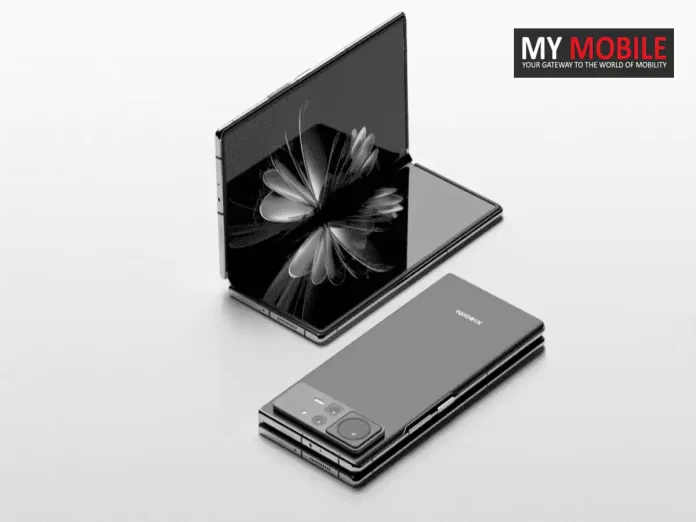
Xiaomi looks set to take its foldable smartphone game to new heights if the latest leaks around the upcoming Mi Mix Fold 4 turn out to be accurate.

Details emerging paint a picture of a radically improved folding experience which is likely to put it ahead of the galaxy Fold 5 in the pecking order.

Mi Mix Fold 4: Leaked Specs

Xiaomi's Next Foldable Flagship Leaks Reveal Cutting-Edge Features
Xiaomi’s Next Foldable Flagship Leaks Reveal Cutting-Edge Features

The leak, reportedly from a reputable Chinese tipster, suggests the Mi Mix Fold 4 will benefit from a sturdier hinge design.

This revised hinge mechanism could allow for a lighter overall chassis weight between 220-240g while minimising the visible crease when unfolded.

Crucially, the leak also hints at proper water resistance finally making an appearance.

If true, an IP rating would make the Mix Fold 4 one of the first foldable phones to offer meaningful protection against spills and splashes.

Under the hood, the Mix Fold 4 seems poised to pack Qualcomm’s latest and greatest Snapdragon 8 Gen 3 chip.

This top-tier silicon could be paired with a meaty 16GB RAM and up to an incredible 1TB of storage.

Mix Fold 4 Camera Setup, Satellite Connectivity
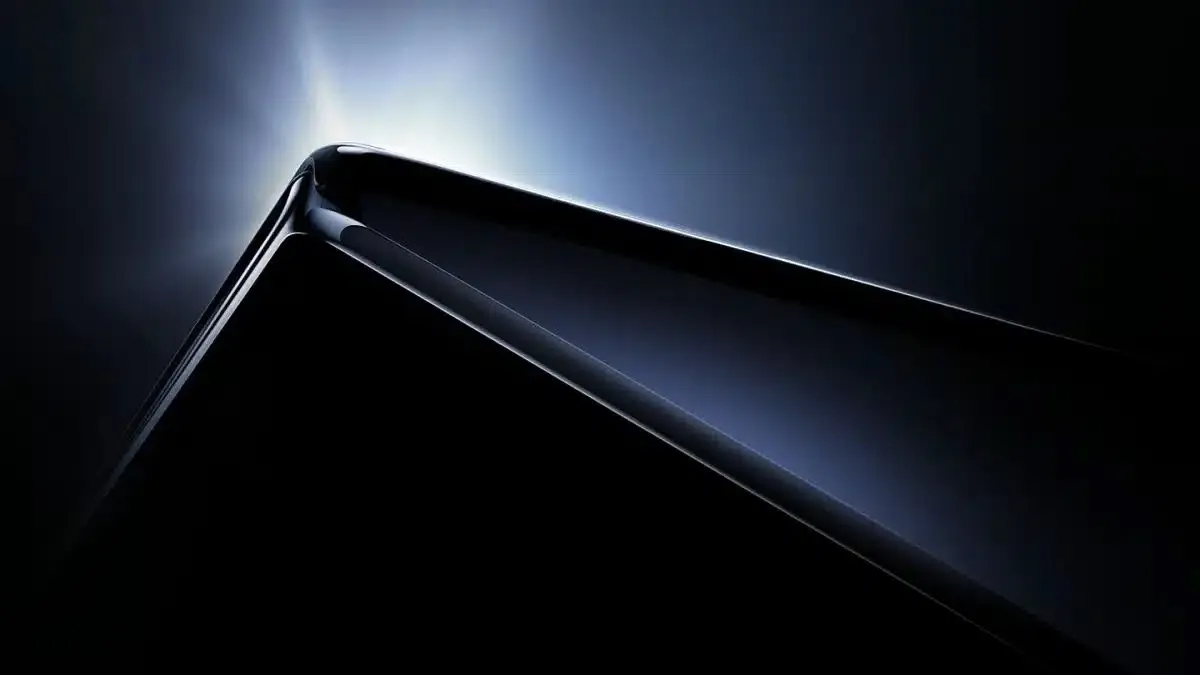
Mi Mix Fold 4 to feature a lighter design with a more robust hinge and minimized crease

The camera department is tipped for a serious overhaul too. 

Headlining is a huge 50MP main sensor with 1/1.55″ size, accompanied by a 5x optical zoom telephoto lens and 13MP ultrawide.

Even the selfie cameras, with 16MP sensors on both inner and outer displays, seem well-specced.

Additionally, the leak points to some very intriguing extras like two-way satellite connectivity for remote coverage and an X-axis linear vibration motor promising improved haptic feedback.
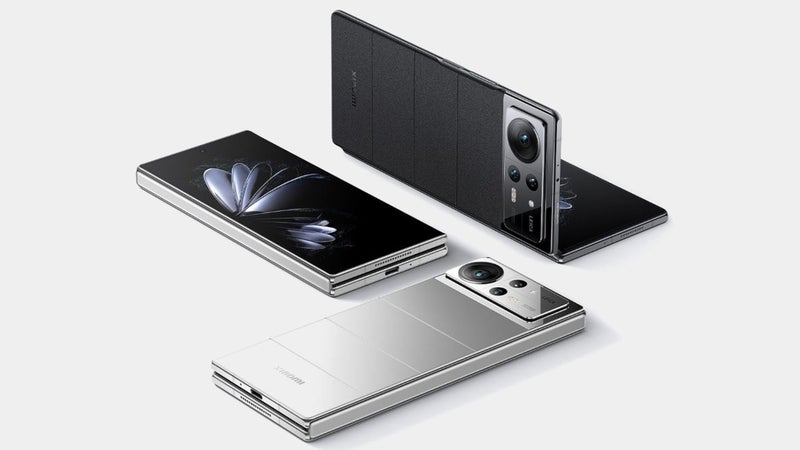
Introduces 50MP main camera, two-way satellite connectivity, and 100W fast charging

With a rumoured 5,000mAh battery with 100W fast charging rounding things out, it seems Xiaomi isn’t leaving any stones unturned in making the Mix Fold 4 a foldable tour de force.

Of course, leaks can prove inaccurate.

But if these details hold true, Xiaomi’s next flagship folding phone could redefine what a premium foldable is capable of in terms of performance, imaging prowess and true all-weather durability.

Xiaomi Mix Fold 4 Specs

GENERAL

Sim Type Dual Sim, GSM+GSM
Dual Sim Yes
Sim Size Nano+Nano SIM
Device Type Smartphone
Release Date August 11, 2024 (Expected)

DESIGN

Dimensions Unfolded: 173.3 x 133.4 x 7.6 mm Folded: 173.3 x 69.8 x 17.2 mm

DISPLAY

Type Color AMOLED Screen (1B)
Touch Yes, 380 Hz Touch Sampling Rate
Size 8.2 inches, 1914 x 2160 pixels, 144 Hz
Aspect Ratio 4:3
PPI ~ 360 PPI
Screen to Body Ratio ~ 90.3%
Features HDR10+, LTPO 2.0, AI Master Image Quality Engine, 1500nit Brightness
Notch No
Foldable Display Yes
Dual Display Yes, AMOLED, 6.7 inches, 1080 x 2520 pixels, 21:9, 120 Hz Refresh rate

MEMORY

RAM 12 GB
Storage 512 GB
Storage Type UFS 4.0
Card Slot No

CONNECTIVITY

GPRS Yes
EDGE Yes
3G Yes
4G Yes
5G Yes
VoLTE Yes, Dual Stand-By
Vo5G Yes
Wifi Yes, with wifi-hotspot
Bluetooth Yes, v5.3, A2DP, LE
USB Yes, USB-C
USB Features USB on-the-go, USB Charging
IR Blaster Yes

EXTRA

GPS Yes, with tri-band A-GPS, GLONASS, BDS, GALILEO, QZSS, NavIC
Fingerprint Sensor Yes, In Display
Face Unlock Yes
Sensors Accelerometer, Gyro, Proximity, Compass, Color Spectrum, Barometer
3.5mm Headphone Jack No
NFC Yes
Extra Features 2 Way Satellite Communication Support

CAMERA

Rear Camera 200 MP f/1.8 (Wide Angle)
48 MP (Telephoto)
13 MP f/2.4 (Ultra Wide) with autofocus
Features HDR, Panorama
Video Recording 8K @ 24/30 fps UHD, 4K @ 30/60 fps UHD, 1080p @ 30 fps FHD
Flash Yes, Dual LED
Front Camera Under Screen 50 MP (Wide Angle)
Front Video Recording 1080p @ 30 fps FHD, 720p @ 120 fps HD

TECHNICAL

OS Android v14
Custom UI MIUI15
Chipset Qualcomm Snapdragon 8 Gen3
CPU 3.3 GHz, Octa Core Processor
Core Details 1xCortex-X4@3.3 GHz & 5xCortex-A720@3.2 GHz & 2x Cortex-A520@2.3 GHz
GPU Adreno GPU
Java No
Browser Yes

MULTIMEDIA

Email Yes
Music Yes
Video Yes
FM Radio No
Document Reader Yes

BATTERY

Type Non-Removable Battery
Size 5000 mAh, Li-Po Battery
Fast Charging Yes, 100W Fast Charging
Wireless Charging Yes, 65W

FAQs

What new features does the Mi Mix Fold 4 bring to Xiaomi’s foldable lineup?

The Mi Mix Fold 4 is set to introduce several significant upgrades over its predecessor, including a lighter and sturdier hinge design that minimizes the crease when unfolded.

A notable first for foldable phones is its water resistance, potentially with an IP rating, enhancing durability against spills and splashes.

How does the Mi Mix Fold 4’s camera system stand out?

The camera setup on the Mi Mix Fold 4 is poised for a major overhaul, featuring a 50MP main sensor, a telephoto lens with 5x optical zoom, and a 13MP ultrawide lens.

Additionally, both the inner and outer displays are expected to house 16MP selfie cameras, promising high-quality imaging capabilities across the board.

What makes the Mi Mix Fold 4 a contender against other flagship foldables?

Leaked specs suggest the Mi Mix Fold 4 could outshine competitors with its combination of durability, performance, and imaging prowess.

The introduction of water resistance, a lighter chassis, and a less visible crease when unfolded are significant.

Can the Mi Mix Fold 4’s battery and charging capabilities meet high usage demands?

With a rumored 5,000mAh battery and 100W fast charging, the Mi Mix Fold 4 is expected to excel in power management and endurance, catering to heavy usage without frequent recharges.

Also Read: Xiaomi Mix Fold 3 Confirmed to Launch Next Month – August ,but Only in China: to Feature Leica Cameras

Also Read: Xiaomi MIX Fold 3 to get UD camera, 5x optical zoom & 50W wireless charging; Also will use an under-screen camera & a periscope camera

Also Read: Xiaomi Mix Fold 3: Live Image Shots Reveal Design ; Leica-branded Quad cameras, punch-hole curved display & more

Also Read: Xiaomi Mix Fold 3 coming in August with four Leica-tuned Cameras: Passes MIIT Certification

Google Photos Releases its AI Editing Tools for All Android and iOS Users

0
Google Photos Releases its AI Editing Tools for All Android and iOS Users

Highlights

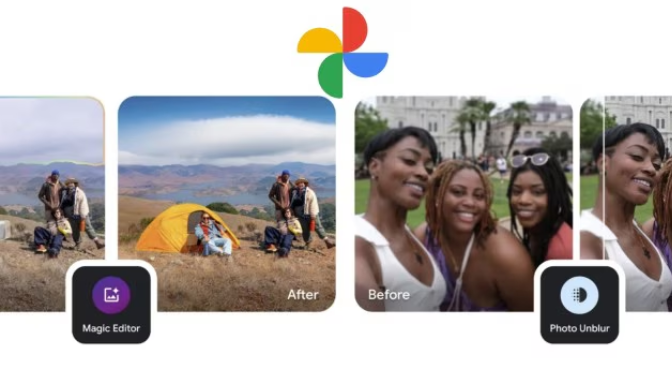
  • Google Photos rolls out free AI-powered Magic Editor to all Android and iOS users from 15th May.
  • Users get 10 free Magic Edits per month, with unlimited access via Google’s paid plans.
  • Compatible with mid-range phones: Android 8.0+ and iOS 15+ devices with at least 4GB RAM.
  • Free suite includes Photo Unblur and Portrait Light, previously exclusive to Pixel and subscribers.

Get ready to experience some AI photo editing wizardry on your smartphone.

Google is rolling out its impressive suite of AI-powered editing tools to all Google Photos users on Android and iOS for free.

Google Photos AI Features Rolls Out for All

No IssuesAre you able to come at 6 pm?
No Issues
Are you able to come at 6 pm?

From 15th May, nifty features like Magic Editor, Photo Unblur and Portrait Light will become available to download on compatible phones and tablets.

Previously, these capabilities were restricted to just Pixel device owners and Google One subscribers.

The headliner is undoubtedly Magic Editor, Google’s generative AI tool that can perform complex edits like removing unwanted objects or changing a person’s pose with startling realism.

While offering it for free sounds too good to be true, there is a small catch.

Non-paying users will be limited to just 10 ‘Magic Edits’ per month.

Go beyond that and you’ll need to subscribe to one of Google’s paid cloud storage plans to unlock unlimited usage.

For many casual snappers though, 10 AI touchups monthly could be enough.

Key Specs Requirements

Users get 10 free Magic Edits per month, with unlimited access via Google's paid plans
Users get 10 free Magic Edits per month, with unlimited access via Google’s paid plans

Google has also lowered the hardware requirements, allowing even mid-range Android 8.0+ phones and iOS 15+ iPhones with at least 4GB RAM to access Magic Editor’s AI smarts.

Tablets aren’t left out either, with Pixel slates joining the fun.

Rounding out the free upgrades are tools like Photo Unblur for sharpening blurry shots and Portrait Light for adjusting luminance in portraits.

These were previously paid-only perks.

The expansive rollout marks Google’s latest move to democratise its AI photo technology.

With Samsung, Oppo and others also offering free AI editing apps, the race is on to bring advanced imaging capabilities to the mass market.

For regular folk, having a powerful AI photo editor in their pocket for free could be a game-changer for capturing and enhancing life’s special moments without spending a fortune.

FAQs

What AI features are being made free in Google Photos?

Google Photos is offering its AI-powered Magic Editor, along with Photo Unblur and Portrait Light features for free to all users on compatible Android and iOS devices.

This marks a significant expansion from the tools being exclusive to Pixel devices and Google One subscribers, democratizing access to advanced photo editing capabilities.

How does the Magic Editor work, and what are its limitations for free users?

Magic Editor in Google Photos utilizes generative AI technology to allow users to perform complex edits like removing objects or altering a person’s pose with high realism.

While this feature is being made available for free, non-paying users will be limited to 10 Magic Edits per month.

To gain unlimited access, users will need to subscribe to Google’s cloud storage plans.

What are the hardware requirements to use the new Google Photos AI editing features?

Google has lowered the hardware requirements for accessing its AI editing tools in Google Photos.

Now, mid-range Android phones running version 8.0 or higher and iPhones with iOS 15 or higher, both with at least 4GB of RAM, can utilize these advanced editing features.

This update extends the accessibility of AI photo editing to a broader range of devices.

Can the Photo Unblur and Portrait Light features truly enhance my photos?

Yes, the Photo Unblur and Portrait Light features in Google Photos are designed to significantly enhance photo quality.

Photo Unblur sharpens blurry images, making them clearer, while Portrait Light adjusts the lighting on subjects’ faces in portraits.

These tools can transform average photos into polished, professional-looking shots.

Also Read: MIT’s PhotoGuard Technology: Protecting Images from Malicious AI Edits and Unauthorised Access

Also Read: ChatGPT 5: A Glimpse into the Future of OpenAI’s AI Evolution

Also Read: Top 5 AI Photo Editors To Use For Mind Blowing Transformations

Intel Unveils Gaudi 3 AI Accelerator Challenging NVIDIA’s Dominance

0
Gaudi 3 AI Accelerator

Highlights

  • Gaudi 3 delivers a 50% faster AI training time over its predecessor, Gaudi 2.
  • Outperforms NVIDIA’s H100 in training and inference, promising 50% quicker LLaMA benchmarks.
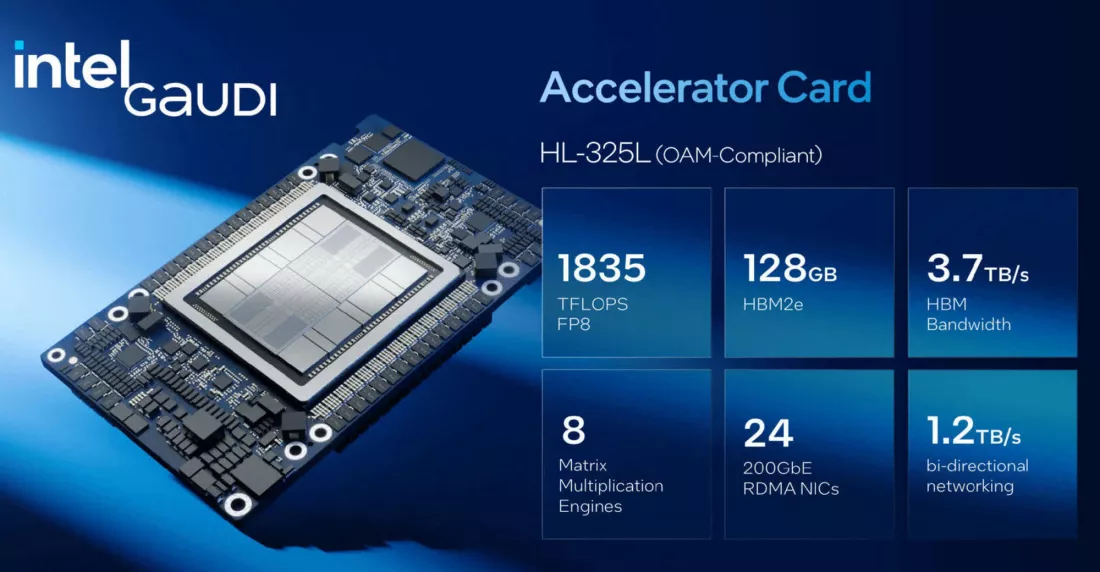
  • Equipped with 128GB HBM2e memory and a whopping 3.7TB/s bandwidth.
  • Partnerships with major server manufacturers like Dell, HPE, and Lenovo already in place.

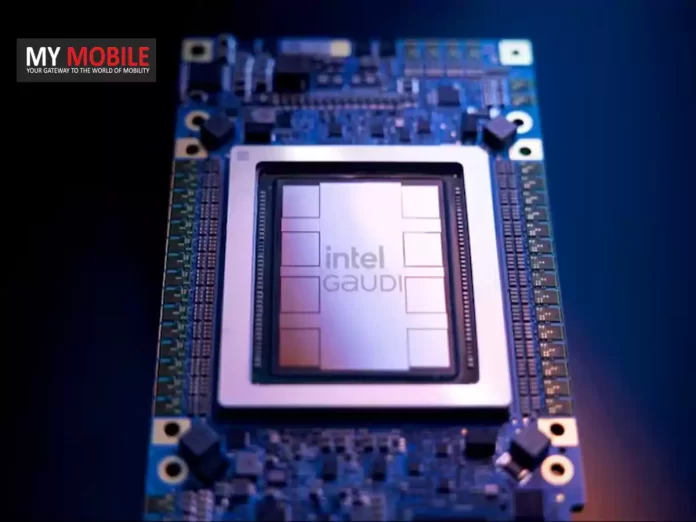
Intel has pulled back the curtain on its latest AI hardware accelerator aimed at powering the next wave of advanced AI applications.

The Gaudi 3 chip promises a major performance boost over previous generations.

Intel Gaudi 3 Specs

Intel Unveils Gaudi 3 AI Accelerator Challenging NVIDIA's Dominance
Intel Unveils Gaudi 3 AI Accelerator Challenging NVIDIA’s Dominance

At an event showcasing Intel’s AI strategy, the tech giant revealed new details and benchmarks for the Gaudi 3 accelerator.

And the numbers are eye-catching.

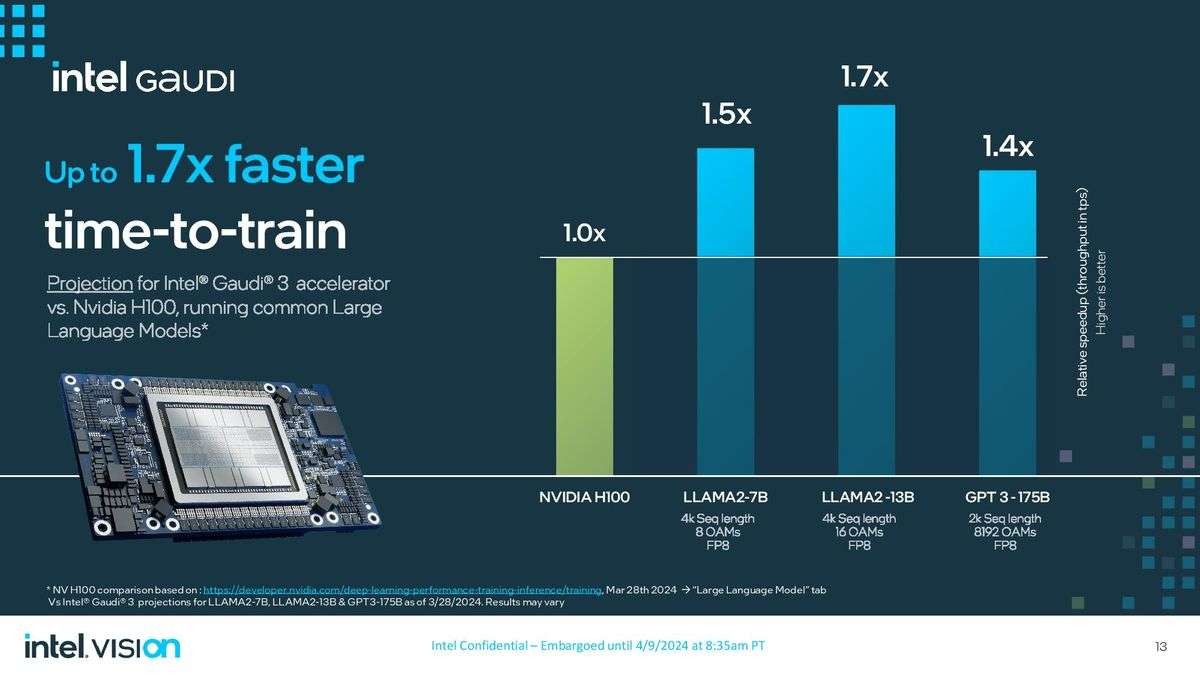
Compared to Intel’s flagship AI chip Habana Gaudi 2, the new Gaudi 3 delivers a 50% faster training time across large language models like LLaMA 2.

It achieves this improved speed while being more power efficient thanks to TSMC’s 5nm chip manufacturing process.

Guadi 3 Outperforms Competitors

But Intel hasn’t just pitted Gaudi 3 against its own chips.

Gaudi 3 delivers a 50% faster AI training time over its predecessor, Gaudi 2

Benchmarks also show it outcrunching NVIDIA’s powerful H100 data centre GPU on AI model training across a suite of tests.

For the hotly-contested LLaMA benchmarks, Gaudi 3 is claimed to be 50% quicker at training the 7B and 13B parameter versions.

The performance uplift carries through to inference workloads too.

Here, Intel asserts Gaudi 3 provides 50% faster inferencing than H100 with better power efficiency on models like LLaMA 7B/70B and the gigantic 180B parameter Falcon model.

Gaudi 3’s specifications seem to back up the bold claims.

It packs a hefty 128GB of HBM2e memory with a staggering 3.7TB/s of bandwidth.

Outperforms NVIDIA's H100 in training and inference, promising 50% quicker LLaMA benchmarks
Outperforms NVIDIA’s H100 in training and inference, promising 50% quicker LLaMA benchmarks

And with a huge 900W TDP, it has ample thermal headroom for demanding AI workloads.

While real-world tests await, Intel is clearly positioning Gaudi 3 as a formidable rival to NVIDIA’s AI computing prowess.

Major server makers like Dell, HPE and Lenovo are already on board as partners too.

As demand for generative AI skyrockets, Intel is betting big that Gaudi 3’s potent combination of speed, efficiency and scalability will give it an edge in the cut-throat AI silicon market.

FAQs

What advancements does the Gaudi 3 AI Accelerator bring to AI model training?

Intel’s Gaudi 3 AI Accelerator marks a significant leap in AI model training performance.

Offering a 50% faster training time compared to its predecessor, the Gaudi 2, and surpassing NVIDIA’s H100 in a range of benchmark tests, it’s tailored for large language models like LLaMA 2.

With these capabilities, Gaudi 3 is designed to significantly speed up the development and deployment of advanced AI applications.

How does Gaudi 3 compare to NVIDIA’s H100 GPU in terms of performance?

In direct comparisons, the Gaudi 3 AI Accelerator outperforms NVIDIA’s H100 data centre GPU, especially in training large AI models.

Benchmarks indicate that Gaudi 3 is 50% faster at training both 7B and 13B parameter versions of the LLaMA model.

This performance advantage extends to inference tasks, where Gaudi 3 also claims a 50% speed increase over the H100, showcasing its superior efficiency and computational power.

What are the key specifications of the Gaudi 3 AI Accelerator?

The Gaudi 3 AI Accelerator boasts impressive specifications, including 128GB of HBM2e memory and an astounding 3.7TB/s bandwidth, which are critical for processing vast amounts of data quickly.

Its 900W total design power (TDP) provides the thermal capacity required for sustained high-performance operation, making it well-suited for demanding AI workloads and large model training.

Who are Intel’s partners in bringing Gaudi 3 to the market?

Intel has secured partnerships with leading server manufacturers, including Dell, HPE, and Lenovo, to integrate the Gaudi 3 AI Accelerator into their server offerings.

These collaborations ensure that the Gaudi 3 will be readily available for deployment in data centres and research institutions, facilitating widespread adoption of this cutting-edge AI technology.

Also Read: Intel Announces 14th Gen Core HX and Ultra CPUs at CES 2024

Also Read: Intel Core 14th Gen i9-14900KS Powers Desktop PCs to Record-Breaking Speeds

Nubia Flip Launches as the Most Affordable Foldable Phone Globally: What You Need to Know

0

Highlights

  • Nubia Flip sets new affordability records for foldable phones starting at just £315.
  • Features a 6.49-inch FHD+ AMOLED display and Qualcomm Snapdragon 7 Gen 1 chip.
  • Offers a 50MP main camera and a 16MP selfie camera within its foldable design.
  • Supports 5G, WiFi 6, Bluetooth 5.3, and has a side fingerprint sensor for security.

Folding phones just got a lot more affordable with the global launch of the Nubia Flip.

This clamshell-style foldable hits the market as the cheapest flip smartphone available.

Originally launched in China, the Nubia Flip is now rolling out to the UK, US, Australia, Singapore and other countries from April 23rd.

And its bargain pricing is turning heads.

The entry-level model with 8GB RAM and 256GB storage starts at just £315 in the UK (around Rs 35,000).

Even the higher-end 12GB/512GB version costs only £525 (about Rs 50,000).

Nubia Flip Launches as the Most Affordable Foldable Phone Globally

That dramatically undercuts Samsung’s Galaxy Z Flip4, which sells for £999.

So what are you getting for the money?

The Nubia Flip packs respectable mid-range specs into its unique folding design:

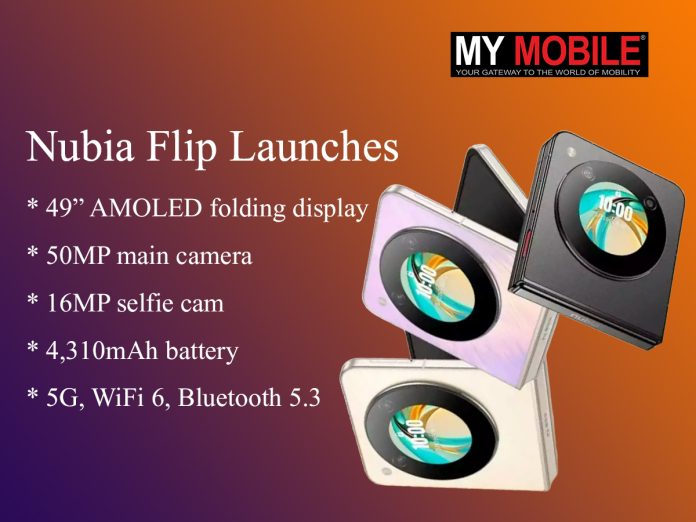
  • 49-inch FHD+ AMOLED folding display 
  • Qualcomm Snapdragon 7 Gen 1 chip
  • 50MP main camera, 16MP selfie cam
  • 4,310mAh battery with 33W charging
  • 5G, WiFi 6, Bluetooth 5.3
  • Side fingerprint sensor
  • 200,000+ fold lifespan

Nubia Flip: Features

Features a 6.49-inch FHD+ AMOLED display and Qualcomm Snapdragon 7 Gen 1 chip

While not a flagship powerhouse, the foldable Nubia Flip seems ideal for those wanting an affordable taste of the flip phone experience.

Its folding mechanism is rated for over 200,000 unfolds as well.

The camera setup includes a 50MP main sensor paired with a 2MP depth camera for portrait shots.

For selfies, it has a 16MP front-facing camera.

Powered by Qualcomm’s Snapdragon 7 Gen 1 chip, the Nubia Flip promises solid mid-range performance.

Nubia claims the Flip can fully charge in 73 minutes with its 33W fast charging.

However, it lacks wireless charging capabilities.

With pre-orders now open across global markets, the ultra-cheap Nubia Flip is offering foldable phone fans a wildly more affordable path to flipping their smartphone open and closed.

Nubia Flip 5G Specs

GENERAL

Sim Type Single Sim, GSM
Dual Sim No
Sim Size Nano SIM
Device Type Smartphone
Release Date February 26, 2024

DESIGN

Dimensions 76 x 170 x 7.3 mm
Weight 209 g
Bezel less No
Design Type Flip (Clamshell)
Colors Cosmic Black, Sunshine Gold, Flowing Lilac

DISPLAY

Type Color OLED Screen (1B Colors)
Touch Yes
Size 6.9 inches, 1188 x 2790 pixels, 120 Hz
Aspect Ratio 21:9
PPI ~ 439 PPI
Screen to Body Ratio ~ 85.7%
Notch Yes, Punch Hole
Foldable Display Yes
Dual Display Yes, OLED, 1.43 inches, 466 x 466 pixels

MEMORY

RAM 12 GB
Storage 256 GB
Card Slot No

CONNECTIVITY

GPRS Yes
EDGE Yes
3G Yes
4G Yes
5G Yes
5G Bands NR: n1/n2/n3/n5/n7/n8/n12/n20/n25/n28/n38/n40/n41/n66/n77/n78/n79
VoLTE Yes, Dual Stand-By
Wifi Yes, with wifi-hotspot
Wifi Version WIFI 802.11 a/b/g/n/ac/ax, wifi6E
Bluetooth Yes, v5.2, A2DP, LE
USB Yes, USB-C
USB Features USB Tethering, USB on-the-go, USB Charging

EXTRA

GPS yes with A-GPS, Galileo, Glonass, BeiDou
Fingerprint Sensor Yes, Side
Face Unlock Yes
Sensors Fingerprint (side-mounted) accelerometer, gyro, proximity, compass
3.5mm Headphone Jack No
NFC Yes
Extra Features E-Sim

CAMERA

Rear Camera 50 MP (Wide Angle)
2 MP (Depth Sensor) with autofocus
Camera Sensor Sony IMX890
Features HDR, panorama
Video Recording 4K, 1080p
Flash Yes, LED
Front Camera Punch Hole 16 MP (Wide Angle)
Front Video Recording 1080p @ 30 fps FHD

TECHNICAL

OS Android v13
Custom UI ColorOS 14
Chipset Qualcomm Snapdragon 7 Gen1
CPU 2.4 GHz, Octa Core Processor
Core Details 1x Cortex-X3@ 3.2GHz & 4x Cortex-A715@ 2.8GHz & 3x Cortex-A510@2.0 GHz
GPU Adreno 644
Java No
Browser Yes

MULTIMEDIA

Email Yes
Music MP3, M4A, 3GA, AAC, OGG, OGA, WAV, AMR, AWB, FLAC, MID, MIDI, XMF, MXMF, IMY, RTTTL, RTX, OTA, APE, DSF, DFF
Video MP4, M4V, 3GP, 3G2, AVI, FLV, MKV, WEBM
FM Radio No
Document Reader Yes

BATTERY

Type Non-Removable Battery
Size 4310 mAh, Li-ion Battery
Fast Charging Yes, 33W Fast Charging
Reverse Charging Yes

FAQs

What makes the Nubia Flip stand out in the foldable smartphone market?

The Nubia Flip marks a significant turning point in the foldable smartphone market by offering a high-quality foldable experience at an unprecedented price point.

Starting at just £315 for the base model, it provides consumers with an affordable entry into the foldable phone category without compromising on essential features like a high-quality display, camera, and connectivity options.

How does the Nubia Flip compare in price to other foldable phones?

The Nubia Flip dramatically undercuts the competition, with its price significantly lower than similar devices from leading brands like Samsung.

For example, the Galaxy Z Flip4, a direct competitor, is priced at £999, making the Nubia Flip a more accessible option for those curious about foldable technology without the high cost typically associated with it.

What are the key specifications of the Nubia Flip?

The Nubia Flip boasts a 6.49-inch FHD+ AMOLED folding display, ensuring crisp and vibrant visuals. It’s powered by a Qualcomm Snapdragon 7 Gen 1 processor, suitable for handling daily tasks and mid-range gaming.

The device also features a dual-camera setup, including a 50MP main camera and a 16MP front-facing camera, packed into its innovative folding design.

Can the Nubia Flip handle the demands of modern connectivity?

Yes, the Nubia Flip is well-equipped to meet modern connectivity demands. It supports 5G networks, offering fast internet speeds for streaming and browsing.

Additionally, it comes with WiFi 6 for reliable home connectivity and Bluetooth 5.3 for connecting a wide range of peripherals and accessories, making it a versatile choice for tech-savvy users.

Also Read: Nubia Z50S Pro on Geekbench and 3C Certification Websites: Camera Sample Showcase & Specifications Revealed Ahead Of Launch
Also Read: Nubia Red Magic 8S Pro International Debut Launch on July 18: Expected Price, Specifications

Also Read: Nubia RedMagic 9 Pro Listed on 3C Certification To Reveal 165W Fast Charging & More
Xiaomi Launches Redmi Pad Pro in China with High-End Features: Pricing, Features, Specs

0
Xiaomi Launches Redmi Pad Pro in China with High-End Features: Pricing, Features, Specs

Highlights

  • Redmi Pad Pro debuts with prices starting at CNY 1,499 for the base model.
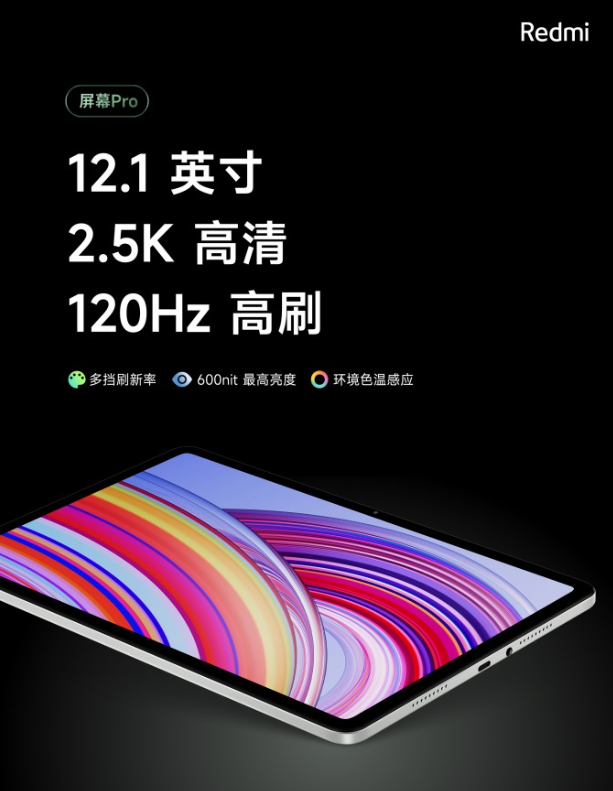
  • Features a 12.1-inch 2.5K LCD display and a 120Hz refresh rate for smooth visuals.
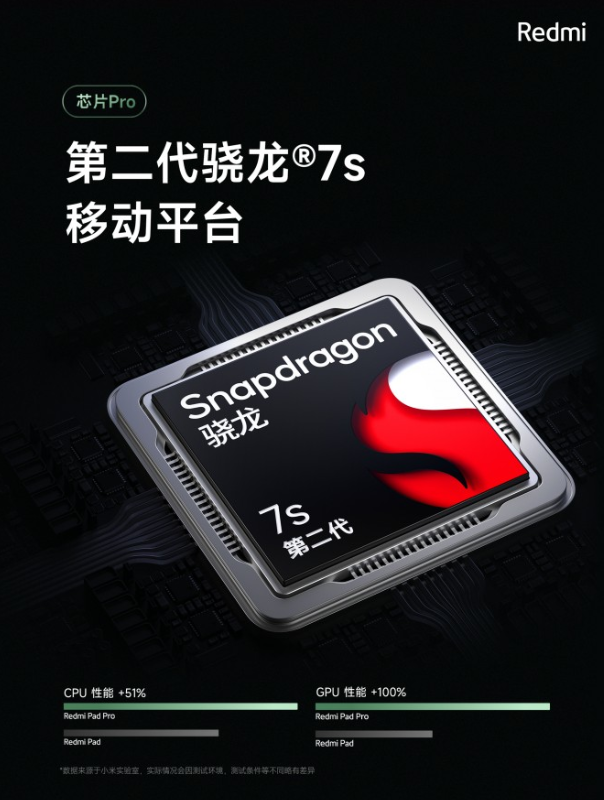
  • Powered by Qualcomm Snapdragon 7 Gen 2 processor for robust performance.
  • Supports 33W fast charging for its substantial 10,000mAh battery.

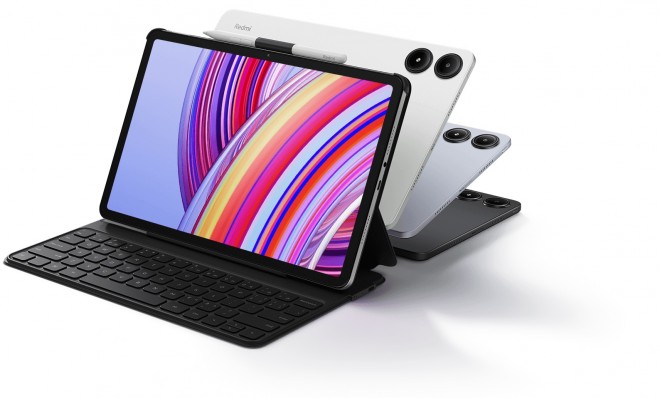
Xiaomi has officially unveiled the Redmi Pad Pro, a new affordable tablet that packs a punch.

While sticking to the Redmi brand’s budget-friendly ethos, this tablet is far from average.

Redmi Pad Pro: Pricing and Availability

Redmi Pad Pro: Pricing and Availability
Redmi Pad Pro debuts with prices starting at CNY 1,499 for the base model

The Redmi Pad Pro starts at CNY 1,499 (approx. Rs. 18,000) for the 6GB/128GB variant and goes up to CNY 1,799 (approx. Rs. 21,600) for the 8GB/256GB model.

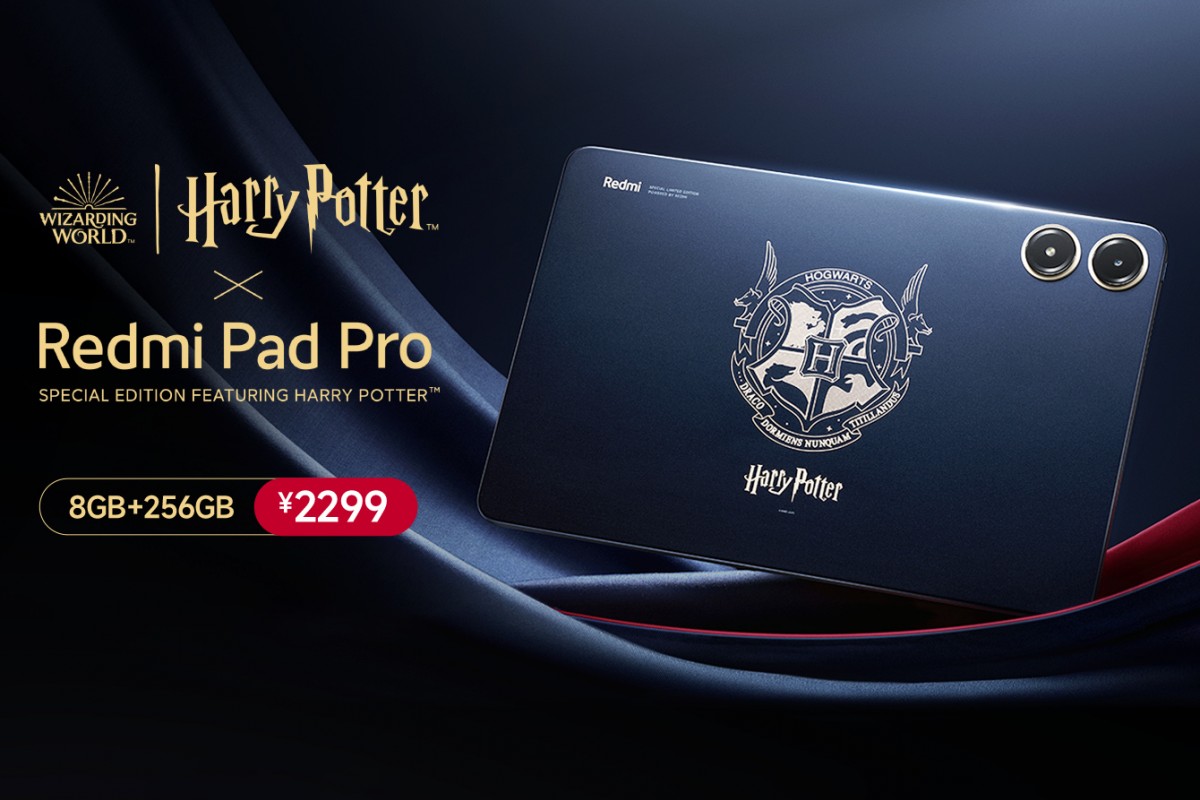
The exclusive Harry Potter edition (8GB/256GB) is priced at CNY 2,999 (approx. Rs. 36,000).

Open sales in China are scheduled for April 15.

Redmi Pad Pro: Key Specs

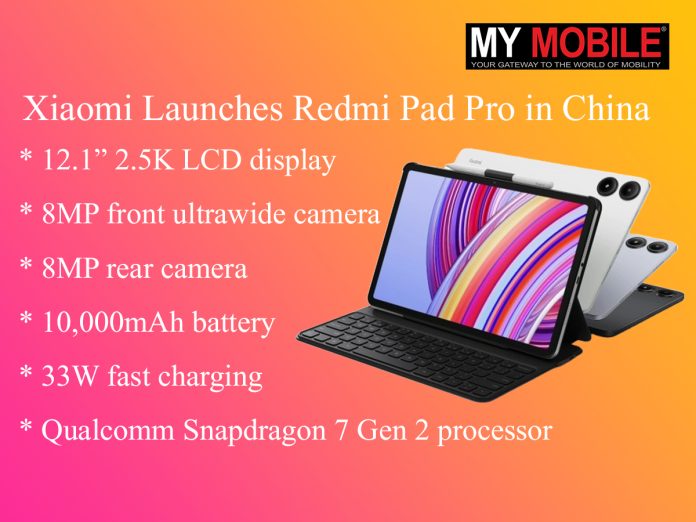
Features a 12.1-inch 2.5K LCD display and a 120Hz refresh rate for smooth visuals
  • 1-inch 2.5K LCD display with 120Hz refresh rate
  • Qualcomm Snapdragon 7 Gen 2 processor
  • 6GB/8GB RAM
  • 128GB/256GB storage
  • 8MP front ultrawide camera
  • 8MP rear camera
  • 10,000mAh battery with 33W fast charging

Redmi Pad Pro: Features

Powered by Qualcomm Snapdragon 7 Gen 2 processor for robust performance

The Redmi Pad Pro comes in grey, green, and blue color options, as well as an exclusive Harry Potter edition.

The Harry Potter variant includes a stylus pen, a leather cover, and additional Harry Potter-themed merchandise.

The tablet runs HyperOS based on Android 14 out of the box.

tablet runs HyperOS based on Android 14
Tablet runs HyperOS based on Android 14

It supports continuity features with HyperOS phones and Xiaomi PCs, allowing users to mirror their phone’s screen, share files and mobile data connectivity, and use the tablet’s display as a secondary screen wirelessly connected to compatible Xiaomi PCs.

Under the hood, the Redmi Pad Pro is powered by Qualcomm’s Snapdragon 7 Gen 2 processor, paired with 6GB or 8GB of RAM and 128GB or 256GB of storage.

It features an 8MP ultrawide lens on the front and an 8MP wide lens on the back for capturing photos and videos.

Supports 33W fast charging for its substantial 10,000mAh battery
It boasts a 12.1-inch LCD screen with a 2.5K resolution and a smooth 120Hz refresh rate

The tablet’s hardware is fueled by a 10,000mAh battery that supports 33W fast charging, ensuring a quick top-up from 0% to 100%.

On the front, the Redmi Pad Pro boasts a 12.1-inch LCD screen with a 2.5K resolution and a smooth 120Hz refresh rate for an immersive viewing experience.

Xiaomi Redmi Pad Pro Specs

GENERAL

Sim Type No Sim Supported, No Sim Supported
Dual Sim No
Device Type Tablet
Release Date August 15, 2023

DESIGN

Dimensions 167.1 x 255.5 x 7.4 mm
Weight 478 g
Colors Lavender Purple, Graphite Gray, Mint Green

DISPLAY

Type Color IPS Screen (1B Colors)
Touch Yes
Size 11 inches, 1200 x 1920 pixels, 90 Hz
Aspect Ratio 15:09
PPI ~ 207 PPI
Screen to Body Ratio ~ 81.4%
Features 400 nits(typ) Brightness, Wide Color Gamut, True-tone, HDR10

MEMORY

RAM 4 GB
Storage 128 GB
Card Slot Yes, upto 1 TB

CONNECTIVITY

3G No
Wifi Yes, with wifi-hotspot
Wifi Version Wi-Fi 5
Bluetooth Yes, v5.0, A2DP, LE
USB Yes, USB-C
USB Features USB Tethering, USB on-the-go, USB Charging

EXTRA

GPS Yes, with A-GPS, GLONASS, GALILEO, QZSS (5G model only)
Sensors Accelerometer, proximity
3.5mm Headphone Jack Yes
Extra Features Quad Speakers

CAMERA

Rear Camera 8 MP 1/4″, 1.12µm, AF f/2 (Wide Angle) with autofocus
Features Panorama, HDR
Video Recording 1080p @ 30 fps FHD
Front Camera 5 MP 1/5″, 1.12µm f/2.2 (Ultra Wide)
Front Video Recording 1080p @ 30 fps FHD

TECHNICAL

OS Android v13
Custom UI MIUI 14
Chipset Qualcomm Snapdragon 680
CPU 2.4 GHz, Octa Core Processor
Core Details 4×2.4 GHz Kryo 265 Gold & 4×1.9 GHz Kryo 265 Silver
GPU Adreno 610
Java No
Browser Yes

MULTIMEDIA

Email Yes
Music Yes
Video Yes
FM Radio No
Document Reader Yes

BATTERY

Type Non-Removable Battery
Size 8000 mAh, Li-Po Battery
Fast Charging Yes, 10W

FAQs

What makes the Redmi Pad Pro stand out in the tablet market?

The Redmi Pad Pro distinguishes itself in the tablet market through its exceptional balance of price and performance.

Starting at CNY 1,499, it offers a 12.1-inch 2.5K LCD display with a 120Hz refresh rate, a Qualcomm Snapdragon 7 Gen 2 processor, and a 10,000mAh battery with 33W fast charging.

This combination of high-end features at an affordable price makes it an attractive option for consumers.

Can you tell me more about the Redmi Pad Pro’s display features?

The Redmi Pad Pro boasts a 12.1-inch 2.5K LCD display, offering a high resolution for sharp and clear visuals.

With a 120Hz refresh rate, the tablet ensures smooth scrolling and an enhanced viewing experience, making it ideal for gaming, streaming, and browsing.

What are the connectivity and continuity features of the Redmi Pad Pro?

The Redmi Pad Pro excels in connectivity and continuity with HyperOS devices.

It allows users to mirror their phone’s screen on the tablet, share files and mobile data connectivity seamlessly, and even use the tablet as a wireless secondary display for compatible Xiaomi PCs.

These features are facilitated by the tablet running HyperOS based on Android 14, enhancing productivity and user experience.

How does the Redmi Pad Pro’s camera setup fare for users?

Equipped with an 8MP ultrawide front camera and an 8MP wide rear camera, the Redmi Pad Pro caters to both video conferencing and photography needs.

While it may not rival high-end tablets or smartphones in camera technology, it provides adequate functionality for everyday tasks like video calls, online meetings, and basic photography.

Also Read: Redmi Pad 2 Clears 3C Certification; To Support 18W Fast Charging

Also Read: Redmi Pad 2 Listed On Geekbench: To feature Qualcomm Snapdragon 680; Launch Expected Soon

YouTube Kids Enhances Child Safety with Read-Only Comments Feature

0
YouTube Kids Enhances Child Safety with Read-Only Comments Feature

Highlights

  • YouTube Kids introduces a “read-only” comments feature to balance interaction and safety.
  • The update marks a significant enhancement in YouTube’s parental control options.
  • Aimed at creating a safer space for kids, allowing them to view comments without interaction.
  • Reflects YouTube’s response to increasing demands for improved online child protection measures.

In a move to create a safer online environment for children, YouTube has introduced a “read-only” comments feature on its YouTube Kids platform.

Parental Control Evolution

YouTube Kids Enhances Child Safety with Read-Only Comments Feature

The announcement, made via an email to parents who supervise their child’s account, marks a significant evolution in YouTube’s parental control features.

Previously, comments were completely disabled, preventing both reading and commenting.

However, YouTube recognised the importance of age-appropriate interactions and promised to work with parents and experts to implement a more nuanced approach for older children.

A Balanced Approach

YouTube Kids introduces a "read-only" comments feature to balance interaction and safety
YouTube Kids introduces a “read-only” comments feature to balance interaction and safety

The “read-only” comments option allows kids to view comments without the ability to participate actively.

This decision acknowledges the potential benefits of community interaction while mitigating the risks associated with unmoderated user-generated content.

YouTube’s move comes amidst growing pressure from lawmakers and advocacy groups for tech companies to enhance child protection measures.

In 2021, the platform introduced heightened protections for minors, but the demand for further safeguards persisted.

Legislative Push

YouTube Music and TV Update: Major Enhancements and Future Growth
The update marks a significant enhancement in YouTube’s parental control options

On a broader scale, Congress has been urging tech firms to prioritise child safety on their platforms.

Proposed bills such as the Kids Online Safety Act and COPPA 2.0 (Children and Teens’ Online Privacy Protection Act) aim to establish robust parental controls, data protection measures, and restrictions on targeted advertising toward minors.

A Safer Online Experience

Know Kids Activity over YouTube
Aimed at creating a safer space for kids, allowing them to view comments without interaction

By implementing the “read-only” comments feature, YouTube is committing to creating a safer online experience for its youngest users.

The company is acknowledging the potential risks associated with unmoderated user-generated content and prioritises the well-being of children navigating the platform.

FAQs

What is the “read-only” comments feature on YouTube Kids?

YouTube Kids has rolled out a “read-only” comments feature, which permits children to view comments on videos without the ability to post comments themselves.

This change aims to provide a safer online environment by preventing children from engaging in potentially harmful interactions, while still allowing them to observe community discussions in a controlled manner.

Why did YouTube decide to introduce the “read-only” comments feature?

YouTube introduced this feature in response to growing concerns about child safety on its platform.

By allowing children to view comments without participating, YouTube acknowledges the value of community interaction but takes a cautious approach to protect young users from the dangers of unmoderated content and inappropriate discussions.

How does the “read-only” comments feature work?

Under this new system, children using YouTube Kids can scroll through comments on videos they watch, but they won’t have the option to add their comments.

This approach is designed to reduce the risk of exposure to negative content and interactions, while still giving kids a sense of the broader community conversation around the videos they enjoy.

What prompted YouTube to evolve its parental control features?

The evolution of YouTube’s parental control features, including the introduction of “read-only” comments, comes as a direct response to feedback from parents, experts, and legislative pressures.

These stakeholders have been vocal about the need for platforms like YouTube to offer more robust protections for minors online, prompting YouTube to innovate its child safety features.

Also Read: YouTube Is Escalating Its Crackdown on Ad Blockers

Also Read: What Kids Were Looking For During Spring 2022?

Also Read: How Does YouTube Watch Time Work? Know Kids Activity over YouTube!

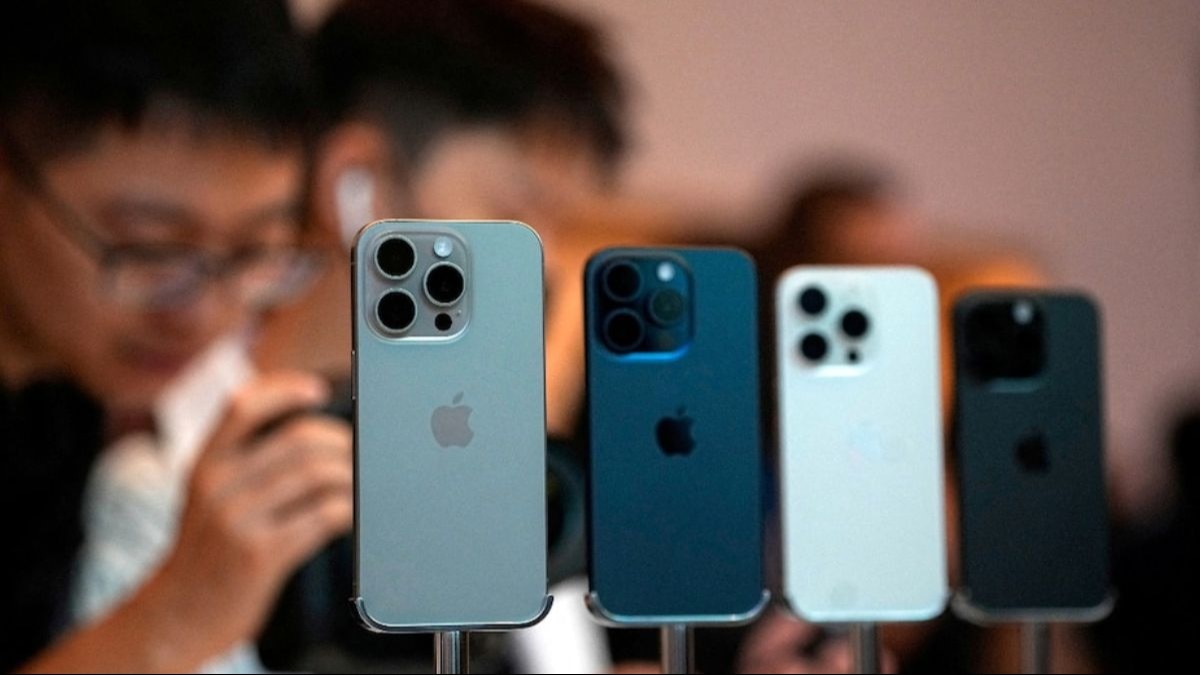
Apple’s iPhone 17 Pro Could Be Powered by TSMC’s 2nm Chipset: Report

0
Apple's iPhone 17 Pro Could Be Powered by TSMC’s 2nm Chipset: Report

Highlights

  • iPhone 17 Pro rumored to be the first to use TSMC’s advanced 2nm chip technology.
  • TSMC’s 2nm production aligns with iPhone 17 Pro’s release, hinting at a late 2023 low-volume start.
  • Apple might have exclusive access to TSMC’s initial 2nm chips, leading the mobile computing race.
  • The move to 2nm chips sets the stage for further advancements and AI capabilities in mobile technology.

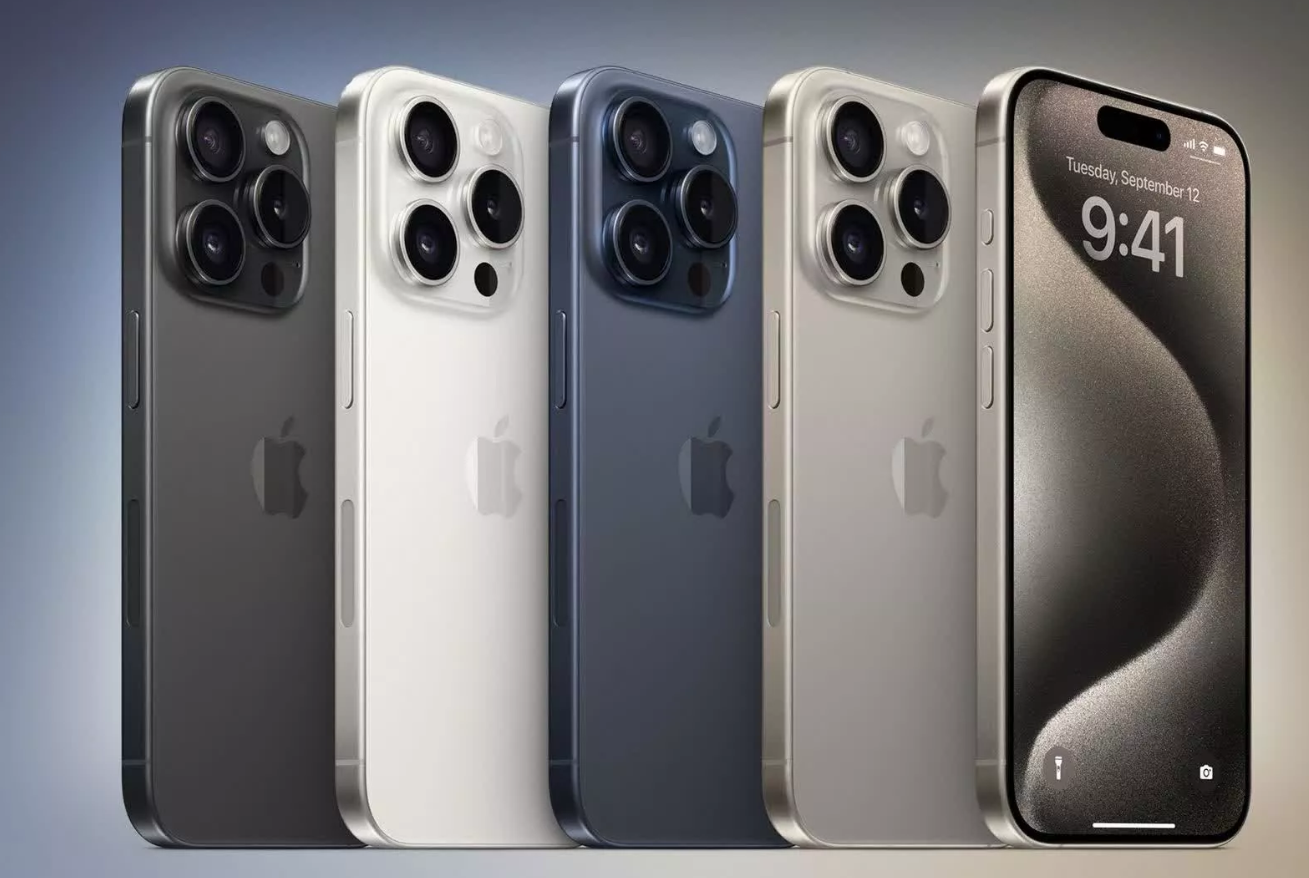
While Apple remains tight-lipped about its upcoming iPhone 16, rumours are already swirling about the next generation – the iPhone 17 series.

A recent report reveals details about the top-tier iPhone 17 Pro model.

It suggests Apple’s flagship for next year could be the first smartphone to feature a chipset built on TSMC’s advanced 2nm process technology.

TSMC’s 2nm Chips: Timing is Everything

Apple's iPhone 17 Pro Could Be Powered by TSMC’s 2nm Chipset: Report
Apple’s iPhone 17 Pro Could Be Powered by TSMC’s 2nm Chipset

The Taiwanese company kick-started its 2nm program back in 2022, fuelling speculation that Apple could be among the first to commercially deploy these cutting-edge chips.

Insiders suggest TSMC will begin low-volume 2nm production by late 2023, gearing up for full-scale manufacturing in early 2025 – conveniently aligning with the iPhone 17 Pro’s projected release timeline.

Apple’s Potential 2nm Exclusivity

iPhone 17 Pro rumored to be the first to use TSMC's advanced 2nm chip technology
iPhone 17 Pro rumored to be the first to use TSMC’s advanced 2nm chip technology

Rumours were floating that Apple has secured exclusive rights to TSMC’s initial 2nm output, a strategic move that could grant the Cupertino tech titan a significant lead over rivals.

If realised, the iPhone 17 Pro would be the first smartphone to flaunt the awe-inspiring capabilities of 2nm silicon, a feather in Apple’s cap as it continues to push boundaries in mobile computing.

Beyond 2nm: The Next Frontier

iPhone 15 Series
The move to 2nm chips sets the stage for further advancements and AI capabilities in mobile technology

After the 2nm process, the next step will be an enhanced 1.4nm variation, projected to arrive by late 2026.

However, these predictions are subject to change due to unforeseen circumstances.

With iOS 18 expected to emphasise artificial intelligence (AI) capabilities, the next Apple chipset is likely to pack additional muscle for AI processing.

Major chipmakers like Qualcomm and MediaTek have already been fortifying their offerings for AI workloads, as exemplified by the recently released Snapdragon 8 Gen 3.

Apple is anticipated to follow suit.

The iPhone 16 series, slated for release later this year, is expected to retain the current 3nm chips.

However, Apple could introduce improvements to extract maximum performance from this technology.

APPLE IPHONE 17 KEY SPECIFICATIONS

Key Specs

RAM 6 GB
Processor Apple A16 Bionic
Rear Camera 12 MP + 12 MP + 12 MP
Front Camera 12 MP
Battery 4700 mAh
Display 6.2 inches (15.75 cm)

General

Launch Date December 28, 2023 (Unofficial)
Operating System iOS v16

Performance

Chipset Apple A16 Bionic
CPU Hexa Core (3.46 GHz, Dual core, Everest + 2.02 GHz, Quad core, Sawtooth)
Architecture 64 bit
Fabrication 4 nm
Graphics Apple GPU (Five-core graphics)
RAM 6 GB

Display

Display Type OLED
Screen Size 6.2 inches (15.75 cm)
Resolution 1179 x 2556 pixels
Pixel Density 454 ppi
Bezel-less display Yes
Touch Screen Yes, Capacitive Touchscreen, Multi-touch

Camera

MAIN CAMERA
Camera Setup Triple
Resolution 12 MP, Primary Camera
12 MP
12 MP
Autofocus Yes
Flash Yes, LED Flash
Image Resolution 4000 x 3000 Pixels
Settings Exposure compensation
Shooting Modes Continuous Shooting
High Dynamic Range mode (HDR)
Camera Features Digital Zoom
Auto Flash
Face detection
Touch to focus
Video Recording 1920×1080 @ 30 fps
FRONT CAMERA
Camera Setup Single
Resolution 12 MP, Primary Camera
Video Recording 1920×1080 @ 30 fps

Battery

Capacity 4700 mAh
Type Li-Polymer
Removable No
Quick Charging Yes, Fast
USB Type-C No

Storage

Internal Memory 128 GB
Expandable Memory No

Network & Connectivity

SIM Slot(s) Dual SIM, GSM+GSM
SIM Size SIM1: Nano, SIM2: eSIM
Network Support 5G Not Supported in India, 4G Supported in India, 3G, 2G
VoLTE Yes
SIM 1
4G Bands:
TD-LTE 2300(band 40)
FD-LTE 1800(band 3)
3G Bands:
UMTS 1900 / 2100 / 850 / 900 MHz
2G Bands:
GSM 1800 / 1900 / 850 / 900 MHz
GPRS:
Available
EDGE:
Available
SIM 2
4G Bands:
TD-LTE 2300(band 40)
FD-LTE 1800(band 3)
3G Bands:
UMTS 1900 / 2100 / 850 / 900 MHz
2G Bands:
GSM 1800 / 1900 / 850 / 900 MHz
GPRS:
Available
EDGE:
Available
Wi-Fi Yes, Wi-Fi 4 (802.11 b/g/n)
Wi-Fi Features Mobile Hotspot
Bluetooth Yes, v5.3
GPS Yes with A-GPS, Glonass
USB Connectivity Mass storage device, USB charging

Multimedia

Loudspeaker Yes
Audio Jack Lightning

Sensors

Fingerprint Sensor No
Other Sensors Light sensor, Proximity sensor, Accelerometer, Barometer, Compass, Gyroscope

FAQs

What is special about the iPhone 17 Pro’s rumoured chip technology?

The iPhone 17 Pro is rumoured to be the first smartphone to feature a chipset built on the advanced 2nm process technology by TSMC.

This leap in technology promises significant improvements in performance and energy efficiency, potentially setting a new standard for mobile computing.

When can we expect TSMC to begin production of the 2nm chips?

TSMC is expected to start low-volume production of its 2nm chips by late 2023, with plans to ramp up to full-scale manufacturing in early 2025.

This timeline aligns well with the anticipated release of the iPhone 17 Pro, suggesting the device could be the first to market with this technology.

Has Apple secured exclusive rights to TSMC’s 2nm chips?

There are rumours that Apple has obtained exclusive rights to the initial output of TSMC’s 2nm chips.

If true, this could give Apple a significant competitive edge by being the first to offer a smartphone with such advanced chip technology, further cementing its position as a leader in innovation.

How will the 2nm chip technology impact future smartphone capabilities?

The shift to 2nm chip technology is expected to bring about a new era in smartphone performance, with enhanced speed, efficiency, and capabilities, especially in areas requiring high computational power like artificial intelligence (AI).

This could revolutionize how smartphones are used, making them more powerful and efficient than ever before.

Also Read: iPhone 17 Rumoured to Feature Advanced Display Glass Similar to Galaxy S24 Ultra

Also Read: iPhone 17 Battery: Apple To Reportedly Explore Space-Saving Innovations

Also Read: Base iPhone models will get 120Hz refresh rates only in 2025, claims analyst Ross Young: Apple’s future iPhone launch roadmap leaked: ProMotion in all iPhones, in-display Face ID: iPhone 17 rumours have begun

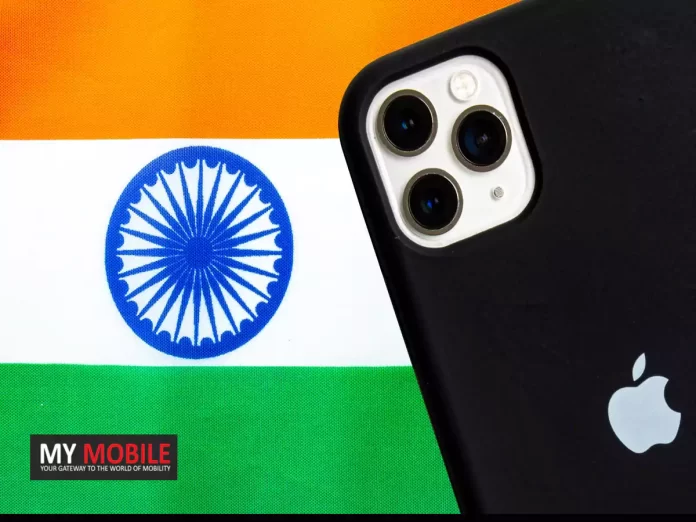
Apple’s Shift Towards India Gains Momentum as 1 in 7 iPhones Now “Made in India”

0
Apple's Shift Towards India Gains Momentum as 1 in 7 iPhones Now "Made in India"

Highlights

  • One in seven iPhones now assembled in India as Apple diversifies production.
  • COVID-19 disruptions in China accelerate Apple’s shift to other manufacturing bases.
  • Political tensions between the U.S. and China push Apple to reduce dependency.
  • Apple aims to produce up to half of all iPhones in India by 2027.

In a significant development, a recent report has revealed that one in every seven iPhones is now being assembled in India.

This milestone shows Apple’s accelerated drive towards supplier diversification and a more balanced global production footprint to reduce dependence on China.
Apple’s Fracturing Relationship with China

Apple's Shift Towards India Gains Momentum as 1 in 7 iPhones Now "Made in India"
Apple’s Shift Towards India Gains Momentum as 1 in 7 iPhones Now “Made in India”

For years, Apple has grappled with the risks associated with its heavy dependence on China for iPhone manufacturing.

The COVID-19 pandemic and the resultant disruptions at the world’s largest iPhone assembly plant served as a stark reminder of the vulnerabilities posed by this over-reliance.

Industry estimates suggest that the Cupertino company lost a staggering $1 billion per week due to these disruptions.

Moreover, escalating political tensions between the United States and China have further compounded Apple’s concerns.

Recent events have seen the Chinese government discouraging its citizens from purchasing iPhones, adding to the urgency for Apple to diversify its manufacturing base.

India Becoming an iPhone Manufacturing Hub

Apple aims to produce up to half of all iPhones in India by 2027

India has long been viewed as a prime candidate to become Apple’s secondary manufacturing hub, and the latest report from Bloomberg suggests that significant progress has been made towards this goal over the past year.

While ambitious targets of producing a quarter of all iPhones in India by 2025 and potentially half by 2027 have been floated, the recent developments indicate that Apple’s plans are solidifying at a rapid pace.

Initially, iPhone assembly in India was divided among three suppliers: Foxconn, Pegatron, and Wistron/Tata.

This tripartite arrangement helped mitigate the risks associated with over-reliance on a single supplier.

However, recent reports indicate that Pegatron and Tata are working more closely together, with Tata potentially taking over the operation of Pegatron’s sole iPhone plant in the country.

While the details of this joint venture are still unclear, it raises the possibility of Apple’s assembly roster in India being reduced from three companies to two.

In any case, with 1 in 7 iPhones now bearing the “Made in India” label, the company’s commitment to reducing its reliance on any single region is becoming increasingly evident.

FAQs

Why is Apple diversifying its iPhone manufacturing base to India?

Apple’s decision to diversify its iPhone manufacturing base to India is primarily driven by the need to reduce its dependency on China.

The COVID-19 pandemic highlighted the risks of concentrated production, and escalating U.S.-China political tensions have made diversification a strategic imperative for the Cupertino-based tech giant.
How significant is iPhone assembly in India currently?

A recent report has revealed that one in every seven iPhones is now being assembled in India.

This marks a significant milestone in Apple’s efforts to establish a more balanced and resilient global production footprint, showcasing India’s growing role as a key manufacturing hub for Apple.

What challenges has Apple faced with its reliance on Chinese manufacturing?

Apple’s heavy reliance on Chinese manufacturing has exposed the company to several challenges, including the major disruptions caused by the COVID-19 pandemic at the world’s largest iPhone assembly plant.

These disruptions resulted in substantial financial losses, estimated at $1 billion per week. Furthermore, political tensions between the U.S. and China have exacerbated concerns over this dependence.

What are Apple’s future plans for iPhone production in India?

Apple has set ambitious targets for its production in India, aiming to manufacture a quarter of all iPhones in the country by 2025 and potentially increasing this share to half by 2027.

These plans underscore India’s strategic importance to Apple as it seeks to diversify its manufacturing base and mitigate risks.

Also Read: iPhone Storage Mysteriously Showing Full? How to Fix the System Data Issue

Also Read: Apple iPhone Shipments in China Drop 24% Amid Huawei’s Resurgence

OpenAI Unleashes GPT-4 Turbo with Vision: A New Era of Multimodal AI Technology

0
OpenAI Unleashes GPT-4 Turbo with Vision: A New Era of Multimodal AI Technology

Highlights

  • GPT-4 Turbo with Vision combines text and visual inputs for advanced AI interactions.
  • Cost-effective AI with reduced pricing for input and output tokens.
  • Enhanced 128k context window supports extensive text processing.
  • Streamlined development with support for JSON mode and function calling.

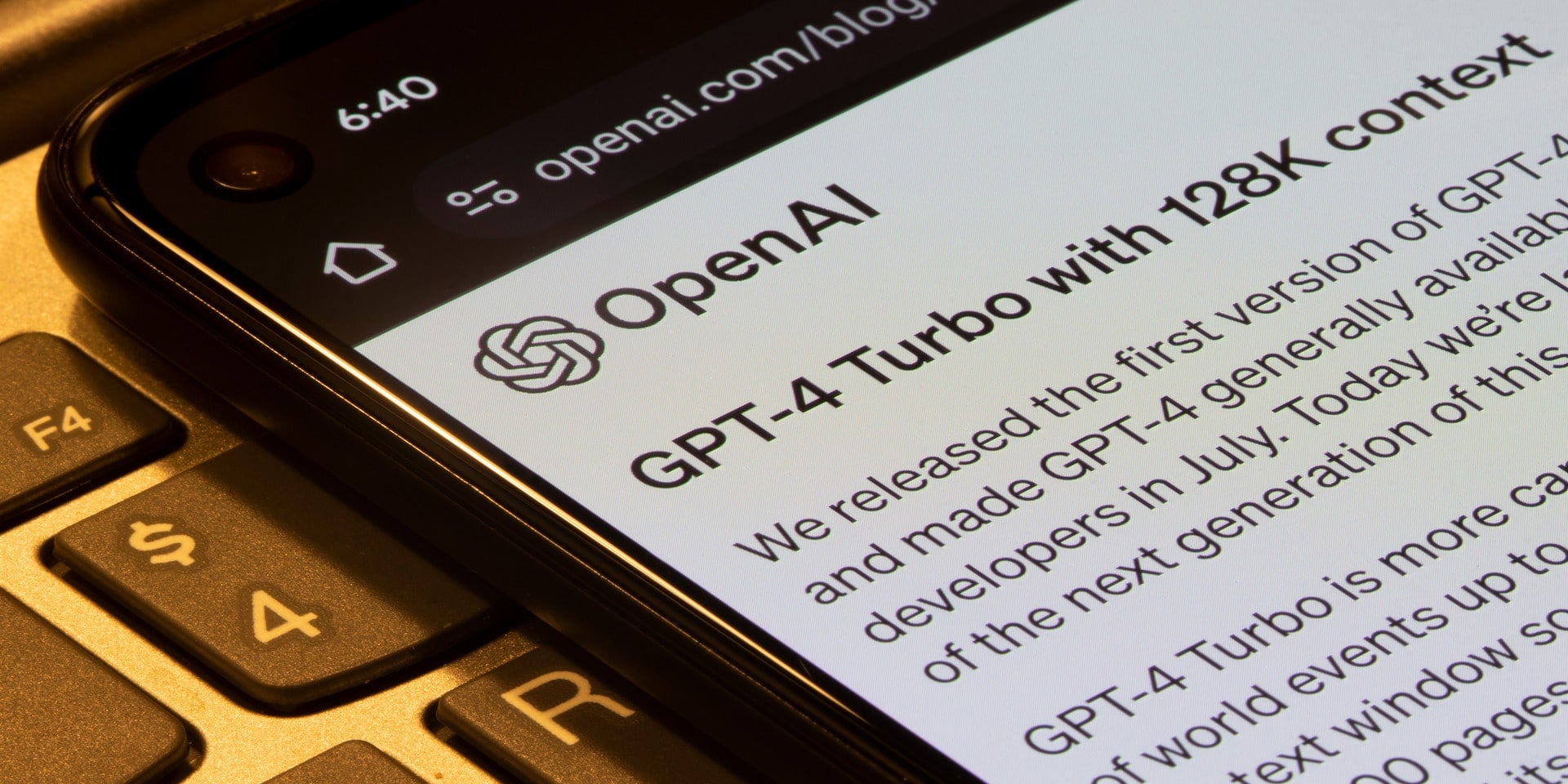
OpenAI has taken a major leap forward in the world of artificial intelligence with the launch of GPT-4 Turbo with Vision, now accessible through their API.

This upgraded model brings a host of powerful capabilities, including the ability to process both text and visual inputs seamlessly.

GPT- 4 Turbo: A Deep Dive

GPT-4 Turbo with Vision combines text and visual inputs for advanced AI interactions.

At its core, GPT-4 Turbo with Vision is a cutting-edge multimodal model that can understand and generate accurate outputs based on a combination of written text and image data.
Backed by an extensive knowledge base spanning a wide range of topics, this AI tool leverages advanced reasoning skills to deliver truly insightful responses.

One of the standout features of this new release is its support for JSON mode and function calling for Vision requests.

This added functionality allows for more streamlined and efficient interactions with the model, opening up new possibilities for developers and researchers alike.

But GPT-4 Turbo with Vision isn’t just about added featuresit’s also a significant performance upgrade over previous iterations.

Thanks to optimisations made by OpenAI, input tokens are now priced at a third of the cost, while output tokens are available at half the price of the earlier GPT-4 model.

This makes the new version not only more capable but also more cost-effective for users.

And the enhancements don’t stop there. GPT-4 Turbo with Vision boasts an impressive 128k context window, allowing it to process an enormous amount of text – over 300 pages – in a single prompt.

This means users can provide richer, more detailed inputs, enabling the model to generate more nuanced and contextually relevant outputs.

OpenAI Warns About Limitations

Enhanced 128k context window supports extensive text processing

While GPT-4 Turbo with Vision is undoubtedly a groundbreaking achievement, OpenAI has been transparent about its limitations.

The model may struggle with processing certain types of images, such as those that are upside-down or have fish-eye effects.

Additionally, it is not recommended for interpreting medical images like CT scans or X-ray reports.

OpenAI has also acknowledged that GPT-4 Turbo with Vision may not perform optimally with non-Latin languages, such as Korean or Japanese.

And for security reasons, the model has been specifically blocked from solving CAPTCHAs.

Despite these caveats, the potential applications of GPT-4 Turbo with Vision are vast.

From powering advanced visual analysis tools to enhancing chatbots and virtual assistants, this technology could revolutionise the way we interact with and leverage artificial intelligence.

FAQs

What is GPT-4 Turbo with Vision and how does it work?

GPT-4 Turbo with Vision is a state-of-the-art multimodal AI model developed by OpenAI that processes both textual and visual information to generate accurate responses.

It builds on the capabilities of GPT-4 by adding vision-based understanding, allowing it to interpret images alongside text, thereby facilitating a more holistic form of interaction with users and developers.

How is GPT-4 Turbo with Vision more cost-effective than its predecessors?

The new GPT-4 Turbo with Vision model introduces a significant cost reduction, charging only a third of the cost for input tokens and half the cost for output tokens compared to the previous GPT-4 model.

This makes it not only more advanced in terms of capabilities but also more accessible and affordable for a broader range of applications.

What new features does GPT-4 Turbo with Vision offer?

Beyond its multimodal capabilities, GPT-4 Turbo with Vision supports JSON mode and the ability to call functions within Vision requests.

This enhancement streamlines interactions with the AI, making it easier for developers to integrate and utilize its capabilities in their applications, thereby expanding the potential use cases for this advanced AI tool.

What are the limitations of GPT-4 Turbo with Vision?

Despite its advancements, GPT-4 Turbo with Vision has its limitations. It may face challenges in processing images with certain characteristics, such as being upside-down or having fish-eye effects, and is not suitable for interpreting medical images.

Moreover, the model has some constraints in handling non-Latin languages effectively and cannot solve CAPTCHAs for security reasons.

Also Read: ChatGPT 4 Can Now Identify and Describe Faces, Raising Concerns About AI’s Power

Also Read: Apple Developing ReALM AI System Claimed to be Better Than ChatGPT 4

Motorola Announces Global Launch Date for the Moto Edge 50 Series

0
Motorola Edge 50 Fusion Design Unveiled in Latest Leaked Video

Highlights

  • Motorola unveils Moto Edge 50 series globally on April 16th.
  • Edge 50 Pro in India starts at Rs 31,999 with advanced specifications.
  • Rumored features of Edge 50 Fusion and Ultra models promise innovation.
  • Edge 50 Pro sports a 6.7-inch display, Snapdragon 7 Gen 3, and a 50MP triple camera.

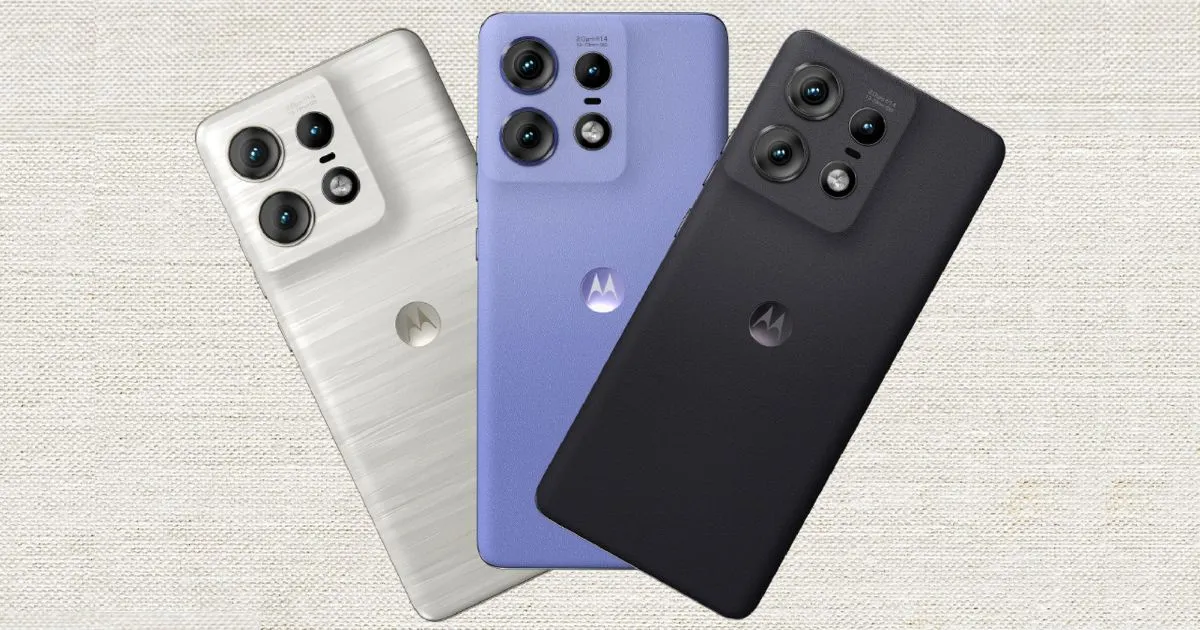
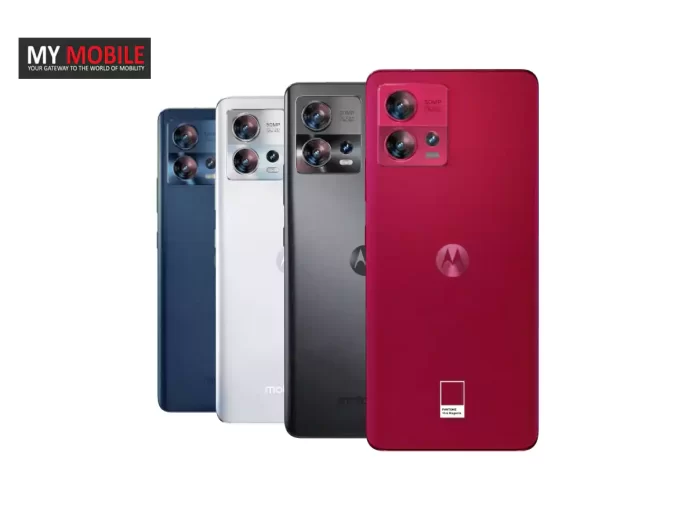
Just a week after unveiling the Moto Edge 50 Pro in India, Motorola announced it will globally launch its full Edge 50 lineup on April 16th.

The Edge 50 series is expected to comprise three models – the Edge 50 Fusion, Edge 50 Pro, and the flagship Edge 50 Ultra.

Moto Edge 50 Series: Pricing

Motorola Announces Global Launch Date for the Moto Edge 50 Series

In India, the 8GB/256GB base variant costs Rs 31,999 and includes a 68W charger.

The higher-end 12GB/256GB model with a 125W charger is priced at Rs 35,999.

Expect the Moto Edge 50 Fusion pricing to be slightly low while the Edge 50 Ultra is likely to be in the flagship territory.

Moto Edge 50 Series: Specs

Motorola unveils Moto Edge 50 series globally on April 16th

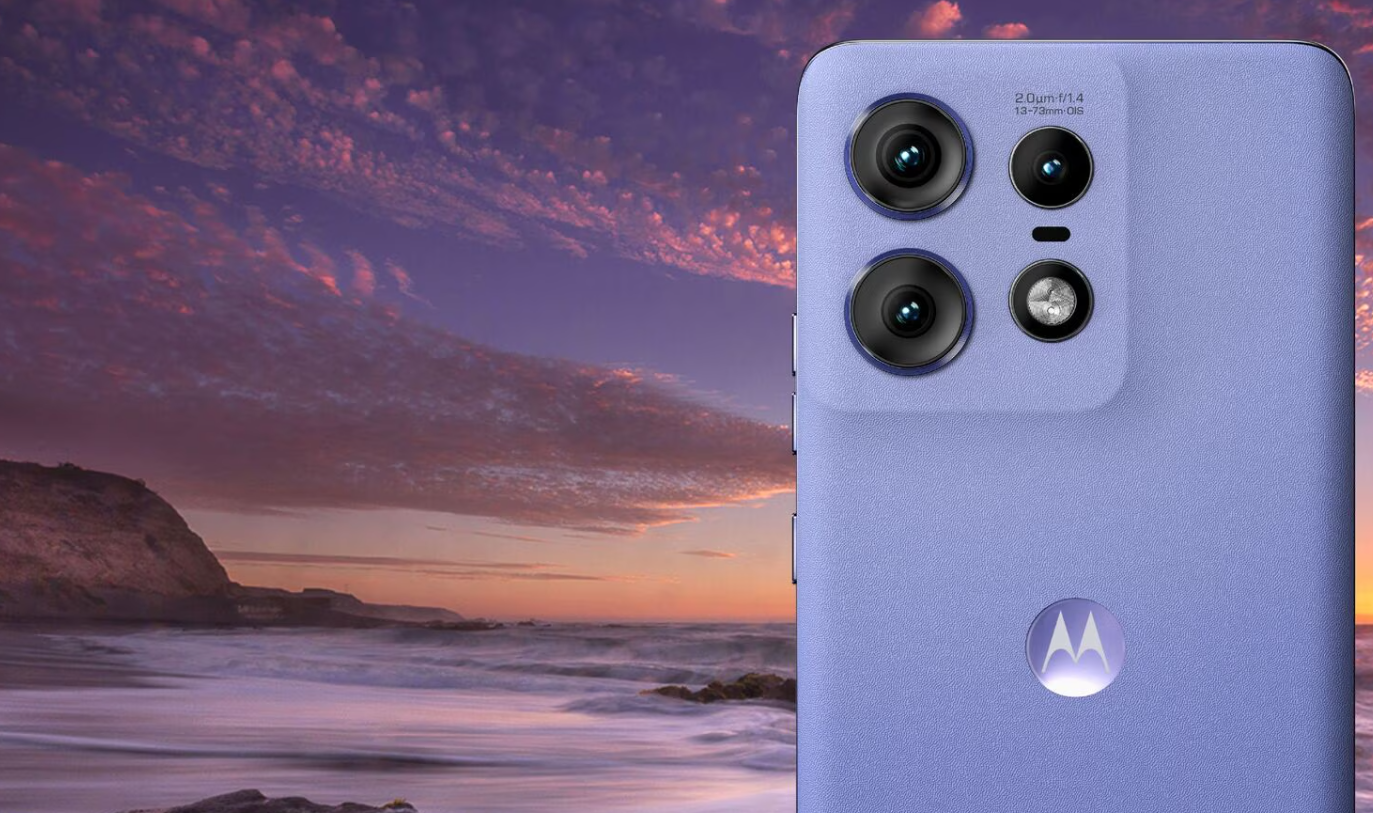
The Edge 50 Pro, already released in India, is a smartphone powerhouse.

It features a stunning 6.7-inch curved pOLED display with a silky smooth 144Hz refresh rate and an impressive peak brightness of 2,000 nits.

Under the hood, it packs the latest and greatest Qualcomm Snapdragon 7 Gen 3 chipset coupled with up to a hefty 12GB of LPDDR5X RAM and 256GB of blazing-fast UFS 3.1 storage.

In the camera department, the Edge 50 Pro means business with its triple camera array.

The setup includes a 50MP main shooter with optical image stabilization (OIS) for shake-free photos and videos, a 10MP telephoto lens for lossless zoom, and a 13MP ultra-wide camera to capture wider scenes.

Selfie lovers are covered too with a high-resolution 32MP front-facing camera.

Keeping this multimedia beast running all day is a large 4,500mAh battery that supports insanely fast 125W TurboPower wired charging and 50W wireless charging.

Edge 50 Pro sports a 6.7-inch display, Snapdragon 7 Gen 3, and a 50MP triple camera

The Edge 50 Pro runs a clean build of Android 14 out of the box with Motorola’s lightweight Hello UI on top.

While details are limited, rumors suggest the Fusion model will have a 6.7-inch curved pOLED screen, Snapdragon 6 Gen 1 chip, 50MP OIS main camera, 13MP ultra-wide, 32MP selfie cam, 5,000mAh battery with 68W charging and IP68 dust/water resistance.

As for the premium Edge 50 Ultra, it could feature a 6.7-inch 144Hz OLED panel, the top-tier Snapdragon 7 Gen 3 SoC, a triple 50MP+10MP+13MP camera array, and a 4,500mAh cell with support for crazy 125W wired and 50W wireless charging speeds.

Motorola is pulling no punches with its 2023 Edge lineup, packing the latest hardware and innovative features into sleek, flagship-grade designs.

All will be revealed when the full Moto Edge 50 series goes official for global markets on April 16th.

Motorola Edge 50 Specs

GENERAL

Sim Type Dual Sim, GSM+GSM
Dual Sim Yes
Sim Size Nano SIM
Device Type Smartphone
Release Date April 04, 2024 (Expected)

DESIGN

Dimensions 161.2 x 74 x 8.6 mm (6.35 x 2.91 x 0.34 in)
Bezel less Yes
Colors Interstellar Black, Lunar Blue

DISPLAY

Type Color OLED Screen (1B Colors)
Touch Yes, 480 Hz Touch Sampling Rate
Size 6.72 inches, 1080 x 2400 pixels, 165 Hz
Aspect Ratio 20.5:9
PPI ~ 392 PPI
Screen to Body Ratio ~ 90.5%
Glass Type Corning Gorilla Glass Victus Plus
Features Dolby Vision, DCI-P3 colour space, Peak Brightness: 1300 nits, Curved Display
Notch Yes, Punch Hole

MEMORY

RAM 12 GB
Storage 256 GB
Storage Type UFS 4.0
Card Slot No

CONNECTIVITY

GPRS Yes
EDGE Yes
3G Yes
4G Yes
5G Yes
5G Bands 1, 2, 3, 5, 7, 8, 20, 28, 38, 40, 41, 66, 77, 78 SA/NSA/Sub6
VoLTE Yes, Dual Stand-By
Vo5G Yes
Wifi Yes, with wifi-hotspot
Wifi Version Wi-Fi 802.11 a/b/g/n/ac/ax
Bluetooth Yes, v5.3, A2DP, LE
USB Yes, USB-C v3.2
USB Features USB on-the-go, USB Charging

EXTRA

GPS GPS, A-GPS, LTEPP, SUPL, GLONASS, GALILEO
Fingerprint Sensor Yes, In Display
Face Unlock Yes
Sensors Accelerometer, Gyro, Proximity, Compass
3.5mm Headphone Jack No
NFC Yes
Water Resistance Yes, 1.5 m upto 30 min, Water-repellent Design
IP Rating IP68
Dust Resistant Yes

CAMERA

Rear Camera 200 MP 1/1.55″, 1.0µm, multi-directional PDAF, OIS f/1.8 (Wide Angle)
50 MP 114˚, 1/2.76″, 0.64µm, AF f/2.2 (Ultra Wide)
12 MP 1/2.93″, 1.22µm, PDAF, 2x optical zoom f/1.6 (Telephoto) with autofocus
Features panorama, HDR
Video Recording 4K @ 30 fps UHD, 1080p @ 30 fps FHD
Flash Yes, Dual LED
Front Camera Punch Hole 60 MP 1/2.8″, 0.61µm f/2.2 (Wide Angle)
Front Video Recording 4K @ 30 fps UHD, 1080p @ 30 fps FHD
TECHNICAL
OS Android v14
Chipset Qualcomm Snapdragon 8 Gen3
CPU Octa Core Processor
GPU Adreno GPU
Java No
Browser Yes

MULTIMEDIA

Email Yes
Music Yes
Video Yes
FM Radio No
Document Reader Yes

BATTERY

Type Non-Removable Battery
Size 4600 mAh, Li-Po Battery
Fast Charging Yes, 150W Fast Charging
Wireless Charging Yes, 50W
Reverse Charging Yes, 5W
Talk Time 32 hours

FAQs

What models are included in the Moto Edge 50 series launch?

The Moto Edge 50 series is anticipated to include three models: the Edge 50 Fusion, Edge 50 Pro, and the flagship Edge 50 Ultra.

The series aims to cater to a wide range of consumers with different needs and budgets, promising innovative features across all devices.

What are the pricing details of the Moto Edge 50 series in India?

For the Indian market, the Moto Edge 50 Pro is available in two variants: an 8GB/256GB model priced at Rs 31,999 and a higher-end 12GB/256GB model at Rs 35,999.

Prices for the Edge 50 Fusion and Edge 50 Ultra have not been officially released but are expected to vary, with the Fusion model being more affordable and the Ultra model targeting the flagship segment.

Can you detail the specifications of the Moto Edge 50 Pro?

The Moto Edge 50 Pro boasts a 6.7-inch curved pOLED display with a 144Hz refresh rate and 2,000 nits peak brightness.

It’s powered by a Qualcomm Snapdragon 7 Gen 3 chipset, up to 12GB LPDDR5X RAM, and 256GB UFS 3.1 storage.

The device features a 50MP main camera with OIS, a 10MP telephoto, a 13MP ultra-wide lens, and a 32MP front camera.

It includes a 4,500mAh battery with 125W wired and 50W wireless charging, running Android 14.

What rumored features does the Moto Edge 50 Fusion offer?

The Edge 50 Fusion is rumored to feature a 6.7-inch curved pOLED screen, a Snapdragon 6 Gen 1 chipset, a 50MP OIS main camera, a 13MP ultra-wide camera, a 32MP selfie camera, a 5,000mAh battery with 68W charging, and IP68 dust and water resistance.

These specs indicate the Fusion model will offer high-end performance with some compromises for a more affordable price.

Also Read: Motorola’s New TVC Brings Alive ‘Intelligence Meets Art’ Starring Brand Ambassador Kriti Sanon and Introducing Babil Khan as Moto AI Ally for the Launch of Motorola Edge50 Pro

Also Read: Motorola Announces New Delhi Event for April 3, Edge 50 Pro Expected

Also Read: Moto Edge 50 Pro Launched in India With Snapdragon 7 Gen 3: Pricing, Features, Specs