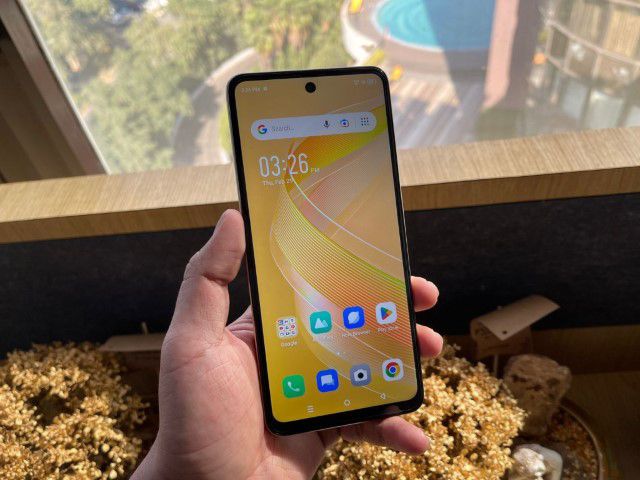
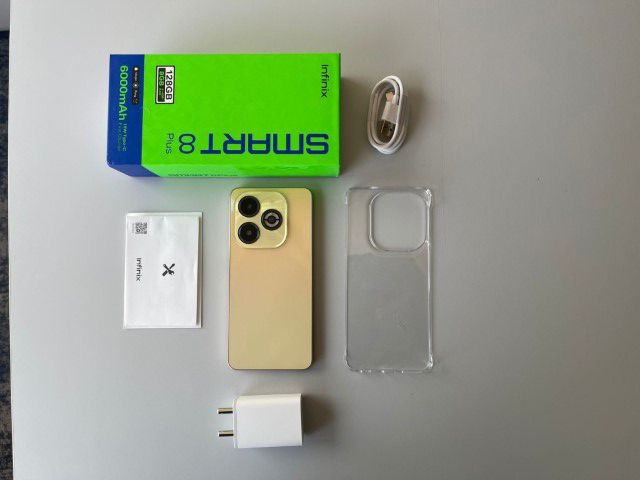
* Launched at Rs 6,999, the Infinix Smart 8 Plus offers exceptional value for budget buyers. * Boasts a robust 6000mAh battery for extended use. * Features a 50MP Dual AI Camera setup for quality photography. * Supports a 90Hz refresh rate on a 6.6-inch HD+ display for smooth visuals. * The Infinix Smart 8 Plus will be available for purchase for the first time today in the country. * The Infinix Smart 8 Plus is a budget segment offering that is powered by a MediaTek Helio G36 processor.
Infinix, a brand known for its value-driven approach, has been particularly active in this segment.
Earlier this year, the Infinix Smart 8 made its debut, and now, hot on its heels, comes the Infinix Smart 8 Plus.
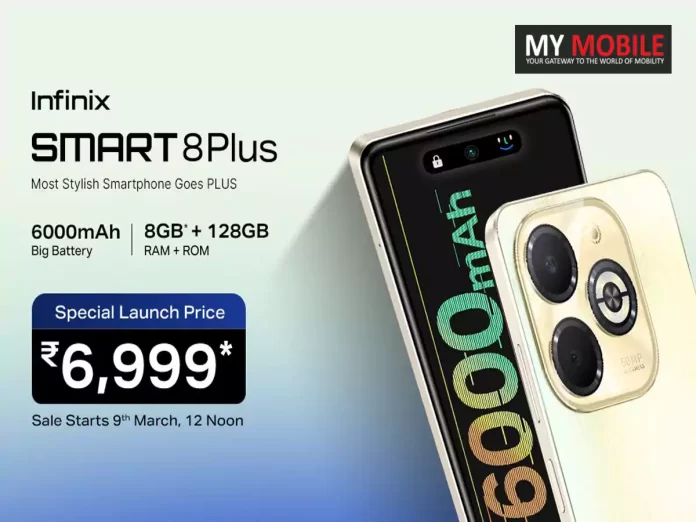
Priced at a competitive Rs 6,999, inclusive of bank offers, the Smart 8 Plus is positioned as a compelling choice for budget-conscious buyers.
Infinix, the trailblazing technology brand renowned for its innovative mobile devices, is thrilled to announce the availability of the Infinix Smart 8 Plus smartphone.
Featuring a massive 6000mAh battery with 18W Type C Fast Charging, the Smart 8 Plus is available on Flipkart at INR 6,999* starting today .
Set to redefine the smartphone experience, combining style, innovation, and performance in a single, affordable package, the Smart 8 Plus is a device that not only stands out for its elegance but also delivers top-notch features for capturing life’s moments and staying connected in style.
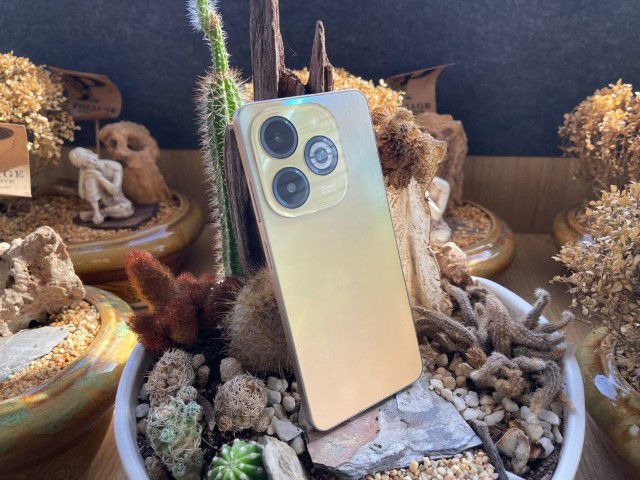
Designed with precision and durability in mind, the Smart 8 Plus boasts an elegant timber texture finish, making it a statement of sophistication.
The Infinix Smart 8 Plus is a budget segment offering that is powered by a MediaTek Helio G36 processor
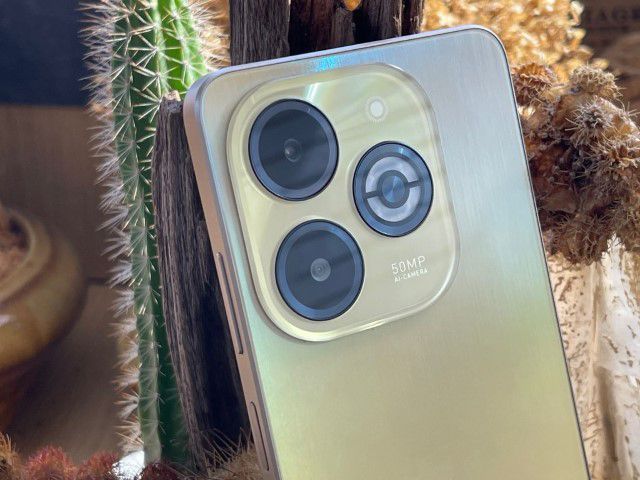
A powerhouse of imaging capabilities, the device comes equipped with a remarkable 50 MP Dual AI Camera and Quad LED ring flash, every photo becomes a masterpiece.
The 8 MP front camera guarantees stunning selfies, capturing your best moments with unparalleled clarity and detail. Immerse yourself in a world of vibrant visuals on the Smart 8 Plus’s mesmerizing 90Hz Punch-Hole display.
The innovative Magic Ring atop the screen provides quick access to essential information, keeping you connected and informed at a glance.
Security is a top priority in the digital age, and the Smart 8 Plus ensures your data is safe with a side-mounted fingerprint scanner and facial recognition technology.
The Infinix Smart 8 Plus will be available for purchase for the first time today in the country
With 128 GB of internal storage and up to 2TB Micro SD support, the Smart 8 Plus offers boundless space for all your photos, videos, and apps.
DTS Sound Processing ensures an immersive audio experience at your fingertips.
Running on the latest Android 13 Go (XOS 13), the Smart 8 Plus provides a seamless and intuitive user experience, redefining smartphone excellence with its blend of innovative features, premium design, and unmatched performance.
Infinix Smart 8 Plus: Key Specs
Infinix Smart 8 Plus: Key Specs
* Processor: MediaTek Helio G36, a combination of 2.2 GHz and 1.8 GHz quad-core setups. * RAM: Up to 4GB, expandable to 8GB via virtual swap. * Storage: 128GB onboard, expandable. * Display: 6.6-inch HD+ with a 90Hz refresh rate. * Camera: 50MP Dual AI Camera, 8MP selfie camera with front flash. * Battery: 6000mAh with 18W charging. * Software: XOS skin atop Android 13 Go, minimal bloatware.
Infinix Smart 8 Plus: Price in India, Launch Offers, and Availability
Infinix Smart 8 Plus: Price in India, Launch Offers, and Availability
The Infinix Smart 8 Plus price in India is Rs 7,799. The smartphone will be up for grabs starting at 12:00 PM, today exclusively via Flipkart.
In today’s sale, the Infinix Smart 8 Plus will be available at an introductory price of Rs 6,999, including a flat Rs 800 discount via SBI, HDFC, ICICI Credit and Debit Card transactions. Infinix is also offering extra Rs 1,000 off on exchange.
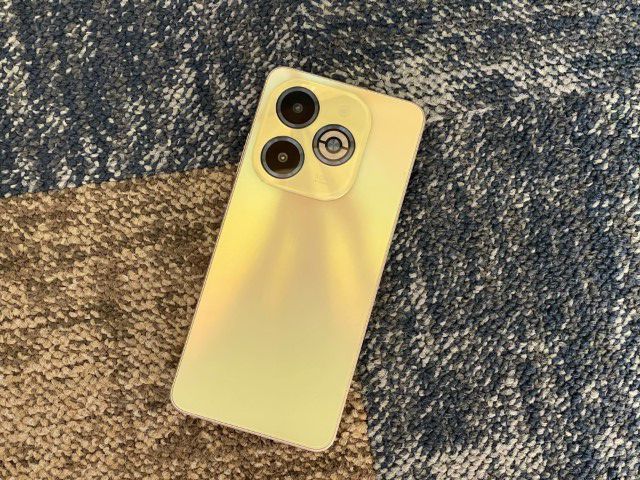
Its standout timber texture finish across three vibrant color variants – Galaxy White, Timber Black, and Shiny Gold – adds a touch of elegance and distinctiveness.
Photography is a delight with the Smart 8 Plus, thanks to its 50MP Dual AI rear camera equipped with a Quad-LED ring flash for capturing detailed and vibrant images under any lighting conditions.
The 8MP front camera ensures selfies that are decent for the price.
Visuals come alive on the 6.6-inch HD+ display that boasts a 90Hz refresh rate, making every scroll and swipe smoother than ever.
Coupled with DTS Sound Processing, users are treated to an immersive audio-visual experience.
Under the hood, the MediaTek Helio G36 Octa-Core Processor ensures the phone runs smoothly, whether you’re multitasking or gaming.
The massive 6000mAh battery, supported by 18W fast charging, guarantees that the phone keeps up with your busy lifestyle.
The Smart 8 Plus also emphasizes security with its quick and reliable side-mounted fingerprint and facial recognition features.
5 Reasons to Buy the Infinix Smart 8 Plus
5 Reasons to Buy the Infinix Smart 8 Plus
* Long-lasting Battery Life Complemented by Fast Charging Capabilities: The Infinix Smart 8 Plus is powered by a robust 6000mAh battery, ensuring that your phone stays active throughout the day, even with heavy usage. * Camera for Photography Enthusiasts: With its 50MP Dual AI rear camera setup and Quad LED ring flash, the Smart 8 Plus is for those who love capturing life’s moments. * High-refresh-rate Display: The device boasts a 6.6-inch HD+ display with a 90Hz refresh rate, ensuring that every interaction feels smoother and more responsive. * Generous Storage Capacity with Expandable RAM: Comes with 128GB of internal storage and the option to expand the RAM from 4GB to 8GB using Virtual RAM technology * Elegant Design with a Unique Finish: The Smart 8 Plus doesn’t just perform well; it looks great too. Available in three colours – Galaxy White, Timber Black, and Shiny Gold – and featuring a sophisticated timber texture finish.
Infinix Smart 8 Plus -Should you buy ?
Infinix Smart 8 Plus -Should you buy ?
After spending considerable time with the Infinix Smart 8 Plus, and diving deep into its design, camera capabilities, performance, and software, it’s time to sum up my experience.
Positioned aggressively in the fiercely competitive sub-Rs 10,000 smartphone market in India, the Smart 8 Plus comes forth as a proper entry-level contender.
It brings to the table a well-rounded package that hits many of the right notes for an entry-level smartphone.
Performance and photography are not its strong suit but given its very minimal hit on your wallet, I feel that it is a sacrifice worth living by.
Whether it’s your entry-level smartphone of choice will depend on your priorities, but it’s certainly worth considering.
Infinix Smart 8 Plus Specs
GENERAL
Sim Type
Dual Sim, GSM+GSM
Dual Sim
Yes
Sim Size
Nano+Nano SIM
Device Type
Smartphone
Release Date
January 30, 2024
DESIGN
Dimensions
75.7 x 163.7 x 9 mm
Weight
204 g
Bezel less
No
Colors
Galaxy White, Shiny Gold, Timber Black
DISPLAY
Type
Color IPS Screen (16M Colors)
Touch
Yes
Size
6.6 inches, 720 x 1612 pixels, 90 Hz
Aspect Ratio
20:9
PPI
~ 267 PPI
Screen to Body Ratio
~ 84.4%
Features
500nits Brightness
Notch
Yes, Punch Hole
MEMORY
RAM
4 GB
Storage
64 GB
Card Slot
Yes
CONNECTIVITY
GPRS
Yes
EDGE
Yes
3G
Yes
4G
Yes
VoLTE
Yes
Wifi
Yes, with wifi-hotspot
Bluetooth
Yes, v5.0
USB
Yes, USB-C v2.0
USB Features
USB Charging
EXTRA
GPS
Yes
Fingerprint Sensor
Yes, Side
Face Unlock
Yes
Sensors
Accelerometer, Proximity, Compass
3.5mm Headphone Jack
Yes
CAMERA
Rear Camera
50 MP f/1.9 (Wide Angle)
0.08 MP with autofocus
Features
Ring- HDR, panorama
Video Recording
1080p @ 30 fps FHD
Flash
Yes, LED
Front Camera
Punch Hole 8 MP f/2 (Wide Angle)
TECHNICAL
OS
Android v13
Custom UI
XOS 13
Chipset
Mediatek Helio G36
CPU
2.2 GHz, Octa Core Processor
Core Details
4x Cortex-A53@2.2 GHz & 4x Cortex-A53@1.7 GHz
GPU
PowerVR GE8320
Java
No
Browser
Yes
MULTIMEDIA
Email
Yes
Music
Yes
Video
Yes
FM Radio
Yes
Document Reader
Yes
BATTERY
Type
Non-Removable Battery
Size
6000 mAh, Li-Po Battery
Fast Charging
Yes, 18W
FAQs
What is the price of the Infinix Smart 8 Plus, and when is it available?
The Infinix Smart 8 Plus is priced at Rs 6,999 and will be available for purchase starting 9th March 2024, exclusively on Flipkart.
What are the key specifications of the Infinix Smart 8 Plus?
The key specs include a 6.6-inch HD+ display, MediaTek Helio G36 Octa-Core Processor, 50MP Dual AI rear camera, 8MP front camera, and a 6000mAh battery with 18W fast charging.
Can the Infinix Smart 8 Plus’s RAM and storage be expanded?
Yes, the Infinix Smart 8 Plus comes with 4GB of RAM, expandable to 8GB with Virtual RAM, and 128GB of internal storage, expandable up to 2TB.
What makes the Infinix Smart 8 Plus stand out in the smartphone market?
Its standout features include a timber texture finish in three colors, high-quality photography capabilities, a smooth display with a 90Hz refresh rate, and a powerful battery, all at an affordable price point.
How does the Infinix Smart 8 Plus enhance the user’s multimedia experience?
The device enhances multimedia experiences with its HD+ display, DTS Sound Processing for immersive audio, and a high-performance camera setup for superior photography and videography.
Infinix Smart 8 Plus launches at 6,999*, features 6000 mAh battery. Details?
• Priced at INR 6,999, the latest smartphone by Infinix features an elegant and sophisticated timbre texture
• The new Smart 8 Plus includes a 50 MP Dual AI Camera with Quad LED ring flash and an 8 MP front camera with LED flash
• Long life with a 6000mAh battery with 18W Type-C fast charging port
• Features 128GB internal storage and up to 8GB of RAM (4 GB +4GB Virtual RAM)
• Immersive visuals and rich sound with a 90Hz Punch-Hole Display and DTS Sound Processing
• Fast and secure with side fingerprint and face unlock, powered by the advanced MediaTek Helio G36 Octa Core Processor
• Runs on the latest Android 13 Go
• The smartphone will be available on sale from 9th March 2024on Flipkart
Infinix, today announced the launch of its latest masterpiece, the Smart 8 Plus. Featuring a massive 6000mAh battery with 18W Type C Fast Charging, the Smart 8 Plus stands as a powerhouse in the smartphone domain.
Priced at INR 6,999*, the latest smartphone by Infinix offers a plethora of features that combine style, innovation, and performance.
Is Infinix Smart 8 Plus Aesthetically Pleasing ?
Embodying elegance and sophistication, the Smart 8 Plus boasts a premium design featuring a timber texture finish, setting it apart as an attractive option that is both aesthetic and modern in the smartphone market.
The Smart 8 Plus will be available in 3 colour variants- Galaxy White, Timber Black and Shiny Gold.
Does Infinix Smart 8 Plus unleash Your Creativity with Superior Imaging?
Capture life’s moments with breathtaking clarity and detail using the Smart 8 Plus’s 50 MP Dual AI Camera, complemented by a Quad-LED ring flash for professional-grade photography in any lighting condition.
For stunning selfies, the 8 MP front camera with LED flash ensures users always look their best.
Does Infinix Smart 8 Plus have mesmerising Display & Immersive Experience?
Users enjoy an immersive experience in a world of vibrant visuals with the Smart 8 Plus’s smooth and hypnotic 90Hz Punch-Hole display.
The innovative Magic Ring atop the screen adds a touch of magic, displaying essential information like battery percentage, charging status, and in-call time, ensuring you stay connected and informed at all times.
Does Infinix Smart 8 Plus give secure, Seamless Performance ?
The Smart 8 Plus’s side-mounted fingerprint scanner and facial recognition technology ensure the highest level of safety and security for users’ data.
Powered by the MediaTek Helio G36 2.2 Ghz Octa Core Processor, the Smart 8 Plus delivers lightning-fast performance and seamless multitasking capabilities.
Does Infinix Smart 8 Plus have Massive Storage & Immersive Sound?
With 128 GB of internal storage, up to 8 GB RAM via MemFusion technology and support for up to 2TB Micro SD, the Smart 8 Plus ensures boundless space for your photos, videos, and apps.
Delve deep into an unparalleled audio experience with DTS Sound Processing, delivering rich and immersive sound quality.
Can I Experience the Future of Smartphones through Infinix Smart 8 Plus?
The Smart 8 Plus runs on Android 13 Go (XOS 13), offering a seamless and intuitive user experience.
With its blend of innovative features, premium design, and unmatched performance, the Smart 8 Plus redefines smartphone excellence and stands as a prime example of Infinix’s commitment to delivering cutting-edge technology to its customers.
inclusive bank offers
What makes the Infinix Smart 8 Plus stand out in the budget smartphone segment?
The Infinix Smart 8 Plus distinguishes itself with its affordable pricing, powerful battery, and high-resolution camera, making it a compelling choice for value-conscious consumers.
How does the camera performance of the Infinix Smart 8 Plus compare to other budget smartphones?
With a 50MP Dual AI Camera, the Infinix Smart 8 Plus aims to deliver superior photography capabilities, offering crisp, vibrant photos that stand out among budget smartphones.
What battery life can users expect from the Infinix Smart 8 Plus?
Users can enjoy extended battery life thanks to the 6000mAh battery, ensuring that the device can easily last through a day of heavy use without needing a recharge.
Is the Infinix Smart 8 Plus suitable for gaming and multimedia consumption?
Yes, the MediaTek Helio G36 processor, coupled with a 90Hz display, makes the Infinix Smart 8 Plus a solid choice for casual gaming and smooth video playback.
How does the Infinix Smart 8 Plus enhance the user experience with its software?
Running on Android 13 Go with XOS skin, the Infinix Smart 8 Plus offers a clean, bloatware-minimized interface, enhancing usability and ensuring a fluid user experience.
The first few iterations of the Moto Razr were perhaps not appreciated fully, due to a variety of reasons, with the biggest being the lack of a proper usable cover screen.
However, with the Razr 40 Ultra, Moto has made the device’s standout feature the expansive and functional cover screen.
Even a full year into its launch the Razr 40 Ultra is redefining the flip phone experience.
I had a chance to explore the folding handset and here are my first impressions of the Moto Razr 40 Ultra.
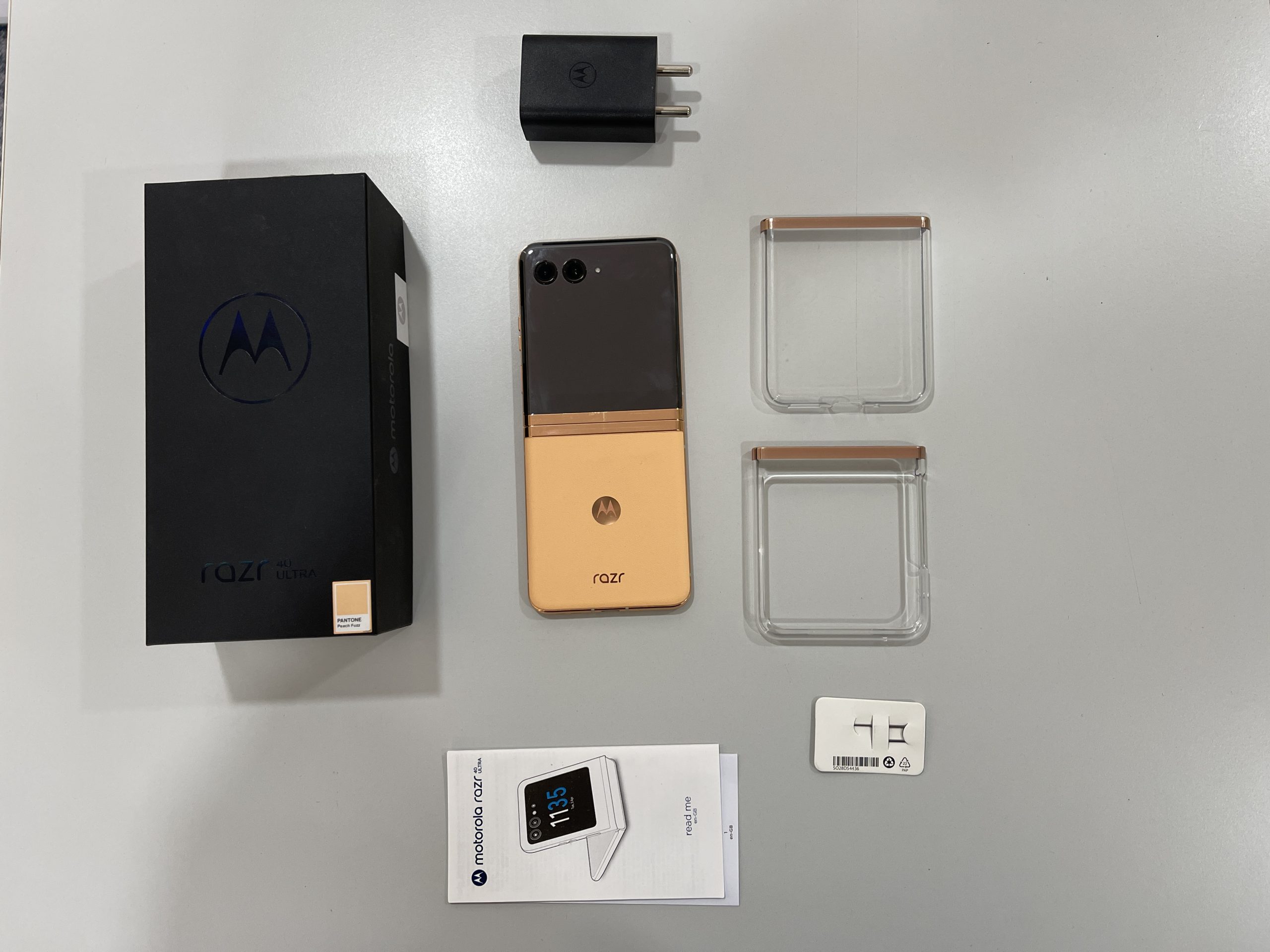
The packaging includes a charger, a quick start guide, and a USB Type-C cable.
Also shout-out to the rather eco-friendly packaging on the device which contributes to lower plastic waste.
Moto Razr 40 Ultra: Unboxing Video
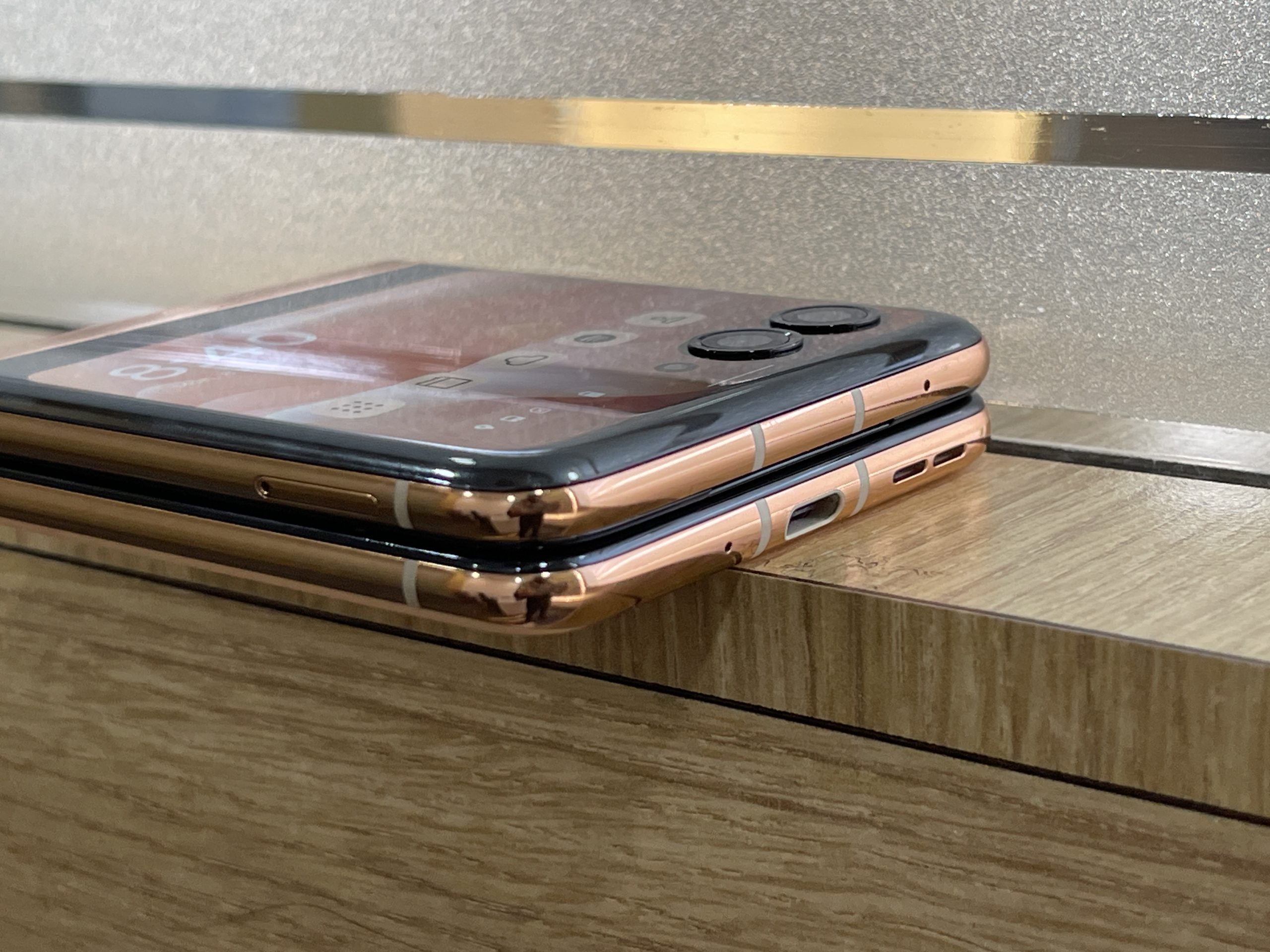
Moto Razr 40 Ultra: Design and Display
Moto Razr 40 Ultra: Design
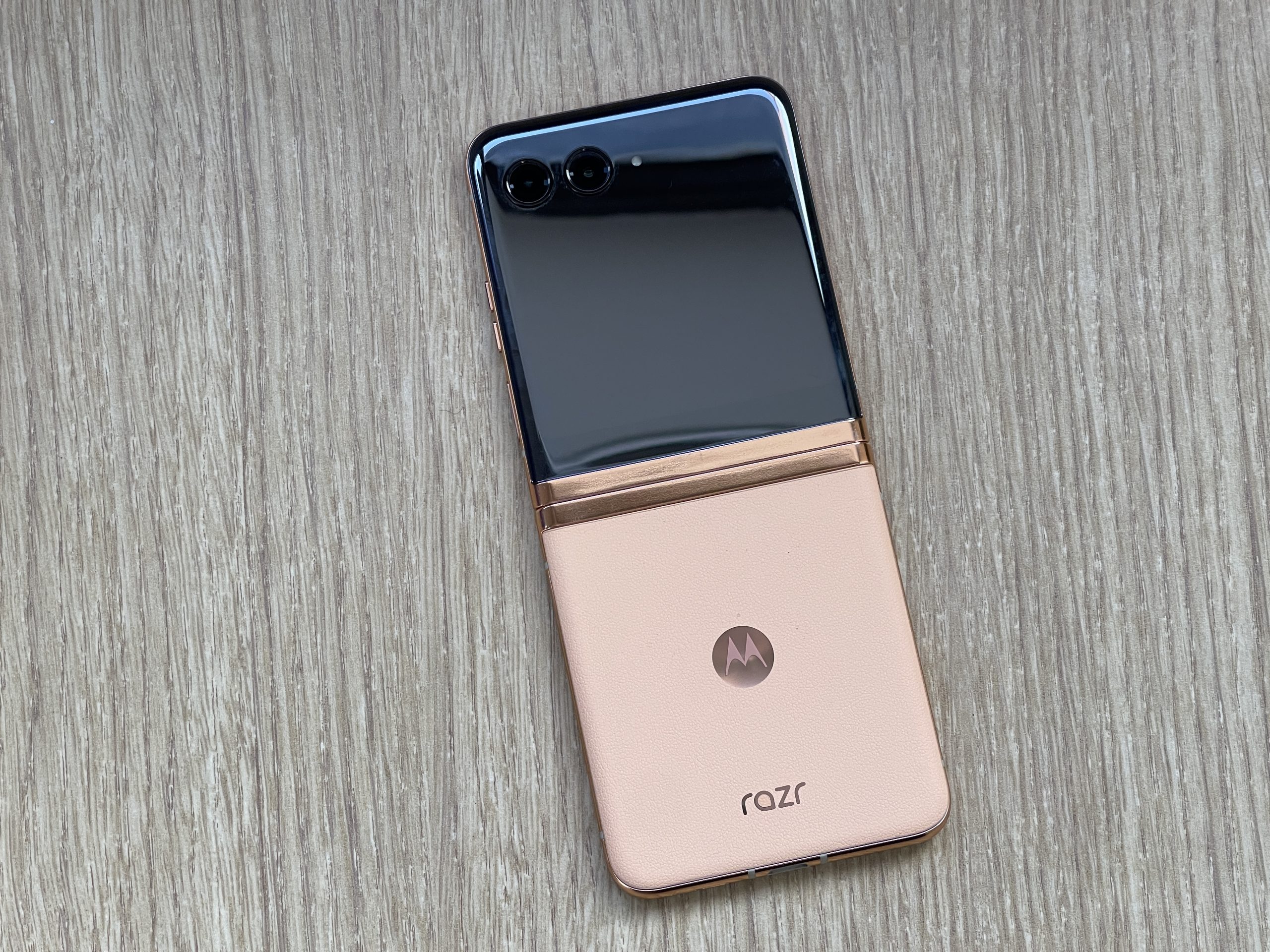
I really like how the Razr 40 Ultra looks and feels.
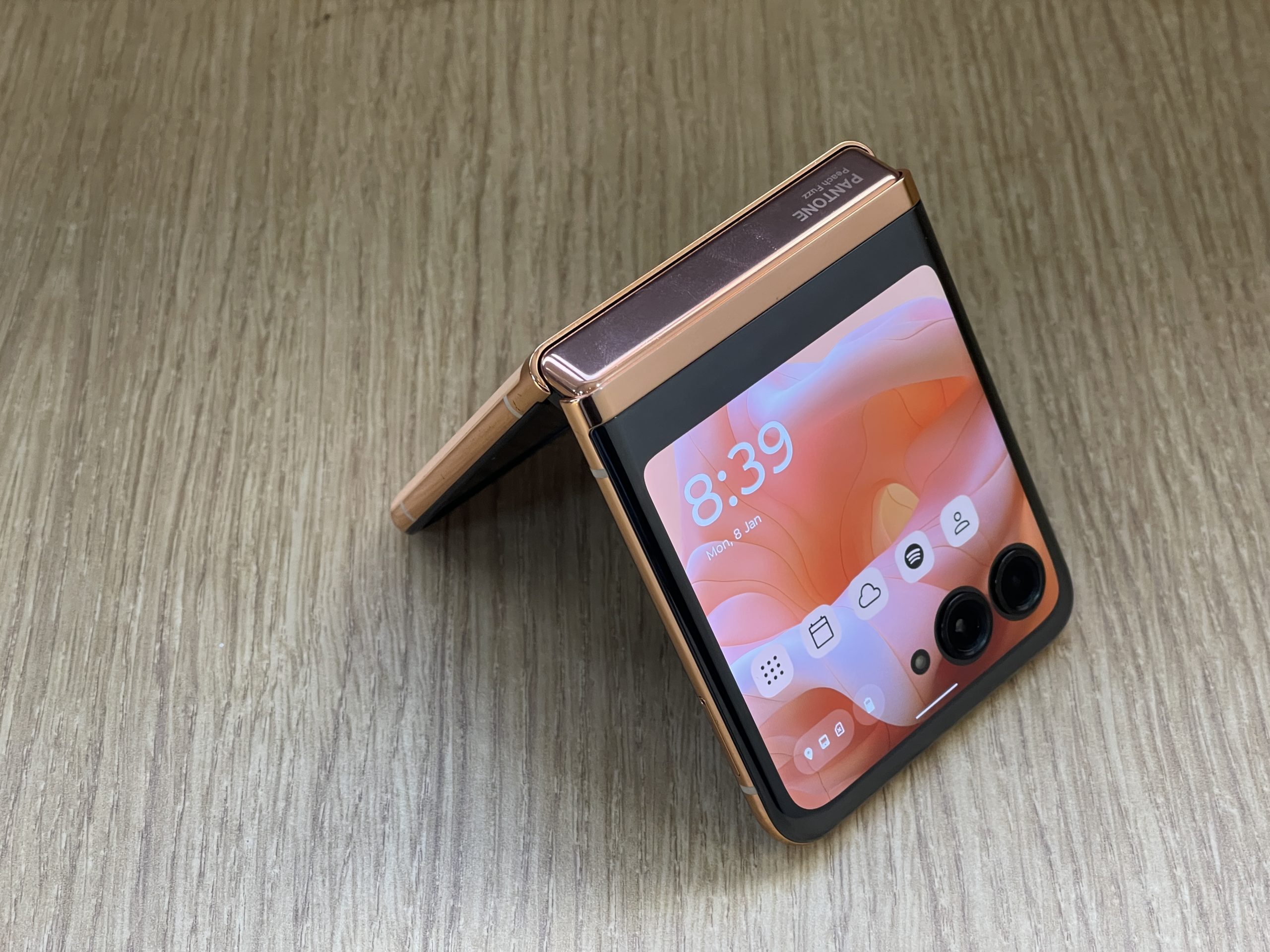
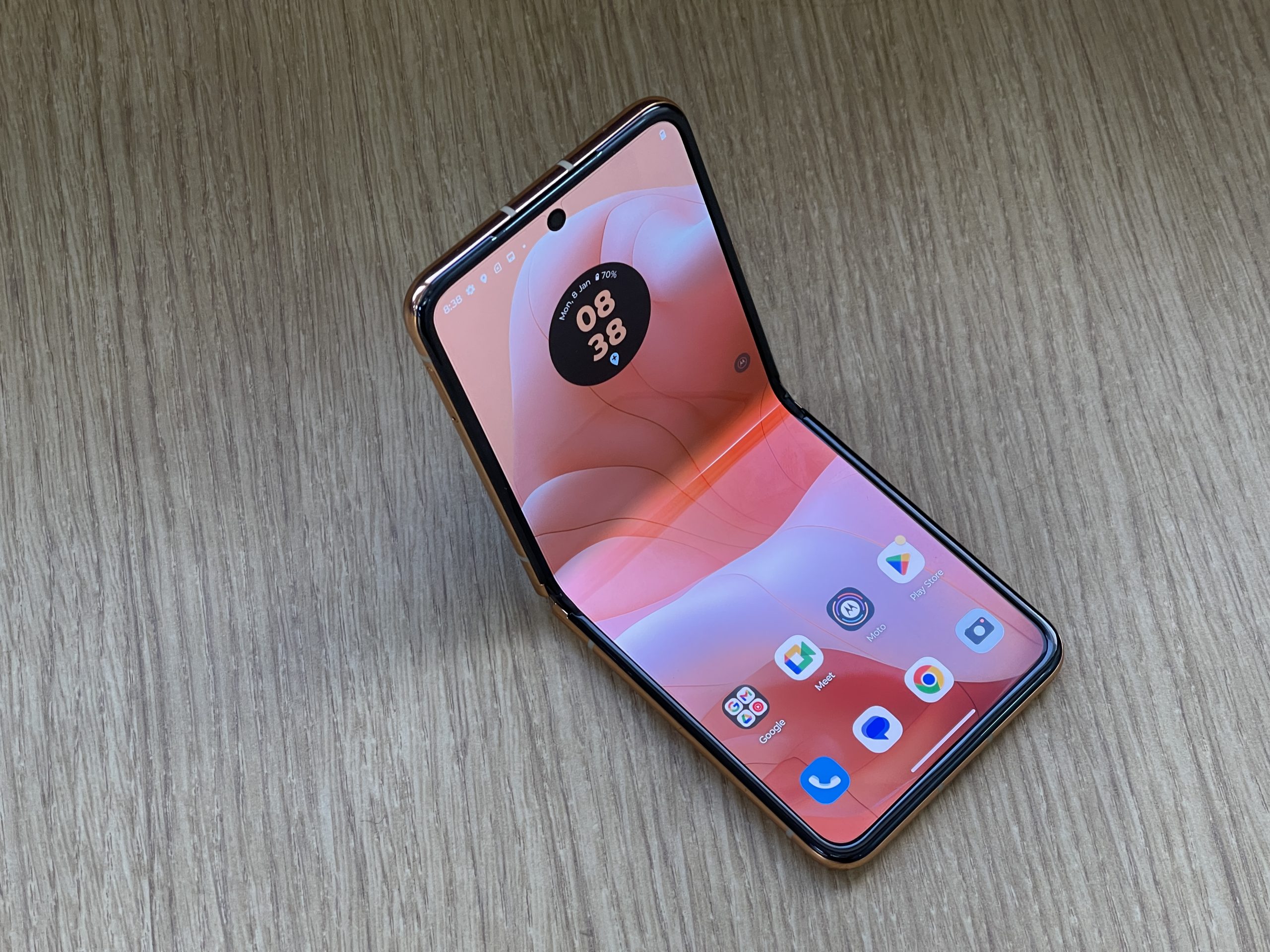
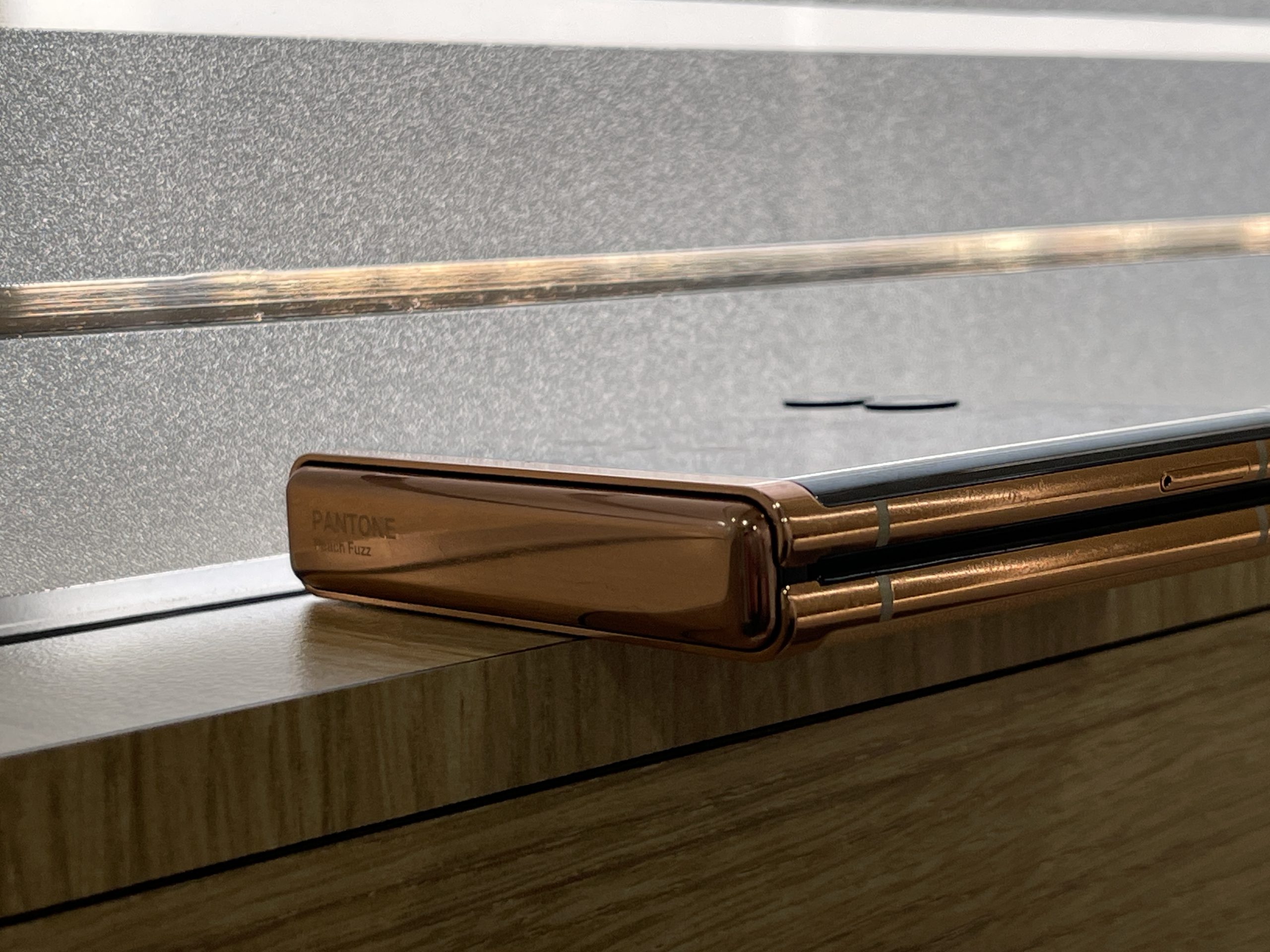
The way its hinge works to make the phone almost flat when folded is pretty cool.
It gives the phone a very sleek appearance and also protects the inside screen from dust.
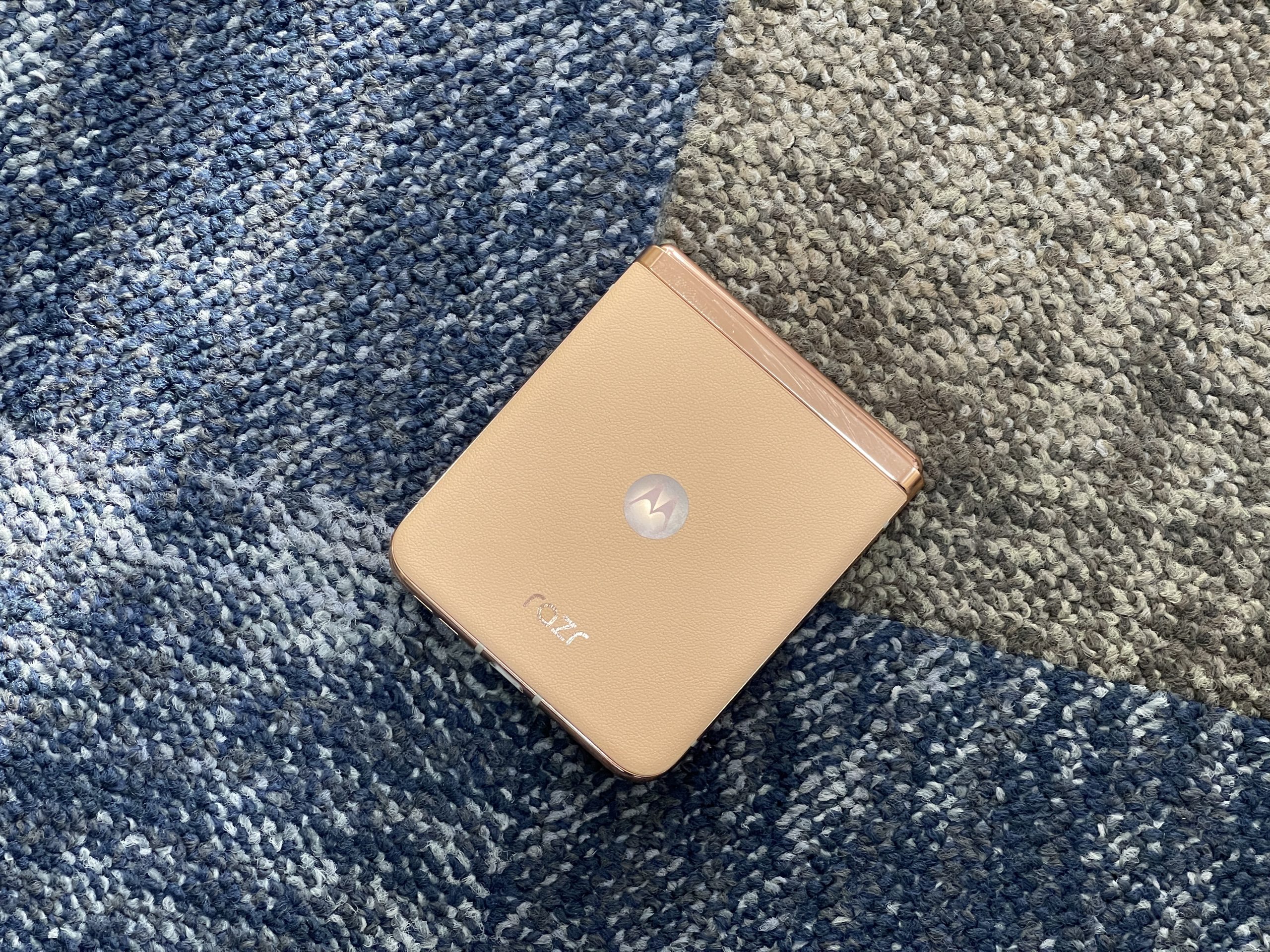
Buyers can choose between a shiny black or a bold magenta color, and both have different back materials.
The black one has a smooth, glass back, while the magenta one has a leather-like finish that’s nice to hold.
I have received the latter of the two and I’ve been quite impressed with the construction of the device.
Moto Razr 40 Ultra: Display
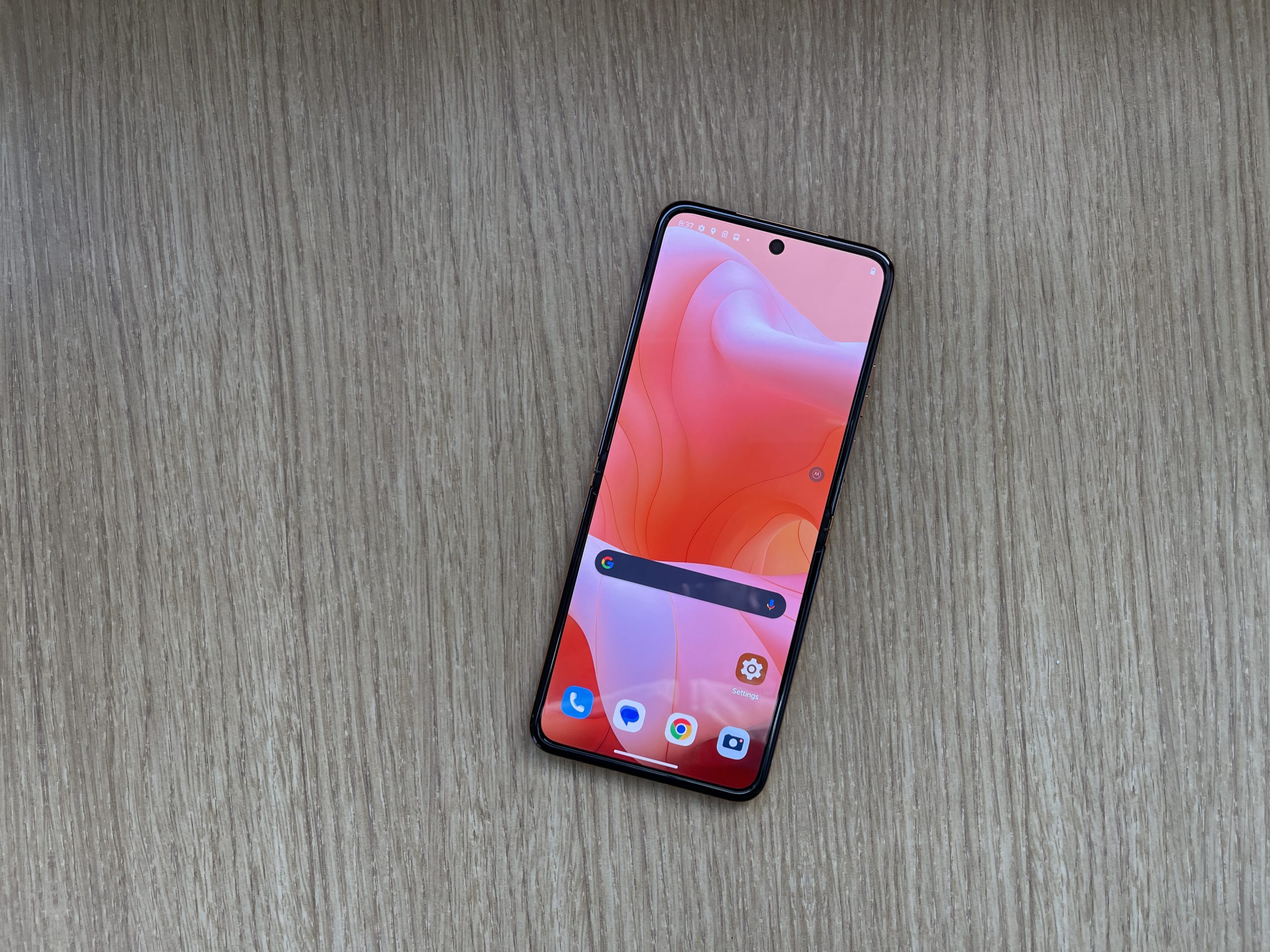
The screen on this phone is impressive too apart from the fact that it, you know, folds in half.
The main display refreshes super fast, at 165 times a second, making everything from scrolling through apps to watching videos feel really smooth.
Plus, it’s super bright. I can see the screen clearly even when I’m outside in bright sunlight.
Powered by Snapdragon 8+ Gen 1 chipset
This mix of a folding designand a rather decent screen did make my initial time with the Razr 40 Ultra a lot of fun.
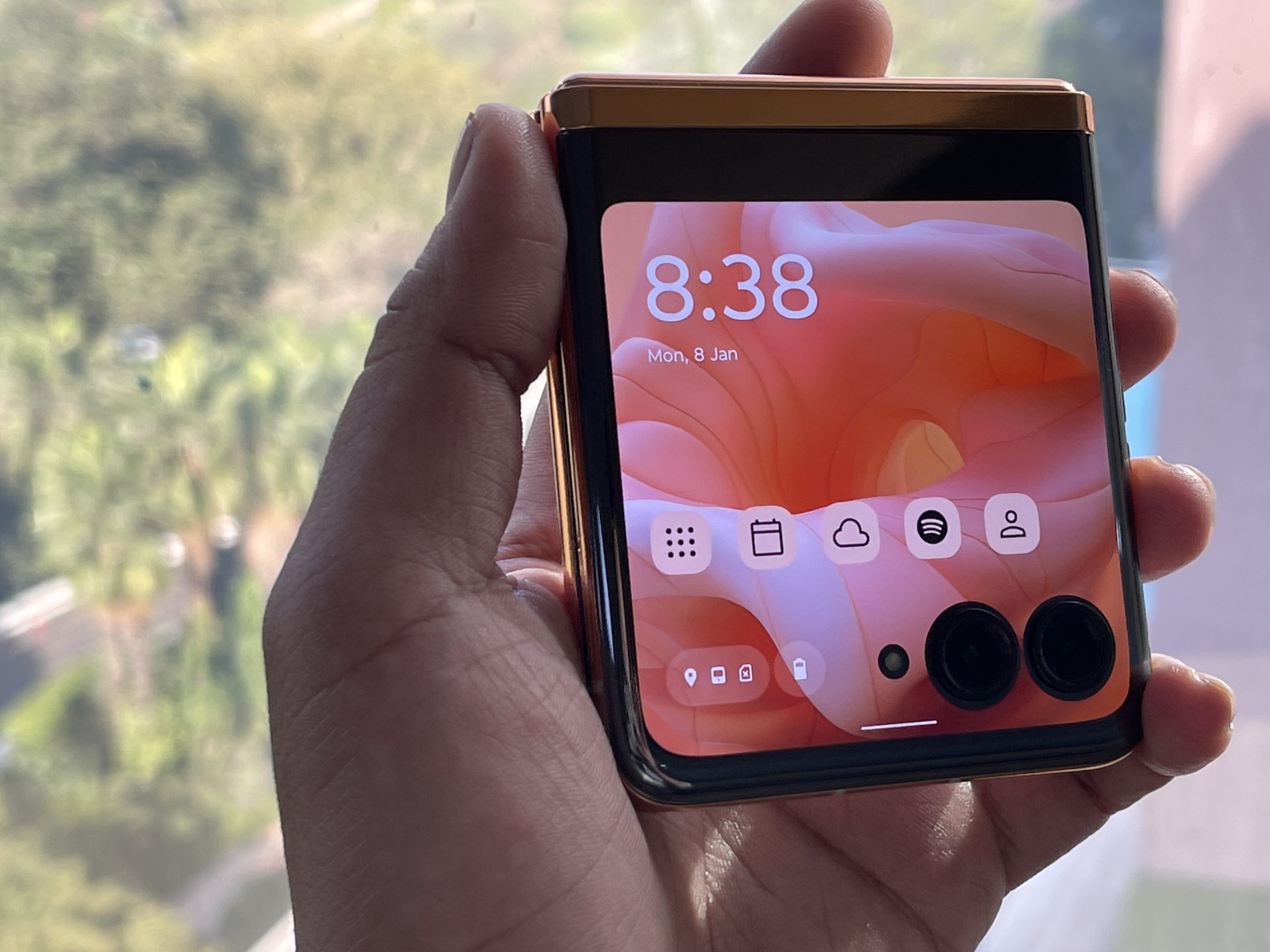
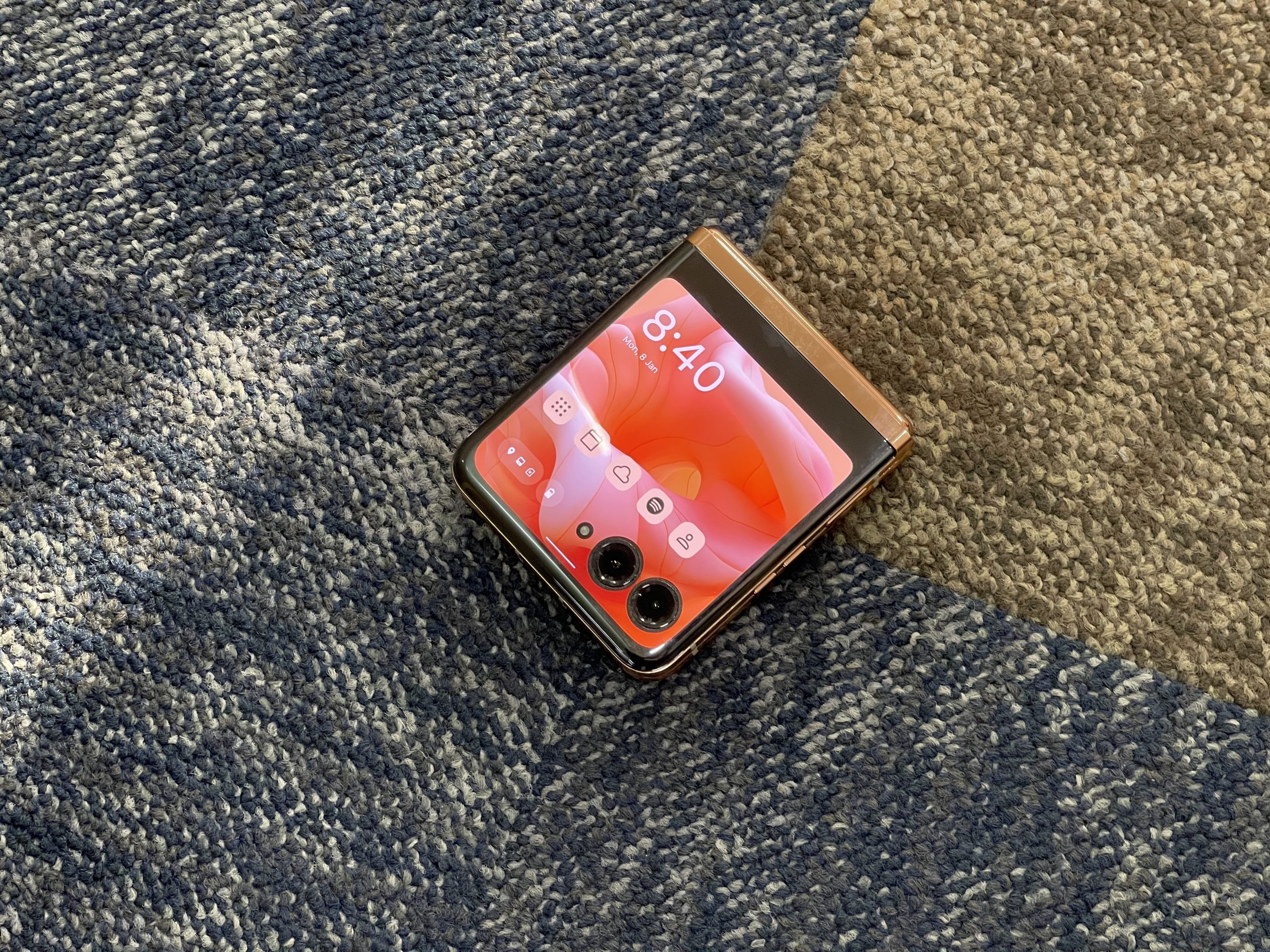
Then there’s also the cover screen on the front which warps around the camera lenses. As compared to its predecessor, the Razr 40 Ultra’s cover screen is much larger and can function as a secondary smartphone screen.
I will be diving into it properly with the full review.
Moto Razr 40 Ultra: Cameras
Moto Razr 40 Ultra: Cameras
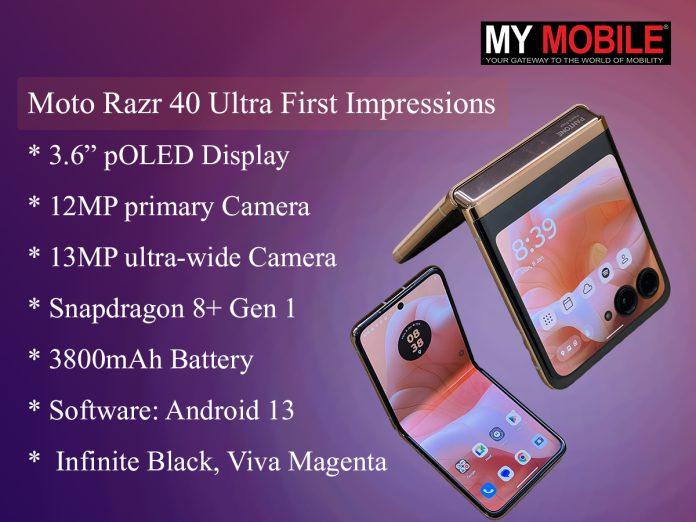
The Moto Razr 40 Ultra is equipped with a capable dual-camera system, featuring a 12MP primary shooter and a 13MP ultra-wide angle lens, both protected by the durable Gorilla Glass Victus.
In my time using it, the Razr 40 Ultra’s innovative design enhances the camera’s usability significantly.
The large and interactive outer screen serves a dual purpose, acting not just as a display for notifications and quick tasks but also as an effective viewfinder for taking selfies.
The convenience of this setup cannot be overstated, as it elevates the selfie-taking experience to new heights, providing clarity and detail that front cameras often struggle to match.
For those eager to dive deeper into the capabilities of the Moto Razr 40 Ultra’s camera system, including detailed analyses of image quality under various lighting conditions, color accuracy, and the effectiveness of the ultra-wide lens, stay tuned for my comprehensive review
A benefit of the flagship chipset is that the device’s cover screen, allows me to do a range of tasks with the same function continuing seamlessly on the mains display. In my opinion, this feature is a game-changer, setting a new standard for flip phone functionality.
Supports Android 13 and offers a 3800mAh battery with 33W wired and 5W wireless charging
However, the compact nature of the Razr 40 Ultra doesn’t leave much room for thermal output, which raises some questions about its performance under prolonged heavy usage.
In my time with the device, I noticed it handled everyday tasks with ease, but I’m curious to see how it fares during intensive processes like gaming or video editing.
Moto Razr 40 Ultra: Software and Battery
Moto Razr 40 Ultra: Software
Running on Android 14, my experience with the Razr 40 Ultra has been notably modern and user-friendly.
The cover screen and main display maintain continuity in terms of functionality, a feature I found particularly impressive.
The interface across both screens is remarkably clean, contributing to a user experience that feels both polished and intuitive.
What stood out to me was how effectively the cover screen is utilized, allowing for tasks typically reserved for the main screen to be executed with ease.
Moto Razr 40 Ultra: Battery
This includes everything from checking notifications to replying to messages, making the cover screen feel like a regular phone in its own right. You can be sure I will explore this more in my full review of the device.
The device is fueled by a 3800mAh battery, supplemented with 33W wired and 5W wireless charging capabilities.
Regarding the battery life, my initial usage has been promising.
The device managed to support a full day’s worth of activities, from emails and calls to streaming and social media browsing, without needing a midday charge.
This preliminary performance gives me optimism about the device’s ability to handle more demanding tasks, although further testing is needed to draw definitive conclusions.
Moto Razr 40 Ultra: Verdict
Moto Razr 40 Ultra: Battery
So as far as my initial impressions go, the Moto Razr 40 Ultra stands out as a strong contender in the flip phone market, challenging established players with its innovative cover screen and high-performance features.
As it goes head-to-head with the Galaxy Z Flip 4, and the Z Flip 5 which will launch in a few months, the Razr 40 Ultra not only appears to compete but also sets new benchmarks for what users can expect from a flip phone.
Stay tuned for a more thorough coverage of the device in my forthcoming detailed review.
MOTOROLA RAZR 40 ULTRA SPECIFICATIONS
Key Specs
RAM
12 GB
Processor
Qualcomm Snapdragon 8 Plus Gen 1
Rear Camera
50 MP + 50 MP + 12 MP
Front Camera
60 MP
Battery
3640 mAh
Display
6.73 inches (17.09 cm)
General
Launch Date
July 18, 2023 (Unofficial)
Operating System
Android v13
Performance
Chipset
Qualcomm Snapdragon 8 Plus Gen 1
CPU
Octa core (3.2 GHz, Single core, Cortex X2 + 2.75 GHz, Tri core, Cortex A710 + 2 GHz, Cortex A510)
Architecture
64 bit
Fabrication
4 nm
Graphics
Adreno 730
RAM
12 GB
Display
Display Type
P-OLED
Screen Size
6.73 inches (17.09 cm)
Resolution
1080 x 2400 pixels
Aspect Ratio
20:9
Pixel Density
391 ppi
Bezel-less display
Yes with punch-hole display
Touch Screen
Yes, Capacitive Touchscreen, Multi-touch
Refresh Rate
120 Hz
Screen to Body Ratio (claimed by the brand)
70.7 %
Camera
MAIN CAMERA
Camera Setup
Triple
Resolution
50 MP f/1.88, Primary Camera
50 MP, Ultra-Wide Angle Camera
12 MP f/2.2, Depth Camera
Autofocus
Yes
Flash
Yes, LED Flash
Image Resolution
8150 x 6150 Pixels
Settings
Exposure compensation
Shooting Modes
Continuous Shooting
High Dynamic Range mode (HDR)
Camera Features
Digital Zoom
Auto Flash
Face detection
Touch to focus
Video Recording
1920×1080 @ 30 fps
FRONT CAMERA
Camera Setup
Single
Resolution
60 MP, Primary Camera
Video Recording
1920×1080 @ 30 fps
Battery
Capacity
3640 mAh
Type
Li-Polymer
Removable
No
Quick Charging
Yes, Rapid, 33W
USB Type-C
Yes
Storage
Internal Memory
512 GB
Expandable Memory
No
Storage Type
UFS 3.1
Network & Connectivity
SIM Slot(s)
Dual SIM, GSM+GSM
SIM Size
SIM1: Nano, SIM2: eSIM
Network Support
5G Not Supported in India, 4G Supported in India, 3G, 2G
What is the price of the Moto Razr 40 Ultra in India?
The Moto Razr 40 Ultra is priced at Rs 69,999 for the 8GB/256GB variant, available on Amazon.
How does the cover display of the Moto Razr 40 Ultra enhance its usability?
The Moto Razr 40 Ultra’s 3.6-inch pOLED cover display offers high functionality, serving as a secondary screen that can handle a variety of tasks, making the device more versatile and user-friendly.
Can the Moto Razr 40 Ultra’s cameras compete with other flagship smartphones?
Equipped with a 12MP primary and a 13MP ultra-wide camera, the Moto Razr 40 Ultra aims to provide high-quality imaging, challenging the notion that flip phones compromise on camera capabilities.
What makes the Moto Razr 40 Ultra stand out in the foldable phone market?
With its unique cover screen functionality, premium build quality, and powerful internals, the Moto Razr 40 Ultra sets a new standard for flip phones, offering a blend of style, performance, and innovation.
How does the battery performance of the Moto Razr 40 Ultra hold up with daily usage?
With a 3800mAh battery and fast charging options, initial impressions suggest the Moto Razr 40 Ultra can comfortably support a full day’s usage, balancing performance and energy efficiency effectively.
These devices, while catering to the same broad category of AR/VR technology, are designed with significantly different goals and audiences in mind, making their comparison a study in contrasts rather than direct competition.
Apple Vision Pro: A Premium Leap into Mixed Reality
Apple Vision Pro: A Premium Leap into Mixed Reality
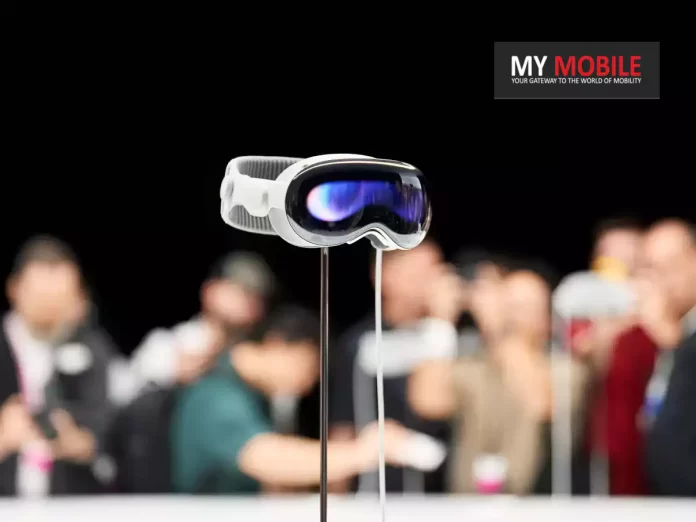
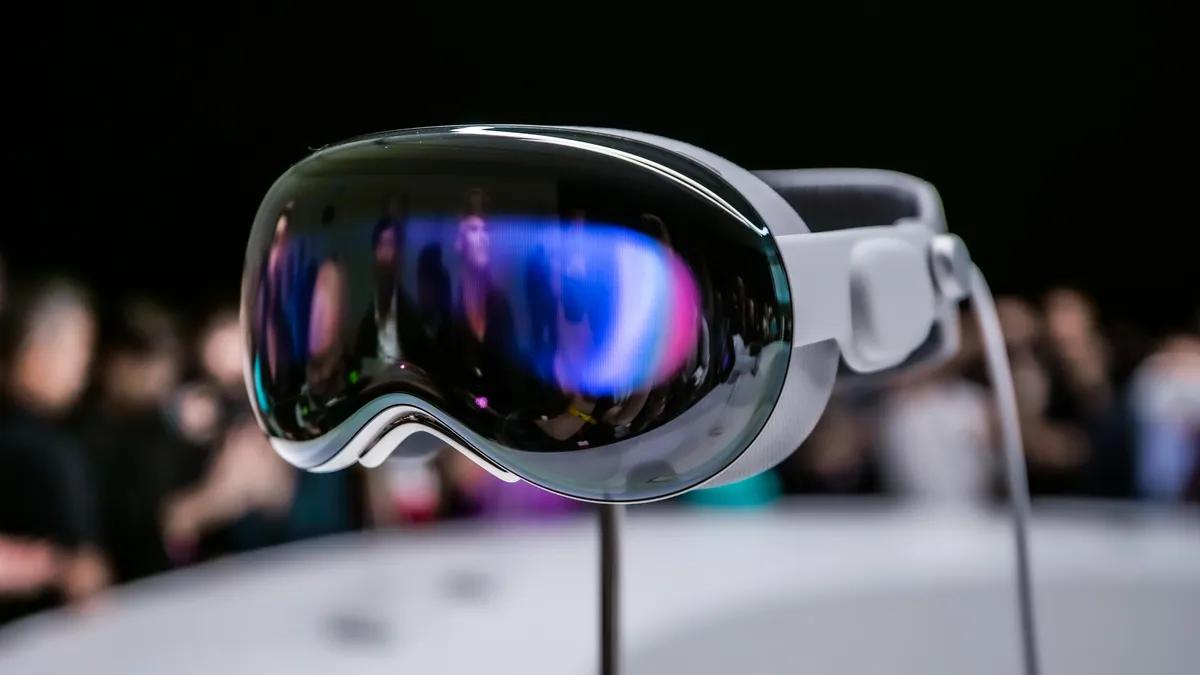
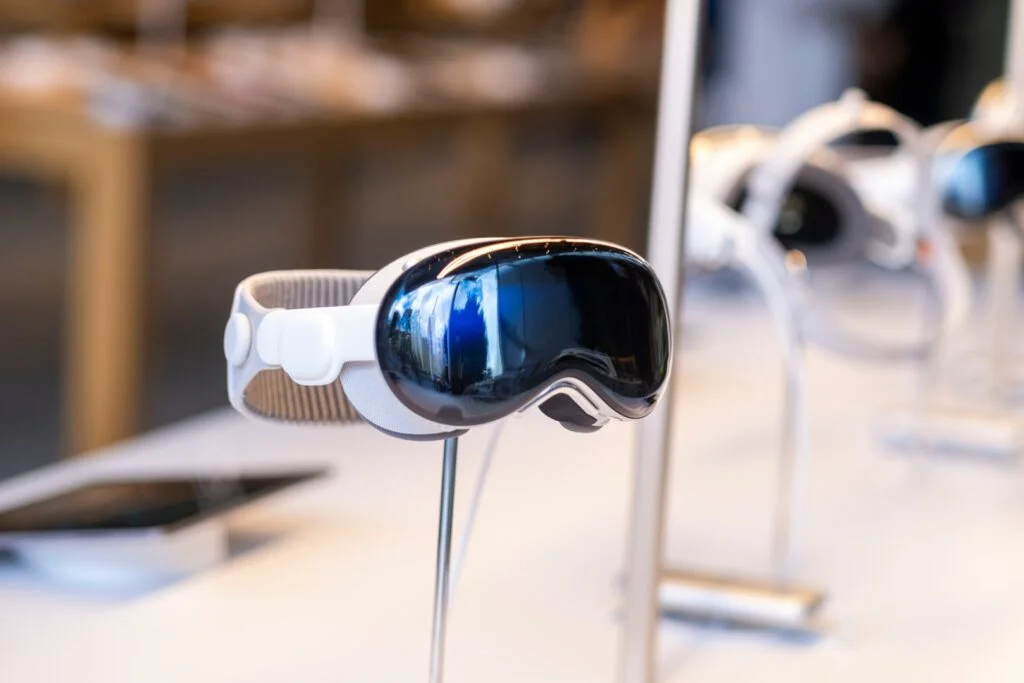
The Apple Vision Pro marks the tech giant’s ambitious foray into the mixed reality space, powered by the efficient M2 chip alongside an additional R1 processor dedicated to augmented reality computations.
It sports a ginormous pricetag as well at $3,499.
This setup facilitates impressive multitasking capabilities and supports popular productivity applications such as Adobe Lightroom, promising exceptional performance.
This feature not only elevates the premium feel of the device but also enhances the immersive VR experience.
Interaction with the Vision Pro is primarily through hand and finger gestures, with support for Apple’s magic keyboardand trackpad for productivity tasks.
The Vision Pro is equipped with a couple of 1.41-inch micro-OLED displays, offering a combined 4K resolution.
With peak brightness at 5000 nits, it promises exceptionally bright and clear visuals.
Unlike most VR headsets, the Vision Pro relies on an external battery pack connected via a wire, potentially affecting the user’s mobility.
Meta Quest 3: Making VR More Accessible
Meta Quest 3: Making VR More Accessible
The Meta Quest 3, on the other hand, is powered by the Qualcomm Snapdragon XR2 Gen 2 chip, and is positioned as a more accessible VR headset at just $500.
It aims to refine the VR experience with enhancements over its predecessors, targeting VR enthusiasts and gamers with its Android-based operating system.
The Quest 3’s LCD display offers a 120Hz refresh rate and a resolution of 4128 x 2208 pixels, ensuring smooth and detailed visuals, although it may not match the brightness level of the Vision Pro.
The design of the Quest 3 is an iterative update over the Quest 2, featuring a slimmer profile and full-color passthrough for mixed reality experiences.
It comes with Bluetooth-enabled controllers for interaction but also supports finger and hand gestures.
Unlike the Vision Pro, the Quest 3 integrates its battery into the headset, offering a truly wireless experience.
Performance, Apps, and Games
Performance, Apps, and Games
When it comes to performance, both headsets are capable of multitasking and running a variety of apps.
The Vision Pro will run VisionOS, based on iOS frameworks, and will have access to a wide range of iOS and iPadOS apps and games.
In contrast, the Quest 3, with its Android-based OS, will continue to leverage a strong library of VR games and apps, making it a preferred choice for VR gaming.
These headsets have arrays of cameras on the outside that capture the real world and show it to you on displays inside.
Virtual displays, games, and even 3D objects can be layered over the real world.
When it comes to passthrough and image quality, the Apple Vision Pro takes the prize. Despite having a smaller field of view at only 95 degrees compared to Quest 3’s 110, the quality is significantly better.
This is likely due to the quality of the front-facing cameras and chipsets.
The Meta Quest 3 and Apple Vision Pro feel very different but also very much the same; it just depends on how you look at them.
Its displays are fantastic, as is the way it multitasks apps.
However, the Meta Quest 3 has its advantages. For instance, it can only run one app at a time, unless you’re using the browser and a 2D app.
The Vision Pro can multitask with many apps simultaneously, making it feel more like a real office tool.
In terms of ecosystems, while Vision Pro has a much easier ecosystem, it’s only with other Apple stuff and even that feels incomplete.
Quest 3’s ecosystem is wide and plays pretty well with others, but often requires a lot of fiddling around to learn how to configure things or get them set up.
Price and Accessibility
Price and Accessibility
One of the most significant differences between the two is their price point.
The Apple Vision Pro’s premium featurescome with a high cost of $3499, positioning it as a luxury item beyond the reach of the average consumer.
In contrast, the Meta Quest 3 is priced more accessibly at $499 for the base model, making it an attractive option for a broader audience.
What makes the Apple Vision Pro stand out from the Meta Quest 3?
The Apple Vision Pro stands out with its premium design, advanced mixed reality capabilities, and multitasking prowess, supported by the M2 and R1 chips, offering a unique experience for productivity and immersive applications.
How does the Meta Quest 3 compare in terms of accessibility and price?
The Meta Quest 3 is priced at $499, making it more accessible to a broader audience. It focuses on delivering a high-quality VR experience, especially for gaming, with a more straightforward, wireless setup.
Can the Apple Vision Pro and Meta Quest 3 be used for gaming?
While both headsets support gaming, the Meta Quest 3 is specifically designed with gaming in mind, leveraging its Android-based OS and VR game library. The Vision Pro also offers gaming capabilities but focuses more on mixed reality experiences and productivity.
What are the key differences in design between the two headsets?
The Apple Vision Pro mimics a pair of premium ski goggles and includes a 3D display that shows the wearer’s eyes, while the Meta Quest 3 features a slimmer update over its predecessor with full-color passthrough for mixed reality.
How do the ecosystems of the Apple Vision Pro and Meta Quest 3 compare?
The Apple Vision Pro integrates seamlessly with Apple’s ecosystem, offering a more unified experience for users of Apple products. In contrast, the Quest 3 has a broader ecosystem compatibility but may require additional setup for optimal performance.
The outage lasted for around 2 to 3 hours before everything returned to functioning normally.
In the aftermath, social media and several new reports have soared with conjectures and theories around the cause of the outage.
Global Meta Outage: What Do We Know and What Was the Likely Cause?All Meta-owned platforms including Facebook and InstagramThe global Meta outage affected users worldwide for approximately two hours
Let’s take a quick look at what we know about the global Meta outage and what was the likely cause.
What Happened During the Global Meta Outage?
Facebook, Instagram and other Meta-owned platforms were down for approximately two hours
Facebook, Instagram and other Meta-owned platforms were down for approximately two hours around the world on Tuesday.
The outages were first reported at around 3.30 pm GMT i.e. 10.30 am EST, 2.30 am AEDT.
Facebook & Instagram suffer massive outage
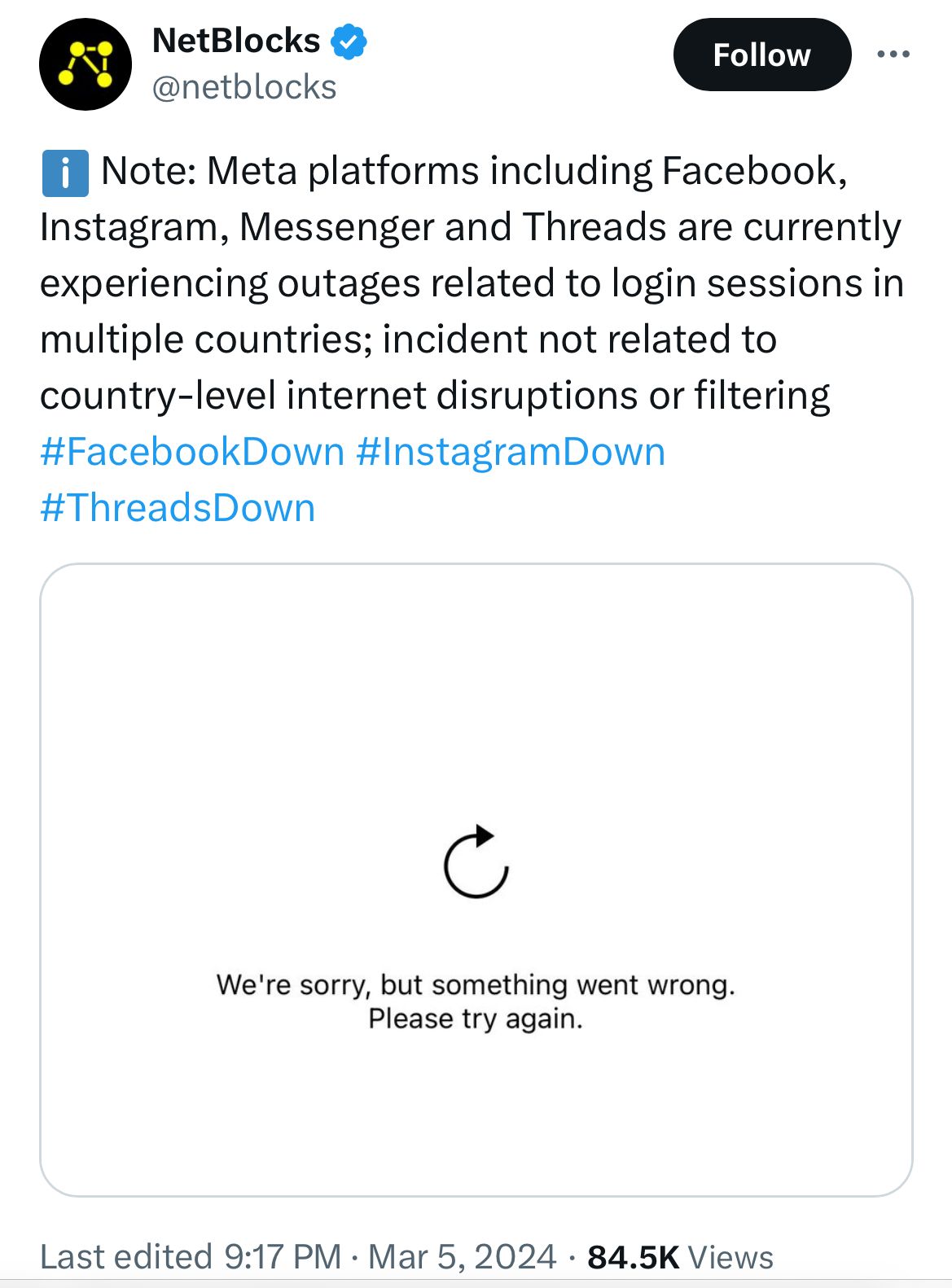
During the outage, the services refused login attempts and feed stalls.
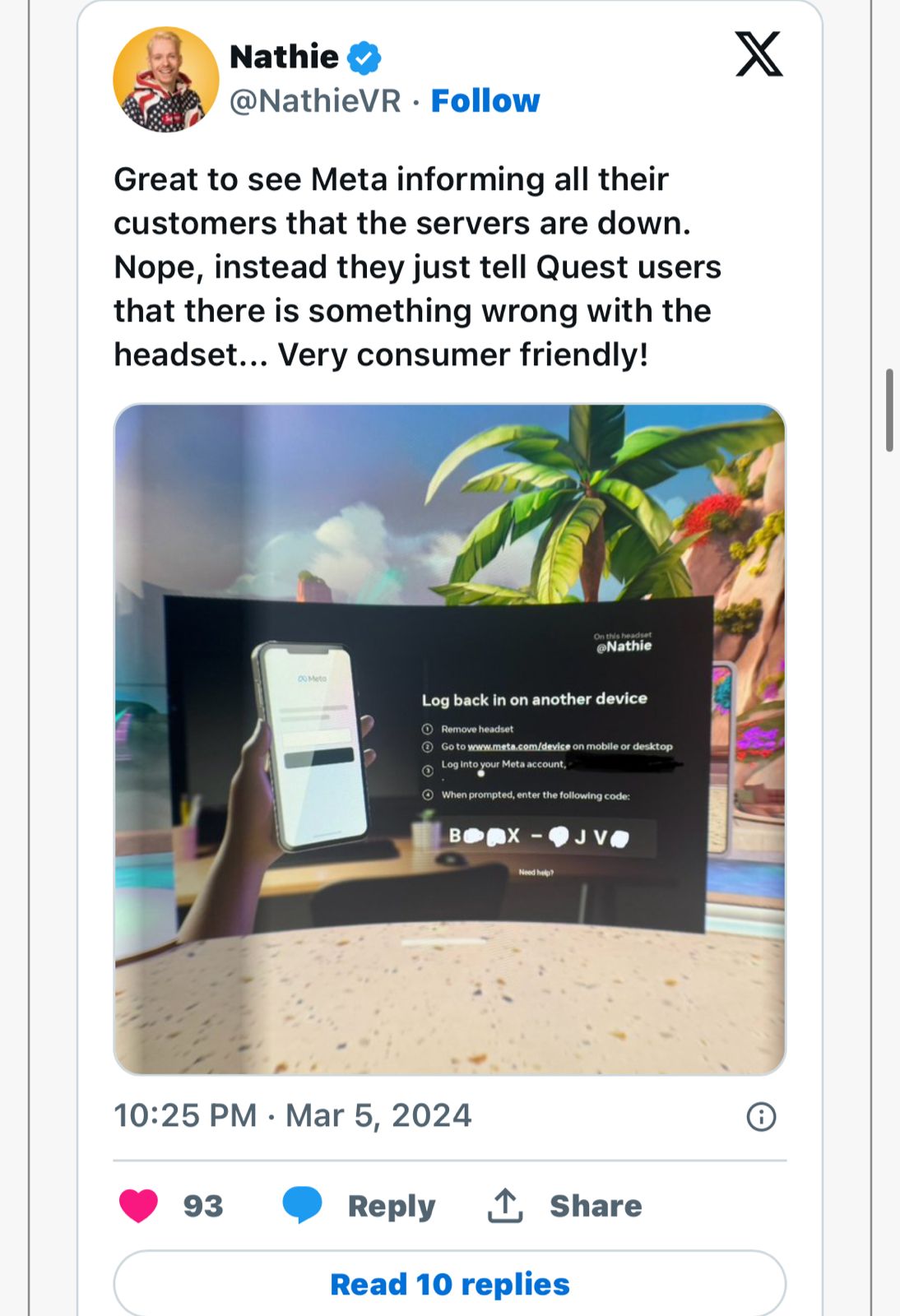
Users reportedly were logged out of their Facebook accounts, encountered difficulties refreshing their feeds, stories/comments failing to load, complete shutdown or an error message upon launch.
Andy Stone, Communications Director, Meta, took to X to inform people that the Mark Zuckerberg-led company is working on the said issue.
Interestingly, the Meta outage coincided with reportedly login issues on Google’s platform as well.
This encouraged several users to speculate a common cause between the outages at the two tech conglomerates.
It is significant to note that both tech companies largely control their infrastructure.
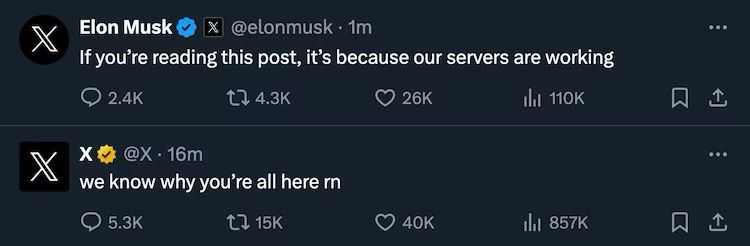
Elon Musk tweeted that X servers were working all fine.
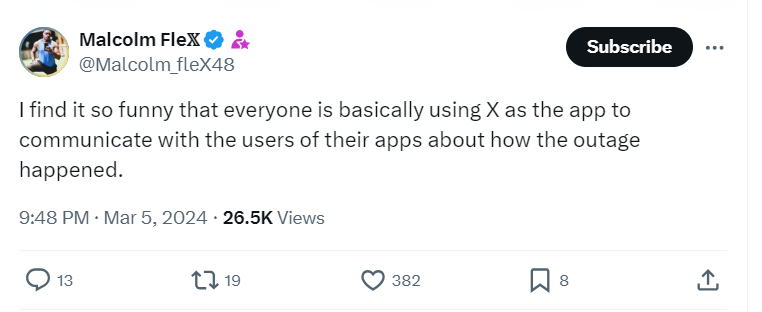
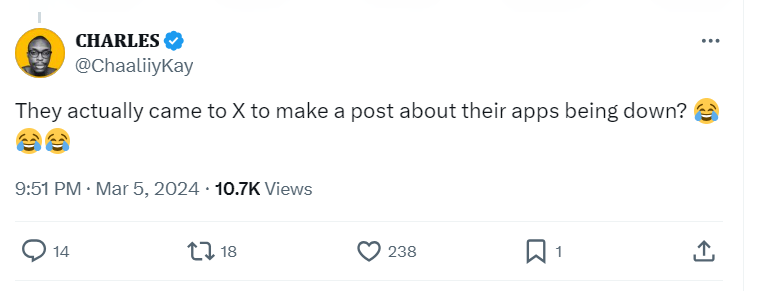
Users from all Meta platforms were quick to flock to X and report the outage.
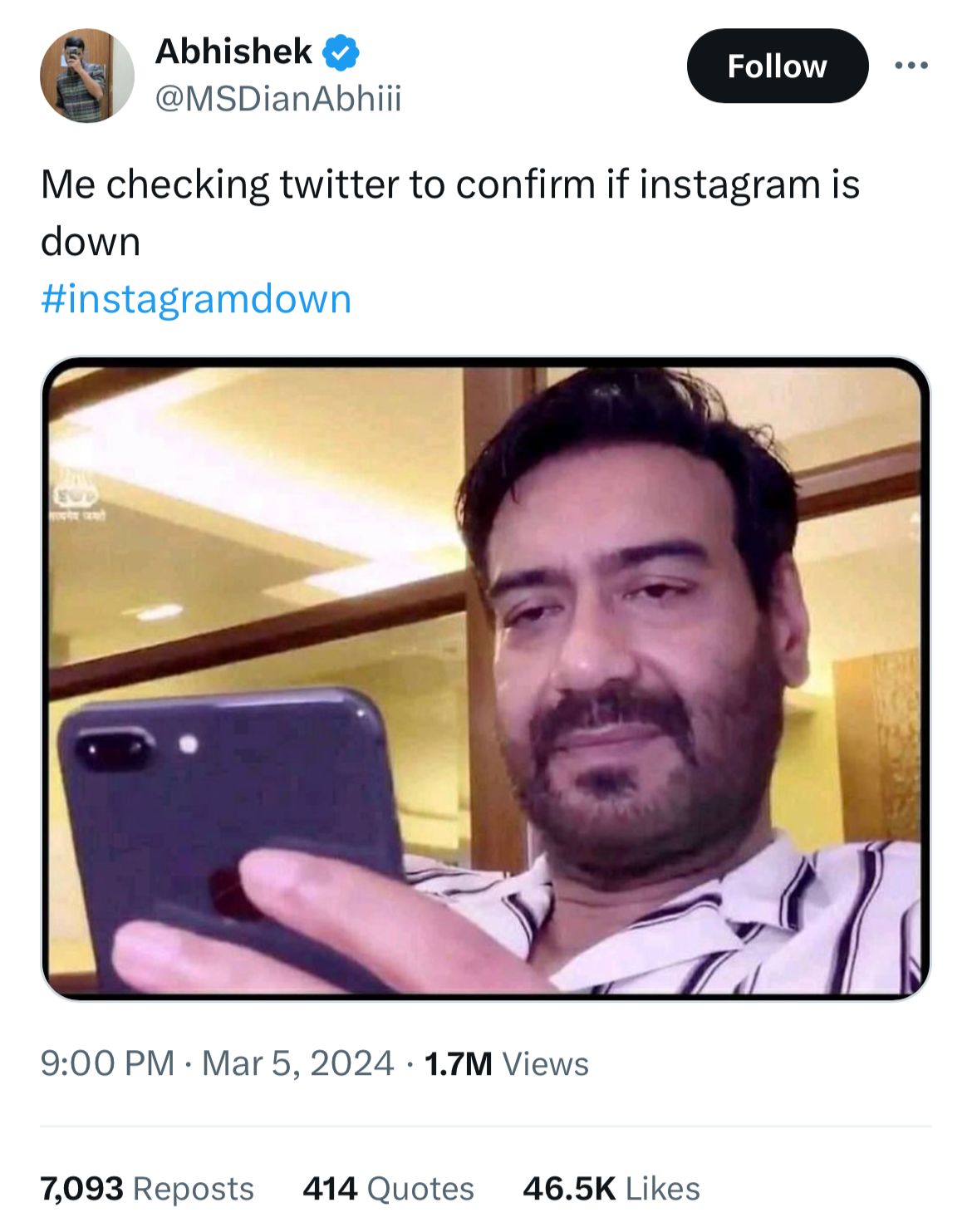
The Meta-down memes were overflowing on X with people sharing videos and images depicting the outage scenario.
Outage attributed to a technical issue, with Meta confirming the situation via social media
Musk too joined the bandwagon and shared a meme showing how X was superior.
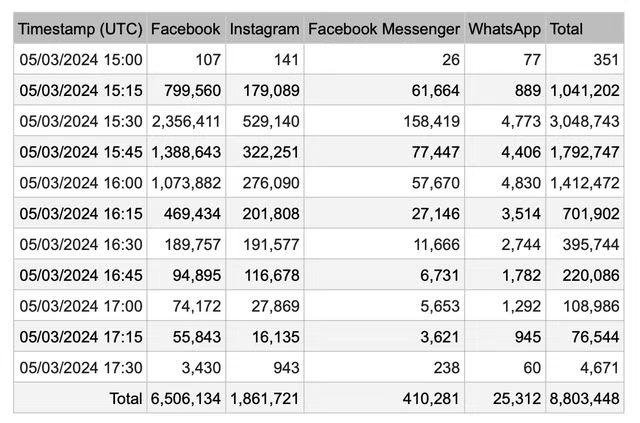
As per the outage tracking website Downdetector.com, there were over 550,000 reports of disruptions for Facebook and more than 92,000 for Instagram.
Facebook, Instagram, and WhatsApp experienced an outage similar to the recent one in 2021 as well.
It was also reported that the outage for WhatsApp and Threads was much smaller compared to Instagram and other platforms.
Outage raises questions about the reliability of major social networks during critical times
Moreover, Meta shares were 1.2% down in afternoon trading.
What was Meta’s Response?
What was Meta’s Response?
The network outage problem across Google and Meta apps was reported around 9 pm, as per network outage tracking platform Down Detector.
Meta acknowledged the widespread issues affecting their platforms and assured users that they are actively working to resolve the problem.
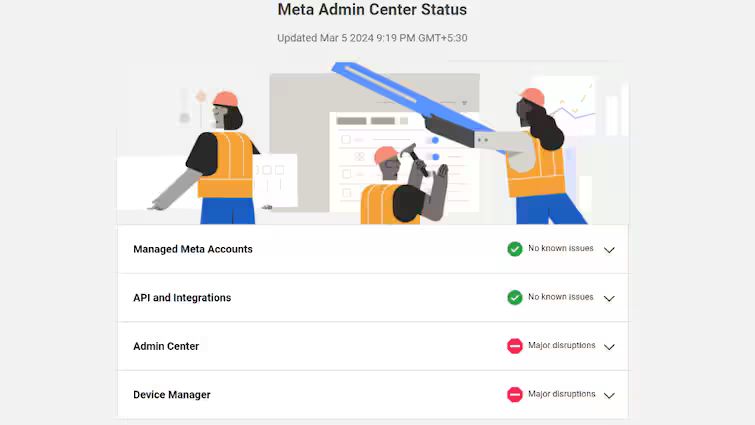
Meta business products, which showed a Major Disruptions label for services such as Facebook, Graph, and WhatsApp Business.
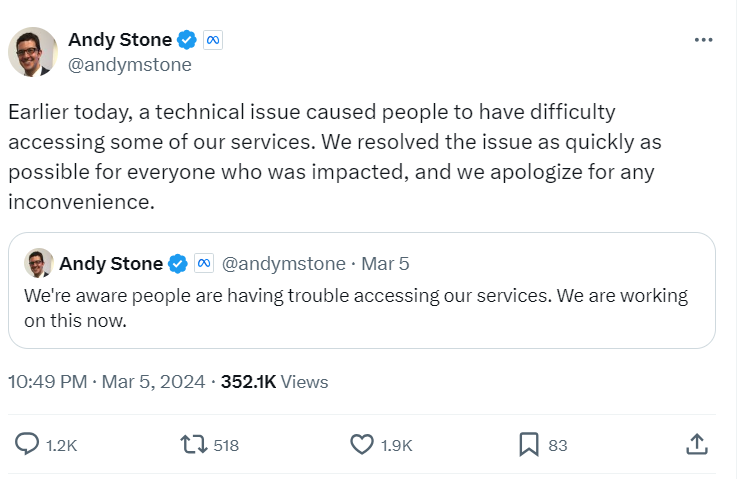
Meta spokesperson Andy Stone in an X post acknowledged the snag when it took place. “We’re aware people are having trouble accessing our services. We are working on this now,” he posted.
Once the issue was resolved, Stone also confirmed, “Earlier today, a technical issue caused people to have difficulty accessing some of our services. We resolved the issue as quickly as possible for everyone who was impacted, and we apologise for any inconvenience.”
The outage lasted for about two hours, with services beginning to come back online gradually.
However, the spokesperson didn’t identify the issue that caused the global disruption.
What Was the Likely Cause of Global Meta Outage?
Technical Glitch left users worldwide unable to access these services
There was widespread speculation that Meta might have fallen victim to a cyber attack, particularly given the timing of Super Tuesday.
It is the time when a significant number of US states conduct their primary presidential elections.
Meta reported a technical issue amid brewing conjectures
However, although security experts acknowledge this possibility, the US Cybersecurity and Infrastructure Security Agency has expressed scepticism, deeming such an occurrence unlikely.
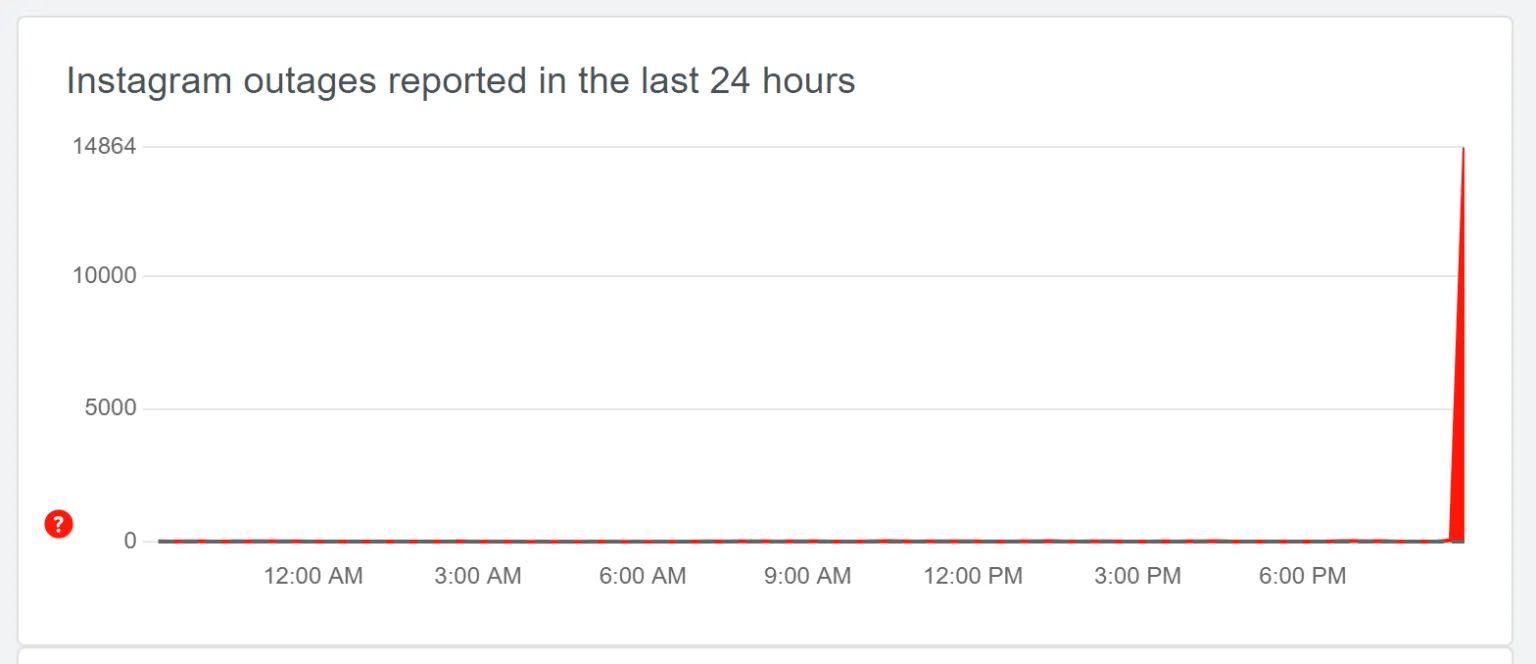
According to monitoring service Downdetector, error reports spiked about 10:25 a.m. ET on Tuesday, March 5. As of approximately 10:40 a.m., Downdetector had received more than 500,000 error reports. About 76% of the problems reported by Facebook users related to trouble logging in.
The White House National Security Council was also monitoring the incident. A senior US cybersecurity and infrastructure security agency official said on a press call: “We are aware of the incident and at this time we are not aware of any specific election nexus or any specific malicious cyber activity.”
(Down Detector) As you can see, it seems like the outage was all over in a couple of hours.
Since seemingly similar issues with login attempts were also reported with Google platforms, many claims suggested the issue could be broader than meta.
Cybersecurity expert and an associate professor of computer science and member of the Johns Hopkins University Information Security Institute, Matthew Green reportedly said, “There are a number of services having trouble with at least parts of their systems, particularly the ability to log into websites. This may indicate a common cause, like a failure at a major cloud services provider.”
Facebook and Instagram down – updates: Meta gives reason for worldwide outage
Earlier, Meta experienced the largest outage in 2021 when Facebook went down. It later prompted an apology from founder and CEO Mark Zuckerberg.
Global meta outage: What do we know, and what was the likely cause?
FAQs
What happened in the Meta outage of 2021?
Facebook, Instagram, and WhatsApp experienced an outage similar to the recent one in 2021 as well. It lasted for nearly 6 hours and impacted more than 3 billion users worldwide. In a later blog post, Facebook noted that the outage happened due to a mishap during a routine maintenance job.
What is the impact of Global Meta Outage on the company?
After the global outage hit Meta’s social media platforms on Tuesday, March 5th, 2024, billions of users were impacted and the company lost an estimated $3 billion. According to reports by several media portals, the stocks of Meta closed in red down 1.6 per cent at USD 490.22 during March 5 trading session according to NASDAQ.
What issues did users face during the recent Meta outage?
Users reported various issues, such as being logged out of their Facebook accounts, making it impossible to log back in. Similarly, Instagram users encountered difficulties refreshing their feeds, with stories and comments failing to load for some individuals. Threads, an app developed by Meta, is also experiencing a complete shutdown, displaying an error message upon launch.
What is Downdetector?
Downdetector is an online platform that provides users with real-time information about the status of various websites and services.
What caused the Meta outage?
The Meta outage was attributed to a technical issue, as confirmed by Meta’s communications director Andy Stone.
The exact nature of the technical problem was not specified, but backend services like authentication were speculated to be affected.
How long did the Meta outage last?
The outage lasted for about two hours, with services beginning to come back online gradually. Some users continued to experience issues even after the initial recovery.
Were any hacker groups responsible for the Meta outage?
While several hacker groups claimed responsibility for the outage, similar past events have typically been attributed to internal technical errors rather than external attacks.
How did Meta respond to the outage?
Meta responded promptly by acknowledging the issue on social media and assuring users that they were working to resolve it. Services were restored within a few hours.
What impact did the Meta outage have?
The outage occurred on Super Tuesday, raising concerns about its potential impact on voter outreach and information dissemination. However, Meta’s swift action mitigated long-term effects, highlighting the vulnerability of digital platforms.
Was WhatsApp Business too down for some users ?
Meta’s status dashboard showed the application programming interface for WhatsApp Business was also facing issues.
There were around 200 reports of outages for WhatsApp on Downdetector, which tracks outages by collating status reports from several sources, including users.
Google play store also was down following Instagram & Facebook ?
DownDetector showed the Google Play Store having issues starting at around 10:03 am ET. The number of complaints submitted to DownDetector soared from 1 to 2,058 in only 30 minutes.
Complaints about the Play Store being down came in from Android users in U.S. cities like Seattle to Android owners unable to search for any new apps in Southwest Brazil.
One DownDetector subscriber wrote, “Play Store not searching for apps. Just keeps spinning and spinning. I guess it is playing with the spinning thing instead of doing its job at being a store.”
According to the Google Play Status Dashboard, an issue with the Play Integrity API started creating the issue at around 10:37 am ET and it ended at 11:40 am ET.
The Play Integrity API helps app developers check to make sure that user actions and requests are coming from a legit Android user who has purchased or installed a developer’s app or game.
It can also detect whether the Android user is using a tampered version of the developer’s app.
Has Mark Zuckerberg’s Meta loses $3 billion after Instagram, Facebook global outage?
Has company’s share price fallen ?
The stocks of Meta closed in red down 1.6 per cent at USD 490.22 during March 5 trading session according to NASDAQ.
Mark Zuckerberg, founder, chairman and CEO of Meta, lost over USD 2.79 billion in a day to USD 176 billion in his new worth, as per Bloomberg Billionaires Index, but he maintained his position as the world’s fourth-richest person.
According to Reuters, Meta’s status dashboard showed the application programming interface for WhatsApp Business was also facing issues. There were around 200 reports of outages for WhatsApp on Downdetector, which tracks outages by collating status reports from several sources, including users.
In February 2024, the Facebook co-founder’s net worth surged by USD 27.1 billion after Meta’s quarterly results far exceeded Wall Street’s expectations, sending its shares up about 20 per cent. He became worth USD 169.5 billion, the richest he’s ever been, and surpassed Bill Gates to move into the fourth spot on the Bloomberg Billionaires Index.
Meta announced a quarterly cash dividend of 50 cents a share for Class A and B common stock beginning in March. With Zuckerberg holding about 350 million shares, he would take home about $175 million in each quarterly payment before taxes, according to data compiled by Bloomberg.
Was the global outage a repeat of 2021 ?
The explanation appears to be that it was effectively a repeat of what happened back in 2021: a mistake made by someone at Meta.
That time there was an error which occurred, when engineers were checking the availability of network capacity.
During one of these routine maintenance jobs, a command was issued with the intention to assess the availability of global backbone capacity, which unintentionally took down all the connections in our backbone network, effectively disconnecting Facebook data centers globally.
Our systems are designed to audit commands like these to prevent mistakes like this, but a bug in that audit tool didn’t properly stop the command.
This change caused a complete disconnection of our server connections between our data centers and the internet.
Whether you’re a student, a professional, or simply looking for value, this guide will showcase the top contenders in the budget smartphone arena.
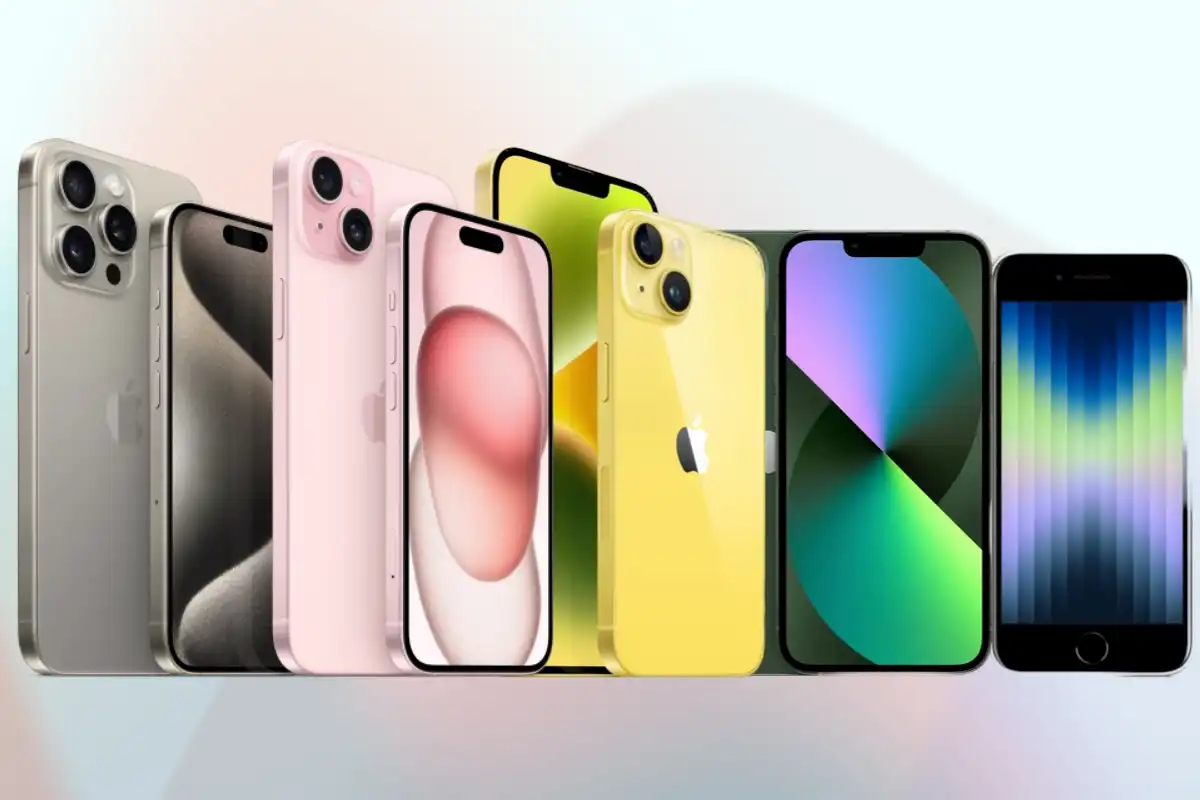
Best Budget and Affordable iPhone
Best Budget and Affordable Android
Best Budget and Affordable Phones Under 10K
Are you looking for a smartphone that offers both quality and affordability?
With new models flooding the market every season, it’s easy to get lost in a sea of options.
Well, that’s why we’re here to simplify the process for you.
Our buyer’s guide for the best budget and affordable phones in 2024 is tailor-made for you to discover the perfect smartphone that meets your needs without burning a hole in your pocket.
So, without further ado, let’s get to our picks.
Best Budget and Affordable iPhone
iPhone SE
iPhone SE
The iPhone SE comes with a 60 Hz refresh rate 4.70-inch touchscreen display offering a resolution of 750×1334 pixels (HD+) at a pixel density of 326 pixels per inch (ppi) and an aspect ratio of 16:9. The display sports Other for protection.
However, released in March 2022, this model is not easily available in the market today.
Moreover, the 4.7-inch screen utilising older LCD screen technology and an underwhelming battery life don’t make this one the best iPhone option.
Features
7″ (11.94 cm) IPS LCD Display
Apple A15 Bionic Hexa Core Processor
4 GB RAM | 64 GB Storage
Dual SIM: 5G & 4G Network
12 MP Rear Camera
7 MP Front Camera
2018 mAh
20W Fast Charging
iOS v15
Pros & Cons
Pros
Cons
● Affordable
● Home button and Touch ID FTW
● Compact design
● Good camera quality
● Outdated software
● The bezels above and below the screen look dated
● 20-watt USB-C charger not included
iPhone 13
iPhone 13
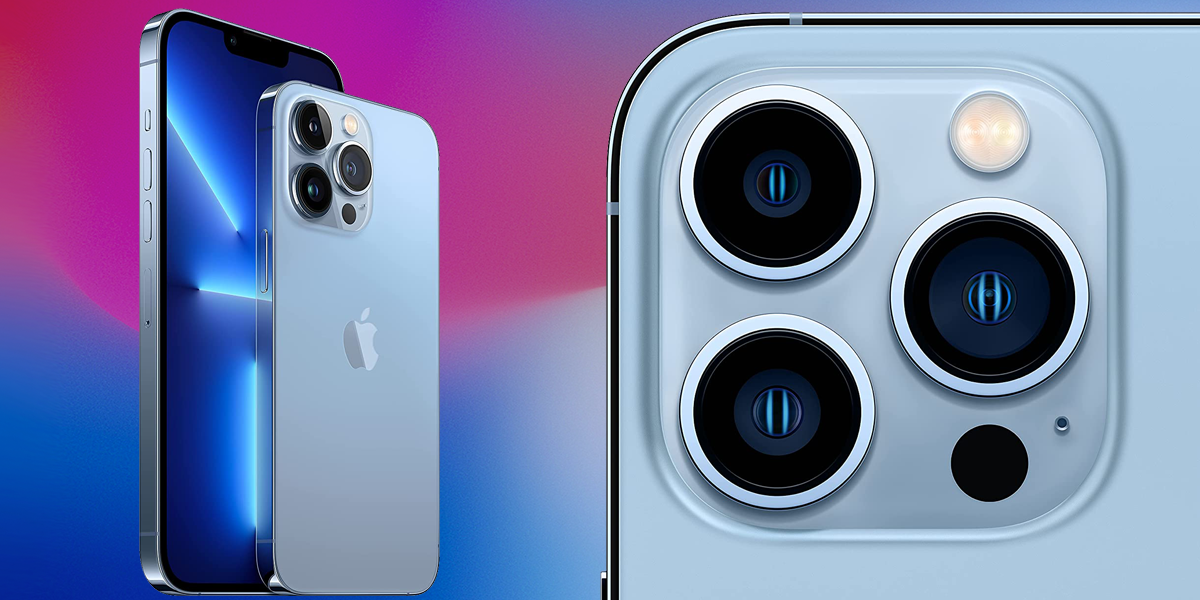
The iPhone 13, at the price of ₹52,090, comes with a few subtle upgrades when compared to its predecessor iPhone 12.
It has a bright, vibrant 6.1-inch OLED screen, but with only a 60Hz refresh rate. The A15 Bionic SoC offers ample power for gaming and resource-intensive applications.
Its versatile cameras deliver exceptional quality for both still photography and video recording, boasting the same Cinematic Mode and Photographic Styles features found in the pricier iPhone 13 Pro.
While the battery life is satisfactory, it falls short of exceptional. iOS 15 ensures seamless operation, keeping everything running smoothly.
Storage options include 128GB, 256GB, and 512GB, providing ample space for your needs. Equally impressive in terms of features and performance, the iPhone 13 mini stands as a comparable alternative.
Features
1″ (15.49 cm) 60Hz OLED Display
Apple A15 Bionic Hexa Core Processor
4 GB RAM | 128 GB Storage
Dual SIM: 5G & 4G Network
12+12 MP Rear Camera
12 MP Front Camera
3227 mAh
20W Fast Charging
iOS v15
Pros & Cons
Pros
Cons
● Good display with perfect calibration
● Improved battery life
● Dynamic photos in challenging conditions
● Snazzy Cinematic video mode
● Double predecessor storage for the same price
● Slow display refresh rate
● No fast Wired and wireless charging
● Taller notch eats into some video formats
Price – ₹52,090
Best Budget and Affordable Android
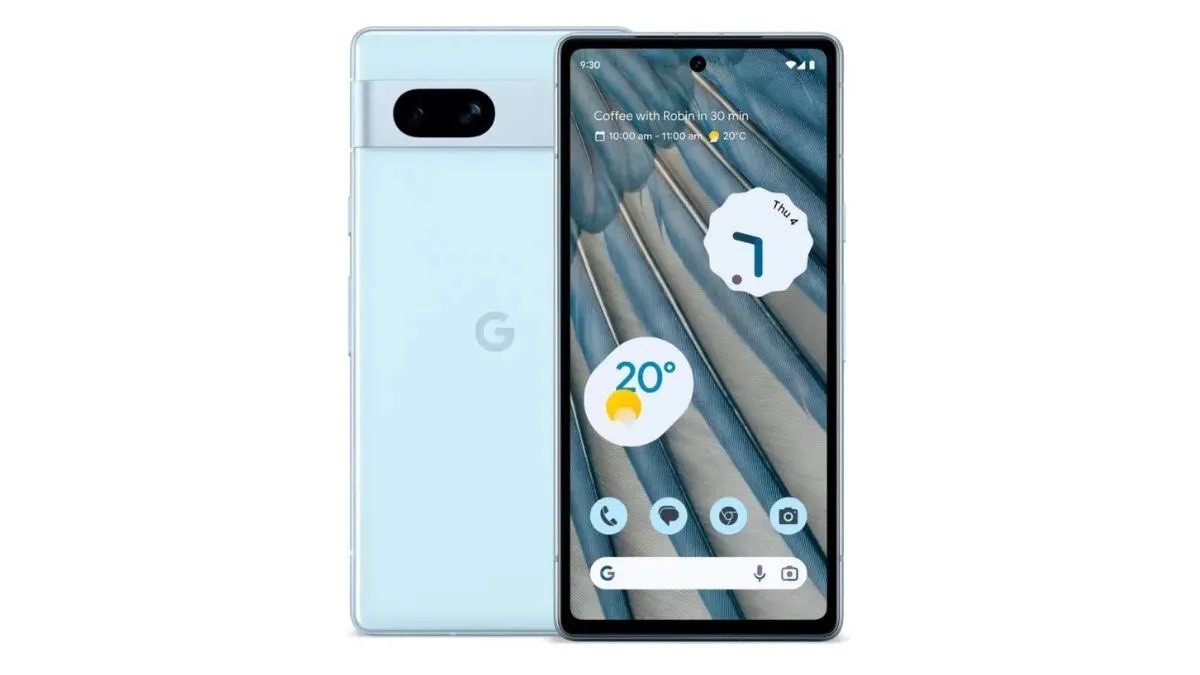
Google Pixel 7a
Google Pixel 7a
Currently priced at ₹39,999, the Pixel 7a features a 6.1-inch 1080p OLED display with HDR support and a 90 Hz refresh rate.
The display has a 20:9 aspect ratio and a circular cutout in the upper centre for the front-facing camera.
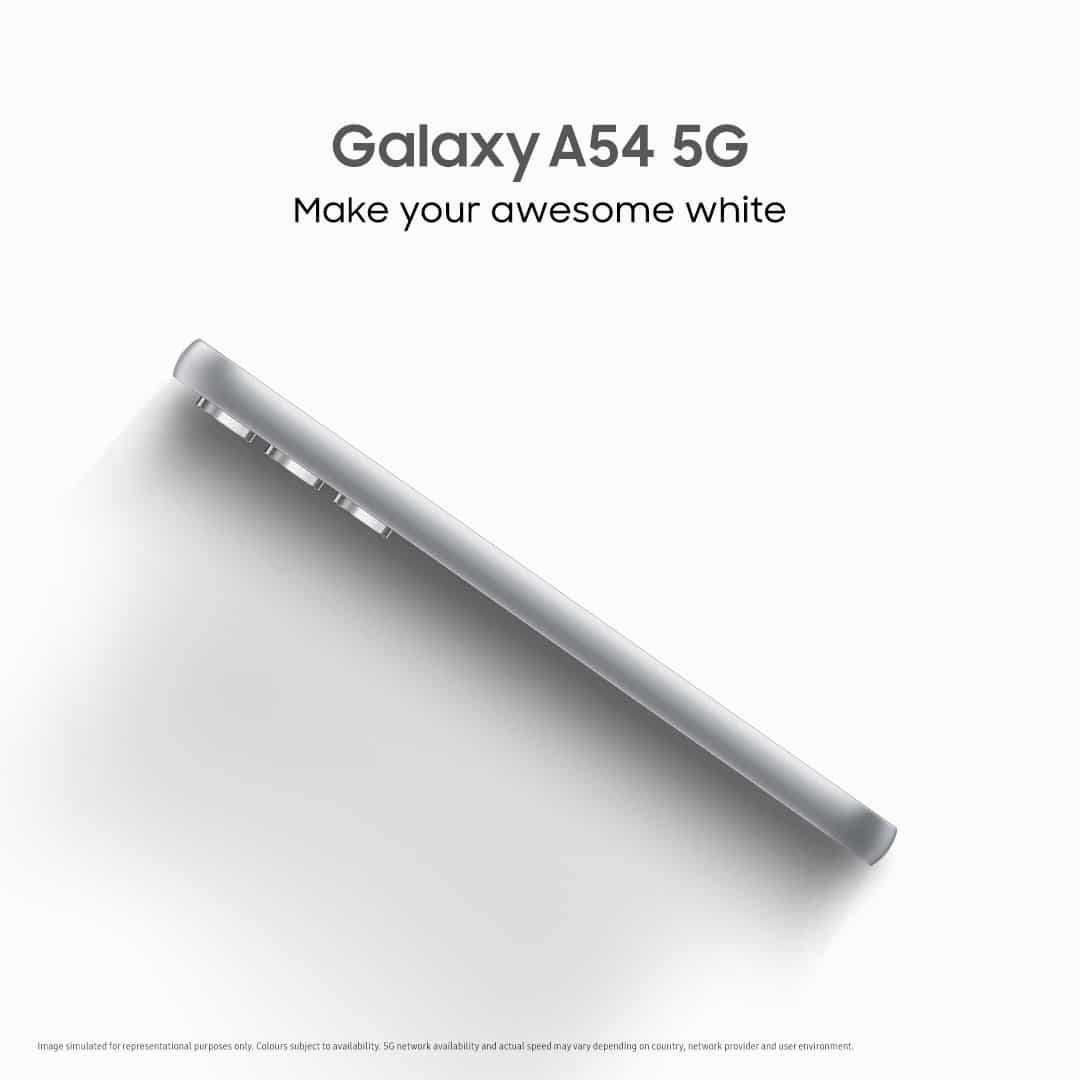
The Samsung Galaxy A54 5G runs Android 13 and is powered by a 5000mAh non-removable battery.
As far as the cameras are concerned, the Samsung Galaxy A54 5G on the rear packs a triple camera setup featuring a 50-megapixel primary camera; a 12-megapixel camera, and a 5-megapixel camera.
It has a single front camera setup for selfies, featuring a 32-megapixel sensor.
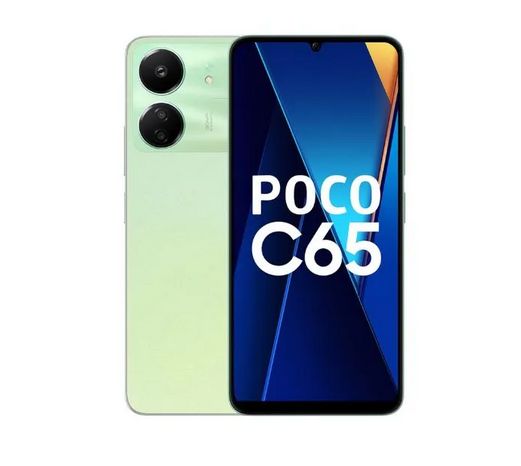
Currently retailing at ₹10,899,Poco M6 5G mobile was launched at the end of 2023and phone comes with a 90 Hz refresh rate 6.74-inch touchscreen display (HD+) at a pixel density of 260 pixels per inch (ppi). It has variants of 4GB, 6GB and 8GB of RAM.
The Poco M6 5G runs Android 13 and is powered by a 5000mAh non-removable battery. The Poco M6 5G supports proprietary fast charging.
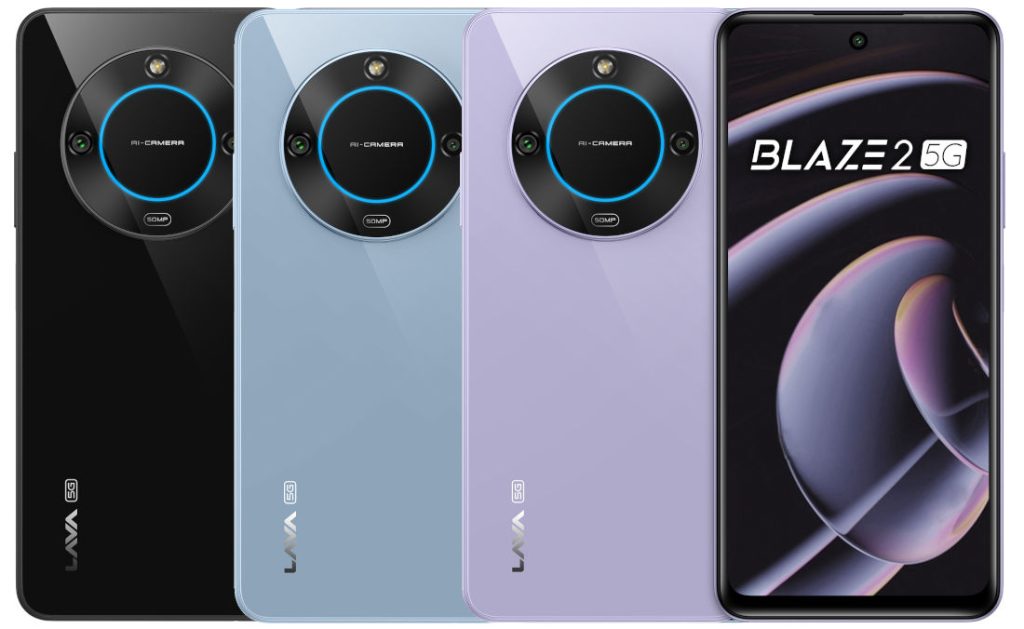
The Lava Blaze 2 5G runs Android 13 and is powered by a 5000mAh battery. The Lava Blaze 2 5G supports proprietary fast charging.
As far as the cameras are concerned, the Lava Blaze 2 5G on the rear packs a 50-megapixel camera.
It has a single front camera setup for selfies, featuring an 8-megapixel sensor.
Lava Blaze 2 5G is based on Android 13 and packs 64GB of inbuilt storage that can be expanded via microSD card (up to 1000GB).
The Lava Blaze 2 5G is a dual-SIM (GSM and GSM) mobile that accepts Nano-SIM and Nano-SIM cards.
Features
56″ (16.66 cm) 90Hz IPS LCD Display
MediaTek Dimensity 6020 Octa-core Processor
4 GB RAM | 64 GB Storage
Dual SIM: 5G & 5G Network
50+0.08 MP Rear Camera
8 MP Front Camera
5000 mAh
18W Fast Charging
Android v13 OS
Pros & Cons
Pros
Cons
● Smooth performance
● Bloat-free UI
● Good battery life
● Fast charging capability
● Mediocre display
● Average cameras
FAQs
How much maximum storage does the Pixel 7a have?
The Pixel 7a uses the Google Tensor G2 system-on-chip, with 8 GB of RAM and 128 GB of non-expandable UFS 3.1 internal storage.
Is the iPhone 13 waterproof?
The iPhone 13 is water-resistant. It has a rating of “IP68” which means it’s fully protected from dust and can handle being underwater for up to 30 minutes at a depth of 6 meters.
Is Lava Blaze 2 a 5G device or not?
Yes, Powered by an octa-core MediaTek Dimensity 6020 processor, Lava Blaze 3 is a 5 G-enabled device.
Does the Samsung A54 support wireless charging?
The Samsung Galaxy A54 5G does not support wireless charging. However, USB charging is supported by the Portable Battery Pack.
What is the starting price of the Lava Blaze 2 5G?
The Lava Blaze 2 5G is priced at Rs. 9,999 for its base variant.
What is unique about the Blaze 2 5G’s camera setup?
The smartphone introduces a segment-first Ring Light feature and is equipped with a 50MP Rear Camera and an 8MP front camera with screen flash.
What operating system does the Blaze 2 5G come with?
The device runs on AndroidTM 13, with a promised upgrade to Android 14, and offers two years of quarterly security updates.
What are the key design features of the POCO M6 5G?
The POCO M6 5G boasts a dual-tone design with an eye-catching Orion Blue gradient finish. It also features a rectangular black camera bar, housing a 50MP AI lens, and a comfortable, lightweight build.
How does the display of the POCO M6 5G perform?
The device comes with a 6.74-inch LCD screen offering HD+ resolution and a 90Hz refresh rate. It provides a decent visual experience, balancing color and brightness effectively for its price range.
What is the camera performance like on the POCO M6 5G?
The primary 50MP AI camera, supported by a 2MP depth sensor, delivers average daytime photos with a tendency for oversaturation and lack of sharpness. Low-light performance and selfie quality are modest, reflecting its entry-level positioning.
What are the performance capabilities of the POCO M6 5G?
Powered by the MediaTek Dimensity 6100+ SoC, the phone handles daily tasks and light gaming adequately. It comes with up to 8GB of RAM and 256GB of storage, providing sufficient capacity for most users.
What are the different variants and pricing of the POCO M6 5G?
The POCO M6 5G is available in three variants: 4GB RAM + 128GB storage at Rs 10,499, 6GB RAM + 128GB storage at Rs 11,499, and the 8GB RAM + 256GB storage variant at Rs 13,499.
What are the key specifications of the POCO M6 5G?
Key features include a MediaTek Dimensity 6100+ 5G SoC, a 6.74-inch HD+ 90Hz display, up to 16GB RAM, up to 256GB storage expandable to 1TB, a 50MP AI Dual Camera, and a 5000mAh battery with 33W charging.
What operating system does the POCO M6 5G run on?
The POCO M6 5G operates on Android 13 with Xiaomi’s MIUI 13 interface, offering users a customizable and user-friendly experience.
What are the main features of the POCO M6 5G’s display?
The smartphone sports a 6.74-inch HD+ screen with a 90Hz refresh rate, offering smooth and vibrant visuals.
The addition of Corning Gorilla Glass adds to the durability, protecting the display from daily wear and tear.
Can you elaborate on the camera capabilities of the POCO M6 5G?
The POCO M6 5G is equipped with a 50MP AI Dual rear camera, which is expected to deliver detailed and vibrant photos in various lighting conditions.
The phone also features a front-facing camera, which will be thoroughly tested in terms of selfie and video call quality in the upcoming detailed review.
What about the performance and battery life of the POCO M6 5G?
Powered by the MediaTek Dimensity 6100+ 5G SoC and up to 16GB RAM, the POCO M6 5G is poised to offer robust performance.
It houses a 5000mAh battery with 33W fast charging, suggesting a long battery life even with heavy usage. The device’s performance and battery efficiency will be further evaluated in the detailed review.
How does the camera setup of the POCO M6 5G enhance photography?
The POCO M6 5G boasts a 50MP AI dual camera setup, designed to capture high-quality images and videos.
The primary camera, paired with an AI lens, promises detailed and vibrant photography, catering to various shooting scenarios.
How do the displays of the POCO M6 and M6 Pro differ?
The POCO M6 sports a 6.74-inch HD+ display with a standard 90Hz refresh rate, suitable for typical smartphone usage.
The M6 Pro upgrades this experience with a slightly larger 6.79-inch FHD+ display, featuring an adaptive refresh rate that adjusts to content, enhancing both visual quality and battery performance.
What are the processing capabilities of the POCO M6 and M6 Pro?
The POCO M6 is equipped with MediaTek’s Dimensity 6100+ SoC, delivering reliable daily performance.
The M6 Pro, powered by the Qualcomm Snapdragon 4 Gen 2 SoC, provides a more potent performance, especially in more intensive tasks and gaming, owing to Qualcomm’s industry-leading efficiency and power management.
What is the starting price of the Samsung Galaxy A54 5G in India?
The Galaxy A54 5G is priced at Rs. 38,999 for the 8GB RAM + 128GB storage model.
How many colours were originally available for the Galaxy A54 5G, and what’s the new addition?
The phone was initially available in Awesome Lime, Awesome Violet, and Awesome Graphite. The ‘Awesome White’ is the latest addition.
What are the camera specifications for the Galaxy A54 5G?
It features a triple rear camera setup: 50MP primary, 12MP ultra-wide, and 5MP macro lens. The front houses a 32MP camera.
How many OS upgrades and security updates does Samsung promise for this device?
Samsung commits to four OS upgrades and five years of security updates for the Galaxy A54 5G.
What are Google Pixel 7a specifications &features?
* Display: The Google Pixel 7a features a 6.1-inch FHD+ OLED display with a 90Hz refresh rate, a punch-hole cutout for the selfie shooter, 429 PPI, Corning Gorilla Glass layer, always-on-display with At a Glance and Now playing features, HDR and a high-brightness mode.
* Processor: The Pixel 7a is powered by the Tensor G2 chipset and Titan M2 security chip.
* RAM and storage: The smartphone packs 8GB of LPDDR5 RAM and 128GB UFS 3.1 storage.
* OS: The Pixel 7a boots Android 13 OS out of the box. The company is promising 5 years of updates.
* Battery: The phone packs a 4,300mAh battery with fast charging support and Qi wireless charging as well.
* Cameras: As for the cameras, you will find a 64MP primary camera with f/1.89 aperture, 80-degree field of view and Super Res Zoom up to 8x and a 13MP ultra-wide-angle lens with f/2.2 aperture. There is a 13MP front camera for selfies and video chats.
* Camera features: The Pixel 7a will have support for Photo Unblur, Magic Eraser, Night Sight, Long Exposure, Real Tone, Face Unblur, Panorama, Manual white balancing, Top Shot, Portrait Mode, Super Res Zoom, and more.
* Connectivity: Pixel 7a features 5G, 4G LTE, dual-band Wi-Fi, Bluetooth 5.3, GPS, NFC, and a USB Type-C port for charging.
* Dimensions: The Pixel 7a measures 9mm X 152 x 72.9 width and weighs 193.5 grams.
* Others: The Google Pixel 7a has an in-display fingerprint sensor for security, stereo speakers, 2 microphones, an IP67 rating for dust and water resistance, and noise suppression.
What are Google Pixel 7a alternatives?
The Google Pixel 7a will compete with a few phones priced around Rs 40,000 in India, including Google’s own Pixel 7. Take a look:
* The OnePlus 11R touts a 120Hz OLED display, a powerful Snapdragon 8+ Gen 1 SoC, and 100W charging
* The Google Pixel 7 is priced slightly higher than the Pixel 7a and gets a lot of the same features. However, it offers a bigger 6.3-inch display.
* The Xiaomi 12 Pro gets a flagship-grade display with a 2K AMOLED panel and a 120Hz refresh rate. It also touts a super-fast 120W charging support.
Considering the iterative changes, is it worth upgrading from the iPhone 13 or 14 to the iPhone 15?
For those on older models like the iPhone X, XS, 11, or 12, the iPhone 15 promises a host of improvements.
However, for iPhone 13 or 14 users, the iPhone 15 offers more nuanced upgrades that might cater more to those looking for the latest tech than drastic user experience enhancements.
Apple iPhone SE 4 Specs
GENERAL
Sim Type
Dual Sim, GSM+GSM
Dual Sim
Yes
Sim Size
Nano+eSIM
Device Type
Smartphone
Release Date
March 8, 2024 (Expected)
DISPLAY
Type
Color OLED Screen (16M Colors)
Touch
Yes
Size
6.1 inches, 750 x 1580 pixels
Aspect Ratio
16:9
PPI
~ 441 PPI
Screen to Body Ratio
~ 65.4%
Features
1,400:1 Contrast Ratio (typical), True Tone Display, Wide Colour Display (P3), Haptic Touch, 625 nits Max Brightness
MEMORY
Storage
64 GB
Card Slot
No
CONNECTIVITY
GPRS
Yes
EDGE
Yes
3G
Yes
4G
Yes
5G
Yes
VoLTE
Yes
Wifi
Yes, with wifi-hotspot
Bluetooth
Yes, v5.3, A2DP, LE
USB
Yes, Lightning Port
USB Features
USB Charging
EXTRA
GPS
Yes, with A-GPS, GLONASS, GALILEO, QZSS, BEIDOU
Fingerprint Sensor
Yes, Front
Face Unlock
Yes
Sensors
Barometer, Three Axis Gyro, Accelerometer, Proximity Sensor, Ambient Light Sensor
3.5mm Headphone Jack
Lightning
NFC
Yes
Water Resistance
Yes
IP Rating
IP67
Dust Resistant
Yes
CAMERA
Rear Camera
12 MP f/1.8 with autofocus
Features
Deep Fusion, Smart HDR 4, Photographic Styles, Advanced Red-eye Correction, Auto Image Stabilisation, Burst Mode, Photo Geotagging
Video Recording
4K, 1080p
Flash
Yes, LED
Front Camera
10.8 MP f/2.2 with Retina Flash
Front Video Recording
1080p @ 30 fps FHD
TECHNICAL
OS
iOS v16
Chipset
Apple Bionic A15
CPU
3.22 GHz, Hexa Core Processor
Core Details
2×3.22 GHz Avalanche + 4xX.X GHz Blizzard
GPU
Apple GPU
Java
No
Browser
Yes
MULTIMEDIA
Email
Yes
Music
AAC, MP3, Apple Lossless, FLAC, Dolby Digital and Dolby Digital Plus
Also Read: Google Pixel 7a with 6.1-inch OLED display, Tensor G2 SoC, 64MP camera & IP67 water resistant body launched in India: Check price, Specifications, Offer’s & Features
Netflix Top 10: find out the most-watched shows in the world right now in both English and non-English categories.
New on Netflix: February 2024 – full list of shows and movies
New on Netflix: March 2024 – full list of shows and movies
Dive into the binge-worthy universe of Netflix’s Top 10!
This list of the most-watched shows captivating audiences worldwide is out now.
Keeping up the tradition of releasing the names of popular shows, Netflix announced the top 10 shows last week.
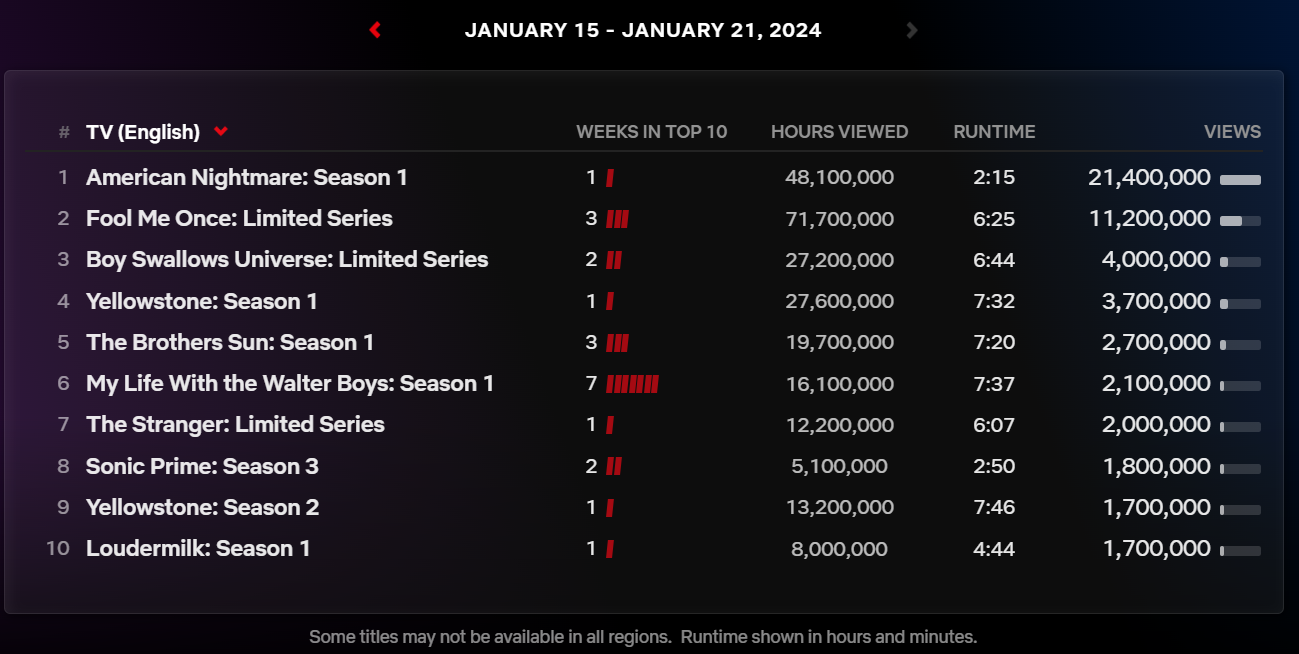
From the pulse-pounding suspense of “American Nightmare” with a staggering 21.4 million views to the heartwarming drama of “Boy Swallows Universe” at 4 million views, this curated list unveils the current streaming sensations.
Netflix Top 10: The Most-Watched Shows in the World Right Now
Whether you’re into family sagas like “Yellowstone” or the mind-bending twists of “The Stranger,” the popular shows this week have diverse flavours that make these shows a must-watch.
Prepare for a rollercoaster ride through the hottest picks on Netflix!
Netflix Top 10: The Most-Watched Shows in the World Right Now
Category – TV English
American Nightmare: Season 1
American Nightmare: Season 1
21.4M views
Synopsis – After a harrowing home invasion and kidnapping in 2015, a couple is accused of staging the ordeal when the woman reappears in this true-crime docuseries.
In 2015, California couple Aaron Quinn and Denise Huskins were attacked at home during the night.
After Denise was kidnapped, Aaron became a suspect.
Days later, Denise reappears seemingly unharmed and recalls the details of her terrifying abduction as doubts from authorities begin to swirl.
More attempted kidnappings lead detectives to a new — and unexpected — suspect. Aaron and Denise go head-to-head with the Vallejo Police Department.
Genre – Documentary
Fool Me Once: Limited Series
Fool Me Once: Limited Series
11.2M views
Synopsis – Follows Maya Stern who is trying to come to terms with the brutal murder of her husband, Joe.
But when Maya installs a nanny cam to keep an eye on her young daughter, she is shocked to see a man she recognises in her house.
Her husband, who she thought was dead… Detective Sergeant Sami Kierce leads the homicide investigation into Joe’s death while grappling with secrets of his own.
Meanwhile, Maya’s niece and nephew, Abby and Daniel, are trying to find the truth about their mother’s murder, several months earlier. Are the two cases connected?
Team – Created by bestselling author Harlan Coben, was directed by BAFTA Award winner David Moore (Outlander, The Last Kingdom) and adapted to a series by writer Danny Brocklehurst (Brassic, Come Home).
Fool Me Once stars Michelle Keegan, Richard Armitage, and BAFTA winners Adeel Akhtar and Joanna Lumley.
Genre – Thriller
Boy Swallows Universe: Limited Series
Boy Swallows Universe: Limited Series
4M views
Synopsis – Brisbane, 1985: a lost father, a mute brother, a junkie mum, a heroin dealer for a stepfather and a notorious crim for a babysitter.
It’s not as if Eli Bell’s life isn’t complicated enough already.
He’s just trying to follow his heart and understand what it means to be a good man, but fate keeps throwing obstacles in his way – not the least of which is Tytus Broz, a Brisbane drug dealer.
But now Eli’s life is going to get a whole lot more serious: he’s about to meet the father he doesn’t remember, break into Boggo Road Gaol on Christmas Day to rescue his mum, come face to face with the criminals who tore his world apart, and fall in love with the girl of his dreams.
Starring: Travis Fimmel, Phoebe Tonkin, Simon Baker
Genre – Drama
Yellowstone: Season 1
Yellowstone: Season 1
3.7M views
Synopsis – Yellowstone follows the Dutton family, led by John Dutton, who controls the largest contiguous ranch in the United States, under constant attack by those it borders – land developers, an Indian reservation, and America’s first National Park.
It is an intense study of a violent world far from media scrutiny – where land grabs make developers billions, and politicians are bought and sold by the world’s largest oil and lumber corporations.
Where drinking water poisoned by fracking wells and unsolved murders are not news: they are a consequence of living in the new frontier.
It is the best and worst of America seen through the eyes of a family that represents both
Starring: Kevin Costner, Luke Grimes, Kelly Reilly
Creators: Taylor Sheridan, John Linson
Genre – Drama
The Brothers Sun: Season 1
The Brothers Sun: Season 1
2.7M view
Synopsis – The series follows a Taipei gangster, Charles Sun, who’s settled into his life as a ruthless killer.
But when his father is shot by a mysterious assassin, Charles must go to L.A. to protect his mother and utterly unaware younger brother Bruce.
Starring: Michelle Yeoh, Justin Chien, Sam Song Li
Creators: Byron Wu, Brad Falchuk
Genre – Action
My Little Life with Walter Boys: Season 1
My Little Life with Walter Boys: Season 1
2.1M Views
Synopsis – After losing her family in a tragic accident, fifteen-year-old Manhattanite Jackie Howard leaves behind her privileged and proper life in New York and moves to rural Colorado to be with her guardian – her mother’s best friend, Katherine, who is raising ten kids with her husband, George.
While settling into her new, chaotic countryside home, Jackie is determined to stay focused on her dream of getting into Princeton…all while wrapping her head around her feelings for two very different Walter brothers: the reliable and bookish Alex, and the mysterious and troubled Cole. Will she be able to stay true to herself and still find romance?
Starring: Nikki Rodriguez, Sarah Rafferty, Marc Blucas
Genre – Drama
The Stranger: Limited Series
The Stranger: Limited Series
2M Views
Synopsis – The series will follow Adam Price, who seems to be living the perfect life – two great sons, and a watertight marriage.
A mysterious stranger, a woman in her 20s wearing a baseball cap, approaches Adam Price and tells him a secret. His wife goes missing as a result of the disclosure. As the story progresses, the stranger is revealed to be connected with more secrets.
Based on the 2015 Harlan Coben novel of the same title, the Stranger is an eight-episode British mystery thriller miniseries. It is written primarily by Danny Brocklehurst.
The miniseries premiered on Netflix on 30 January 2020 first. It stars Richard Armitage, Siobhan Finneran, and Hannah John-Kamen. It was filmed in and around Manchester and Stockport.
Starring: Richard Armitage, Siobhan Finneran, Jennifer Saunders
Creators: Harlan Coben
Genre – Drama
Sonic Prime: Season 3
Sonic Prime: Season 3
1.8M Views
Synopsis – When Nine steals the Paradox Prism to create a world all for himself, Sonic must team up with unlikely allies to protect the Shatterverse as he knows it.
The seven-part season brings its story to a satisfying conclusion thanks to fun action, well-executed animation, and solid growth from its lead character.
Sonic Prime Season 3 (2024) series stars Deven Mack Jr as Sonic The Hedgehog, Ashleigh Ball as Nine, Ian Hanlin as Big The Cat/ Froggy, Shannon-Chan Kent as Rusty Rose, Brian Drummond as Dr. Eggman, and, others.
Starring: Deven Mack, Ashleigh Ball, Brian Drummond
Genre – Animation
Yellowstone: Season 2
Yellowstone: Season 2
1.7M Views
Synopsis – In the second season of “Yellowstone,” the Dutton family faces escalating tensions as they strive to maintain control of their sprawling Montana ranch amidst external threats and internal conflicts.
John Dutton, the patriarch, continues to grapple with adversaries, including powerful land developers, Native American reservations, and an ambitious politician.
As the battles for land and power intensify, secrets are revealed, alliances are tested, and the Duttons must navigate treacherous waters to protect their legacy.
Against the backdrop of the majestic Yellowstone National Park, Season 2 delves deeper into the complexities of the Dutton family dynamics and the challenges that come with maintaining a stronghold in the ruthless world of ranching.
Starring: Kevin Costner, Luke Grimes, Kelly Reilly
Creators: Taylor Sheridan, John Linson
Genre – Drama
Loudermilk: Season 1
Loudermilk: Season 1
1.7M Views
Synopsis – Sam Loudermilk is a recovering alcoholic and substance abuse counsellor with a bad attitude.
Although he has his drinking under control, Loudermilk discovers that when your life is a mess, getting clean is the easy part.
A dark comedy straight out of the Ricky Gervaise playbook. A hole with a heart of gold and no filter for a lead character, check.
In January 2024, all 3 seasons of Loudermilk were licensed to be on both Netflix as well as Amazon Prime.
Previously, Amazon had acquired the rights to stream the series.
The series was originally released for the first time in March 2021 in the United States.
Starring: Ron Livingston, Will Sasso, Anja Savcic, Laura Mennell
Genre – Drama
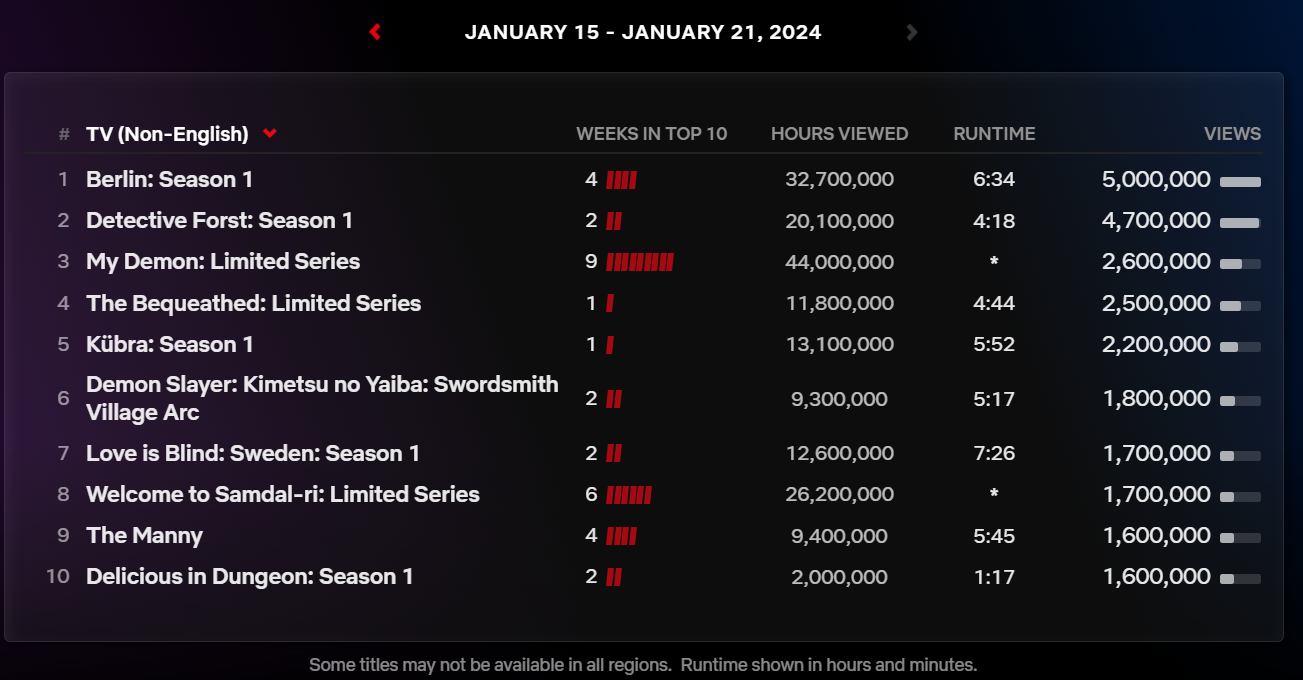
Netflix Top 10: find out the most-watched shows in the world right now in both English and non-English categories.
Category – Non-English
Berlin: Season 1
Detective Forst: Season 1
My Demon: Limited Series
The Bequeathed: Limited Series
Kubra: Season 1
Demon Slayer: Kimetse no Yaiba: Swordsmith Village Arc
Love is Blind: Sweden Season 1
Welcome to Samdal-ri: Limited Series
The Manny
Delicious in Dungeon: Season 1
New on Netflix: February 2024
New on Netflix: February 2024
As we are approaching the second month of the year, Netflix is also gearing to expand its library adding loads of new shows and movies.
Whether it is the highly-anticipated, eight-episode Avatar: The Last Airbender series or Best Picture Oscar winner “Everything Everywhere All at Once,” brace yourself for an exciting streaming time outlay for the coming month. Here’s what we are excited about –
Avatar: The Last Airbender
Avatar: The Last Airbender
This month, the highly anticipated live-action series, Avatar: The Last Airbender, takes centre stage on the streaming service.
Drawing inspiration from the beloved Nicktoon, this latest rendition reintroduces Aang, Katara, Sokka, and Zuko to audiences, vowing to stay true to the cartoon’s essence.
In stark contrast to the criticized M. Night Shyamalan movie, this adaptation is poised to deliver a faithful and immersive experience for fans, bringing the fantastical world of bending and adventure to life in a way that honours the source material.
Cast: Gordon Cormier, Dallas Liu, Kiawentiio, Ian Ousley, Paul Sun-Hyung Lee, Elizabeth Yu, Daniel Dae Kim
Genre – Action-adventure, Fantasy, Drama
Orion and the Dark
Orion and the Dark
New Netflix films making their way to the service include Orion and the Dark, an animated fairy tale featuring the voices of Jacob Tremblay, Paul Walter Hauser, and Werner Herzog. The film is set for release on Netflix on February 2, 2024.
Directed by Sean Charmatz (in his feature directorial debut), this animated fantasy adventure comedy film is written by Charlie Kaufman. The series is based on the children’s book of the same name by Emma Yarlett.
It is produced by DreamWorks Animation Television as their first original feature film.
Voice Cast – Jacob Tremblay, Colin Hanks, Paul Walter Hauser, Werner Herzog, Ike Barinholtz,
Gina Rodriquez, Tom Ellis, and Damon Wayans Jr. star in the new romantic comedy movie Players, which follows a group of friends who spend their time trying to make hook-up schemes.
Netflix is also set to expand its content library with a trove of beloved series and blockbuster films. Joining the lineup are the first four seasons of the fan-favourite“Brooklyn Nine-Nine,” the complete eight-season run of “Monk,” all three seasons of the action-packed “Warrior,” and the latest seasons of both “Young Sheldon” and “The Blacklist.”
Cast – Gina Rodriguez, Damon Wayans Jr., Tom Ellis, Joel Courtney, Augustus Prew, Liza Koshy, Ego Nwodim, Marin Hinkle
Genre – Rom-com
Genre – Rom-com
Movie enthusiasts can anticipate a cinematic feast with acclaimed titles such as “It,” “Moneyball,” “Fury,” “Tom and Jerry,” “The Great Gatsby,” “Magic Mike’s Last Dance,” “Southpaw,” “Ruby Gillman: Teenage Kraken,” and “Ready Player One.” Additionally, Netflix will feature a selection of A24 gems, including “X,” “Waves,” “Marcel the Shell with Shoes On,” and the Best Picture-winning sci-fi action comedy “Everything Everywhere All at Once.”
Apart from this, find everything coming on Netflix in February 2024 below.
Full List of What’s Coming to Netflix in February
Full List of What’s Coming to Netflix in February:
Coming Soon
Detective Forst (NETFLIX SERIES)
The Indrani Mukerjea Story: Buried Truth (NETFLIX DOCUMENTARY)
February 1
¡Sálvese quien pueda! (NETFLIX SERIES)
American Assassin
Anaconda
Enough
Fury
The Great Gatsby (2013)
How to Train Your Dragon 2
It (2017)
Magic Mike’s Last Dance
Moneyball
The Other Boleyn Girl
Pacific Rim
Resident Evil
Resident Evil: Retribution
W.A.T.: Under Siege
Shot Caller
Something’s Gotta Give
Tom and Jerry (2021)
X
Young Sheldon: Season 6
February 2
Let’s Talk About CHU (NETFLIX SERIES)
Orion and the Dark (NETFLIX FAMILY)
Plus One
February 3
Ready Player One
February 5
30 for 30: Four Falls of Buffalo
30 for 30: Nature Boy
Dee & Friends in Oz
Monk: Seasons 1-8
My Wife and Kids: Seasons 1-5
The Re-Education of Molly Singer
February 7
Love Never Lies Poland: Season 2 Part 2 (NETFLIX SERIES)
Luz: The Light of the Heart (NETFLIX FAMILY)
Raël: The Alien Prophet (NETFLIX DOCUMENTARY)
February 8
One Day (NETFLIX SERIES)
February 9
A Killer Paradox (NETFLIX SERIES)
Alpha Males: Season 2 (NETFLIX SERIES)
Ashes (NETFLIX FILM)
Bhakshak (NETFLIX FILM)
Lover, Stalker, Killer (NETFLIX DOCUMENTARY)
February 10
Horrible Bosses 2
February 11
The Blacklist: Season 10
February 13
Kill Me If You Dare (NETFLIX FILM)
Sunderland ‘Til I Die: Season 3 (NETFLIX DOCUMENTARY)
Taylor Tomlinson: Have It All (NETFLIX COMEDY)
February 14
A Soweto Love Story (NETFLIX FILM)
Good Morning, Verônica: Season 3 (NETFLIX SERIES)
The Heartbreak Agency (NETFLIX FILM)
Love Is Blind: Season 6 (NETFLIX SERIES)
Players (NETFLIX FILM)
February 15
AlRawabi School for Girls: Season 2 (NETFLIX SERIES)
The Catcher Was a Spy
Crossroads
House of Ninjas (NETFLIX SERIES)
Little Nicholas: Life of a Scoundrel (NETFLIX DOCUMENTARY)
Ready, Set, Love (NETFLIX SERIES)
The Vince Staples Show — NETFLIX SERIES
February 16
The Abyss (NETFLIX FILM)
Comedy Chaos (NETFLIX SERIES)
Einstein and the Bomb (NETFLIX DOCUMENTARY)
Warrior: Seasons 1-3
February 19
Little Angel: Volume 4
Rhythm + Flow Italy (NETFLIX SERIES)
February 20
Mike Epps: Ready to Sell Out (NETFLIX COMEDY)
Ruby Gillman, Teenage Kraken
February 21
Can I Tell You A Secret? (NETFLIX DOCUMENTARY)
February 22
Avatar: The Last Airbender (NETFLIX FAMILY)
Southpaw
February 23
Everything Everywhere All at Once
Formula 1: Drive to Survive: Season 6 (NETFLIX DOCUMENTARY)
Mea Culpa (NETFLIX FILM)
Through My Window: Looking at You (NETFLIX FILM)
February 24
The 30th Annual Screen Actors Guild Awards (NETFLIX LIVE EVENT)
Marcel the Shell with Shoes On
The Real World: Season 9
February 26
Blippi Wonders: Season 3
Brooklyn Nine-Nine: Seasons 1-4
Rhythm + Flow Italy (NETFLIX SERIES) (new episodes)
February 28
American Conspiracy: The Octopus Murders (NETFLIX DOCUMENTARY)
The Mire: Millennium (NETFLIX SERIES)
Code 8 Part II (NETFLIX FILM)
February 29
A Round of Applause (NETFLIX SERIES)
The Tourist: Season 2 (NETFLIX SERIES)
Full List of What Netflix is Removing in February
February 1
Arctic
Black Christmas
Black Swan
DC League of Super-Pets
Downsizing
Eagle Eye
Green Lantern
Guilty
Heat
How Do You Know
How to Train Your Dragon
In the Line of Fire
Murder on the Orient Express
National Champions
Scott Pilgrim vs. the World
Sherlock Gnomes
Taken
Taken 2
The Addams Family
The Mortal Instruments: City of Bones
The One
The Wife
The Wretched
Who Am I
Zig & Sharko (Season 3)
February 4
Doob: No Bed of Roses
The Ultimate Braai Master (Season 7)
February 5
The Informer
The Ultimate Braai Master (Season 1)
February 6
Bangkok Love Stories: Innocence (Season 1)
Sons of the Caliphate (2 Seasons)
February 8
Meet the Adebanjos (Seasons 1, 2, 3)
February 10
Prisoners
February 11
Father Stu
Goosebumps
Mundina Nildana
February 12
The Is the Life
February 13
Christine
Sleepless Society: Insomnia
February 15
Ayana
Chicken Run
Prometheus
Real Steel
February 16
Last Man Down
The Resurrection of Gavin Stone
February 17
Pahuna
Versailles (Season 3)
February 20
Kevin James: Sweat the Small Stuff
Operation Finale
February 21
Zindagi in Short
February 24
Married at First Sight (Season 12)
The Real World
February 27
19-2 (Seasons 1, 2, 3)
Million Pound Menu (Season 1, 2)
Unsolved: Tupac & Biggie (Season 1)
February 28
American Pickers
February 29
Babylon Berlin (Seasons 1, 2, 3)
Morbius
Snowpiercer
The Farewell
The Last Black Man in San Francisco
What’s Coming to Netflix on March 1st
What’s Coming to Netflix on March 1st
21 Bridges (2019) – Action movie starring Chadwick Boseman
Aníkúlápó: Rise of the Spectre (Season 1) Netflix Original – Yoruba drama.
A Madea Family Funeral (2019) – This was Tyler Perry’s last Madea movie… well, until he jumped over to Netflix anyway!
Beverly Hills Ninja (1997) – Comedy starring Chris Farley
Bonnie & Clyde (1967) – Classic movie.
Devil in a Blue Dress (1995)
Dragon Quest: The Adventure of Dai (2020)
Dumb and Dumber (1994) – Comedy starring Jim Carrey and Jeff Daniels.
Fear (1996) – Mystery thriller starring Mark Wahlberg.
Furies (Season 1) Netflix Original – Crime thriller series from France.
Godzilla (2014) – The classic Japanese monster comes to our screens in this American adaptation.
Love & Basketball (2000) – Sports romance movie.
Maamla Legal Hai (Season 1) Netflix Original – Bollywood series.
My Little Pony: Tell Your Tale (Season 2)
My Name is Loh Kiwan (2024) Netflix Original – South Korean drama about a North Korean defector who fights for refugee status in Belgium.
Out of Africa (1985) – Romance starring Meryl Streep and Robert Redford.
Shake, Rattle & Roll Extreme (2023) – Indonesian horror anthology movie.
Spaceman (2024) Netflix Original – Adam Sandler headlines this new sci-fi movie based on an excellent book. He plays an astronaut who is his country’s first to head to space.
Somebody Feed Phil (Season 7) Netflix Original – Latest season of the food/travel docu-series presented by Philip Rosenthal.
Step Brothers (2008) – Comedy starring Will Ferrell.
The Amazing Spider-Man Collection:
The Amazing Spider-Man
The Amazing Spider-Man 2
The Disaster Artist (2017) – Comedy following the development of the movie: The Room.
The Gift (2015) – Thriller starring Jason Bateman.
The Great Debaters (2007) – Set in the mid-1930s, this biopic tells the story of a teacher pushing his high school debate team to greatness. Stars Denzel Washington.
The Jamie Foxx Show (Seasons 1-5) – Classic sitcom about a struggling entertainer living and working at his aunt and uncle’s in Hollywood.
Think Like a Man (2012)
Think Like a Man Too (2014) – Rom-com starring Kevin Hart about a romantic weekend in Las Vegas that escalates into insanity with the men and women trying to outdo each other.
Turbo (2013) – DreamWorks animated movie featuring the voices of Ryan Reynolds and Paul Giamatti.
Wanderlust (2012) – Ensemble comedy about a couple who moves to Atlanta. Starring Jennifer Anniston and Paul Rudd.
Vampires (1998)
Voyagers (2021) – Colin Farrell features in this sci-fi movie from director Neil Burger. About an expedition to a distant planet that goes awry when the passengers discover they’re being drugged.
Yesterday (2019) – Danny Boyle’s musical movie serving as an homage to The Beatles about a young musician who becomes a pop sensation.
What’s Coming to Netflix on March 3rd
Netflix Slam (2024)
The Netflix Slam (2024) Netflix Original – LIVE – Rafael Nadal will face off against Carlos Alcaraz in Las Vegas.
What’s Coming to Netflix on March 4th
Hot Wheels Let’s Race (Season 1)
Hot Wheels Let’s Race (Season 1) Netflix Original – Mattel is bringing its classic toys to Netflix with a new series.
The Resident (Seasons 1-6) – Medical drama that first aired on sports and ran for 107 episodes.
The Program: Cons, Cults, and Kidnapping (Limited Series) Netflix Original – Investigative docuseries about a woman still haunted by her experience in the world of troubled teens.
What’s Coming to Netflix on March 6th
Full Swing (Season 2) Netflix Original
Full Swing (Season 2) Netflix Original – Return of the Golfing documentary series.
SuperSex (Season 1) Netflix Original – Italian 7-episode biopic series on the life of Rocco Siffredi.
What’s Coming to Netflix on March 7th
I Am Woman (2019)
I Am Woman (2019) – Musical romance movie from Tilda Cobham-Hervey. Pokémon Horizons: The Series (Season 1) Netflix Original – The latest season of the anime based on the card-trading game with an all-new cast.
The Gentlemen (Season 1) Netflix Original – Guy Ritchie’s debut Netflix series that’s set in the world he excellently established with the movie.
The Signal (Limited Series) Netflix Original – German drama series about a scientist who goes missing from the International Space Station.
Thomas & Friends: All Engines Go (Season 3)
What’s Coming to Netflix on March 8th
Blown Away (Season 4) Netflix Original
Blown Away (Season 4) Netflix Original – New season of the reality series.
Damsel (2024) Netflix Original – Millie Bobby Brown headlines this new fantasy movie where she plays a damsel who decides to take fate into her own hands with a fire-breathing dragon hunting her down.
To Kill a Tiger (2024) Netflix Original – Oscar-nominated Indian documentary about a man and his teen daughter who survives a harrowing crime.
What’s Coming to Netflix on March 9th
Queen of Tears (Season 1) Netflix Original
Queen of Tears (Season 1) Netflix Original – K-drama series.
What’s Coming to Netflix on March 10th
Eye Love You (Season 1) – Japanese drama series.
What’s Coming to Netflix on March 11th
CoComelon (Season 10)
CoComelon (Season 10)
Young Royals (Season 3) Netflix Original – Episodes 1-5 of the final season of the Swedish coming-of-age drama series.
What’s Coming to Netflix on March 12th
Miraculous: Tales of Ladybug & Cat Noir (Season 6)
Miraculous: Tales of Ladybug & Cat Noir (Season 6) – Newest season of the animated superhero series for kids.
Miraculous World: New York, United Heroez (2020) – Animated kids special.
Steve Trevino: Simple Man (2024) Netflix Original – Stand-up comedy special.
Turning Point: The Bomb and the Cold War (Limited Series) Netflix Original – 9-part series directed by Brian Knappenberger that retells the entire Cold War.
What’s Coming to Netflix on March 13th
Bandidos (Season 1
Bandidos (Season 1) Netflix Original
) Netflix Original – Mexican drama series about a gang of skilled misfits venturing the uncover long-hidden Mayan treasures.
What’s Coming to Netflix on March 14th
24 Hours with Gaspar (2024) Netflix Original
24 Hours with Gaspar (2024) Netflix Original – Indonesian dystopian crime drama.
Art of Love (2024) Netflix Original – Turkish film about a policeman working in Interpol’s Art Crime Unit who tracks down a famous thief who’s motives are unclear.
Barbie & Stacie to the Rescue (2024) – Animated film.
From Dreams to Tragedy: The Fire That Shook Brazilian Football (2024) Netflix Original – Sports documentary.
Girls5Eva (Seasons 1-2) – The Peacock Original series about a group of popstars who had a one-hit wonder in the 1990s reuniting to try and make it big again.
Girls5Eva (Season 3) Netflix Original – The latest season of the comedy that’s coming to Netflix exclusively with them heading on tour this season.
Red Ollero: Mabuhay Is A Lie (2024) Netflix Original – Stand-up comedy special. Tyson’s Run (2022) – Kim Bass directs this film about a young autistic man who befriends champion marathon runner Aklilu
What’s Coming to Netflix on March 15th
Cat and Dog (2024)
Cat and Dog (2024) – French-Canadian family comedy movie.
Chicken Nugget (Season 1) Netflix Original – Korean series about a father and admirer of a woman looking for answers after she becomes a chicken nugget.
Guide to Prepare for Separation
Irish Wish (2024) Netflix Original – Lindsay Lohan returns to Netflix for her second major film where she’ll be starring alongside Ed Speleers.
Mister America (2019) – Mockumentary from Eric Notarnicola. About a man mounting a political campaign to unseat the San Bernardino district attorney.
Murder Mubarak (2024) Netflix Original – Indian Bollywood film about a gym trainer who is murdered at an elite Dehli club.
The Guv’nor (2016) – Documentary on the live of Lenny McLean.
The Outreau Case: A French Nightmare (Limited Series) Netflix Original – Courtroom docu-series about one of the biggest scandals in French history.
What’s Coming to Netflix on March 16th
Judge Dee’s Mystery (Season 1)
Judge Dee’s Mystery (Season 1) – New Episodes Weekly – Historical detective series from China.
What’s Coming to Netflix on March 17th
New 30 for 30 Sports Documentaries
New 30 for 30 Sports Documentaries: 30 for 30: I Hate Christian Laettner 30 for 30: Survive and Advance 30 for 30: The Fab Five
What’s Coming to Netflix on March 18th
Love & Hip Hop: New York (Seasons 1-2)
Love & Hip Hop: New York (Seasons 1-2) – Reality series.
Vida the Vet (Season 1) – British animated kids series. Young Royals (Season 3) Netflix Original – Season finale. Young Royals Forever (2024) Netflix Original – Documentary on the making of the hit Swedish series.
What’s Coming to Netflix on March 19th
Forever Queens (Season 2) Netflix Original
Brian Simpson: Live from the Mothership (2024) Netflix Original – Stand-up comedy special.
Forever Queens (Season 2) Netflix Original – Mexican drama series.
Physical: 100: Season (Season 2) Netflix Original – Korean competition reality series.
What’s Coming to Netflix on March 20th
Bodies Bodies Bodies (2022)
Bodies Bodies Bodies (2022) – A24’s ensemble thriller where a group of rich
twentysomethings meet at a remote mansion which soon turns into a slaughter.
Homicide: New York (Season 1) Netflix Original – From the creator of Law & Order comes to a new docu-series that follows detectives and prosecutors revisiting their biggest cases.
There’s Something in the Barn (2023) – Horror comedy about a killer gnome that’s on the loose. SVOD debut.
What’s Coming to Netflix on March 21st
3 Body Problem (Season 1) Netflix Original
3 Body Problem (Season 1) Netflix Original – The ambitious new sci-fi series from David Benioff and D.B. Weiss
Andragogy (2023) – Featured at TIFF 2023, this doc looks into the negative impact social media and cancel culture can have on people’s lives.
What’s Coming to Netflix on March 22nd
Buying Beverly Hills (Season 2) Netflix Original
Buying Beverly Hills (Season 2) Netflix Original – Return of the reality series.
El paseo 7 (2023) – Colombian comedy.
On The Line (2022) – Thriller starring Mel Gibson.
Shirley (2024) Netflix Original – Regina King plays the late senator Shirley Chisholm, who was the first Black woman to hold an office.
The Casagrandes (2024) Netflix Original – New Nickelodeon movie serves as a continuation of the classic Nick series that is itself a spin-off of The Loud House.
What’s Coming to Netflix on March 25th
Gabby’s Dollhouse (Season 9) Netflix Original
Gabby’s Dollhouse (Season 9) Netflix Original – Newest season of the DreamWorks Television hybrid series.
Polly Pocket (Season 5) – Animated kids series.
What’s Coming to Netflix on March 26th
Dave Attell: Hot Cross Buns (2024) Netflix Original
Dave Attell: Hot Cross Buns (2024) Netflix Original – Stand-up comedy special.
What’s Coming to Netflix on March 27th
Bad Exorcist: Easter (2024) Netflix Original
Bad Exorcist: Easter (2024) Netflix Original
Rest In Peace (2024) Netflix Original – Argentinian crime drama movie.
Testament: The Story of Moses (Limited Series) Netflix Original – Docudrama on the Story of Moses.
The Accountant (2016) – Ben Affleck stars in this action thriller.
The Believers (Season 1) Netflix Original – Thai crime drama.
The Conners (Seasons 1-5) – Comedy sitcom series starring John Goodman about a working-class family facing everyday life.
What’s Coming to Netflix on March 28th
Entre Tierras (Season 1)
Entre Tierras (Season 1) – Spanish drama series about an Andalusian woman in the 1960s who accepts a marriage proposal from a Manchegan to provide for her family – with unexpected results.
When You Finish Saving The World (2023) – A24 Release – The SVOD premiere of the drama starring Julianne Moore and Finn Wolfhard.
What’s Coming to Netflix on March 29th
Heart of the Hunter (2024) Netflix Original
Heart of the Hunter (2024) Netflix Original – South African thriller about when a former hitman’s ally reveals a plot within the South African government’s ranks.
Is It Cake? (Season 3) Netflix Original – Gameshow presented by Mikey Day asking a very simple question.
The Beautiful Game (2024) Netflix Original – Bill Nighy stars in this new British movie about The Homeless World Cup.
The Wages of Fear (2024) Netflix Original – French remake of the classic movie from director Julien Leclercq. About a team that has 24 hours to transport two trucks of explosives across an unforgiving landscape.
Upcoming Kapil Sharma’s Comedy Show (Season 1) Netflix Original – Indonesian sitcom.
What’s Coming to Netflix on March 30th
Vikings (Seasons 1-6)
Vikings (Seasons 1-6) – The historical drama series following Ragnar Lothbrok, the greatest hero of his age.
What’s Coming to Netflix on March 31st
Kill Bill Movie Collection
Kill Bill Movie Collection: Kill Bill: Vol. 1 (2003) Kill Bill: Vol. 2 (2004) Martin (Seasons 1-5) – Classic comedy sitcom starring Martin Lawrence.
The Hunger Games Movie Collection: The Hunger Games (2012) The Hunger Games: Catching Fire (2013) The Hunger Games: Mockingjay – Part 1 (2014) The Hunger Games: Mockingjay – Part 2 (2015)
FAQs
Q1. Why does my Netflix not show the top 10?
Answer. The top 10 lists may not appear if a TV show or movie in the list has a maturity rating that isn’t allowed or is restricted by your Netflix profile’s settings. You can change your profile’s allowed maturity rating and other parental controls from the profile and parental controls settings of your account.
Q2. How does Netflix choose the top 10?
Answer. Netflix is overhauling the way it calculates its top 10 shows and movies. Instead of ranking popular titles by total viewing time, the company said that now it will rank them based on “views”. It defines these “views” as the number of hours viewed divided by the total runtime.
Q3. How does Netflix calculate viewership?
Answer. Netflix’s equation for calculating views — total time divided by run time — isn’t new: The Hollywood Reporter has occasionally employed it to contextualize total viewing time data going back more than two years.
Q4. Which series is No. 1 on Netflix?
Answer. American Nightmare Season 1 (2024) The newest true crime obsession on Netflix is American Nightmare.
Q5. What is the most successful Netflix series?
Answer. Most Successful Netflix Shows Of All Time Include –
Squid Game Is Still Being Talked About.
Stranger Things Is The Most Popular Series On Netflix.
Intuitive gesture-based searches directly on your screen.
Available on Pixel 8, Pixel 8 Pro, and Galaxy S24 series.
Enhances shopping, learning, and travel planning with simple circling.
Prioritises privacy and minimal performance impact on devices.
Google is always looking at innovative ways to make searching easier on the internet.
With the Galaxy S24 series launch, Google, in collaboration with Samsung, did exactly that with its new Circle to Search feature.
This feature, designed to redefine the way we search for information on our smartphones, promises a more intuitive and less interruptive user experience.
Circle to Search is an advanced feature that allows users to initiate searches directly from their screen with simple gestures,such as circling, highlighting, scribbling, or tapping on the content of interest.
This approach is aimed at simplifying the process of obtaining information without needing to exit the application or disrupt the current workflow.
It caters to a variety of content types, including text, images, and even items within videos.
How Circle to Search Enhances User Interaction
How Circle to Search Enhances User Interaction
Gesture-based interaction is at the core of Circle to Search, offering a fresh and engaging way to access information.
By simply drawing around the subject of interest, users can instantly fetch relevant data, articles, images, and shopping links.
The Galaxy S24 Ultrawas the perfect test subject thanks to its stylus input which could provide precision circles around objects that the user was interested in.
Diverse Applications and Use Cases
Diverse Applications and Use Cases
If it wasn’t abundantly clear before, Circle to Search is about transforming how we interact with digital content daily.
Here are some practical applications:
Instant Shopping: See an item you like in a video or photo? A quick circle can lead you to stores where you can purchase it or find similar products.
Learning and Exploration: Encounter an unfamiliar term or concept? Circle it to access definitions, explanations, or related information instantly.
Travel Inspiration and Planning: Spot a destination that catches your interest? Circle it for travel tips, attractions, and dining options in the area.
Quick Comparisons: Comparing products or services becomes effortless, as circling items on-screen can bring up comparative data, reviews, and prices in seconds.
Integrating with Android Devices
Initially available on the Pixel 8, Pixel 8 Pro, and the Samsung Galaxy S24 series, Circle to Search is set to expand its reach. This integration highlights the collaboration between Google and Samsung, aiming to push the boundaries of what’s possible with Android devices.
The feature’s implementation into the Android ecosystem suggests a future where gesture-based searches become a standard across multiple devices, enhancing accessibility and user satisfaction.
Technical and Privacy Considerations
Technical and Privacy Considerations
Implementing such a feature requires careful consideration of privacy and data security.
The developers behind Circle to Search have emphasised the importance of user consent and data protection, ensuring that searches are conducted securely and privately.
Moreover, the feature is designed to be efficient, with minimal impact on device performance or battery life, making it a practical addition to everyday mobile use.
Future Prospects
Future Prospects
The introduction of Circle to Search is just the beginning.
As technology evolves, we can anticipate further enhancements to this feature, including improved accuracy, broader gesture recognition capabilities, and integration with a wider range of apps and services.
Circle to Search allows users to search for information by circling, highlighting, or tapping content on their screen, streamlining the process of obtaining information without leaving their current app or workflow.
How do I use Circle to Search?
To use Circle to Search, simply draw a circle around the text, image, or item in a video you’re interested in. Relevant search results, including articles, images, and shopping links, will be instantly displayed.
On which devices is Circle to Search available?
Initially, Circle to Search is available on the Google Pixel 8, Pixel 8 Pro, and Samsung Galaxy S24 series, with plans to expand to other Android devices in the future.
What can I search for with Circle to Search?
Circle to Search supports a wide range of content types, including text, images, and video items. It can be used for instant shopping, learning, travel planning, and making quick comparisons.
How does Circle to Search handle privacy and data security?
The development team has emphasized the importance of privacy and data security, ensuring searches are conducted securely with user consent and minimal data collection, safeguarding user privacy.
What are 5 ways to use Circle to Search ?
1. Shop what you see
Circle to Search can help you discover more about items you see, and shop for them whenever and wherever inspiration strikes.
So if you see someone wearing a unique, patterned top or spot a beautifully designed rotating cake stand online, long press the home button or navigation bar, and circle or scribble the items you’re interested in. From there, you can shop the same or similar options from retailers across the web.
2. Look up a word or phrase
With Circle to Search, it’s easy to look up definitions of words or phrases. Say you’re watching a video featuring a drink with the word “prebiotic” on it, but you aren’t quite sure what that means — or how it’s different from “probiotic.”
Usually, you would have to leave where you are and search for the word. Now, just long press the home button or navigation bar to activate Circle to Search and highlight “prebiotic” to learn more about it. When you’re done, just swipe away and resume the video.
3. Get travel inspiration
Circle to Search can even give you ideas for your next trip. Maybe you come across a video or social media post of someone exploring a city, and you spot a uniquely designed building.
Previously, you might have taken a screenshot and switched apps to search it, typed out a description or scrolled through the comments to try and find out what it was. With Circle to Search, simply scribble over the building to quickly identify it (and maybe add it to your own travel itinerary).
4. Compare options
Now you can easily compare options without leaving your screen. Say you’re texting with friends to decide where to eat.
They send you two different restaurant options, but you’re not familiar with either. Instead of switching between your text thread and an app to look them up, long press the home button or navigation bar and highlight one of the restaurant’s names. Without leaving your messaging app, you’ll see the restaurant’s menu, photos of popular dishes, customer reviews and its location.
Once you’ve looked at both options, just swipe away and let the group know which spot you’re craving.
5. Ask more complex questions
Circle to Search not only gives you quick information, it can give you AI-powered overviews (available in select countries).
Let’s say you’ve come across several social media posts with interesting-looking corn dogs, and you want to know why these delicious treats are trending. You can use Circle to Search to look them up and ask a more nuanced question, like “Why are these so popular?”
You’ll quickly learn that these are Korean corn dogs and understand why they’re trending through helpful information that’s pulled together from across the web. Once you’re done, you can swipe away and get right back to scrolling.
How to get Circle to Search feature and use it to search anywhere ?
All you have to do is set up Google Assistant on your Android phone and you are all set.
Once your Google Assistant is set up properly, simply start using the apps as you do.
The moment you feel like looking up something on the screen, say Hey Google or Ok Google and tap on the “Screen Search” option or “say Screen Search”.
Google Assistant will trigger the search by scanning the content of the current screen. You can then tap any area on the screen to highlight it and Google will search it for you to give the relevant result.
How to Use Circle to Search on Your Android Phone ?
Whether you use gesture navigation or 3-button navigation on your Pixel 8 or Galaxy S24, you can follow these steps to take advantage of Circle to Search:
Long-press the gesture navigation bar or the Home button on your phone.
This will show a prompt about Circle to Search and how to use it.
Tap the Try it now button.
Now, tap the subject or draw a circle around it to look up using Google.
You can also drag a line to highlight text for a Google search. Don’t worry about being perfect; it’s possible to adjust the circle or line later.
A Google search popup will appear with the search results. This can be text-based or image-based, depending on the subject.
After invoking Circle to Search, you can use the two-finger pinch gesture to zoom in on a subject. Further, you can refine the results by entering additional search terms in the search bar.
To return to the app you were using, swipe down from the top of the search window, press the back button, or tap the X button in the top-left corner.
For safety reasons, you cannot use Circle to Search in banking and other secure apps.
To view your Circle to Search history or delete the last 15 minutes of your activity, tap the three dots icon at the top-right corner of the Circle to Search screen and select the relevant option.
How to Disable Circle to Search?
If you don’t like the Circle to Search gesture or keep accidentally triggering it, you can turn it off on your Pixel by following these steps:
Open Settings on your phone.
Navigate to Display > Navigation mode > Gesture Navigation.
Turn off the Hold handle to search option.
On Galaxy phones, you can toggle off Circle to Search by heading to Settings > Display > Navigation bar.
If you frequently switch between apps to run a Google search, this Circle to Search feature will make your life easier. It’s an excellent addition to Android that makes searching for items displayed on your phone’s screen much easier and quicker.
While I am not involved in professional sound mixing, I am aware that several consumers in the industry have a history of utilsing Sennheiser headphones for production and DJing.
My expectations were high, driven by my positive experiences with Sennheiser’s more consumer-friendly options.
So I am reviewing the Sennheiser HD 490 PRO+ as a casual user and not a professional user.
Pros and Cons
Pros
Cons
Balanced sound
Not casual-friendly
Ultra-comfortable
Slightly higher price point
Lightweight build
Advanced plugin
Sennheiser HD 490 PRO+ Review: Key Specifications
Sennheiser HD 490 PRO+ Review: Key Specifications
Type: Open-back, over-ear headphones
Frequency Response: Unspecified, designed for flat, uncolored sound reproduction
Impedance: Not specified
Accessories: Two sets of washable, replaceable ear pads, Dear Reality dearVR MIX-SE plugin
Weight: Remarkably lightweight (exact weight not specified)
Design Features: Sennheiser Open-frame Architecture, innovative low-frequency cylinder system
Sennheiser HD 490 PRO+ Review: Unboxing
Sennheiser HD 490 PRO+ Review: Unboxing
Unboxing the Sennheiser HD 490 Pro+ reveals a hardcover case and the headphones.
The case is designed for protection during transit.
Inside the case, you find the headphones and a 3m semi-coiled cable.
The box also contains an extra headband pad, a 3.5mm to 6.3 mm jack adapter, and two sets of ear pads.
Unique to the Pro+ is an unlock code for the dearVR Mix SE plugin.
Sennheiser HD 490 PRO+ Review: Unboxing Video
Sennheiser HD 490 PRO+ Review: Design, Build, and Comfort
Sennheiser HD 490 PRO+ Review: Design
The HD 490 PRO+ impresses with its incredibly lightweight construction right out of the box.
Its open-back design is a significant contributor to both the headphones’ physical lightness and the spacious soundstage they project, providing a listening experience that’s as expansive as it is detailed.
Again, this feedback is from a casual consumer point of view.
I’m sure users with a professional studio will have a much more detailed outlook on the headphones.
Sennheiser HD 490 PRO+ Review: Comfort
What I can say for sure though is that Sennheiser’s commitment to comfort is evident in the HD 490 PRO+.
The precision-engineered ergonomics eliminate pressure points, allowing for prolonged use without discomfort.
The inclusion of two sets of ear pads—one velour and one standard—offers options for comfort and sound preference, and I feel that the velour pads stand out for their superior softness and comfort.
Sennheiser HD 490 PRO+ Review: Sound Quality
Sennheiser HD 490 PRO+ Review: Sound Quality
Objectively, the headphones are said to be extensive in mimicking a flat sound signature and bassline so that producers can make music in the purest form.
The headphones’ open-back design and technical ingenuity deliver an uncoloured, dynamic sound across the full audio spectrum, with a special emphasis on a wide, dimensional sound stage and precise sound localization.
Again my emphasis has to be that of a casual audiophile and not someone in the business of using studio-grade headphones.
Even so, to my untrained ears, the innovative low-frequency cylinder system ensures the low-end is full, accurate, and clearly defined, marking a high standard in sound reproduction.
Sennheiser HD 490 PRO+ Review: Additional Features
Sennheiser HD 490 PRO+ Review: Additional Features
The HD 490 PRO+ comes with additional features that enhance the user experience.
The two sets of washable, replaceable ear pads are designed to cater to long sessions of production or mixing, addressing ear fatigue and allowing for sound customization.
Moreover, the inclusion of the Dear Reality dearVR MIX-SE plugin offers an advanced spatial audio technology tool, transforming your workstation into an ultimate virtual mixing environment and further enriching the headphones’ versatility and usability.
Despite its feather-light build, it does not fall short in delivering exceptional sound quality, comfort, and durability, all of which will be key for audio professionals to make the kind of music that is devoid of any external audio influence.
The subtle nuances offered by the additional ear pads and the EQ customization cater to the targeted needs of audiophiles and professionals alike.
Remarkably lightweight design without compromising durability
Overall, the HD 490 PRO+ is a testament to what modern headphones can achieve, combining versatility, comfort, and performance in a way that honors the Sennheiser legacy.
The HD 490 PRO+ is available in the market for Rs 32,990 although the original price stands at Rs 41,300.
Reasons to Buy the Sennheiser HD 490 PRO+
Reasons to Buy the Sennheiser HD 490 PRO+
Exceptional Sound Quality: Delivers uncolored, dynamic sound across the full audio spectrum with a wide soundstage and precise localization.
Supreme Comfort: Precision-engineered ergonomics and soft, replaceable ear pads allow for extended use without discomfort.
Advanced Features: Includes the Dear Reality dearVR MIX-SE plugin for an immersive virtual mixing environment.
Lightweight Design: The remarkably lightweight construction enhances comfort without compromising on durability.
Professional Precision: Designed for flat, uncolored sound reproduction, ideal for professional production and DJing tasks.
Reasons Not to Buy the Sennheiser HD 490 PRO+
Reasons Not to Buy the Sennheiser HD 490 PRO+
Not for Casual Consumers: Tailored for professionals, its flat sound signature and expansive soundstage might not cater to the casual listener’s preference for more enhanced bass or treble.
Price Point: Given its professional-grade features, the price may be steep for those not needing advanced production capabilities.
FAQs
What sets the Sennheiser HD 490 PRO+ apart from other professional headphones?
The HD 490 PRO+ stands out with its balanced sound, wide soundstage, and ultra-comfortable, lightweight design, making it ideal for prolonged use in professional settings.
Can the ear pads of the Sennheiser HD 490 PRO+ be replaced?
Yes, the HD 490 PRO+ comes with two sets of washable, replaceable ear pads designed for long production or mixing sessions, addressing ear fatigue and allowing for sound customization.
What is the Dear Reality dearVR MIX-SE plugin included with the HD 490 PRO+?
The Dear Reality dearVR MIX-SE plugin transforms your workstation into a virtual mixing environment with advanced spatial audio technology, enriching the headphones’ versatility and usability.
Is the Sennheiser HD 490 PRO+ suitable for casual listeners?
While the HD 490 PRO+ is designed with professionals in mind, offering a flat sound signature and expansive soundstage, casual listeners might find its sound precision and comfort appealing, though it is primarily aimed at professional use.
How does the open-back design of the HD 490 PRO+ affect sound quality?
The open-back design contributes to the headphones’ spacious soundstage and detailed sound localization, delivering an uncolored, dynamic sound across the full audio spectrum suitable for professional production and DJing.
What is the price of Sennheiser 490 Pro headphones ?
The Sennheiser HD 490 Pro and HD 490 Pro Plus retail for an MRP of Rs. 34,500 and Rs. 41,300, respectively.
What is the discounted price of Sennheiser 490 Pro headphones?
These are available via Amazon.in at discounted prices of Rs. 27,590 and Rs. 32,990, respectively.
What are the features of Sennheiser HD 490 Pro ?
Sennheiser HD 490 Pro headphones come with an extremely wide, dimensional sound staging for premium driver performance and a more authentic sound reproduction.
Users can choose to plug the headphone cable into either the right or left earpiece, keeping in mind different studio setups and preferences.
Sennheiser has also eliminated the pressure points to ensure comfort during long hours of usage. They flaunt a unique, open-back design for natural ventilation, which the brand claims is to make hours of work ‘feel like minutes’.
Sennheiser has even provided two sets of ear pads- Velour for a warmer response and Fabric for a flat, more neutral sound output.
Additionally, producers get a free license for the Dear Reality dearVR MIX-SE plugin with the headphones to transform a user’s digital audio workstation into a virtual mixing environment with the inclusion of spatial audio.
Lastly, Sennheiser HD 490 Pro also comes in a Plus variant that offers a trendy box, an additional 3m cable and an extra fabric headband pad.
What is the color available in Sennheiser HD 490 Pro ?
The newly announced studio headphones come in the Black colour variant.
Is there a Pro + version & Pro Pro + Version of the Sennheiser 490 HD Pro ?
Additionally, there is a Pro+ version of the headphones available for Rs 32,990.
The original price of the HD 490 Pro Pro+ version is mentioned as Rs 41,300.
What are Sennheiser HD 490 Pro quick Specifications?
* Accoustic principle: Open * Transducer principle: Dynamic; 38mm transducer * Max. sound pressure level: 128dB * Impedance: 130 Ω (1 kHz) * Weight: 260 g (without cable) * Dear Reality dearVR MIX-SE plugin included * Two unique sets of washable, replaceable ear pads * Box Contents (HD 490 PRO): 3.5 mm jack plug to 6.3 mm adapter, 1.8 m cable, mixing ear pads, producing ear pads, Quick Guide, Safety Guide * Box Contents (HD 490 PRO Plus): 3.5 mm jack plug to 6.3 mm adapter, 1.8 m cable, and 3 m cable, mixing ear pads, producing ear pads, extra headband pad, case, Quick Guide, Safety Guide * Power rating: 300 mW
What are Sennheiser HD 490 Pro Features & Specifications?
Full-Spectrum Audio Accuracy
To tackle this complexity, the Sennheiser engineers have given the HD 490 PRO an extremely wide, dimensional sound stage for precisely localising the components of a mix.
Ultralight voice coils ensure a fast and authentic sound reproduction.
The frequency response is uncoloured and honest across the entire audio spectrum, with the low end being full, accurate, and clearly defined thanks to a special low-frequency cylinder.
The open-mesh ear cup covers reveal Sennheiser’s Open-frame Architecture, which minimises resonances and distortion.
For an optimal listening experience, the transducers sit at a slight angle, thereby emulating a typical monitor loudspeaker set-up.
The HD 490 PRO studio headphones deliver a wide, spatial sound stage with excellent localisation, enabling producers to create refined masters
The Sennheiser HD 490 PRO studio headphones put users in full control of every detail of the mix.
A Pleasure to Wear
An excellent pair of studio headphones would only be half as good if it were uncomfortable.
Therefore, the Sennheiser engineers have put decades of experience from professional headset design into the HD 490 PRO.
Their lightweight, ergonomic design eliminates any pressure points, as the headband does not press on the sensitive parts of the head.
Also, the circumaural ear pads feature a Sennheiser-patented soft comfort zone for the temples of glasses while maintaining good sealing.
A patent has also been applied for regarding the special axes geometry of the HD 490 PRO.
This design makes sure that the headphones optimally adapt to the head when they are put on, and maintain an equal contact pressure no matter what the shape of the user’s head.
Two types of ear pads to perfectly adapt to the task at hand.
The producing ear pads (velour) of the HD 490 PRO have a slightly warmer response to create perspective and help users make a holistic judgement of the sound.
The mixing ear pads (fabric), on the other hand, allow for a very flat, neutral sound that helps dive into detail when a sound reference is needed in finishing off a mix.
Both ear pads are washable – a solution that is both hygienic and sustainable.
The type of ear pad has a massive impact on sound reproduction – with the HD 490 PRO, users get two headphones in one.
With the producing ear pads reproduction is slightly warmer, while the mixing ear pads help to drill down on the individual frequencies.
A licence to dearVR MIX-SE The HD 490 PRO includes a free licence for the innovative dearVR MIX-SE plugin from Dear Reality.
The plugin turns a DAW into an ultimate virtual mixing environment, simulating the carefully designed acoustics of ideal mixing studios.
Not only is the engineer or musician placed in the sweet spot, dear VR MIX-SE also helps them ensure a balanced and consistent translation of their mixes on different systems.
Attention to Detail
The meticulous design of this top-of-the-range studio model does not stop with the accessories.
For example, the headphone cable can be plugged into the right or left ear piece of the HD 490 PRO to cater to different studio set-ups and preferences.
A patented cable coil structure ensures that the headphone cable does not transmit any noise when it hits the desk or rubs against the clothing.
The left/right designation is clearly visible on the inside dust covers of the transducers, while for the visually impaired, the headband fork carries braille information.
Each HD 490 PRO is delivered complete with two different sets of ear pads (mixing and producing) plus a 1.8 m headphone cable and a dearVR MIX-SE licence.
The HD 490 PRO Plus (pictured) includes a case, additional 3 m headphone cable and an extra fabric headband pad.
Perhaps it might also be using a different mechanism for its movement which would enable easier openings with just one hand.
Galaxy Z Flip 6 vs. Galaxy Z Flip 5: Refined Aesthetics
Galaxy Z Flip 6 vs. Galaxy Z Flip 5: Refined Aesthetics
Overall, the Galaxy Z Flip 6 appears to embrace a more modern design with its flat, boxy edges, marking a departure from the rounded contours of its predecessor.
There’s also speculation that this will likely lead to a bigger battery capacity on the Z Flip 6.
Noteworthy is the inclusion of dual microphones atop the frame and a significantly larger front earpiece, which should give us an improved audio experience.
The streamlined design extends to the volume rockers and power buttons, emphasizing the device’s sleek profile.
Galaxy Z Flip 6 vs. Galaxy Z Flip 5: Expected Spec Differences
Galaxy Z Flip 6 vs. Galaxy Z Flip 5: Expected Spec Differences
The Galaxy Z Flip 6 is anticipated to feature a larger 6.9-inch display with a 120 Hz refresh rate, promising smoother animations and interactions.
Galaxy Z Flip 6 vs. Galaxy Z Flip 5: Consistency in Innovation
Galaxy Z Flip 6 vs. Galaxy Z Flip 5: Consistency in Innovation
Samsung’s strategy of maintaining design continuity mirrors the approach taken by tech stalwarts like Apple and Google with their flagship devices.
This consistency is crucial for brand identity and user familiarity.
While the visual differences between the Z Flip 5 and Z Flip 6 may be subtle, the real impact of these enhancements is expected to be felt in hand, offering a more refined user experience.
Samsung Galaxy Z Flip 6 Specs
GENERAL
Sim Type
Single Sim, GSM
Dual Sim
No
Sim Size
Nano-SIM +eSIM
Device Type
Smartphone
Release Date
July 26, 2024 (Expected)
DESIGN
Design Type
Flip (Clamshell)
DISPLAY
Type
Color Dynamic AMOLED 2x (1B Colors)
Touch
Yes
Size
6.9 inches, 1080 x 2640 pixels, 144 Hz
PPI
~ 426 PPI
Screen to Body Ratio
~ 85.4%
Glass Type
Corning Gorilla Glass Victus Plus
Features
HDR10+, 1200 nits (peak)
Notch
Yes, Punch Hole
Foldable Display
Yes
Dual Display
Yes, Super AMOLED, 3.6 inches, 260 x 512 pixels, 302 PPI
How does the camera on the Galaxy Z Flip 6 compare to the Z Flip 5?
The Galaxy Z Flip 6 is rumored to sport a 50MP primary camera, a significant upgrade from the Z Flip 5’s 12MP sensor, indicating enhanced photographic capabilities.
What design changes are expected with the Galaxy Z Flip 6?
The Z Flip 6 is anticipated to have a sleeker hinge, flat boxy edges for a modern look, and possibly a larger battery due to the new design.
Will there be improvements in the Galaxy Z Flip 6’s display and performance?
Yes, the Galaxy Z Flip 6 is expected to feature a larger 6.9-inch display with a 120Hz refresh rate and be powered by the Snapdragon 8 Gen 3 SoC, offering smoother interactions and faster performance.
What can users expect in terms of the Galaxy Z Flip 6’s audio experience?
With dual microphones and a larger front earpiece, the Galaxy Z Flip 6 should offer an improved audio experience for calls and media playback.
How does the hinge design of the Galaxy Z Flip 6 differ from its predecessor?
The Galaxy Z Flip 6 is expected to have a thinner hinge design, potentially improving the device’s aesthetics and possibly reducing the visibility of the foldable screen’s crease.
•The CMF Buds offers unique features targeted towards audiophiles looking for quality sound and functionality at an affordable price point. •The CMF Buds are engineered with a 12.4mm driver and Ultra Bass Technology 2.0, designed to enhance the listening experience for fans of EDM and bass-heavy music genres. •They also incorporate Dirac Opteo technology for sound correction, multiple EQ settings for customization, and boast an impressive battery life of up to 8 hours on a single charge, with a total of 35.5 hours including the charging case. •The Buds feature 42 dB of ANC, clear voice technology for calls, and an IP54 rating for dust and water resistance.
CMF, the sub-brand of Nothing, has today announced the sale commencement of its recently launched Buds.
The highly anticipated CMF Buds are set to hit the shelves today at 12 PM IST, available at an exclusive introductory price of just ₹2,299.
CMF Buds offers unique features targeted towards audiophiles
“Last September, we launched our sub-brand, CMF by Nothing, bringing great design to more people and delivering an uncompromised user experience in a segment that has often been neglected,” said Akis Evangelidis, Co-founder of Nothing.
“The reception for our first-generation products has been amazing, and they quickly became bestsellers. Today, we are excited to launch Buds and Neckband Pro, and even more excited about everything that’s to come.”
The CMF Buds are engineered with a 12.4mm driver
An iconic design to cater to the diverse needs of modern consumers, CMF Buds boast best-in-class ANC technology within the price segment, capable of reducing noise by up to 42 dB across a frequency bandwidth of up to 2900 Hz.
They also incorporate Dirac Opteo technology for sound correction
With the tap of a button, users can seamlessly transition into Transparency Mode, allowing the outside world to harmoniously blend with the audio experience.
Engineered for superior sound quality, CMF Buds feature a 12.4 mm Bio-fibre Driver complemented by Ultra Bass Technology 2.0, delivering a rich and dynamic soundscape that captivates the senses.
The Buds feature 42 dB of ANC, clear voice technology for calls
Digitally enhanced using Dirac OpteoTM patented correction technology and equipped with five popular EQ settings tailored to different music genres, users can customize their sound profile effortlessly for a truly personalized listening journey.
Digitally enhanced using Dirac OpteoTM patented correction technology and equipped with five popular EQ settings tailored to various music styles, for professional tuning with just a single tap.
A fast ten-minute charge powers users ahead for 6.5 hours.
This is all thanks to the large 45 mAh battery in each bud and a 460 mAh battery in the case.
CMF Buds Features
Faqs
How do the CMF Buds and Neckband Pro stand out in the audio market?
CMF Buds offer 42 dB ANC and Ultra Bass Technology 2.0 with a 12.4mm driver, while the Neckband Pro features 50 dB ANC, spatial audio effects, and up to 37 hours of battery life.
How is the battery life of CMF buds ?
Battery
Users can enjoy up to 8 hours of non-stop listening on a single charge or extend Playback time to 35.5 hours by using Buds with the charging case. A fast ten-minute charge powers users ahead for 6.5 hours.
This is all thanks to the large 45 mAh battery in each bud and a 460 mAh battery in the case.
What are the best features of CMF buds ?
Active Noise Cancellation
With a depth of 42 dB and a bandwidth of up to 2900 Hz, Buds are best-in-class (within the price segment) for blocking out unwanted noise.
When the time calls, listeners can let the world back in by turning on Transparency Mode.
To ensure crisp, clear calls, four HD mics work with Clear Voice Technology and an advanced wind noise reduction algorithm.
12.4 mm Bio-fibre Driver
Buds are crafted with enhanced acoustic components and Ultra Bass Technology 2.0 to deliver an expansive soundscape spanning deep bass, balanced mid-range notes and ethereal treble.
Digitally enhanced using Dirac OpteoTM patented correction technology and equipped with five popular EQ settings tailored to various music styles, for professional tuning with just a single tap.