Home Blog Page 77

India to Launch Homegrown Smartphone Brands Within 12–18 Months, Says IT Minister Ashwini Vaishnaw

0

Highlights

  • India to launch homegrown smartphone brands within 12–18 months with groundwork completed.
  • IT Minister Ashwini Vaishnaw met Google DeepMind CEO Demis Hassabis and OpenAI’s Chris Lehane to discuss AI’s potential and future collaborations.
  • India emphasised “AI for global good,” inviting DeepMind and OpenAI to contribute.
Union IT Minister Ashwini Vaishnaw at the World Economic Forum (WEF) 2026.

Union IT Minister Ashwini Vaishnaw has said that India is on track to introduce its own smartphone brands with launches expected over the next 12 to 18 months. Speaking on the sidelines of the World Economic Forum (WEF) 2026, the minister stated that the government has completed all the necessary groundwork to make this possible. Here’s more on that.

Indian Smartphone Brands on the Way

Vaishnaw highlighted that India now has a strong and mature electronics manufacturing ecosystem, making this the right time to push for domestic smartphone brands.

“Now we have a very substantial electronics ecosystem in our country, this is the time when we will be going for getting our own Indian brands in mobile phones. We have done all the homework that is required to be done,” he said.

He added that the ecosystem has progressed significantly, with the government engaging closely with component manufacturers involved in mobile phone production.

“Today and yesterday, we had significant meetings with the entire ecosystem, which produces the thousands of things that are required to go into a mobile phone. And it’s very happy, very satisfying progress. Very soon, maybe another one year from now, or maybe maximum 18 months from now, we should have our own Indian Brands coming out,” Vaishnaw noted.

Meetings With Global Tech Leaders at WEF 2026

IT Minister Ashwini Vaishnaw Met Mr. Demis Hassabis, CEO & Co‑founder, Google DeepMind and Mr. Chris Lehane, Chief Global Affairs Officer, OpenAI, at WEF, Davos.

During the WEF 2026 event, the IT Minister also met Google DeepMind CEO and co-founder Demis Hassabis, along with OpenAI’s Chief Global Affairs Officer Chris Lehane. The discussions focused on artificial intelligence and its broader impact.

Following the meeting, Hassabis shared his thoughts on X (formerly Twitter), expressing optimism about collaboration with India.

“Great to meet you Minister @AshwiniVaishnaw. Really enjoyed our discussion on AI’s incredible potential to benefit humanity & India’s important role in realising this,” Hassabis wrote, while also confirming his participation in an upcoming summit in New Delhi.

Focus on ‘AI for Global Good’

Vaishnaw also hosted OpenAI’s Chris Lehane to discuss the theme of “AI for global good.” He encouraged both Google DeepMind and OpenAI to actively participate in shaping India’s upcoming AI policy frameworks, underlining the government’s focus on responsible and inclusive AI development.

FAQs

Q1. When will India launch its own smartphone brands?

Answer. India is expected to introduce homegrown smartphone brands within the next 12 to 18 months, as the government has already completed the necessary groundwork.

Q2. Why does the IT Minister believe now is the right time for Indian smartphone brands?

Answer. Ashwini Vaishnaw highlighted that India now has a mature electronics manufacturing ecosystem, with strong engagement from component makers, making this the ideal time to push for domestic brands.

Q3. What global tech leaders did the IT Minister meet at WEF 2026?

Answer. At the World Economic Forum 2026, Vaishnaw met Demis Hassabis (CEO & Co‑founder of Google DeepMind) and Chris Lehane (Chief Global Affairs Officer of OpenAI) to discuss artificial intelligence and its role in shaping India’s upcoming AI policy frameworks.

Also Read

https://www.mymobileindia.com/union-minister-vaishnaw-india-to-develop-affordable-ai-model-to-rival-chatgpt-deepseek/

https://www.mymobileindia.com/social-media-platforms-must-fairly-compensate-news-organizations-it-minister-vaishnaw-2/

Samsung Galaxy A57 Design Revealed on TENAA, Shows Slimmer Build and Tweaked Camera Module

0

Highlights

  • Samsung Galaxy A57 TENAA photos reveal a slimmer 6.9mm build and a new two-layer camera housing with a pill-shaped lens section.
  • It features a 6.6-inch FHD+ AMOLED display, octa-core processor (likely Exynos 1680), 50MP triple rear cameras, 12MP front camera and 5,000mAh battery with 45W fast charging.
  • The phone is expected to launch by late February 2026.

image

Samsung Galaxy A57 on TENAA. (Screenshot by TheTechOutlook)

The Samsung Galaxy A57 recently appeared in China’s TENAA certification database, confirming its complete specifications. At the time, however, the listing did not include images of the device. That has now changed as TENAA has updated the entry with official photos, offering the first clear look at the Galaxy A57’s design.

Galaxy A57 Design Revealed on TENAA

image

Samsung Galaxy A57 design revealed. (Credit - Gizmochina/TheTechOutlook)
Samsung Galaxy A57 design revealed. (Credit – Gizmochina/TheTechOutlook)

At first glance, the Galaxy A57 sticks closely to the design language of its predecessor. It continues with a flat display and flat rear panel, along with Samsung’s familiar raised “key island” on the right side that houses the power and volume buttons. Overall, the changes appear more refined than dramatic.

The most noticeable update is on the rear panel. Samsung has reworked the camera housing with a new two-layer design. The camera module now features a thicker outer frame that matches the phone’s body colour, enclosing an inner black pill-shaped section where the camera lenses are placed.

Another key change is the phone’s slimmer profile. The Galaxy A57 is expected to measure just 6.9mm in thickness, making it thinner than its predecessor, which had a 7.4mm body.

Samsung Galaxy A57 – Specifications (Revealed)

According to the TENAA listing, the Galaxy A57 will feature a 6.6-inch AMOLED display with FHD+ resolution. It will be powered by an octa-core processor clocked at up to 2.9GHz, which Geekbench data suggests could be the Exynos 1680 chipset.

In terms of cameras, the smartphone is expected to include a 50-megapixel main sensor, a 12-megapixel ultra-wide camera, and a 5-megapixel macro lens. On the front, a 12-megapixel camera will handle selfies and video calls.

The Galaxy A57 will pack a 5,000mAh battery with support for 45W fast charging. It is expected to launch in at least two storage configurations, which are 8GB RAM with 256GB storage and 12GB RAM with 256GB storage. On the software side, the device will run Android 16 with One UI 8 on top.

Samsung is tipped to officially unveil the Galaxy A57 by late February, ahead of the launch of the Galaxy S26 series.

FAQs

Q1. What design changes are introduced in the Galaxy A57?

Answer. The Galaxy A57 features a slimmer 6.9mm profile and a new two-layer camera housing with a pill-shaped lens section.

Q2. What are the key specifications of the Galaxy A57?

Answer. It comes with a 6.6-inch FHD+ AMOLED display, an octa-core processor (likely Exynos 1680), 50MP triple rear cameras, and a 12MP front camera.

Q3. When is the Galaxy A57 expected to launch?

Answer. Samsung is tipped to officially unveil the Galaxy A57 by late February 2026, ahead of the Galaxy S26 series launch.

Also Read

https://www.mymobileindia.com/samsung-galaxy-a37-spotted-on-bluetooth-sig-certification-site-global-launch-expected-soon/

https://www.mymobileindia.com/samsung-galaxy-a-series-prices-set-to-increase-in-india-by-up-to-%e2%82%b92000/

Report Claims 149 Million Passwords Linked to Gmail, Facebook, Netflix Exposed in Massive Data Leak

0

Highlights

  • Over 149 million usernames and passwords linked to Gmail, Facebook, Instagram, Netflix, and other services were found in an unsecured, unencrypted 96GB database.
  • The leak includes credentials from financial services, crypto wallets, banking accounts, and even government emails.
  • Experts warn of credential-stuffing attacks, identity theft, fraud, and phishing campaigns.
(Photo by Zulfugar Karimov on Unsplash)

Login details of more than 149 million online accounts linked to major platforms such as Gmail, Instagram, Facebook, and Netflix have reportedly been exposed online. According to a report published by ExpressVPN, the leak was uncovered by cybersecurity researcher Jeremiah Fowler.

The report claims that the publicly accessible data set includes credentials like usernames and passwords from multiple internet services. This reportedly covers 48 million Gmail accounts, 4 million Yahoo accounts, 17 million Facebook accounts, 6.5 million Instagram accounts, 3.4 million Netflix accounts, 1.5 million Outlook accounts, and several others.

According to Fowler, the exposed database was left unsecured and unencrypted. “The publicly exposed database was not password-protected or encrypted. It contained 149,404,754 unique logins and passwords, totalling a massive 96 GB of raw credential data. In a limited sampling of the exposed documents, I saw thousands of files that included emails, usernames, passwords, and the URL links to the login or authorisation for the accounts,” he said in the report.

Emails sent to the companies named in the report reportedly did not receive any immediate response.

Database Reportedly Accessible to Anyone

Fowler stated that the database was openly accessible, meaning anyone who came across it could potentially access login credentials belonging to millions of users worldwide.

“The exposed records included usernames and passwords collected from victims around the world, spanning a wide range of commonly used online services and about any type of account imaginable,” he added.

The limited sample of data reviewed by the researcher is said to include credentials linked to financial services, cryptocurrency wallets, trading platforms, banking accounts, and credit card logins.

A particularly serious concern highlighted in the report is the presence of credentials associated with government email addresses. Fowler said he found multiple accounts linked to “.gov” domains from several countries.

While not every government-linked account grants access to sensitive systems, even limited access could have serious implications depending on the role and permissions of the compromised user.

Exposed government credentials could be potentially used for targeted spear-phishing, impersonation, or as an entry point into government networks. This increases the potential of .gov credentials posing national security and public safety risks,” he said.

Potential Risks for Users

Fowler warned that the exposure of such a large number of unique usernames and passwords could pose a significant security threat, especially for individuals who may be unaware that their information has been compromised.

“Because the data includes emails, usernames, passwords, and the exact login URLs, criminals could potentially automate credential-stuffing attacks against exposed accounts, including email, financial services, social networks, enterprise systems, and more.”

“This dramatically increases the likelihood of fraud, potential identity theft, financial crimes, and phishing campaigns that could appear legitimate because they reference real accounts and services,” he added.

FAQS

Q1. How many accounts were affected in the data leak?

Answer. The exposed database contained 149,404,754 unique logins and passwords, totaling 96GB of raw credential data.

Q2. Which platforms’ credentials were included in the leak?

Answer. The leak reportedly covered 48M Gmail, 17M Facebook, 6.5M Instagram, 3.4M Netflix, plus Yahoo, Outlook, and more.

Q3. Why is this leak considered a serious risk?

Answer. The exposed records included financial services, crypto wallets, and government (.gov) accounts, raising risks of fraud, identity theft, and national security threats.

Also Read

https://www.mymobileindia.com/nordpass-reveals-most-common-password-in-india-and-how-easy-to-crack-it/

https://www.mymobileindia.com/meta-fined-101-5m-over-facebook-and-instagram-password-breach-involves-up-to-600-million-accounts/


iQOO 15 Ultra to Launch With Touch-Based Shoulder Triggers and Haptic Feedback for Enhanced Gaming

0

Highlights

  • The iQOO 15 Ultra is set to debut in China in February 2026, just before the Chinese Spring Festival.
  • It will introduce touch-based shoulder triggers with 600Hz sampling rate, custom mapping, haptic feedback via linear motor and an anti-sweat algorithm for better grip.
  • The phone will have dual independent chips for minimal input delay.

image

iQOO 15 Ultra previously revealed renders. (Image credit – iQOO)

The iQOO 15 Ultra is set to launch in China in February, ahead of the Chinese Spring Festival that begins on January 17. Ahead of its launch, a company official has revealed a major gaming-focused feature of the smartphone. Here’s what we know based on recent reveals.

iQOO 15 Ultra Gaming-Focused Features Revealed

iQOO Product Manager Galant V on Weibo shared a detailed post outlining more about the gaming capabilities of the iQOO 15 Ultra.

iQOO Product Manager Galant V’s Weibo post.

According to the post, the smartphone has been developed with a strong focus on gaming performance and precise controls. The touch-based shoulder triggers will be positioned on the left and right edges of the frame, allowing the “fingers to naturally rest” on the device while gaming.

The shoulder triggers will support custom mapping, enabling users to assign shortcut functions and create combo actions based on their gaming preferences. In addition, the triggers are expected to offer a 600Hz sampling rate, which could result in faster response times and more accurate inputs during gameplay.

The official further confirmed that the shoulder triggers will feature haptic feedback powered by a linear motor. This is expected to provide tactile feedback similar to physical shoulder buttons found on gaming-focused devices. To improve accuracy and grip during extended gaming sessions, iQOO will also implement an “anti-sweat” algorithm.

Powering the shoulder triggers will be dual independent chips that transmit instructions separately. According to the company, this setup is designed to ensure minimal input delay and smoother overall performance.

iQOO 15 Ultra – What Else We Know?

The iQOO 15 Ultra has been confirmed to arrive in 2077 (black) and 2049 (silver) colour options. Previously, the iQOO Product Manager shared a screenshot of the handset’s AnTuTu benchmark scores. As per the image, the device scored 45,18,403 points overall, with 13,22,001 points in CPU performance and 15,94,848 points in GPU performance.

However, the company executive clarified that these scores are based on internal testing conducted by iQOO.

FAQs

Q1. When will the iQOO 15 Ultra launch?

Answer. The iQOO 15 Ultra is set to launch in China in February 2026, just before the Chinese Spring Festival.

Q2. What special gaming features does the iQOO 15 Ultra include?

Answer. It introduces touch-based shoulder triggers with 600Hz sampling rate, custom mapping, haptic feedback via linear motor, and an anti-sweat algorithm for better grip.

Q3. How does iQOO ensure smooth performance with these triggers on 15 Ultra?

Answer. The triggers are powered by dual independent chips, designed to minimise input delay and deliver smoother gameplay.

Also Read

https://www.mymobileindia.com/iqoo-15-ultra-official-design-unveiled-with-sci-fi-colours-active-cooling-fan-details-surface/

https://www.mymobileindia.com/iqoo-15-ultra-teased-ahead-of-february-china-launch-active-cooling-confirmed-other-key-specs-leaked/

Apple Records Best-Ever Year in India as iPhone Shipments Hit 14 Million Units in 2025

0

Highlights

  • Apple shipped 14 million iPhones in India in 2025, boosting its market share to a record 9%, up from 7% in 2024.
  • Success comes with the broader product lineup, wider retail availability and financing options like no-cost EMIs and bank offers.
  • Apple exported India-made iPhones worth $50 billion since FY22 with $16 billion in FY26 alone.
iPhone Shipments in India Hit 14 Million Units in 2025. (Image credit - Apple)
iPhone Shipments in India Hit 14 Million Units in 2025. (Image credit – Apple)

Apple had its strongest year so far in India with iPhone shipments seeing a major jump in 2025. As per a new report, the growth helped Apple significantly increase its market share in India, which is now the world’s second-largest smartphone market by volume. Here’s more on recent numbers.

iPhone Shipments Grow Sharply in India

According to market data from Counterpoint Research, cited by TechCrunch, Apple’s iPhone shipments in India rose substantially in 2025. This pushed the company’s market share to a record 9 percent, up from roughly 7 percent in 2024. The report notes that this is Apple’s best annual performance in India so far.

Analysts attribute Apple’s strong growth to multiple factors including a broader product lineup that ranges from the latest iPhone 17 series to the previous-generation iPhone 16 models and the non-flagship iPhone 16e. Improved availability of iPhones across both online and offline retail channels also played a key role. In addition, attractive financing options such as no-cost EMIs and bank offers helped make iPhones more accessible to Indian consumers.

Despite Apple’s gains, the overall Indian smartphone market remained flat in 2025 with total shipments estimated at around 152–153 million units.

Made-in-India iPhones Reach Major Milestone

Apple has also been steadily reducing its reliance on China by expanding manufacturing operations in other regions, with India emerging as a key assembly hub. Union Minister of Electronics and Information Technology Ashwini Vaishnaw recently shared that Apple has achieved a major milestone by shipping made-in-India iPhone models worth $50 billion (about Rs. 4.51 lakh crore) in total.

Under the Make in India initiative, Apple and its contract manufacturers, including Foxconn, were onboarded through the PLI scheme. In the first nine months of FY26 alone, Apple exported iPhones worth around $16 billion (about Rs. 1.44 lakh crore). This has taken total shipments of India-made iPhones to $50 billion since FY22.

Meanwhile, experts believe this figure will rise further, as a few months are still left before the current financial year comes to an end.

Interestingly, this comes even as the overall smartphone market in India remained largely stagnant. The total shipments in India hovered around 152 million units for the year.

FAQs

Q1. How many iPhones did Apple ship in India in 2025?

Answer. Apple shipped 14 million iPhones, marking its best-ever year in the Indian market.

Q2. What was Apple’s market share in India in 2025?

Answer. Apple’s share rose to a record 9%, up from about 7% in 2024, according to Counterpoint Research.

Q3. What milestone did Apple achieve with India-made iPhones?

Answer. Apple exported India-made iPhones worth $50 billion since FY22, including $16 billion in FY26 alone.

Also Read

https://www.mymobileindia.com/foxconn-to-boost-iphone-production-in-india-with-1-5-billion-investment-adds-new-semiconductor-plant/

https://www.mymobileindia.com/apple-expands-iphone-production-in-india-with-new-tata-and-foxconn-plants/

Redmi Note 15 Pro 5G Series Pre-Booking Goes Live in India, Offers Free Screen Replacement

0

Highlights

  • The Redmi Note 15 Pro 5G series launches in India on January 29, 2026, with pre-bookings live on Amazon for ₹1,999.
  • Buyers must complete the purchase on February 3, 2026 to avail the benefits.
  • A Redmi Watch Move is also promoted with the Pro Plus, though its availability for all buyers is unclear.
Redmi Note 15 Pro 5G Series Pre-Booking Starts. (Image credit - Redmi)
Redmi Note 15 Pro 5G Series Pre-Booking Starts. (Image credit – Redmi)

Xiaomi has already confirmed that the Redmi Note 15 Pro 5G series will officially launch in India on January 29, 2026. The lineup includes the Redmi Note 15 Pro and the Redmi Note 15 Pro Plus. Ahead of the launch, pre-bookings have now opened on Amazon India with the product listings revealing complete specifications, memory configurations, and colour options. So, here’s what we know.

Redmi Note 15 Pro 5G Series Pre-Booking

Redmi Note 15 Pro 5G Series Pre-Booking page on Amazon. (Image credit - Redmi)
Redmi Note 15 Pro 5G Series Pre-Booking page on Amazon. (Image credit – Redmi)

Redmi Note 15 Pro 5G Series is now available for pre-booking.

To pre-book any model in the series, customers are required to pay ₹1,999. In return, Xiaomi is offering one free screen replacement valid for one year. To avail of this benefit, buyers must complete the full purchase on February 3, 2026, between 10:00 am and 11:59 pm.

This also confirms that the open sale of the Redmi Note 15 Pro 5G series will begin on the same day. The pre-booking amount of ₹1,999 will be refunded as an Amazon Pay balance once the offer is redeemed.

On the Amazon India listing for the Redmi Note 15 Pro Plus, a promotional banner also highlights a free Redmi Watch Move with an AMOLED display.

Redmi Note 15 Pro 5G Series Pre-Booking offer. (Image credit - Redmi)
Redmi Note 15 Pro 5G Series Pre-Booking offer. (Image credit – Redmi)

However, the page does not clearly specify whether this smartwatch offer is exclusive to pre-booking customers or if it will be extended to all buyers as part of the launch deals. Notably, the Redmi Note 15 Pro 5G product page does not mention the Redmi Watch Move offer.

Colour and Storage Variants Revealed

Redmi Note 15 Pro 5G Series. (Image credit - Redmi)
Redmi Note 15 Pro 5G Series. (Image credit – Redmi)

The Redmi Note 15 Pro Plus will be available in Coffee Mocha, Carbon Black, and Mirage Blue colour options. It will be offered in three memory variants, which includes 8GB RAM with 256GB storage, 12GB RAM with 256GB storage, and 12GB RAM with 512GB storage.

Meanwhile, the standard Redmi Note 15 Pro 5G will come in Silver Ash, Carbon Black, and Mirage Blue colours. Buyers will be able to choose between 8GB RAM with 128GB storage and 8GB RAM with 256GB storage options.

FAQs

Q1. When will the Redmi Note 15 Pro 5G series launch in India?

Answer. Xiaomi has confirmed the official launch date as January 29, 2026, with open sales starting on February 3, 2026.

Q2. What benefits do customers get with pre-booking Redmi Note 15 Pro 5G series?

Answer. By paying ₹1,999, buyers receive a free one-year screen replacement and the amount is later refunded as Amazon Pay balance once the purchase is completed.

Q3. What colour and storage options are available for Redmi Note 15 Pro 5G series?

Answer. Redmi Note 15 Pro Plus: Coffee Mocha, Carbon Black, Mirage Blue; 8GB+256GB, 12GB+256GB, 12GB+512GB. Redmi Note 15 Pro: Silver Ash, Carbon Black, Mirage Blue; 8GB+128GB, 8GB+256GB.

Also Read 

https://www.mymobileindia.com/redmi-note-15-pro-series-goes-global-with-200mp-cameras-and-sic-batteries/

https://www.mymobileindia.com/redmi-note-15-pro-and-pro-debut-in-china-with-7000mah-battery-90w-charging-snapdragon-7s-gen-4-and-ip69k-protection/

Modified iPhone Air Spotted with Physical SIM Slot Despite Global eSIM-Only Design

0

Highlights

  • A Chinese electronics store modified the eSIM-only iPhone Air to include a physical SIM slot.
  • The Taptic Engine vibration motor was removed and replaced with a smaller one to free space.
  • The modified device reportedly supports 5G mobile data, phone calls, and IP68 water resistance

image

Modified iPhone Air with physical SIM slot spotted online.

The iPhone Air is Apple’s first smartphone to be sold worldwide as an eSIM-only device. But now a new report from China suggests that a physical SIM slot can still be added through hardware modification. Images shared online show a modified iPhone Air featuring a SIM tray placed next to the USB-C port. Here’s more on that.

Modified iPhone Air with SIM Slot

Details about the project remain limited and we haven’t been able to verify the original source the viral images related to the project. But it is said to have been carried out by an electronics store located in Shenzhen’s Huaqiangbei market. Some of the project images were shared by famous tipster Ice Universe @UniverseIce on X.

image

Viral images show a modified iPhone Air with a physical SIM slot.

To make room for the physical SIM slot, the iPhone Air’s original Taptic Engine vibration motor had to be removed. In its place, the modifier reportedly installed a much smaller vibration motor.

By removing the standard Taptic Engine, enough internal space was freed up to accommodate a physical SIM tray. The modification also included connecting a SIM card reader, allowing the physical SIM slot to function normally.

One of the images shows the modified iPhone Air using a China Telecom SIM card, while another image captures the device placing a phone call. The report claims that the phone is able to access 5G mobile data without issues. Even more notably, the device is said to have retained its IP68 ingress protection rating despite the hardware changes.

iPhone Air

Apple iPhone 17 series has been released as eSIM-only in the US, while markets such as Europe continue to receive models with physical SIM card slots. The iPhone Air, however, stands out as the only iPhone that is eSIM-only across all global markets.

The modification suggests that Apple could have included a physical SIM slot in the iPhone Air without major design hurdles, aside from the impact on the vibration motor. That trade-off appears to be the key compromise in this setup. Since the modified device has not been tested hands-on, it remains unclear how much weaker the smaller vibration motor is compared to the original Taptic Engine.

FAQs

Q1. What makes the iPhone Air unique compared to other iPhones?

Answer. The iPhone Air is Apple’s first globally eSIM-only device, unlike other iPhones that still ship with SIM slots in some regions.

Q2. How was the physical SIM slot added to the iPhone Air?

Answer. Modifiers in Shenzhen’s Huaqiangbei market removed the original Taptic Engine and replaced it with a smaller vibration motor to free space for a SIM tray and card reader.

Q3. Does the modified iPhone Air still function normally after the change?

Answer. Yes, reports show it can place calls, access 5G mobile data, and retain IP68 water resistance, despite the hardware modification.

Also Read

https://www.mymobileindia.com/iphone-18-series-and-iphone-air-2-display-sizes-leak-pro-models-tipped-to-get-under-display-face-id/

https://www.mymobileindia.com/iphone-air-2-could-launch-in-fall-2026-as-apple-revisits-its-ultra-thin-iphone-plans/

Oppo Find N6 Spotted on TDRA, IMDA, and TUV platforms; 80W Charging Revealed

0

Highlights

  • Oppo Find N6 appeared on UAE’s TDRA, Singapore’s IMDA, and TUV listings.
  • These appearances confirm global launch plans and connectivity support including 5G, NFC, GPS, and eSIM.
  • TUV certification revealed 80W wired fast charging,
Oppo Find N6 in the picture for reference. (Image credit - Oppo)
Oppo Find N6 in the picture for reference. (Image credit – Oppo)

Oppo Find N6 has been listed on multiple international certification databases in the last few days. The device has surfaced on the UAE’s TDRA and Singapore’s IMDA websites, indicating that Oppo may be gearing up to launch the Find N6 in these markets. In addition, a TUV certification listing has revealed further details about the phone’s charging capabilities. Here’s a quick roundup of everything we know based on recent appearances.

Oppo Find N6 Appears on TDRA, IMDA and TUV platforms

image

Oppo Find N6 global variant spotted on TDRA. (Screenshot by TheTechOutlook)

According to the UAE’s TDRA database, the device is listed under the product type “Mobile Phone” with the marketing name OPPO Find N6. It carries the model number CPH2765 and has been assigned the equipment registration number ER5549/26.

The certification was issued on January 23, 2026 and will remain valid until January 22, 2029.

image

Oppo Find N6 spotted on IMDA. (Screenshot by TheTechOutlook)

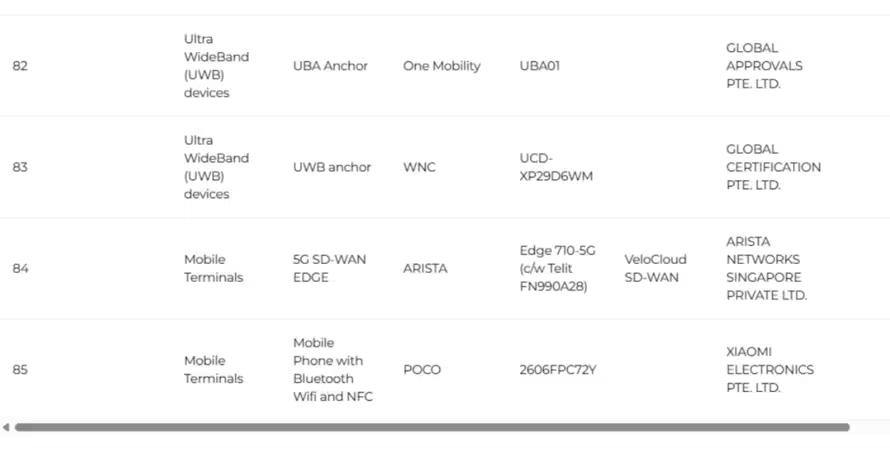
The Singapore IMDA listing also includes the same model number, CPH2765, under the equipment type “Mobile Terminals” and the brand name OPPO. This certification confirms support for WCDMA, LTE, 5G, Bluetooth, Wi-Fi, NFC, GPS, and eSIM. Although the device name is not explicitly mentioned in the IMDA entry, the listing points toward a potential launch in Singapore.

Oppo Find N6 Global Variant spotted on TUV confirming 80W charging specs. (Screenshot by TheTechOutlook)

The Oppo Find N6 has additionally been spotted on the TUV certification platform with certificate number SG PSB-IV-15844. This listing mentions a rated input of 5VDC, 2.0A or 5–11VDC, 7.3A Max, which confirms 80W wired fast charging. This aligns with the earlier 3C certification, suggesting that both the Chinese and global variants of the device are likely to offer the same charging specifications.

Oppo Find N6 – Expected Specifications and Launch Timeline

Based on previous reports, the Oppo Find N6 is expected to be powered by the Snapdragon 8 Elite Gen 5 processor. It may feature a battery capacity of around 6,000mAh and include a 200MP multispectral camera. The device is also tipped to weigh approximately 225 grams and could support an AI stylus.

As of the launch timeline, famous Weibo tipster Digital Chat Station (DCS) revealed that the phone is mostly getting announced in China after the Chinese Spring Festival. For those unaware, the Chinese Spring Festival takes place from February 17 to March 3, 2026, which makes a March launch more probable.

For context, the Oppo Find N5 was announced on February 20, 2025. It was unveiled globally on the same day as its China launch. If Oppo follows a similar strategy this year, the Find N6 could also debut globally alongside its official launch in China.

FAQs

Q1. Where has the Oppo Find N6 been spotted recently?

Answer. The device appeared on UAE’s TDRA, Singapore’s IMDA, and TUV certification platforms, confirming global launch preparations.

Q2. What charging capability does the Oppo Find N6 support?

Answer. TUV certification revealed 80W wired fast charging, aligning with earlier 3C certification details.

Q3. What are the expected key specifications of the Oppo Find N6?

Answer. It may feature a Snapdragon 8 Elite Gen 5 processor, 6,000mAh battery, 200MP multispectral camera, and support for an AI stylus.

Also Read

https://www.mymobileindia.com/oppo-find-x9s-specifications-leaked-oppo-find-n6-foldable-tipped-for-february-2026-oppo-pad-5-india-launch-confirmed/

https://www.mymobileindia.com/oppo-find-n6-and-oppo-find-x9-ultra-china-launch-timelines-tipped/

Google Photos Rolls Out ‘Me Meme’ AI feature for Creating Personalised Memes

0

Highlights

  • Google Photos’ Me Meme tool uses generative AI to insert a user’s photo into popular meme templates with editable captions.
  • Users select a portrait in Google Photos, choose or upload a template, and the AI generates a meme-style image; the feature is optional and manual.
  • It is currently rolling out in the US only.
(Photo by Rubaitul Azad on Unsplash)

Google has started rolling out a new Google Photos feature that allows users to create personalised memes using artificial intelligence. The “Me Meme” tool uses generative AI to place a user’s photo into popular meme formats along with captions. Here’s more on that.

Google Photos Adds Me Meme – AI-Powered Personalised Memes

Google officially announced the new feature on a support page, where a community manager confirmed the rollout. The AI-powered tool works by taking a selected photo of a person and inserting it into well-known meme templates, complete with humorous or relatable text.

Users can choose from a library of preset meme styles or upload their own templates, and they can also edit the captions to better match the intended joke or message.

Me Meme is part of a wider push to bring AI-assisted creation tools into Google Photos. It aims to give users access to stylised edits, quick enhancement suggestions, and automated creations.

At the moment, the feature is only available in the US.

How Does Me Meme Feature Work?

image

To create a meme, users need to select a portrait or image of themselves in Google Photos, tap the “Create” or “Meme” option, and then choose a template or add a custom one. The AI then generates a meme-style image, placing text above and below the photo in the familiar meme layout.

According to Google, the templates and captions are designed to be fun, shareable, and respectful of the original meme formats commonly seen on social media.

Google has also clarified that Me Meme is entirely optional and only works on photos that users manually select. The feature does not generate memes automatically, and all AI processing remains within the Photos app unless the user decides to save or share the result.

As of now, there is no confirmation on whether the generated memes will count toward Google Photos storage limits. However, several reports noted that existing policies suggest that newly created items will be counted as new files.

Me Meme expands Google Photos’ growing set of AI-powered tools, which already includes features like Create with AI, Photo to video, Remix, Collage, and more.

FAQS

Q1. What is the Me Meme feature in Google Photos?

Answer. It’s an AI-powered tool that lets users place their own photos into popular meme templates with editable captions.

Q2. How do users create memes with Me Meme?

Answer. By selecting a portrait in Google Photos, tapping “Create” or “Meme,” and then choosing or uploading a template; the AI generates the meme layout with text.

Q3. Where is the Me Meme feature available right now?

Answer. The rollout has started in the US only, as part of Google Photos’ expanding set of AI creation tools.

Also Read

https://www.mymobileindia.com/samsung-plans-to-bring-google-photos-to-samsung-ai-tv-lineup/

https://www.mymobileindia.com/google-photos-recap-2025-releases-with-new-personalisation-editing-and-sharing-features/

Apple-Intel Partnership Rumours for Future iPhone Chips Surface Again

0

Highlights

  • Apple may partner with Intel for future iPhone chips starting in 2028 using Intel’s 14A process.
  • Apple to continue to design the chips and TSMC remains the main supplier.
  • Intel could also produce low-end M-series chips for Macs and iPads by 2027 with its 18A process.

image

(Photo by Luan Gjokaj on Unsplash)

Apple is once again rumoured to be considering a renewed partnership with Intel for chip production, although the processors themselves would still be designed by Apple. Instead of chip design, Intel’s role would reportedly be limited to manufacturing.

According to a research note by GF Securities analyst Jeff Pu, as reported in a recent MacRumors report, Intel is expected to start supplying certain Apple chips using its upcoming 14A manufacturing process. This process is said to be on track for mass production in 2028.

Pu had previously stated that Intel could secure a chip supply agreement with Apple for some non-Pro iPhone models beginning in 2028. If this timeline holds, Intel may manufacture a portion of future A21 or A22 chips for iPhones. However, TSMC is still expected to remain Apple’s main chipmaking partner.

The report suggests that Intel would not be involved in the design of iPhone chips. Its role would be restricted to fabrication, marking a clear departure from the Intel Mac era, when Apple relied on Intel-designed x86 processors. Apple started moving away from Intel processors in its Mac lineup in 2020.

Intel has worked with Apple before in other areas as well, having supplied cellular modems for select iPhone models ranging from the iPhone 7 to the iPhone 11.

Beyond iPhones, Apple’s renewed ties with Intel could also extend to Mac and iPad chips. Last year, Tianfeng Securities analyst Ming-Chi Kuo said Intel might begin shipping Apple’s lowest-end M-series chip for certain Mac and iPad models as early as mid-2027. For those chips, Apple is reportedly planning to use Intel’s 18A process. Kuo did not reference iPhone chips in that prediction.

A partnership with Intel could help Apple diversify its supply chain at a crucial time. Nvidia has reportedly overtaken Apple as TSMC’s largest customer, increasing competition for chip manufacturing capacity, particularly for AI servers and consumer devices. At the same time, working with Intel could support Apple’s efforts to expand U.S. manufacturing, aligning with the Trump administration’s push to boost domestic production.

FAQs

Q1. Is Intel designing future iPhone chips?

Answer. No, Apple will continue to design its own processors. Intel’s role would be limited to manufacturing them.

Q2. When could Intel start making chips for iPhones?

Answer. According to analyst Jeff Pu, Intel may begin supplying chips for some non-Pro iPhone models in 2028 using its 14A process.

Q3. Will Apple still rely on TSMC?

Answer. Yes, TSMC remains Apple’s primary chipmaking partner, with Intel expected to handle only a portion of future production to diversify Apple’s supply chain.

 Also Read

https://www.mymobileindia.com/apple-may-bring-intel-back-as-a-chip-manufacturing-partner-for-future-iphones-and-macs/

https://www.mymobileindia.com/intel-core-ultra-series-3-processors-built-on-intel-18a-unveiled-at-ces-2026-powering-next-gen-ai-pcs/