Home Blog Page 719

OnePlus Open vs Samsung Galaxy Z Fold 5: The Ultimate Comparison of Foldable Phone Flagships

0

Highlights

  • OnePlus Open redefines camera technology with a 48MP Sony sensor and 64MP periscope-style telephoto lens.
  • Samsung Galaxy Z Fold 5 excels in storage options, offering up to 1TB.
  • OnePlus Open features a robust design with a cobalt molybdenum and titanium alloy chassis.
  • Both phones offer unique software experiences, with OxygenOS emphasizing quick updates and One UI focusing on customisation.

The foldable smartphone arena is heating up, and OnePlus and Samsung are two brands that are giving us a glimpse into the future of mobile technology.

The OnePlus Open and Samsung Galaxy Z Fold 5 stand as flagships, representing the pinnacle of each company’s foldable tech.

Let’s dive deep into the intricate specs, design, display, internal hardware, camera, and software features to offer you a comprehensive comparison.

Credit for the testing goes to Digital Trends for this comparison article.

Key Specs

OnePlus Open Sale Today

OnePlus Open: Rs 1,39,999

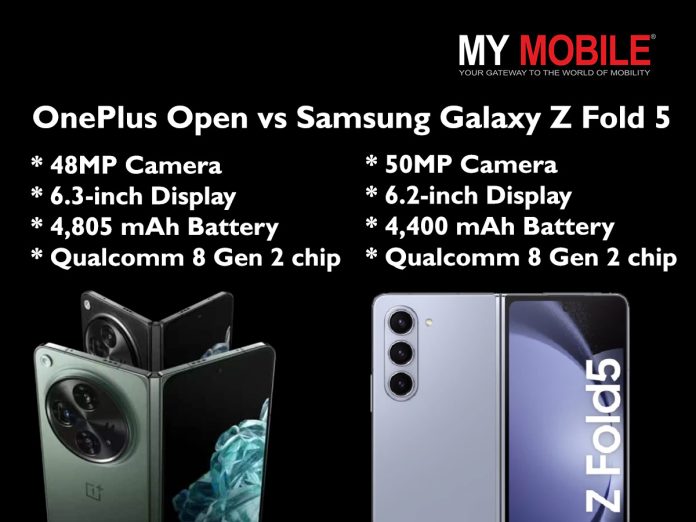
  • Processor: Qualcomm 8 Gen 2 chip
  • RAM: 16GB
  • Storage: Up to 512GB
  • Battery: 4,805 mAh
  • Camera: 48MP main sensor, 48MP ultrawide, 64MP periscope-style telephoto
  • Display: 6.3-inch 2K outer, 7.82-inch inner
  • Fast Charging: 67W
  • IP Certification: IPX4

Samsung Galaxy Z Fold 5: Rs 1,54,990

  • Processor: Qualcomm 8 Gen 2 chip
  • RAM: 12GB
  • Storage: Up to 1TB
  • Battery: 4,400 mAh
  • Camera: 50MP telephoto, 10MP ultrawide, 10MP secondary telephoto
  • Display: 6.2-inch HD+ outer, 7.6-inch inner
  • Fast Charging: 25W
  • IP Certification: IPX8

Design

OnePlus Open: Pricing
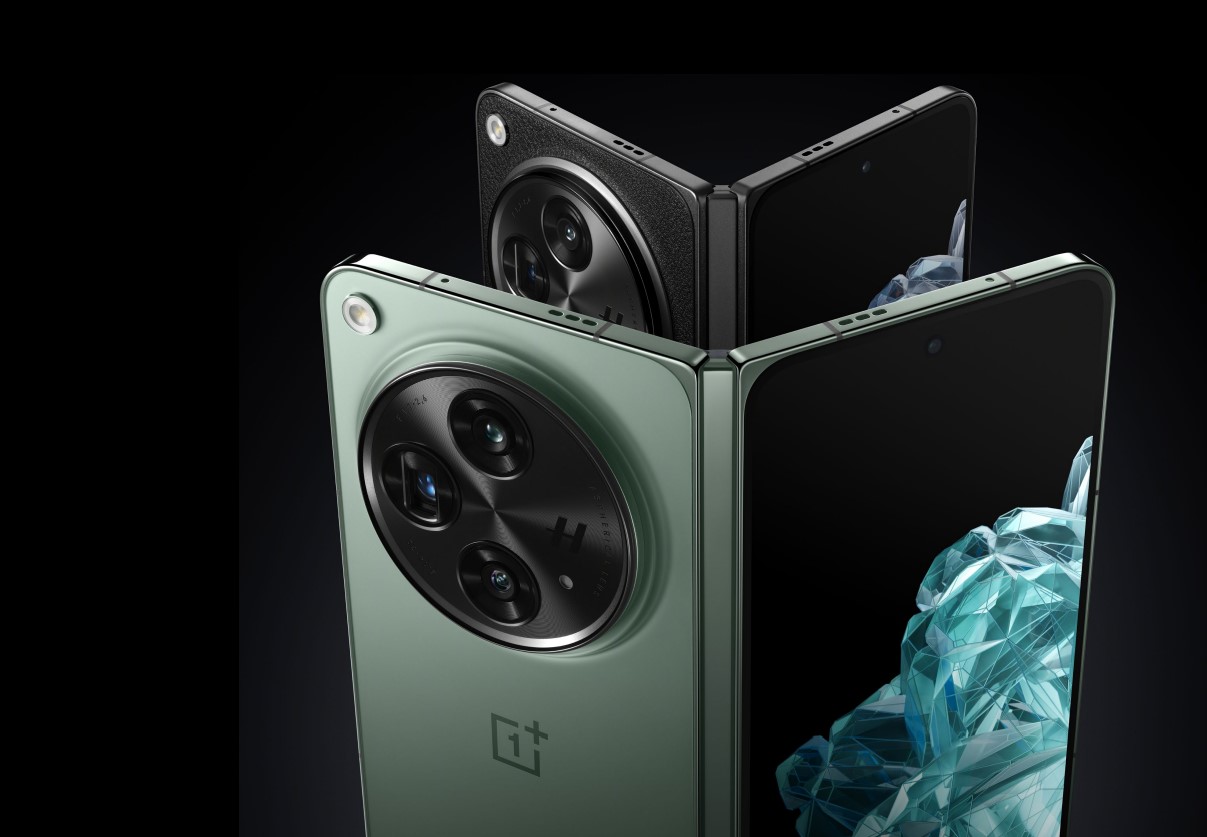
OnePlus Open Design

One of the noteworthy design elements of Samsung’s Z Fold 5 is its improved hinge and foldable screen, eliminating the display wedge issue that was a flaw in earlier models.

OnePlus, on its first attempt, comes with a gapless design that leaves no room for dirt or liquid intrusion.

While both phones boast a metal and glass foundation, OnePlus steps up the game with a cobalt molybdenum and titanium alloy chassis, which is said to be four times stronger than surgical-grade stainless steel.

Verdict: OnePlus leads with more robust materials and a gapless design in its first attempt.

Display
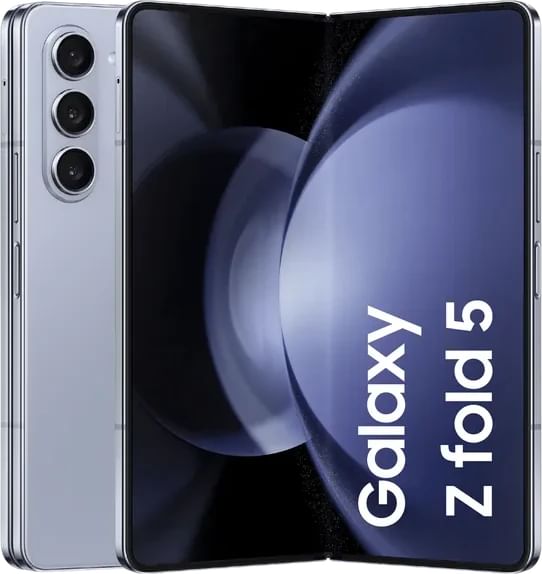
Samsung Galaxy Z fold 5 Display

Both phones use Ultra-Thin Glass (UTG) technology, but diverge from there. Samsung sticks to Corning’s Gorilla Glass Victus, whereas OnePlus goes with Ceramic Guard, claimed to be 20% stronger.

The OnePlus Open also offers better display resolution and natural 20:9 aspect ratio for the outer screen, addressing issues of odd app scaling seen in Samsung’s tall aspect ratio display.

Verdict: OnePlus Open offers better screen durability and display experience.

Internal Hardware

OnePlus Open Internal Hardware

While both phones run on Qualcomm’s 8 Gen 2 chip, OnePlus Open offers a higher 16GB RAM compared to Samsung’s 12GB.

Samsung takes the cake in storage capacity with up to 1TB, while OnePlus tops at 512GB.

However, OnePlus has a bigger 4,805 mAh battery with 67W fast charging, overshadowing Samsung’s 4,400 mAh battery and 25W fast charging.

Verdict: OnePlus takes the edge in performance, but Samsung wins on storage.

Camera
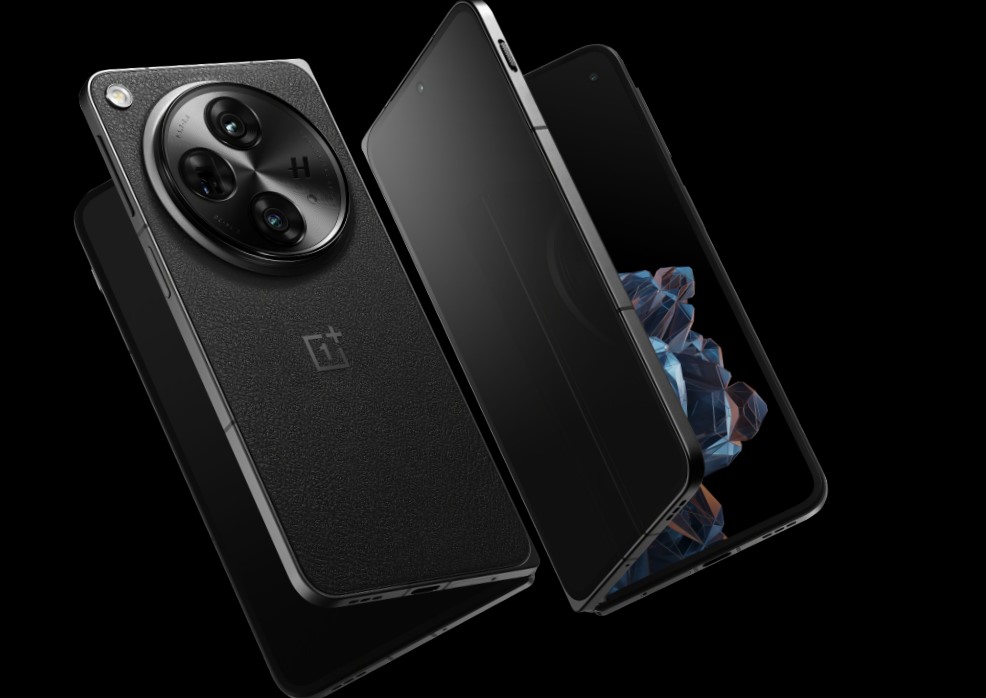
OnePlus Open Overview:
OnePlus Open Camera

Oneplus has gone to great lengths to redefine camera capabilities in foldable smartphones.

The OnePlus Open introduces an entirely new 48MP Sony sensor that employs a reimagined pixel-level photodiode architecture.

Complementing the primary sensor is another 48MP electronically stabilized camera dedicated to ultrawide shots.

The star of the show is the 64MP periscope-style telephoto lens.

Despite the phone’s slim profile, OnePlus managed to incorporate a telephoto lens that offers a 3x optical zoom range, a sensor-based 6x zoom output, and a staggering 120x Ultra Res digital zoom.

In contrast, the Samsung Galaxy Z Fold 5 offers a 50MP telephoto lens, accompanied by a 10MP ultrawide sensor and another 10MP telephoto camera.

While these are commendable specs, the telephoto camera offers only a 3x optical zoom and a 30x digital zoom.

Unlike the folded lens system in the OnePlus Open, the Z Fold 5’s regular telephoto lens doesn’t promise the same zoom output. It

Verdict: OnePlus Open outclasses Samsung Z Fold 5 with more advanced camera technology.

Software

OnePlus Open Software

Software plays a pivotal role in shaping the user experience on any smartphone, and foldable phones are no exception.

OnePlus’ OxygenOS has been praised for its quick updates and community-driven approach. Users appreciate its simplified yet highly customizable interface.

In the case of the OnePlus Open, OxygenOS allows up to three apps to run concurrently on the split-screen, maximizing the utility of the phone’s larger inner display.

Even though it offers fewer system-level tweaks than Samsung’s One UI, OxygenOS has been quicker to fix software bugs, largely owing to an active community of developers and users.

Samsung’s One UI, on the other hand, is a powerhouse of features and system-level customizations.

The Samsung Labs toolkit and Good Lock modules allow users to tailor the UI according to their preferences in a way that OxygenOS doesn’t permit.

One UI on the Galaxy Z Fold 5 also supports DeX, which transforms your smartphone into a ChromeOS-like experience when connected to a larger screen.

This is particularly beneficial for power users who want to turn their phone into a makeshift workstation.

Verdict: Preference depends on whether you value customization (OxygenOS) or productivity (One UI).

Final Verdict
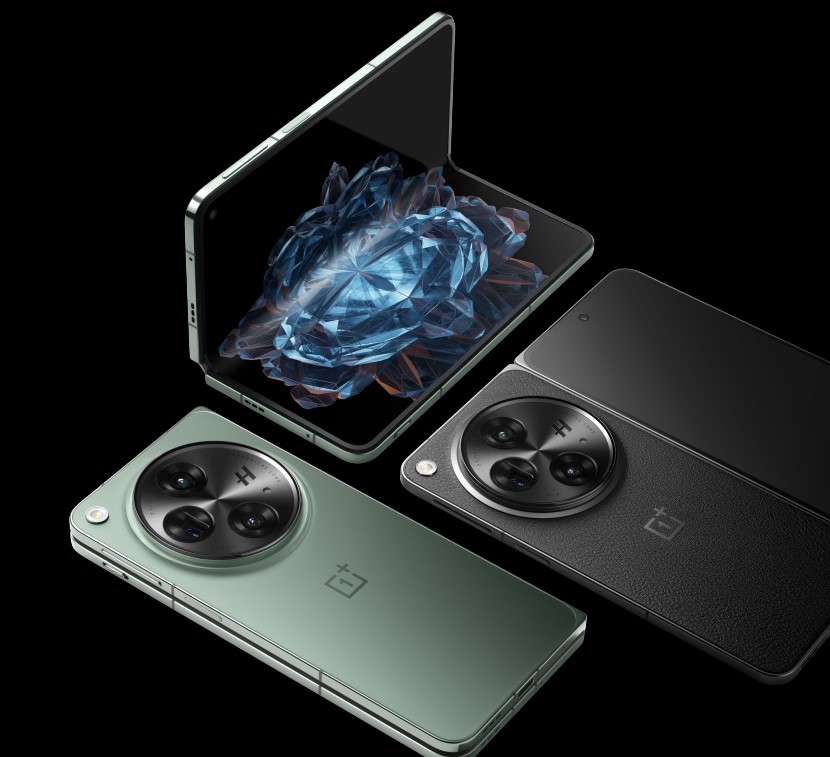
OnePlus Open Overview:
Final Verdict

The OnePlus Open and Samsung Galaxy Z Fold 5 are two formidable players in the foldable phone market.

While both have their merits and demerits, the OnePlus Open seems to take a slight edge in design, display, and camera departments.

On the other hand, Samsung excels in storage capacity and software features. Ultimately, the choice boils down to what you value more in a foldable smartphone.

FAQs

How does the camera of the OnePlus Open differ from the Galaxy Z Fold 5?

The OnePlus Open features a 48MP main sensor, 48MP ultrawide, and a 64MP periscope-style telephoto lens. Samsung’s Galaxy Z Fold 5 has a 50MP telephoto, 10MP ultrawide, and another 10MP secondary telephoto camera.

Which phone offers better storage options?

While both phones use the Qualcomm 8 Gen 2 chip, Samsung Galaxy Z Fold 5 provides up to 1TB storage, whereas OnePlus Open tops at 512GB.

What sets the design of OnePlus Open apart?

OnePlus Open utilizes a cobalt molybdenum and titanium alloy chassis, which is claimed to be four times stronger than surgical-grade stainless steel, and offers a gapless design.

How do the software experiences differ?

OxygenOS on the OnePlus Open is community-driven and fixes bugs quickly. Samsung’s One UI offers a plethora of customization options and supports DeX for a desktop-like experience.
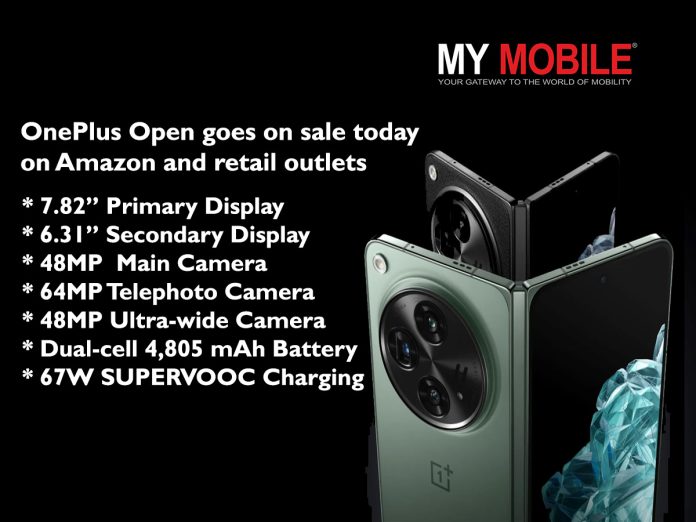

OnePlus Open Goes Up For Sale Starting Today on Amazon, Retail Outlets

0

Highlights

  • OnePlus Open launches in India today, signaling a shift in the premium smartphone segment.
  • Priced at Rs. 1,39,999 with 16GB RAM and 512GB inbuilt storage.
  • Identical hardware to Oppo Find N3, featuring dual AMOLED screens and next-gen Sony LYTIA-T808 sensor.
  • Available through multiple purchase channels with special launch discounts and trade-in bonuses.

The OnePlus Open, the much-anticipated foldable phone from OnePlus, has finally reached Indian shores, a week after its global launch.

This device not only marks the company’s foray into the foldable phone segment but also competes neck-to-neck with Oppo Find N3, sharing identical hardware specifications.

Pricing and Availability

Priced at Rs. 1,39,999, the OnePlus Open is going on sale today on Amazon, OnePlus’ website, and other retail outlets.

However, OnePlus is offering financial incentives, including a Rs. 5,000 discount via ICICI Bank and OneCard Instant Bank transactions and a Rs. 8,000 trade-in bonus on select smartphones.

OnePlus Open: Key Specs

  • Primary Display: 7.82-inch Flexi-fluid AMOLED,
  • Secondary Display: 6.31-inch, 2K (2484×1116), 
  • Operating System: OxygenOS 13.2 based on Android 13
  • CPU: Qualcomm Snapdragon 8 Gen 2
  • RAM: 16GB LPDDR5X, 
  • Storage: 512GB UFS 4.0
  • Main Camera: 48MP Sony sensor, 7P lens, OIS, EIS
  • Telephoto Camera: 64MP, 3X optical zoom, 6X in-sensor zoom
  • Ultra-wide Camera: 48MP
  • Battery: Dual-cell 4,805 mAh
  • Charging: 67W SUPERVOOC

OnePlus Open: Features

OnePlus Open: Pricing
OnePlus Open India Sale

At the core of the OnePlus Open are its dual AMOLED displays—each offering stunning 2K resolution and a fluid 120Hz refresh rate.

The inner display is a magnificent 7.82-inch screen, while the outer screen measures 6.31 inches.

Whether it’s for productivity or entertainment, this smartphone aims to provide an unparalleled visual experience.

Powering the device is Qualcomm’s latest Snapdragon 8 Gen 2 octa-core chipset, designed to deliver top-tier performance across gaming, multitasking, and more.

The phone comes with a generous 16GB of LPDDR5X RAM, and a whopping 512GB of UFS 4.0 internal storage.

OnePlus Open: Key Specs
OnePlus Open key Specification

If that’s not enough, the RAM can be virtually extended up to an additional 12GB, ensuring that performance bottlenecks are a thing of the past.

Photography enthusiasts have a lot to look forward to as well.

The OnePlus Open is outfitted with three Hasselblad-branded rear cameras, one of which features the next-gen Sony LYTIA-T808 “Pixel Stacked” CMOS sensor.

From everyday snapshots to professional-grade photos, the camera setup is poised to cover all the bases.

The OnePlus Open comes equipped with a 4,805mAh battery, which is more than capable of powering the device throughout the day.

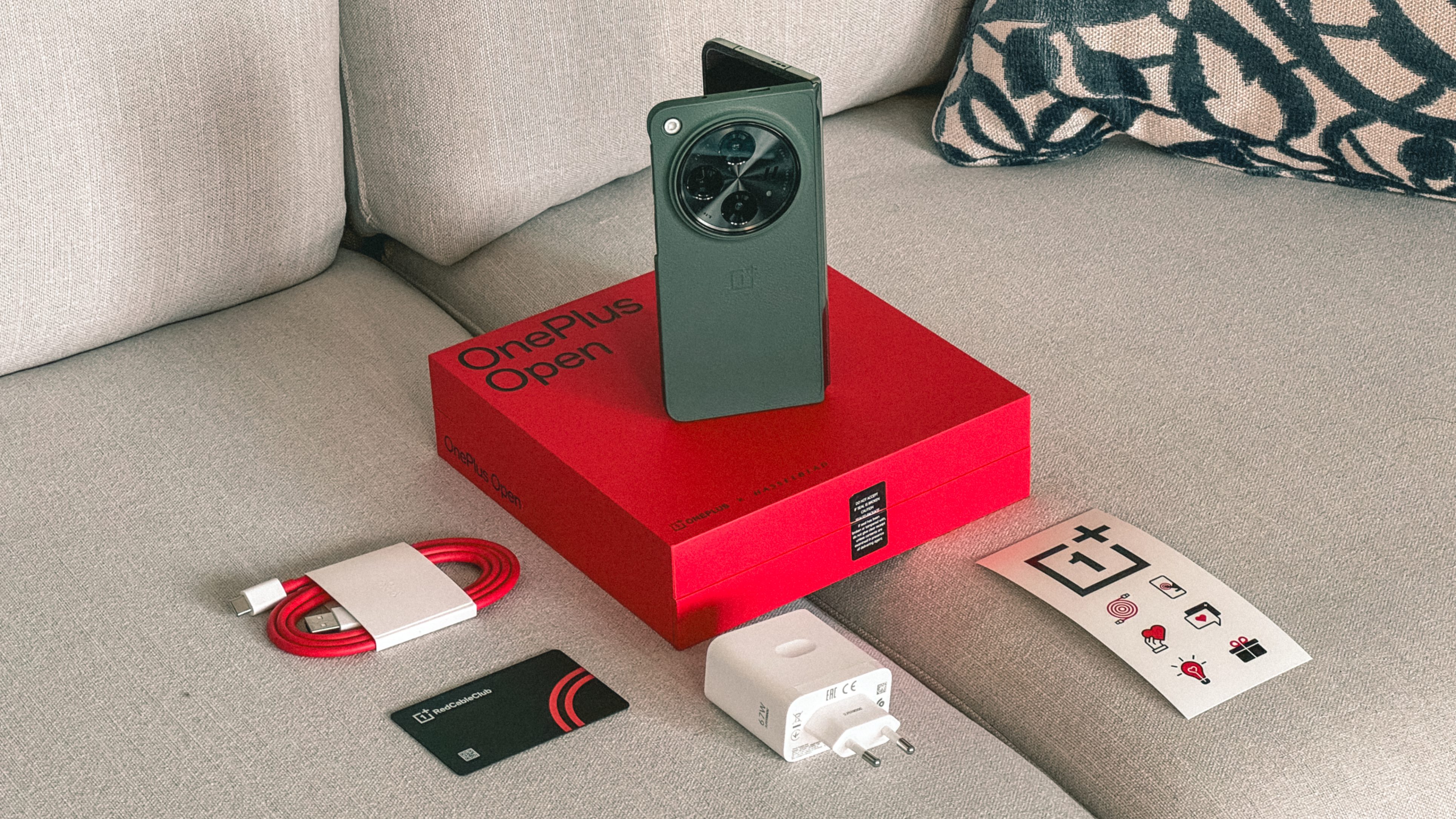
Interestingly, while the packaging includes an 80W charger, the smartphone itself maxes out at a 67W charging speed.

This still ensures quick power replenishment, allowing users to get back to using their phone in a shorter amount of time.

OnePlus Open Overview:
OnePlus Open

When it comes to additional features, the OnePlus Open has quite an impressive array.

It runs on OxygenOS 13.2, based on Android 13, and offers next-gen connectivity options such as 5G, Wi-Fi 7, and Bluetooth 5.3.

Further adding to its allure are a USB-C port for fast data transfer, Dolby Atmos sound for enhanced audio experiences, and a side-mounted fingerprint reader for quick and secure access.

An alert slider for easy notification management is the cherry on top, making the OnePlus Open a comprehensive package.

FAQs

When does the OnePlus Open become available in India?

The OnePlus Open is launching in India today, expanding the offerings in the premium smartphone segment.

How can I buy the OnePlus Open?

Consumers can buy the device through OnePlus’s official website, Amazon, and authorized retail stores across the country.

What special offers can buyers avail?

OnePlus is offering a launch discount of Rs. 5,000 via ICICI Bank and OneCard Instant Bank transactions. Additionally, a trade-in bonus of Rs. 8,000 is available for selected smartphones.

Does the OnePlus Open feature a top-tier camera setup?

Absolutely. The device boasts a trio of Hasselblad-branded rear cameras, featuring the next-gen Sony LYTIA-T808 “Pixel Stacked” CMOS sensor, promising an exceptional photography experience.

Also Read: OnePlus Open Launched in India With Folding AMOLED Screen, Snapdragon 8 Gen 2: Pricing, Specs, Features, and More

Also Read: OnePlus Open Leaks Suggest Longevity of 10 Years with 100 Folds Daily

iPhone’s Declining Sales in China Exacerbated by Huawei’s Resurgence 

0

Highlights

  • Apple’s flagship experiences a significant decline in China’s market.
  • The Chinese tech giant makes a striking comeback with its Mate 60 Pro.
  • Huawei’s resurgence adds new pressure on Apple in China.
  • Future data will reveal if this decline for iPhone is a blip or a trend.

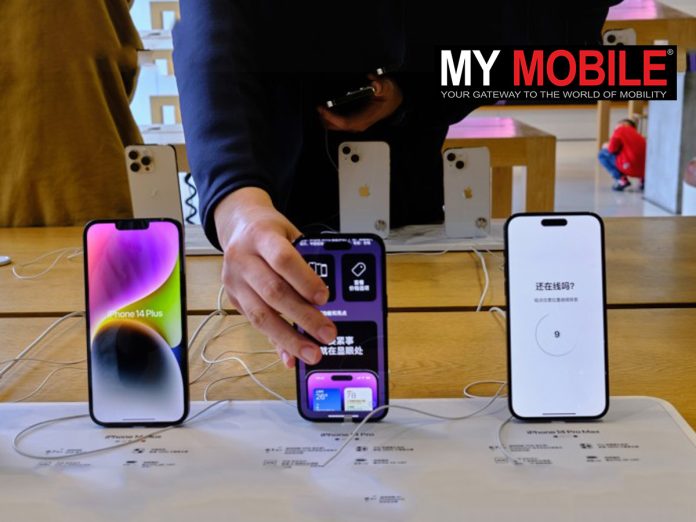
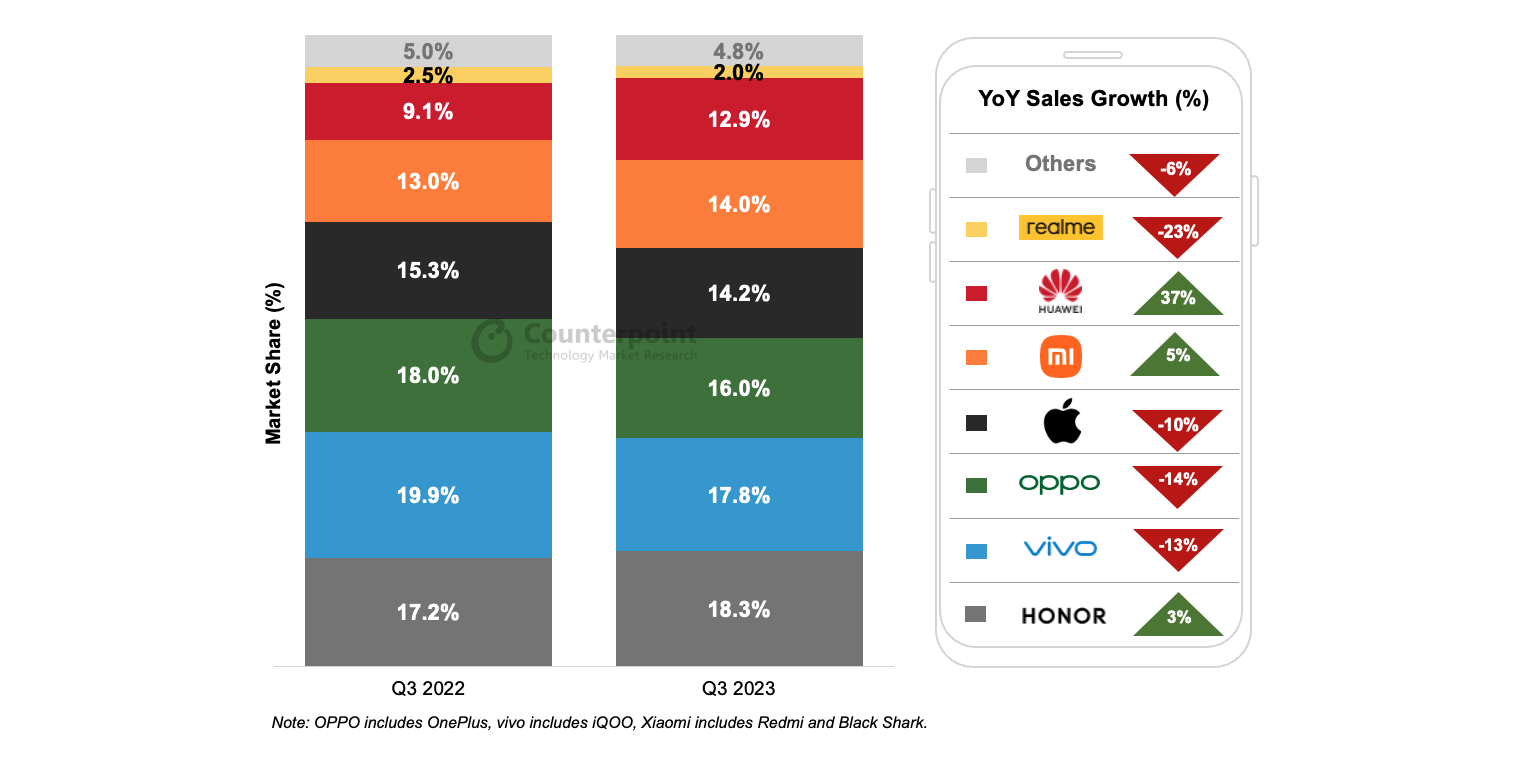
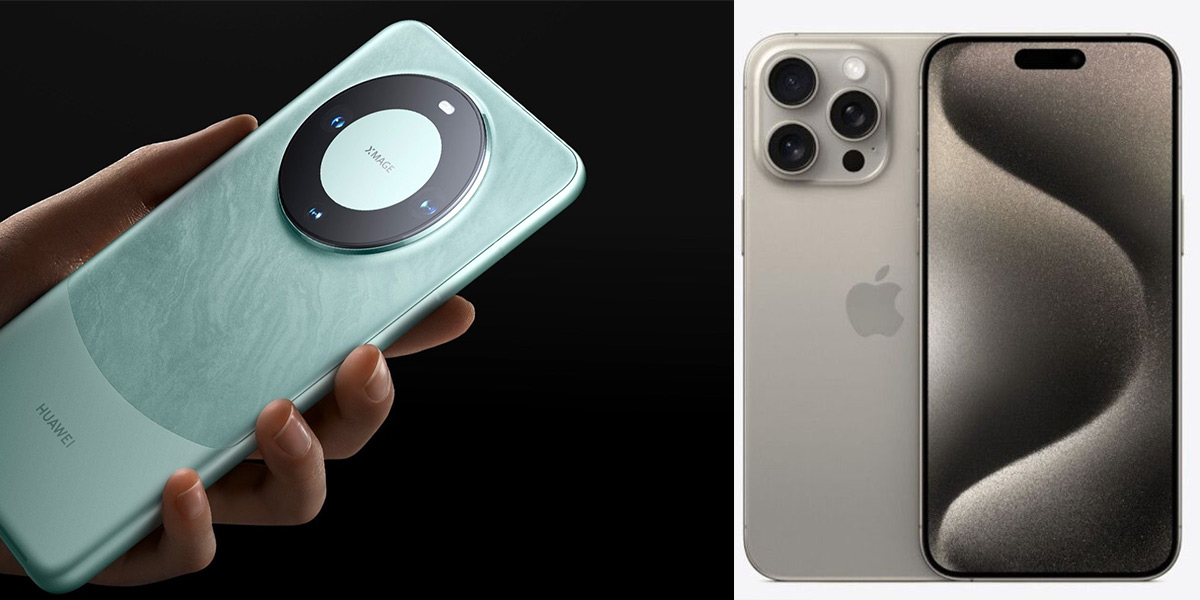
Apple is grappling with a sobering reality in China as its iPhone sales nosedive by 10% year-over-year in Q3 2023.

A comprehensive look by Counterpoint at China’s smartphone market, which has only declined by 3%, suggests that the iPhone’s dip is not solely a symptom of market contraction.

The big plot twist? Huawei’s staggering resurgence is adding fuel to the fire.

Examining the Decline in iPhone Sales in China

Examining the Decline in iPhone Sales in China
  • A Concerning Drop: Q3 2023 data reveals a 10% year-on-year decline in iPhone sales in China, significantly outpacing the overall 3% market contraction.
  • Timing Matters: One mitigating factor could be that this data only captures the first week of new iPhone sales, which could have been influenced by supply chain hiccups.
  • Huawei’s Impact: Huawei’s sales, on the other hand, jumped by 37%, largely driven by its premium Mate 60 Pro model.
  • Competitive Scenario: The Chinese smartphone market has always been competitive, but Huawei’s comeback further threatens Apple’s position.

Huawei Impact on iPhone’s Declining Sales

Huawei Impact on iPhone’s Declining Sales

While other brands like Mi and Honor registered modest growth, Huawei’s 37% sales growth stands in stark contrast and points to a recovering brand ready to challenge Apple head-on.

Huawei’s latest premium model, the Mate 60 Pro, is a key player in this comeback story and could be a significant reason behind iPhone’s dwindling sales numbers in China.

The Apple-Huawei rivalry took center stage in 2014 when the iPhone 6 was launched with a larger screen, appealing to Chinese consumers.

Huawei responded with competitive pricing and patriotic marketing, achieving market dominance until U.S. sanctions disrupted its momentum in 2020.

Apple capitalized on this, but with Huawei making a comeback, the iPhone is under renewed pressure.

With a 10% dip in sales in a single quarter, questions arise about the iPhone’s longer-term standing in the Chinese market.

The next quarter’s data will be pivotal, particularly in light of Huawei’s return to form.

FAQs

Why did iPhone sales drop by 10% in China in Q3 2023?

The 10% decline in iPhone sales in China is a combination of factors. While the data only includes the first week of new iPhone sales, Huawei’s remarkable 37% sales growth with its new Mate 60 Pro also plays a significant role.

How did Huawei manage to grow its sales by 37%?

Huawei’s resurgence is largely attributed to the launch of its first premium model in three years, the Mate 60 Pro. This new model has rekindled interest in the brand, allowing it to capture a significant share of the premium smartphone market in China.

How does the iPhone’s sales decline compare to the overall market?

The overall smartphone market in China contracted by 3% year-over-year. However, the iPhone’s 10% sales decline is notably higher, indicating specific challenges for Apple beyond just a shrinking market.

What does the future look like for iPhone sales in China?

The upcoming quarter will be crucial in determining whether the iPhone’s sales decline is an isolated incident or the beginning of a declining trend. Huawei’s resurgence adds an element of uncertainty, making it a space to watch closely.

Apple Subscription Price Increase: What You Need to Know About the New Costs for Apple TV+, Arcade, and News+

0

Highlights

  • Apple TV+ monthly subscription jumps 40% to $9.99, competing directly with premium video streaming services.
  • First-ever price adjustments for Apple Arcade and Apple News+ since their 2019 launch.
  • Apple One bundles undergo price hikes but remain relatively cost-effective compared to individual service subscriptions.
  • Price increases effective immediately in the U.S. and select international markets

Today, Apple rolled out new pricing for its popular digital services: Apple TV+, Apple Arcade, and Apple News+.

This marks a significant increase for consumers and reveals key insights into Apple’s service strategy.

New Pricing Details

  • Apple TV+: Price upped from $6.99/month to $9.99/month
  • Apple Arcade: Increase from $4.99/month to $6.99/month
  • Apple News+: Now at $12.99/month, up from $9.99
  • Apple One Bundles: Individual bundle now at $19.95/month, Family at $25.95/month, and Premier at $37.95/month
  • Annual Subscription for Apple TV+: Hiked from $69/year to $99/year

Interestingly, this is the inaugural price change for both Apple Arcade and Apple News+ since their launch in 2019.

However, the Apple TV+ service has seen its second price increase since its debut.

Apple also made adjustments to its Apple One bundles, making them more expensive.

However, the overall percentage increase for the bundle is slightly less than the sum of its individual parts.

Apple TV+ Price Increase

The Individual bundle is now priced at $19.95 per month, up from $16.95, while the Family bundle now costs $25.95 and Premier is priced at $37.95.

The Apple TV+ service, which initially launched at a $4.99/month price point in November 2019, now stands at $9.99/month after today’s 40% jump.

This move pits Apple TV+ squarely against premium video streaming competitors, marking a strategic shift.

Though the new rates are effective immediately for new subscribers in the United States and select international regions such as the UK and parts of Europe, existing subscribers will face these increases 30 days from today.

Notably, the impact on the Indian market remains undisclosed.

FAQs

What are the new monthly costs for Apple’s subscription services?

Apple TV+ now costs $9.99 per month, up from $6.99. Apple Arcade has moved from $4.99 to $6.99, and Apple News+ is priced at $12.99, up from $9.99.

Is this the first time Apple has increased the prices of these services?

This is the first price change for Apple Arcade and Apple News+ since their 2019 launch. However, this is the second increase for Apple TV+, which originally debuted at $4.99 per month.

What about the Apple One bundles?

Apple has also adjusted the pricing for its Apple One bundles. The Individual bundle now costs $19.95, the Family bundle is $25.95, and the Premier bundle stands at $37.95 per month.

When do these price changes take effect?

The new prices are effective immediately for new subscribers in the U.S., the UK, and select parts of Europe. Existing subscribers will see the price increase in 30 days, starting with their next renewal period.

Read More: Samsung Launches Frame TV in India

Read More: Next Gen Apple TV 4K Come with A15 Chipset

Crossbeats Launches Nexus Smartwatch with ChatGPT Integration in India

0

Highlights

  • First wearable in India to integrate OpenAI’s ChatGPT for enhanced user experience.
  • Priced at Rs 5,999 with a pre-booking down-payment of just Rs 999.
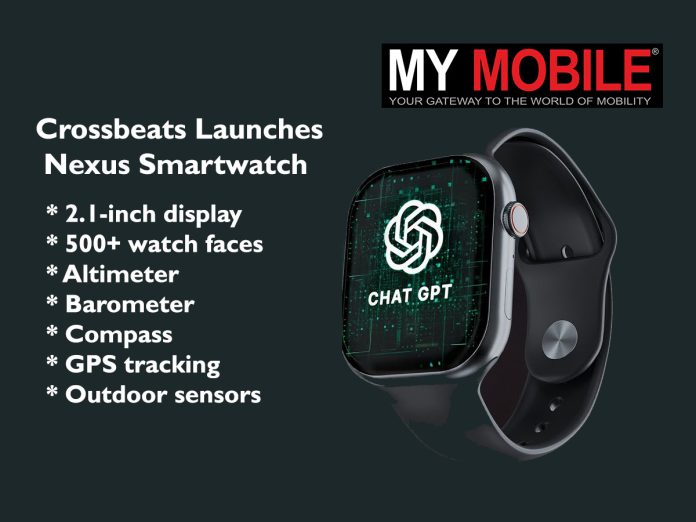
  • Features a 2.1-inch full-touch AMOLED display and over 500 customizable watch faces.
  • Multifaceted sensors like Altimeter, Barometer, and Compass make it an adventurer’s choice.

Crossbeats has catapulted itself into a pioneering role within India’s ever-expanding wearable industry with the launch of its Nexus smartwatch.

This device isn’t just another entry into the segment; it is a transformative experience.

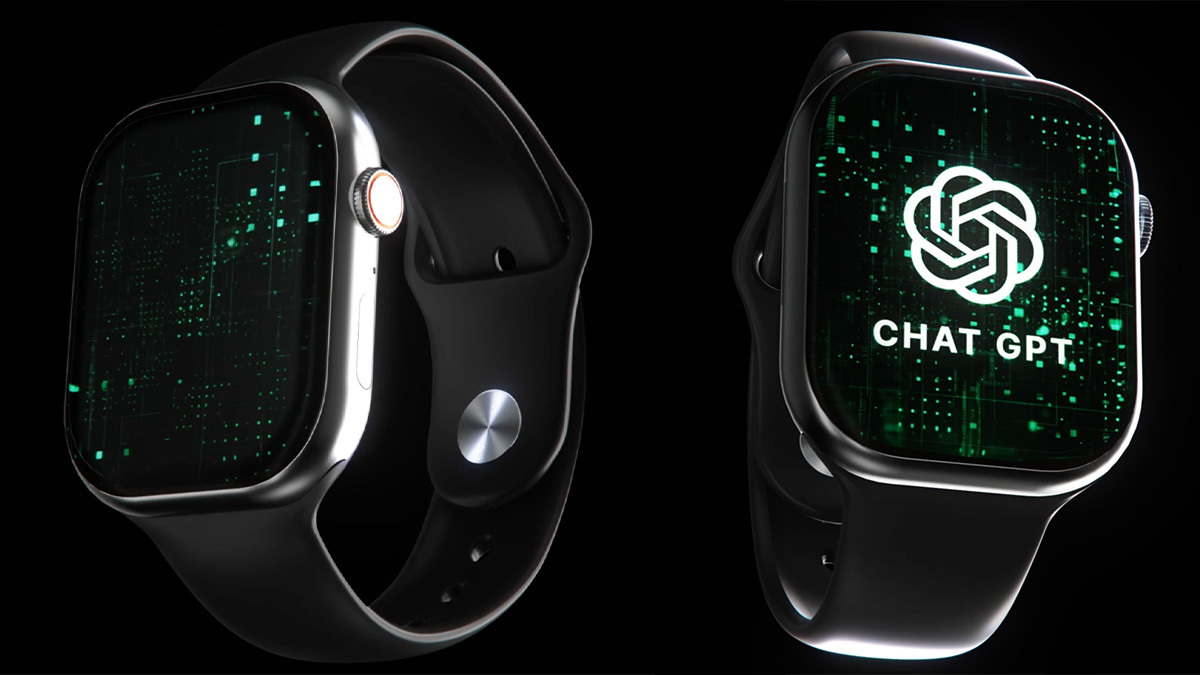
For the first time in India, a wearable device is fully integrated with OpenAI’s cutting-edge ChatGPT technology.

Price and Availability

Crossbeats Nexus Smartwatch Price , Availability & Offers

The Nexus comes with a competitive price tag of Rs 5,999, making it accessible for a wide demographic of tech-savvy users.

It is available in two classic colors: Silver for those who prefer a sleek, modern look, and Black for those who opt for a timeless, elegant design.

The pre-booking process has started, requiring a down-payment of Rs 999.

This isn’t just a deposit; it will be adjusted against the full purchase price of the smartwatch.

Those who jump on the pre-booking bandwagon will not only secure their device but also avail themselves of a 5 percent discount. 

To sweeten the deal further, pre-bookers will receive a piece of merchandise signed by the popular artist, SKY.

While it has been announced that the sales will kick off during the auspicious Diwali season, the exact dates are yet to be revealed.

The Feature Breakdown

Crossbeats Nexus Smartwatch Features
  • Display: The Nexus flaunts a 2.1-inch full-touch AMOLED display that promises vibrant colours and sharp visuals.
  • Customization: The smartwatch allows users to select from over 500 customizable watch faces, giving them the freedom to match their device with their mood, attire, or occasion.
  • Tracking and Navigation: The device isn’t just a watch; it’s a companion on your adventures. With GPS Dynamic Route tracking, it offers real-time mapping capabilities, ensuring you’re never lost.
  • Multifaceted Sensors: Beyond the usual, the Nexus is equipped with an Altimeter, a Barometer, and a Compass, making it an ideal choice for outdoor enthusiasts and adventurers.

The ChatGPT Angle

Crossbeats Nexus Smartwatch ChatGPT Integration

The most revolutionary feature of the Nexus is its integration with OpenAI’s ChatGPT technology.

While specific operational details are still under wraps, what we do know is that this technology aims to redefine user interaction with smartwatches.

ChatGPT, renowned for its conversational capabilities and advanced language understanding, promises a more intuitive and personalised user experience.

However, it’s important to note that the terms and conditions mention that full access to ChatGPT’s features could be dependent on the quality of internet connectivity available to the user.

FAQs

What sets the Nexus smartwatch apart from others?

The Nexus smartwatch is the first in India to integrate OpenAI’s ChatGPT, aiming to redefine user interaction with wearable devices.

How much does the Nexus cost and what are the pre-booking benefits?

The smartwatch is priced at Rs 5,999. Pre-booking requires a down-payment of Rs 999, which gets adjusted in the final price, and also earns a 5 percent discount.

What features can we expect in the display and customization?

The Nexus features a 2.1-inch full-touch AMOLED display and offers over 500 customizable watch faces.

What extra sensors does the Nexus have for adventurers?

The smartwatch is equipped with an Altimeter, a Barometer, and a Compass, making it a perfect fit for outdoor enthusiasts.

Also Read: ChatGPT’s OpenAI Seeks Talent: Comprehensive Guide to Job Roles, Skills, and Salaries

Also Read: What is WormGPT? How is it Different from ChatGPT?

Also Read: ChatGPT 4 Can Now Identify and Describe Faces, Raising Concerns About AI’s Power

Xiaomi 14 and 14 Pro with Qualcomm Snapdragon 8 Gen 3 SoC Announced in China

0

Highlights

  • Powered by the revolutionary Qualcomm Snapdragon 8 Gen 3 chipset
  • First smartphones to feature Xiaomi’s new HyperOS, replacing MIUI
  • High-end camera capabilities with Leica-branded triple 50MP setup
  • Diverse storage and RAM options starting from 8GB+256GB to 16GB+1TB

Xiaomi has announced the launch of its new Xiaomi 14 and 14 Pro smartphones in China.

These are the first phones equipped with the Qualcomm Snapdragon 8 Gen 3 chipset and come with the newly introduced HyperOS, replacing the MIUI software.

Here’s everything you need to know about these new releases.

Xiaomi 14 series: Pricing and availability

Xiaomi 14 series: Pricing and availability

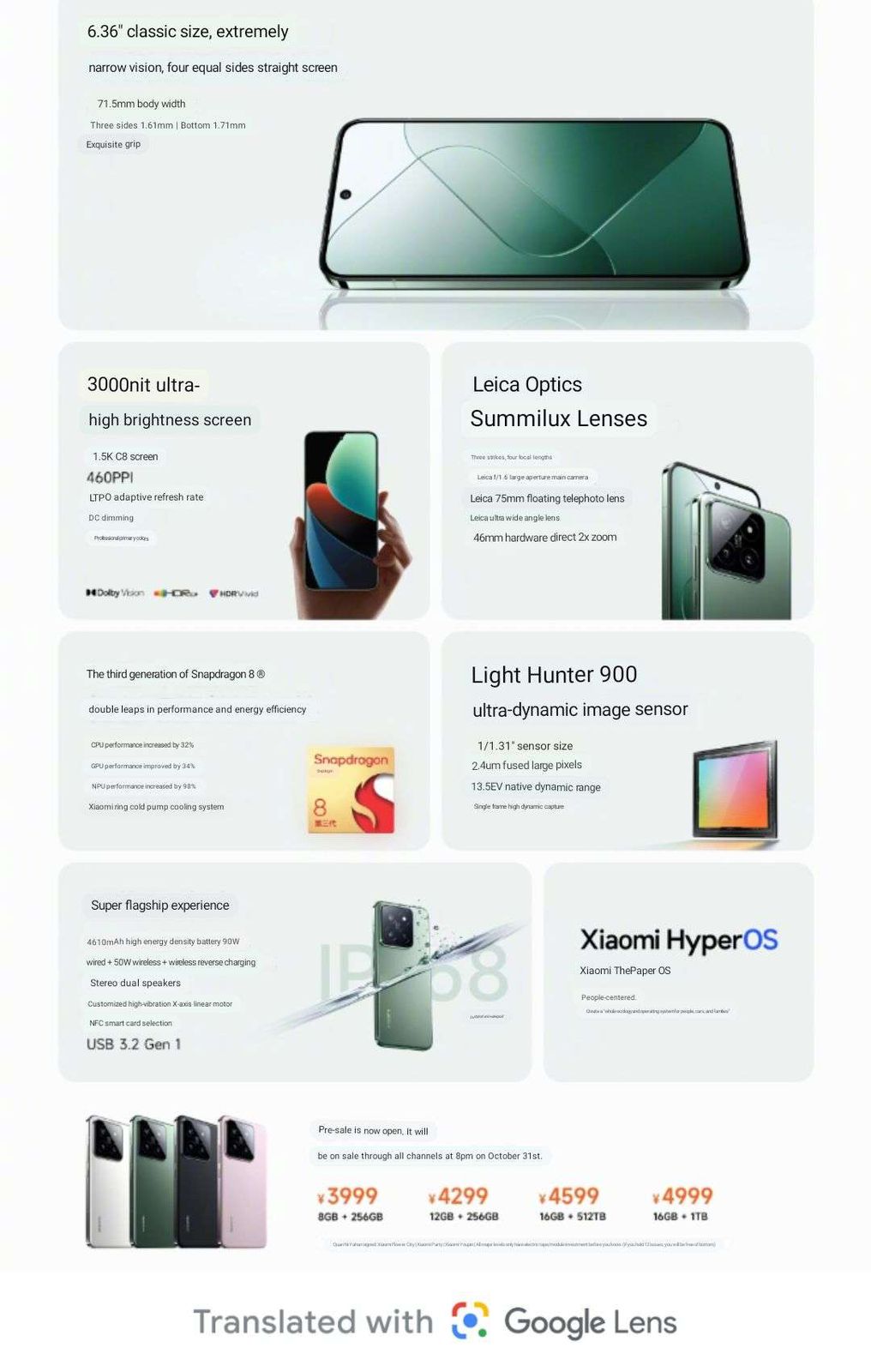
The Xiaomi 14 and Xiaomi 14 Pro smartphones are now open for pre-orders in China, with official sales set to commence on October 31.

The starting price point for the Xiaomi 14 is approximately CNY 3,999 (Rs 45,500) for the base version, which comes with 8GB of RAM and 256GB of storage.

Additional configurations for this model include 12GB + 256GB at CNY 4,299 (Rs 49,000), 16GB + 512GB at CNY 4,599 (Rs 52,000), and 16GB + 1TB at CNY 4,999 (Rs 57,000).

For the Xiaomi 14 Pro, the entry-level model, equipped with 12GB RAM and 256GB storage, is priced at CNY 4,999 (Rs 57,000).

Two more configurations are available: a 16GB + 512GB variant at CNY 5,499 (Rs 62,500) and a 16GB + 1TB model for CNY 5,999 (Rs 68,000).

Xiaomi 14 Pro Specifications

Xiaomi 14 & Xiaomi 14 Pro Specification
  • Display: 6.73-inch 2K LTPO C8 AMOLED, 120Hz refresh rate, 3000 nits peak brightness.
  • Processor: Qualcomm Snapdragon 8 Gen 3 chipset.
  • RAM and Storage: Options of 12GB+256GB, 16GB+512GB, and 16GB+1TB.
  • Cameras: Leica-branded 50MP primary, ultra-wide, and telephoto sensors. 50MP front-facing camera.
  • Battery and Charging: 4,880mAh battery, 120W fast charging, 50W wireless charging.
  • Software: HyperOS based on Android 14.
  • Additional Features: USB 3.2 Gen2, Wi-Fi 7, NFC, under-display fingerprint sensor, IP68 rating.

Xiaomi 14 Specifications

  • Display: 6.36-inch 1.5K C8 LTPO OLED, 120Hz refresh rate, 3000 nits max brightness.
  • Processor: Qualcomm Snapdragon 8 Gen 3 chipset.
  • RAM and Storage: Variants include 8GB+256GB, 12GB+256GB, 16GB+512GB, and 16GB+1TB.
  • Cameras: Leica-branded 50MP primary, ultra-wide, and telephoto sensors. 32MP front camera.
  • Battery and Charging: 4,610mAh battery, 90W fast charging, 50W wireless charging.
  • Software: HyperOS based on Android 14.
  • Additional Features: 5G, IP68 rating, USB 3.2 Gen1, Wi-Fi 7, NFC, under-display fingerprint sensor.

Xiaomi 14 Series: Features

Xiaomi 14 Series

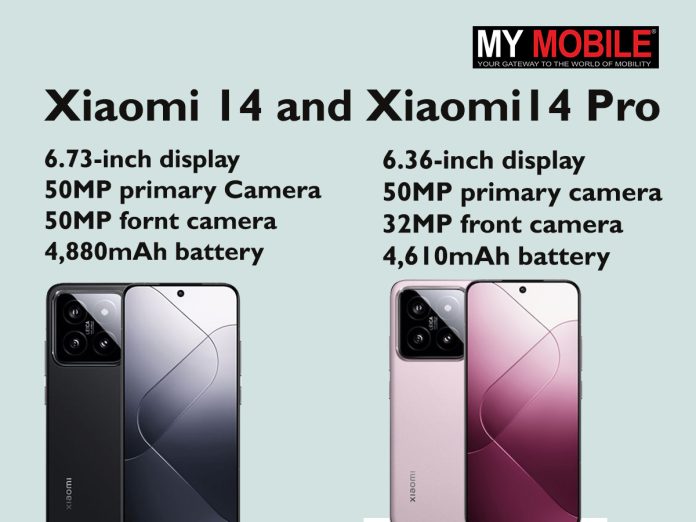
When it comes to the display, the Xiaomi 14 Pro sports a 6.73-inch 2K LTPO C8 AMOLED display with a 120Hz refresh rate and a peak brightness of 3000 nits.

In contrast, the Xiaomi 14 offers a slightly smaller 6.36-inch 1.5K C8 LTPO OLED display but maintains the 120Hz refresh rate and 3000 nits of maximum brightness.

Both phones present a sleek design aesthetic, featuring curved edges and a large square-shaped camera module at the rear.

The Xiaomi 14 comes in four color optionsWhite, Black, Pink, and Green—while the 14 Pro is available in White, Black, and Green, with a special Titanium Edition also on offer.

Photography is another strong suit for these new flagships.

The Xiaomi 14 Pro boasts a Leica-branded camera setup, including 50MP primary, ultra-wide, and telephoto sensors, along with a 50MP front-facing camera for selfies.

The Xiaomi 14 is not far behind, offering a similar Leica-branded triple camera setup with a 32MP front-facing camera.

Both devices come with multiple RAM and storage options, ranging from 8GB+256GB to 16GB+1TB for the Xiaomi 14, and 12GB+256GB to 16GB+1TB for the Xiaomi 14 Pro.

Both phones are powered by the new Qualcomm Snapdragon 8 Gen 3 chipset and run on Xiaomi’s latest HyperOS software, based on Android 14.

Xiaomi 14 Pro Leica-branded camera setup

The presence of Qualcomm’s latest flagship silicone on both devices is a first for the smartphone world.

On the battery front, the Xiaomi 14 Pro houses a 4,880mAh battery with support for 120W fast charging and 50W wireless charging.

The Xiaomi 14 features a slightly larger 4,610mAh battery but supports 90W fast charging and 50W wireless charging.

Both phones also offer a variety of additional features such as an IP68 rating for dust and water resistance, USB 3.2 Gen, Wi-Fi 7, NFC, and an under-display fingerprint sensor.

XIAOMI 14 KEY SPECIFICATIONS

General

Launch Date September 7, 2023 (Unofficial)
Brand Xiaomi
Model 14
Operating System Android v13
SIM Slot(s) Dual SIM, GSM+GSM
SIM Size SIM1: Nano
SIM2: Nano
Network 5G: Not Supported in India,
4G: Available Supported in India,
3G: Available, 2G: Available
Fingerprint Sensor Yes
Quick Charging Yes

 Display

Screen Size 6.43 inches (16.33 cm)
Screen Resolution 1080 x 2100 pixels
Pixel Density 367 ppi
Display Type AMOLED
Touch Screen Yes, Capacitive Touchscreen, Multi-touch

 Performance

Chipset Qualcomm Snapdragon 8 Plus Gen 1
Processor Octa core (3.2 GHz, Single core, Cortex X2 + 2.75 GHz, Tri core, Cortex A710 + 2 GHz, Quad core, Cortex A510)
Architecture 64 bit
Graphics Adreno 730
RAM 12 GB

 Storage

Internal Memory 256 GB
Expandable Memory No

Camera

MAIN CAMERA
Resolution 50 MP f/1.9, Wide Angle, Primary Camera
50 MP f/1.9, Telephoto Camera
50 MP f/2.2, Ultra-Wide Angle Camera
Autofocus Yes, Phase Detection autofocus
Flash Yes, LED Flash
Image Resolution 8150 x 6150 Pixels
Settings Exposure compensation
Shooting Modes Continuous Shooting
High Dynamic Range mode (HDR)
Camera Features Digital Zoom
Auto Flash
Face detection
Touch to focus
Video Recording 1920×1080 @ 30 fps
FRONT CAMERA
Resolution 32 MP f/2.45, Primary Camera
Video Recording 1920×1080 @ 30 fps

 Battery

Capacity 5000 mAh
Type Li-Polymer
User Replaceable No
Wireless Charging Yes
Quick Charging Yes, Fast, 67W
USB Type-C Yes

Network & Connectivity

SIM Size SIM1: Nano, SIM2: Nano
Network Support 5G Not Supported in India, 4G Supported in India, 3G, 2G
VoLTE Yes
SIM 1
4G Bands:
TD-LTE 2300(band 40)
FD-LTE 1800(band 3)
3G Bands:
UMTS 1900 / 2100 / 850 / 900 MHz
2G Bands:
GSM 1800 / 1900 / 850 / 900 MHz
GPRS:
Available
EDGE:
Available
SIM 2
4G Bands:
TD-LTE 2300(band 40)
FD-LTE 1800(band 3)
3G Bands:
UMTS 1900 / 2100 / 850 / 900 MHz
2G Bands:
GSM 1800 / 1900 / 850 / 900 MHz
GPRS:
Available
EDGE:
Available
Wi-Fi Yes, Wi-Fi 4 (802.11 b/g/n)
Wi-Fi Features Mobile Hotspot
Bluetooth Yes, v5.2
GPS Yes with A-GPS, Glonass
NFC Yes
USB Connectivity Mass storage device, USB charging

 Multimedia

Loudspeaker Yes
Audio Jack USB Type-C

 Special Features

Fingerprint Sensor Yes
Fingerprint Sensor Position On-screen
Other Sensors Light sensor, Accelerometer, Compass, Gyroscope

XIAOMI 14 PRO KEY SPECIFICATIONS

Key Specs

RAM 12 GB
Processor Qualcomm Snapdragon 8 Gen 1
Rear Camera 64 MP + 64 MP + 64 MP
Front Camera 32 MP
Battery 5100 mAh
Display 6.8 inches (17.27 cm)

General

Launch Date June 17, 2023 (Unofficial)
Operating System Android v12

Performance

Chipset Qualcomm Snapdragon 8 Gen 1
CPU Octa core (3 GHz, Single core, Cortex X2 + 2.5 GHz, Tri core, Cortex A710 + 1.8 GHz, Quad core, Cortex A510)
Architecture 64 bit
Fabrication 4 nm
Graphics Adreno 730
RAM 12 GB

Display

Display Type Super AMOLED
Screen Size 6.8 inches (17.27 cm)
Resolution 1080 x 2400 pixels
Pixel Density 387 ppi
Screen Protection Corning Gorilla Glass v5
Bezel-less display Yes with punch-hole display
Touch Screen Yes, Capacitive Touchscreen, Multi-touch

Camera

MAIN CAMERA
Camera Setup Triple
Resolution 64 MP, Primary Camera
64 MP
64 MP
Autofocus Yes
Flash Yes, LED Flash
Image Resolution 9000 x 7000 Pixels
Settings Exposure compensation, ISO control
Shooting Modes Continuous Shooting
High Dynamic Range mode (HDR)
Camera Features Auto Flash
Face detection
Touch to focus
Video Recording 1920×1080 @ 30 fps
FRONT CAMERA
Camera Setup Single
Resolution 32 MP, Primary Camera
Video Recording 1920×1080 @ 30 fps

Battery

Capacity 5100 mAh
Type Li-Polymer
Removable No
Quick Charging Yes, Fast
USB Type-C Yes

Storage

Internal Memory 256 GB
Expandable Memory No

Network & Connectivity

SIM Slot(s) Dual SIM, GSM+GSM
SIM Size SIM1: Nano, SIM2: Nano
Network Support 5G Not Supported in India, 4G Supported in India, 3G, 2G
VoLTE Yes
SIM 1
4G Bands:
TD-LTE 2300(band 40)
FD-LTE 1800(band 3)
3G Bands:
UMTS 1900 / 2100 / 850 / 900 MHz
2G Bands:
GSM 1800 / 1900 / 850 / 900 MHz
GPRS:
Available
EDGE:
Available
SIM 2
4G Bands:
TD-LTE 2300(band 40)
FD-LTE 1800(band 3)
3G Bands:
UMTS 1900 / 2100 / 850 / 900 MHz
2G Bands:
GSM 1800 / 1900 / 850 / 900 MHz
GPRS:
Available
EDGE:
Available
Wi-Fi Yes, Wi-Fi 4 (802.11 b/g/n)
Wi-Fi Features Mobile Hotspot
Bluetooth Yes, v5.2
GPS Yes with A-GPS, Glonass
NFC Yes
USB Connectivity Mass storage device, USB charging

Multimedia

Loudspeaker Yes
Audio Jack USB Type-C

Sensors

Fingerprint Sensor Yes
Fingerprint Sensor Position On-screen
Fingerprint Sensor Type Optical
Other Sensors Light sensor, Proximity sensor, Accelerometer, Compass, Gyroscope

FAQs

What’s new in the Xiaomi 14 Series smartphones?

The Xiaomi 14 Series is the first to be equipped with Qualcomm’s Snapdragon 8 Gen 3 chipset and Xiaomi’s new HyperOS software. These flagships offer a robust set of features from display to cameras.

How many variants are available for the Xiaomi 14 and 14 Pro?

The Xiaomi 14 is available in four variants, while the Xiaomi 14 Pro comes in three different variants. Both offer a range of RAM and storage options to suit various needs.

What are the camera capabilities of these new models?

Both the Xiaomi 14 and 14 Pro feature Leica-branded triple 50MP camera setups, with the Pro model boasting an additional 50MP front-facing camera for selfies.

When will these phones be available for purchase?

Both models are available for pre-order in China starting today, with sales set to commence on October 31st.

Also Read: Xiaomi to launch Android 13-based MIUI 14 with India-exclusive features to release on February 27th

Also Read: Xiaomi Smartphones’ Battery Customization Via MIUI

Infinix Zero 30 4G With Helio G99 SoC, 120Hz AMOLED Display Launched in Indonesia

0

Highlights

  • Helio G99 Chipset promises seamless and fast performance
  • Vibrant 6.78-inch AMOLED display with 120Hz refresh rate
  • Powerful camera setup featuring a 108MP rear sensor and a 50MP front sensor
  • IP54 rating for assured dust and splash resistance

Expanding its dynamic portfolio, Infinix has launched yet another exciting addition to the Zero 30 family in Indonesia—the Infinix Zero 30 4G.

Designed to offer a seamless blend of power, functionality, and affordability, this new model introduces several key differences that cater to diverse user preferences.

Availability and Pricing

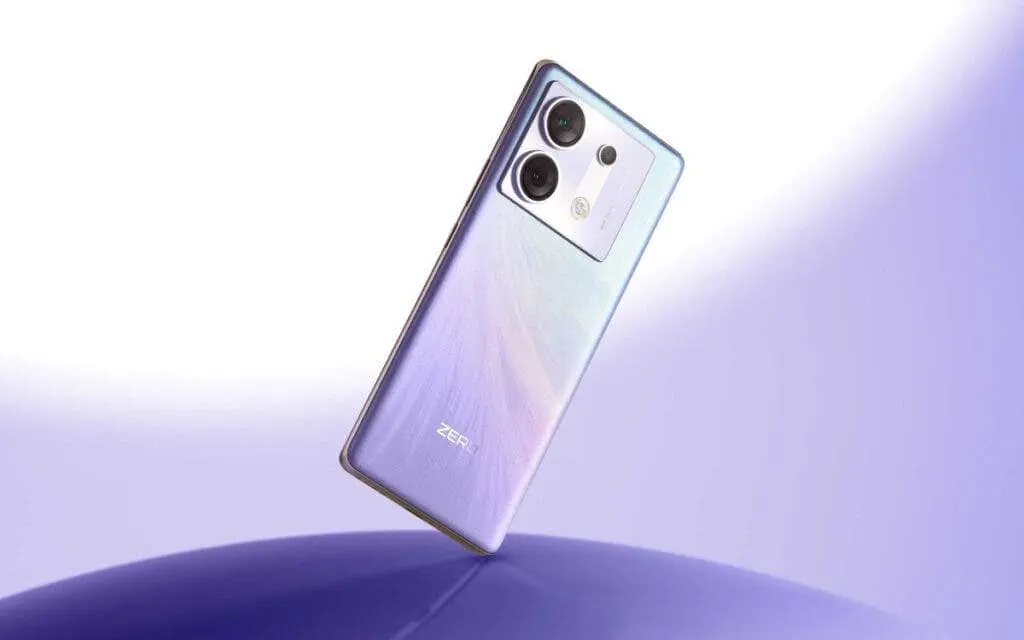
This smartphone comes in three elegant colour choices: Sunset Gold, Misty Green, and Pearly White.

Priced at IDR 2,899,000 (approximately Rs 15,000), it offers excellent value for budget-conscious consumers.
Starting October 27, the Infinix Zero 30 4G will be available exclusively on Lazada.

Key Specs

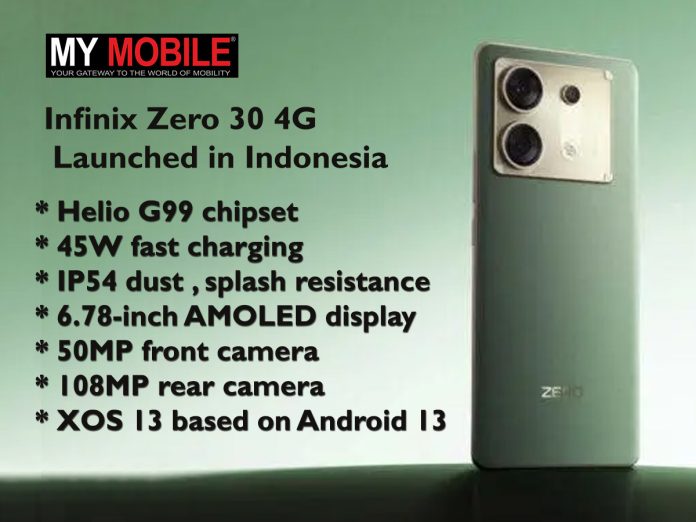
  • Chipset: Helio G99 for robust performance
  • Charging Speed: 45W Fast Charging
  • Durability: IP54 rating for dust and splash resistance
  • Display: 6.78-inch curved AMOLED with FHD+ resolution
  • Refresh Rate: 120Hz
  • Front Camera: 50MP with 4K video recording capabilities
  • Rear Camera: 108MP ISOCELL HM6 main sensor with OIS, along with two 2MP auxiliary sensors
  • RAM: 8GB
  • Storage: 256GB internal storage
  • Operating System: XOS 13 based on Android 13
  • Colours: Sunset Gold, Misty Green, Pearly White

Infinix Zero 30 4G: Features

Infinix Zero 30 4G

Under the hood, the Infinix Zero 30 4G is equipped with a Helio G99 chipset, ensuring a smooth user experience.

Although the charging speed stands at 45Wslightly slower compared to the 68W charging speed of the Zero 30 5G—the device still promises swift battery rejuvenation for on-the-go users.

The smartphone earns its stripes with an IP54 rating, providing a higher level of dust and splash resistance compared to the IP53 rating of the Zero 30 5G.

Whether you’re outdoors or in a challenging environment, the device promises reliability.

Sporting a curved 6.78-inch AMOLED display, the Zero 30 4G offers vibrant FHD+ resolution.

While the refresh rate is toned down to 120Hz, it continues to deliver a fluid and immersive viewing experience.

Photography enthusiasts are in for a treat. The front camera boasts a 50MP lens capable of 4K video recording.

At the back, the device houses a 108MP ISOCELL HM6 1/1.67main sensor with Optical Image Stabilization (OIS), flanked by two 2MP auxiliary sensors.

The Infinix Zero 30 4G does not compromise on memory and storage, offering 8GB of RAM and 256GB of built-in storage.

Running on XOS 13 based on Android 13, the device ensures a responsive and up-to-date user interface.

Experience the new standard of robust features and performance with the Infinix Zero 30 4G.

Secure your device starting tomorrow and redefine what a budget smartphone can offer.

FAQs

What chipset does the Infinix Zero 30 4G use?

The Infinix Zero 30 4G is powered by a Helio G99 chipset, ensuring robust performance for all your smartphone needs.

Is the Infinix Zero 30 4G water and dust-resistant?

Yes, the smartphone comes with an IP54 rating, making it dust and splash-resistant.

What camera features can we expect?

The device offers a 108MP rear camera and a 50MP front camera, both capable of delivering high-quality photos and videos.

When and where can I buy the Infinix Zero 30 4G?

The smartphone will be available exclusively on Lazada starting from October 27, 2023.

Nokia 105 Classic Launch: The Feature Phone That Offers UPI Payment Support

0

Highlights

  • Introduces UPI payment support in a feature phone for the first time
  • Comes with an 800mAh battery for all-day connectivity
  • Available in two colours and four versatile variants including Single and Dual SIM options
  • Offered with a one-year assured replacement guarantee from HMD Global

In a surprising yet welcome announcement, HMD Global has revealed the launch of the Nokia 105 Classic—a feature phone that doesn’t just take calls but also enables UPI payments.

With this move, Nokia reiterates its commitment to making financial transactions easier and more accessible for everyone.

Here’s everything you need to know about the price, availability, specifications, and unique features of the Nokia 105 Classic in India.

Price and Availability

The Nokia 105 Classic comes with a starting price of just Rs 999, offering unparalleled value.

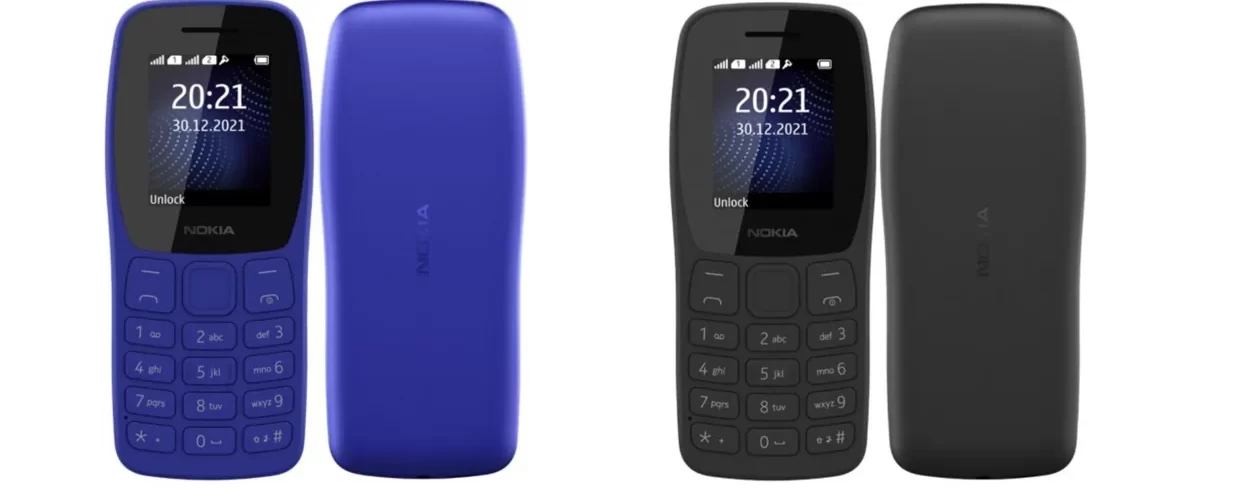
For those who want options, the phone is available in two elegant colours: Charcoal and Blue.

HMD Global goes a step further, offering the phone in four distinct variants: Single SIM, Dual SIM, with charger, and without charger. 

Adding to the allure, the company provides an assured one-year replacement guarantee.

You can secure your device either online via Nokia’s e-site or through offline stores across the nation.

  • Specifications: Simple Yet Powerful
  • Keypad: Typing is effortless thanks to well-spaced buttons, enabling easy texting even in low-light conditions.
  • Design: Ergonomically designed, the phone sits comfortably in your hand, providing a sturdy grip that complements its robust build.
  • Battery: An 800mAh battery ensures you stay connected throughout the day, without worrying about frequent charging.
  • Extras: The phone comes with a loudspeaker for clear audio and a wireless FM radio application for entertainment on the go.
  • Features: Where Classic Meets Cutting-Edge

Nokia 105 Classic Features

Nokia 105 Classic

The Nokia 105 Classic may look like a simple feature phone, but it comes packed with functionalities that make it stand out.

One of its most talked-about features is the in-built UPI application that allows for secure financial transactions. Whether you’re splitting a bill or paying for services, doing so has never been easier on a feature phone.

The device is not just about nostalgia; it’s about evolving with the needs of modern users.

Additionally, the wireless FM radio ensures you’re never far from entertainment, and its loudspeaker means you can share the fun with friends.

HMD Global has confirmed that the phone is designed to be robust and has undergone rigorous testing to withstand daily wear and tear.

Nokia 105 Classic Key Specs

Feature Nokia 105 Classic
Display 1.77-inch QQVGA (120×160 pixels) color display
Operating System Series 30+
Processor Single-core MediaTek MT6260A
RAM 4MB
Storage 4MB, expandable up to 32GB via microSD card
Rear Camera No
Front Camera No
Connectivity 2G (GSM), Bluetooth
Battery Removable 800mAh battery
Dimensions 119 x 49.2 x 14.4 mm
Weight 74.04 grams

FAQs

What makes the Nokia 105 Classic unique among feature phones?

The Nokia 105 Classic is the first feature phone to include UPI payment support, making it easier for users to carry out financial transactions.

How long does the 800mAh battery last?

The 800mAh battery is designed to provide all-day usage, although actual battery life may vary based on usage patterns.

What are the available colour options for the Nokia 105 Classic?

The Nokia 105 Classic is available in two colour options: Charcoal and Blue.

Is there a warranty or replacement guarantee for the phone?

Yes, HMD Global offers an assured one-year replacement guarantee on the new Nokia 105 Classic.

Honor Magic 6 Series to Debut with Qualcomm Snapdragon 8 Gen 3 and AI Assistant YOYO

0

Highlights

  • Honor Magic 6 to feature Qualcomm’s latest Snapdragon 8 Gen 3 platform.
  • In-built AI assistant YOYO can perform complex tasks locally.
  • Introduces an eye-tracking feature called Magic Capsule.
  • Series includes Magic 6 and a more advanced Magic 6 Pro model.

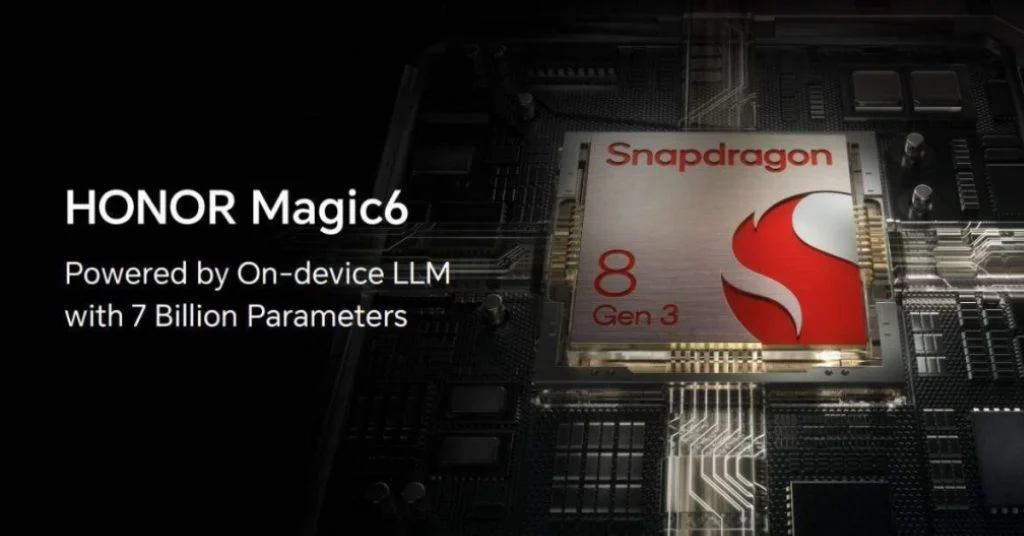
Honor’s upcoming Magic 6 series has been confirmed to be incorporating Qualcomm’s state-of-the-art Snapdragon 8 Gen 3 mobile platform.

It doesn’t end with the silicon.

Honor is taking strides to redefine smartphone interactions with its newly announced AI assistant, YOYO.

Unlike run-of-the-mill voice assistants, YOYO integrates a large language model boasting an expansive 7 billion parameters.

The AI assistant is capable of completing a variety of complex tasks without the need for cloud-based data processing, keeping user data secure and privacy intact.

Honor Magic 6 Snapdragon 8 Gen3

Adding another layer to the human-device interaction spectrum is Magic Capsule, an eye-tracking-based system.

Although details are scant at this juncture, the underpinning technology, Snapdragon Seamless, suggests the potential for a fluid and interactive user experience that transcends the touchscreen.

The series, expected to include the Magic 6 and Magic 6 Pro models, caters to both the mainstream and high-end market segments.

Particularly interesting is the Magic 6 Pro, which has been sighted with a pill-shaped notch and a sophisticated camera setup. 

It’s anticipated to inherit the same 12MP ultrawide selfie camera and ToF 3D camera previously seen in the Magic 5 Pro.

Honor has been making a lot of waves in the Indian market as well with the launch of the Honor 90.

As of right now HTech, the company that sells Honor devices in India, has remained mum on the announcement of new products in the Indian market.

Whether the Honor Magic 60 series sees the day of light in the country’s ever-expanding smartphone realm, is a topic for another day.

FAQs

What is the new AI assistant YOYO capable of?

YOYO is an on-device AI assistant powered by a large language model with 7 billion parameters. It can answer questions, create short videos, and provide personalized recommendations without requiring cloud data.

What does Magic Capsule bring to the table?

Magic Capsule is a new interaction method that uses eye-tracking technology. Though specific details are yet to be released, it promises to offer a new way to engage with your smartphone.

What are the hardware specifications of the Honor Magic 6 series?

The Honor Magic 6 series will feature Qualcomm’s Snapdragon 8 Gen 3 mobile platform. The Pro version is also expected to include a 12MP ultrawide selfie camera and a time-of-flight (ToF) 3D camera.

When can we expect the Honor Magic 6 series to be released?

While Honor has not yet provided a specific release date, the Magic 6 series is expected to be launched early next year.

Vivo Y100 5G’s China Telecom Website Listing Reveals Price, Specs Ahead of Launch

0

Highlights

  • Vivo Y100 5G China Variant to launch with Qualcomm’s Snapdragon 675 SoC.
  • Featuring a robust 5,000mAh battery for extended use.
  • 64MP primary camera with OIS confirmed.
  • Multiple RAM and storage options, starting at 8GB RAM and 128GB internal storage.

Vivo is all set to launch its Y100 5G smartphone in China tomorrow, October 27.

The Chinese version is expected to differentiate itself from the Indian variant in various ways, including design, chipset, and battery capacity.

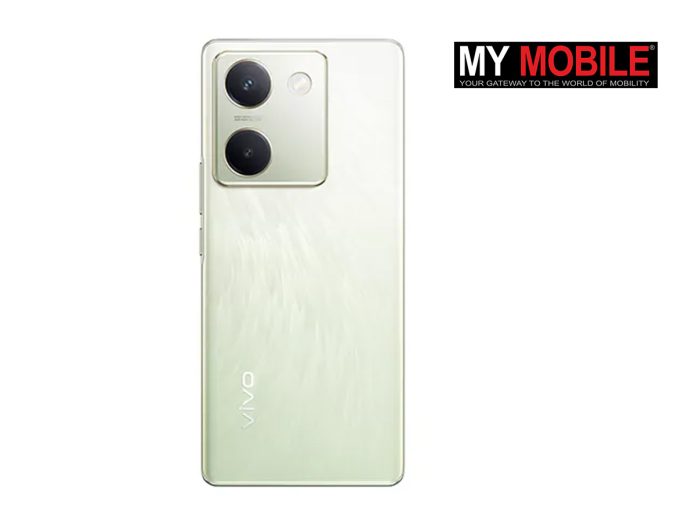
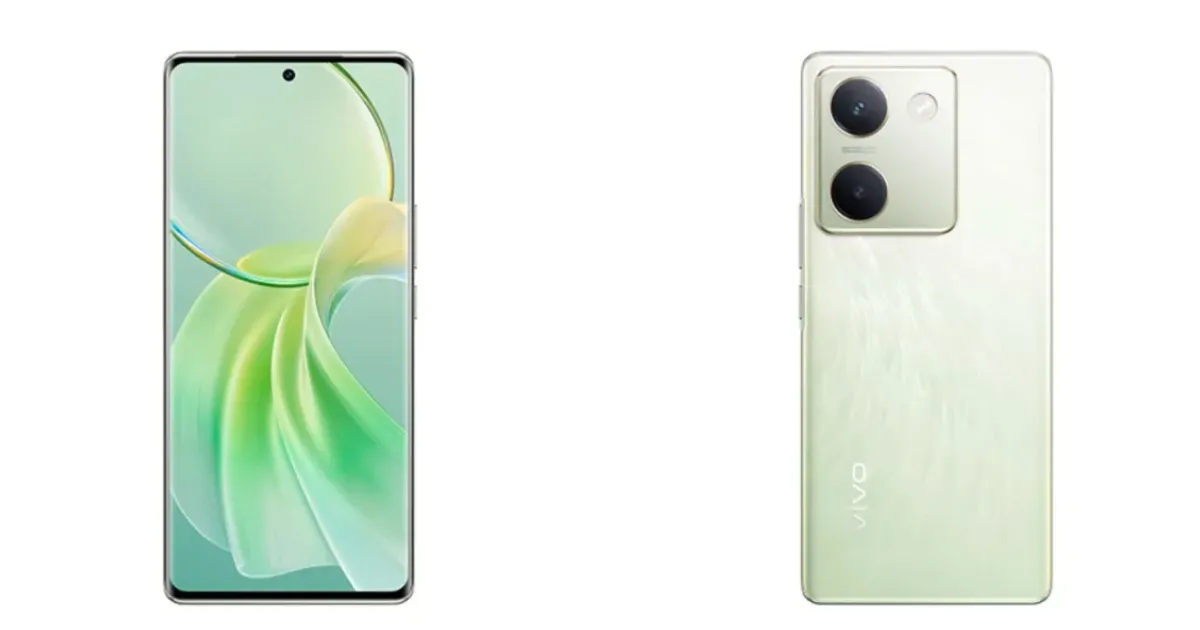
Vivo Y100
Vivo V2313A

Most notably, a 64MP primary camera and a 5,000mAh battery are confirmed features.

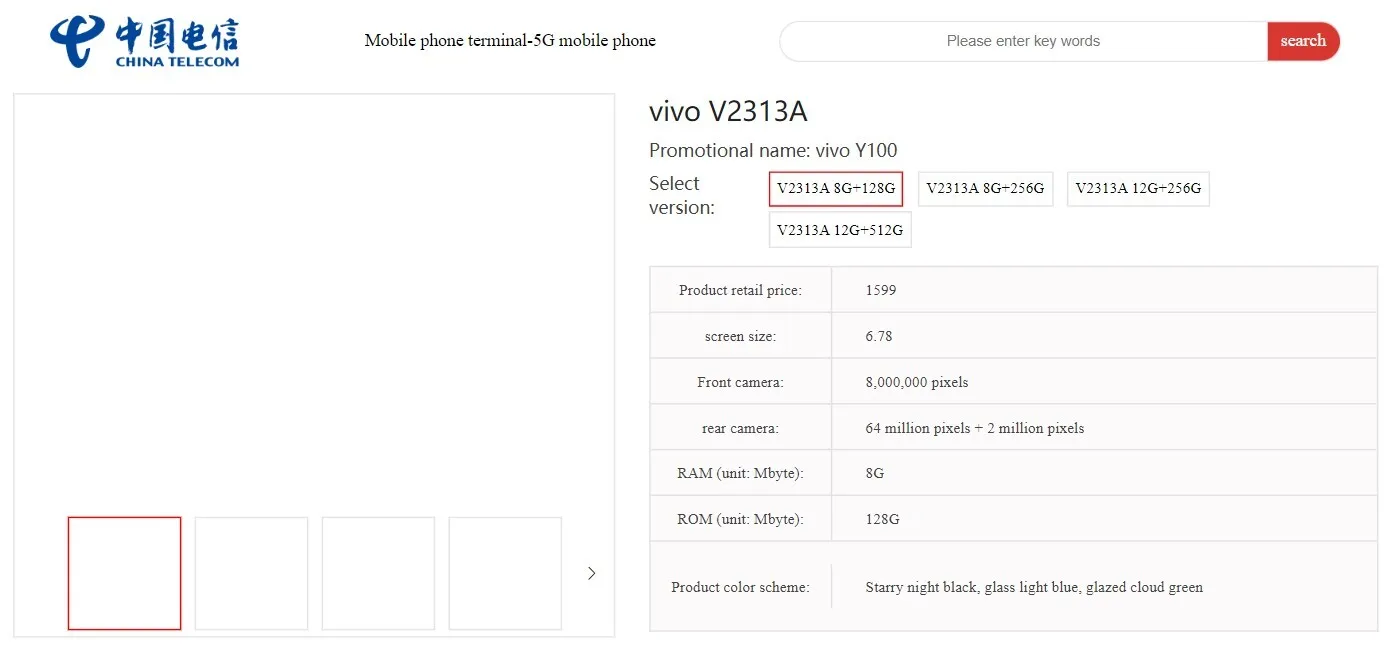
To shed more light on the specifications and pricing, the smartphone’s full details have been leaked courtesy of a listing on China Telecom’s website.

Expected Pricing and Availability

Vivo Y100

According to the China Telecom listing, the base model with 8GB of RAM and 128GB of internal storage will be priced at approximately CNY 1599 (around Rs 18,400).

Meanwhile, the variant with 8GB of RAM and 256GB storage will retail for CNY 1799 (about Rs 20,500). 

For the high-end 12GB RAM model, customers can choose between 256GB and 512GB of internal storage, costing CNY 1999 (roughly Rs 22,800) and CNY 2199 (approximately Rs 25,100) respectively.

The device will be available in Starry Night Black, Glass Light Blue, and Glazed Cloud Green color options.

Key Expected Specs

  • Processor: Snapdragon 675
  • Display: 6.78-inch Full HD+
  • Operating System: Android 13
  • Camera: 64MP primary sensor with OIS, 2MP secondary lens, 8MP front camera
  • Battery: 5,000mAh
  • RAM and Storage: Options for 8GB/12GB RAM and 128GB/256GB/512GB internal storage
  • Dimensions and Weight: 164.42×74.92×7.57mm, 183 grams

Vivo Y100 5G: Expected Features

After examining the details revealed by the listing, it’s evident that Vivo is leaving no stone unturned to captivate the Chinese smartphone market.

Under the hood, the device will run on Qualcomm’s octa-core Snapdragon 675 SoC, and it’s designed to operate on Android 13 right from the get-go.

Moreover, the Y100 5G will be available in multiple RAM and storage configurations, giving consumers ample choice based on their specific needs.

In terms of optics, the device features a dual-camera setup.

The primary 64MP sensor will come with OIS, supported by a 2MP secondary lens. Selfie aficionados will also appreciate the 8MP front-facing camera.

Regarding design and dimensions, the device will measure 164.42×74.92×7.57mm and weigh 183 grams.

Powering all these features will be a robust 5,000mAh battery, ensuring longevity and consistent performance.

Vivo Y100 5G Key Specifications

Key Specs

RAM 8 GB
Processor MediaTek Dimensity 900 MT6877
Rear Camera 50 MP + 8 MP + 2 MP
Front Camera 50 MP
Battery 5000 mAh
Display 6.0 inches (15.24 cm)

General 

Launch Date June 21, 2023 (Unofficial)
Operating System Android v12

Performance

Chipset MediaTek Dimensity 900 MT6877
CPU Octa core (2.4 GHz, Dual core, Cortex A78 + 2 GHz, Hexa Core, Cortex A55)
Architecture 64 bit
Fabrication 6 nm
Graphics Mali-G68 MC4
RAM 8 GB

Display

Display Type AMOLED
Screen Size 6.0 inches (15.24 cm)
Resolution 1080 x 2400 pixels
Aspect Ratio 20:9
Pixel Density 439 ppi
Bezel-less display Yes with punch-hole display
Touch Screen Yes, Capacitive Touchscreen, Multi-touch
Refresh Rate 120 Hz

Camera

MAIN CAMERA
Camera Setup Triple
Resolution 50 MP, Primary Camera
8 MP, Ultra-Wide Angle Camera
2 MP, Macro Camera
Autofocus Yes
OIS Yes
Flash Yes, LED Flash
Image Resolution 8150 x 6150 Pixels
Settings Exposure compensation, ISO control
Shooting Modes Continuous Shooting
High Dynamic Range mode (HDR)
Camera Features Digital Zoom
Auto Flash
Face detection
Touch to focus
Video Recording 3840×2160 @ 30 fps
FRONT CAMERA
Camera Setup Single
Resolution 50 MP, Primary Camera

Battery

Capacity 5000 mAh
Type Li-Polymer
Removable No
Quick Charging Yes, Fast, 66W
USB Type-C Yes

Storage

Internal Memory 128 GB
Expandable Memory No

Network & Connectivity

SIM Slot(s) Dual SIM, GSM+GSM
SIM Size SIM1: Nano, SIM2: Nano
Network Support 5G Not Supported in India, 4G Supported in India, 3G, 2G
VoLTE Yes
SIM 1
4G Bands:
TD-LTE 2300(band 40)
FD-LTE 1800(band 3)
3G Bands:
UMTS 1900 / 2100 / 850 / 900 MHz
2G Bands:
GSM 1800 / 1900 / 850 / 900 MHz
GPRS:
Available
EDGE:
Available
SIM 2
4G Bands:
TD-LTE 2300(band 40)
FD-LTE 1800(band 3)
3G Bands:
UMTS 1900 / 2100 / 850 / 900 MHz
2G Bands:
GSM 1800 / 1900 / 850 / 900 MHz
GPRS:
Available
EDGE:
Available
Wi-Fi Yes, Wi-Fi 4 (802.11 b/g/n)
Wi-Fi Features Mobile Hotspot
Bluetooth Yes, v5.3
GPS Yes with A-GPS
USB Connectivity Mass storage device, USB charging

Multimedia

Loudspeaker Yes
Audio Jack USB Type-C

Sensors

Fingerprint Sensor Yes
Fingerprint Sensor Position On-screen
Fingerprint Sensor Type Optical
Other Sensors Light sensor, Proximity sensor, Accelerometer

FAQs

What processor does the Vivo Y100 5G China Variant have?

The smartphone is set to feature Qualcomm’s Snapdragon 675 SoC, offering efficient performance and multitasking capabilities.

What are the camera specifications?

The device will boast a dual-camera setup, with a 64MP primary sensor that includes Optical Image Stabilization and a 2MP secondary lens.

What about the device’s battery?

The Vivo Y100 5G China Variant will come with a 5,000mAh battery, aiming for long-lasting performance and durability.

Are multiple storage options available?

Yes, the smartphone will offer various RAM and storage configurations, including options for 8GB or 12GB of RAM and up to 512GB of internal storage.