Vivo S2 FE has cleared Bluetooth SIG certification under model number V2640, finally confirming its name.
The same model number also appeared in the IMEI database but there is no official confirmation from the brand yet.
The phone is expected to be a budget-friendly alternative to Vivo S2 5G.
We have previously reported that Vivo is preparing another smartphone for its S2 series. The device has already been mentioned in earlier leaks and the latest certification suggests that Vivo is continuing development of the new S-series smartphone. Previously, there was some uncertainty about the smartphone moniker but that has also been cleared with the new listing appearance. Here’s what we know about the upcoming Vivo phone.
Vivo S2 FE on Bluetooth SIG Listing
Screenshot by @ZionsAnvin on X.
According to the latest post by tipster Anvin on X, the upcoming Vivo S2 FE has now cleared Bluetooth SIG certification, providing an official confirmation of its model number. However, the certification does not reveal any hardware specifications yet.
The Vivo S2 FE has appeared on the Bluetooth SIG certification database under the model number V2640. The same model number was also recently spotted in an IMEI database, further strengthening the existence of the upcoming smartphone.
The Vivo S2 FE name first surfaced in July 2026 when a tipster claimed that Vivo’s next S-series smartphone would carry the FE branding instead of being launched as the Vivo S2 Pro.
Vivo S2 FE – What To Expect?
There is currently no confirmed information about the specifications of the Vivo S2 FE. Reports suggest Vivo could position it as a more affordable alternative to the recently launched Vivo S2 5G.
The S2 series itself marks Vivo’s return to the S branding in India after almost six years. The company had last used the S-series name in the country with the Vivo S1, which launched in 2019 and was aimed at budget-conscious buyers with a price below Rs 20,000. Vivo has recently brought the series back to the market with the launch of Vivo S2.
With the Vivo S2 FE V2640 now appearing on both Bluetooth SIG and IMEI databases, more information could surface through additional certification and regulatory listings
HMD has hiked Vibe 2 prices in India by Rs 1,000 across all three variants, effective September 1, 2026.
After prices increase, the 4+64GB now costs Rs 15,999, 4+128GB costs Rs 17,999 and 6+128GB is priced at Rs 19,999.
The phone features 120Hz display, 6,000mAh battery, 50-megapixel main camera and Unisoc T8200 chip.
HMD Vibe 2. (Image credit – HMD)
HMD has announced a price hike for the HMD Vibe 2 smartphone in India. The company has increased the price of all three memory and storage configurations by Rs 1,000 with the revised prices coming into effect from September 1, 2026.
The HMD Vibe 2 is positioned as an affordable smartphone with features such as a 120Hz display, a 6,000mAh battery and a Unisoc T8200 processor. Following the latest revision, buyers will now have to pay more for every variant of the phone.
HMD Vibe 2 New Price in India
According to HMD’s official announcement, the price increase applies to all HMD Vibe 2 variants sold in India. The 4GB RAM and 64GB storage version, which was previously priced at Rs 14,999, will now cost Rs 15,999.
The 4GB RAM + 128GB storage variant has gone from Rs 16,999 to Rs 17,999. Meanwhile, the top-end 6GB RAM + 128GB storage model will now be available for Rs 19,999 instead of its earlier price of Rs 18,999.
In other words, HMD has applied the same ₹1,000 increase across the entire Vibe 2 range.
Variant
Old Price
New Price
Hike
HMD Vibe 2 4GB + 64GB
Rs 14,999
Rs 15,999
Rs 1,000
HMD Vibe 2 4GB + 128GB
Rs 16,999
Rs 17,999
Rs 1,000
HMD Vibe 2 6GB + 128GB
Rs 18,999
Rs 19,999
Rs 1,000
Should You Buy HMD Vibe 2 At Increased Price?
The HMD Vibe 2 features a 6.75-inch HD+ V-Notch IPS display with a 720×1600-pixel resolution with a 2D design and a 120Hz refresh rate. It is powered by the Unisoc T8200 processor and runs Android 16. There is a 50-megapixel main camera as part of a dual rear camera system. The setup also includes AI features and an LED flash. On the front, there is an 8-megapixel camera for selfies and video calls. The phone packs a large 6,000mAh battery and supports 18W wired charging.
The ₹1,000 increase is relatively minimal but it makes the HMD Vibe 2 slightly less attractive in a highly competitive budget smartphone market.
The entry-level model now crosses the ₹15,000 mark, while the 6GB + 128GB version reaches ₹19,999. At these prices, buyers have more options from competing brands. Buyers planning to purchase the HMD Vibe 2 may want to check for discounts or promotional offers before purchasing. The new prices officially take effect across India from September 1, 2026.
OnePlus 16 tipped to feature a 165Hz global refresh rate across the entire system using a custom BOE panel with X4 luminescent material.
The display is expected to include a self‑developed chip, triple calibration, OPPO eye‑protection tech, narrow bezels and gaming‑focused Oriental Screen 4.0.
Other leaked specs include Snapdragon 8 Elite Gen 6 Pro, around 9,000mAh battery, ColorOS 17, 200MP periscope telephoto camera with 50MP primary and ultra‑wide sensors.
OnePlus appears to be preparing a major display upgrade for its next flagship smartphone expected in October. OnePlus has already been teasing the ultra-high refresh rate for several weeks and the latest leak provides more information about what the company could offer.
The new update shared by tipster Digital Chat Station on Weibo has revealed several details about the OnePlus 16’s screen including a 165Hz refresh rate that is expected to work across the entire system.
OnePlus 16’s System-wide 165Hz Refresh Rate
DCS’s post on Weibo. (Translated via Google Translate)
The OnePlus 16 is expected to use a customised BOE panel featuring the company’s specially developed X4 luminescent material. BOE is reportedly developing this material specifically for the upcoming OnePlus flagship.
Digital Chat Station describes it as the industry’s first global 165Hz ultra-high refresh rate. In this case, “global” means that the 165Hz mode would not be restricted to particular games or applications and it could operate throughout the phone’s interface.
Custom Display Chip and Eye Protection Features
The screen is also expected to use a self-developed display chip manufactured using a new process. According to the leak, the chip will undergo three separate calibration processes. The display could further benefit from OPPO’s latest eye-protection technology.
The panel is also expected to feature narrow bezels on all four sides for a more immersive experience.
Gaming is expected to be another major focus of the OnePlus 16. The phone is reportedly set to use the Oriental Screen 4.0 display alongside upgraded gaming technologies.
OnePlus 16 – What Else We Know?
Beyond the display, several other specifications of the OnePlus 16 have also surfaced through earlier leaks. The phone is expected to be powered by Qualcomm’s Snapdragon 8 Elite Gen 6 Pro chipset. As per the latest rumours, OnePlus 16 RAM options are expected to start with 12GB.
Battery life could also be a major highlight with the smartphone reportedly packing a battery close to 9,000mAh.
On the software side, the OnePlus 16 is tipped to run ColorOS 17. The user interface is reportedly being updated with new animations designed specifically to take advantage of the higher refresh rate.
The rear camera system is expected to include a 200-megapixel periscope telephoto camera as the main highlight. It could be accompanied by 50-megapixel primary and 50-megapixel ultra-wide sensors.
The OnePlus 16 is currently tipped to launch in October. OnePlus has not yet officially announced the smartphone or confirmed its complete specifications.
Vivo X Fold 6 has received BIS certification in India, which suggests an Indian launch could happen soon.
The foldable features a 6.51″ cover display, 8.02″ inner screen, Dimensity 9500 Super chip, 7,000mAh battery with 80W wired/40W wireless charging.
India launch date and pricing remain unconfirmed.
Vivo X Fold 6 was launched in China earlier this year. (Image credit – Vivo)
Vivo could finally be preparing to bring its latest foldable smartphone to India. The Vivo X Fold 6 has now appeared on India’s BIS certification database, suggesting that the company’s plans for an Indian launch may be moving forward.
The foldable was originally introduced in China in June and even after early reports suggested that India could receive the device around the same period, the launch did not happen as expected. The latest BIS certification now provides a fresh indication that Vivo may be getting ready to introduce the X Fold 6 in India.
Vivo X Fold 6 Spotted on BIS
Vivo X Fold 6 has been listed on BIS. (Screenshot bt Xpertpick)
As per the latest Xpertpick report, the Vivo X Fold 6 has been listed on the BIS certification database with the model number V2559. While the listing itself does not mention the commercial name, the same model has previously appeared with the Vivo X Fold 6 name on other certification platforms. These include Malaysia’s SIRIM and Indonesia’s SDPPI certification databases.
The appearance on BIS is particularly important for the Indian market as it suggests that Vivo is taking steps towards launching the device in the country.
As is usually the case with BIS listings, the certification does not provide any information about the phone’s hardware or specifications. However, the Indian version is expected to retain the specifications of the Chinese model.
Meanwhile, Vivo is also expected to launch another wider foldable smartphone in 2027. If the reported plans go ahead, that device could arrive in India during the second half of 2027 strengthening the brand’s presence in the premium foldable smartphone market.
Vivo X Fold 6 Specifications
Vivo X Fold 6. (Image credit – Vivo)
The Vivo X Fold 6 in China comes with a 6.51-inch cover screen and a larger 8.02-inch foldable display on the inside. The smartphone is powered by the Dimensity 9500 Super chipset and draws power from a 7,000mAh battery. The battery supports 80W wired fast charging and 40W wireless charging.
For selfies and video calls, Vivo has equipped both the outer and inner screens with 20-megapixel cameras. The rear camera system consists of three sensors including a 20-megapixel primary camera, a 50-megapixel ultra-wide camera and a 50-megapixel periscope telephoto camera.
For now, the BIS certification is the latest indication that the Vivo X Fold 6 could finally be headed to India. Vivo has yet to officially announce its Indian launch date or pricing.
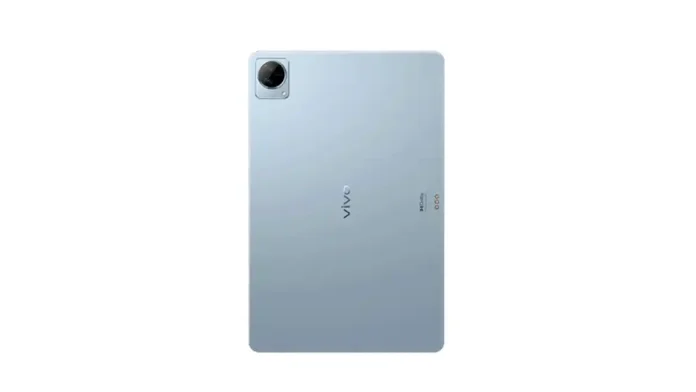
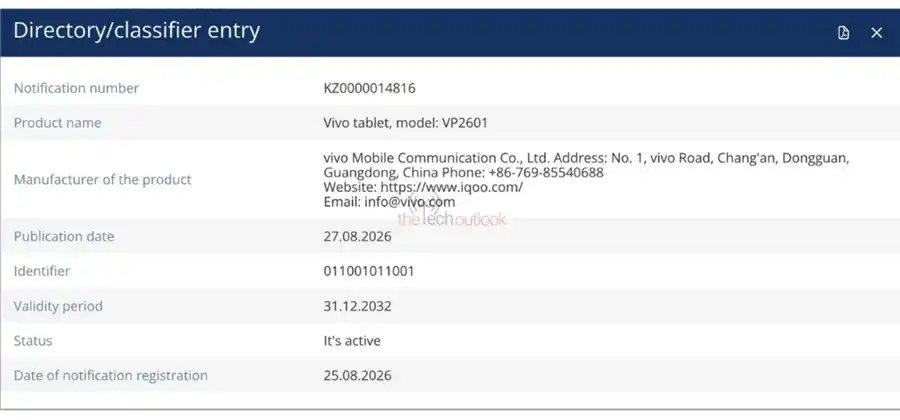
The listing, spotted by TheTechOutlook, does not reveal the tablet’s specifications but it confirms the existence of a Vivo-branded tablet carrying the model number VP2601.
Vivo VP2601 Tablet on EEC Certification. (Screenshot by TheTechOutlook)
The device is listed on the EEC database as a “Vivo tablet” with the model number VP2601. The certification notification carries the number KZ0000014816 and names Vivo Mobile Communication Co., Ltd. as the manufacturer.
The notification was registered on August 25, 2026, and was published on August 27. It carries the identifier 011001011001 and currently has an active status. According to the listing, the certification will remain valid until December 31, 2032.
While the EEC entry does not provide any information about the tablet’s display, processor, battery or other hardware, its appearance on the database is an indication that Vivo could be preparing the device for markets outside China.
Could This Be Vivo’s First Tablet for Global Markets?
Vivo has previously launched tablets under its Pad series but those devices have remained exclusive to the company’s home market, China. If the VP2601 eventually reaches international markets, it could therefore become Vivo’s first tablet officially launched globally.
However, the certification alone does not confirm that the device will be sold worldwide. Vivo has also not revealed the tablet’s name, specifications or launch schedule.
Vivo VP2601 Launch Timeline
The EEC certification has confirmed that Vivo is working on a tablet identified as VP2601 but there is currently very little information about the device itself. Its commercial name, specifications, pricing and launch date have not yet been revealed.
More details could emerge if the tablet appears on more certification platforms in the coming weeks.
Vivo Battery Spotted on the TÜV Certification Database
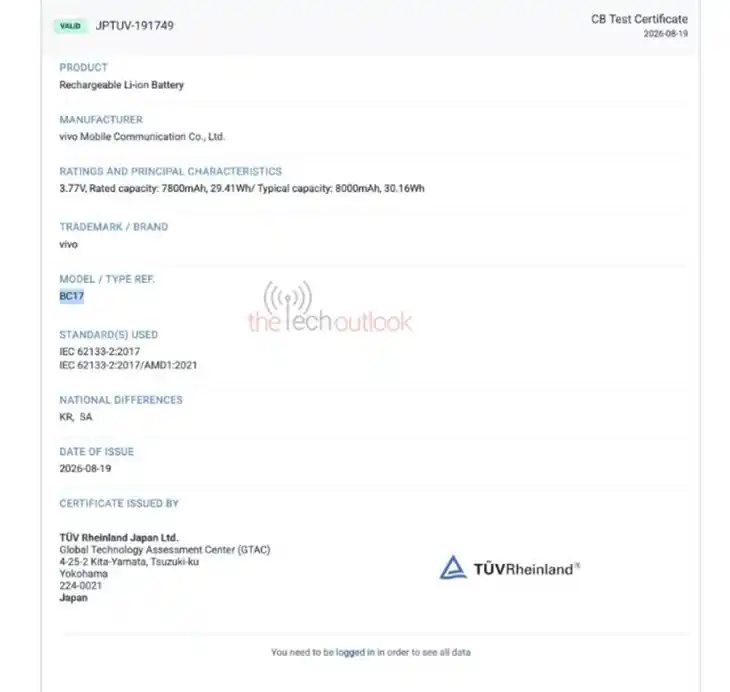
Vivo Battery BC17 Spotted on TUV. (Screenshot by TheTechOutlook)
The EEC appearance comes shortly after another Vivo product was spotted on a certification database. A Vivo-branded battery carrying the model number BC17 was recently listed on the TÜV certification database.
That listing revealed a typical battery capacity of 8,000mAh. An 8,000mAh battery would be a sizeable capacity for a tablet but there is currently no direct evidence connecting the BC17 battery with the VP2601.
We will have to wait for more details before making any connection between the battery and any other upcoming Vivo devices.
POCO X8 5G (Global) Geekbench listing shows Snapdragon 6s Gen 4, octa‑core CPU, 12GB RAM and Android 16.
Previous teasers have confirmed a 9,000mAh battery, 67W fast charging and 22.5W reverse charging.
Some of the expected features include 6.83″ AMOLED display with up to 3,500 nits brightness, 50MP rear + 16MP front cameras and long‑term support with 4 Android OS updates + 6 years of security updates.
POCO has already confirmed that the X8 5G will launch in India on September 4 at 12:00 PM IST. The smartphone will arrive alongside the POCO X8 Power 5G. Ahead of the launch, the global version of the standard POCO X8 5G has appeared on Geekbench revealing key details about its performance hardware. Here’s everything confirmed in the latest benchmark appearance.
POCO X8 5G Geekbench Scores and Processor Details
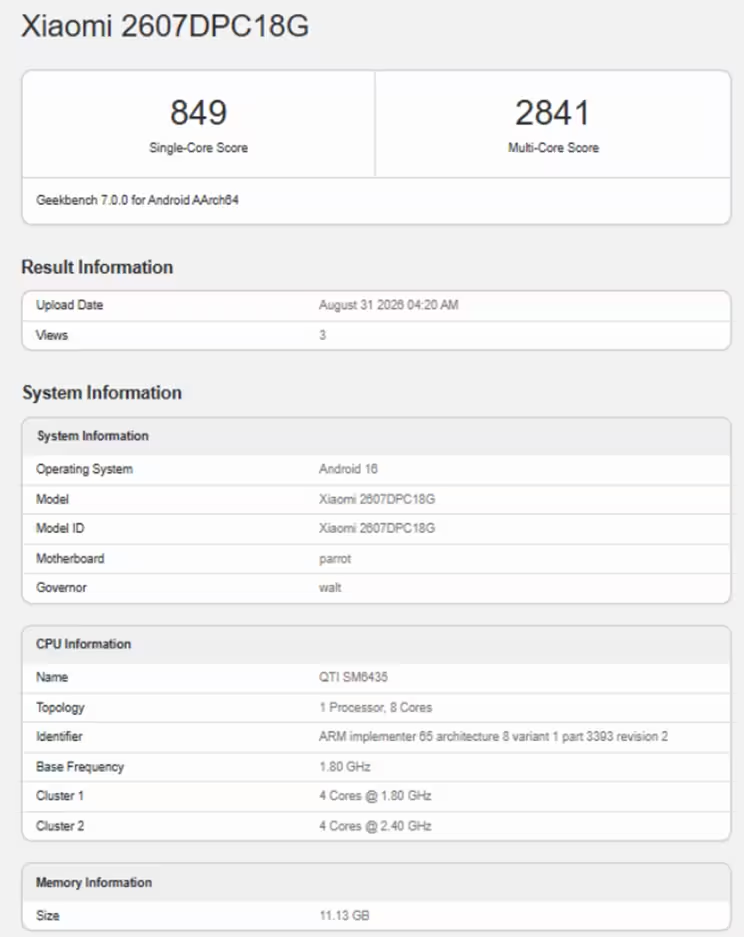
POCO X8 5G on Geekbench. (Screenshot by @ZionsAnvin)
Tipster Anvin on X shared the Geekbench listing of device with model number 2607DPC18G, which is identified as the global version of the POCO X8 5G. The listing was uploaded on August 31, 2026 at 4:20 AM.
According to the Geekbench 7 listing, the POCO X8 5G scored 849 points in the single-core test and 2,841 points in the multi-core test.
The smartphone is listed with Qualcomm’s Snapdragon 6s Gen 4 chipset carrying the model number SM6435. The processor has an octa-core configuration with two clusters. Four cores are clocked at 1.80GHz, while the other four cores can reach 2.40GHz. The listing also identifies the processor architecture as ARM-based.
The Geekbench entry shows the tested phone with 12GB of RAM. It will also run Android 16 out of the box.
Poco X8 5G (2607DPC18G – global version) spotted on Geekbench
– Snapdragon 6s Gen 4 (SM6435)
– 12GB RAM
– Android 16#Poco#PocoX8pic.twitter.com/G3yUGICIfP
Apart from the Snapdragon 6s Gen 4 chipset, the POCO X8 5G’s official teaser in India has confirmed that the model will pack a 9,000mAh battery. The company claims can provide up to 3.2 days of battery life on a single charge and will support 67W fast charging and 22.5W reverse charging.
POCO’s official teaser has already revealed the design of the X8 Power 5G. The phone is shown in a yellow finish with a black squircle-shaped camera module on the rear with two sensors.
POCO X8 5G teaser. (Image credit – POCO)
POCO is also reportedly planning long-term software support for the X8 series. The POCO X8 5G and POCO X8 Power 5G could receive four Android OS updates along with six years of security updates.
It is expected to feature a 6.83-inch AMOLED display. The screen could offer up to 3,500 nits of brightness, although POCO has not yet confirmed the complete display specifications.
For photography, the phone is rumoured to feature a 50-megapixel primary rear camera. A 16-megapixel front-facing camera is expected to handle selfies and video calls.
POCO will reveal the remaining details including the official price and availability when the X8 5G and X8 Power 5G launch in India this week.
Galaxy A58 leak shows 6.88″ 1.5K LTPO OLED, slim 6.99mm metal body, IP68 rating and triple‑camera setup with 50MP main sensor.
It is expected to be powered by 3nm Exynos 1500, LPDDR5 RAM, UFS 3.1 storage, 6,000mAh battery with 45W charging and One UI 9.5.
The price is expected to be around Rs 55,999, placing it in the premium segment.
Samsung appears to be planning a major upgrade for its A-series smartphones with the Galaxy A58. A new report has revealed renders and several details about the upcoming device including a 3nm Exynos processor, a large 6,000mAh battery, an LTPO OLED display and a slim metal design. Here’s what we know about the upcoming smartphone based on the recent report.
Galaxy A58 Renders Leaked, Could Be Just 6.99mm Thick
A recent report by tech publication PaidFreeDroid has leaked official-looking renders of the upcoming Samsung Galaxy A58 smartphone. According to the published images, the smartphone could be available in three colour options named Glacier Red, Gray and Mint.
The phone is tipped to have an extremely slim 6.99mm body with a metal frame, giving it a more premium build. Samsung is also reportedly retaining an IP68 rating, meaning the device will offer protection against dust as well as water immersion.
Galaxy A58 – Key Specifications Leaked
As per the report, the Galaxy A58 is expected to feature a large 6.88-inch 1.5K OLED display. The panel will reportedly use LTPO technology and support a 120Hz refresh rate.
The processor is expected to be one of the biggest changes on the Galaxy A58. The smartphone is reportedly being developed with Samsung’s Exynos 1500 chipset, manufactured using a 3nm process. The move to a newer 3nm chip could bring improvements in sustained performance as well as thermal management. The phone is also expected to use LPDDR5 RAM and UFS 3.1 storage for multitasking and faster app and file access.
It is also tipped to feature a USB Type-C port restricted to USB 2.0 speeds, which means wired data transfers will not be as fast as on devices using newer USB standards.
The phone is said to pack a 6,000mAh battery despite its slim 6.99mm profile. The battery will reportedly support 45W wired fast charging.
For photography, Samsung is expected to give the Galaxy A58 a triple-camera setup on the rear. The system could consist of a 50-megapixel primary sensor, a 12-megapixel ultra-wide camera and a dedicated 12-megapixel macro camera. Selfies and video calls are expected to be handled by a 12-megapixel front-facing camera.
The Galaxy A58 is expected to ship with One UI 9.5. Samsung could also make long-term software support one of the phone’s biggest advantages. The leaked information points to a “6+6” update policy, which means six years of major operating system upgrades along with six years of security updates.
If Samsung follows through with this policy, the Galaxy A58 could remain supported for a considerably longer period than many competing smartphones in the same segment.
Galaxy A58 Expected Price
The leaked information puts the expected price of the Samsung Galaxy A58 at Rs 55,999. At this price, the smartphone would sit firmly in the premium segment and come relatively close to the Samsung’s flagship Galaxy S series.
For now, these details remain based on a leak and Samsung has not officially confirmed the Galaxy A58’s specifications, pricing or launch date.
Xiaomi Pad 9 Pro leak shows 12.5″ 3.2K LCD, Snapdragon 8 Gen 5, 144Hz refresh rate and 11,000mAh battery with 67W charging.
Pad 9 Pro Max tipped with 13″ soft‑light screen, bright red colour option, up to 16GB RAM/1TB storage and 120W charging.
Pro Max confirmed to launch in September with Xring O3 chipset, offering deca‑core CPU, 16‑core GPU and 60% performance boost over previous generation.
Xiaomi has already confirmed that the Pad 9 Pro Max will arrive in September 2026 and will be powered by the company’s in-house Xring O3 chipset. The lineup is expected to consist of three models including the standard Xiaomi Pad 9, Xiaomi Pad 9 Pro and Xiaomi Pad 9 Pro Max.
Ahead of Xiaomi’s September event, new leaks have revealed key specifications of the expected Xiaomi Pad 9 Pro. Separate leaks have also provided details about the colour, memory and other hardware of the top-end Xiaomi Pad 9 Pro Max model.
Xiaomi Pad 9 Pro Display Specifications Leaked
Xiaomi Pad 8 Pro display in the picture for reference only. (Image credit – Xiaomi)
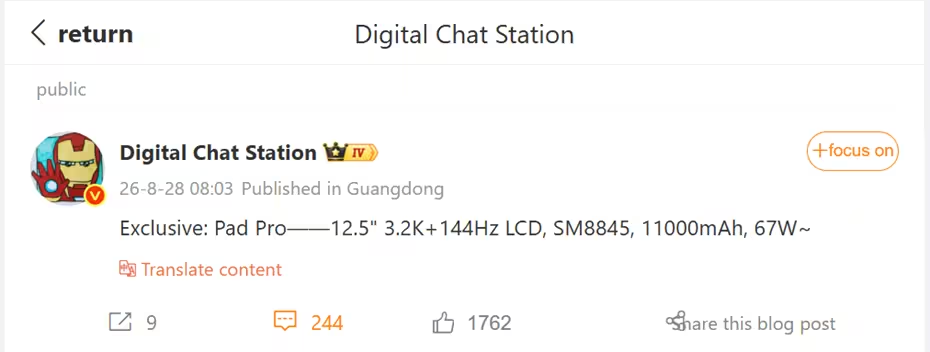
Tipster Digital Chat Station has shared new information on Weibo that is believed to refer to the Xiaomi Pad 9 Pro. According to the leak, the tablet will feature a larger 12.5-inch LCD display with a 3.2K resolution and a peak refresh rate of 144Hz.
DCS’s post on Weibo. (Translated via Google Translate)
Performance could be handled by Qualcomm’s Snapdragon 8 Gen 5 chipset, which is a 3nm processor that features eight Oryon CPU cores and an Adreno 829 GPU.
The tablet is also expected to receive a sizeable battery upgrade. It could pack an 11,000mAh battery and support 67W wired fast charging.
These specifications would represent a notable change over the current Xiaomi Pad 8 Pro. The existing model has an 11.2-inch LCD panel with a 144Hz refresh rate, a Snapdragon 8 Elite chipset and a 9,200mAh battery, while also supporting 67W charging. The combination of a larger display and higher-capacity battery could make the upcoming Pad 9 Pro better suited for watching videos, gaming and long productivity sessions.
Xiaomi Pad 9 Pro Max Colour and Storage Details
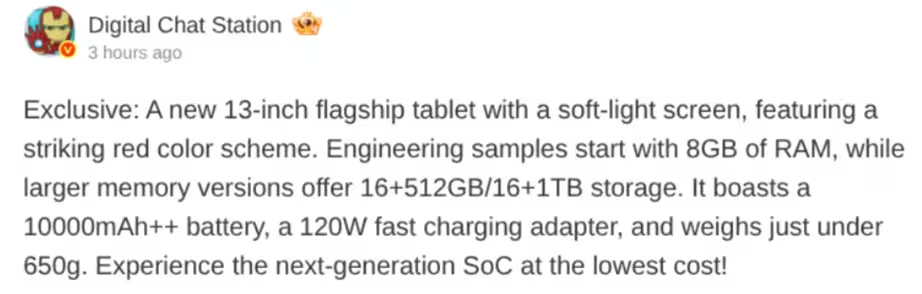
Digital Chat Station separately shared information about the more powerful Xiaomi Pad 9 Pro Max. The top-end tablet is reportedly being developed with a 13-inch display and a soft-light screen option.
DCS’s previous post. (Screenshot by Gizmochina)
The tablet could also be offered in a bright red colour. Xiaomi has recently used this red design approach on products such as the Redmi K100 Pro Max and the upcoming Xiaomi 18 Fold, and the Pad 9 Pro Max could follow the same trend.
In terms of memory, an engineering sample is reportedly equipped with 8GB of RAM. However, retail versions are expected to offer up to 16GB of RAM, with 512GB and 1TB storage options.
The Pad 9 Pro Max is also tipped to feature a battery with a capacity above 10,000mAh. It could support a 120W charging adapter. Despite its large hardware, the tablet is reportedly expected to weigh around 650 grams.
The Xring O3 chipset is expected to be one of the biggest highlights of the Xiaomi Pad 9 Pro Max. According to Digital Chat Station, the tablet could become the most affordable way to experience Xiaomi’s next-gen in-house processor.
The Xring O3 will reportedly power both the Pad 9 Pro Max and Xiaomi 18 Fold, making them the first devices to use the new chipset. The foldable phone is expected to cost more than $1,500, which could make the tablet a considerably more accessible option for those interested in Xiaomi’s new chip.
The Xring O3 reportedly uses a deca-core CPU consisting of six ultra-large cores and four large cores. The processor can reportedly reach a maximum clock speed of 4.35GHz. Its multi-core benchmark score has crossed 15,000 points, representing a 60 percent improvement over the previous-generation chip.
Graphics processing is expected to be handled by a 16-core G2-Ultra NX GPU, which will also bring support for third-generation ray tracing.
Xiaomi Pad 8 Pro in the picture for reference only. (Image credit – Xiaomi)
Xiaomi Pad 9 Series – What Else We Know?
The company is expected to hold an event in early September where it will introduce the Xiaomi 18 Fold along with new tablets from the Xiaomi Pad 9 series.
Xiaomi has already confirmed that the Pad 9 Pro Max will arrive in September 2026 and will be powered by the company’s in-house Xring O3 chipset. The broader lineup is expected to consist of three models namely the standard Xiaomi Pad 9, Xiaomi Pad 9 Pro and Xiaomi Pad 9 Pro Max.
The three-model strategy would allow Xiaomi to cover different screen sizes and price segments rather than focusing on a single premium tablet.
Xiaomi has not yet officially announced the standard Pad 9 or Pad 9 Pro and their complete specifications and pricing remain unknown. At present, the Pad 9 Pro Max is the only model with a confirmed September launch timeline along with official confirmation that it will use the company’s Xring O3 chipset.
More information about the remaining Pad 9 models is expected to emerge as Xiaomi’s September launch event approaches.
POCO F9 Ultra confirmed with 8,050mAh battery, 100W wired and 50W wireless charging.
F9 series to feature a 200MP Samsung HP5 main sensor (1/1.56‑inch) alongside triple rear cameras with telephoto lenses.
Philippines leak suggests ₱49,999 (~$523) for F9 Pro and ₱89,999 for F9 Ultra, nearly double the Pro’s price.
POCO has revealed more details about its upcoming F9 series ahead of the September 1 launch. The latest official teasers have confirmed key battery and camera information for the POCO F9 Ultra and the F9 lineup, while a new leak has also hinted at the possible Philippines pricing of the two flagship phones. Here’s what we know about the upcoming lineup based on recent leaks and official teasers.
POCO F9 Ultra Battery Specs Confirmed
POCO F9 Ultra battery teasers. (Image credit – POCO)
According to information shared by tipster Tech Home on X, based on official POCO teasers, the POCO F9 Ultra will pack an 8,050mAh battery. The phone will support 100W wired fast charging as well as 50W wireless fast charging.
This gives the F9 Ultra a large battery while also offering fast wired and wireless charging options. POCO has already positioned the upcoming phone as an “all-round performance flagship” with gaming being one of its major focus areas.
POCO F9 Series To Feature 200MP Samsung Camera
POCO F9 Series camera teasers. (Image credit – POCO)
The latest teasers have also revealed an important camera detail for the POCO F9 series. The smartphones will use a 200-megapixel Samsung HP5 main camera sensor.
The primary sensor is said to measure 1/1.56-inch. This will be one of the key camera features of the F9 lineup, which is also expected to include triple rear camera setups with telephoto lenses.
POCO has previously highlighted the performance capabilities of the F9 series including support for industry-leading 185FPS gaming and more than 20 games with native 185FPS support. The phones will also feature a 185Hz LTPS display and a 4,800Hz instantaneous TSR for improved gaming responsiveness.
POCO F9 Pro and F9 Ultra – Philippines Prices Leaked
Alongside the official teasers, tipster Abhishek Yadav @yabhishekhd on X has shared the alleged Philippines pricing of the POCO F9 Series models.
According to the leak, the POCO F9 Pro with 12GB of RAM and 256GB of storage could be priced at ₱49,999 in the Philippines. This works out to approximately Rs 76,700 or around $523.
The POCO F9 Ultra, meanwhile, is reportedly priced at ₱89,999. This would make the Ultra model almost twice as expensive as the F9 Pro in the Philippines.
However, these prices are currently unofficial and should be treated with caution. POCO has not yet confirmed the Philippines pricing of either smartphone.
The company is scheduled to launch the POCO F9 Pro and POCO F9 Ultra on September 1, when their official pricing and availability details are expected to be announced.
An alleged iQOO Pad Mini leak shows a compact tablet with a slim design and a square camera module.
The pad is expected to include an 8.8-inch 2.8K OLED display with an ultra-high refresh rate and Qualcomm’s Snapdragon 8 Elite Gen 6 chipset.
Device name, complete specs and launch timeline remain unknown.
iQOO appears to be getting closer to entering the mini tablet segment. A new leak has offered a possible first look at the company’s upcoming compact tablet, which has been rumoured for some time. Here’s everything we know about this upcoming iQOO device so far.
Alleged iQOO Pad Mini Spotted
Alleged iQOO Pad Mini. (Image credit – TechHome on X)
Tipster Tech Home has shared an image on X showing what appears to be a compact iQOO tablet being held by an iQOO executive. The executive can be seen wearing an iQOO T-shirt and an iQOO ID strap, hinting that the device could be an upcoming product from the company.
The image does not reveal much about the tablet. However, it appears to have a light-coloured finish and a slim, compact body. The rear panel is also expected to feature a square-shaped camera module. Its relatively compact size also fits previous reports about iQOO working on a mini tablet.
iQOO is reportedly planning to enter the smaller tablet category after launching several larger tablets. Previous information from tipster Digital Chat Station on Weibo claimed that the company was developing a compact tablet to compete directly with the RedMagic Astra 2.
Previous DCS post on Weibo. (Translated via Google Translate)
The iQOO tablet is expected to feature an 8.8-inch display with narrow bezels on all four sides. The panel is also rumoured to support an “ultra-high” refresh rate. More recent leaks have pointed towards a 2.8K OLED display, which could make the tablet suitable for gaming and multimedia consumption. Tipster has claimed that it will be powered by Qualcomm’s sixth-generation Snapdragon 8 Elite processor.
The tablet is also expected to feature a metal frame or metal unibody construction. This could give the compact device a more premium feel while also helping with durability.
The company has also not officially confirmed the device yet. For now, details such as the tablet’s RAM, storage, battery capacity, charging speed and camera specifications remain unknown.