
Home Blog Page 720

Samsung Health’s Extensive Study Shows Globally Sleep Quality is Declining

0

Highlights

  • Samsung Health study reveals global sleep duration has fallen below the essential 7-hour threshold.
  • Sleep efficiency is declining worldwide, with North America witnessing the greatest decrease.
  • Gender and age disparities exist in sleep efficiency, with females and older individuals affected the most.

Are we getting enough sleep? A question that often pops up in discussions about health and well-being.

Samsung aims to shed light on this question with one of the largest sleep health studies ever conducted.

Despite a marked increase in interest in sleep tracking, Samsung’s extensive research paints a grim picture: worldwide sleep quality is on the decline.

Declining Sleep Durations and Efficiency: A Global Concern
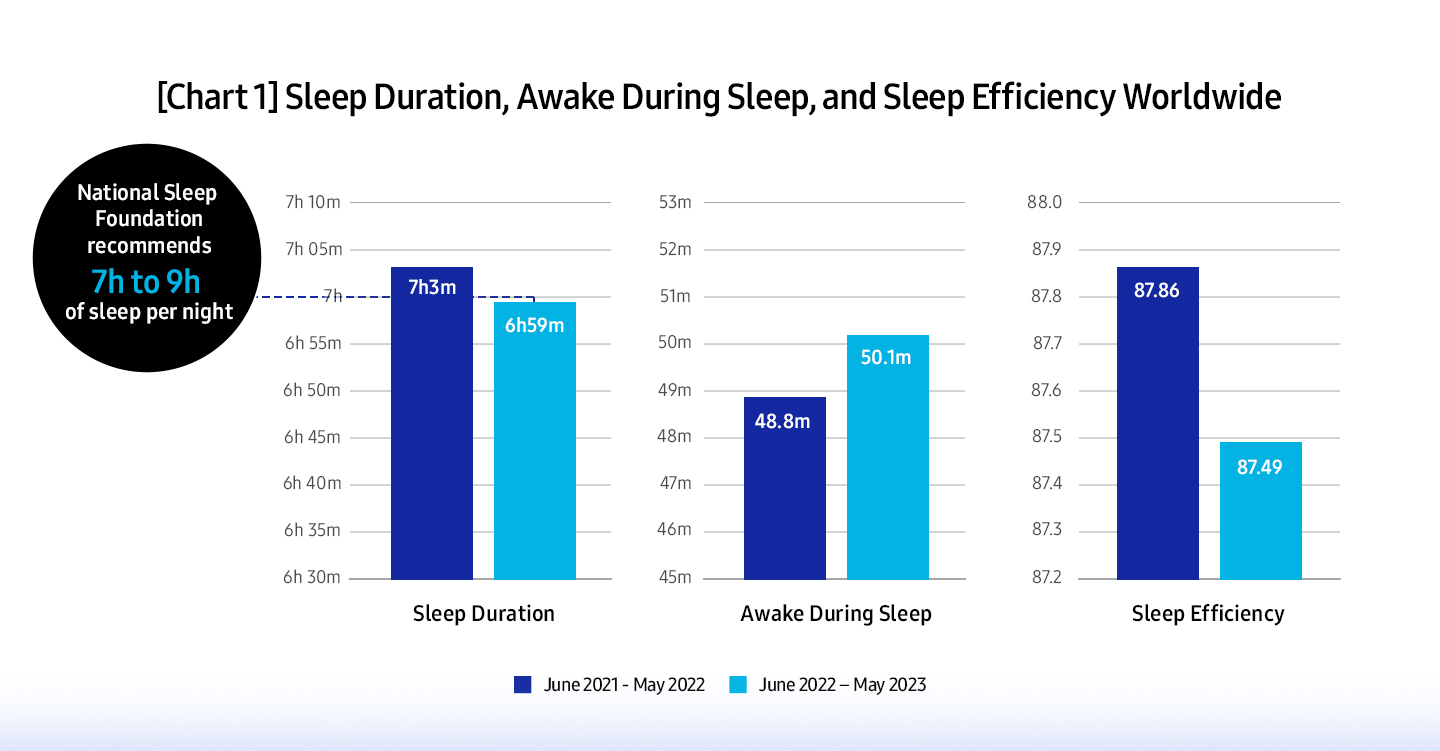
Declining Sleep Durations and Efficiency

Samsung’s Health app data reveals a worrying trend: average sleep durations are falling below the essential 7-hour threshold, slipping from 7 hours and 3 minutes to just 6 hours and 59 minutes.

This decline is not restricted to any particular region or demographic, suggesting that it’s a global issue.

Sleep efficiency, calculated based on the ratio of actual sleep time to time spent in bed, is also waning.

North America takes the hit with the greatest decrease, while Asia fares better with the lowest decline in sleep efficiency.

The Gender and Age Disparities in Sleep Efficiency
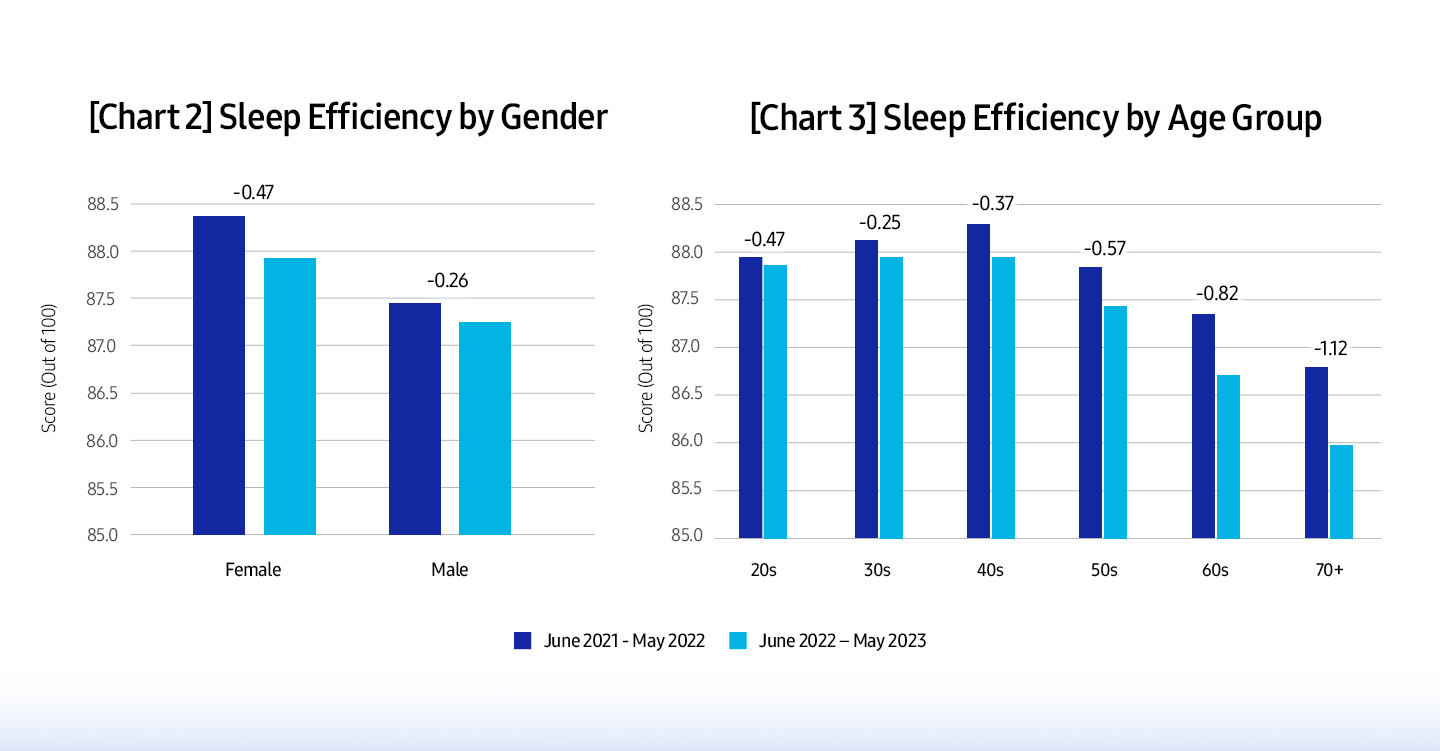
Sleep Efficiency by age & Gender

While both males and females are witnessing a decline in sleep efficiency, it’s the women who have experienced the most significant decrease in the past year.

Age also seems to play a role in sleep efficiency, with older demographics showing a more pronounced decline.

Individuals aged over 70 experienced almost double the decline compared to those in their 20s.

Sleep Debt’s Impact on Younger Generations
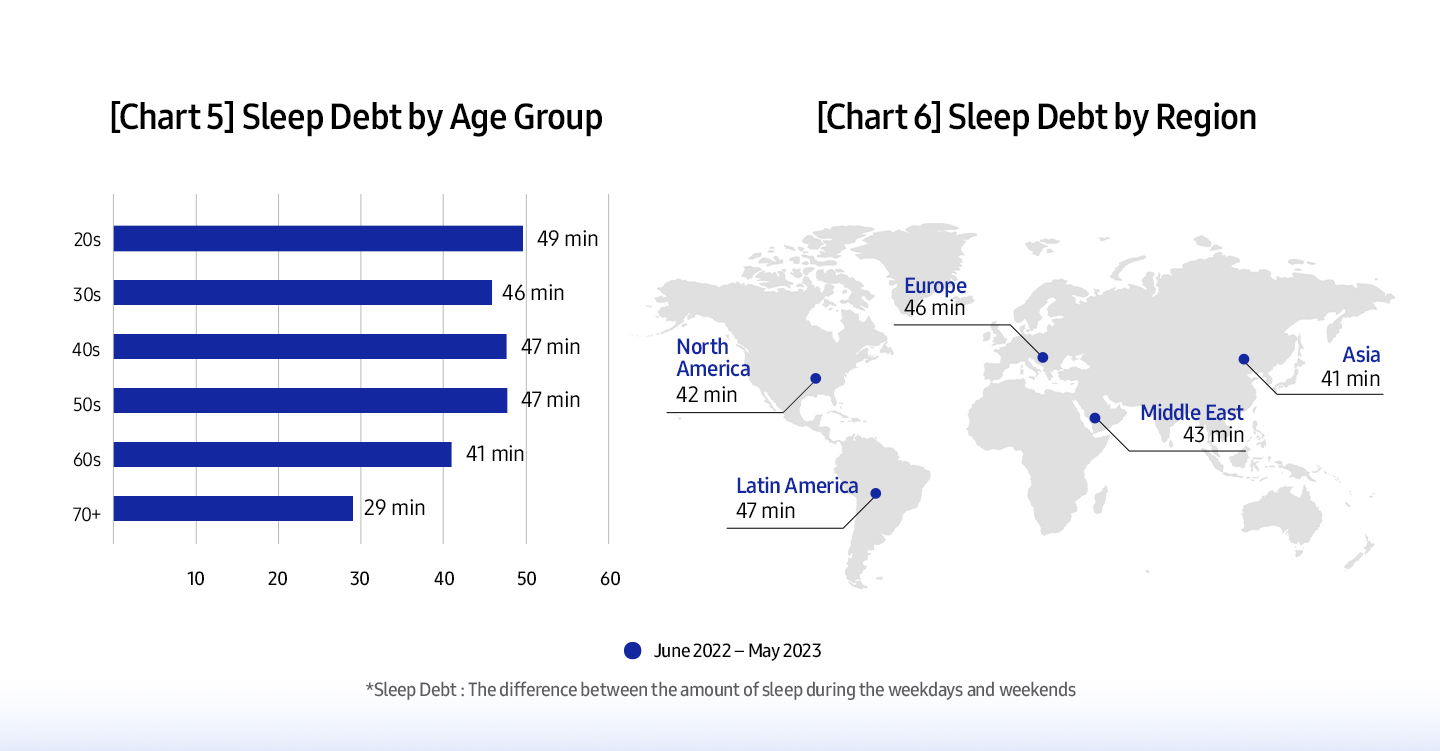
Sleep Debt’s Impact on Younger Generations

Sleep debt, the disparity between weekday and weekend sleep, is another alarming aspect of global sleep health.

Samsung’s data indicates that those in their 20s have almost double the sleep debt compared to those in their 70s.

This inconsistency further contributes to the decline in overall sleep quality.

Regional Differences in Sleep Debt
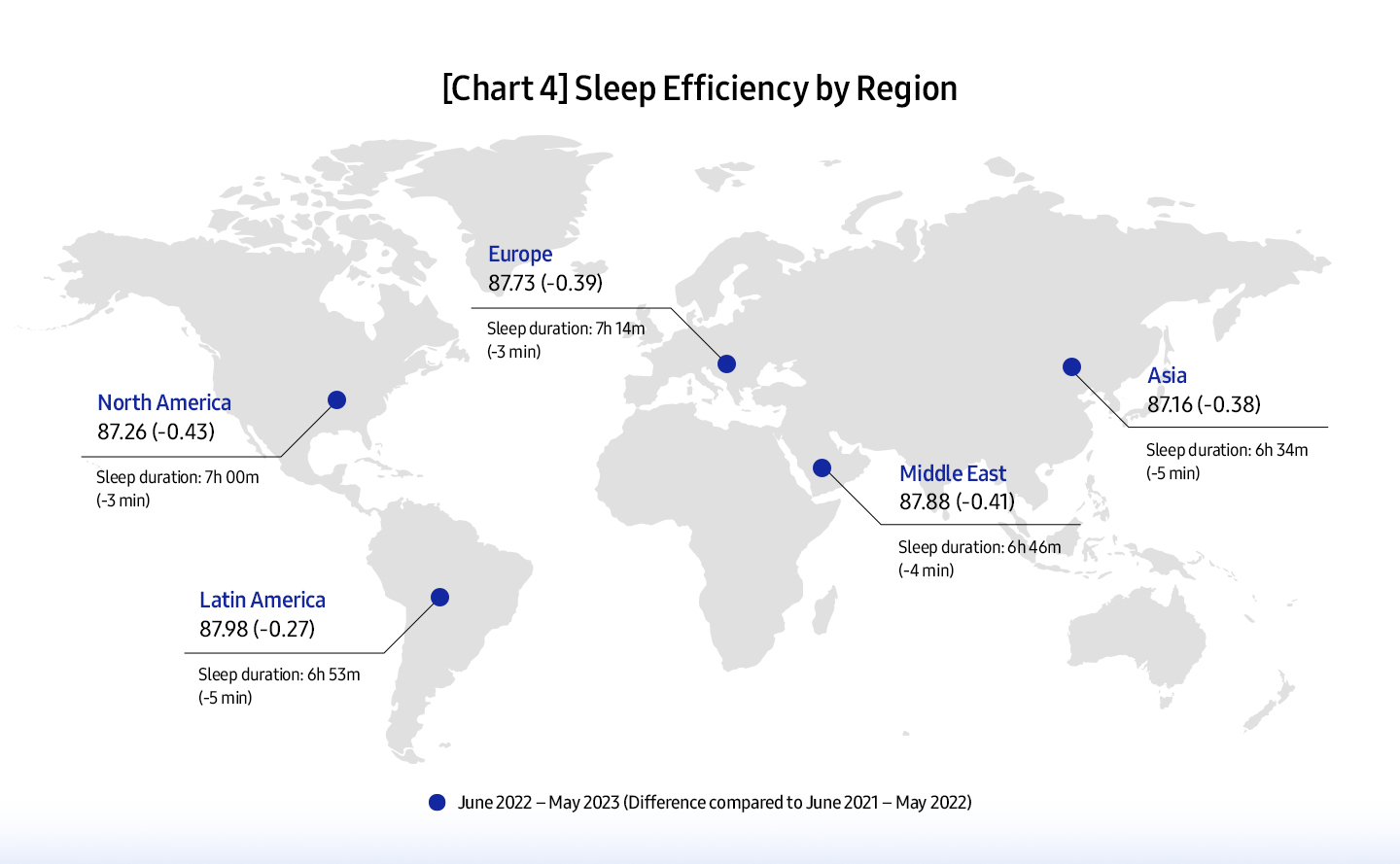
sleep efficiency by region

By region, Asia had the shortest sleep debt, averaging at 41 minutes, whereas Latin America recorded the longest at 47 minutes.

On weekends, people globally catch up on lost sleep by sleeping an additional 44 minutes, on average.

FAQs

What does the Samsung Health study say about global sleep durations?

The study indicates that the average sleep duration worldwide has fallen below the recommended 7 hours, specifically to 6 hours and 59 minutes.

Is sleep efficiency a global issue?

Yes, the study reveals that sleep efficiency is declining across the globe. North America has experienced the greatest decrease, followed by Europe and other regions.

How does age affect sleep quality according to the study?

Older individuals, particularly those over 70, have seen a more significant decline in sleep efficiency compared to younger age groups.

What is sleep debt and who is most affected?

Sleep debt refers to the inconsistency between weekday and weekend sleep. It is highest among people in their 20s, who have nearly double the sleep debt compared to those in their 70s.

Rising Qualcomm Chipset Costs May Impact Samsung Galaxy S25 Pricing

0

Highlights

  • Samsung Galaxy S25 may face a price hike due to increasing chipset costs.
  • Qualcomm’s anticipated expensive chipsets could influence Samsung’s pricing strategy.
  • Dual usage of Exynos and Snapdragon serves as a strategic leverage for Samsung.

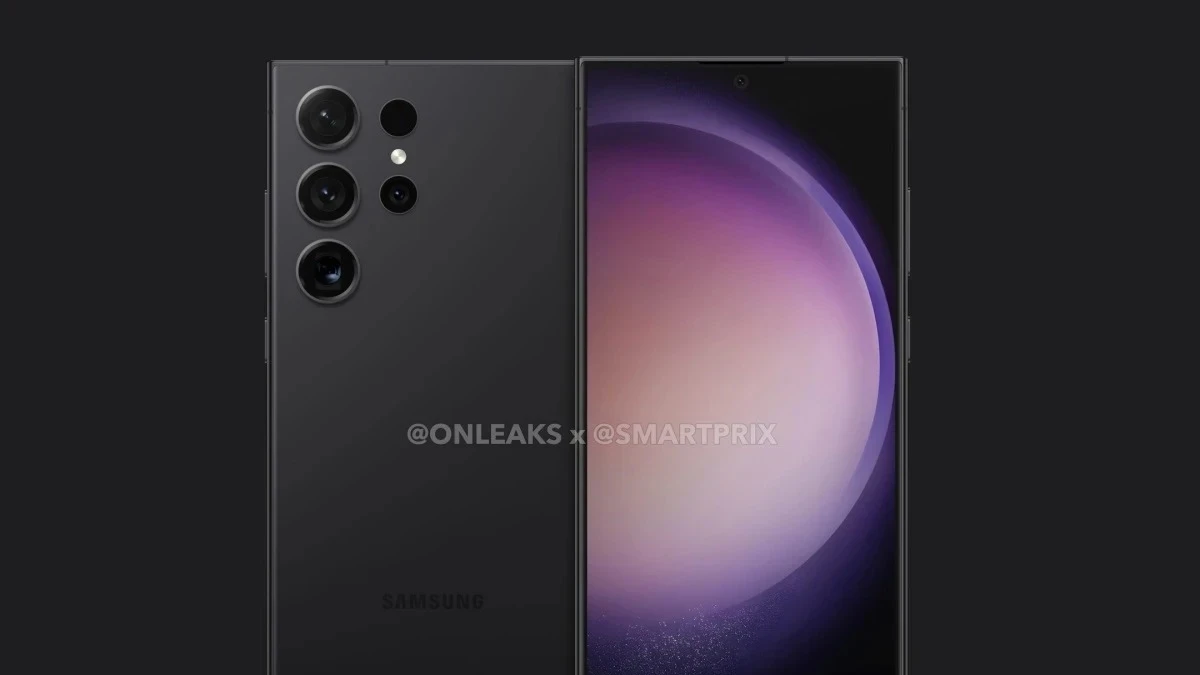
Samsung’s Galaxy S24 Ultra may share the $1,199 price tag with its predecessor, the Galaxy S23 Ultra.

However, potential increases in chipset costs could lead to a pricing change in the upcoming Galaxy S25.

Here’s a look into the factors that might affect the device’s price tag.

The Current Situation

Samsung’s Galaxy S24 Ultra

Industry sources indicate that the Galaxy S24 Ultra will likely retain the current Samsung price point, leaving consumers optimistic about stable pricing in the short term.

The company traditionally uses a mix of its own Exynos chipsets and Qualcomm’s Snapdragon chipsets in its Galaxy S series.

For the Galaxy S23 series, Samsung standardised on the Snapdragon 8 Gen 2 across all models globally.

However, the Galaxy S24 series is expected to feature both the Exynos 2400 and the Snapdragon 8 Gen 3.

Samsung’s dual approach of using both Exynos and Snapdragon serves as a strategic hedge against Qualcomm’s pricing power.

Qualcomm has more leverage in negotiations when Samsung exclusively uses Snapdragon chipsets, affecting the cost margins.

A potential rise in chipset costs from Qualcomm, especially with the introduction of Oryon CPU cores in 2024, could compel Samsung to rethink its pricing strategy.

The Impact on 2025 Models

Qualcomm’s anticipated release of more expensive chipsets could influence the starting price of Samsung’s Galaxy S25 series.

This also potentially affects the pricing of Samsung’s foldable lineup— the Galaxy Z Fold 7 and Galaxy Z Flip 7— since they are also powered exclusively by Snapdragon chipsets.

Samsung faces a choice between maintaining current profit margins by raising prices or finding efficiencies elsewhere to keep prices stable.

Either way, it’s consumers who will feel the financial implications.

FAQs

Why might the Samsung Galaxy S25 be more expensive?

Rising costs of chipsets from Qualcomm could lead Samsung to reconsider its pricing strategy for the Galaxy S25 and other future models.

How do chipsets affect smartphone pricing?

Chipsets are a core component in smartphones, and a rise in their costs will inevitably impact the overall pricing of the device, affecting the consumer’s pocket.

Why does Samsung use both Exynos and Snapdragon chipsets?

Samsung uses both to maintain a strategic position against Qualcomm’s pricing power. This dual approach serves as a hedge when negotiating costs.

Could this price change affect other Samsung models?

Yes, other Samsung models like the Galaxy Z Fold 7 and Galaxy Z Flip 7 could also face price changes as they are exclusively powered by Snapdragon chipsets.

X Debuts Audio and Video Calling on iOS, Broader Rollout for Android Expected Soon

0

Highlights

  • X introduces audio and video calling, initially available exclusively for iOS.
  • Android users will have to wait for the feature, which is expected to roll out at a later date.
  • The new feature offers user customization, with options to limit calls to certain groups such as followers or verified accounts.
  • Questions remain about the availability of the feature for premium subscribers only.

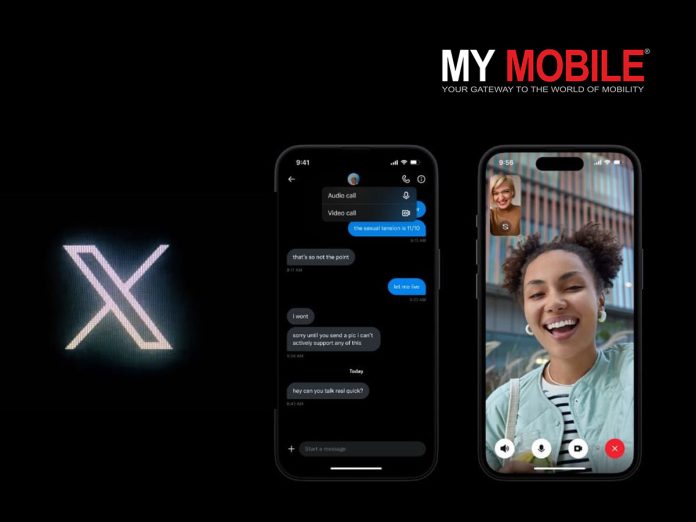
In a quiet but significant move, X (formerly Twitter) has introduced audio and video calling capabilities for its users.

This feature, which was rolled out without much fanfare, is likely to change the dynamics of the platform, taking it beyond a text-based microblogging site.

The introduction came after a cryptic teaser from the platform’s owner, Elon Musk, who tweeted “ready for it…?”

just as notifications about the new feature began popping up for users.

The Feature Explained

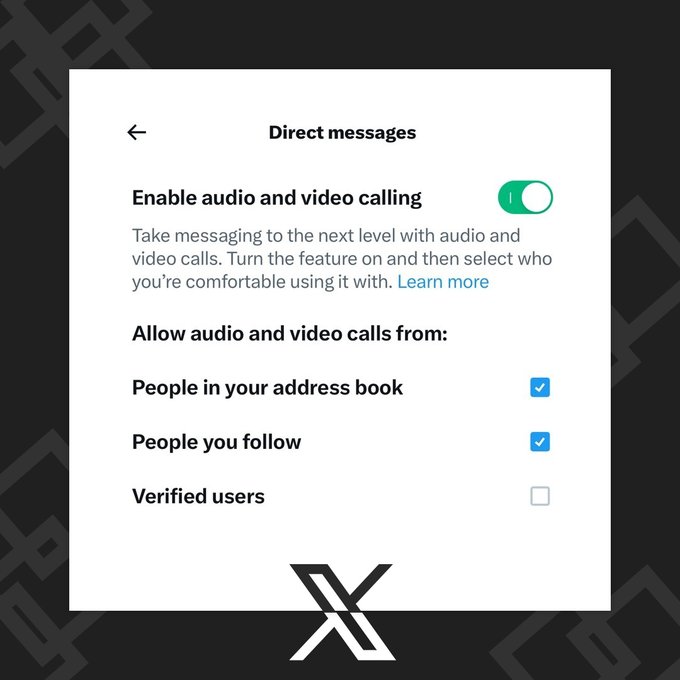
Some X users have reported receiving a notification that reads, “Audio and video calls are here!” To enable the feature, users need to go to the app settings where a toggle for “Enable audio and video calling” is now available.

The options for the feature are quite versatile.

Users can customize who can contact them, with the ability to limit calls to those in their address book, those they follow, verified users, or a mix of these categories.

Direct Message : Audio and video calls are here!

Starting a call is straightforward.

Users can initiate a call by opening a direct message with another user, and selecting the phone icon located in the top right corner of the screen.

Elon Musk has stated that the feature will be compatible across multiple platforms—iOS, Android, Mac, and PC—and, interestingly, doesn’t require a phone number to operate.

Currently, however, the feature only works on iOS devices with a broader roll-out expected soon.

Premium or for All?

What remains ambiguous is whether this feature will be exclusive to premium subscribers.

X has increasingly moved valuable features under its premium umbrella, which could suggest that audio and video calling might also be locked behind a paywall.

This speculation gains further traction as Musk has recently announced plans to charge an annual fee for accessing the platform.

The company has already started testing this approach in select countries, charging users in New Zealand and the Philippines $1 per year.

The Broader Implications

The annual fee, X states, aims to combat bots and spammers on the platform while balancing the need for platform accessibility.

The introduction of audio and video calls could be a significant draw for users, making the annual fee more palatable.

FAQs

How can iOS users enable the audio and video calling feature on X?

iOS users can activate this feature by going into the app settings and toggling on the “Enable audio and video calling” option. They can then customize who is allowed to call them.

Is the new feature also available for Android users?

Currently, the feature has been introduced only for iOS. Android users will have to wait for a future update to gain access.

Is the audio and video calling feature exclusive to premium users?

It’s not yet clear whether the feature will be available only for premium subscribers. Historically, X has placed new features under its premium service.

Is X planning to charge an annual fee for using the platform?

Elon Musk has hinted at an annual fee for using X, with pilot trials already happening in select countries like New Zealand and the Philippines.

Upcoming Smartphones Equipped with the New Snapdragon 8 Gen 3 Chipset: From OnePlus 12 to iQOO 12

0

Highlights

  • Latest Snapdragon 8 Gen 3 chipset promises to revolutionize mobile technology across brands like OnePlus, Realme, and iQOO.
  • OnePlus 12 rumoured to feature a stunning display with a peak brightness of 2,600 nits.
  • Realme GT 5 Pro hints at a 200MP camera setup, showcasing advancements in photography.
  • iQOO 12 aims to be India’s pioneer in integrating the Snapdragon 8 Gen 3 chipset, promising cutting-edge technology.

In the realm of mobile computing, Qualcomm has made a significant leap with the introduction of its Snapdragon 8 Gen 3 chipset.

This new piece of technology is billed as a game-changer, not just for its impressive generative AI capabilities, but also for its enormous upgrade in gaming performance.

Moreover, this SoC promises a 30 percent boost in speed compared to its previous generation, and some analysts suggest it could even outpace Apple’s A17 Pro chipset in particular use cases.

Core Capabilities of Snapdragon 8 Gen 3

  • Generative AI Support: The new chipset is poised to drive AI innovation on mobile devices.
  • Gaming Performance: Geared towards delivering unparalleled gaming experiences.
  • Speed and Efficiency: The chipset promises a 30 percent performance boost over its predecessor.

All Smartphones Expected to Pack in the Qualcomm Snapdragon 8 Gen 3

The power and promise of the Snapdragon 8 Gen 3 have mobilized a plethora of phone manufacturers to integrate it into their flagship models.

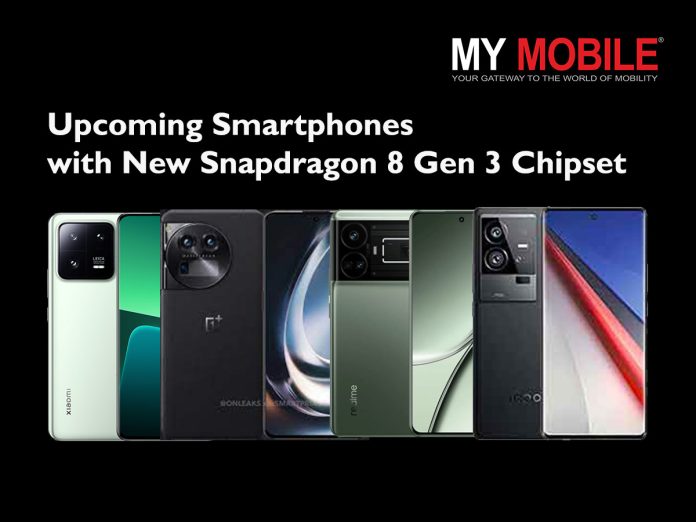
Xiaomi, OnePlus, Vivo, and Realme are among the industry giants that have announced their commitment to this revolutionary technology. Let’s delve into the specifics.

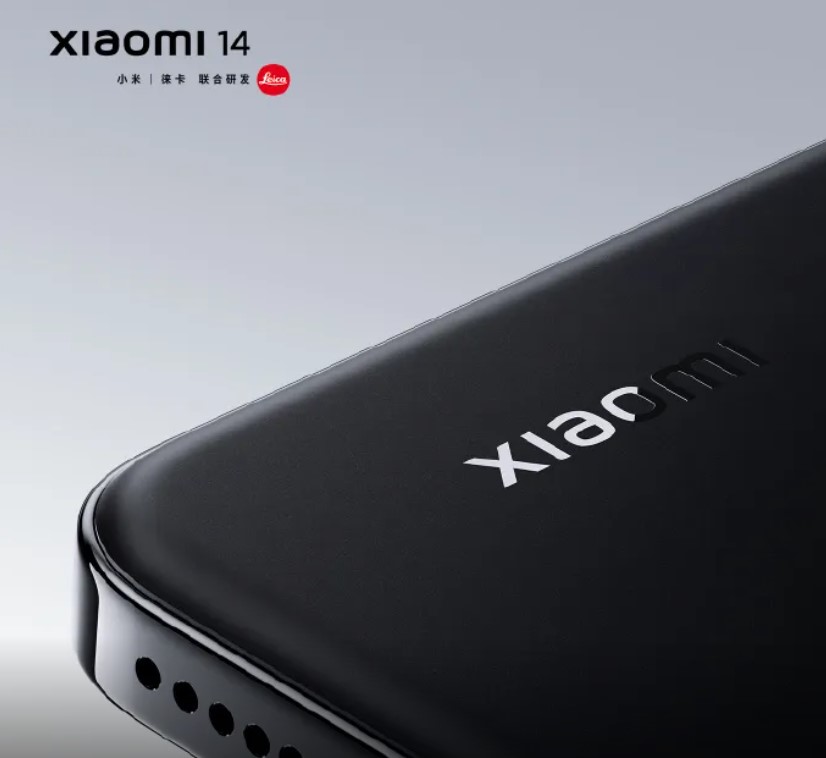
Xiaomi 14 Series

Xiaomi 14 Series

Xiaomi has been at the forefront of integrating the latest technology into its smartphones. The Xiaomi 14 Series is no different and is set to feature the Snapdragon 8 Gen 3 chipset.

The device is already generating buzz for its launch scheduled for today October 26 in China.

Expected Key Specifications

  • Display: 6.36-inch LTPO OLED, 1.5K resolution, 120Hz refresh rate
  • Processor: Snapdragon 8 Gen 3
  • Camera: Triple-camera setup with 50MP primary, OIS support
  • Battery: 5000mAh with 90W fast charging
  • Additional Features: In-display fingerprint sensor, Gorilla Glass protection

This model is expected to have an in-display fingerprint sensor and a Gorilla Glass screen for additional durability.

The device aims to provide an optimal blend of performance and efficiency, thanks to its 90W fast charging and massive 5000mAh battery.

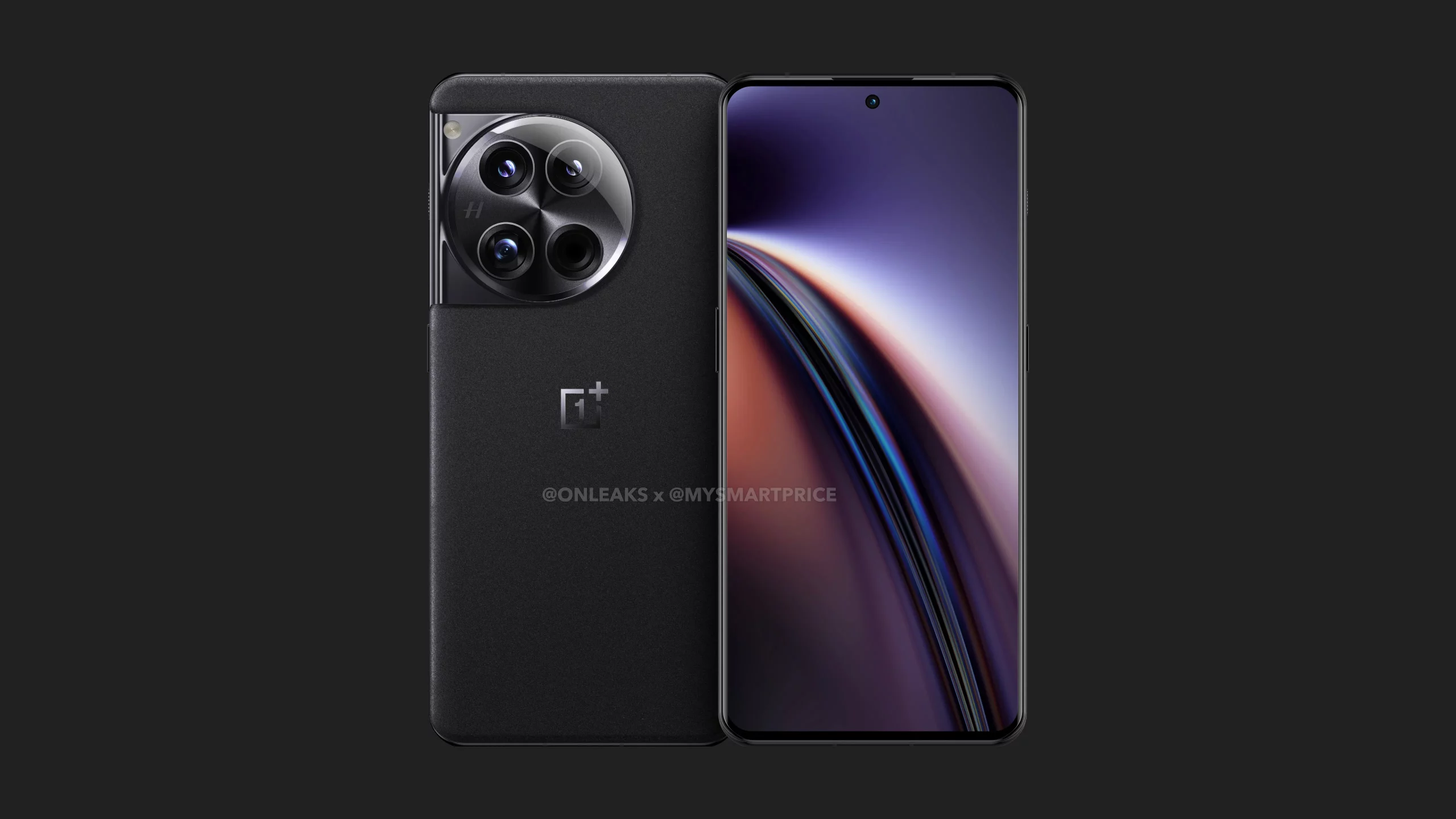
OnePlus 12

OnePlus 12

The OnePlus 12 is another eagerly awaited model. Slated for a late 2023 or early 2024 release, this smartphone is also set to leverage the capabilities of the Snapdragon 8 Gen 3 chip.

The device is likely to get a proper global and Indian release, as has been the case for previous OnePlus devices.

Expected Key Specifications

  • Display: 6.82-inch curved display, adaptive 120Hz, peak brightness of 2,600 nits
  • Processor: Snapdragon 8 Gen 3
  • Camera: 50MP Sony IMX989
  • Battery: 5,000mAh, 120W
  • Additional Features: OxygenOS, 5G connectivity, BOE Display

While the full specifications are yet to be revealed, it’s confirmed that the OnePlus 12 will run on OxygenOS and include 5G connectivity.

The device is expected to offer impressive brightness levels of up to 2,600 nits, making it one of the brightest displays on the market.

The presence of the Snapdragon 8 Gen 3 SoC can make it one of the fastest phones in the market.

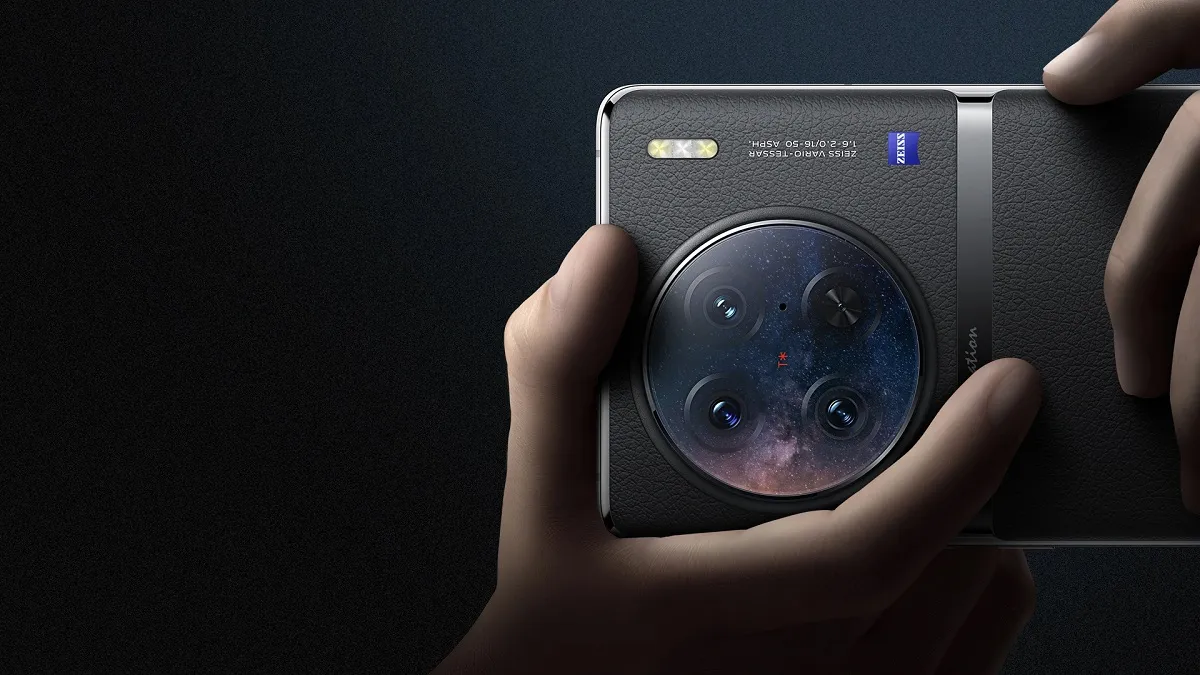
Vivo X100 Pro+

Vivo X100 Pro+

Vivo, a brand known for its camera-centric smartphones, is jumping on the Snapdragon 8 Gen 3 bandwagon with the Vivo X100 Pro+.

This device has a November 17 launch date set for the Chinese market although an Indian and global launch should not be too far behind.

Expected Key Specifications

  • Display: 6.8-inch, 144Hz, LTPO 3.0
  • Processor: Snapdragon 8 Gen 3
  • Camera: 50MP primary with Sony IMX 989 sensor, multiple lenses
  • Battery: 5,000mAh, 120W
  • Additional Features: Advanced photography modes, Ultra-Stable video

Vivo X100 Pro+ will not just focus on photography but is also expected to feature advanced video capabilities.

It’s anticipated to offer Ultra-Stable video modes and additional lenses for versatile shooting conditions.

There are other features on the Vivo X100 Pro+ that should get revealed overtime as the launch date approaches.

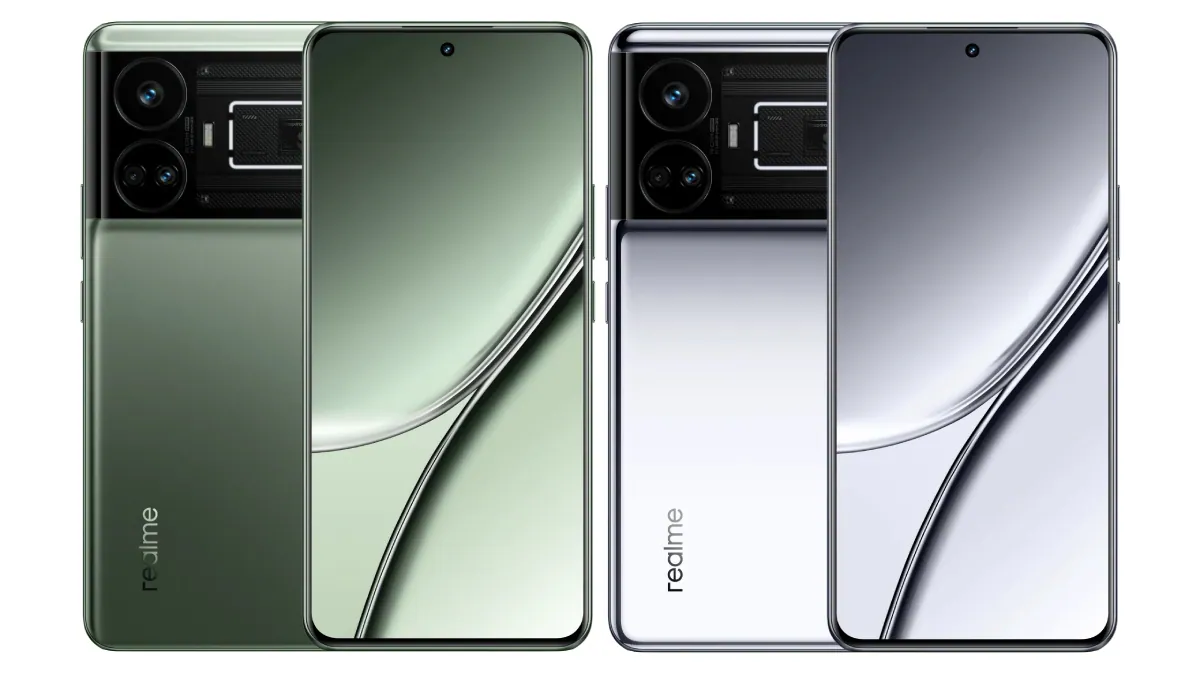
Realme GT 5 Pro

Realme GT 5 Pro

Realme GT 5 Pro, the next model from Realme, is also expected to feature the Snapdragon 8 Gen 3.

It aims to offer a versatile, high-performance user experience.

As of right now the device seems to be limited for the Chinese market.

However, the company is known to rebrand its devices and package them for global release as well.

Expected Key Specifications

  • Display: Curved AMOLED, 2K resolution, 144Hz refresh rate
  • Processor: Snapdragon 8 Gen 3
  • Camera: Possibly 200MP
  • Battery: 5,000mAh, 100W
  • Additional Features: Realme UI, 5G support

Not much is revealed about the camera and battery, but with a 144Hz refresh rate and 2K resolution, the display promises to be a visual treat.

Realme UI and 5G support are also expected features, enhancing overall usability.

More details about the phone should be revealed in due time.

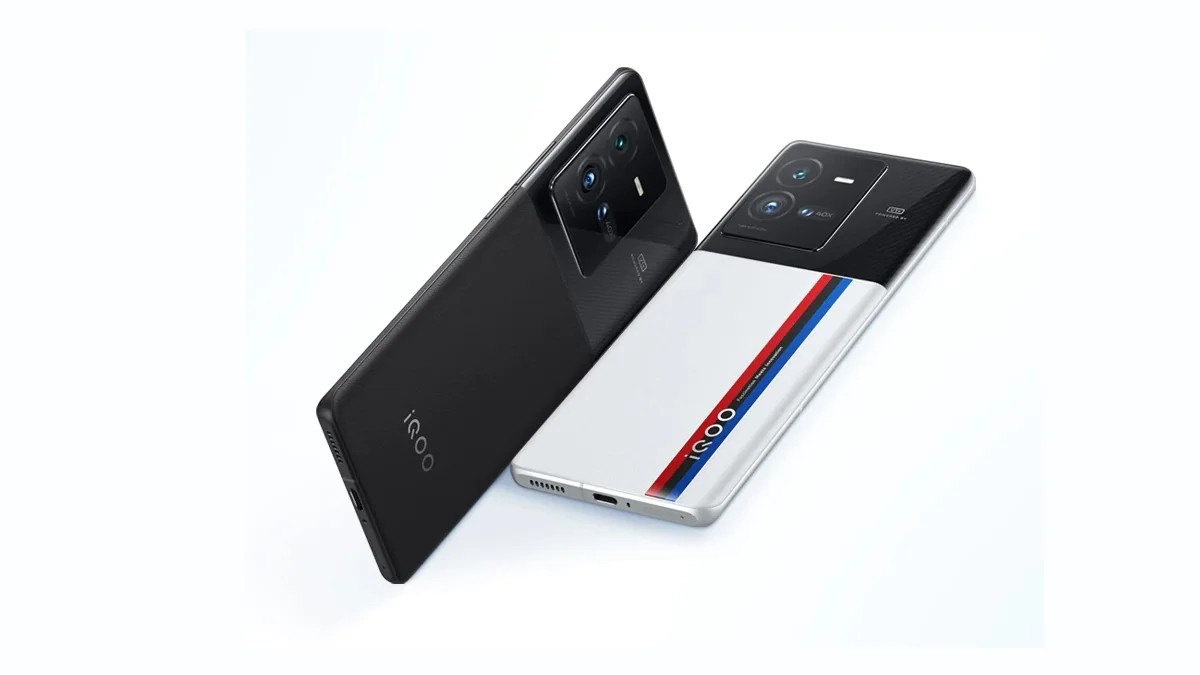
iQOO 12

iQOO 12

iQOO 12 is unique for being poised as India’s first phone to feature the Snapdragon 8 Gen 3 chipset.

Specifics are still under wraps, but rumours have suggested some enticing features.

Expected Key Specifications

  • Display: 6.7-inch, 120Hz, LTPO 3
  • Processor: Snapdragon 8 Gen 3
  • Camera: 64MP telephoto, 3X optical zoom
  • Battery: 5,000mAh, 120W
  • Additional Features: IP68 rating, in-display fingerprint reader

The phone is rumored to have a larger battery capacity and may forego super-fast charging in favour of long-lasting battery life.

The 64MP telephoto camera with 3X optical zoom hints at a focus on photography capabilities.

XIAOMI 14 KEY SPECIFICATIONS

General

Launch Date September 7, 2023 (Unofficial)
Brand Xiaomi
Model 14
Operating System Android v13
SIM Slot(s) Dual SIM, GSM+GSM
SIM Size SIM1: Nano
SIM2: Nano
Network 5G: Not Supported in India,
4G: Available Supported in India,
3G: Available, 2G: Available
Fingerprint Sensor Yes
Quick Charging Yes

 Display

Screen Size 6.43 inches (16.33 cm)
Screen Resolution 1080 x 2100 pixels
Pixel Density 367 ppi
Display Type AMOLED
Touch Screen Yes, Capacitive Touchscreen, Multi-touch

 Performance

Chipset Qualcomm Snapdragon 8 Plus Gen 1
Processor Octa core (3.2 GHz, Single core, Cortex X2 + 2.75 GHz, Tri core, Cortex A710 + 2 GHz, Quad core, Cortex A510)
Architecture 64 bit
Graphics Adreno 730
RAM 12 GB

 Storage

Internal Memory 256 GB
Expandable Memory No

Camera

MAIN CAMERA
Resolution 50 MP f/1.9, Wide Angle, Primary Camera
50 MP f/1.9, Telephoto Camera
50 MP f/2.2, Ultra-Wide Angle Camera
Autofocus Yes, Phase Detection autofocus
Flash Yes, LED Flash
Image Resolution 8150 x 6150 Pixels
Settings Exposure compensation
Shooting Modes Continuous Shooting
High Dynamic Range mode (HDR)
Camera Features Digital Zoom
Auto Flash
Face detection
Touch to focus
Video Recording 1920×1080 @ 30 fps
FRONT CAMERA
Resolution 32 MP f/2.45, Primary Camera
Video Recording 1920×1080 @ 30 fps

 Battery

Capacity 5000 mAh
Type Li-Polymer
User Replaceable No
Wireless Charging Yes
Quick Charging Yes, Fast, 67W
USB Type-C Yes

Network & Connectivity

SIM Size SIM1: Nano, SIM2: Nano
Network Support 5G Not Supported in India, 4G Supported in India, 3G, 2G
VoLTE Yes
SIM 1
4G Bands:
TD-LTE 2300(band 40)
FD-LTE 1800(band 3)
3G Bands:
UMTS 1900 / 2100 / 850 / 900 MHz
2G Bands:
GSM 1800 / 1900 / 850 / 900 MHz
GPRS:
Available
EDGE:
Available
SIM 2
4G Bands:
TD-LTE 2300(band 40)
FD-LTE 1800(band 3)
3G Bands:
UMTS 1900 / 2100 / 850 / 900 MHz
2G Bands:
GSM 1800 / 1900 / 850 / 900 MHz
GPRS:
Available
EDGE:
Available
Wi-Fi Yes, Wi-Fi 4 (802.11 b/g/n)
Wi-Fi Features Mobile Hotspot
Bluetooth Yes, v5.2
GPS Yes with A-GPS, Glonass
NFC Yes
USB Connectivity Mass storage device, USB charging

 Multimedia

Loudspeaker Yes
Audio Jack USB Type-C

 Special Features

Fingerprint Sensor Yes
Fingerprint Sensor Position On-screen
Other Sensors Light sensor, Accelerometer, Compass, Gyroscope


ONEPLUS 12 KEY SPECIFICATION

Key Specs

RAM 8 GB
Processor Qualcomm Snapdragon 888
Rear Camera 50 MP + 8 MP + 48 MP
Front Camera 32 MP
Battery 5000 mAh
Display 6.7 inches (17.02 cm)

General

Launch Date June 7, 2023 (Unofficial)
Operating System Android v12

Performance

Chipset Qualcomm Snapdragon 888
CPU Octa core (2.84 GHz, Single core, Kryo 680 + 2.42 GHz, Tri core, Kryo 680 + 1.8 GHz, Quad core, Kryo 680)
Architecture 64 bit
Fabrication 5 nm
Graphics Adreno 660
RAM 8 GB

Display

Display Type OLED
Screen Size 6.7 inches (17.02 cm)
Resolution 1080 x 2400 pixels
Pixel Density 393 ppi
Screen Protection Corning Gorilla Glass v5
Bezel-less display Yes with punch-hole display
Touch Screen Yes, Capacitive Touchscreen, Multi-touch

Camera

MAIN CAMERA
Camera Setup Triple
Resolution 50 MP, Primary Camera
8 MP
48 MP
Autofocus Yes
Flash Yes, LED Flash
Image Resolution 8150 x 6150 Pixels
Settings Exposure compensation, ISO control
Shooting Modes Continuous Shooting
High Dynamic Range mode (HDR)
Camera Features Digital Zoom
Auto Flash
Face detection
Touch to focus
Video Recording 1920×1080 @ 30 fps
FRONT CAMERA
Camera Setup Single
Resolution 32 MP, Primary Camera
Video Recording 1920×1080 @ 30 fps

Battery

Capacity 5000 mAh
Type Li-Polymer
Removable No
Quick Charging Yes, Fast
USB Type-C Yes

Storage

Internal Memory 128 GB
Expandable Memory No

Network & Connectivity

SIM Slot(s) Dual SIM, GSM+CDMA
SIM Size SIM1: Nano, SIM2: Nano
Network Support 5G Not Supported in India, 4G Supported in India, 3G, 2G
VoLTE Yes
SIM 1
4G Bands:
TD-LTE 2300(band 40)
FD-LTE 1800(band 3)
3G Bands:
UMTS 1900 / 2100 / 850 / 900 MHz
2G Bands:
GSM 1800 / 1900 / 850 / 900 MHz
GPRS:
Available
EDGE:
Available
SIM 2
4G Bands:
TD-LTE 2300(band 40)
FD-LTE 1800(band 3)
3G Bands:
UMTS 1900 / 2100 / 850 / 900 MHz
2G Bands:
GSM 1800 / 1900 / 850 / 900 MHz
GPRS:
Available
EDGE:
Available
Wi-Fi Yes, Wi-Fi 4 (802.11 b/g/n)
Wi-Fi Features Mobile Hotspot
Bluetooth Yes, v5.2
GPS Yes with A-GPS, Glonass
NFC Yes
USB Connectivity Mass storage device, USB charging

Multimedia

Loudspeaker Yes
Audio Jack USB Type-C

Sensors

Fingerprint Sensor Yes
Fingerprint Sensor Position On-screen
Fingerprint Sensor Type Optical
Other Sensors Light sensor, Proximity sensor, Accelerometer, Compass, Gyroscope


VIVO X100 PRO PLUS KEY SPECIFICATIONS

Key Specs

RAM 12 GB
Processor MediaTek Dimensity 9200
Rear Camera 108 MP + 16 MP + 64 MP
Front Camera 64 MP
Battery 5100 mAh
Display 6.81 inches (17.3 cm)

 General

Launch Date December 21, 2023 (Unofficial)
Operating System Android v13

 Performance

Chipset MediaTek Dimensity 9200
CPU Octa core (3.05 GHz, Single core, Cortex X3 + 2.85 GHz, Tri core, Cortex A715 + 1.8 GHz, Quad core, Cortex A510)
Architecture 64 bit
Fabrication 4 nm
Graphics Mali-G710 MC10
RAM 12 GB

Display

Display Type AMOLED
Screen Size 6.81 inches (17.3 cm)
Resolution 1080 x 2400 pixels
Pixel Density 386 ppi
Bezel-less display Yes with punch-hole display
Touch Screen Yes, Capacitive Touchscreen, Multi-touch

 Camera

MAIN CAMERA
Camera Setup Triple
Resolution 108 MP, Primary Camera
16 MP
64 MP
Autofocus Yes
Flash Yes, LED Flash
Image Resolution 12000 x 9000 Pixels
Settings Exposure compensation
Shooting Modes Continuous Shooting
High Dynamic Range mode (HDR)
Camera Features Digital Zoom
Auto Flash
Face detection
Touch to focus
Video Recording 1920×1080 @ 30 fps
FRONT CAMERA
Camera Setup Single
Resolution 64 MP, Primary Camera
Video Recording 1920×1080 fps

Battery

Capacity 5100 mAh
Type Li-Polymer
Removable No
Quick Charging Yes, Fast
USB Type-C Yes

Storage

Internal Memory 512 GB
Expandable Memory No
SIM Slot(s) Dual SIM, GSM+GSM
SIM Size SIM1: Nano, SIM2: Nano
Network Support 5G Not Supported in India, 4G Supported in India, 3G, 2G
VoLTE Yes
SIM 1
4G Bands:
TD-LTE 2300(band 40)
FD-LTE 1800(band 3)
3G Bands:
UMTS 1900 / 2100 / 850 / 900 MHz
2G Bands:
GSM 1800 / 1900 / 850 / 900 MHz
GPRS:
Available
EDGE:
Available
SIM 2
4G Bands:
TD-LTE 2300(band 40)
FD-LTE 1800(band 3)
3G Bands:
UMTS 1900 / 2100 / 850 MHz
2G Bands:
GSM 1800 / 1900 / 850 / 900 MHz
GPRS:
Available
EDGE:
Available
Wi-Fi Yes, Wi-Fi 4 (802.11 b/g/n)
Wi-Fi Features Mobile Hotspot
Bluetooth Yes, v5.3
GPS Yes with A-GPS, Glonass
USB Connectivity Mass storage device, USB charging

 Multimedia

Loudspeaker Yes
Audio Jack USB Type-C

Sensors

Fingerprint Sensor Yes
Fingerprint Sensor Position On-screen
Fingerprint Sensor Type Optical
Other Sensors Light sensor, Proximity sensor, Accelerometer, Compass, Gyroscope


IQOO 12 5G SPECIFICATIONS

Key Specs

RAM 12 GB
Processor Qualcomm Snapdragon 8 Gen 2
Rear Camera 64 MP + 16 MP + 12 MP
Front Camera 24 MP
Battery 5000 mAh
Display 6.79 inches (17.25 cm)

General

Launch Date December 11, 2023 (Unofficial)
Operating System Android v13

Performance

Chipset Qualcomm Snapdragon 8 Gen 2
CPU Octa core (3.36 GHz, Single core, Cortex X3 + 2.8 GHz, Quad core, Cortex A715 + 2 GHz, Tri core, Cortex A510)
Architecture 64 bit
Fabrication 4 nm
Graphics Adreno 740
RAM 12 GB

Display

Display Type AMOLED
Screen Size 6.79 inches (17.25 cm)
Resolution 1080 x 2400 pixels
Pixel Density 388 ppi
Bezel-less display Yes with punch-hole display
Touch Screen Yes, Capacitive Touchscreen, Multi-touch

Camera

MAIN CAMERA
Camera Setup Triple
Resolution 64 MP, Primary Camera
16 MP
12 MP
Autofocus Yes, Phase Detection autofocus
Flash Yes, LED Flash
Image Resolution 9000 x 7000 Pixels
Settings Exposure compensation, ISO control
Shooting Modes Continuous Shooting
High Dynamic Range mode (HDR)
Camera Features Digital Zoom
Auto Flash
Face detection
Touch to focus
Video Recording 1920×1080 @ 30 fps
FRONT CAMERA
Camera Setup Single
Resolution 24 MP, Primary Camera
Video Recording 1920×1080 @ 30 fps

Battery

Capacity 5000 mAh
Type Li-Polymer
Removable No
Quick Charging Yes, Fast, 200W
USB Type-C Yes

Storage

Internal Memory 256 GB
Expandable Memory No

Network & Connectivity

SIM Slot(s) Dual SIM, GSM+GSM
SIM Size SIM1: Nano, SIM2: Nano
Network Support 5G Not Supported in India, 4G Supported in India, 3G, 2G
VoLTE Yes
SIM 1
4G Bands:
TD-LTE 2300(band 40)
FD-LTE 1800(band 3)
3G Bands:
UMTS 1900 / 2100 / 850 / 900 MHz
2G Bands:
GSM 1800 / 1900 / 850 / 900 MHz
GPRS:
Available
EDGE:
Available
SIM 2
4G Bands:
TD-LTE 2300(band 40)
FD-LTE 1800(band 3)
3G Bands:
UMTS 1900 / 2100 / 850 / 900 MHz
2G Bands:
GSM 1800 / 1900 / 850 / 900 MHz
GPRS:
Available
EDGE:
Available
Wi-Fi Yes, Wi-Fi 4 (802.11 b/g/n)
Wi-Fi Features Mobile Hotspot
Bluetooth Yes, v5.3
GPS Yes with A-GPS, Glonass
NFC Yes
USB Connectivity Mass storage device, USB charging

Multimedia

Loudspeaker Yes
Audio Jack USB Type-C

Sensors

Fingerprint Sensor Yes
Fingerprint Sensor Position On-screen
Fingerprint Sensor Type Optical
Other Sensors Light sensor, Proximity sensor, Accelerometer, Compass, Gyroscope

FAQs

What makes the Snapdragon 8 Gen 3 Chipset special?

Qualcomm’s Snapdragon 8 Gen 3 is a next-generation chipset that promises significant advancements in AI, gaming performance, and overall speed, making it a cornerstone for future smartphones.

What can we expect from the OnePlus 12?

The OnePlus 12 is rumored to be featuring an adaptive 120Hz display with a peak brightness of 2,600 nits, along with other top-tier specs, marking it as one of the flagship models to look out for.

What’s unique about the Realme GT 5 Pro?

Realme GT 5 Pro is speculated to come with a 200MP camera setup and a high refresh rate display, targeting consumers who crave top-notch performance and camera capabilities.

Why is the iQOO 12 significant for the Indian market?

iQOO 12 is aiming to be India’s first smartphone to incorporate the Snapdragon 8 Gen 3 chipset, potentially setting a new benchmark in the Indian smartphone market.

Xiaomi 14 Series Launch Today in China: All You Need to Know About the Upcoming Flagship Smartphones

0

Highlights

  • Xiaomi 14 Series set to debut in China today, with a global launch awaited.
  • Leaked renders suggest a flat-screen AMOLED display and a central punch-hole camera.
  • Rumoured to be powered by Qualcomm’s Snapdragon 8 Gen 3 processor.
  • Expected enhancements in charging speeds and battery capacity, with 90W wired and 50W wireless charging.

Xiaomi is gearing up to unveil its much-anticipated Xiaomi 14 series today in China. The tech giant has carved a niche for itself with feature-rich smartphones that offer flagship-level performance at competitive prices.

As such, with the Xiaomi 14 series, expectations are soaring high.

Here’s a deep dive into all the essential details surrounding this high-profile launch.

Event Details: How To Tune In

Xiaomi 14 : How To Tune In

Xiaomi is scheduled to pull the curtain back on its Xiaomi 14 series at 7:00 PM CST (4:30 PM IST).

For those wanting to get the first look at these innovative smartphones, the event will be live-streamed via Xiaomi China and Weibo.com. 

Expected Key Specs

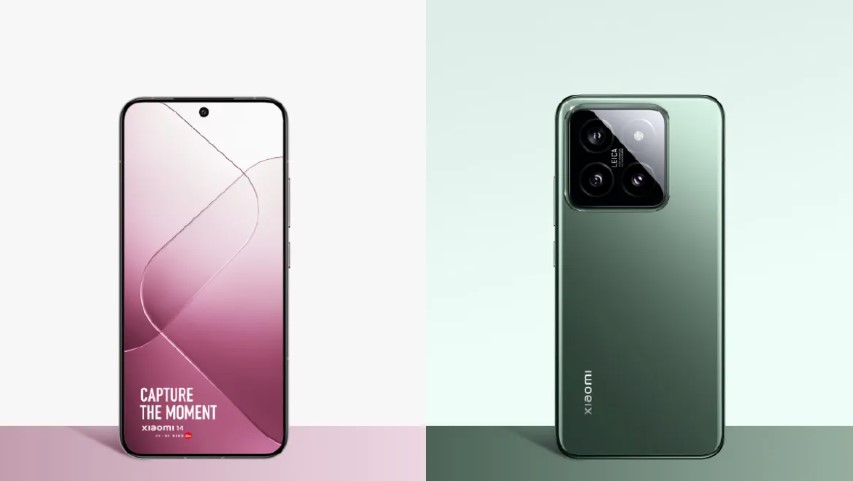
  • Flat-screen AMOLED display
  • Centre punch-hole selfie camera
  • Snapdragon 8 Gen 3 processor
  • 90W wired, 50W wireless charging
  • 4,860mAh and 5,000mAh battery
  • IP68 rating
  • 50.3MP Sony IMX989 sensor
  • Colours: white, black, green, pink
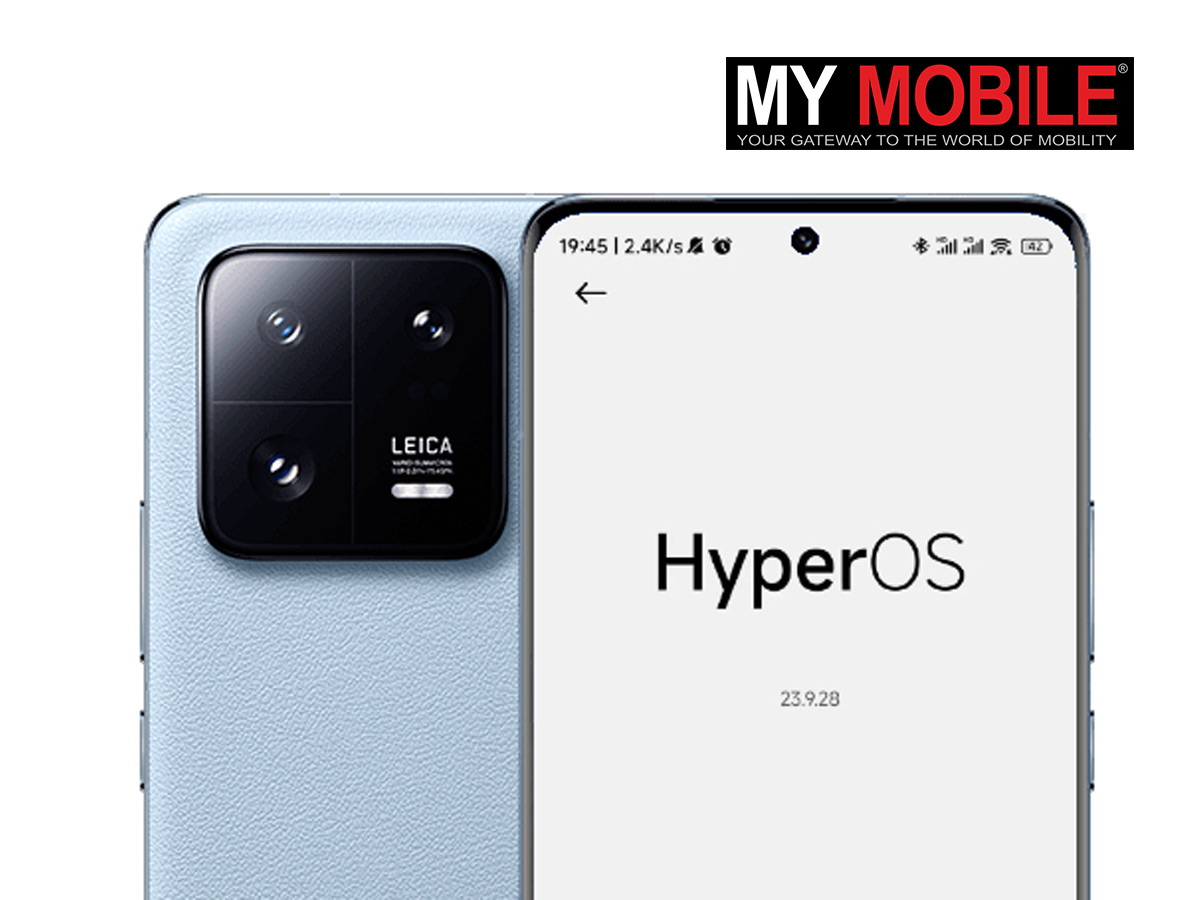
  • HyperOS Android skin

The New Skin: HyperOS

Xiaomi HyeprOS

Xiaomi isn’t just launching a new series of smartphones; it’s also debuting its new Android skinHyperOS.

While the details are scant, this new interface is likely to offer a range of customisation options and enhanced user experiences.

It’s an integral part of today’s launch, and it’s worth keeping an eye on.

Design and Display

Xiaomi 14 series Design and Display

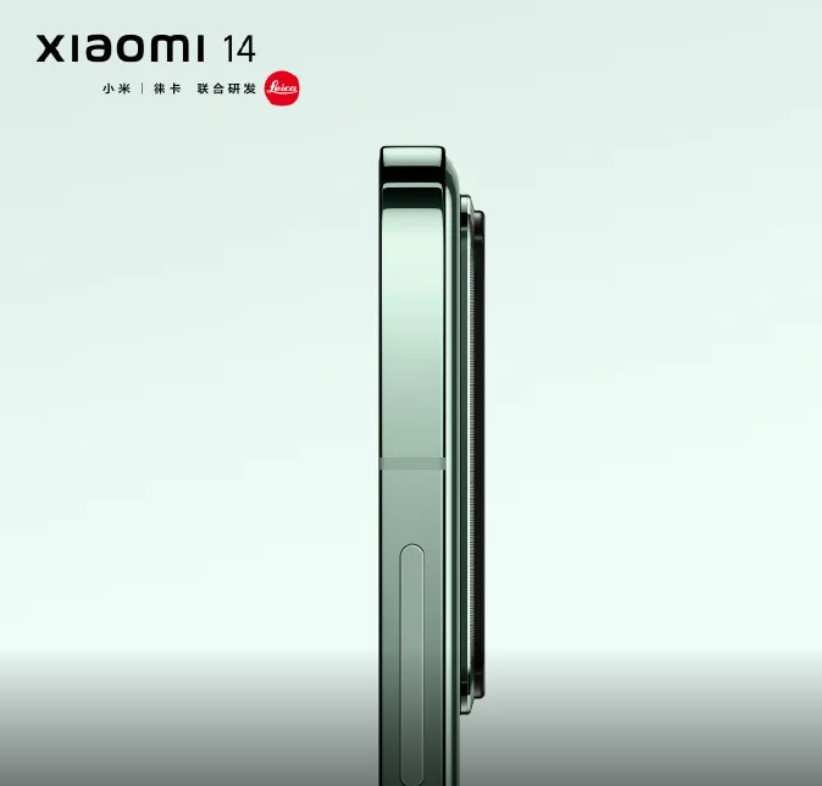
The leaked renders indicate a significant design overhaul.

Xiaomi seems to be bidding farewell to the curved display, joining the ranks of Pixel 8 Pro and the forthcoming Galaxy S24 series, which are also expected to feature flat panels.

Specifically, the Xiaomi 14 Pro is touted to come with a 6.6-inch AMOLED display, along with a centre-placed punch-hole selfie camera.

The same can be expected from other devices in the Xiaomi 14 lineup.

Processor and Performance

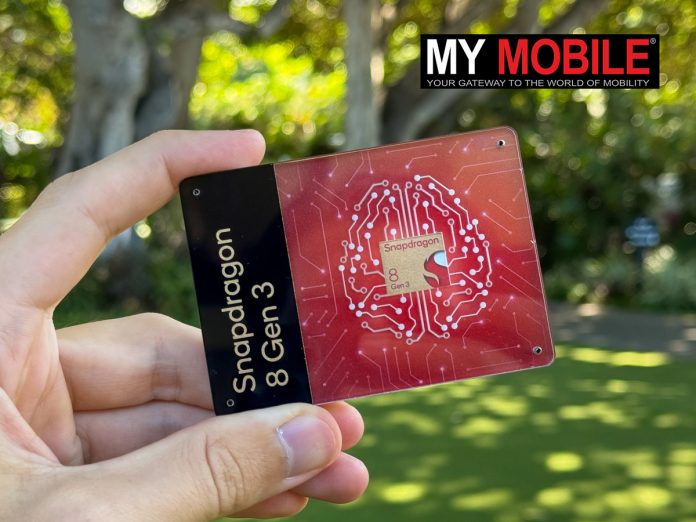
The series is projected to be powered by Qualcomm’s latest Snapdragon 8 Gen 3 chipset, announced yesterday by the silicone maker.

Known for its cutting-edge technology, this chipset is more than likely to promise improved efficiency and faster processing, setting high expectations for the device’s overall performance.

Battery and Charging

Xiaomi 14 series Battery & Charging

Battery life and charging capabilities are one of the most crucial aspects of modern smartphones.

The Xiaomi 14 might just push the envelope further.

The standard Xiaomi 14 model is rumored to offer 90W wired and 50W wireless charging.

It’s a substantial leap from its predecessor, which featured a 67W plug.

The Pro model, on the other hand, is likely to stick with its 120W wired and 50W wireless charging but may feature a larger battery capacity of up to 5,000mAh.

Camera Capabilities

While official details are still pending, the Xiaomi 14 Pro is rumoured to feature a 50.3MP 1-inch-type Sony IMX989 sensor for primary image-taking responsibilities.

If true, this would signify a significant advancement in smartphone photography, keeping in line with Xiaomi’s history of pushing mobile camera technology.

As for the other devices in the lineup, we can only guess.

Additional Features

We can expect some staple features to continue, like an IP68 rating ensuring water and dust resistance, eSIM capabilities for better connectivity, and advanced 8K video recording features.

You can expect these features tp contribute to making the Xiaomi 14 series a compelling package.

Speculation: What Could Be

There’s some speculative excitement too. Fans are wondering whether Xiaomi will push some of the Pro features down to the standard Xiaomi 14 model.

Could we possibly see the variable refresh LTPO display, or more robust Gorilla Glass Victus protection in the standard model? Only time will tell.

Global Launch and Model Variants

One of the looming questions is when the series will be made available globally.

Moreover, Xiaomi is known for launching multiple models under its flagship seriesUltra, T, S, and others.

FAQs

When and where is the Xiaomi 14 Series launching?

The Xiaomi 14 Series is launching today in China at 7:00 PM. CST or 4:30 PM IST. The event will be live-streamed on Xiaomi China and Weibo.com.

What are the anticipated design changes in the Xiaomi 14 Series?

Leaked renders suggest that the new series will feature a flat-screen AMOLED display, as opposed to the curved screens of previous models. The Xiaomi 14 Pro is also expected to have a center-placed punch-hole camera.

What processor will the Xiaomi 14 Series use?

Although not confirmed, the series is expected to be powered by Qualcomm’s latest Snapdragon 8 Gen 3 processor, which promises faster and more efficient performance.

Are there any improvements in charging and battery life?

Yes, rumours indicate that the Xiaomi 14 will feature 90W wired and 50W wireless charging. Battery capacity is also expected to see a bump, with the Pro model possibly going up to 5,000mAh.

Qualcomm Unveils Benchmark Scores for Snapdragon 8 Gen 3 That Will Power the Galaxy S24 Series

0

Highlights

  • Qualcomm’s Snapdragon 8 Gen 3 set to exclusively power Samsung Galaxy S24 Ultra with significant improvements over its predecessor.
  • The chipset boasts a 30% faster and 20% more power-efficient Kryo CPU.
  • Official benchmark scores reveal the Gen 3 outperforms Gen 2 in multiple tests including Geekbench and AnTuTu.

Qualcomm has taken the wraps off the official benchmark scores for its latest flagship chip, the Snapdragon 8 Gen 3.

This high-performance processor will exclusively power Samsung’s upcoming Galaxy S24 Ultra, with the Galaxy S24 and S24+ also offering versions integrated with Exynos 2400 in select markets like Europe and Korea.

Upon its announcement, Qualcomm emphasised the AI capabilities of the Snapdragon 8 Gen 3, stating that the processor might as well be dubbed ‘Gen AI.’

The chipmaker states that this is due to its specialised AI co-processor and an array of AI-centric features.

Recently Google’s Tensor G3 chipset also packed in a lot of AI prowess, however, Qualcomm has remained mum on how well its own chipset coped compared to Google’s offering.

In any case, these are the key highlights of Qualcomm’s next-gen flagship silicone.

Snapdragon 8 Gen 3

Key Specifications

  • Manufactured using TSMC’s 4nm technology, promising second-generation stability and compatibility.
  • Delivers a 10% hike in overall system efficiency.
  • Features a Kryo CPU that’s both 30% faster and 20% more power-efficient.
  • Multi-core CPU architecture consisting of 1 x Cortex-X4 running at 3.3GHz, 3 x A720 at 3.2GHz, 2 x A720 at 3.0GHz, and 2 x A520 at 2.3GHz.
  • Adreno GPU offers a 25% speed boost and 25% better power efficiency.
  • AI capabilities see a 98% improvement in performance and 40% better efficiency per watt.
  • The Spectra ISP supports 8K HDR and offers advanced features like multi-camera real-time semantic segmentation, Dolby HDR photo technology, and dual always-sensing cameras.
  • Enhanced gaming experience through Snapdragon Elite Gaming features and new hardware-accelerated ray tracing.
  • Snapdragon X75 5G Modem-RF System provides peak download speeds up to 10 Gbps.
  • Qualcomm FastConnect 7800 Mobile Connectivity System supports Wi-Fi 7 with a speed of up to 5.8 Gbps.

Benchmark Scores Unveiled

  • Geekbench single-core score: 2329 points
  • Geekbench multi-core score: 7526 points
  • AnTuTu benchmark: 2.14 million points
  • PCMark score: 21628 points
  • GFXBench Aztec Ruins OpenGL and Vulkan tests resulted in 83 FPS and 96 FPS respectively.
  • 3DMark WildLife Extreme test scored 32 FPS.
  • Jetstream 2 browser test marked at 241 points.

When these benchmarks are compared to the previous Snapdragon 8 Gen 2 chipset that powered the Galaxy S23 Ultra, it’s apparent that the Gen 3 chipset shows significant improvements.

For context, the Galaxy S23 Ultra’s Gen 2 scored around 5000 points in Geekbench multi-core tests, while the Gen 3 demo device surpassed the 7000-point threshold.

Qualcomm is also collaborating with tech giants like Microsoft and Meta to unlock the full AI potential of the Snapdragon 8 Gen 3 chipset.

While these details are promising, the real test will be how device manufacturers like Samsung utilize this next-gen technology in their upcoming smartphones. 

In more news, the iQOO 12 series has been confirmed to sport the Qualcomm Snapdragon 8 Gen 3 chipset, a first for the Indian market.

Globally, it would appear that China will be even earlier with the introduction of this SoC on the Xiaomi 14 series.

FAQs

What are the key specifications of Snapdragon 8 Gen 3?

The chipset features a multi-core CPU architecture, an Adreno GPU with a 25% speed boost, and enhanced AI capabilities. It is manufactured using TSMC’s second-generation 4nm technology.

How does Snapdragon 8 Gen 3 compare with its predecessor in benchmark scores?

The new chipset scores higher in Geekbench, AnTuTu, and other benchmark tests. For instance, it scored 7526 points in Geekbench multi-core tests compared to around 5000 points scored by its predecessor.

What devices will be powered by the Snapdragon 8 Gen 3?

Besides Samsung’s Galaxy S24 series, the chipset will also be featured in the iQOO 12 series in India and Xiaomi 14 series in China.

What are Qualcomm’s plans for AI capabilities?

Qualcomm is working closely with Microsoft and Meta to maximize the AI potential of Snapdragon 8 Gen 3, although specific comparisons with Google’s Tensor G3 chipset have not been made public.

Koffee with Karan-8: Watch on Disney+Hotstar; Check out the Koffee with Karan Guest List

0

Highlights

  • Koffee with Karan is back on Disney+ Hotstar with Season 8.
  • Host Karan Johar shared the announcement recently on his Instagram account with promos of the first episode released across social media platforms.
  • The show will stream from October 26.

Exciting news for all Bollywood gossip mongers out there! Brace yourselves because the hottest coffee is about to brew with Tinsel Town’s hottest host.

Yes, you guessed it right!

Koffee with Karan is making a grand return, promising a brand-new experience but the same tittle-tattle.

Karan Johar’s Talk Show Koffee With Karan

Filmmaker, Producer and Host, Karan Johar himself confirmed the much-awaited Koffee with Karan Season 8 premiere, scheduled for October 26, 2023, on Disney+ Hotstar.

Karan, ever the master of teasers, shared a video on his Instagram handle.

Where to Watch Koffee With Karan Season 8?

Koffee With Karan Upcoming Guests

Koffee With Karan has been renewed for another season.

The next season will stream on the OTT platform Disney+Hotstar.

Karan Johar shared the announcement video from ‘KWK 8’ on Instagram and wrote, “Turns out, my own Konscience wants to troll me too!

But screw what he thinks, I’m still brewing Season 8! #HotstarSpecials #KoffeeWithKaran Season 8 – streams from 26th October only on @disneyplushotstar (sic).”

Koffee With Karan Season 8 – First Episode Deets

Koffee With Karan Season 8

The excitement for the 8th season of ‘Koffee With Karan‘ has reached new heights, especially with the revelation that Ranveer Singh and Deepika Padukone will be the inaugural guests on the iconic couch.

The teaser for the first episode teases viewers with some secrets and delightful moments between the couple.

Deepika & Ranveer Singh On Koffee with Karan Season 8

In the promo video, Deepika and Ranveer were seen revealing deets about their secret engagement in 2015.

Deepika shared her bond with ‘Rocky Randhawa,’ emphasizing her marital status.

The teaser also offered glimpses of the intriguing games played during the episode, adding an element of anticipation to the upcoming show.

Get ready for an exhilarating ride!

Check out the Koffee with Karan Guest List

Koffee With Karan Thrilling Guest

Ever since the announcement, fans have been eagerly anticipating the lineup of celebrities set to grace Karan Johar’s show this season.

While official confirmations are yet to be made, sources in multiple media reports have already spilled the beans, suggesting a thrilling Guest List for the upcoming season.

The dynamic B-town couple Ranveer Singh and Deepika Padukone have already shared their charm and wit in a lively episode, having been recently filmed for ‘Koffee with Karan Season 8’ at the illustrious YRF studio in Mumbai.

Promos of the episode have recently been released on social media, making way for conversations across platforms.

Apart from the power couple Deepika Padukone-Ranveer Singh, the sister-in-low duo – Alia Bhatt-Kareena Kapoor Khan are also slated to make an appearance in the show this season.

Several other celebrity pairings are generating buzz, with names like Kiara Advani and her husband Sidharth Malhotra, as well as the dynamic duo Rohit Shetty and upcoming show.

Rumours also suggest Cousins Kajol and Rani Mukerji will reunite on the show for the first time since appearing together in 2007.

According to multiple media reports, discussions have taken place with Shah Rukh Khan as well, although nothing is finalized yet due to the actor’s busy schedule with other commitments.

Since its inception in 2004, Karan Johar’s talk show, Koffee with Karan, has delved into the private lives of Bollywood stars and celebrities.

With seven successful seasons under its belt, the show continues to captivate audiences with its candid conversations and intriguing insights into the world of Bollywood.

FAQs

Q1. When did Koffee With Karan first premiere?

Answer. Koffee With Karan, the iconic talk show hosted by Karan Johar, first premiered on television in India on November 19, 2004. Since then, it has become one of the most popular and enduring celebrity chat shows in the country.

Q2. How often does a new season of Koffee With Karan air?

Answer. The frequency of the new seasons of Koffee With Karan can vary. Typically, a new season is launched every year or every couple of years, featuring a fresh lineup of Bollywood celebrities. However, the exact schedule can depend on various factors, including Karan Johar’s and the celebrities’ availability.

Q3. Where can I watch old Koffee With Karan episodes?

Answer. Viewers can watch Koffee With Karan on the OTT (Over-The-Top) platform Disney+ Hotstar. The show is available for streaming on this platform, allowing fans to catch up on missed episodes and enjoy exclusive behind-the-scenes content related to the show. Please note that the availability of the show may vary based on the region, so viewers should check the platform’s library for the most up-to-date information.

Q4. How many seasons of Koffee With Karan are there?

Answer. Debuted on 19 November 2004, Koffee with Karan has aired seven seasons since, with an eighth season scheduled to premiere. Distributed by Disney Star, the first six seasons aired on Star World channel between 2004 and 2019.

Also Read: Disney Plus Hotstar to hike prices in US markets

Also Read: Jio Unveils Exciting Prepaid Plans with Disney+ Hotstar for Cricket World Cup 2023

Also Read: Disney + Hotstar India Down: Users complain streaming platform’s app outage during India vs Australia match, Live Status & Reports

Apple Reportedly Gearing Up to Refresh AirPods Lineup in 2024

0
  • Next-generation AirPods Max to feature USB-C charging and new color options.
  • Fourth-generation entry-level and mid-tier AirPods to come with a new design and possibly noise-cancelling features.
  • Minor updates were introduced to AirPods Pro last year, with another update expected in 2025.

Apple’s AirPods have become a cultural mainstay since their debut in 2016, a common sight at least in the US and now recently in other countries as well.

The wireless earbuds have not just been a trendsetter but also a significant revenue generator for Apple, requiring continual innovations to sustain consumer interest.

According to a recent report by Bloomberg, the tech giant is planning to revamp several versions of its AirPods models next year.

This move is part of Apple’s strategy to keep its products updated and cater to an evolving consumer base.

The high-end AirPods Max, priced at $549, are expected to receive a refresh that includes a USB-C charging port and a range of new color options.

The entry-level and mid-tier models, currently priced at $129 and $169 respectively, are slated to be succeeded by fourth-generation iterations featuring a redesigned structure, truncated stems, and possibly noise-canceling capabilities for select versions.

Last year, Apple’s AirPods Pro, costing $249, received minor updates and introduced a model featuring a USB-C port this fall. Another update for the AirPods Pro line is expected to roll out by 2025.

Apple’s AirPods

This past autumn, a software feature was added to the AirPods Pro using artificial intelligence.

This feature automatically lowers the noise cancelation function when the user speaks, making it more convenient to keep the earbuds in all day.

Revenue from AirPods is reported under Apple’s Wearables, Home, and Accessories division, which disclosed $41 billion in revenue during the 2022 fiscal year.

This figure also accounts for sales of the Apple Watch.

With the impending launch of Apple’s Vision Pro VR/AR headsets in 2024 and beyond, it remains to be seen how the updated AirPods will integrate into this new ecosystem.

Currently, only the second-generation AirPods Pro have been cited in conjunction with the Vision Pro, both devices being equipped with the H2 chip.

FAQs

What changes can we expect in the new AirPods Max?

The new AirPods Max are expected to come with a USB-C charging port and a range of fresh color options.

What about the entry-level and mid-tier AirPods?

Both the entry-level and mid-tier models are set to be replaced by fourth-generation versions. These new models will feature a redesigned form, shorter stems, and may include noise-canceling capabilities in certain versions.

When are updates expected for the AirPods Pro?

The AirPods Pro received minor changes last year and are anticipated to have another update around 2025.

How do AirPods sales affect Apple’s overall revenue?

Sales from AirPods are included in Apple’s Wearables, Home, and Accessories division, which accounted for $41 billion in revenue for the fiscal year 2022.

Lenovo Dives Into the AI Arena with the Introduction of MotoAI at Tech World ’23 Event

0

Highlights

  • Lenovo formally announces MotoAI, their ambitious next-gen personal assistant, during Tech World ’23.
  • Designed for a seamless experience across PCs and smartphones, MotoAI boasts a learning model that’s personalized to individual user needs.
  • Unique to MotoAI is its ability to run operations locally on-device, offering users an extra layer of data security, differentiating it from cloud-based alternatives.

In an audacious stride into the ever-expanding field of AI and machine learning, Lenovo unveiled an array of groundbreaking technologies at the company’s Tech World ’23 event.

However, stealing the limelight was MotoAI—a sophisticated personal assistant that’s under active development and aims to redefine the way we think about AI assistants.

Lenovo says that MotoAI is more than just a typical voice-activated helper; it’s an intelligent system engineered for adaptability and perpetual learning.

Lenovo Dives
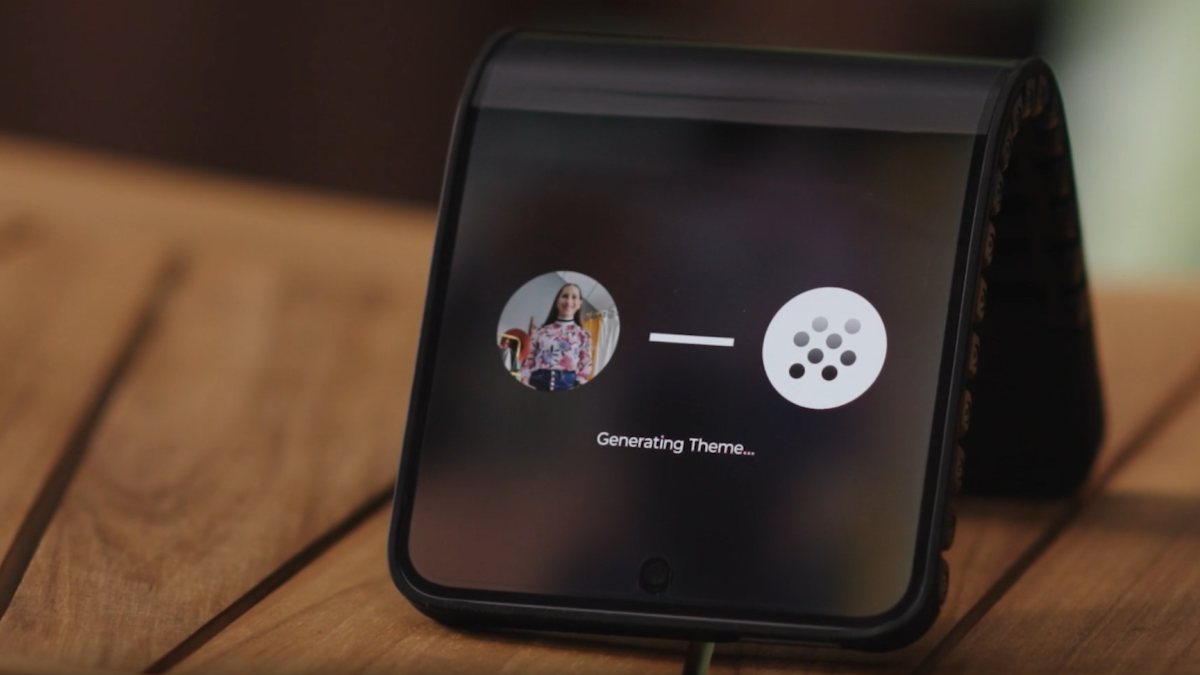
Lenovo MotoAI Next-Gen Personal Assistant

It is designed to be universally compatible with both PCs and smartphones, MotoAI features a foundational learning model that is not just personalized to each user but is also built to evolve through continuous interaction.

This ensures that the AI assistant can grow smarter over time, adapting to the user’s changing habits and preferences.

What sets MotoAI apart from its contemporaries, as per Lenovo, is its robust commitment to user privacy.

Unlike many other AI assistants that use cloud-based platforms to store and process data, MotoAI takes a different approach.

It performs all its data processing tasks locally, right on the user’s device.

Lenovo claims that this novel feature not only speeds up task execution but also adds a significant layer of data security, that should definitely grant users a peace of mind.

MotoAI comes with an expansive and ever-updating knowledge base that interacts with users through natural language, either by voice or text.

Lenovo has positioned MotoAI as an all-encompassing tool, capable of a broad range of functions—from answering intricate questions and drafting detailed messages to efficiently scheduling tasks and reminders.

FAQs

What is MotoAI and where was it introduced?

MotoAI is a next-generation AI personal assistant unveiled by Lenovo at their Tech World ’23 event. It’s designed for both PCs and smartphones and aims to offer a tailored user experience.

How does MotoAI differ from other AI assistants?

MotoAI is engineered for adaptability and continuous learning. Unlike many cloud-based AI assistants, MotoAI processes all data locally on the device, providing enhanced data security.

What tasks can MotoAI perform?

MotoAI is built to handle a variety of tasks. It can answer questions, draft messages, schedule appointments, and many other activities that can benefit from an AI-powered tool.

How does MotoAI ensure data privacy?

MotoAI stands out for its on-device data processing. This means all tasks are executed and all data is stored locally on the user’s device, offering an extra layer of security and privacy.

Google Photos Update Introduces New Video Creation Tool for Easier Sharing

0

Highlights

  • The app will feature a new video creation tool accessible via a top menu.
  • The new Highlight video option enables quick creation of memory reels.
  • Powered by AI, the feature offers customization options including music and trimming.
  • The update also expands other features, such as new albums, collages, and more.

Google Photos is about to make reminiscing and sharing memories even simpler.

A forthcoming update for the app on iOS and Android devices will introduce a new video creation tool that aims to streamline the process of making video highlight reels.

Users can expect to see this new feature rolling out tomorrow.

Accessible from a newly added top menu within the app, the video creation tool comes as a new ‘Highlight video’ option.

This feature allows users to sift through collections of people, places, and activities to put together a video instantaneously.

A built-in search bar will suggest topics, letting you zero in on specific locations, dates, or moments.

Once the criteria are selected, a video is auto-generated, complete with the ability to pause, play, add more items, and even alter the music and trim down the video as desired.

The AI-driven feature also synchronizes the music with the generated video, making for a seamless viewing experience.

Google Photos Update

In addition to the video creation tool, the new top menu provides access to creating new albums and collages.

Users will also have the facility to share cinematic photos and animations.

This comes on the heels of earlier updates this year, including an expanded ‘locked folder’ feature on iOS and web platforms, and improved editing tools for web users.

It’s crucial to differentiate this new tool from the pre-existing ‘memories’ feature on Google Photos.

The latter also received an upgrade recently and became available to Chromebook users earlier this year.

FAQs

What are the new features in the Google Photos update?

  • A new video creation tool
  • An updated top menu for album and collage creation
  • Improved sharing features for cinematic photos and animations

When is the update expected to roll out?

The update is expected to be available starting tomorrow on both iOS and Android devices.

Is the new video tool AI-powered?

Yes, AI powers the new video creatio

Google Photos New Update Video Creation

n tool for better customization and synchronization.