WhatsApp introduced Member Tags, Text Stickers, and Event Reminders in group chats.
Member Tags let users assign roles, Text Stickers turn typed words into graphic stickers and Event Reminders help groups plan.
These updates are available worldwide and build on WhatsApp’s existing group tools.
(Photo by Alexander Shatov on Unsplash)
WhatsApp has rolled out a set of new features aimed at making group chats more organised, expressive, and easier to manage when important conversations are happening. Group Chats on WhatsApp remain central to planning events, managing communities, and staying connected across devices. Now, the Meta-owned messaging platform is refining how users interact within shared conversations.
The latest update brings three new tools, Member Tags, Text Stickers, and Event Reminders. Each of these features are designed to add more flexibility and structure to group chats.
Member Tags, Text Stickers, and Event Reminders
WhatsApp introduces new Group Chat features. (Image credit – Meta)
Member Tags allow users to assign themselves different roles in different group chats, adding useful context to conversations. For instance, a user can appear as “Coach” in one group and “Dad” in another, depending on the group’s purpose.
Text Stickers make chats more expressive by instantly converting typed words into sticker-style graphics. These can also be saved to custom sticker packs for future use.
Event Reminders enhance group planning by letting users set custom early reminders when creating and sharing events in a group chat. According to Meta, “this helps everyone remember to commute to the party you’re hosting or hop on the call at the right time.”
Availability
The new group chat features are now available to WhatsApp users globally. They follow other recent updates to the platform including third-party chat support in the EU and the launch of WhatsApp for Apple Watch.
Recent WhatsApp Group Chat Upgrades
These additions build on WhatsApp’s expanding list of group-focused features introduced in recent years. Existing tools already allow users to share large files of up to 2GB, send HD photos and videos, share screens during calls, and use voice chats for real-time discussions without starting a formal call.
According to WhatsApp, the latest updates are part of its broader push to deliver what it considers the best group chat experience across platforms and devices. With group conversations playing an increasingly important role in both personal and professional communication, the platform appears focused on reducing friction, improving clarity, and giving users greater control over how they connect.
FAQs
Q1. What new features has WhatsApp introduced for group chats?
Answer. WhatsApp has rolled out Member Tags, Text Stickers, and Event Reminders to make group conversations more organised, expressive, and easier to manage.
Q2. How do Member Tags, Text Stickers, and Event Reminders work?
Answer. Member Tags let users assign themselves roles (e.g., “Coach” or “Dad”) depending on the group. Text Stickers instantly convert typed words into sticker-style graphics that can be saved for later use. Event Reminders allow users to set custom alerts for upcoming events, helping everyone stay on schedule.
Q3. Are these new features available to all WhatsApp users?
Answer. Yes, the features are now available globally and build on WhatsApp’s existing group tools like large file sharing, HD media, screen sharing, and voice chats.
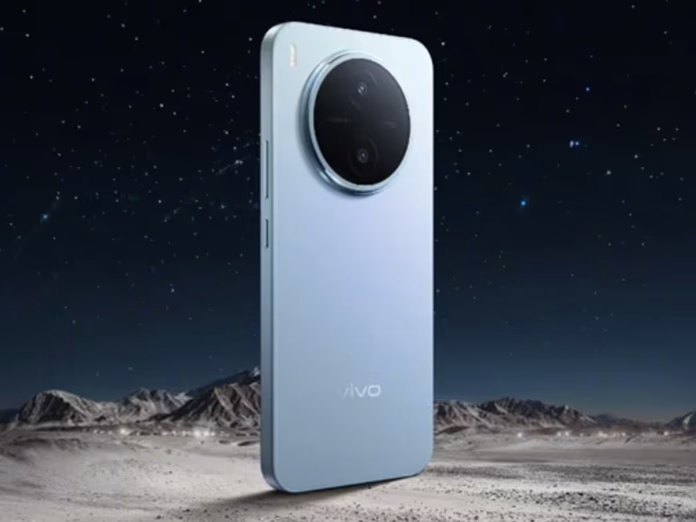
iQOO has officially confirmed the launch date of its upcoming Z-series smartphone, the iQOO Z11 Turbo. The brand had already teased several key aspects of the device including its pricing strategy, colour options, chipset, design elements, and IP ratings. But now making things more official, the company has revealed the China launch date.
iQOO Z11 Turbo – China Launch Date
The iQOO Z11 Turbo is set to launch in China on January 15 and will be positioned as a performance-centric smartphone with a strong focus on battery life and flagship-level hardware. The handset is already available for pre-order through the official iQOO online store in China.
iQOO’s official post on Weibo. (Translated via Google Translate)
iQOO Z11 Turbo – Key Features (Revealed)
In a Weibo post, iQOO Product Manager Xing Cheng confirmed that the iQOO Z11 Turbo will pack a massive 7,600mAh battery. The smartphone will also support 100W wired fast charging and feature “Direct-Drive Power Supply 2.0” technology. According to the executive, the handset will measure 7.9mm in thickness and weigh approximately 202 grams.
iQOO has also confirmed that the Z11 Turbo will ship with IP68 and IP69 ratings for dust and water resistance.
Separately, tipster Digital Chat Station claimed on Weibo revealed several key features of the upcoming phone. According to DCS, the phone will be powered by Qualcomm’s octa-core Snapdragon 8 Gen 5 chipset, which is built on a 3nm manufacturing process. The phone is confirmed to feature a 6.59-inch display with 1.5K resolution.
For photography, the device will sport a 200-megapixel “ultra-clear” primary rear camera and an 8-megapixel secondary camera. It will feature a 32-megapixel front-facing camera for selfies and video calls.
In terms of build quality, the smartphone will feature a metal frame, a glass back panel, and rounded corners. For security, the smartphone will also be equipped with an ultrasonic fingerprint scanner.
The device is tipped to be offered in multiple RAM and storage configurations including 12GB + 256GB, 12GB + 512GB, 16GB + 256GB, 16GB + 512GB, and 16GB + 1TB variants.
Price Range, Availability, and Colour Options (Revealed)
iQOO has also revealed the colour options for the Z11 Turbo. The smartphone will be available in Canglang Floating Light (blue), Halo Powder (pink), Extreme Night Black, and Sky White colour options.
The company has even confirmed that the smartphone will be priced between CNY 2,500 (roughly Rs. 32,000) and CNY 3,000 (about Rs. 38,000) in the country. The handset is currently available for pre-order via the Vivo China online store.
FAQs
Q1. When is the iQOO Z11 Turbo launching in China?
Answer. The iQOO Z11 Turbo is set to officially launch on January 15, 2026, with pre-orders already open via the Vivo China online store.
Q2. What are the standout specifications of the iQOO Z11 Turbo?
Answer. It features a 7,600mAh battery with 100W fast charging, Snapdragon 8 Gen 5 chipset, a 6.59-inch 1.5K display, and a 200MP primary rear camera.
Q3. How much will the iQOO Z11 Turbo cost and in what variants?
Answer. The phone will be priced between CNY 2,500–3,000 (~₹32,000–₹38,000), available in four colour options and multiple RAM/storage variants up to 16GB + 1TB.
Infinix Note 60 series to debut two-way satellite calling and messaging, covering two-thirds of Earth, with HD voice support and seamless cellular-satellite switching.
Infinis introduced HydroFlow Liquid Cooling with a dual piezoelectric pump and the world’s first blade-less piezoelectric fan, delivering precise, silent, and highly efficient heat dissipation.
It also showcased a split gaming controller, Active Visual Backplate Technology with dynamic light-based designs and the ModuVerse magnetic ecosystem.
At CES Showstoppers 2026, Infinix outlined its mobile technology roadmap under the “Joyful Tech, Beyond Limits” philosophy. The brand showcased multiple innovations spanning connectivity, thermal management, gaming accessories, and smartphone design. Highlights included Infinix’s first global satellite communication solution, the industry’s first HydroFlow Liquid Cooling Architecture, and Active Visual Backplate Technology, all aimed at improving sustained performance and personalised user experiences.
Infinix Note 60 Series to Debut Two-way Satellite Calling and Messaging
Infinix NOTE 60 Series will be arriving this year with Satellite Calling and Messaging. (Image credit – Infinix)
Infinix first introduced its Explorer Satellite Communication Technology in 2023, which supported two-way text messaging in remote locations. Building on that foundation, the company has now unveiled a more advanced Infinix Satellite Communication system.
The new solution supports not only two-way text messaging but also high-definition voice calls. It includes Speaker Mode and Bluetooth headset calling for added convenience, along with wind suppression technology designed to capture clear audio even in windy conditions.
The upcoming Infinix Note 60 series will be the first to feature this satellite communication system. It remains unclear whether the feature will be available across the entire lineup or limited to select models, such as the Pininfarina-designed Infinix Note 60 Ultra.
According to the company, the Infinix Satellite Communication system is expected to cover roughly two-thirds of the Earth’s surface. It supports transmission speeds of up to 4Kbps, which, while modest, are sufficient for HD voice calls. The system is also designed to seamlessly switch between cellular and satellite connectivity.
Infinix claims users will be able to access satellite connectivity without any additional registrations, with more details expected to be shared later.
HydroFlow Liquid Cooling and Blade-less Fan Technology Unveiled
Alongside satellite communication, Infinix introduced a new active cooling solution called HydroFlow, which the company describes as “one of the smartphone world’s most advanced” liquid cooling technologies.
At its core is the industry’s first Dual Piezoelectric Ceramic Single Pump. This system uses electric current to drive high-frequency deformation of piezoelectric ceramics, pushing fluorinated liquid at speeds of up to 6.5 ml/min, double that of conventional active liquid cooling systems. The liquid channels reportedly cover 100 percent of the mainboard’s primary heat sources, delivering what Infinix calls “unprecedented cooling precision and efficiency.”
Complementing this is what the brand claims to be the world’s first piezoelectric fan technology for smartphones. It uses an ultra-thin 0.1mm vibrating sheet that pulses 25,000 times per second to generate a high-pressure, turbulent air jet. According to Infinix, this results in more than ten times greater heat dissipation compared to traditional spinning blade fans. The solid-state, blade-less design also enables near-silent operation.
Infinix added that it is already working on a full-chamber immersive cooling solution, where liquid directly contacts key components to enable faster heat dissipation.
New Gaming Controller and Active Visual Backplate Technology
Industry-first split controller with a pressure-sensitive touchpad and ultra-low-latency connectivity designed for boundless control. (Image credit – Infinix)
The company also showcased an industry-first split gaming controller featuring a large pressure-sensitive touchpad and ultra-low latency performance. It is paired with wireless magnetic triggers equipped with “mouse-grade micro-switches.”
On the design front, Infinix introduced Active Visual Backplate Technology. Using precise optical microstructures, the technology manipulates reflected light to create a rear panel design that changes based on viewing angles and surroundings. By simply rotating the phone, users can experience “flowing colours, vivid and continuous animations, or mesmerising 3D stereoscopic images on the back cover.”
Infinix introduces Active Visual Backplate Technologies.
As an extension of this concept, Infinix is incorporating smart materials such as bistable thermo-chromatic ink and starry photochromic leather. These materials allow patterns and colours to shift dynamically in response to temperature changes and ambient light. The visuals are layered on top of a “Monolithic Cold-carved Polymer structure,” which integrates the camera module into the rear panel for a more refined look and smoother feel.
According to the company, these combined technologies bring “living personality into Infinix products, with designs that are stunning at first glance and extraordinary upon closer inspection.”
ModuVerse Magnetic Sccessory Ecosystem Announced
Infinix AI ModuVerse. (Image credit – Infinix)
Rounding out its CES 2026 announcements, Infinix unveiled ModuVerse, a new magnetic accessory ecosystem built around “a unified magnetic interface.” The company highlighted five initial Modu accessories.
According to Infinix’s press note, “the AI ModuVerse includes the Mic Modu for professional noise reduction; a magnetically attached anti-shake enhanced SportsCam Modu; a Meeting Modu integrating translation and notes generation; a StackPower Modu supporting on-demand power expansion; and a VlogCam Modu for AI-driven subject tracking and gesture control.”
As of now, Infinix has not confirmed when these technologies will make their way into commercially available products. The company says more information will be shared once implementation plans are finalised.
FAQs
Q1. What new connectivity feature is coming with the Infinix Note 60 series?
Answer. The Note 60 series will debut two-way satellite communication, supporting HD voice calls, text messaging, and seamless switching between cellular and satellite networks.
Q2. What cooling innovations did Infinix unveil at CES 2026?
Answer. Infinix introduced HydroFlow Liquid Cooling with a dual piezoelectric pump and the world’s first blade-less piezoelectric fan, offering precise, silent, and highly efficient heat dissipation.
Q3. What accessories and design technologies were showcased by Infinix?
Answer. Infinix revealed a split gaming controller, Active Visual Backplate Technology with dynamic light-based designs, and the ModuVerse magnetic accessory ecosystem featuring modular add-ons like Mic Modu, SportsCam, and VlogCam.
Honor Magic 8 Air leak shows a slim design with an aluminium frame and a horizontal camera bar.
Honor Magic 8 RSR camera features a 200MP periscope telephoto lens with 4.3x–7x optical zoom, plus 50MP main, ultra-wide, and selfie cameras.
Magic 8 Air expected later this month; Magic 8 RSR tipped to debut before Chinese New Year.
Honor Magic 8 Air leaked image. (Image credit – @UniverseIce on X)
Honor is expected to soon expand the Honor Magic 8 lineup with a new model. Some reports have claimed it to be the Honor Magic 8 Air. The device is tipped to focus on a slim and lightweight design with comparisons already being drawn to Apple’s iPhone Air. Here’s what we know so far.
Well-known tipster Ice Universe @UniverseIce on X recently posted a design schematic of the Honor Magic 8 Air. It reveals an early look at the smartphone’s rear panel.
The leaked schematic shows a horizontal camera bar design that is visually similar to Google’s Pixel series. Unlike Pixel phones, the LED flash on the Magic 8 Air appears to be integrated within the camera module itself rather than placed outside.
It is said that this is a schematic diagram of the Honor Magic 8 Air.
Only 6.3mm thick.The weight is 158 grams..What are your thoughts? pic.twitter.com/e9Gf3BwWA7
The image also hints at an aluminium frame, suggesting a premium yet lightweight build. According to the leak, the Honor Magic 8 Air could measure just 6.3mm in thickness and weigh around 158 grams. The sides of the device are shown with a volume rocker, a power button, and a third button, which is believed to be a dedicated AI button, similar to those seen on the Honor Magic 8 and Honor Magic 8 Pro.
In comparison, the iPhone Air is said to be thinner at 5.6mm but heavier, weighing approximately 165 grams. This indicates that Honor may be prioritising weight reduction over achieving the absolute thinnest profile.
iPhone Air (left) and Honor Magic 8 Air (right). (Image credit – Honor)
Supporting this claim, Honor Product Manager Li Kun recently shared an image of the Magic 8 Air placed on a weighing scale next to the iPhone Air, highlighting its lighter build.
Honor Magic 8 Air – What Else We Know?
As per recent leaks, the smartphone may feature a 6.3-inch flat OLED display with 1.5K resolution, a MediaTek Dimensity 9500 chipset, a 5,500mAh battery, and support for 80W fast wired charging.
There has been some uncertainty surrounding the final name of the device. The President of the Product Line at Honor Terminal Co., Ltd., Fang Fei previously stated that Honor was working on a smartphone combining the strengths of both the Pro and Air series. This led to speculation that the phone could be called “Honor Magic 8 Pro Air.”
However, based on Ice Universe’s post, the device is now expected to launch simply as the Honor Magic 8 Air.
The device is expected to launch later this month.
Honor Magic 8 RSR Camera Samples Released
Separately, rumours around the Honor Magic 8 RSR flagship smartphone are getting serious. It is expected to arrive ahead of the Chinese New Year, which falls on February 17. To stir some excitement, Honor has officially shared camera samples captured using the phone’s periscope telephoto camera.
Honor Magic 8 RSR Periscope Telephoto Camera Details
Honor has released telephoto sample images taken with the Magic 8 RSR, showcasing its 200-megapixel periscope telephoto camera. The camera is said to feature an f/2.6 aperture and ISZ focal lengths of 170mm and 230mm.
According to released details, the large-sensor periscope lens could offer an effective focal length of around 85mm and support telephoto macro photography. Other reports suggest the sensor will deliver optical zoom ranging from 4.3x to 7x.
The rear camera setup on the Magic 8 RSR is also expected to include a 50-megapixel OmniVision OV50R main camera with ultra-high dynamic range and a 50-megapixel ultra-wide camera. On the front, the device is said to feature a 50-megapixel autofocus-enabled selfie camera.
Honor Magic 8 RSR – Key Details (Tipped)
On the front, the Honor Magic 8 RSR is tipped to sport a 6.7-inch LTPO OLED display with a quad-curved design. The screen is expected to offer 1.5K resolution and include an ultrasonic in-display fingerprint sensor, along with support for 3D face recognition.
Powering the device could be the Snapdragon 8 Elite Gen 5 chipset, paired with a battery capacity of around 7,000mAh. The smartphone is also rumoured to support 120W wired charging and 50W wireless charging and is expected to run MagicOS 10 based on Android 16.
FAQs
Q1. What is unique about the Honor Magic 8 Air design?
Answer. The Magic 8 Air is tipped to feature a slim 6.3mm aluminium frame, weighing just 158g, with a horizontal camera bar and a dedicated AI button.
Q2. What are the key specifications of the Honor Magic 8 Air?
Answer. Leaks suggest a 6.3-inch flat OLED display (1.5K), MediaTek Dimensity 9500 chipset, 5,500mAh battery, and 80W fast charging.
Q3. What camera setup is expected on the Honor Magic 8 RSR?
Answer. The Magic 8 RSR is said to include a 200MP periscope telephoto lens (4.3x–7x zoom), a 50MP main camera, a 50MP ultra-wide, and a 50MP autofocus selfie camera.
Lenovo unveiled the Legion Pro Rollable Concept laptop with an expandable OLED display and AI-powered gaming features.
Also showcases a SteamOS Legion Go handheld launching June 2026 at $1,199.
AI ecosystems introduced Project Kubit Personal AI Hub for cross-device analytics, and lightweight Lenovo AI Glasses with live translation, intelligent recognition, and productivity prompts.
Lenovo Showcases Rollable Legion Pro Concept.
Lenovo unveiled a wide range of concept devices and future-facing technologies at the Consumer Electronics Show (CES) 2026, highlighting its vision for gaming, artificial intelligence, displays, and smart accessories. Among the key announcements were the Lenovo Legion Pro Rollable Concept, a SteamOS-powered Lenovo Legion Go (8.8”, 2), rollable ThinkPad concepts, AI wearables, and a personal AI hub designed for multi-device ecosystems.
Lenovo Legion Pro Rollable Concept and SteamOS Legion Go
At CES 2026, Lenovo introduced one of its most ambitious Legion gaming concepts to date, a high-end laptop with a rollable OLED display that can expand significantly when needed. Alongside this, the company announced a SteamOS variant of the Lenovo Legion Go (8.8”, 2), expanding its handheld gaming lineup beyond Windows.
Lenovo Legion Pro Rollable Concept
Lenovo Rollable Legion Pro Concept.
The Legion Pro Rollable Concept is a premium gaming laptop built around a 16-inch base form factor, with a screen that can expand horizontally to 21.5 inches and further to 24 inches. Lenovo says the concept is aimed at esports professionals and gamers who travel frequently but still require a large display for competitive play.
The device features a Lenovo PureSight OLED gaming display that unrolls from both sides using a dual-motor mechanism. According to Lenovo, the tension-based design enables smooth expansion and retraction with minimal vibration and noise.
Gamers can switch between three distinct usage modes like a 16-inch Focus Mode for reflex training and precision, a 21.5-inch Tactical Mode for improving peripheral awareness, and a 24-inch Arena Mode designed for competitive matches and team-based training.
Internally, the proof-of-concept is based on the Legion Pro 7i platform and is shown with top-tier Intel Core Ultra processors and an NVIDIA GeForce RTX 5090 Laptop GPU. It also integrates Lenovo AI Engine+, powered by the Lenovo LA Core (LA1 + LA3), which uses real-time scenario detection to boost frame rates and optimise system resources.
Additional AI-powered gaming features include AI Scene Detection, which identifies the type of game being played and highlights key areas on-screen, AI Game Assistance that offers real-time guidance during difficult gameplay moments, and Adaptive AI Lighting that changes ambient lighting based on in-game activity.
Lenovo Legion Go (8.8”, 2) with SteamOS
Lenovo also announced a SteamOS-powered version of the Lenovo Legion Go (8.8”, 2), which originally launched last year with Windows. The company says this is its most powerful Legion handheld to natively ship with SteamOS.
The handheld features an 8.8-inch WUXGA 16:10 OLED PureSight touchscreen with a 144Hz refresh rate, 500 nits brightness, and Variable Refresh Rate support. It is powered by up to an AMD Ryzen Z2 Extreme processor, paired with up to 32GB of 8000MHz RAM. Storage options go up to 2TB via PCIe Gen 4 with additional expansion through a microSD slot.
The upgraded 74Whr battery is said to offer over 50 percent higher capacity compared to the previous generation, enabling smoother gameplay across AAA, indie, and retro titles.
Pricing and Availability
The Lenovo Legion Go (8.8”, 2) powered by SteamOS is expected to start at $1,199 (approximately Rs. 1,08,115). Availability in the US is expected from June 2026.
Lenovo Personal AI Hub Concept
Lenovo also introduced Project Kubit, officially referred to as the Personal AI Hub Concept. This on-device personal edge cloud solution is designed to support AI-enabled applications across PCs, smartphones, wearables, and smart home products.
The system consists of two Lenovo ThinkStation PGX compact AI workstations powered by the Nvidia GB10 Grace Blackwall Superchip. It includes a touchscreen interface and supports voice-based interaction. Lenovo claims the hub aggregates data across platforms, giving users access to advanced analytics and AI-driven applications.
Lenovo AI Glasses Concept
Another highlight from the event was the Lenovo AI Glasses Concept. These lightweight smart glasses feature built-in displays and on-device AI processing, allowing contextual information such as notifications, navigation, translations, and productivity prompts to appear directly in the user’s field of view.
Powered by the Lenovo Qira platform, the glasses leverage paired smartphones and PCs to deliver sub-millisecond live translation and intelligent image recognition. They also support the Catch Me Up feature, which summarises messages and calls to reduce notification overload.
The Lenovo AI Glasses Concept weighs 45g and is claimed to offer up to eight hours of battery life. Lenovo positions the device as an assistive accessory rather than a solution for immersive content consumption.
AI-powered Display Concepts
Lenovo showcased the Smart Sense Display Concept, featuring a 27-inch Ultra HD panel capable of wirelessly connecting to multiple personal devices such as smartphones, laptops, and tablets.
The display supports multi-screen collaboration, natural-language interaction via voice or touch, and flexible multitasking tools including drag-and-drop window management.
Smart accessory concepts
In addition to core devices, Lenovo also revealed several smart accessory concepts. These include the Adaptable Keyboard Concept, which offers adjustable keystroke depth and optical actuation, and the Lenovo Self-Charging Kit Concept. The latter includes a keyboard and mouse powered by light-harvesting technology that works in lighting conditions as low as 50 lux, with the mouse capable of charging even under indoor lighting.
Together, Lenovo’s CES 2026 announcements highlight the company’s focus on rollable displays, AI-driven ecosystems, and modular, power-efficient accessories designed for the next generation of computing.
FAQs
Q1. What is the Lenovo Legion Pro Rollable Concept?
Answer. It’s a premium gaming laptop with a rollable OLED display that expands from 16 inches to 24 inches, offering three usage modes (Focus, Tactical, Arena) for esports and competitive play.
Q2. What are the key features of the SteamOS Lenovo Legion Go (8.8”, 2)?
Answer. The handheld has an 8.8-inch OLED PureSight display with 144Hz refresh rate, powered by an AMD Ryzen Z2 Extreme processor, up to 32GB RAM, and a 74Whr battery offering smoother AAA gameplay.
Q3. How much will the SteamOS Lenovo Legion Go cost and when will it be available?
Answer. It is expected to start at $1,199 (~₹1,08,115), with US availability from June 2026.
Q4. What is Lenovo’s Personal AI Hub Concept (Project Kubit)?
Answer. Project Kubit is an on-device edge cloud solution that aggregates data across PCs, smartphones, wearables, and smart home devices, enabling AI-driven analytics and applications.
Q5. What are Lenovo AI Glasses and their capabilities?
Answer. The Lenovo AI Glasses Concept are lightweight smart glasses (45g) with built-in displays and AI processing, offering live translation, intelligent image recognition, contextual notifications, and up to 8 hours of battery life.
The iPhone 17e is tipped to be Apple’s most budget-friendly iPhone, entering mass production shortly after CES 2026.
It is expected to feature a 6.1-inch Dynamic Island display, an underclocked A19 chip, MagSafe charging, slimmer bezels and an 18MP Centre Stage front camera.
It is expected in limited colour options like black and white.
iPhone 16e.
The upcoming iPhone 17e is likely to be positioned as the most affordable model in Apple’s smartphone lineup. Recent leaks suggest the launch is closer than previously anticipated.
iPhone 17e May Enter Production After CES
According to a new leak shared by tipster Smart Pikachu on Weibo, the iPhone 17e is set to enter “production” shortly after CES 2026. For context, the Consumer Electronics Show is currently underway in Las Vegas and is scheduled to conclude on January 9.
Tipster Smart Pikachu on Weibo. (Translated Via Google Translate)
This suggests Apple is moving closer to the manufacturing phase for its next entry-level iPhone.
Display and Performance Details tipped
The tipster claims that Apple is positioning the iPhone 17e to compete with budget flagship smartphones. The device is said to feature a 6.1-inch display with Dynamic Island support, but without a high refresh rate. While the standard iPhone 17 reportedly became the first regular iPhone to offer a 120Hz refresh rate, multiple leaks indicate that Apple may not extend this feature to the iPhone 17e.
In terms of performance, the iPhone 17e is expected to be powered by the A19 processor. However, it is said to be an underclocked version compared to the chip used in the standard iPhone 17.
iPhone 17e – What Else We Know So Far?
iPhone 16e.
Earlier reports suggest that the iPhone 17e could support MagSafe charging and feature slimmer bezels. The phone is also expected to run iOS 26 out of the box, similar to the rest of the iPhone 17 lineup.
While the device has long been rumoured to retain a single rear camera sensor like its predecessor, it may see an upgrade on the front. Leaks indicate that the iPhone 17e could feature an 18MP Centre Stage front-facing camera, matching the selfie camera setup on other iPhone 17 models.
The iPhone 16e marked Apple’s first smartphone to use the company’s proprietary modem. Now, the iPhone 17e is expected to continue this approach. However, it may feature the newer C1X modem, which Apple reportedly introduced with the iPhone Air.
There is currently little information about colour options, which suggests that the iPhone 17e could be limited to black and white variants, similar to its predecessor.
In India, the iPhone 16e launched at a starting price of ₹59,900, and its successor is expected to be priced in a similar range. That said, ongoing memory chip shortages andtariff-related issues could potentially push Apple to increase prices this time around.
FAQs
Q1. When will the iPhone 17e enter production?
Answer. Leaks suggest the iPhone 17e will move into mass production shortly after CES 2026, which ends on January 9.
Q2. What are the key specifications of the iPhone 17e?
Answer. It is expected to feature a 6.1-inch Dynamic Island display (no 120Hz), an underclocked A19 chip, slimmer bezels, MagSafe charging, and an 18MP Centre Stage front camera.
Q3. How will the iPhone 17e be priced and what modem will it use?
Answer. The iPhone 17e is likely to be priced around ₹59,900 in India, though tariffs and shortages may raise costs. It will use Apple’s C1X proprietary modem.
Motorola unveiled the Razr 60 FIFA World Cup 26 Edition priced at $700 (US & Canada only), alongside new accessories like the Moto Pen Ultra and Moto Tag 2.
A new Moto Watch with Polar partnership offers fitness tracking, OLED display, and up to 13 days of battery life.
The company has also introduced Qira AI Assistant for cross-device integration and showcased Project Maxwell.
The event highlighted Motorola’s expanding ecosystem across smartphones, wearables, audio products, accessories, and artificial intelligence. Here’s a roundup of everything we got to see during the unveiling.
Motorola Razr 60 FIFA World Cup 26 Edition
Motorola Razr 60 FIFA World Cup 26 Edition.
Motorola announced the Razr 60 FIFA World Cup 26 Edition, a limited-edition clamshell foldable created for football fans. The device features a soft textured rear panel with design patterns inspired by the FIFA World Cup and comes in a green colour option.
The special edition model retains the same specifications as the standard Razr 60 but adds custom wallpapers, a FIFA-themed ringtone, and a FIFA watermark for photos.
The phone will be available only in the US and Canada starting February 12, priced at $700.
Meanwhile, Motorola Mobility will also be the Official Smartphone Partner of the FIFA Club World Cup 2025. This marks the beginning of Motorola’s partnership with FIFA through to 2027.
“Motorola is proud to support this new global club football landmark with smarter technology,” said Sergio Buniac, President of Motorola.“The FIFA Club World Cup 2025 represents an incredible opportunity to showcase not only the world’s best football clubs, but also the transformative potential of innovation. Through our infrastructure, devices – from smartphones to Lenovo PCS & servers, and services, we’ll help FIFA deliver a globally inclusive tournament for fans around the world.”
FIFA Secretary General Mattias Grafström said, “The inaugural FIFA Club World Cup will mark a new era in global club football – one that is inclusive, innovative and more connected than ever before. We’re delighted to have Motorola and Lenovo joining us for this groundbreaking tournament. Their world-class technology and global perspective will help elevate the experience for fans, teams and other stakeholders.”
New Moto Watch With Polar Partnership
New Moto Watch With Polar Partnership.
The company also introduced a new Moto Watch, marking Motorola’s partnership with Polar for fitness and health tracking. The smartwatch features a 1.43-inch circular OLED display protected by Gorilla Glass 3 and includes a PPG sensor, Bluetooth 5.3, dual-frequency GPS, and an IP68 rating.
It is offered in aluminium finishes with a stainless steel crown and Pantone-colour watch bands. Motorola claims the watch can deliver up to 13 days of battery life without the always-on display enabled. Health features include continuous heart-rate monitoring, sleep tracking, and support for multiple workout modes.
The Moto Watch will be available in select markets across Asia, Europe, the Middle East, Latin America, and Oceania, with stainless steel, silicone, or soft-luxe strap options.
Sound Flow Bluetooth Speaker With Bose Audio
Motorola unveiled the Sound Flow portable Bluetooth speaker featuring Sound by Bose. The speaker is equipped with a 20W woofer, a 10W tweeter, and dual passive radiators. Connectivity options include Bluetooth 5.0, Wi-Fi 5, and UWB.
The Sound Flow carries an IP67 rating and houses a 6,000mAh battery, which is claimed to provide up to 12 hours of playback. It features a twill-textured fabric finish, comes in Pantone Carbon and Pantone Warm Taupe colours. Furthermore, it includes capacitive touch controls.
Moto Pen Ultra and Moto Tag 2
Motorola also announced two new accessories at the event. The Moto Pen Ultra features a 1.4mm tip, Bluetooth 5.3 connectivity, 4,096 levels of pressure sensitivity, and a 6-axis motion sensor. It includes a USBType-C charging case, carries an IP55 rating, weighs 4.7g, and is claimed to offer sub-5ms latency.
The updated Moto Tag 2 is powered by UWB, Bluetooth channel sounding, and the Find Hub network. It has an IP68 rating and is claimed to deliver up to 500 days of battery life using a user-replaceable battery. The Tag 2 also includes a physical button that can be used to locate a paired device or function as a remote camera shutter.
Qira AI Assistant and Project Maxwell
Motorola and Lenovo jointly announced Qira, a unified AI assistant designed to offer a seamless cross-device AI experience. According to Motorola, Qira simplifies switching between apps, AI tools, and hardware by bringing together offerings such as Moto AI, Lenovo AI Now, Creator Zone, and Learning Zone under a single platform.
Qira is described as a system-level, context-aware AI that can be activated using the “Hey, Qira” wake phrase, a dedicated hardware key, or a persistent on-screen pill. Motorola said Qira will roll out to select Lenovo devices in Q1 2026, followed by Motorola devices at a later stage.
Alongside Qira, Motorola showcased an AI Perceptive Companion proof of concept called Project Maxwell, developed by Motorola’s 312 Labs.
Project Maxwell is a wearable accessory equipped with a camera and microphone that integrates with Qira to continuously process visual, audio, and environmental data, delivering real-time, context-aware insights. It is powered by Multimodal Perception Fusion and Natural Language Interaction and Intention Capture technologies.
FAQs
Q1. What is the Motorola Razr 60 FIFA World Cup 26 Edition?
Answer. It’s a limited-edition clamshell foldable designed for football fans, featuring FIFA-inspired textures, wallpapers, ringtones, and a photo watermark. Priced at $700, it will be available in the US and Canada from February 12, 2026.
Q2. What features does the new Moto Watch offer?
Answer. Developed in partnership with Polar, the Moto Watch has a 1.43-inch OLED display, heart-rate and sleep tracking, dual-frequency GPS, and up to 13 days of battery life.
Q3. What is the Motorola Sound Flow Bluetooth speaker?
Answer. The Sound Flow is a portable speaker with Sound by Bose, offering a 20W woofer, 10W tweeter, dual passive radiators, IP67 durability, and up to 12 hours of playback.
Q4. What is Motorola’s Qira AI Assistant and Project Maxwell?
Answer. Qira is a unified AI assistant for cross-device experiences, launching on Lenovo devices in Q1 2026. Project Maxwell is a wearable AI concept that integrates with Qira to deliver real-time, context-aware insights using multimodal perception technologies.
Motorola unveiled the Motorola Signature Series at CES 2026, launching first in select global markets.
It features Snapdragon 8 Gen 5, a 6.8-inch Pantone-validated AMOLED display, and a 5,200mAh battery.
It is equipped with four 50MP cameras and has earned the DXOMARK Gold Label with a score of 164, highlighting best-in-class imaging.
Motorola Signature Debuts at CES 2026.
Motorola has officially introduced the Motorola Signature smartphone at the Consumer Electronics Show (CES) 2026. The new handset marks the debut of the Motorola Signature series and comes with a contoured design, an aircraft-grade aluminium frame, and twill linen-inspired textures. The premium smartphone features four 50-megapixel cameras and is backed by a 5,200mAh battery. Here’s more on the newly unveiled device.
Motorola Signature – Price and Availability
The Motorola Signature is priced at EUR 899.99 (roughly Rs. 82,000) for the single configuration with 12GB RAM and 512GB internal storage. Pricing and availability are expected to vary by region.
Motorola Signature Colours.
It will be available in two colour options, which are Pantone Carbon and Pantone Martini Olive.
Motorola has confirmed that the phone will first go on sale in select Middle East, Africa, Latin America, and Asia-Pacific markets over the coming months.
Motorola Signature – Key Specs
The smartphone features a 6.8-inch Super HD (1,264 x 2,780 pixels) LTPO AMOLED display with 450 PPI pixel density, up to 6,200 nits peak brightness, and a 165Hz refresh rate. The panel is Pantone-validated for colour and skin tone accuracy, supports up to 100 percent DCI-P3 colour gamut, and offers a 360Hz touch sampling rate. Protection is handled by Corning Gorilla Glass Victus 2.
Motorola Signature.
Under the hood, the Motorola Signature is powered by Qualcomm’s Snapdragon 8 Gen 5 chipset, paired with LPDDR5X RAM and UFS 4.1 storage. The phone includes an in-display ultrasonic fingerprint sensor, face unlock, and ThinkShield security features.
Audio duties are handled by dual stereo speakers with Dolby Atmos support.
The dual-SIM (nano + eSIM) Motorola Signature runs Android 16 with Hello UI on top. Motorola has promised up to seven OS upgrades and seven years of security updates, which it says is the brand’s most extensive software support policy to date. The company will also offer on-demand white-glove assistance later this year, giving users access to curated luxury experiences across travel, dining, events, and more.
Camera System and DXOMARK Gold Label
Motorola Signature camera module.
For photography, the Motorola Signature features a triple rear camera setup with a 50-megapixel Sony LYTIA 828 primary sensor, a 50-megapixel ultra-wide lens, and a 50-megapixel periscope telephoto Sony LYTIA 600 sensor offering 3x optical zoom. A multispectral 3-in-1 light sensor is also present on the rear. On the front, the phone houses a 50-megapixel Sony LYTIA 500 sensor for selfies and video calls.
The Motorola Signature has earned a Gold Label Camera recognition from DXOMARK, a distinction reserved for devices delivering a best-in-class camera experience. With a DXO score of 164, it is claimed to have the best camera on an ultra-thin phone among the devices tested.
Other Features
Connectivity options on the Motorola Signature include Wi-Fi 7, Bluetooth 6, 5G, 4G LTE, NFC, GPS, and USB Type-C. The phone carries IP68 and IP69 ratings for dust and water resistance, along with MIL-STD-810H10 durability certification. It measures 162.1 x 76.4 x 6.99mm and weighs 186g.
The handset packs a 5,200mAh silicon-carbon battery that supports 90W TurboPower wired charging and 50W TurboPower wireless charging. It also offers 10W wireless reverse charging and 5W wired reverse charging. Motorola claims the device can deliver up to 52 hours of battery life on a single charge.
FAQs
Q1. What is the Motorola Signature and when was it launched?
Answer. The Motorola Signature is a premium smartphone introduced at CES 2026, marking the debut of the Signature series.
Q2. What are the key specifications of the Motorola Signature?
Answer. It features a 6.8-inch LTPO AMOLED display with 165Hz refresh rate, powered by Snapdragon 8 Gen 5, paired with 12GB RAM and 512GB storage, and backed by a 5,200mAh battery.
Q3. What makes the Motorola Signature’s camera system special?
Answer. The phone offers four 50MP cameras (triple rear + front), including Sony LYTIA sensors, and has earned DXOMARK Gold Label with a score of 164 for best-in-class imaging.
Q4. How much does the Motorola Signature cost and where will it be available?
Answer. It is priced at EUR 899.99 (about ₹82,000) and will first go on sale in select Middle East, Africa, Latin America, and Asia-Pacific markets.
Motorola unveiled the Razr Fold at CES 2026 with a global debut expected in the summer of 2026.
It features an 8.1-inch 2K inner display and a 6.6-inch cover screen, available in Pantone Blackened Blue and Lily White.
Other revealed features include triple 50MP rear cameras, 32MP and 20MP selfie cameras, Dolby Vision video and Moto Pen Ultra stylus support.
Motorola Razr Fold.
Motorola has expanded its foldable portfolio at CES 2026 with the announcement of the Motorola Razr Fold. It is the company’s move into large-screen, book-style foldable smartphones. Although several specifications are yet to be disclosed, the brand has confirmed key details around design, displays, cameras, and stylus support. Here’s what we know about the device so far.
Motorola Razr Fold – Form Factor
The Motorola Razr Fold is the company’s first foldable phone that opens horizontally, similar to a compact tablet. It features an 8.1-inch LTPO foldable inner display with 2K resolution, designed to support multitasking, productivity, and immersive media consumption.
On the outside, the device sports a 6.6-inch cover display that works like a standard smartphone screen, allowing users to handle most daily tasks without unfolding the device.
In terms of design, the phone will be available in Pantone Blackened Blue and Pantone Lily White colour options.
Motorola Razr Fold colours
Motorola Razr Fold – Key Features
Cameras are a major highlight of the Razr Fold. The phone is equipped with a triple rear camera system, all using 50-megapixel sensors. This includes a Sony LYTIA primary sensor, a 50-megapixel ultra-wide camera with macro functionality, and a 50-megapixel periscope telephoto lens offering 3x optical zoom.
For selfies and video calls, Motorola has added a 32-megapixel camera on the cover display and a 20-megapixel camera on the inner screen. The device also supports Dolby Vision video recording, placing it firmly in the premium content creation category.
On the software front, Motorola is focusing on features tailored for foldable devices. These include adaptive user interfaces, flexible app layouts, and enhanced multitasking options.
The Razr Fold also supports the Moto Pen Ultra stylus, enabling note-taking, sketching, and other creative tasks. This feature remains relatively rare in the foldable smartphone segment.
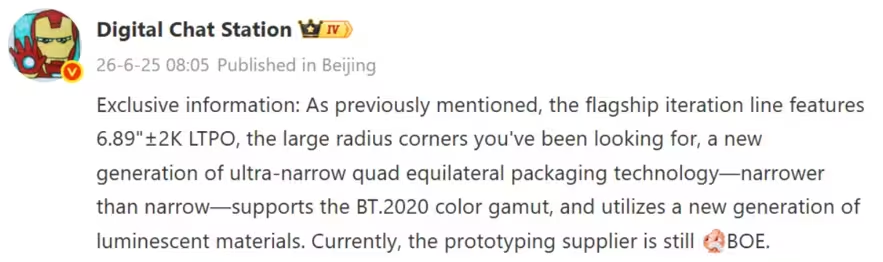
Motorola Razr Fold.
Expected Price and Launch Timeline
Motorola has not officially announced the price of the Razr Fold yet. However, leaks and industry sources suggest that the device could start at around $1,500.
More details on pricing and regional availability including for the United States are expected closer to the global launch. As of now, the launch is reportedly planned for the summer of 2026.
FAQs
Q1. What is the Motorola Razr Fold and when was it announced?
Answer. The Motorola Razr Fold is the brand’s first book-style foldable smartphone, unveiled at CES 2026.
Q2. What are the key display features of the Razr Fold?
Answer. It has an 8.1-inch LTPO foldable inner display with 2K resolution and a 6.6-inch cover display for everyday tasks.
Q3. What camera setup does the Razr Fold offer?
Answer. The phone features a triple 50MP rear camera system (Sony LYTIA primary, ultra-wide macro, periscope telephoto), plus 32MP cover and 20MP inner selfie cameras with Dolby Vision video recording.
Q4. When will the Razr Fold launch and what is the expected price?
Answer. The global launch is reportedly planned for summer 2026, with leaks suggesting a starting price of around $1,500.
Morgan Stanley predicts Apple will introduce a 200-megapixel camera in the iPhone 21 in 2028.
Apple is expanding suppliers and boosting US-based production to reduce reliance on single sources with Sony and STMicro involved in camera and LiDAR components.
Under-display Face ID is expected in 2027, while Apple maintains its current supplier (LITE) for Face ID sensors.
iPhone 17 Pro series camera module. (Image credit – Apple)
Apple is expected to introduce 200-megapixel cameras to the iPhone lineup in 2028, according to researchers at investment bank Morgan Stanley. The report suggests that Apple will rely on Samsung’s 200MP camera technology while also expanding its supplier base to reduce long-term costs and avoid dependence on a single source.
iPhone 21 Likely to Be First With 200MP Camera
While speculation around Apple’s shift to 200MP cameras has been circulating for some time, Morgan Stanley believes the upgrade will arrive later than some earlier predictions. The firm’s note to investors, seen by AppleInsider, states that the iPhone 21 will be the first Apple device to feature a 200MP camera sensor.
Previously, it was widely expected that Apple would move to 200MP cameras at some point with some reports even predicting the change could happen as early as the iPhone 18 series. Last spring, Weibo tipster Digital Chat Station claimed that Apple was already developing a 200MP version of the iPhone camera.
Supplier Diversification and US Manufacturing Plans
According to Morgan Stanley, the delayed timeline is partly linked to Apple’s efforts to diversify its supply chain rather than rely on a single supplier. The move is also believed to align with Apple’s broader goal of increasing iPhone component production in the United States.
This supports earlier reports suggesting that Samsung could manufacture CMOS image sensors for future iPhones at its facility in Austin, Texas. Those reports also indicated that Apple plans to adopt a 200MP camera in a future iPhone model, potentially because Sony has not been able to match Samsung’s sensor technology at that level.
A closer look at the iPhone 17 Pro series internal camera module. (Image credit – Apple)
Camera Suppliers and LiDAR Changes
Sony currently supplies several camera components for the iPhone and is also involved in providing LiDAR sensors. However, Morgan Stanley notes that Apple is now in discussions with STMicro as an additional supplier for LiDAR components, signalling further diversification in this area as well.
At present, Apple equips all rear iPhone cameras including Ultra Wide and Telephoto lenses with 48MPsensors. The main camera was the first to transition from 12MP to 48MP, setting the stage for future resolution upgrades.
Face ID Roadmap and Supply Chain Outlook
Despite expected changes to camera hardware, Morgan Stanley does not anticipate any major shift in the supply chain for Face ID sensors. These components are currently supplied by a single company, LITE, and the firm believes this arrangement will continue.
That said, Morgan Stanley researchers are confident that under-display Face ID technology could arrive in 2027, coinciding with the 20th anniversary of the original iPhone.
The report suggests that Apple’s strategy of expanding suppliers and adjusting component sourcing should help maintain stable supplies while keeping costs under control. As a result, Morgan Stanley expects Apple to continue absorbing rising component costs instead of passing them on to consumers.
FAQs
Q1. When will Apple introduce a 200MP camera in the iPhone?
Answer. Apple is expected to debut a 200-megapixel camera in the iPhone 21, slated for release in 2028, according to Morgan Stanley’s report.
Q2. Which suppliers will Apple rely on for the 200MP camera and other components?
Answer. Apple will primarily use Samsung’s 200MP sensor technology, while also diversifying suppliers. Sony remains involved in camera components, and Apple is in talks with STMicro for LiDAR sensors to reduce reliance on a single source.
Q3. What changes are expected in Face ID technology?
Answer. Morgan Stanley anticipates under-display Face ID arriving in 2027, coinciding with the iPhone’s 20th anniversary. However, Apple is expected to continue sourcing Face ID sensors from its current supplier, LITE.