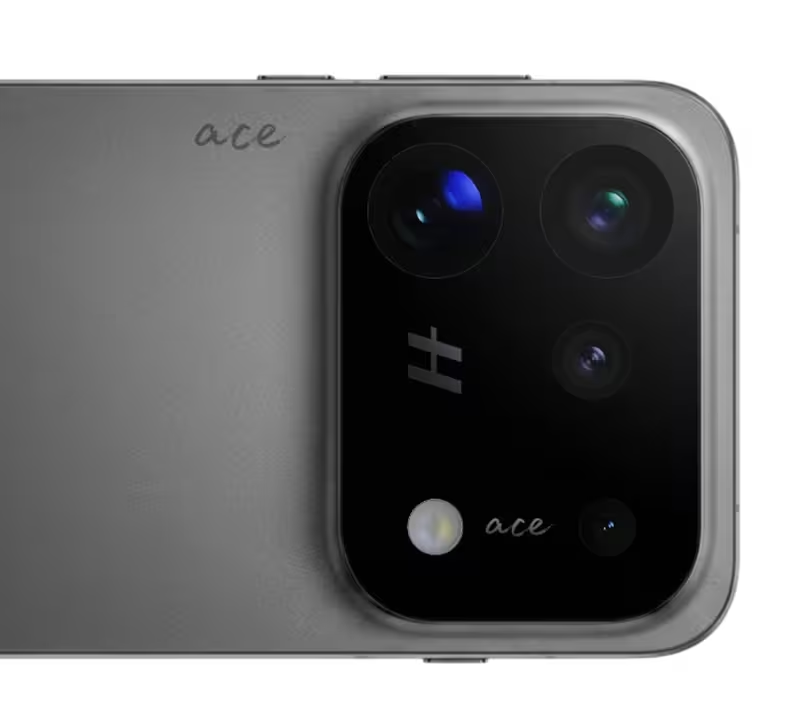
OPPO Find X10 series tipped for a global launch in late October 2026 with India debut expected before Diwali.
The lineup would globally include Find X10, Find X10 Pro and Find X10 Pro Max.
The phones are expected to feature MediaTek’s new 2nm Dimensity 9600/9500 chipsets, 200MP cameras and around 8,000mAh batteries with wireless charging.
OPPO could bring its next-gen flagship smartphones to global markets sooner than expected. The company is reportedly preparing to launch the Find X10 series globally by late October with India also said to be part of the initial rollout. Here’s what we know based on the recent leaks.
Oppo Find X10 Global Launch Timeline
According to the information shared by trusted tipster Yogesh Brar, Oppo is aiming for an October launch for its Find X10 Series smartphones. It appears the brand may leave only a short gap between the Chinese debut and the global launch.
Notably, OPPO is yet to introduce the Find X10 lineup in its home market of China.
Find X10 Series Could Arrive in India Before Diwali
The global launch of the Find X10 Series is not the only hint the tipster shared. It appears the Find X10 series could arrive in time for the Diwali shopping season for Indian buyers. The Indian lineup is expected to consist of two smartphones, the Find X10 and the higher-end Find X10 Pro Max.
Meanwhile, OPPO could offer a wider range in some international markets with the Find X10 Pro reportedly joining the other two models.
Oppo Find X10 Series – Expected Specs
(Image credit – @TechHome100 on X)
The Find X10 Pro Max is expected to be positioned as the flagship of the series and could bring some high-end hardware. Rumours suggest that the phone will have a 6.78-inch 1.5K flat screen with narrow, symmetrical bezels.
Performance could be handled by MediaTek’s upcoming 2nm Dimensity 9600 Pro chipset. The camera hardware is also expected to be a major highlight, with the phone reportedly featuring a 200-megapixel main camera. The primary sensor is said to be a Samsung unit based on the company’s HPC hardware.
The Find X10 Pro, on the other hand, could share the same 6.78-inch screen size but is expected to use a 1.5K LTPO panel. The display may support the wider BT.2020 colour gamut, potentially giving it a broader colour range.
As for the standard Find X10, it is expected to sit below the Pro models but could still offer flagship-level hardware. It is reportedly being developed with the Dimensity 9500 Plus chipset. Camera performance could remain a key part of the phone’s appeal. The Find X10 may feature a 200-megapixel primary camera, although its main sensor is expected to be smaller than the one on the Pro Max, measuring 1/1.4-inch.
The phone could also include a 3x periscope telephoto camera. This would give users a dedicated option for capturing distant subjects and could improve zoom photography compared with a standard telephoto setup.
OPPO may also make battery capacity one of the biggest upgrades across the Find X10 family. Reports suggest that all models could feature batteries with capacities around 8,000mAh. The company is also expected to bring back wireless charging.
POCO F9 Pro and F9 Ultra launch September 1 with Snapdragon 8 Elite Gen 5 chipsets.
Both models feature 185Hz LTPS displays with support for 185FPS gaming across 20+ titles, enhanced by POCO’s WildBoost Engine for responsiveness.
Audio tuned by Bose; F9 Ultra adds a 2.1-channel system with built-in subwoofer.
POCO has revealed more details about its upcoming F9 series smartphones ahead of the official launch. The POCO F9 Pro and POCO F9 Ultra are both performance-focused flagship smartphones improved gaming capabilities, high refresh rate displays and upgraded audio experience.
The POCO F9 series is set to launch on September 1, when the company is also expected to announce the pricing and availability details for the markets where the phones will be introduced. Here’s what we know about the phones.
Snapdragon 8 Elite Gen 5 Chipsets Confirmed
POCO has confirmed that the F9 Ultra will be powered by the Snapdragon 8 Elite Gen 5, Qualcomm’s latest flagship chipset. The POCO F9 Pro will use the Snapdragon 8 Elite Gen 5 V Series chipset.
The F9 Ultra has reportedly crossed 4.16 million points on AnTuTu, highlighting the performance focus of the upcoming smartphone. POCO is also promoting the series with its new WildBoost Engine, which is designed to enhance gaming performance.
185FPS Gaming and 185Hz Display
Gaming is one of the major areas of focus for the POCO F9 series. The company claims the phones can deliver industry-leading 185FPS gaming, with more than 20 game titles supporting native 185FPS.
The smartphones will feature a 185Hz ultra-high refresh rate LTPS display. POCO is also highlighting a 4,800Hz instantaneous TSR, which should help improve responsiveness during gaming.
With the combination of powerful Snapdragon chipsets, a high-refresh-rate display and the new WildBoost Engine, the F9 series is expected to target users who want high performance during demanding games and other intensive tasks.
Bose-Tuned Audio and Built-in Subwoofer
POCO has also revealed an upgraded audio setup for the F9 series. Both smartphones will feature sound tuned in collaboration with Bose with the company specifically highlighting the gaming audio experience.
The POCO F9 Ultra will go a step further with a 2.1-channel audio system and a built-in subwoofer. The dedicated subwoofer appears to be positioned on the rear of the phone and is expected to deliver a more immersive audio experience while gaming or watching movies.
What Else We Know So Far?
POCO has also revealed the colour options for the two upcoming smartphones. The POCO F9 Pro will be available in an Aurora Green finish, while the more premium POCO F9 Ultra will come in a Dark Cherry shade.
Despite being marketed primarily around performance and gaming, the POCO F9 Pro and F9 Ultra are not expected to compromise on their camera systems. Both smartphones will feature triple rear camera setups. The camera systems will also include telephoto lenses, allowing users to capture distant subjects and take portraits with optical zoom capabilities.
POCO is calling the upcoming models “All-round performance flagships”, suggesting that the company wants the F9 Pro and F9 Ultra to handle more than just gaming. The phones are expected to offer strong performance for other demanding and high-intensity tasks as well.
While POCO has not yet revealed the complete details of its cooling system, the phones are expected to feature adequate thermal management to keep temperatures under control during extended periods of heavy use.
More details including the pricing and availability of the POCO F9 Pro and F9 Ultra will be revealed at the September 1 launch event.
The Vivo T5 5G, Poco X8 series and Infinix HOT 70 Pro 5G are set to arrive early in the month, followed by Apple’s iPhone 18 Pro, iPhone 18 Pro Max and the first foldable iPhone.
Samsung will then bring the Galaxy S26 FE to sale in India later in the month
Mivi and OPPO could also announce their new smartphones during September.
September 2026 is shaping up to be a busy month for the smartphone market in India. Several new phones are set to launch or go on sale during the month with brands such as Vivo, Poco, Infinix, Apple and Samsung preparing to unveil new devices.
The upcoming phones include options across different price segments. Some models bring large batteries and fast charging, while others are expected to focus on cameras, performance and premium designs. Apple is also expected to introduce its first foldable iPhone alongside the iPhone 18 Pro and iPhone 18 Pro Max. Here are the upcoming phones in September 2026 and everything we know about them so far.
Vivo T5 5G – Launch on September 2
The Vivo T5 5G is scheduled to launch in India on September 2. The smartphone will be powered by the MediaTek Dimensity 7500 Turbo chipset. Vivo claims that the chipset can achieve an AnTuTu score of 1.2 million points and deliver on-device AI performance of 10 tokens per second when running a 3-billion-parameter model.
The Vivo T5 5G will pack a large 7,050mAh battery and it will also feature a 1.5K-resolution 3D curved AMOLED display with a 144Hz refresh rate and up to 2,000 nits of peak brightness. On the software side, the Vivo T5 5G will run Android 16 with OriginOS 6.
Vivo has already revealed the phone’s design and and it looks quite similar to the Vivo S2 5G and follows a premium design approach. It will be available in Silver Green and Royal Bronze finishes. The phone is expected to be priced between Rs 40,000 and Rs 50,000.
Poco X8 Power 5G – Launch on September 4
Poco has confirmed that the Poco X8 Power 5G will launch in India on September 4 at 12:00 pm IST. Poco India announced the launch date through an X post on Friday. The smartphone will be sold in India via Flipkart and dedicated product pages for the upcoming models are already live on the e-commerce platform.
One of the biggest highlights of the Poco X8 Power 5G will be its massive 10,000mAh battery. Poco claims that it can provide up to 3.5 days of playback on a single charge. The battery will support 100W wired charging as well as 27W wired reverse charging.
The phone has been teased in a yellow finish with a black squircle-shaped camera module on the back. The camera island appears to feature two camera sensors.
The Poco X8 Power 5G is expected to feature a 6.83-inch 1.5K AMOLED display with a 120Hz refresh rate. It is also rumoured to use the Snapdragon 6 Gen 5 chipset paired with LPDDR5X RAM and UFS 4.0 storage.
For photography, the phone is said to feature a 50-megapixel primary rear camera with OIS, an 8-megapixel ultrawide camera and a 32-megapixel front camera.
Poco X8 5G – Launch on September 4
The Poco X8 5G will also launch in India on September 4 at 12:00 pm IST, alongside the Poco X8 Power 5G.
The standard Poco X8 5G is teased to come with a 9,000mAh battery. The company claims that the phone can deliver up to 3.2 days of battery life on a single charge. It will support 67W charging and 22.5W reverse charging.
Poco’s official teaser video has shown the X8 5G in orange and white colour options. The phone will feature a vertically positioned dual-camera setup on the rear.
The Poco X8 5G is rumoured to be powered by the Snapdragon 6s Gen 4 chipset. It could feature a 6.83-inch AMOLED display with up to 3,500 nits of brightness. For cameras, the rear setup may include a 50-megapixel primary sensor, while the front camera could be a 16-megapixel unit.
Both the Poco X8 Power 5G and Poco X8 5G are expected to offer IP66, IP68, IP69 and IP69K ratings for protection against dust and water. Poco may also offer four Android OS updates and six years of security updates for both smartphones.
Infinix HOT 70 Pro 5G – Launch on September 4
The Infinix HOT 70 Pro 5G is set to launch in India on September 4. It will be sold through Flipkart and the Infinix India online store with pre-orders also starting on the same day. Infinix is expected to reveal the official pricing for all variants during the launch event.
One of the phone’s key design features is the Interactive Active Matrix Cube (AMC), which is integrated into the rear camera module area. This mini dot-matrix display on the back can provide visual alerts for incoming calls, app notifications, charging, gaming and music playback.
The phone uses Infinix’s Dynamic Shine Design and has a slim 7.85mm profile. It will be offered in several finishes with each colour having a different effect. The Thermo Orange variant uses a temperature-sensitive finish that changes colour depending on heat. Mirage Green combines colour-shifting effects with a glow-in-the-dark finish, while Silk Glow Purple uses a light-reactive texture that changes with movement. The Dive Blue version comes with a standard anti-glare matte finish.
The Infinix HOT 70 Pro 5G will feature a 6.76-inch Full HD+ display with an adaptive 144Hz refresh rate. It will be powered by the 6nm MediaTek Dimensity 7100 5G chipset and will be available with up to 8GB of RAM and up to 256GB of internal storage.
For photography, the phone will have a 50-megapixel Sony IMX882 primary camera with support for 2x in-sensor lossless zoom. It will also come with AI-powered photography tools such as AI Eraser, AI Background adjustments and AI Sharpness optimisation.
The phone will pack a 6,000mAh battery with support for 45W wired fast charging. It will also have IP68 water and dust resistance and MIL-STD durability compliance.
iPhone 18 Pro – Launch on September 9
Apple is expected to launch the iPhone 18 Pro on September 9. The upcoming Pro model is tipped to feature a 6.3-inch OLED display with slimmer bezels. It is also expected to have a smaller Dynamic Island, which could be around 35 percent smaller than the current design.
The iPhone 18 Pro is expected to be powered by Apple’s A20 Pro chipset, which is reportedly based on a 2nm process. The chip could deliver around 15 to 18 percent higher performance while being approximately 30 percent more power efficient.
The phone is expected to feature 12GB of RAM with storage options going up to 1TB. For cameras, it could get a triple 48-megapixel rear camera setup with a variable-aperture primary sensor. An 18-megapixel front camera is also expected.
The iPhone 18 Pro could feature a slightly larger battery of around 5,100mAh and support MagSafe as well as USB-C fast charging.
The expected colour options include Dark Cherry, Light Blue, Dark Gray and Silver. In India, the iPhone 18 Pro is expected to be priced between Rs 1,39,900 and Rs 1,44,900.
iPhone 18 Pro Max – Launch on September 9
The iPhone 18 Pro Max is also expected to arrive on September 9 alongside the iPhone 18 Pro. It is tipped to feature a larger 6.9-inch OLED display and the same smaller Dynamic Island design. The phone is also expected to use a titanium frame.
Under the hood, the iPhone 18 Pro Max will reportedly use the same 2nm A20 Pro chipset, although the hardware could be optimised for the larger device. It is expected to come with 12GB of RAM and storage options of up to 2TB.
The camera system could receive improvements including enhanced optical zoom and a stacked sensor designed to improve dynamic range.
The larger iPhone could also benefit from a bigger battery. It is tipped to feature a battery of around 5,567mAh, compared with the 5,088mAh battery on its predecessor. This could result in longer battery life.
The iPhone 18 Pro Max could be priced between Rs 1,54,900 and Rs 1,64,900 in India.
Apple iPhone Ultra (iPhone Fold) – Launch on September 9
Apple is expected to enter the foldable smartphone market with the iPhone Ultra, also referred to as the iPhone Fold. The device is tipped to use a passport-style foldable design that remains relatively compact when closed.
The foldable iPhone could feature a 5.5-inch cover display and a larger 7.8-inch inner screen. The internal display is expected to have an almost crease-free appearance, reportedly helped by a Liquid Metal hinge.
At just 4.5mm when unfolded and around 9 to 9.5mm when folded, the device could become the thinnest iPhone ever made. It is expected to use a combination of titanium and aluminium for its construction and could weigh around 229 to 240 grams.
For cameras, the foldable iPhone is tipped to feature two 48-megapixel rear cameras without a dedicated telephoto lens. It could also have two 24-megapixel front cameras with one camera placed on each display.
The iPhone Ultra is expected to run on the 2nm Apple A20 chipset and could come with 12GB of RAM. It may use a roughly 4,883mAh two-cell battery and Apple’s C2 modem for advanced connectivity.
Apple is also reportedly considering Touch ID instead of Face ID for the foldable, which could make more sense for its unusual form factor.
Samsung Galaxy S26 FE – Sale in India From September 18
The Samsung Galaxy S26 FE is scheduled to go on sale in India on September 18.
The phone will feature a 6.7-inch Full HD+ Dynamic AMOLED 2X display with a 120Hz refresh rate and up to 1,900 nits of peak brightness. It will also carry an IP68 rating for dust and water resistance. Powering the Galaxy S26 FE will be the Exynos 2500 SoC, which is built using a 3nm process. The phone will come with 8GB of RAM and up to 512GB of internal storage.
On the camera front, the Galaxy S26 FE will feature a triple rear camera setup. This includes a 50-megapixel f/1.8 primary camera with OIS, a 12-megapixel f/2.2 ultrawide camera with a 123-degree field of view and an 8-megapixel f/2.4 telephoto camera. The telephoto camera will offer up to 3x optical zoom, up to 30x digital zoom and OIS.
For selfies and video calls, the phone will have a 12-megapixel f/2.2 front camera with an 85-degree field of view.
The Galaxy S26 FE will pack a 4,900mAh battery with support for 45W wired fast charging and 15W wireless charging.
Samsung has not yet announced the India price of the Galaxy S26 FE.
Mivi One 5G – Launch Date Yet to Be Announced
Mivi is preparing to make its entry into India’s smartphone market with its first phone. The upcoming Mivi One 5G has appeared on Geekbench, revealing some of its key specifications.
The Geekbench listing identifies the device as the Mivi MVNOE. It is shown running Android 16 and comes with Qualcomm’s Snapdragon 4 Gen 2 chipset and 6GB of RAM. It includes two cores clocked at 2.21GHz and six cores running at 1.96GHz. On Geekbench 7, the phone scored 677 points in the single-core test and 1,490 points in the multi-core test.
Earlier exclusive report that Mivi’s first smartphone could be priced below Rs 15,000. Mivi has already appeared on Flipkart through a promotional poster. The image shows the phone in a green colour option with a flat rear panel and rounded corners.
OPPO F35 – September Launch Likely
The OPPO F35 was previously expected to launch in India by the end of August. However, the latest information points towards a possible September launch. The series is expected to be led by the OPPO F35 Pro, which could be priced between Rs 40,000 and Rs 45,000 in India.
The OPPO F35 Pro is reportedly a rebadged version of the China-exclusive OPPO A7 Pro Max. The phone is tipped to feature a 6.78-inch 1.5K LTPS OLED flat display with a 120Hz refresh rate. It could be powered by Qualcomm’s Snapdragon 4 Gen 5 chipset and paired with UFS 3.1 storage.
For cameras, the phone may feature a 50-megapixel primary rear sensor paired with a 2-megapixel secondary camera. On the front, it could have a 50-megapixel Samsung JN5 autofocus camera with a 100-degree field of view for selfies and video calls.
The OPPO F35 Pro is also expected to offer IP66, IP68 and IP69K ratings for dust and water resistance. Another major highlight could be its 10,000mAh battery, which would potentially make it OPPO’s largest battery-capacity smartphone launched in India so far.
The phone could measure 8.57mm in thickness. Its leaked specifications closely resemble those of the China-exclusive OPPO A7 Pro Max, which has added further weight to the rebadging reports.
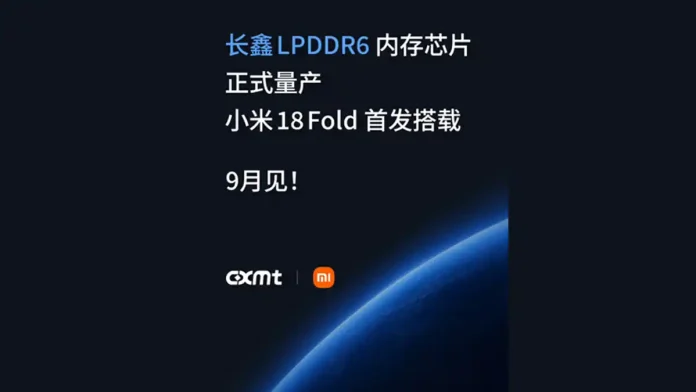
Xiaomi 18 Fold will be the world’s first smartphone to feature CXMT’s new LPDDR6 memory supported by Xiaomi’s XRING O3 chipset.
CXMT’s LPDDR6 delivers up to 12,800Mbps transfer speeds and 16GB per chip capacity.
Xiaomi 18 Fold is expected to launch in China in September.
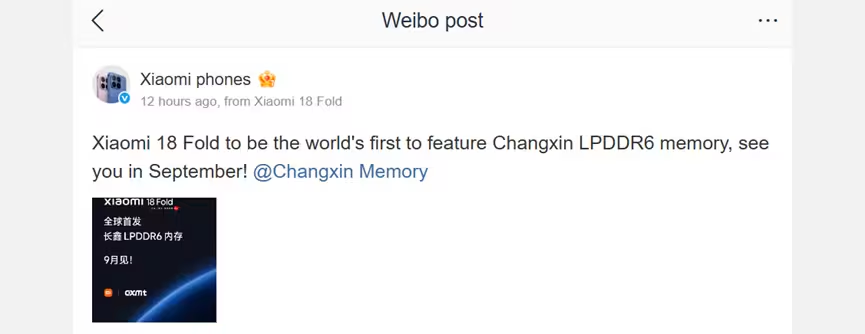
Xiaomi is expected to launch its next-gen foldable smartphone, the Xiaomi 18 Fold, in September alongside its new SkyNomad SUV. Ahead of the launch, the brand has now confirmed that the upcoming foldable will be the world’s first phone to come with CXMT’s new LPDDR6 memory technology. Here’s what we know about this tech far.
Xiaomi 18 Fold To Debut CXMT LPDDR6 Memory
Lei Jun’s official post on Weibo. (Translated via Google Translate)
Xiaomi Founder, Chairman and CEO, Lei Jun has congratulated CXMT on Weibo for achieving mass production of LPDDR6 memory. Describing the development as “remarkable”, Lei Jun revealed that Xiaomi’s XRING O3 is the first chipset in the industry to support the new LPDDR6 memory standard with the Xiaomi 18 Fold becoming the first smartphone to use it.
Xiaomi’s official post on Weibo. (Translated via Google Translate)
Lei Jun also said that more Chinese technology companies will collaborate on similar projects in the future.
Xiaomi introduced the XRING O3 chipset recently as the industry’s first chip designed to support LPDDR6 memory.
Xiaomi has yet to disclose the complete specifications of the Xiaomi 18 Fold. However, more details about its design, hardware and features are expected to emerge soon as the foldable smartphone is officially confirmed for a September launch.
CXMT’s LPDDR6 Memory – What to Expect?
As per IT Home’s recent report, CXMT has provided details about its latest memory technology in its 2026semi-annual report. CXMT has now become an early memory supplier for the first LPDDR6-powered smartphone
The company describes LPDDR6 as a significant step up from its previous-generation LPDDR5X memory that brings improvements to both the memory architecture and data transfer system. CXMT’s LPDDR6 memory can offer transfer speeds of up to 12,800Mbps and supports capacities of up to 16GB per memory chip.
It is expected to help smartphones handle multiple applications more smoothly, launch apps quicker and process demanding AI-related tasks more efficiently. For CXMT, the development also represents an important milestone in its efforts to compete with established memory manufacturers such as Samsung and SK Hynix.
The company has already supplied samples to key customers for testing and is currently focused on expanding its mass-production capabilities.
Poco X8 5G and Poco X8 Power 5G will launch in India on September 4 via Flipkart.
X8 5G will offer 9,000mAh battery, while X8 Power 5G packs 10,000mAh battery.
The phones are expected to feature 6.83-inch AMOLED displays, 50MP cameras, IP66–IP69K durability, 4 OS updates and 6 years of security updates.
Poco is bringing its next-generation X-series smartphones to India. The company has confirmed the India launch date for Poco X8 5G and Poco X8 Power 5G on its official X account and has also released teaser videos revealing key details.
Poco X8 5G and Poco X8 Power 5G India Launch Date and Battery
Poco India has confirmed that the Poco X8 5G and Poco X8 Power 5G will launch in India on September 4 at 12:00 pm IST. Both smartphones will be sold through Flipkart and dedicated product microsites for the two models are already live on the e-commerce platform.
Make the plans.
Take the detours.
Live it up!
The POCO X8 5G has 9000mAh battery and 3.2 days of power to keep up.
The standard Poco X8 5G will pack a 9,000mAh battery, which the company claims can provide up to 3.2 days of battery life on a single charge. It will support 67W fast charging and 22.5W reverse charging.
The Poco X8 Power 5G will take the battery capacity even further with a 10,000mAh battery. Poco claims that it can offer up to 3.5 days of playback time. The phone will support 100W wired charging as well as 27W wired reverse charging.
Both models will feature bypass charging, PPS charging and smart charging. Poco has also confirmed a six-year battery life rating for the two smartphones.
Poco X8 and X8 Power Design Teased
Poco X8 design revealed. (Image credit – Poco)
Poco’s official teaser videos have provided a first look at the designs of the upcoming phones. The Poco X8 5G is shown in orange and white colour options and features a vertically positioned dual rear camera setup.
Poco X8 Power design revealed. (Image credit – Poco)
The Poco X8 Power 5G, meanwhile, appears in a yellow finish with a black, squircle-shaped camera module on the rear. The camera island appears to house two camera sensors.
Poco X8 5G, Poco X8 Power 5G – Expected Specifications
Poco X8 Series teasers. (Image credit – Poco)
The Poco X8 Power 5G and Poco X8 5G are expected to be positioned below the Poco X8 Pro in the Indian lineup.
According to current rumours, the Poco X8 Power 5G could feature a 6.83-inch 1.5K AMOLED display with a 120Hz refresh rate. It is expected to be powered by the Snapdragon 6 Gen 5 chipset paired with LPDDR5X RAM and UFS 4.0 storage.
X8 Power 5G is rumoured to feature a 50-megapixel primary rear camera with OIS along with an 8-megapixel ultrawide camera. For selfies and video calls, it could have a 32-megapixel front camera.
Poco X8 Series teasers. (Image credit – Poco)
The standard Poco X8 5G is expected to use the Snapdragon 6s Gen 4 chipset. It could feature a 6.83-inch AMOLED display with up to 3,500 nits of brightness. On the camera front, the phone is rumoured to have a 50-megapixel primary rear camera and a 16-megapixel front-facing camera.
Both smartphones are expected to offer a highly durable build with IP66, IP68, IP69 and IP69K ratings for protection against dust and water. Poco may also provide four Android OS updates and six years of security updates for the Poco X8 5G and Poco X8 Power 5G.
Vivo T5 5G launches in India on Sept 2 via Flipkart with an expected price between Rs 40,000 and Rs 50,000.
Confirmed specs include Dimensity 7500 Turbo chipset, 1.5K 144Hz curved AMOLED display with 2,000 nits brightness and slim 7.9mm body despite large battery.
Other features are a 7,050mAh battery and OriginOS 6 (Android 16).
Vivo has already announced the launch date of the Vivo T5 5G and is now revealing some of its key specifications. The upcoming phone is being positioned as a slim mid-range 5G smartphone with a high-refresh-rate curved display and a large battery. Here’s what we know based on recent teasers.
Vivo T5 5G India Launch Date and Price
Vivo has confirmed that the T5 5G will launch in India on September 2, 2026 through Flipkart. The smartphone will be available in two colour options named Royal Bronze and Silver Green.
While Vivo has not announced the price yet, the phone is expected to be positioned in the Rs 40,000 to Rs 50,000 price segment.
Vivo T5 5G Specifications (Confirmed)
Vivo T5 5G teasers. (Image credit – Vivo)
Latest teasers confirm that the Vivo T5 5G will be powered by the MediaTek Dimensity 7500 Turbo chipset. Vivo claims that the smartphone has achieved an AnTuTu score of 1.2 million points. The company has also highlighted its on-device AI capabilities, claiming performance of 10 tokens per second on a 3-billion-parameter model.
Vivo T5 5G teasers. (Image credit – Vivo)
The phone’s display is another major highlight. It will feature a 1.5K 3D curved AMOLED panel with a 144Hz refresh rate and up to 2,000 nits peak brightness. Despite carrying a large battery, the smartphone is expected to have a body measuring around 7.9mm in thickness. Vivo is promoting it as one of the slimmest smartphones in its segment to feature a battery larger than 7,000mAh.
The front panel will have a punch-hole cutout for the selfie camera.
Powering the smartphone will be a 7,050mAh battery, making battery capacity one of the key selling points of the T5 5G. However, Vivo has not yet revealed its charging speed or claimed battery life.
On the rear, the Vivo T5 5G will use a Skyline design similar to the Vivo S2. Teaser images also confirm a dual-camera setup, although the detailed camera specifications have not been revealed yet.
The smartphone will run OriginOS 6 based on Android 16 out of the box. Vivo has not yet announced the available RAM and storage configurations.
With the launch only a few days away, Vivo is expected to reveal more information soon, particularly details about the camera hardware, battery life and charging speed.
Redmi 17 5G confirmed to launch in India on September 3 via Amazon, mi.com and retail stores.
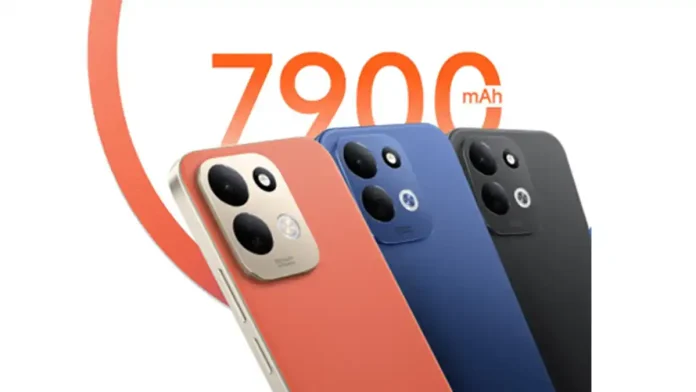
It will be India’s first phone with the Snapdragon 4 Gen 5 chipset and feature dual rear cameras with 50MP main sensor, a 7,900mAh battery with 22.5W reverse wired charging.
Pricing and memory variants to be revealed at launch.
Xiaomi has officially confirmed the India launch date of the Redmi 17 5G. The India-bound version is based on the global Redmi 17 that was recently introduced in Malaysia with a vegan leather finish. It is worth noting that the Redmi 17 sold in China is a separate model with different specs. The smartphone coming to India will arrive next month with a large 7,900mAh battery and a new Snapdragon chipset. Here’s everything we know about the launch and the phone.
Redmi 17 5G India Launch Date (Confirmed)
According to the official teasers, the Redmi 17 5G will launch in India on September 3.
Xiaomi has confirmed that the smartphone will be available through Amazon, mi.com and offline retail stores. The company has not revealed the Indian price or storage and RAM configurations yet and these details are expected to be announced during the launch.
There are currently no reliable leaks regarding the Redmi 17 5G’s India pricing.
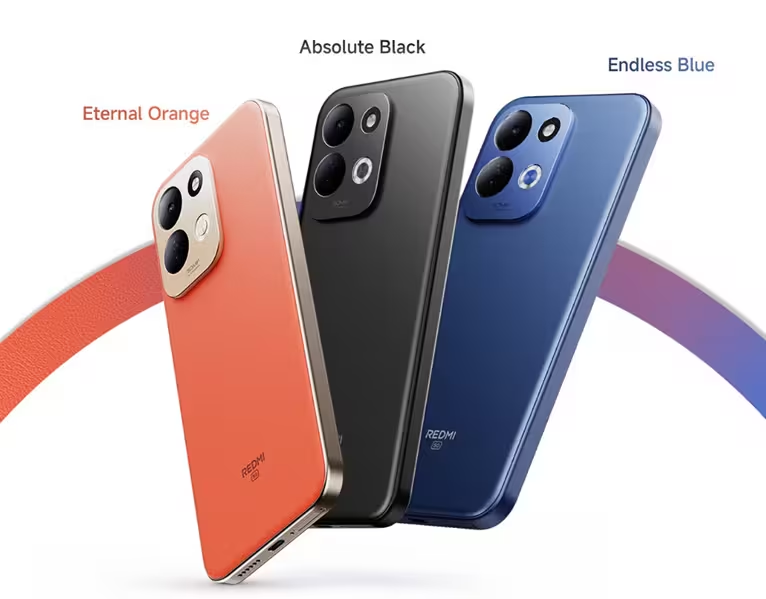
To start with, the design shown in Xiaomi’s teasers includes a textured vegan leather-style rear panel and a contrasting camera island with rounded corners. The Redmi 17 5G will be offered in three colour options named Eternal Orange, Endless Blue and Absolute Black.
Xiaomi has officially confirmed that the Redmi 17 5G will become India’s first smartphone powered by the Snapdragon 4 Gen 5 chipset. Launched a couple of months ago, this Qualcomm chipset is designed specifically for affordable 5G smartphones.
Xiaomi has also confirmed a dual-camera setup on the rear through its teasers. While the complete camera specifications are yet to be revealed, the main sensor is expected to be a 50-megapixel unit. At the front, the phone will feature a centrally placed punch-hole cutout for the selfie camera.
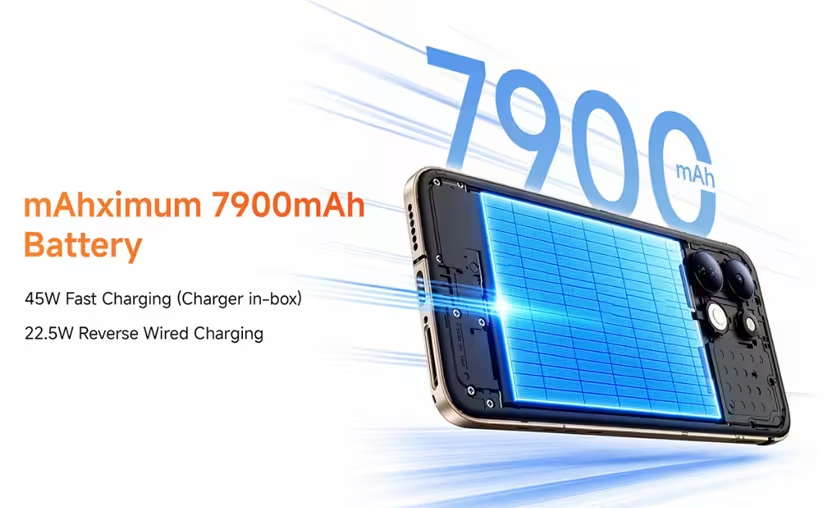
The biggest highlight of the Redmi 17 5G is its 7,900mAh battery, which is 900mAh larger than the battery on its predecessor. The phone will also support 22.5W reverse wired charging, allowing users to charge compatible accessories and other devices using the smartphone.
However, Xiaomi has not yet revealed the standard wired charging speed for the Indian version.
We can expect more details including complete specifications, memory variants and pricing details to emerge in the coming days.
Oppo unveils ProXDR camera tech with DeepPix HDR sensor, delivering up to 17EV dynamic range.
It supports 4K HDR video with lower power use and automatic HDR activation across shooting conditions.
The company is also redesigning the camera app to debut alongside ProXDR in the Oppo Find X10 series, launching in September.
Oppo is working on a new smartphone camera technology that could significantly improve the way high-dynamic-range content is captured and displayed. It has now confirmed details of its new ProXDR technology, which focuses on expanding dynamic range while improving camera performance.
The details of the new tech were officially shared by Oppo Chief Product Officer and OnePlus founder Liu Zuohu. It offers an early look at the imaging technology that could feature on the company’s upcoming flagship smartphones. Here’s more on the latest update.
Oppo ProXDR Could Offer Up to 17EV Dynamic Range
Oppo’s ProXDR Camera Tech teaser. (Image credit – Vivo)
The ProXDR technology by Oppo combines real-time high-dynamic-range processing with high-resolution imaging. The technology is built around DeepPix, which Oppo describes as a new high-dynamic-range sensor technology.
The company has also upgraded the entire imaging pipeline, covering everything from capturing light and processing images to displaying the final result.
According to Oppo, the new system can deliver a single-frame dynamic range of up to 17EV. This wider dynamic range should allow the camera to preserve more details in both bright highlights and darker areas of a scene.
The company is also focusing on producing images that look closer to real-world scenes especially in situations where there is a significant difference between bright and dark areas. Along with retaining more detail in highlights and shadows, ProXDR is designed to provide smoother and more natural lighting transitions as well as accurate colour reproduction.
ProXDR to Support 4K HDR Video
Oppo’s ProXDR technology will also support full-size 4K HDR video capture. The company says the system has been designed to consume less power while also offering better stability during longer recording sessions.
Another key feature is that users will not have to manually enable a separate setting or switch to a dedicated shooting mode to use the high-dynamic-range processing. Oppo says ProXDR is designed to remain active automatically across different shooting conditions.
This approach could make HDR capture more convenient while allowing the camera to adapt to changing lighting conditions without requiring users to adjust settings themselves.
Oppo Is Also Redesigning Its Camera App
Liu Zuohu has also revealed that the company is redesigning its native camera application. The new app will build on developments from previous generations while introducing changes to the way the camera system captures and presents images.
The new camera technology is expected to make its debut with the Oppo Find X10 series, which is scheduled to launch in September.
Vivo X500 Pro Max confirmed to feature a 6.85-inch BOE Q11 2K Zeiss Master Color display, first of its kind globally.
Display improvements: 93% less motion blur, 43% better color uniformity, 22% better brightness uniformity, 21% lower power use, doubled lifespan.
It is equipped with an under-display multispectral sensor offering 98% light detection accuracy and 0.3-lux brightness precision.
It appears the upcoming Vivo X500 Pro Max will bring some major display upgrades as the company confirms details. Vivo Product Manager Han Boxiao on Weibo has been shared information about the upcoming Vivo X500 series and revealed details about the display that will be used on the Vivo X500 Pro Max.
The new screen is designed to improve visual quality while also reducing some of the common drawbacks including higher power consumption and panel longevity concerns. Here’s what we know based on recent reveals.
Vivo X500 Pro Max to Feature 6.85-inch 2K Display
The Vivo X500 Pro Max will reportedly be the first smartphone in the world to feature a 6.85-inch BOE Q11 2K Zeiss Master Color display. The panel will support 2K resolution with the higher pixel density expected to deliver sharper and more detailed visuals even with the larger screen size.
Vivo X500 Pro Max display teaser. (Image credit – Vivo)
The Q11 display uses upgraded light-emitting materials from BOE along with platform-level improvements. Vivo claims that these changes have reduced motion blur during scrolling by 93% compared with the previous generation. The panel also uses hardware-level Demura processing along with Vivo’s pixel-level compensation algorithms.
According to the company, this improves colour uniformity by 43% and brightness uniformity by 22%, helping provide more consistent colours and brightness across the display.
The new panel is also designed to address the power consumption and durability trade-offs usually associated with 2K displays. Vivo says the X500 Pro Max’s screen consumes 21% less power than the previous-generation 1.5K display, while its lifespan has been doubled. This suggests that users may get the benefits of a higher resolution without a major compromise in power efficiency or display durability.
Vivo has also equipped the X500 Pro Max display with an under-display high-precision multispectral sensor for brightness adjustment. The sensor can identify visible light across different spectrums and colour temperatures. Vivo claims that its detection accuracy reaches a 98% match with the light visible to the human eye.
This allows the smartphone to adjust more naturally as surrounding lighting conditions change. The sensor is paired with 0.3-lux screen brightness adjustment precision, which Vivo describes as the best in the Android segment.
Launch Timeline
The Vivo X500 series is scheduled to launch in China in September.
The company is expected to share more details about the Vivo X500 Pro Max next week. It is also likely to reveal information about OriginOS 7 along with the standard Vivo X500 and X500 Pro models.
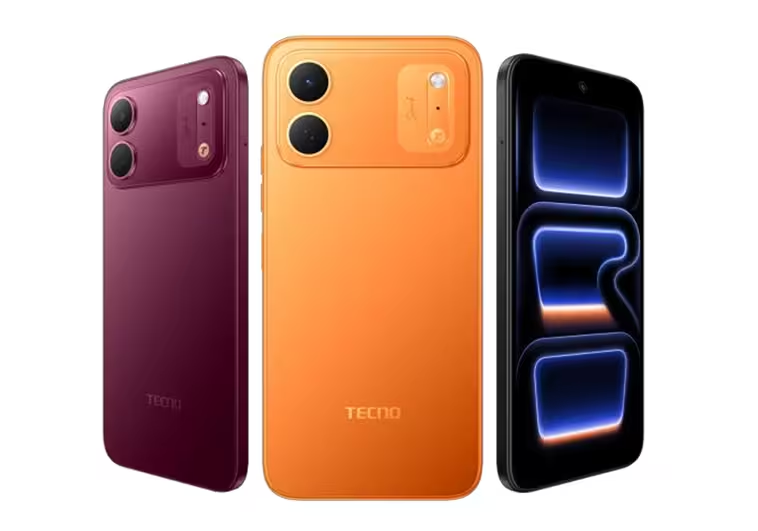
Tecno Spark Go 3 Pro launched in India at Rs 15,999 in four colour options.
The phone will be available for purchase starting September 4 via Amazon and Flipkart.
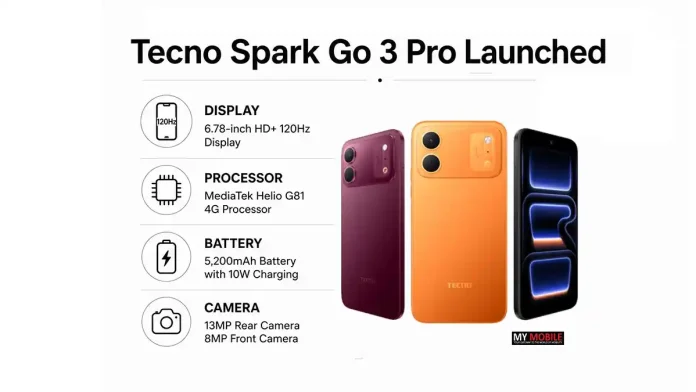
Key specs – Helio G81 chipset, 6.78-inch HD+ 120Hz display, up to 12GB RAM, 64GB/128GB storage, IP68/IP69 durability, 13MP rear and 8MP front cameras and 5,200mAh battery with 10W charging with 4G-only connectivity.
Tecno Spark Go 3 Pro launched in India. (Image credit – Tecno)
Tecno has launched the new Spark Go 3 Pro in India, adding another option to its smartphone lineup. The new smartphone comes with a MediaTek Helio G81 4G chipset, a 120Hz display, up to 12GB of RAM with memory expansion, and an IP68 and IP69 rating for added protection against water and dust. Here’s everything you need to know about the upcoming smartphone.
Sabka mind ab hoga blow. Aa gaya hai naya #SparkGo3Pro 😎
Desh Jaise Dumdaar features ke saath:
💪 Segment’s First IP68 & IP69 Rated Phone*
🏋️ Drop Resistant* Upto 1.5m**
🎙️ AI Voiceprint Noise Cancellation
✅ Upto 12GB*** RAM
🔊 Dual DTS Speakers
⚡ 5200mAh Battery & Supports… pic.twitter.com/5lqTSfPHI7
The Tecno Spark Go 3 Pro price starts at Rs 15,999 in India. The sale will begin on September 4 at 12 noon through Amazon and Flipkart.
The smartphone is offered in four colour options named Burgundy Red, Sunrise Orange, Eclipse Black and Mist Silver.
Tecno Spark Go 3 Pro – Key Features
The Tecno Spark Go 3 Pro features a 6.78-inch (17.22cm) IPS LCD with a 20:9 aspect ratio. The display has an HD+ resolution of 720 × 1526 pixels, 260 PPI pixel density and a 120Hz refresh rate. It also supports a 240Hz touch sampling rate for faster touch response. The screen can reach up to 580 nits of brightness in HBM mode.
The phone measures 168.32mm in height, 79.22mm in width and 8.04mm in thickness, while weighing 194 grams.
The smartphone is powered by the MediaTek Helio G81 4G processor, which is based on a 12nm process. It features an octa-core CPU clocked at up to 2.0GHz paired with a Mali-G52 MC2 GPU running at 820MHz.
The Tecno Spark Go 3 Pro comes with 12GB RAM comprising 4GB physical RAM and 8GB extended RAM with LPDDR4X memory. Storage options include 64GB and 128GB, using UFS 2.2 storage. The storage can also be expanded.
It has a 13-megapixel rear camera with an f/1.8 aperture, a 77-degree field of view and autofocus. It also gets a rear flash. On the front, the smartphone features an 8-megapixel camera with an f/2.0 aperture and a 77.5-degree field of view. The selfie camera has fixed focus and is supported by a screen flash.
The Tecno Spark Go 3 Pro is equipped with a 5,200mAh Li-ion Polymer battery. The battery is non-removable and the phone comes with a 10W charger for charging.
The Tecno Spark Go 3 Pro is a 4G smartphone and does not support 5G. For added durability, the phone comes with IP68 and IP69 ratings along with SGS protection.
Connectivity features include Wi-Fi, Bluetooth, GPS and OTG support. The phone also has an infrared sensor and a side-mounted fingerprint sensor. Other sensors include an ambient light sensor, accelerometer and e-compass. There is no NFC or hardware gyroscope.