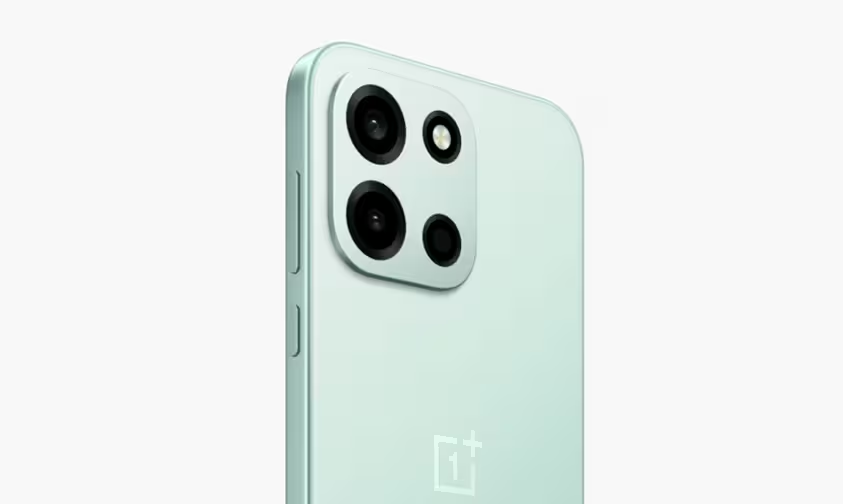
Ai+ Pulse 2 debuts in India at ₹5,999 for the base 4GB + 64GB variant.
The sales will start on March 11 via Flipkart.
Key Features – 6.745-inch HD+ 120Hz display, Unisoc T7250 processor, 50MP dual AI rear camera, 8MP selfie camera, 6,000mAh battery supporting 18W fast charging and runs Android 16 with NxtQuantum OS.
Ai+ Pulse 2 has been officially launched in India. (Image credit – Ai+)
Ai+ has expanded its budget smartphone lineup in India with the launch of the Ai+ Pulse 2. Successor to AI+ Pulse, the new device introduces key upgrades focused on battery life, display smoothness, updated software, and camera improvements. The phone retains an affordable price tag for entry-level buyers.
Ai+ Pulse 2 Price in India and Sale Details
The Ai+ Pulse 2 will be offered in two storage variants. The 4GB RAM + 64GB storage model is priced at Rs 5,999 (approximately $65) for the first 24 hours of sale. Meanwhile, the 6GB RAM + 128GB storage variant will be available at Rs 7,999 (around $90) during the launch window.
The first sale is scheduled to begin on March 11 at 12pm via Flipkart.
The smartphone will be available in five colour options, which include Green, Blue, Pink, Purple and Black.
Ai+ Pulse 2 colour variants. (Image credit – Ai+)
Ai+ Pulse 2 – Key Features
The Ai+ Pulse 2 features a 6.745-inch HD+ display with a 120Hz refresh rate, offering noticeably smoother scrolling and animations compared to its predecessor. The screen delivers up to 450 nits of typical brightness and supports 10-point multi-touch input for better responsiveness.
Powering the device is the Unisoc T7250 octa-core processor, built on a 12nm architecture. The chipset is paired with LPDDR4x RAM and eMMC storage, ensuring reliable performance for daily tasks such as browsing, streaming, and social media use.
On the camera front, the smartphone sports a 50-megapixel dual AI rear camera system. For selfies and video calls, the front camera has been upgraded to an 8-megapixel sensor, promising clearer self-portraits.
One of the biggest highlights of the Ai+ Pulse 2 is its 6,000mAh Li-polymer battery, which supports 18W fast charging. Despite housing a large battery, the company claims the device maintains a slim profile within its segment. The handset also comes with an IP64 rating, offering enhanced protection against dust and minor splashes.
In terms of software, the Pulse 2 runs on Android 16 with NxtQuantum OS layered on top. The updated interface is designed to provide a cleaner user experience and stable everyday performance.
FAQs
Q1. What is the price of the Ai+ Pulse 2 in India?
Answer. The 4GB+64GB variant is priced at ₹5,999 for the first 24 hours, while the 6GB+128GB variant costs ₹7,999 during the launch window.
Q2. When will the Ai+ Pulse 2 go on sale?
Answer. The first sale begins on March 11 at 12 PM IST via Flipkart.
Q3. What are the key display features of the Ai+ Pulse 2?
Answer. It has a 6.745-inch HD+ display with a 120Hz refresh rate, 450 nits brightness, and 10-point multi-touch input for smoother and more responsive use.
Q4. What are the camera specifications of the Ai+ Pulse 2?
Answer. The phone sports a 50MP dual AI rear camera system and an upgraded 8MP front camera for clearer selfies and video calls.
Q5. How powerful is the battery and what durability rating does the Ai+ Pulse 2 have?
Answer. It packs a 6,000mAh Li-polymer battery with 18W fast charging and carries an IP64 rating for dust and splash resistance.
Nothing will host a special drop event on March 7 at 6 pm IST at its Indiranagar store in Bengaluru.
The first 100 buyers get a special engraved edition, free Nothing Ear (a) earbuds and an option to add CMF Buds 2 Plus at a discounted ₹999.
Official India launch is set for March 5 via Flipkart.
Nothing Phone (4a). (Image credit – Nothing)
Nothing is gearing up to launch the Nothing Phone (4a) in India later this week. However, customers in Bengaluru will get early access to the smartphone through a special retail drop event. The UK-based company has confirmed that fans will be able to purchase the device ahead of its nationwide sale. Here are more details.
Nothing Phone (4a) Exclusive Drop Event in Bengaluru
Nothing Phone (4a) exclusive drop event announced in Bengaluru. (Image credit – Nothing)
According to an official press release andd company’s official social media posts, the exclusive drop event will take place on March 7 at 6 pm IST. The event will be hosted at the recently inaugurated Nothing Store, located at 660/1, 100 Feet Road, 1st Stage, Indiranagar, Bengaluru, Karnataka.
During the event, customers will be able to purchase the Nothing Phone (4a) before it becomes available anywhere else in India.
Touch them first.
Nothing Store Soho and Bengaluru.
Headphone (a) + Phone (4a).
7 March, 11:00 GMT pic.twitter.com/mi3wMK0eLi
The Bengaluru drop event will include several limited-time promotional benefits for early buyers –
Early Access – Customers attending the event can purchase the Phone (4a) before it is available through other global retail channels.
Exclusive Bundle – The first 100 customers will receive a special engraved edition of the Phone (4a), along with a complimentary pair of Nothing Ear (a) earbuds.
Accessory Add-on – The first 100 buyers will also get the option to add the CMF Buds 2 Plus to their purchase at a discounted price of ₹999.
The Nothing Phone (4a) is officially set to launch in India on March 5 at 4 pm IST. After launch, it will go on sale via Flipkart.
The company recently showcased Nothing Phone (4a) at Mobile World Congress 2026 in Barcelona earlier this week. The handset has now been confirmed to launch in four colour options, which include Black, Blue, Pink and White.
About the price, recent reports have indicated that the Nothing Phone (4a) could be priced starting at Rs. 31,999 for the base model with 8GB RAM and 128GB storage. The smartphone is also said to be offered in 8GB+256GB and 12GB+256GB variants in India. However, the company has not officially confirmed the pricing and configuration details yet.
Teasers suggest the smartphone will feature a triple rear camera setup and a redesigned Glyph Bar interface with seven LED segments. It is also expected to be powered by an unspecified Snapdragon chipset from Qualcomm.
FAQs
Q1. When and where is the exclusive Bengaluru drop event happening?
Answer. The event will take place on March 7 at 6 pm IST at the Nothing Store in Indiranagar, Bengaluru.
Q2. What special offers are available for early buyers of Nothing Phone (4a) at the drop event?
The first 100 customers will get a special engraved edition of the Phone (4a), free Nothing Ear (a) earbuds, and the option to buy CMF Buds 2 Plus at ₹999.
Q3. What do we know about the Nothing Phone (4a) launch in India?
Answer. The phone officially launches on March 5 at 4 pm IST via Flipkart, expected to start at ₹31,999, available in Black, Blue, Pink and White, with a triple rear camera, redesigned Glyph Bar and a Snapdragon chipset.
A rare total lunar eclipse will occur on March 3, 2026.
It will begin at 3:20 PM IST, peaking between 6:33–6:40 PM and ending near 6:47 PM IST.
Most regions will see only the final phase due to late moonrise with northeast states likely to have the best views.
(Photo by Yu Kato on Unsplash)
A rare total lunar eclipse, known in India as Chandra Grahan, will light up the sky on March 3, 2026. The celestial event comes close to the festival of Holi, making it even more special for skywatchers across the country.
During a total lunar eclipse, the Earth moves between the Sun and the Moon, casting its shadow on the Moon. As sunlight filters through Earth’s atmosphere, the Moon can take on a reddish hue. In India, most viewers will witness the final phase of the eclipse because moonrise will occur after the eclipse has already progressed significantly.
Lunar Eclipse 2026 – Timings in India
The total lunar eclipse is expected to begin around 3:20 PM IST. The maximum phase or greatest eclipse, is likely between 6:33 PM and 6:40 PM IST. The event is expected to conclude near 6:47 PM IST.
However, visibility will vary by location. In many Indian cities, the Moon will rise after the totality phase has already taken place. This means most people will observe the Moon emerging from Earth’s shadow rather than witnessing the full eclipse from start to finish.
Best Places to Watch the Lunar Eclipse or Chandra Grahan in India
The North-eastern states are expected to offer the best viewing opportunities. Regions such as Assam, Meghalaya, Arunachal Pradesh and Tripura may witness a larger portion of the reddish Moon compared to other parts of the country.
Kolkata and several areas in West Bengal are also likely to get a relatively better view. In contrast, people living in western and northern parts of India will mostly see the final stages of the eclipse due to later moonrise timings.
Lunar Eclipse 2026 – City-Wise Moonrise Timings
Here’s how the eclipse is expected to appear across major Indian cities –
City
Best Time To View Lunar Eclipse
Delhi
In Delhi, the Moon is expected to rise around 6:29 PM. By then, the eclipse will be nearing completion and viewers will mostly see the Moon gradually coming out of Earth’s shadow as it climbs higher in the sky.
Mumbai
Moonrise in Mumbai is anticipated at approximately 6:41 PM. Visibility will be quite limited, as the eclipse will almost be over. Only a small portion of the final phase may be visible shortly after the Moon appears.
Kolkata
Kolkata stands out among major cities with one of the better viewing windows. The Moon will rise around 5:59 PM, allowing residents to see a larger portion of the eclipse compared to western regions.
Bengaluru
Bengaluru may offer slightly better chances. The Moon is expected to rise around 6:22 PM. If weather conditions remain clear, viewers might catch a faint reddish tint during the last phase.
Chennai
Chennai is expected to witness moonrise slightly earlier than many northern cities. If the sky remains clear, people may get around 30 minutes or more to observe the eclipse after moonrise.
How to Watch Chandra Grahan Safely?
Unlike solar eclipses, lunar eclipses are completely safe to observe with the naked eye. There is no need for protective glasses or filters. On a clear evening, simply stepping outside and looking at the sky will be enough.
For a closer look at the Moon’s surface details and its reddish glow,binoculars or a telescope can enhance the experience. Several space agencies are also expected to live-stream the event online, allowing people to watch even if weather conditions or other factors prevent outdoor viewing.
The 2026 total lunar eclipse is considered one of the rarest astronomical events of the year.
How to Take Photos of the Moon During Lunar Eclipse?
(Photo by JUNG YEON-JE/AFP via Getty Images)
Capturing the Blood Moon can be a rewarding experience if done correctly. According to NASA, here are some helpful photography tips.
Using a Digital Camera
Use a tripod – A tripod helps stabilise the camera and reduces shake. Using a self-timer instead of pressing the shutter manually further minimises movement.
Adjust camera settings – Even though it’s dark, avoid low-light presets. Set white balance to daylight and use a fast shutter speed with a smaller aperture. Since moonlight is reflected sunlight, daylight settings bring out more surface details.
Zoom in – The Moon appears larger to the naked eye than in photos, so zooming in helps capture better detail.
Taking Lunar Eclipse Photos on a Smartphone
Modern smartphones are increasingly capable of astrophotography, but they perform best with wide-angle shots. Instead of zooming in excessively, frame the Moon creatively in different ways such as reflected in a lake, positioned between buildings or rising above mountains or trees.
Use a small tripod or universal smartphone holder for stability. If necessary, prop the phone against a bottle or rock, especially since the Moon will be relatively low in the sky during the eclipse.
Timed exposures can reduce blur. Once the composition is set, tap the Moon on the screen to focus and slide your finger down to slightly reduce brightness for better detail.
For higher quality results, shoot in RAW format if your device supports it –
On iPhones, enable ProRAW
On Samsung devices, use Expert RAW
On Google Pixel phones, activate RAW in settings.
If RAW isn’t available, Night Mode is the next best option.
Newer phones are optimised for low-light photography. Night Mode activates automatically on iPhones, Expert RAW on Samsung allows manual shutter and ISO control, and Pixel’s Astrophotography mode captures detailed long exposures when the phone remains steady.
If your phone offers Pro or Manual mode, experiment with lower ISO settings to reduce grain and slower shutter speeds to allow more light. Small adjustments can significantly enhance sharpness, detail, and colour vibrancy in your lunar eclipse photos.
FAQs
Q1. When will the total lunar eclipse occur in India?
Answer. The eclipse will take place on March 3, 2026, starting at 3:20 PM IST, peaking between 6:33–6:40 PM IST, and ending near 6:47 PM IST.
Q2. Which regions in India will have the best view of the 3rd March 2026 eclipse?
Answer. The North-eastern states (Assam, Meghalaya, Arunachal Pradesh, Tripura) and Kolkata will offer the best views, while western/northern cities like Delhi and Mumbai will only see the final phase.
Q3. Is it safe to watch the lunar eclipse with the naked eye?
Answer. Yes, lunar eclipses are completely safe to observe without protective glasses. Binoculars or telescopes can enhance the view, and space agencies may live-stream the event.
Tecno unveiled Camon 50 Series phones with Helio G200 Ultimate chipset, up to 16GB RAM, 6.78″ AMOLED 144Hz display, 50MP cameras and 6,500mAh battery with 45W charging.
POVA CURVE 2 5G introduced with a 8,000mAh battery, slim 7.42mm body, Dimensity 7100 5G chipset and 144Hz curved AMOLED display.
Tecno also announced a Tonino Lamborghini collaboration, showcased a modular concept phone and introduced AI innovations.
Tecno Camon 50 Series. (Image credit – Tecno)
At Mobile World Congress 2026, Tecno Mobile expanded its AI-powered product ecosystem with a wide range of announcements. Leading the showcase was the launch of the Tecno Camon 50 Series, the successor to last year’s Camon 40 lineup. Alongside that, Tecno also introduced the POVA CURVE 2 5G, revealed a modular concept phone and announced a strategic collaboration with Tonino Lamborghini. Here are more details on all that is new in the Tecno world.
Tecno Camon 50 Series Launched
The Tecno Camon 50 Series includes two models, the Tecno Camon 50 Pro and the standard Tecno Camon 50. Both smartphones feature a 6.78-inch AMOLED display with 1.5K resolution and a 144Hz refresh rate. Powering the devices is the MediaTek Helio G200 Ultimate chipset, and they run on Android 16 with Tecno’s HiOS 16 skin layered on top.
The Camon 50 Pro comes equipped with 16GB RAM and 256GB internal storage. The regular Camon 50 offers up to 12GB RAM and up to 256GB storage.
The Tecno Camon 50 Pro sports a triple rear camera system led by a 50-megapixel primary sensor with optical image stabilisation (OIS). It is accompanied by a 50-megapixel telephoto lens with 3x optical zoom and an 8-megapixel ultra-wide-angle camera.
The standard Camon 50 also features a 50-megapixel main rear camera but without OIS support. It retains the same ultra-wide-angle shooter as the Pro variant. On the front, both smartphones are equipped with a 32-megapixel selfie camera.
Both handsets are backed by a 6,500mAh battery with 45W fast charging support. They include an in-display fingerprint sensor and AI-powered enhancements aimed at improving photography and overall system performance.
Connectivity features remain identical across both devices including NFC, an infrared remote control, and dual stereo speakers with Dolby Atmos support.
In terms of colour options, the Camon 50 Pro is available in Moonshadow Black, Malachite Green, Nebula Titanium, Fir Green, Lavender Mist, and Ethereal Blue. Meanwhile, the Camon 50 is offered in Moonshadow Black, Malachite Green, Nebula Titanium, Fir Green, Lavender Mist, and Cream Mint finishes.
Tecno POVA CURVE 2 5G Unveiled
The highlight of the POVA 8 Series is the Tecno POVA CURVE 2 5G. The standout feature is its massive 8,000mAh battery packed inside a slim 7.42mm body, which Tecno claims is the largest battery ever offered in the POVA lineup.
The device runs on the MediaTek Dimensity 7100 5G chipset and features a 144Hz curved AMOLED display. It also carries an IP64 rating for dust and water resistance. According to the company, the battery is engineered for a six-year lifespan.
More details are expected to be out as the phone approaches a formal launch day.
Tecno’s Strategic Collaboration With Tonino Lamborghini
Beyond smartphones, Tecno announced a strategic partnership with Tonino Lamborghini. The collaboration is built around combining advanced technology with luxury lifestyle design aesthetics. Tecno stated that exclusive co-branded editions will roll out across multiple product categories.
The first product from this partnership is the Tonino Lamborghini Tecno Taurus (Mega Mini G1 Pro), which the company claims is the world’s smallest water-cooling gaming PC. It is designed to deliver high performance in a compact form factor.
Following this, Tecno plans to launch the Tecno Pova Metal Tonino Lamborghini Limited Edition smartphone with further expansion expected into a broader AIoT ecosystem.
Tecno’s Modular Concept Phone and AI Innovations
Tecno also showcased experimental technologies including its Modular Magnetic Interconnection Technology. This concept envisions smartphones that can be upgraded using swappable magnetic components such as external battery packs and specialised camera lenses.
Additionally, the brand introduced the Pova Ecosystem concept, presenting an integrated gaming suite that includes the Pova Metal smartphone, dedicated gaming controllers, and matching earphones.
On the software front, Tecno unveiled its Edge-Side AIGC (Artificial Intelligence Generated Content) Preview technology. Developed in collaboration with Arm, the feature aims to eliminate screen flickering and lag typically associated with real-time AI filters.
FAQS
Q1. What smartphones did Tecno launch at MWC 2026?
Answer. Tecno introduced the Camon 50 Series with Camon 50 and Camon 50 Pro and the POVA CURVE 2 5G, alongside showcasing a modular concept phone.
Q2. What are the key specs of the Tecno Camon 50 Pro?
Answer. It features a 6.78-inch AMOLED 1.5K 144Hz display, Helio G200 Ultimate chipset, 16GB RAM + 256GB storage, triple rear cameras (50MP main with OIS, 50MP telephoto, 8MP ultra-wide), and a 6,500mAh battery with 45W charging.
Q3. What makes the Tecno POVA CURVE 2 5G stand out?
Answer. Its highlight is a massive 8,000mAh battery in a slim 7.42mm body, paired with a Dimensity 7100 5G chipset, 144Hz curved AMOLED display, and IP64 rating.
Q4. What is Tecno’s collaboration with Tonino Lamborghini about?
Answer. Tecno partnered with Tonino Lamborghini to blend advanced tech with luxury design, debuting the world’s smallest water-cooling gaming PC and planning co-branded smartphones and AIoT products.
Q5. What experimental technologies did Tecno showcase?
Answer. Tecno unveiled Modular Magnetic Interconnection Technology for swappable phone components, the Pova Ecosystem gaming suite, and Edge-Side AIGC Preview for smoother real-time AI filters.
Oppo A6s Pro quietly debuted in Bangladesh at BDT 39,990 for the 8GB + 256GB variant.
Pre-order window closes on Mar 3 and offers perks like an extended warranty, free replacement and an Oppo backpack.
It sports a 6.57-inch OLED 120Hz display, Helio G100 Max chipset, a 50MP ultra-wide selfie camera, a 50MP rear sensor, IP69K rating and 7,000mAh battery with 80W SuperVOOC charging.
Oppo A6s Pro Launches. (Image credit – Oppo)
Oppo has officially introduced yet another addition to its A-series lineup, the Oppo A6s Pro. According to a recent GSMArena report, the smartphone has quietly gone official in Bangladesh. The brand has apparently shared details via a Facebook post instead of a dedicated product page. Here’s everything we know about the launch and device as of now.
Oppo A6s Pro – Price and Pre-Order Offers
The 8GB RAM + 256GB storage variant of the new Oppo A6s Pro is priced at BDT 39,990 in Bangladesh.
The device went up for pre-orders on February 24 and the pre-order window closes on March 3. Customers who pre-order the device will receive several benefits, which include the following –
A 1-year extended warranty worth BDT 799
A 90-day free replacement guarantee
An Oppo backpack
The Oppo A6s Pro is available in two colour options, Eclipse Blue and a new Lumina Frost variant.
Oppo A6s Pro colours. (Image credit – Oppo)
Oppo A6s Pro – Key Features
The newly launched Oppo A6s Pro is essentially a minor refresh of the existing Oppo A6 Pro. The phone features a 6.57-inch OLED display with a 120Hz refresh rate and peak brightness of up to 1,400 nits. It also includes an in-display fingerprint sensor and stereo speakers for an enhanced multimedia experience.
Under the hood, the Oppo A6s Pro is powered by the same Helio G100 Max chipset found in the A6 Pro. The processor is paired with a vapour chamber cooling system designed to reduce thermal throttling during intensive tasks.
One of the biggest highlights of the smartphone is its massive 7,000mAh battery, which supports 80W SuperVOOC fast charging for quicker top-ups.
On the camera front, the rear setup includes a 50MP primary sensor accompanied by a 2MP secondary helper lens. The Oppo A6s Pro sports a 50MP ultra-wide selfie camera, making it ideal for group selfies. This upgraded 50MP front camera is the main improvement over the standard A6 Pro model.
In terms of durability, the Oppo A6s Pro carries an IP69K rating, offering protection against water submersion and high-pressure water jets. The device measures 8mm in thickness and weighs 190 grams.
FAQs
Q1. What is the price of the Oppo A6s Pro in Bangladesh?
Answer. The Oppo A6s Pro (8GB RAM + 256GB storage) is priced at BDT 39,990.
Q2. When was the Oppo A6s Pro available for pre-order and what benefits were offered?
Answer. Pre-orders ran from February 24 to March 3, with perks including a 1-year extended warranty, 90-day free replacement, and an Oppo backpack.
Q3. What are the standout features of the Oppo A6s Pro?
Answer. It features a 6.57-inch OLED 120Hz display, Helio G100 Max chipset, 7,000mAh battery with 80W fast charging, stereo speakers, and an in-display fingerprint sensor.
Q4. What makes the Oppo A6s Pro different from the standard A6 Pro?
Answer. The main upgrade is a 50MP ultra-wide selfie camera, ideal for group selfies, compared to the standard front camera on the A6 Pro.
Q5. How durable is the Oppo A6s Pro and what are its design details?
Answer. It carries an IP69K rating for strong water resistance, measures 8mm thick, weighs 190g, and comes in Eclipse Blue and Lumina Frost colours.
Apple debuts iPad Air with M4 chip offering up to 30% faster CPU performance, 12GB RAM, 120GB/s memory bandwidth and support for Apple Intelligence.
Connectivity upgrades include the new N1 wireless chip with Wi-Fi 7, Bluetooth 6 and Apple’s in-house C1X modem.
It comes at $599 (11-inch) and $799 (13-inch), same color choices and storage tiers.
Apple Launches iPad Air With M4 Chip. (Image credit – Apple)
Apple has officially introduced the latest iPad Air, bringing major internal upgrades while retaining its familiar design. The refreshed model now features Apple’s powerful M4 chip, 12GB of RAM, the new N1 wireless chip with Wi-Fi 7 support and the company’s custom C1X modem in cellular variants. Here are more details, starting with price and availability.
New iPad Air – Pricing and Availability
The new iPad Air is available for pre-order starting Wednesday, March 4, via Apple.com and the Apple Store app. Official availability begins on Wednesday, March 11.
In the United States, pricing remains unchanged –
$599 for the 11-inch model
$799 for the 13-inch model
Colour options continue to include Blue, Purple, Starlight and Space Gery. Storage configurations remain 128GB, 256GB, 512GB and 1TB.
New iPad Air with Chip
Design-wise, the new iPad Air remains identical to the previous-generation version powered by the M3 chip, which offered 8GB RAM and Wi-Fi 6E connectivity. However, under the hood, there are notable improvements aimed at boosting performance and connectivity.
The biggest highlight of the new iPad Air is the upgrade from the M3 processor to the M4 chip. According to Apple, the M4-powered iPad Air delivers up to 30% faster multi-core CPU performance compared to the M3 model.
The M4 chip inside the iPad Air includes an 8-core CPU, a 9-core GPU and a 16-core Neural Engine.
In addition to improved processing power, memory bandwidth has increased from 100GB/s on the previous model to 120GB/s, as per Apple’s technical specifications. The unified memory has also been bumped up to 12GB from 8GB, offering better multitasking and improved handling of demanding applications.
Apple has also added its custom N1 wireless networking chip to the new iPad Air. With the N1 chip, the device now supports Wi-Fi 7, Bluetooth 6, and Thread connectivity.
Apple says the N1 chip enhances wireless performance when connected to 5GHz Wi-Fi networks and improves the overall reliability and performance of features such as AirDrop and Personal Hotspot. The N1 chip was first introduced last year across devices including the iPhone 17, iPhone 17 Pro, iPhone 17 Pro Max, iPhone Air and iPad Pro.
For users opting for cellular models, the new iPad Air now includes Apple’s custom C1X modem supporting 5G and LTE. The previous iPad Air relied on a Qualcomm modem.
Apple states that the C1X modem enables up to 50% faster cellular performance while consuming up to 30% less power compared to the previous-generation iPad Air.
The device also supports Apple Intelligence features a Touch ID power button includes a USB-C port, stereo speakers, two microphones, and remains compatible with the Magic Keyboard and Apple Pencil Pro.
M4 iPad Air vs M3 iPad Air – All the Key Upgrades Explained!
When comparing the M4 iPad Air vs M3 iPad Air, the differences may seem subtle at first glance. Apple has introduced several meaningful upgrades under the hood. Here’s a detailed look at everything that’s new in the latest iPad Air powered by the M4 chip.
M4 Chip Delivers Faster Performance
The biggest highlight of the new iPad Air is the jump from the M3 chip to Apple’s latest M4 processor. According to Apple, the new model “is up to 30 percent faster than iPad Air with M3.”
Incremental chip upgrades can sometimes feel minor in day-to-day usage. However, with the arrival of iPadOS 26, the added power becomes more relevant. The latest software features are significantly more demanding compared to iPadOS 18, making the improved performance more meaningful.
Apple also clarifies that this M4 model is not primarily aimed at users upgrading from the M3 version. Instead, it targets owners of older iPads. The company claims the new iPad Air is “up to 2.3x faster than iPad Air with M1,” while its Neural Engine delivers performance that is 3x faster than the M1 model.
12GB RAM and Higher Memory Bandwidth
Another major upgrade is the increase in unified memory. The M4 iPad Air now comes with 12GB of RAM, compared to 8GB on the previous M3 version, a 50% jump.
Memory bandwidth has also been boosted to 120GB/s, which could enhance the performance of local AI models and other demanding applications.
Before the introduction of iPadOS 26 and advanced AI features, 8GB of RAM was more than sufficient for smooth performance. However, the move to 12GB better aligns the iPad Air with modern computing needs and future workloads.
C1X Modem Brings Faster Cellular Speeds and Improved Efficiency
For those choosing a cellular variant, the M4 iPad Air includes Apple’s latest in-house modem, the C1X. The C1X modem first appeared in iPhone Air and later made its way to the M5 iPad Pro.
By replacing the third-party modem used in the M3 iPad Air, Apple introduces several benefits. As stated in Apple’s press release, “Cellular models of iPad Air also feature C1X, a cellular modem designed by Apple that offers up to 50 percent faster cellular data performance — and for active cellular users, C1X offers up to 30 percent less modem energy usage than iPad Air with M3.”
The combination of faster data speeds and improved energy efficiency is a strong advantage for users who frequently rely on mobile networks. Although Apple officially lists the same battery life for both M4 and M3 iPad Air models, improved modem efficiency could translate to better real-world battery performance during heavy cellular usage.
N1 Wireless Chip Enables Wi-Fi 7 and Bluetooth 6
Another significant hardware addition is Apple’s custom N1 wireless chip. Originally introduced with the iPhone 17 lineup, the N1 chip replaces older wireless solutions for Wi-Fi, Bluetooth, and Thread connectivity.
With the N1 chip, the M4 iPad Air now supports –
Wi-Fi 7 (compared to Wi-Fi 6E on the M3 model)
Bluetooth 6 (compared to Bluetooth 5.3 on the M3 model)
Apple also states that N1 “brings better performance when connected to 5GHz Wi-Fi networks, and improves the overall performance and reliability of features like Personal Hotspot and AirDrop.”
M4 iPad Air vs M3 iPad Air
Beyond the four main upgrades, the new iPad Air remains largely the same as its predecessor. It retains the same design, available sizes, colour options, and pricing structure.
The M4 iPad Air is not designed as a must-upgrade device for current M3 users. However, for those using older iPad models, the shift toward more Apple-designed silicon components makes the M4 iPad Air a more future-ready and performance-focused choice.
FAQs
Q1. What is the price and availability of the new iPad Air M4?
Answer. The iPad Air M4 starts at $599 for the 11-inch model and $799 for the 13-inch model. Pre-orders begin on March 4, with sales starting March 11.
Q2. What are the major performance upgrades in the iPad Air M4 compared to the M3 model?
Answer. It features the M4 chip with an 8-core CPU, 9-core GPU, and 16-core Neural Engine, delivering up to 30% faster CPU performance than the M3 version.
Q3. How much RAM does the iPad Air M4 have?
Answer. The new iPad Air comes with 12GB of RAM, up from 8GB on the M3 model, along with increased memory bandwidth of 120GB/s for better multitasking and AI workloads.
Q4. What wireless improvements does the iPad Air M4 include?
Answer. It introduces Apple’s N1 wireless chip, enabling Wi-Fi 7, Bluetooth 6, and Thread connectivity, improving AirDrop, Personal Hotspot, and overall wireless reliability.
Q5. What modem is used in the cellular version of the iPad Air M4?
Answer. Cellular models now use Apple’s in-house C1X modem, offering up to 50% faster cellular performance and 30% lower power consumption compared to the Qualcomm modem in the M3 model.
Apple introduces iPhone 17e at $599 with doubled base storage (256GB), MagSafe + Qi2 wireless charging and a new Soft Pink colour.
Key upgrades over iPhone 16e include the A19 chip, faster C1X modem, 48MP Fusion rear camera, and MagSafe support, while retaining a 6.1″ display and notch design.
The new model will be available for pre-orders starting March 4.
iPhone 17e. (Image credit – Apple)
Apple has officially unveiled the iPhone 17e at $599 while doubling the base storage compared to its predecessor. The new model enters the iPhone 17 lineup as a more affordable option, but with notable upgrades over last year’s version. Here’s more on the latest iPhone you can find in the stores.
iPhone 17e
The iPhone 17e is available in 256GB of storage, which is an upgrade from the 128GB memory option provided on the iPhone 16e. This move is particularly significant given the recent rise in DDR memory prices driven by increased demand from AI server deployments.
iPhone 17e colours. (Image credit – Apple)
Apple is also offering three colour options for the device, which include Black, White and a new Soft Pink finish.
Under the hood, the iPhone 17e runs on Apple’s latest A19 chip, the same processor used in the base iPhone 17. It also features the C1X modem, Apple’s newest in-house cellular modem, which is also found in the iPhone Air. This replaces the older C1 modem used in the iPhone 16e.
In its announcement, Apple stated, “Apple today announced iPhone 17e, a powerful and more affordable addition to the iPhone 17 lineup. At the heart of iPhone 17e is the latest-generation A19, which delivers exceptional performance for everything users do. iPhone 17e also features C1X, the latest-generation cellular modem designed by Apple, which is up to 2x faster than C1 in iPhone 16e. The 48MP Fusion camera captures stunning photos, including next-generation portraits, and 4K Dolby Vision video. It also enables an optical-quality 2x Telephoto — like having two cameras in one.”
One of the biggest additions to the iPhone 17e is MagSafe support, along with Qi2 wireless charging up to 15W. This marks a major upgrade over the 7.5W Qi wireless charging available on the iPhone 16e. With MagSafe, compatible chargers, stands, wallets, cases, and camera accessories can snap magnetically onto the back of the device for better alignment and convenience.
The iPhone 17e will be available for pre-orders starting March 4 at 6:15 am PT/9:15 am ET. Meanwhile, sales are scheduled to begin a week later on Wednesday, March 11.
iPhone 17e vs iPhone 17 – A Comparison
iPhone 17e vs iPhone 17 – Similarities
To start with, the iPhone 17e shares several core features with the standard iPhone 17.
Both devices are powered by the A19 chip, although the iPhone 17e includes one fewer GPU core. They also come with Ceramic Shield 2 protection on the display, 256GB of base storage and built-in MagSafe support.
From a performance perspective, the difference between the two should be minimal, as they use nearly identical processors.
iPhone 17e (left) and iPhone 17 (right). (Image credit – Apple)
iPhone 17e vs iPhone 17 – Differences
The biggest differences between iPhone 17e and iPhone 17 are in the camera systems and display technology.
On the front, the iPhone 17 features an 18MP Center Stage camera capable of auto-adjusting framing for selfies regardless of how the phone is held. This feature did not make its way to the iPhone 17e, which instead retains a 12MP TrueDepth front camera similar to previous generations.
On the rear, the iPhone 17e includes a single 48MP Fusion main camera, while the iPhone 17 offers a dual-camera setup with an additional Ultra Wide lens. Although the 48MP Fusion camera on the iPhone 17e delivers strong performance, it falls short in certain areas. Its optical image stabilisation is less advanced, and it does not support the latest Photographic Styles. The Dual Capture feature available on iPhone 17 is also absent on the iPhone 17e.
Moreover, the Camera Control button featured on the iPhone 17 is missing from the iPhone 17e.
The display is another area where the differences are more pronounced. The iPhone 17e does not support the 120Hz ProMotion refresh rate or the Always-On display feature found on the iPhone 17. It also features a slightly smaller 6.1-inch display, compared to the 6.3-inch panel on the iPhone 17.
Additionally, the iPhone 17e retains a notch design, making it the only modern iPhone without Dynamic Island. In contrast, the iPhone 17’s Dynamic Island gives it a more premium aesthetic. The iPhone 17 display is also approximately 25% brighter than the one on the iPhone 17e.
Battery life differs with the iPhone 17e offering up to 26 hours of video playback, compared to 30 hours on the iPhone 17. Fast charging speeds are slightly better on the iPhone 17.
In terms of connectivity, the iPhone 17e uses Apple’s C1X modem, whereas the iPhone 17 is equipped with a Qualcomm modem. The iPhone 17e does not include the new N1 wireless chip that comes with the iPhone 17.
The iPhone 17e is available in Soft Pink, Black, and White, while the iPhone 17 comes in Lavender, Sage, Mist Blue, Black, and White.
Price remains the biggest differentiator. The iPhone 17e starts at $599, while the iPhone 17 carries a starting price of $799.
iPhone 17e
iPhone 17
Display
(6.1″) Super Retina XDR display
(6.3″) Super Retina XDR display, ProMotion technology, Always-On display, Dynamic Island
Processor
Apple A19 Hexa Core
Apple A19 Hexa Core
RAM and Storage
8 GB RAM
256 GB Storage
8 GB RAM
256 GB Storage
Camera
48 MP Rear
12 MP Front
48+48 MP Rear
18 MP Front
Battery
Up to 26 hours video playback
Up to 30 hours video playback
Charging
MagSafe wireless charging up to
15W with 20W adapter or higher
MagSafe wireless charging up to
25W with 30W adapter or higher
iPhone 17e brings meaningful upgrades over the iPhone 16e, especially with the inclusion of MagSafe and the newer C1X modem. Meanwhile, the iPhone 17 remains the more feature-packed option. For buyers who can stretch their budget, the standard iPhone 17 definitely looks like it delivers better overall value.
FAQs
Q1. What is the price of the iPhone 17e and when will it be available?
Answer. The iPhone 17e starts at $599. Pre-orders begin on March 4, and sales start on March 11.
Q2. What are the major upgrades of the iPhone 17e compared to the iPhone 16e?
Answer. Key upgrades include 256GB base storage (up from 128GB), the A19 chip, the faster C1X modem, a 48MP Fusion camera, and MagSafe + Qi2 wireless charging support.
Q3. How does the iPhone 17e compare to the standard iPhone 17 in performance?
Answer. Both use the A19 chip, so performance is nearly identical, though the iPhone 17 has one extra GPU core.
Q4. What features are missing in the iPhone 17e compared to the iPhone 17?
Answer. The iPhone 17e lacks Dynamic Island, ProMotion 120Hz, Always-On display, the dual-camera system, advanced front camera features, and has shorter battery life (26 hours vs 30 hours).
Q5. What colour options are available for the iPhone 17e?
Answer. The iPhone 17e comes in Soft Pink, Black, and White, while the iPhone 17 offers more colours, including Lavender, Sage, Mist Blue, Black, and White.
Motorola Razr Fold, company’s first book‑style foldable, launched with Snapdragon 8 Gen 5, 6,000mAh battery, dual pOLED displays and triple 50MP rear cameras.
Motorola Edge 70 Fusion launched with Snapdragon 7s Gen 3 device with 6.8‑inch AMOLED display, IP69/IP68 durability, MIL‑STD‑810H certification and a 5,200mAh battery.
Razr Fold priced at EUR 1,999 in Europe with Moto Pen Ultra bundle, Edge 70 Fusion pricing not yet disclosed.
Motorola has introduced the Motorola Razr Fold and Motorola Edge 70 Fusion at Mobile World Congress 2026. The Razr Fold marks the company’s first book-style foldable smartphone and is powered by the Snapdragon 8 Gen 5 chipset paired with a 6,000mAh battery. The Edge 70 Fusion, meanwhile, runs on the Snapdragon 7s Gen 3 processor and houses a 5,200mAh battery.
Here’s everything you need to know about both new launches, starting pricing and availability.
Motorola Razr Fold and Motorola Edge 70 Fusion – Price and Availability
Motorola has confirmed that the Razr Fold will roll out in select markets across Latin America, North America, Europe, the Middle East, and Asia Pacific in the coming months.
In Europe, the device is priced at EUR 1,999 (approximately Rs. 2,14,200) and will be bundled with the Moto Pen Ultra. It is offered in Pantone Blackened Blue and Pantone Lily White colour options.
Motorola Edge 70 Fusion.
The pricing of the Motorola Edge 70 Fusion has not yet been disclosed. However, it will be available in select countries across Latin America, EMEA, and Asia Pacific regions.
Motorola Razr Fold – Key Features
Motorola Razr Fold comes with a 6.6-inch LTPO pOLED cover display featuring a resolution of 1,080×2,520 pixels, a 21:9 aspect ratio, 165Hz refresh rate, and up to 6,000 nits peak brightness. The outer screen is protected by Corning Gorilla Glass Ceramic 3.
The foldable’s main display is an 8.1-inch LTPO pOLED panel with 2K resolution, 120Hz refresh rate, and up to 6,200 nits peak brightness. It is safeguarded by Ultra Thin Glass (UTG) protection.
Under the hood, the Razr Fold is powered by the Snapdragon 8 Gen 5 SoC along with an Adreno A829 GPU and runs Android 16-based My UX. It supports up to 16GB of LPDDR5X RAM and up to 1TB of UFS 4.1 storage. With Motorola’s RAM Boost feature, users can expand memory by an additional 16GB virtually. The company has promised up to seven Android OS upgrades and seven years of security updates.
For photography, the Razr Fold houses a triple rear camera system comprising a 50-megapixel 1/1.28-inch Sony LYTIA main sensor, a 50-megapixel periscope telephoto lens with 3x optical zoom, and a 50-megapixel ultra-wide-angle camera. On the front, there is a 32-megapixel selfie camera on the cover display and a 20-megapixel shooter on the inner screen. The camera system supports video recording up to 8K at 30fps and 4K at 60fps.
The handset features a side-mounted fingerprint sensor for security. Available sensors include IR, proximity, ambient light, accelerometer, gyroscope, e-compass, SAR sensor, barometer, Hall sensor, and a multi-spectral camera assistant sensor. It comes with dual stereo speakers supporting Dolby Atmos and three microphones.
Connectivity options include 5G, LTE, Wi-Fi 7, NFC, GPS, GLONASS, Galileo, QZSS, BeiDou, NavIC, and a USB Type-C port. The device carries an IP49 rating for protection.
The Motorola Razr Fold packs a 6,000mAh battery with support for 80W wired charging and 50W wireless charging. It measures 160.05×73.6×10.04mm when closed and 144.47×160.05×4.7mm when unfolded, and weighs 243 grams.
Motorola has also unveiled a special FIFA World Cup 26 Collection edition of the Razr Fold. This limited variant features football-inspired design elements, a textured dot pattern, 24K gold-plated accents, a matte finish, and distinctive “26” typography.
Motorola Edge 70 Fusion – Key Specifications
The Motorola Edge 70 Fusion sports a 6.8-inch AMOLED display with 1.5K resolution, 144Hz refresh rate, and up to 5,200 nits peak brightness. The screen is protected by Gorilla Glass 7i.
The smartphone features an IP69 and IP68-rated build and comes with MIL-STD-810H certification for enhanced durability. It is powered by the Snapdragon 7s Gen 3 chipset.
On the camera front, the Edge 70 Fusion includes a 50-megapixel Sony LYTIA 710 primary sensor with OIS, a 13-megapixel ultra-wide camera, and a macro lens offering a 122-degree field of view. For selfies and video calls, it has a 32-megapixel front camera.
The device is equipped with dual stereo speakers supporting Hi-Res Audio and Dolby Atmos. It houses a 5,200mAh battery with 68W fast charging support.
FAQs
Q1. What is the Motorola Razr Fold?
Answer. It is Motorola’s first book‑style foldable smartphone, powered by Snapdragon 8 Gen 5 with a 6,000mAh battery.
Q2. What are the key display features of the Motorola Razr Fold?
Answer. It has a 6.6‑inch LTPO pOLED cover display and an 8.1‑inch LTPO pOLED main display, both with high brightness and fast refresh rates.
Q3. What camera setup does the Motorola Razr Fold offer?
Answer. The phone features a triple 50MP rear camera system, plus 32MP and 20MP front cameras, supporting up to 8K video recording.
Q4. What is the Motorola Edge 70 Fusion?
Answer. It is a Snapdragon 7s Gen 3 smartphone with a 6.8‑inch AMOLED display, IP69/IP68 durability, and a 5,200mAh battery.
Q5. How much does the Motorola Razr Fold cost and where will it be available?
Answer. In Europe, it is priced at EUR 1,999 and bundled with the Moto Pen Ultra, rolling out across Latin America, North America, Europe, the Middle East, and Asia Pacific.
Xiaomi 17 Series and Leica Edition revealed with Snapdragon 8 Elite Gen 5, featuring Leica‑branded cameras, advanced HDR sensor tech and dedicated photography kits for the Ultra model.
Xiaomi Pad 8 unveiled with 11.2‑inch 3.2K displays, HyperOS 3, stylus support and high‑end cameras.
Other new devices announced are Xiaomi Watch 5, Scooter 6 Ultra, Xiaomi Tag tracker, ultra‑slim magnetic power bank and a Vision Gran Turismo concept hypercar.
Xiaomi 17 Series unveiled ahead of MWC 2026. (Image credit – Xiaomi)
Xiaomi introduced a broad portfolio of new products across categories just days before Mobile World Congress 2026 (MWC) in Barcelona, Spain. The brand’s latest lineup includes flagship smartphones focused on advanced mobile photography, dedicated photography kits, a tracking device similar to Apple’s AirTag, an ultra-slim magnetic power bank, Xiaomi Pad 8 Series, a new smartwatch, electric scooters, and more.
Here’s a detailed look at everything Xiaomi announced.
Xiaomi 17 and Xiaomi 17 Ultra
The Xiaomi 17 series with both the Xiaomi 17 and Xiaomi 17 Ultra feature a premium, camera-focused design, with the Ultra variant sporting a more prominent rear camera module. The Xiaomi 17 comes in black, blue, pink, and green finishes, while the Ultra model is available in black in India.
Both devices are powered by Qualcomm’s Snapdragon 8 Elite Gen 5 chipset, aimed at delivering strong gaming, multitasking, and AI capabilities. They also carry IP68 certification for dust and water resistance.
The standard Xiaomi 17 weighs 191 grams and features a 6.3-inch AMOLED display with a peak brightness of 3,500 nits. In comparison, the 219-gram Xiaomi 17 Ultra comes with a larger 6.9-inch LTPO AMOLED display supporting a 120Hz adaptive refresh rate. The most significant difference between the two lies in their camera hardware.
The Xiaomi 17 features a Leica-branded triple camera setup including a 50MP primary sensor, a 50MP ultra-wide camera, and a 50MP telephoto lens with Leica 60mm floating lens design. The Xiaomi 17 Ultra, however, steps up with a 50MP main sensor, a 50MP ultra-wide lens, and a 200MP telephoto camera. It also incorporates LOFIC (Lateral Overflow Integration Capacitor) sensor technology, which aims to deliver DSLR-like high dynamic range photos and videos, particularly in challenging lighting environments.
In terms of battery, the Xiaomi 17 packs a 6,330mAh battery despite its compact size and supports 100W fast charging. The Xiaomi 17 Ultra houses a 6,000mAh battery with support for 90W wired and 50W wireless charging.
The Xiaomi 17 series is scheduled to launch officially in India on March 11 with pricing details expected to be revealed on the same day. Reports indicate that the Xiaomi 17 Pro variants featuring secondary displays will not be introduced in India at this time.
Xiaomi 17 Ultra Photography Kits
Xiaomi also introduced two photography kits designed specifically for the Xiaomi 17 Ultra.
The Xiaomi 17 Ultra Photography Kit is a snap-on accessory with Bluetooth connectivity, a two-stage shutter button, and a dedicated video recording button.
The Xiaomi 17 Ultra Photography Kit Pro adds a leather finish, zoom control, a detachable shutter button, and a dedicated video button. It also integrates a USB-C connection and includes a separate 2,000mAh battery for independent operation.
Leica Leitzphone Powered by Xiaomi
To mark 100 years of the German camera brand, Xiaomi announced a special Leica edition smartphone. The device features a durable aluminium-alloy body with a nickel-anodised finish and a rotating ring on the rear panel that allows users to control zoom, mimicking a traditional camera experience.
On the software side, the phone comes with a Leica-tuned interface catering to both casual users and professional photographers. Features include ‘Leica Essential mode,’ which enables users to apply filters inspired by classic Leica M9 and Leica M3 cameras.
Xiaomi Pad 8 Series
Xiaomi also expanded its tablet lineup with the Xiaomi Pad 8 and Xiaomi Pad 8 Pro, which it claims are among the world’s thinnest tablets designed for professionals as well as everyday users.
Both tablets feature an 11.2-inch 3.2K display with up to 800 nits brightness and a 144Hz refresh rate. They measure just 5.75mm in thickness, weigh 485 grams, and pack a 9,200mAh battery.
The tablets run on Xiaomi HyperOS 3 and introduce features such as split-screen layouts, refreshed lock screens, wallpapers, and customizable widgets.
The Xiaomi Pad 8 Pro is powered by the Snapdragon 8 Elite Mobile Platform and includes a 50MP rear camera and a 32MP front camera for high-quality video calls. The standard Xiaomi Pad 8 is equipped with the Snapdragon 8s Gen 4 Mobile Platform, a 13MP rear camera, an 8MP front camera, and offers up to 256GB of storage.
Xiaomi also introduced the Xiaomi Focus Pen Pro, a new stylus with pressure-sensitive input and support for pinch and double-tap gestures.
Beyond smartphones and tablets, Xiaomi showcased several additional devices.
Xiaomi Scooter 6 Series
The Xiaomi Scooter 6 Series includes the Electric Scooter 6 Ultra, which delivers 1,200W peak power and a claimed range of 75km. It features 12-inch all-terrain tires, front and rear disc brakes, and a three-inch TFT display for speed and range information.
Xiaomi Tag
The Xiaomi Tag is a compact tracking device compatible with both Apple Find My and Google Android Find Hub networks. Weighing 10 grams, it uses a button cell battery that can last over a year. Users can trigger a sound remotely to locate the tag or check the last known time it was attached.
Xiaomi Watch 5
The Xiaomi Watch 5 comes with a 930mAh battery offering up to six days of usage. It features a round 1.54-inch AMOLED display and supports gesture controls for dismissing calls or alarms. The smartwatch can generate a 60-second health report covering heart rate, blood oxygen levels, stress, sleep duration, sleep heart rate, and sleep SpO₂.
Xiaomi Power Bank
Xiaomi’s new ultra-slim power bank measures just 6mm in thickness and weighs 98 grams. It has a 5,000mAh battery capacity and supports 22.5W wired charging and 15W wireless charging. Available in orange, the magnetic power bank can attach to compatible devices for wireless charging.
Xiaomi Vision Gran Turismo
At its MWC 2026 booth, Xiaomi will also showcase a concept electric hypercar called Xiaomi Vision Gran Turismo. Developed in collaboration with Gran Turismo 7 and Polyphony Digital, a subsidiary of Sony Entertainment, the concept features intelligent systems such as Xiaomi Pulse, which interacts with the driver using light and sound.
FAQs
Q1. What makes the Xiaomi 17 Ultra different from the Xiaomi 17?
Answer. The Ultra has a larger display, a 200MP telephoto camera, and LOFIC sensor tech for DSLR‑like HDR imaging.
Q2. What accessories were launched for the Xiaomi 17 Ultra?
Answer. Xiaomi introduced two photography kits with shutter buttons, zoom controls, and extra battery support.
Q3. What is special about the Leica Leitzphone powered by Xiaomi?
Answer. It features a durable alloy body, a rotating zoom ring, and Leica‑tuned software with classic camera filters.
Q4. What are the highlights of the Xiaomi Pad 8 series?
Answer. The tablets are ultra‑thin, have 11.2‑inch 3.2K displays, run HyperOS 3, and include high‑end cameras and stylus support.
Q5. What other products did Xiaomi showcase ahead of MWC 2026?
Answer. Xiaomi announced the Watch 5, Scooter 6 Ultra, Xiaomi Tag tracker, slim magnetic power bank, and a Vision Gran Turismo concept hypercar.
Google has integrated Airtel’s AI-powered spam filters and identity verification into RCS chats in Google Messages.
The system verifies business identities, honors DND preferences, categorises messages and throttles suspicious senders flagged by both AI systems.
(Image credit – Google)
Google has strengthened its Rich Communications Services (RCS) platform in India by integrating advanced spam detection and anti-fraud tools developed by Bharti Airtel. The move is aimed at tackling the rising wave of online scams targeting mobile users across the country.
According to the Airtel announcement on X, its partnership with Google to roll out its AI-powered spam filters and threat detection systems for RCS chats within the Google Messages app. The app comes pre-installed or is widely available on most Android smartphones. Here are more details.
Google-Airtel Join Hands For AI Spam Detection and Identity Validation for RCS
Under this collaboration, Google’s RCS messaging service will utilise Airtel’s intelligence framework to verify the identity of message senders. This verification is based on business identity checks conducted by the telecom operator.
“In a pioneering initiative, we have now partnered with Google to extend customer protection beyond the telco domain and made the rich messaging platform safer and more secure. We now call on the broader OTT communication platforms to work with us and make sure that customers are protected from the spam and financial fraud menace,” said Gopal Vittal, Executive Vice Chairman, Bharti Airtel, in a press release.
“We are committed to continuing to work with the broader ecosystem of carriers to standardise messaging security and create a consistent and trusted messaging experience for all RCS messaging users around the world,” said Sameer Samat, President, Android Ecosystem at Google.
The integration will also allow the RCS platform to honour users’ DND (Do Not Disturb) preferences. Messages will be categorised as either promotional or transactional, with restrictions applied accordingly.
In cases where both Google and Airtel’s AI-based spam detection systems flag a sender as suspicious, the platform will “throttle” the account. This means limiting the number of messages that particular sender can distribute, thereby reducing the risk of mass spam or fraud attempts.
Airtel stated that its anti-spam and anti-scam systems have already blocked 71 billion spam calls and 2.9 billion spam SMS messages on its network across India. According to the company, these measures have contributed to a 68.7 per cent reduction in the financial losses suffered by scam victims.
What is RCS?
RCS, or Rich Communications Services, represents the next evolution of open messaging standards and protocols designed to replace traditional SMS and MMS.
It enhances the default messaging experience by enabling features such as high-quality photo and video sharing, messaging over Wi-Fi or mobile data, read receipts, typing indicators, and group chats.
Expanding Protection Beyond Telecom Networks
The latest Google-Airtel partnership marks a significant shift by extending spam and scam protection beyond the telecom service provider (TSP) level into over-the-top (OTT) communication platforms. This development comes at a time when telecom operators and technology companies in India have been engaged in policy disagreements.
One such issue involves the Department of Telecommunications (DoT) SIM-binding mandate, which came into effect on March 1, 2026. Under this directive, users of messaging platforms such as WhatsApp, Signal and Telegram must have an active SIM card registered on their phones to access these services.
FAQS
Q1. What is the purpose of Google and Airtel’s partnership on RCS chats?
Answer. The collaboration aims to strengthen Google’s Rich Communications Services (RCS) platform in India by integrating Airtel’s AI-powered spam filters and identity verification tools. This helps protect users from online scams, fraudulent messages and spam by verifying business identities.
Q2. How does the new spam and fraud detection system work in Google Messages?
Answer. The system uses Airtel’s intelligence framework to verify the identity of message senders and categorise messages as promotional or transactional. If both Google and Airtel’s AI systems flag a sender as suspicious, the platform limits (or “throttles”) the number of messages that sender can distribute, reducing the risk of mass spam or fraud attempts.
Q3. What impact have Airtel’s anti-spam measures had so far?
Answer. Airtel reports that its systems have already blocked 71 billion spam calls and 2.9 billion spam SMS messages across India.