Home Blog Page 168

iPhone 17 Pro Max Appears Thicker and Heavier in New Hands-On Video

0

Highlights

  • A hands-on video reveals that the iPhone 17 Pro Max is noticeably bulkier than its predecessor.
  • The extra size could allow Apple to include a bigger battery, improving battery life.
  • While the Pro Max gets thicker, the iPhone 17 Air is expected to be Apple’s thinnest model yet.

Apple’s iPhone 17 lineup is expected to launch this fall and a new hands-on video just gave us a close look at the upcoming iPhone 17 Pro Max. Interestingly, it is noticeably thicker and heavier than the current Pro Max model.

Thicker Design Hints at Bigger Battery in iPhone 17 Pro Max

A new 33-second hands-on video posted on X (formerly Twitter) by leaker Majin Bu shows a dummy unit based on the leaked dimensions of the iPhone 17 Pro Max. The clip offers different angles of the phone, highlighting its increased thickness.

To give you all an idea, iPhone 16 Pro Max is 8.25mm in thickness and iPhone 17 Pro Max is 8.725mm.

Caption – iPhone 17 Pro Max dummy unit hands-on video. (Image credit – Majin Bu on X)

That’s about half a millimetre more. It may not sound like much, but it shows Apple isn’t only chasing thin and light designs. For comparison, the 17 Air is nearly 3.2mm thinner.

When Apple reveals its next-generation iPhones in September, much of the attention will likely be on the iPhone 17 Air. This new model is set to replace the Plus variant in Apple’s lineup and is expected to become the thinnest iPhone ever, measuring just 5.6mm thick.

While we know iPhone 17 Air is all about going ultra-thin, Apple is going in the complete opposite direction with the Pro Max model. The iPhone 17 Pro Max is getting bulkier than before, both thicker and heavier than the iPhone 16 Pro Max.

Meanwhile, buyers of the Pro Max typically go for its large screen and top-tier features, so a slightly bulkier build probably won’t be a dealbreaker. The extra space could let Apple fit in a larger battery, which would mean longer battery life, something users always appreciate.

Even though Majin Bu has a fairly reliable leak history, they previously correctly revealed the iPhone 16e name change, this is still unofficial information. As always, it’s best to take leaks with a grain of salt until Apple confirms things.

We’re likely to get the full details in September when Apple is expected to announce the entire iPhone 17 lineup.

FAQs

Q1. How thick is the iPhone 17 Pro Max compared to the iPhone 16 Pro Max?

Answer. The iPhone 17 Pro Max measures 8.725mm in thickness, making it about half a millimetre thicker than the iPhone 16 Pro Max, which is 8.25mm thick.

Q2. What could be the reason behind the iPhone 17 Pro Max’s thicker design?

Answer. The increased thickness might allow Apple to fit a larger battery, leading to improved battery life, which is something users of the Pro Max model typically value.

Q3. How does the iPhone 17 Air differ from the iPhone 17 Pro Max?

Answer. While the iPhone 17 Pro Max is getting bulkier, the iPhone 17 Air is designed to be Apple’s thinnest model ever, measuring just 5.6mm thick and replacing the Plus variant.

Also Read:
iPhone 16 Tops Global Sales in Q1 2025, Apple and Samsung Dominate the Charts

0

Highlights

  • The iPhone 16 was the best-selling smartphone in Q1 2025 with strong demand in Japan, the Middle East and Africa.
  • Apple secured five spots in the global top 10, while Samsung claimed four and Xiaomi was the only other brand represented.
  • Apple’s iPhone 16e made a solid debut, ranking sixth globally, while Samsung’s entry-level Galaxy A06 climbed in popularity.

image

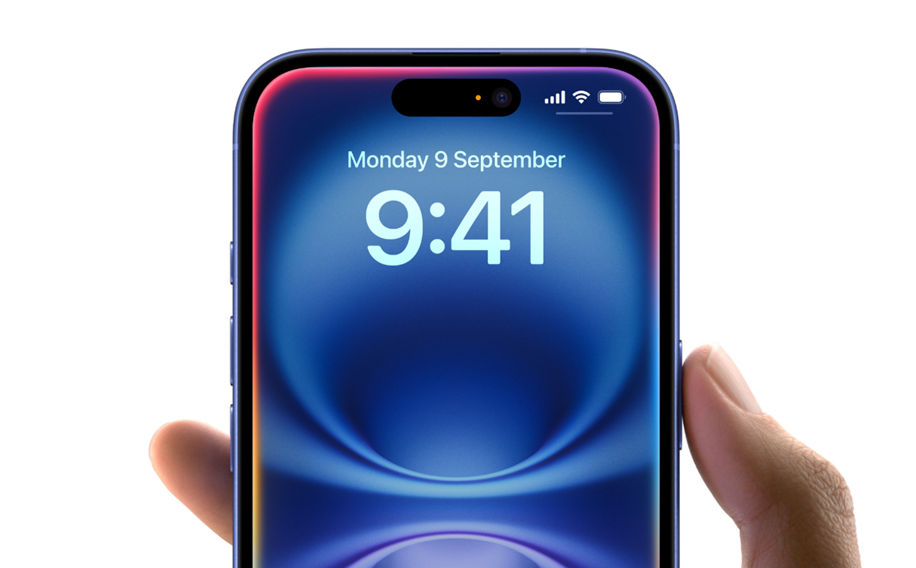
Caption – Apple grabs 5 spots in the top 10 best-selling smartphones Q1 2025 list. (Image credit – Apple)

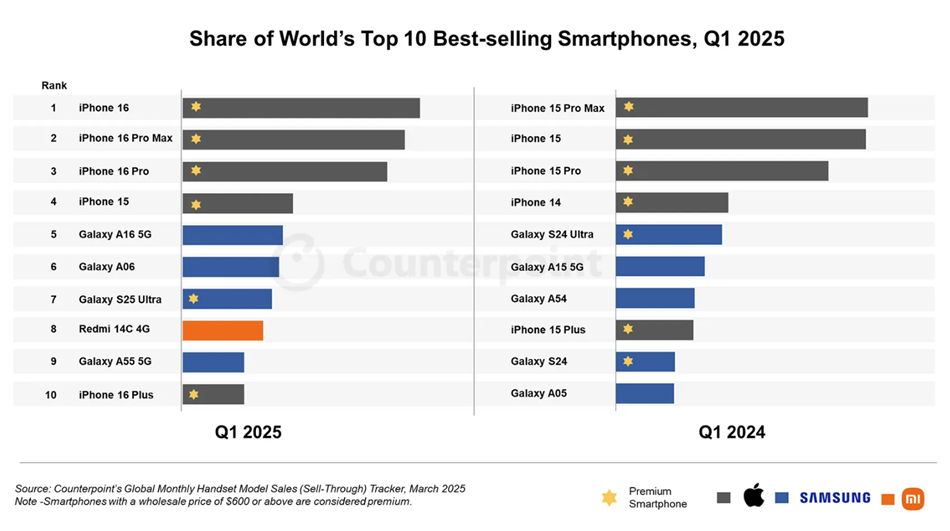
The iPhone 16 was the world’s best-selling smartphone in the first quarter of 2025, according to fresh data from Counterpoint Research. This is the first time since 2022 that the regular, non-Pro iPhone has led global sales during this period.

iPhone 16 Tops the Global Sales Charts

image

Caption – Latest data from Counterpoint research.

Apple claimed five spots in the global top 10 list, continuing a trend that’s held steady over the past five March quarters. Samsung followed with four models and Xiaomi was the only other brand to make the cut.

While the Pro models stayed popular, it was the standard iPhone 16 that drove the most sales, especially in Japan, the Middle East and Africa. Counterpoint credits this surge in Japan to better economic conditions and updated carrier subsidies that worked in Apple’s favour.

The iPhone 16 Pro Max and 16 Pro came in second and third, respectively. However, these models are still facing tough competition in China. Government incentives are now favouring phones priced under CNY 6,000 (around $833), helping local brands like Huawei gain traction.

Apple’s new budget-friendly model, the iPhone 16e, also made a strong debut. March 2025 was its first full month on sale, and it already ranked sixth globally. With a more modern design and a richer feature set than the older SE models, analysts expect the 16e to do significantly better over the next year.

Samsung Loses a Spot

Samsung’s Galaxy S25 Ultra landed in seventh place this quarter, dropping two spots compared to the S24 Ultra in Q1 2024. Counterpoint says that’s mostly because the S25 series launched later in the quarter, giving it less time to rack up sales.

The Galaxy A16 5G took fifth place overall, thanks to solid demand in North America, Latin America and the Asia-Pacific region. Samsung’s entry-level Galaxy A06 also climbed four spots in the top 10, boosted by rising demand for budget phones under $100.

In fact, this low-end segment was the fastest-growing part of the market in Q1, making up nearly 20% of global smartphone sales. Counterpoint attributes the growth to fewer supply chain issues and stronger demand in key emerging markets.

Xiaomi Only Other Brand in the Top 10

The only phone in the top 10 that wasn’t from Apple or Samsung came from Xiaomi. The Redmi 14C 4G saw 43% year-over-year growth, driven by strong sales in the Middle East, Africa, and Latin America.

Like Xiaomi’s recent success in wearables, the 14C’s popularity shows the brand’s strength in offering solid features at very competitive prices.

FAQs

Q1. What was the best-selling smartphone in Q1 2025?

Answer. The iPhone 16 topped global sales, marking the first time since 2022 that a non-Pro model led the rankings.

Q2. Which brands dominated the global top 10 list?

Answer. Apple claimed five spots, Samsung secured four, and Xiaomi was the only other brand to make the cut with its Redmi 14C 4G.

Q3. What contributed to the growth of budget smartphones?

Answer. Stronger demand in key emerging markets, fewer supply chain issues, and affordable pricing under $100 helped boost sales, particularly for Samsung’s entry-level Galaxy A06.

Also Read:

Motorola Razr 60 Launched in India With Dimensity 7400X, 3.6-Inch Cover Display at Rs 49,999

0

Highlights

  • Motorola has launched the budget-friendly Razr 60 flip phone priced at ₹49,999.
  • It features a 3.6-inch cover screen, 6.9-inch AMOLED main display, Dimensity 7400X and Moto AI.
  • The sale will start on June 4th at 12 PM IST on Flipkart, Motorola’s website and leading retail outlets.

Motorola has launched a more affordable flip phone option, the Motorola Razr 60, in India. This launch comes after the recent launch of the Razr 60 Ultra. This new model keeps the iconic foldable design but with some changes to make it easier on the wallet.

It comes with a slightly smaller 3.6-inch cover screen compared to the 4-inch one on the Ultra and is packed with smart features powered by Moto AI and Google Gemini. Here’s everything we know about the new Moto flip phone.

image

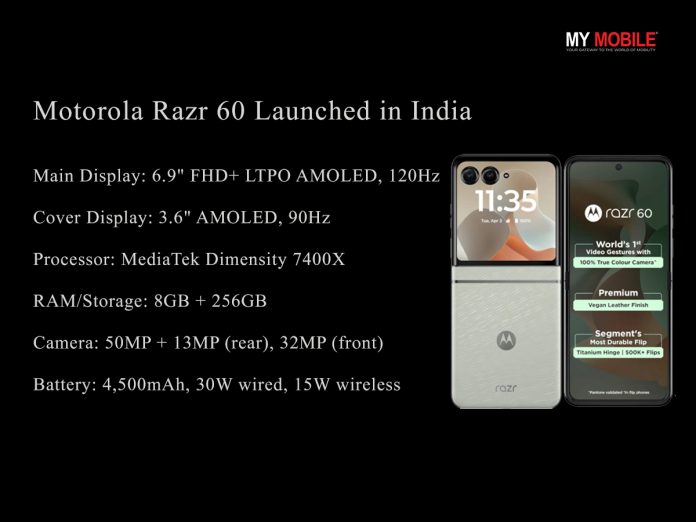
Caption – Motorola Razr 60 Launched in India. (Image credit – Motorola)

Motorola Razr 60 – Price and Availability in India

The Motorola Razr 60 is priced at Rs 49,999 for the single 8GB RAM + 256GB storage variant. It will be available in three PANTONE-inspired colours, which are Gibraltar Sea, Lightest Sky and Spring Bud.

The phone goes on sale starting June 4th at 12 PM IST on Flipkart, Motorola’s website and leading retail outlets.

Motorola Razr 60 – Key Features

  • Main Display: A 9-inch FHD+ LTPO AMOLED panel with 120Hz refresh rate, 3,000 nits peak brightness, and 120% DCI-P3 color support.
  • Cover Screen: A 6-inch LTPS flexible AMOLED screen with up to 90Hz refresh rate and 1,700 nits peak brightness. Protected by Corning Gorilla Glass Victus, this screen gives quick access to essentials like app shortcuts, navigation, media controls, e-wallets, and more.

The phone is powered by the MediaTek Dimensity 7400X, paired with the Mali-G615 MC2 GPU. It is supported by 8GB LPDDR4x RAM and 256GB UFS 2.2 storage.

image

Caption – Motorola Razr 60 key features. (Image credit – Motorola)

Motorola is shipping this affordable flip phone with Android 15 out of the box. Moto AI can understand what’s on the screen and give real-time suggestions. There’s also Catch-Me Up for notification summaries and integration with Google Gemini.

The dual camera setup on the back packs a 50MP primary camera (with OIS) and a 13MP ultra-wide camera that also supports macro shots. The camera supports features like Camera Cartoon, Night Vision, Magic Eraser, Magic Editor, Auto Frame and Photo Unblur. You can also shoot videos in a camcorder-style layout.

On the front, you get a 32MP selfie camera.

Razr 60 packs a 4,500mAh battery with 30W fast wired charging and 15W wireless charging, which overall is a nice bump from the Razr 50’s 4,200mAh cell.

It also features a side-mounted fingerprint scanner, dual stereo speakers with Dolby Atmos, a titanium hinge tested for up to 500,000 flips and an IP48 rating for water protection.

Motorola Razr 60 – What’s New Compared to Razr 50?

Motorola Razr 60 comes with a processor upgrade. From the Dimensity 7300X in the previous generation, we are now getting the Dimensity 7400X.

Battery has also improved to a 4,500mAh capacity, up from 4,200mAh. Moreover, the Razr 60 has an IP48 rating, compared to IPX8 on the Razr 50.

Price ₹49,999
Main Display 6.9″ FHD+ LTPO AMOLED, 120Hz
Cover Display 3.6″ AMOLED, 90Hz
Processor MediaTek Dimensity 7400X
RAM / Storage 8GB + 256GB
Camera 50MP + 13MP (Rear), 32MP (Front)
Battery 4,500mAh, 30W Wired, 15W Wireless
OS Android 15 with Moto AI
Sale Date June 4 @ 12 PM (Flipkart & Motorola site)

FAQs

Q1. What is the price and availability of the Motorola Razr 60 in India?

Answer. The Motorola Razr 60 is priced at ₹49,999 for the 8GB RAM + 256GB storage variant. It will be available from June 4th on Flipkart, Motorola’s website, and retail stores.

Q2. What are the key display features of the Motorola Razr 60?

Answer. The phone has a 6.9-inch FHD+ LTPO AMOLED main display with 120Hz refresh rate and 3,000 nits peak brightness. The cover screen is a 3.6-inch LTPS flexible AMOLED.

Q3. What processor powers the Motorola Razr 60?

Answer. The Razr 60 runs on the MediaTek Dimensity 7400X processor, paired with Mali-G615 MC2 GPU, 8GB LPDDR4x RAM, and 256GB UFS 2.2 storage.

Q4. How has the battery improved compared to Razr 50?

Answer. The Razr 60 packs a 4,500mAh battery with 30W fast wired charging and 15W wireless charging, an upgrade from the Razr 50’s 4,200mAh battery.

Also Read:

Over 184 Million Login Credentials Leaked Online From Google, Apple, Facebook and More

0

Highlights

  • Over 184 million login credentials were leaked online from major platforms like Google, Apple, Facebook, and banking services.
  • The breach was linked to infostealer malware, which harvests data from infected systems including browser autofill information, emails and saved documents.
  • Cybersecurity experts warn of rising data leaks.

image

Caption – Cybersecurity researcher Jeremiah Fowler uncovered a major data breach. (Photo by GuerrillaBuzz on Unsplash)

A massive data leak has exposed more than 184 million login credentials including sensitive usernames and passwords from major platforms like Google, Apple, Facebook and even banking and government services.

The leak was discovered by cybersecurity researcher Jeremiah Fowler, who found the database open and unprotected, according to Website Planet.

Fowler revealed that the unencrypted and publicly accessible database held exactly 184,162,718 unique usernames and passwords. The leaked data is tied to popular services like Google, Microsoft, Facebook, Instagram, Snapchat and even Roblox. Shockingly, the database also included login details for bank accounts, healthcare portals and government websites.

The database has since been taken offline.

What’s even more alarming is how this data was collected. Fowler says the credentials appear to have come from a type of malware known as an infostealer. He describes it as malicious software designed specifically to harvest sensitive information from an infected system.”

Infostealer malware can pull data from web browsers like autofill information and cookies as well as emails, saved documents, and even messages. All it takes is for someone to unknowingly download the malware.

Unfortunately, these kinds of leaks are becoming more common. Last year, the RockYou2024 breach exposed nearly 10 billion credentials, making it the largest password leak to date. Cybercriminals often use these massive datasets to carry out automated brute force attacks, trying various combinations to gain access to accounts.

If you’re concerned, now’s a good time to update your passwords and enable two-factor authentication.

Here’s How to Stay Safe –

  • Use strong passwords
  • Do not reuse the same passwords in different accounts.
  • Update your passwords regularly.
  • Enable two-factor or multi-factor authentication
  • Monitor your accounts regularly for any suspicious activity
  • Schedule auto-antivirus scans at regular intervals
  • Keep an eye out for phishing attempts
  • Never click on links, QR codes or attachments from unknown senders.
  • Clear out old emails with sensitive personal information

FAQs

Q1. What platforms were affected by the massive credential leak?

Answer. The leak exposed 184 million login credentials from major services like Google, Apple, Facebook, Microsoft, Instagram, Snapchat, and even banking and government sites.

Q2. How was the leaked data collected?

Answer. The credentials appear to have been harvested by infostealer malware, which extracts sensitive information from infected systems, including browser autofill data and saved documents.

Q3. What should users do to protect themselves?

Answer. Cybersecurity experts recommend updating passwords, enabling two-factor authentication, and staying vigilant against malware to prevent unauthorised access.

Also Read: NVIDIA Hackers Targeted Samsung: 19GB Confidential Data Leaked

Also Read: LinkedIn Now Latest Victim: Threat Actors Leak Massive User Data

iPhone Exports from India to the U.S. Hit 11.5 Million Amid U.S.-China Trade Tensions: Canalys

0

Highlights

  • Apple exported 11.5 million iPhones from India to the U.S. between January and April 2025.
  • India’s iPhone exports surged 76% in April year-over-year, while China’s exports to the U.S. dropped significantly.
  • Apple has been gradually shifting manufacturing to India since the COVID-19 pandemic.

image

Caption – Canalys report reveals iPhone shipment numbers from India to the US in the last quarter. (Image credit – Apple)

There has been a whole lot of speculation and mainstream conversation recently about Apple iPhone production in India. It is no news that Apple is ramping up production in India and navigating rising trade tensions with China. But a new report is putting things into perspective in terms of numbers.

According to a new report from Canalys (via CNBC), Apple shipped a massive 11.5 million iPhones from India to the U.S. between January and April this year.

Now, this particular period is significant for multiple reasons.

Back in April, it was being reported that Apple flew out three cargo planes full of iPhones from both China and India. Although the company didn’t go into detail during its recent financial call, this new data gives us a better sense of what that production ramp-up in India looked like.

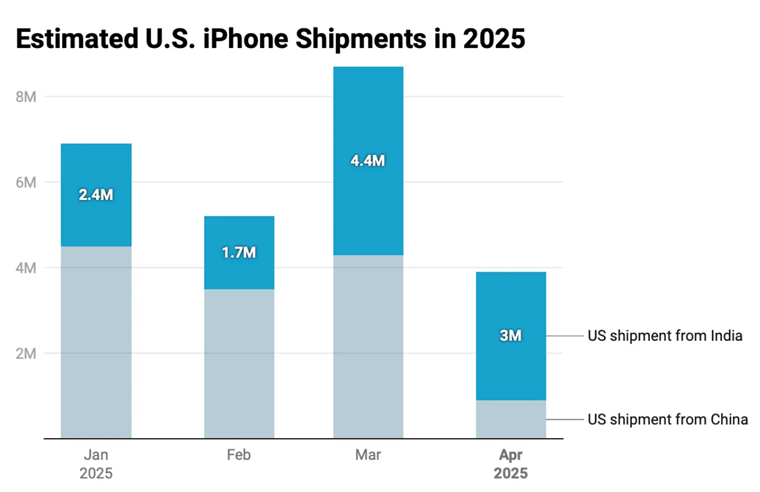
In April alone, 3 million iPhones were exported from India to the U.S., marking a 76% jump compared to the same month last year. However, that figure is down from 4.4 million units in March, suggesting Apple may have anticipated trouble ahead and sped up shipments earlier.

image

Caption – iPhone shipment numbers from India and China. (Image credit – Canalys)

For comparison, iPhone exports from China to the U.S. totalled 4.3 million units in April, dropping sharply to just 900,000 in May. Interestingly, that May figure is also 76% lower year-over-year, the exact same percentage by which India’s April exports grew, highlighting the shifting supply chain dynamics.

Commenting on the report, Le Xuan Chiew, a research manager at Omdia, said, “This latest trade war with China, is the type of disturbance that Apple has long been trying to prepare itself for.”

He added that Apple began shifting parts of its supply chain to India as far back as the COVID-19 pandemic.

All of this is happening as Apple tries to spread out its manufacturing operations, especially with the looming threat of a 25% tariff on iPhones not made in the U.S., recently floated by President Trump.

FAQs

Q1. How many iPhones did Apple export from India to the U.S. in early 2025?

Answer. Apple shipped 11.5 million iPhones from India to the U.S. between January and April 2025, marking a significant shift in production amid ongoing trade tensions.

Q2. How did India’s iPhone exports compare to China’s in April?

Answer. India exported 3 million iPhones to the U.S. in April, a 76% increase year-over-year. Meanwhile, China’s exports to the U.S. dropped from 4.3 million in April to just 900,000 in May.

Q3. Why is Apple shifting more production to India?

Answer. Apple has been diversifying its supply chain since the COVID-19 pandemic to prepare for trade disruptions, including concerns over a potential 25% U.S. tariff on non-U.S.-made iPhones.

iOS 19 to Bring Dedicated Gaming App and Easy eSIM Transfers to Android

0

Highlights

  • Apple is reportedly launching a dedicated gaming app with iOS 19.
  • It will act as a central hub for gamers with achievements, leaderboards, Apple Arcade integration and Mac support.
  • A new eSIM transfer feature will simplify switching to Android, generating a QR code for easy eSIM imports.

image

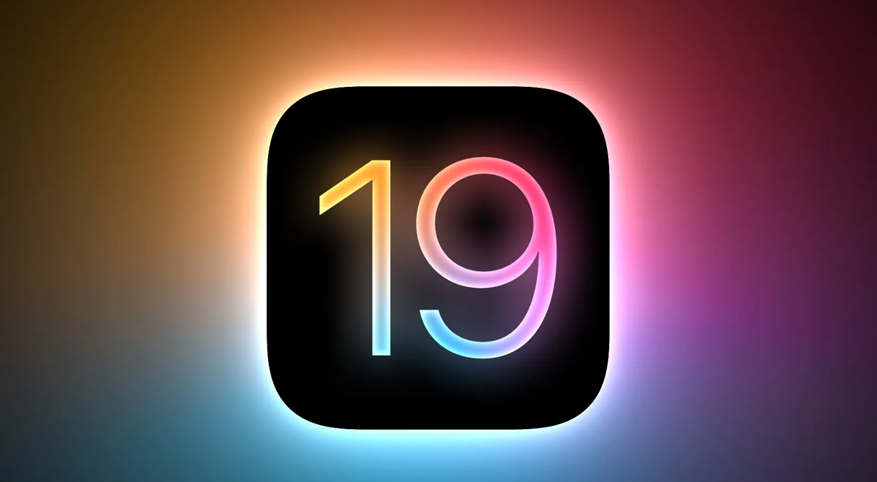
Caption – iOS 19 new rumours suggest a dedicated gaming app could be on the cards. (Image credit – 9to5Mac)

Apple is gearing up to launch a dedicated gaming app with iOS 19, according to a new report from Bloomberg. This lines up with an earlier report from 9to5Mac, which revealed that Apple was working on a standalone app for video games, separate from the App Store.

The upcoming gaming app will act as a central hub for gamers, offering features like achievements, leaderboards and more. It’s expected to take over the role of Game Centre and will also showcase App Store content and include Apple Arcade integration.

But that’s not all, the gaming app will also be available on Mac, and it will even support games downloaded from outside the App Store, offering more flexibility to users.

Adding to the gaming push, it is also reported that Apple has acquired RAC7. It is the studio behind the hit Apple Arcade game Sneaky Sasquatch.

iOS 19 Will Allow Users to Transfer eSIM to Android

In other iOS 19 news, Apple is finally tackling one of the biggest pain points when switching phones, which is eSIM transfers. Right now, moving your eSIM from iPhone to Android is a hassle, but that’s about to change.

According to Android Authority, Apple is working on a new feature in iOS 19 called “Transfer to Android.” A string of code suggests the feature will generate a QR code that Android phones can scan to easily import the eSIM. However, it looks like this will only work on iPhones running iOS 19 or later.

With Apple’s U.S. iPhones now being eSIM-only, this update should make life easier for users and carriers by skipping the need to contact customer service for manual activation.

Apple will officially unveil iOS 19, macOS 16, and more at WWDC on June 9, kicking off with a keynote presentation.

FAQs

Q1. What is the new gaming app in iOS 19?

Answer. Apple is launching a dedicated gaming app in iOS 19, acting as a central hub for gamers with achievements, leaderboards, Apple Arcade integration, and Mac support.

Q2. How will iOS 19 improve eSIM transfers to Android?

Answer. A new feature called “Transfer to Android” will generate a QR code that Android phones can scan to easily import the eSIM, making switching devices simpler.

Q3. What gaming studio has Apple acquired?

Answer. Apple has acquired RAC7, the studio behind Sneaky Sasquatch, strengthening its push into gaming alongside the new gaming app in iOS 19.

Nothing CEO Carl Pei Envisions Future Smartphones Without Apps, Says Apple Has Lost Its Creativity

0

Highlights

  • Carl Pei envisions a future without traditional apps, where AI-powered operating systems handle user tasks automatically.
  • Nothing is shifting toward AI integration with the upcoming Phone (3) marks the first step toward an AI-powered platform.
  • Pei criticises Apple for losing its creativity, calling it “very corporate” and its recent AI efforts underwhelming.

image

Caption – Nothing CEO believes the future of smartphones is one without Apps. (Image credit – Unknown)

Nothing CEO Carl Pei has shared bold thoughts about the future of smartphones. Pei believes traditional apps will disappear in future, replaced by AI-powered operating systems that handle everything for you.

Carl Pei’s Vision For the Future of Smartphones

In a recent interview with WIRED, Pei laid out his vision. He said the goal is for smartphones to evolve into smart, proactive tools that help users get things done without the need to tap through dozens of apps. “The user will spend less time doing boring things and more time on what they care about,” he said.

This aligns with Nothing’s shift towards AI, as revealed in a leaked internal memo that called the upcoming Phone (3) the “first step” toward building an “AI-powered platform.” We’ve already seen early signs of this direction with “Essential Space” on the Nothing Phone (3a).

He compared Nothing’s AI ambitions to Apple’s early success with the iPod, saying his company wants to build the “iPod” of AI, a product that delivers a better experience through simplicity and innovation.

He explained, “If you look back, the iPod was not launched as “an MP3 player with a hard disk drive.” The hard disk drive was merely a means to a better user experience. AI is just a new technology that enables us to create better products for users. So, our strategy is not to make big claims that AI is going to change the world and revolutionize smartphones. For us, it’s about using it to solve a consumer problem, not to tell a big story. We want the product to be the story.”

Interestingly, Pei isn’t sold on the current wave of AI devices like smart glasses. Instead, he believes the smartphone will remain the central device for AI “for the foreseeable future,” but it will “change dramatically.”

“I believe that in the future, the entire phone will only have one app—and that will be the OS. The OS will know its user well and will be optimized for that person… […] The next step after data-driven personalization, in my opinion, is automation. That is, the system knows you, knows who you are, and knows what you want. For example, the system knows your situation, time, place, and schedule, and it suggests what you should do. Right now, you have to go through a step-by-step process of figuring out for yourself what you want to do, then unlocking your smartphone and going through it step by step. In the future, your phone will suggest what you want to do and then do it automatically for you. So it will be agentic and automated and proactive,” Pei added.

What Pei Has To Say About Apple?

Pei didn’t hold back on his thoughts about Apple either. He said Nothing stands out for its “creativity,” while “the creative companies of the past,” like Apple, “have become very big and very corporate, and they’re no longer very creative.”

“Personally, I was very inspired by Apple when I was younger—the first iPod, the first iPhone—that’s the reason I’m in this industry. But now the creative companies of the past have become very big and very corporate, and they’re no longer very creative. They’re no longer inspirational for the younger generation,” Nothing CEO added.

It’s worth noting that Tony Fadell, the man known as the “father of the iPod,” is one of Nothing’s key investors, so Pei’s inspiration from Apple’s earlier, more experimental days runs deep.

Even though Apple has recently introduced Apple Intelligence, Pei isn’t impressed. In fact, he told WIRED that Apple’s latest AI push has been underwhelming, and that the company overall has grown “boring.”

“Apple today is very different from the Apple when I was younger. Last year, they told a very big story about Apple Intelligence. Now, a year later, it’s not much more than some generated emojis. So it’s made consumers very sceptical, he said.

FAQs

Q1. What is Carl Pei’s vision for future smartphones?

Answer. Pei believes traditional apps will disappear, replaced by AI-powered operating systems that proactively handle tasks, reducing manual interactions for users.

Q2. How is Nothing incorporating AI into its devices?

Answer. Nothing is shifting toward AI integration, with the upcoming Phone (3) being the “first step” toward an AI-powered platform focused on automation and personalisation.

Q3. What does Pei think about Apple’s innovation?

Answer. Pei criticises Apple for becoming “corporate” and losing creativity, calling its recent AI push underwhelming and stating that consumers are sceptical about its advancements.

Also Read: Nothing Phone (3) launching in July: Here’s what we know so far

Also Read: Nothing confirms brand’s first over-ear headphones; launch expected this summer


Infinix Hot 60 Pro+ Looks Slimmer, Feels Lighter Than Samsung’s $1,099 S25 Edge

0

Highlights

  • Infinix Hot 60 Pro+ leaked hands-on video shows a slimmer and lighter design than Samsung’s Galaxy S25 Edge.
  • It measures 5.95mm thick and weighs just 154.6g compared to Samsung’s 5.8mm and 163.8g.
  • Hot 60 Pro+ possibly benefits from silicon-carbon battery tech.
  • It is expected to be a mid-range device likely priced under $500.

Slim smartphones are all the rage right now. While you may think the primary battle is between the recently launched Samsung Galaxy S25 Edge and the much-anticipated iPhone 17 Air, it seems more brands are preparing for a face-off. We are specifically talking about Infinix as it seems ready to take on Samsung’s Galaxy S25 Edge with its upcoming Infinix Hot 60 Pro+.

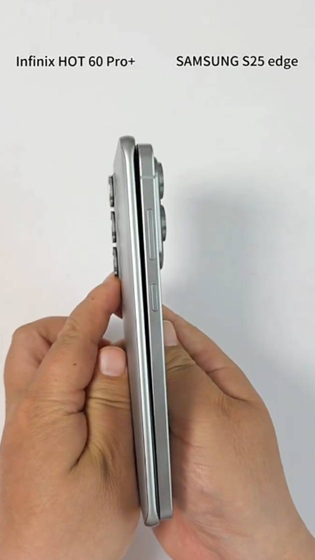
A new hands-on comparison by well-known tipster Ice Universe shows just how close the two phones are in terms of slim design. In some ways, the Infinix might even have the “edge.”

image image image

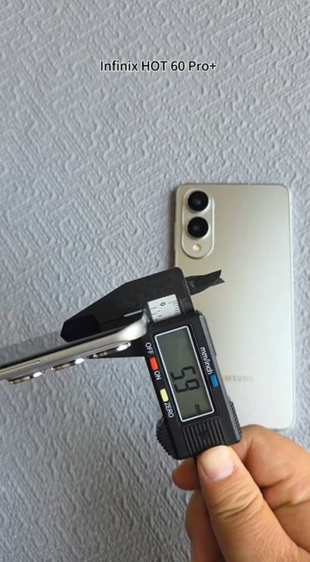
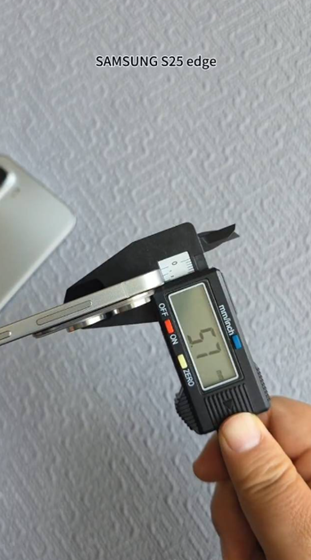
Caption – Infinix Hot 60 Pro+ compared against the Samsung Galaxy S25 Edge. (Image credit – @UniverseIce on X)

In the comparison video posted on X (formerly Twitter), Ice Universe shows the Hot 60 Pro+ measuring just 5.95mm thick based on callipers that round to one decimal place. That’s only slightly thicker than the 5.8mm frame of the Galaxy S25 Edge. But thanks to its curved sides, the Infinix actually looks thinner, which the tipster points out in both the video and accompanying image.


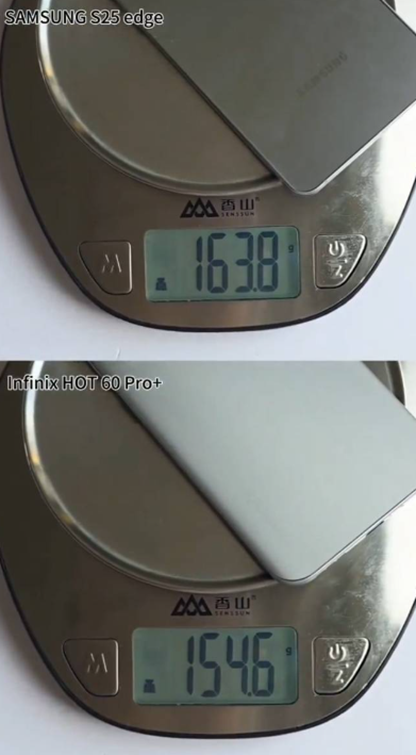
Even more surprising is the weight. The Hot 60 Pro+ weighs just 154.6g, while the S25 Edge comes in at 163.8g. That makes the Infinix not just slimmer-looking, but also lighter in hand.

image

Caption – Weight comparison between Infinix Hot 60 Pro+ and Samsung Galaxy S25 Edge. (Image credit – @UniverseIce on X)

This is a big shift from last year’s Infinix Hot 50 Pro+, which was 6.8mm thick, weighed 162g, and still packed a 5,000mAh battery. With newer silicon-carbon battery tech becoming more common in Chinese smartphones, there’s hope the Hot 60 Pro+ could offer solid battery life even in such a thin and light body.

Meanwhile, Samsung’s Galaxy S25 Edge, despite its premium $1,099.99 price tag, only has a 3,900mAh battery, which many feel isn’t enough for 2025 standards.

While Samsung brings flagship features like a 200MP camera and Snapdragon 8 Elite chip, the Hot 60 Pro+ is expected to stay in the mid-range bracket, likely priced under $500. The video also hints at a triple rear camera setup, though full specs are still under wraps.

With both brands pushing the boundaries of smartphone design, it’ll be interesting to see how the Hot 60 Pro+ holds up once all the details are out.

FAQs

Q1. How does the Infinix Hot 60 Pro+ compare to the Samsung Galaxy S25 Edge in terms of design?

Answer. The Infinix Hot 60 Pro+ is 5.95mm thick and weighs 154.6g, making it slightly thicker but lighter than the Galaxy S25 Edge, which measures 5.8mm and weighs 163.8g.

Q2. What are the differences in battery capacity between the two phones?

Answer. The Hot 60 Pro+ is expected to benefit from newer silicon-carbon battery tech, while the Galaxy S25 Edge has a smaller 3,900mAh battery, which some feel isn’t enough for 2025 standards.

Q3. How do the price and features of the Infinix Hot 60 Pro+ compare to the Galaxy S25 Edge?

Answer. The Hot 60 Pro+ is expected to be a mid-range device priced under $500, while the Galaxy S25 Edge offers premium features like a 200MP camera and Snapdragon 8 Elite chip at $1,099.

Also Read: Infinix HOT 60 Pro could be the world’s thinnest curved-screen phone, to cost under $500

Also Read:Infinix XPad GT unveiled with Snapdragon 888, 13″ 144Hz display and 10000mAh battery

WhatsApp Launches Official App for iPad with Full Feature Support, Available on App Store Now

0

Highlights

  • WhatsApp has officially launched on iPad with full feature support.
  • It is available for download on the App Store for iPads running iPadOS 15.1 or later.
  • Users can access all WhatsApp features including chats, photos, status updates and audio/video calls along with screen-sharing options.
  • The iPad version supports iPadOS-specific tools such as Stage Manager, Split View and Slide Over.

image

Caption – WhatsApp Official App for iPad is now live. (Image credit – WhatsApp)

WhatsApp is now officially available for iPad after years of waiting. Meta has released a dedicated iPadOS version of its popular messaging app and it’s live on the App Store. To use it, your iPad needs to be running iPadOS 15.1 or later.

Regarding the release, WhatsApp said, “As one of our biggest requests, we’re excited to announce that WhatsApp is now available on iPad. Bringing all your favorite features to a larger screen, WhatsApp for iPad makes keeping in touch with friends and family even easier. Make video and audio calls with up to 32 people, share your screen, and use both front and back cameras.”

The news was confirmed by WhatsApp on its official X (formerly Twitter) account, where the company also shared the App Store link for download.

This release has been highly anticipated, as many users have long wanted the option to use WhatsApp on iPads. With the new app, users can enjoy chats, photos, and status updates on a bigger screen, making the experience more immersive.

The iPad version comes with all the features you’d expect from the iPhone app. You can make audio and video calls with up to 32 people, switch between front and rear cameras, and even share your screen during calls.

WhatsApp for iPad also takes advantage of iPadOS-specific features. It supports Stage Manager, so you can resize and rearrange tabs or group different apps together. It also works with Split View and Slide Over, so you can use WhatsApp side-by-side with other apps.

To get started, iPad users can download the app from the App Store and link it to their iPhone using the “Linked Device” option. This syncs messages and data instantly between both devices.

FAQs

Q1. What are the requirements to use WhatsApp on iPad?

Answer. WhatsApp is now available on the App Store for iPads running iPadOS 15.1 or later.

Q2. What features does WhatsApp for iPad offer?

Answer. Users can access chats, photos, status updates, audio/video calls with up to 32 people, and screen-sharing options.

Q3. How does WhatsApp for iPad enhance multitasking?

Answer. The app supports iPadOS-specific tools like Stage Manager, Split View, and Slide Over for better multitasking.

Also Read:

iPhone 18 Could Bring Under-Display Face ID, With Front-Facing Sensors Fully Hidden By iPhone 19

0

Highlights

  • Apple is preparing to move Face ID under the display starting with the iPhone 18 in 2026.
  • The iPhone 19 could completely hide all front-facing sensors by 2027.
  • Apple reported resolves technical challenges including difficulties in placing Face ID’s infrared sensors under a backlit screen.

image

Caption – Multiple reports have hinted so far that iPhone 18 Could Bring Under-Display Face ID. (Image credit – Apple)

This is not the first time we are hearing this but it appears Apple is all set for a big display tech upgrade in future iPhones. The Cupertino giant might finally be ready to move Face ID under the screen, starting with the iPhone 18 in 2026. And if everything goes according to the plan, iPhone 19 in 2027 would be when all front-facing sensors including the selfie camera would be completely hidden under the display.

Apple Working on Perfecting Under-Display Face ID

Apple has long been rumoured to be working on reducing or removing the current pill-shaped cutout on the iPhone’s screen. If a trusted leaker is right, we could see these changes roll out gradually over the next few iPhone releases.

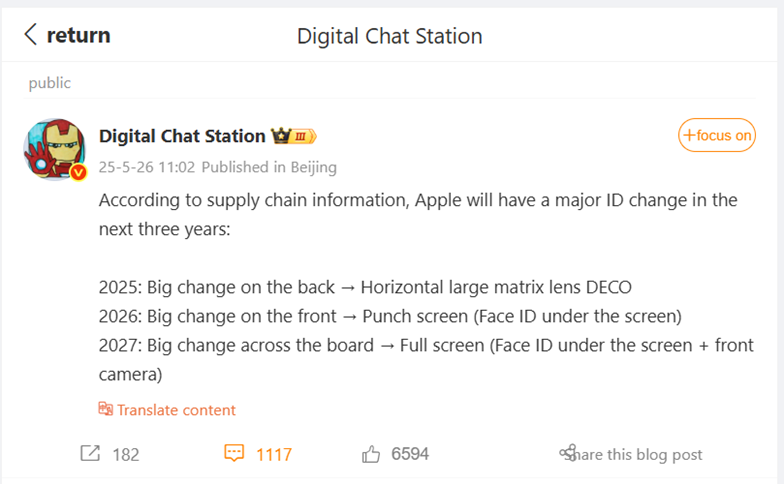
Well-known tipster Digital Chat Station posted on Weibo about Apple’s possible camera upgrades. Citing supply chain sources, they claim Face ID will go through some major changes in just three years.

image

Caption – Digital Chat Station’s recent post on Weibo. (Translated Via Google Translate)

For the 2025 iPhone 17 lineup, the leaker says the main camera changes will be on the back with a new “Horizontal large matrix lens DECO.”

Then the iPhone 18 is expected to switch to a punch-hole screen in 2026. The small hole will house the regular front-facing camera, while Face ID will reportedly be moved under the display. This means Face ID could still work without needing a visible cutout.

By 2027, Apple might take things even further with the iPhone 19. The company is rumoured to use a true full-screen display with no visible interruptions at all, hiding both the front camera and Face ID completely under the screen.

Previous Reports On Under-Display Face ID in iPhones

Digital Chat Station has a solid track record when it comes to Apple leaks and the timeline seems believable especially since similar rumours have surfaced before.

Earlier this year, an Apple patent revealed a possible fix for the biggest challenge with under-display Face ID, which was the infrared light doesn’t pass easily through display panels. Apple’s solution was reportedly to remove certain subpixels in a way that users won’t notice.

Recently, a report from The Information also mentioned that Apple plans to introduce this tech in the iPhone 18 Pro models. Meanwhile, a company rumoured to be working with Apple on this tech recently said it expects its solution to appear in a phone launching in 2026.

The Information’s Wayne Ma wrote, “The design of the iPhone 18 Pro and iPhone 18 Pro Max will include only a small hole cutout in the top-left corner to accommodate the front-facing camera, according to a person with direct knowledge of the matter. This design is a precursor to at least one 2027 iPhone model that will place the front-facing camera underneath the screen to enable a truly edge-to-edge display, two of the people said. Such a move would coincide with the 20-year anniversary of the first iPhone”

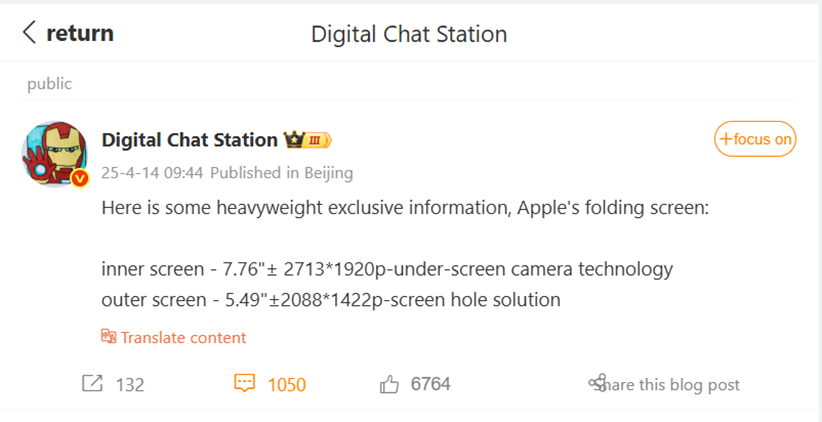
Digital Chat Station too has also previously hinted that this tech might even tie into Apple’s rumoured foldable iPhone. “Here is a heavyweight exclusive information, Apple folding screen. Inner screen [has] under-screen camera technology. inner screen – 7.76″± 27131920p-under-screen camera technology

image

outer screen – 5.49″±20881422p-screen hole solution,” DCS posted.

Caption – Digital Chat Station last month posted about iPhone under display tech experiments. (Translated Via Google Translate)

Now, based on what they’re hearing from the supply chain, it looks like Apple is aiming for a full rollout in 2027.

Back in late 2023, there were even reports that under-display Face ID could show up as early as the iPhone 18.

It is important to note that this kind of upgrade isn’t easy. Apple’s suppliers face real challenges when it comes to fitting Face ID’s infrared dot projectors and sensors under a backlit screen. If the technology doesn’t work perfectly, Apple might have to explore other ways to handle biometric security. Still, a 2026 launch window for under-display Face ID seems realistic.

FAQs

Q1. When will Apple introduce under-display Face ID?

Answer. Apple is expected to move Face ID under the screen starting with the iPhone 18 in 2026. By 2027, the iPhone 19 could completely hide all front-facing sensors under the display.

Q2. What design changes are planned for the iPhone 18 and iPhone 19?

Answer. The iPhone 18 is expected to adopt a punch-hole screen, housing the front camera while moving Face ID beneath the display. By the time the iPhone 19 launches, Apple may introduce a seamless full-screen design with no visible interruptions.

Q3. What challenges does Apple face in implementing under-display Face ID?

Answer. A key challenge is placing Face ID’s infrared dot projectors and sensors under a backlit screen. Apple has been working on solutions, including removing certain subpixels, to ensure reliable functionality.

Also Read: Big Apple Discounts at Vijay Sales Apple Days Sale: Best Deals on iPhone 16, MacBook Pro, AirPods 4, and More

Also Read:Apple Moves iPhone 7 Plus and iPhone 8 to Vintage List; iPad Air 2 and Mini 2 Now Obsolete