Home Blog Page 100

WhatsApp Begins Testing Apple Watch Companion App With Messaging and Emoji Reactions Support

0

Highlights

  • WhatsApp is testing a standalone app for Apple Watch via TestFlight.
  • It will allow beta users to read, reply, start chats, and send emoji reactions directly from their wrist.
  • The app auto-pairs with iPhones running iOS and watchOS 10+, eliminating the need for QR code scanning.
 (Photo by Mariia Shalabaieva on Unsplash)
(Photo by Mariia Shalabaieva on Unsplash)

WhatsApp is expanding its presence to the Apple Watch with a new companion app, offering users access to messages and key features directly from their wrist. The Meta-owned messaging platform has started testing the app with select beta testers and is allowing them to try out the early version through Apple’s TestFlight programme.

The new companion app aims to bring more functionality than basic message notifications. iPhone users enrolled in the WhatsApp beta can now read and reply to messages, send new chats, and even react with emojis without needing to open the app on their phones.

WhatsApp’s Apple Watch App Brings Full Chat Access

WhatsApp reportedly releases a Compatible Apple Watch Beta App for Easier Messaging on Your Wrist. (Image credit - @WABetaInfo)
WhatsApp reportedly releases a Compatible Apple Watch Beta App for Easier Messaging on Your Wrist. (Image credit – @WABetaInfo)

As reported by WABetaInfo, WhatsApp’s companion app for Apple Watch is being distributed via the TestFlight beta (version 25.32.10.71 for iOS). The rollout is currently limited to some users but is expected to expand to more testers in the coming weeks.

The standalone app allows users to read and reply to conversations, preview media, and send emoji reactions directly from the watch. It’s designed to work as an extension of the iPhone app and requires devices running watchOS 10 or newer.

One of the key highlights is its automated pairing process. Unlike the web or desktop version of WhatsApp, users don’t need to scan a QR code to access messages. Once the Apple Watch is paired with the iPhone, the app connects automatically. A sync indicator appears in the top-left corner of the watch display to show connection status.

Other WhatsApp Features in Development

In addition to the Apple Watch companion app, WhatsApp is also testing several new features across its beta builds. A cover photo option for user profiles was recently spotted in WhatsApp beta version 2.25.32.2 for Android, allowing users to personalise their accounts further.

Moreover, a new device storage management tool was discovered in WhatsApp beta 2.25.31.13 for Android, potentially offering users better control over media and file storage. The platform is also reportedly testing a feature that could limit the number of messages sent in new chats, aimed at improving privacy and reducing spam.

FAQs

Q1. What features does the WhatsApp Apple Watch app offer?

Answer. The app allows users to read and reply to messages, start new chats, preview media, and send emoji reactions directly from their Apple Watch.

Q2. How do users access the WhatsApp Apple Watch app?

Answer. Beta testers can access it via Apple’s TestFlight program (version 25.32.10.71 for iOS). The app auto-pairs with the iPhone, no QR code scanning is needed.

Q3. What are the system requirements for using the app?

Answer. The companion app requires an Apple Watch running watchOS 10 or newer and an iPhone with the WhatsApp beta installed. More testers will be added gradually.

Also Tead

https://www.mymobileindia.com/whatsapp-introduces-passkey-encryption-for-chat-backups-on-google-drive-and-icloud/
https://www.mymobileindia.com/whatsapp-to-soon-let-all-users-add-profile-cover-photos-similar-to-facebook-and-linkedin/

Vivo X300 Series Goes Global With Dimensity 9500 Chip, 200MP Cameras, and Up to 90W Charging, India Launch In Coming Months

0

Highlights

  • Vivo X300 series has been globally launched as India launch expected in early December.
  • Both Vivo X300 and X300 Pro feature the new 3nm Dimensity 9500 chip, Android 16-based OriginOS 6, and Q10+ LTPO AMOLED displays with high refresh rates and vivid colour accuracy.
  • It will be available in Europe from November 3 with the price ranging from EUR 1,049 to EUR 1,399 (₹1.08L to ₹1.43L).

image

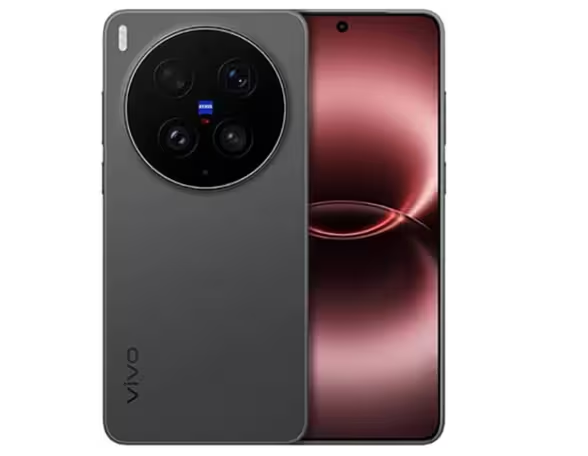
Caption – Vivo X300 Series Goes Global after China debut. (Image credit – Vivo)

Vivo has officially launched the Vivo X300 and Vivo X300 Pro globally, just two weeks after their debut in China. Both smartphones are powered by the new 3nm MediaTek Dimensity 9500 chipset. Reports claim the lineup is expected to make its way to India in early December.

Vivo X300 Series – Price and Availability

The Vivo X300 Pro is priced at EUR 1,399 (approx. Rs. 1,43,000) for the single 16GB RAM + 512GB storage model. Meanwhile, the Vivo X300 starts at EUR 1,049 (around Rs. 1,08,000) for the 12GB RAM + 256GB variant, while the top-end 16GB + 512GB configuration costs EUR 1,099 (around Rs. 1,13,000).

Both models will be available from November 3 in Europe through Vivo’s official online store.

As for colours, the Vivo X300 Pro comes in Dune Brown and Phantom Black, while the standard Vivo X300 will be offered in Halo Pink and Phantom Black colour options.

image

Caption – Vivo X300 5G in Halo Pink colour. (Image credit – Vivo)

Vivo X300 Pro – Key Features

The Vivo X300 Pro runs on Android 16-based OriginOS 6 and features a 6.78-inch Q10+ LTPO AMOLED display with a resolution of 1,260×2,800 pixels. The panel supports a 120Hz refresh rate, 300Hz touch sampling rate, HDR, and P3 colour gamut, with a pixel density of 452ppi and a 94.85% screen-to-body ratio.

At its core, the phone is powered by the 3nm MediaTek Dimensity 9500 SoC paired with a Mali G1-Ultra GPU, up to 16GB LPDDR5X Ultra RAM, and up to 512GB UFS 4.1 storage. It also includes the V3+ imaging chip for advanced camera processing.

For optics, the X300 Pro houses a triple rear camera setup featuring a 50MP (f/1.57) main sensor, a 50MP (f/2.0) ultra-wide lens, and a 200MP (f/2.67) periscope telephoto camera with up to 100x digital zoom. The device also includes a 50MP (f/2.0) front camera for selfies and video calls. The rear cameras support 8K video recording.

image

Caption – Vivo X300 Series. (Image credit – Vivo)

Connectivity features include Wi-Fi 7, Bluetooth 5.4, NFC, GPS, and a USB 3.2 Gen 1 Type-C port. Other hardware elements include a 3D ultrasonic in-display fingerprint sensor, laser autofocus, hall effect sensor, flicker sensor, IR blaster, and multispectral sensor.

The X300 Pro packs a 5,440mAh battery that supports 90W wired and 40W wireless charging. It also features dual speakers, an x-axis linear motor, an Action Button, and a signal amplifier chip.

The phone is IP68-rated for dust and water resistance, measures 161.98×75.48×7.99mm, and weighs 226g.

Vivo X300 – Key Features

The Vivo X300 shares most of the same internals, including the Dimensity 9500 processor, Android 16-based OriginOS 6, and connectivity suite. However, it features a slightly smaller 6.31-inch Q10+ LTPO AMOLED display with a resolution of 1,216×2,640 pixels.

In terms of optics, the standard X300 comes with a 200MP primary sensor with OIS, a 50MP ultra-wide lens, and a 50MP periscope telephoto camera. The front houses the same 50MP selfie shooter as the Pro model.

The device is powered by a 5,360mAh battery, just slightly smaller than the Pro’s, and supports the same charging speeds. It measures 150.57×71.92×7.95mm and weighs 190g.

FAQs

Q1. What processor powers the Vivo X300 and X300 Pro?

Answer. Both models are equipped with the 3nm MediaTek Dimensity 9500 chipset, paired with up to 16GB LPDDR5X RAM and 512GB UFS 4.1 storage for flagship-grade performance.

Q2. What are the camera capabilities of the Vivo X300 Pro?

Answer. The X300 Pro features a triple rear setup: 50MP main, 50MP ultra-wide, and a 200MP periscope telephoto lens with up to 100x digital zoom. It also supports 8K video and includes a 50MP front camera.

Q3. When will the Vivo X300 series launch in India and what are the prices?

Answer. The global launch is underway, with India availability expected in early December. Prices start at EUR 1,049 (₹1.08 lakh) for the X300 and EUR 1,399 (~₹1.43 lakh) for the X300 Pro.

Also Read

https://www.mymobileindia.com/vivo-x300-pro-full-specifications-and-hands-on-images-leak-ahead-of-launch/

https://www.mymobileindia.com/vivo-x300-pro-hands-on-video-unboxing-and-camera-samples-leak-online-ahead-of-launch/

Apple iPad Pro (2025) Teardown Shows It’s Still One of the Hardest Devices to Repair

0

Highlights

  • iPad Pro (2025) teardown reveals extreme difficulty in repairing as the thin design makes internal access risky and delicate.
  • Components like the USB-C port, cameras, and speakers are individually replaceable, while battery replacement is tough due to strong adhesives and screen fragility.
  • iFixit rated it 5/10 for repairability.
 A still from the latest Apple iPad Pro (2025) Teardown video. (Credit - iFixit)
A still from the latest Apple iPad Pro (2025) Teardown video. (Credit – iFixit)

Apple’s latest iPad Pro (2025) powered by the M5 chip has already gone under the screwdriver after its launch earlier this month. Yes, you guessed it right. Thanks to a detailed teardown by iFixit, we have an inside look at the latest device.

The teardown focuses on the 13-inch model with just 5.1mm thickness, a design marvel that also makes it one of Apple’s most difficult devices to repair. So, without further ado, let’s see what the teardown reveals.

M5 Powered iPad Pro (2025) Teardown

According to iFixit, the extreme thinness of the new iPad Pro leaves almost no internal space to work with. The video shows how every component is packed tightly together and mounted flush against the display. The only way to access the internal components is by carefully removing the screen, which is a risky and delicate process.

Despite Apple’s recent move to expand its Self Service Repair program to include iPads, the iPad Pro (2025) remains “one of the least repairable devices” the company has ever made. Detaching the display without cracking it is extremely challenging, though Apple now provides official repair manuals, parts, and tools to make the process somewhat more manageable.

image

Caption – A still from the latest Apple iPad Pro (2025) Teardown video. (Credit – iFixit)

Once the screen is removed, the teardown process becomes simpler. iFixit’s findings show that the tablet opens the same way as its predecessor. The display separated from the frame using adhesive strips. The adhesive is strong and takes time to remove safely, as the display can easily shatter during disassembly. To replace the two battery cells, a total of ten adhesive strips must be pulled out.

The iPad Pro is fairly modular with several components like the USB-C port, cameras, ambient light sensor, LiDAR scanner, and speakers. Notably, all can be replaced individually. Apple also uses two different screw types and its self-service store offers the correct tools and guides.

Replacement parts are expected to be available soon through the same channel.

Ultimately, iFixit awarded the 13-inch iPad Pro (2025) a repairability score of 5 out of 10, where 0 is the hardest to repair and 10 is the easiest. The biggest challenge lies in the battery replacement, since accessing it requires removing the fragile screen first. However, once inside, most other components are relatively straightforward to replace.

Lastly, the teardown also confirms that apart from the upgraded M5 chip, Apple hasn’t made any major internal design changes compared to the previous generation iPad Pro.

You can check out the complete teardown video below –

FAQs

Q1. Why is the iPad Pro (2025) considered difficult to repair?

Answer. Its ultra-thin 5.1mm design leaves minimal internal space, making screen removal extremely delicate. Accessing components like the battery requires carefully detaching the fragile display, which is prone to cracking.

Q2. What components of the iPad Pro (2025) are modular and replaceable?

Answer. Despite its compact design, parts like the USB-C port, cameras, LiDAR scanner, ambient light sensor, and speakers can be individually replaced. Apple also provides official tools and guides via its Self Service Repair program.

Q3. What repairability score did iFixit give the iPad Pro (2025)?

Answer. iFixit rated it 5 out of 10. The biggest challenge is battery replacement due to strong adhesives and the risk of damaging the screen, though other components are easier to swap once inside.

Also Read

https://www.mymobileindia.com/apple-working-on-vapor-chamber-cooling-for-next-gen-ipad-pro-expected-in-2027-report/

https://www.mymobileindia.com/apple-unveils-14-inch-macbook-pro-and-ipad-pro-with-m5-chips-in-india-prices-specs-and-availability/

iQOO Neo 11 Debuts in China With 7,500mAh Battery, Snapdragon 8 Elite Chip, and 100W Fast Charging

0

Highlights

  • iQOO Neo 11 launched in China at a starting price of 2599 yuan (USD 366 / ₹32,460).
  • It features a Snapdragon 8 Elite chip, up to 16GB LPDDR5X RAM, 1TB UFS 4.1 storage, and a 6.82″ 2K LTPO AMOLED display, 7,500mAh silicon-carbon battery with 100W fast charging, IP68/IP69 ratings and a 50MP Sony ultra-stabilised main camera.
  • Global rollout of the phone is expected soon.
iQOO Neo 11 Debuts in China. (Image credit - iQOO)
iQOO Neo 11 Debuts in China. (Image credit – iQOO)

iQOO has launched its latest performance-focused smartphone, the iQOO Neo 11, in China. Designed for gamers and power users, the device brings flagship-grade hardware, advanced cooling, and a massive 7,500mAh battery, all at an aggressive price point. Here’s all you need to know.

iQOO Neo 11 – Key Features

The iQOO Neo 11 features a 6.82-inch 2K LTPO AMOLED display with a 1–144Hz adaptive refresh rate and BOE Q10+ luminous material for enhanced brightness and clarity. It sports 1.4mm ultra-slim bezels, 2592Hz high-frequency PWM dimming, and SGS and TÜV low blue light certifications. With a peak brightness of 4500 nits, it ensures excellent outdoor visibility.

 iQOO Neo 11 display. (Image credit - iQOO)
iQOO Neo 11 display. (Image credit – iQOO)

The screen also uses the same AR anti-reflection coating and true colour mapping technology found on the iQOO 15, providing highly realistic visuals.

image

Caption – iQOO Neo 11 processor. (Image credit – iQOO)

The device is powered by the Snapdragon 8 Elite chipset, achieving an impressive 3.54 million points on AnTuTu. It is paired with the Q2 self-developed chip, up to 16GB LPDDR5X Ultra RAM (9600Mbps), and up to 1TB UFS 4.1 storage, ensuring ultra-fast performance.

For gaming, the Neo 11 integrates a super-sensitive touch chip that supports 3200Hz instantaneous and 300Hz stable 10-finger touch sampling rates, resulting in ultra-low touch latency of just 25.4ms.

The device also features an 8000mm² vapour chamber cooling system, the same as the iQOO 15, delivering 21.7% better coverage than its predecessor. The high-density capillary design helps rapidly absorb and circulate coolant, achieving a 15°C drop in just 10 seconds. It uses ultra-high thermal conductivity graphite (2000W/m·K) for optimal heat management.

The iQOO Neo 11 comes with an aerospace-grade aluminium alloy frame, sandblasted and oxidised for durability, heat dissipation, and fingerprint resistance. The floating mirror design enhances grip during gaming, while the Swift Black variant offers a sleek metallic finish.

Other models use satin glass for a soft, smudge-free texture. The phone has passed military-grade impact tests and is certified with IP68 and IP69 dust and water resistance.

image

Caption – iQOO Neo 11 camera. (Image credit – iQOO)

For photography, the smartphone sports a 50MP Sony ultra-stabilised primary camera with a large sensor for improved light capture and accurate colour reproduction. It uses the NICE algorithm, borrowed from Vivo’s flagship lineup, for depth-based image processing, reducing noise and enhancing detail, especially in low-light shots.

The setup also includes an 8MP secondary sensor and a 16MP front camera, similar to the iQOO Neo 10.

image

Caption – iQOO Neo 11 battery. (Image credit – iQOO)

Powering the device is a 7,500mAh single-cell silicon-carbon battery, which offers 700mAh more capacity than the Neo 10 Pro+ while being lighter. It supports 100W FlashCharge technology, capable of delivering 2 hours of short video playback with just 3 minutes of charging. The new Global Direct Drive Power Supply 2.0 ensures smooth performance during gaming, navigation, or video playback even while charging.

The iQOO Neo 11 runs OriginOS 6 based on Android 16 out of the box.

iQOO Neo 11 – Price and Availability in China

The iQOO Neo 11 is now available for purchase in China, with global availability expected to be announced soon.

image

Caption – iQOO Neo 11 colour options available in China. (Image credit – iQOO)

Pricing –

  • 12GB + 256GB – 2599 yuan (approx. USD 366 / Rs. 32,460)
  • 16GB + 256GB – 2899 yuan (approx. USD 408 / Rs. 36,210)
  • 12GB + 512GB – 2999 yuan (approx. USD 422 / Rs. 37,460)
  • 16GB + 512GB – 3299 yuan (approx. USD 464 / Rs. 41,210)
  • 16GB + 1TB – 3799 yuan (approx. USD 535 / Rs. 47,455)

FAQs

Q1. What chipset powers the iQOO Neo 11, and how does it perform?

Answer. The iQOO Neo 11 is equipped with the Snapdragon 8 Elite chipset, achieving an impressive 3.54 million points on AnTuTu. It’s paired with the Q2 chip, up to 16GB LPDDR5X RAM, and up to 1TB UFS 4.1 storage for flagship-level performance.

Q2. What are the display features of the iQOO Neo 11?

Answer. It sports a 6.82-inch 2K LTPO AMOLED display with a 1–144Hz adaptive refresh rate, 4500 nits peak brightness, ultra-slim bezels, and TÜV/SGS low blue light certifications for eye comfort.

Q3. How does the iQOO Neo 11 handle gaming and heat management?

Answer. The phone includes a 3200Hz touch chip for ultra-low latency (25.4ms) and an 8000mm² vapour chamber cooling system with high thermal conductivity graphite, reducing temperatures by up to 15°C in 10 seconds.

Q4. What is the battery capacity and charging speed of the iQOO Neo 11?

Answer. It features a 7,500mAh single-cell silicon-carbon battery with 100W FlashCharge support, delivering 2 hours of video playback with just 3 minutes of charging.

Q5. What is the price of the iQOO Neo 11 in China?

Answer. Prices start at 2599 yuan (~USD 366 / ₹32,460) for the 12GB+256GB variant and go up to 3799 yuan (USD 535 / ₹47,455) for the 16GB+1TB model. Global availability is expected soon.

Also Read

https://www.mymobileindia.com/iqoo-unveils-pad-5e-tablet-watch-gt-2-smartwatch-and-tws-5-earbuds-in-china-with-premium-features-and-competitive-pricing/

https://www.mymobileindia.com/iqoo-15-launched-in-china-featuring-6-85-inch-amoled-display-snapdragon-8-elite-gen-5-chip-and-7000mah-battery-price-specs-and-more/

WhatsApp Introduces Passkey Encryption for Chat Backups on Google Drive and iCloud

0

Highlights

  • WhatsApp now supports passkey-based encryption for chat backups on Google Drive and iCloud, using biometric authentication.
  • This ensures only the account owner can access backup data and neither WhatsApp nor cloud providers can read messages, media, or voice notes.
  • The feature is rolling out gradually and can be enabled via Settings > Chats > Chat Backup > End-to-End Encrypted Backup.

image

Caption – (Photo by Alexander Shatov on Unsplash)

WhatsApp has rolled out passkey-based encryption for chat backups, adding an extra layer of security for users who store their data on Google Drive or iCloud. This update enhances WhatsApp’s existing end-to-end encryption, which currently protects messages, media, and calls from unauthorised access. Here are all the details you need to know.

WhatsApp – Passkey Encryption for Chat Backups

WhatsApp users can now safeguard their backups using biometric authentication methods such as fingerprint, Face ID, or their phone’s screen lock. The Passkey Encryption for Chat Backups basically eliminates the need to remember or manage a lengthy 64-digit encryption key, making it easier and safer to protect chat history.

image

Caption – Now Passkey Encryption for WhatsApp Chat Backups. (Image credit – Meta)

The encryption ensures that only the account owner can access backup data, neither WhatsApp nor the cloud storage provider can read it. The protection covers everything from messages and photos to voice notes and media files.

WhatsApp revealed that its end-to-end encryption now secures over 100 billion messages exchanged daily by more than 2 billion users. While most messages remain stored locally on users’ devices, many choose to back them up online. The addition of passkey-encrypted backups guarantees that even cloud-stored data remains private and inaccessible to third parties.

How End-to-End Encryption For Chat Backups Works?

According to WhatsApp, its end-to-end encryption ensures that only the sender and recipient can view their messages or calls. Each message is protected by a unique digital key that cannot be accessed by WhatsApp or any intermediary.

This system operates automatically and requires no manual configuration from the user.

Messages sent to business accounts are also secured using the same Signal encryption protocol. It is used to encrypt messages before they leave the sender’s device. Although WhatsApp has clarified that once a business receives a message, the way it is managed completely depends on the company’s privacy policies. There is a chance some businesses allow staff or third-party vendors to view or respond to messages. Some may also use the information for marketing or advertising on Meta’s platforms.

How to Enable WhatsApp Chat BackUp Passkeys?

The rollout of passkey-encrypted backups will happen gradually over the next few weeks and months. To activate the feature, users can navigate to Settings > Chats > Chat Backup > End-to-End Encrypted Backup.

The feature will be available globally soon and users must ensure they are running the latest version of WhatsApp on either Android or iOS to access it.

FAQs

Q1. What is WhatsApp’s new Passkey Encryption for chat backups?

Answer. WhatsApp has introduced passkey-based encryption for chat backups stored on Google Drive and iCloud. This feature uses biometric authentication (like fingerprint, Face ID, or screen lock) to secure backups, eliminating the need to manage a 64-digit encryption key.

Q2. Can WhatsApp or cloud providers access my encrypted backups?

Answer. No. With passkey encryption enabled, only the account owner can access the backup data. Neither WhatsApp nor the cloud storage provider (Google or Apple) can read the messages, media, or voice notes stored in the backup.

Q3. How can I enable passkey encryption for my WhatsApp chat backups?

Answer. To activate the feature, go to Settings > Chats > Chat Backup > End-to-End Encrypted Backup. Ensure you’re using the latest version of WhatsApp on Android or iOS. The rollout is happening gradually and will be available globally in the coming weeks.

Also Read

https://www.mymobileindia.com/whatsapp-to-soon-let-all-users-add-profile-cover-photos-similar-to-facebook-and-linkedin/

https://www.mymobileindia.com/chatgpt-to-exit-whatsapp-by-january-2026-after-meta-bans-third-party-ai-chatbots/

iPhone’s New ‘Slow Charger’ Alert Explained! Know All About Why You’re Seeing It and How to Fix It

0

Highlights

  • iPhones running iOS 26 now show a “Slow Charger” message when connected to low-powered adapters or outdated cables.
  • The alert typically appears with older USB-A chargers or first-gen Qi wireless chargers that deliver under 10 watts.
  • iPhone users can go for an Apple-certified 30W+ USB-C charger or upgrade to MagSafe/Qi2-certified wireless accessories to enable faster charging and remove the alert.
 iOS 26 adds a new charger alert. (Image credit - Reddit)
iOS 26 adds a new charger alert. (Image credit – Reddit)

If your iPhone running iOS 26 has started showing a “Slow Charger” alert on the lock screen, you’re not alone. The latest iOS update adds a new feature that informs users when their phone isn’t charging at optimal speed. Here’s everything you need to know about this feature.

What the ‘Slow Charger’ Alert Mean in iOS 26?

Modern iPhones come with larger batteries than models from a few years ago, meaning they require more power to charge quickly. If you recently upgraded to a new iPhone and are still using your older charger or cable, it may not support fast charging speeds.

Slow Charger Alert in iOS 26. (Image credit  - Apple)
Slow Charger Alert in iOS 26. (Image credit  – Apple)

For example, older USB-A chargers can typically deliver only 5 to 7.5 watts of power. At that rate, charging an iPhone 17 could take three hours or more to reach full battery.

Now, if you are using an old charger, your iPhone with iOS 26 will display a “Slow Charger” message when it detects a low-powered adapter or an older cable. This new alert comes in place of showing the estimated time to reach 80% charge.

How to Fix the ‘Slow Charger’ Alert?

To get rid of the ‘Slow Charger’ warning, you can try any of the following steps.

Use an Apple-certified fast charger

For the best results, use an Apple 30W (or higher) power adapter along with a USB-C cable. This setup allows your iPhone to charge at 20–30 watts, letting it reach 50% charge in under 30 minutes. Apple’s latest power adapters are designed to deliver both efficiency and speed for the newest iPhone models.

Upgrade to certified wireless charging accessories

You can go for MagSafe or Qi2-certified accessories if you prefer wireless charging. The latest iPhones support wireless charging speeds up to 25 watts.

This new alert is part of Apple’s effort to help users understand their charging speeds and identify why their device may be taking longer than usual to recharge. You might also see the Slow Charger message when using Qi wireless chargers, especially first-generation ones that deliver less than 10 watts.

It is important to note that using a slower charger won’t harm your iPhone or its battery, it simply means charging will take longer. Moreover, if you charge your device overnight, this slower speed won’t make much difference.

FAQs

Q1. What does the ‘Slow Charger’ alert mean on iPhones running iOS 26?

Answer. It indicates that your iPhone is connected to a low-powered charger or cable that doesn’t support fast charging, resulting in slower battery refill times.

Q2. Will using a slow charger harm my iPhone or battery?

Answer. No, it won’t damage your device or battery. It simply means charging will take longer, especially noticeable if you need quick top-ups during the day.

Q3. How can I fix or avoid the ‘Slow Charger’ alert?

Answer. Use an Apple-certified 30W+ USB-C charger or upgrade to MagSafe or Qi2-certified wireless accessories to enable faster charging and remove the alert.

Also Read

https://www.mymobileindia.com/iphone-17-brings-ai-powered-adaptive-power-mode-with-ios-26-for-smarter-battery-life/

https://www.mymobileindia.com/apple-rolls-out-ios-26-with-major-features-ios-18-7-out-as-alternative-how-to-install-supported-devices-download-issue-fixes-and-more/

Samsung Working on a New Ultra-Thin Flagship Smartphone Codenamed “More Slim”: Report

0

Highlights

  • Samsung has reportedly ended the Galaxy Edge lineup including the rumoured S26 Edge.
  • A fresh project codenamed “More Slim” is in development aiming to be thinner than the Galaxy S25 Edge.
  • While specs are unknown, the idea of further slimming a smartphone raises concerns about impact on battery size, camera features and build quality.

image

Caption – Samsung Galaxy S25 Edge in the picture for reference. (Image credit – Samsung)

Although there are many conflicting reports, the Samsung Galaxy Edge series appears to have officially reached its end. However, this doesn’t mean Samsung is giving up on slim smartphones just yet. According to a new report, the company is now developing an even thinner flagship device. Here’s the full story.

Samsung “More Slim” Smartphone?

Earlier rumours had suggested that Samsung would replace the Galaxy S26 Plus with an S26 Edge. But subsequent leaks confirmed that the S26 Plus is still part of the lineup and that there won’t be an S26 Edge after all. This indicated that Samsung had discontinued the entire Edge series.

However, a fresh report from Dutch publication GalaxyClub reveals a new twist. The outlet claims that while the S26 Edge has indeed been cancelled and Samsung has shifted its focus to a new ultra-slim model, internally codenamed “More Slim.”

According to the report, Samsung has been working on this “More Slim” device for a few months. The project reportedly started later than the earlier S26 Edge development, suggesting it’s a new initiative rather than a reworked version of the cancelled phone.

What Can We Expect?

While technical details about the More Slim remain scarce, the name alone suggests it could be even thinner than the scrapped S26 Edge.

The codename “More Slim” also appears to be a direct evolution of the “Slim” codename used for the Galaxy S25 Edge. It suggests Samsung intends to refine and push the thin-design concept even further.

Samsung’s decision to make an even thinner device raises some questions. The Galaxy S25 Edge was already a premium-priced smartphone with notable compromises such as a dual-camera setup without a telephoto lens and a modest 3,900mAh battery.

Shrinking the form factor further would likely make it more expensive to produce. This could also make addressing previous concerns like battery capacity and endurance even more challenging.

Despite these hurdles, it seems Samsung has a clear strategy in mind for its next slim smartphone. While things are still under wraps, fans will have no other options but to wait for more details.

FAQs

Q1 . Is Samsung discontinuing the Galaxy Edge series?

Answer. Yes, reports confirm that Samsung has cancelled the Galaxy S26 Edge and ended the Edge series, shifting focus to a new ultra-thin flagship device.

Q2. What is the ‘More Slim’ smartphone Samsung is working on?

Answer. “More Slim” is the internal codename for a new ultra-thin flagship device reportedly in development, aiming to push Samsung’s slim design concept further than before.

Q3. Will the ‘More Slim’ Samsung phone face any design challenges?

Answer. Yes, making the device thinner could impact battery capacity and camera features, similar to the Galaxy S25 Edge which had a smaller battery and lacked a telephoto lens.

Also Read

https://www.mymobileindia.com/samsung-galaxy-s25-edge-debuts-globally-with-ultra-slim-design-snapdragon-8-elite-and-200mp-camera-price-specifications-and-pre-orders-offer/

https://www.mymobileindia.com/samsung-galaxy-s25-edge-video-teases-slim-design-gorilla-glass-ceramic-2-and-all-day-battery-details-leaked-amazon-confirms-india-launch-on-may-13th/

Samsung Expands Galaxy AI Language Support to Gujarati and Filipino

0

Highlights

  • Samsung has added Gujarati and Filipino to Galaxy AI, raising the total supported languages to 22 and enhancing accessibility for diverse users.
  • Native speakers can now use tools like Live Translate, Interpreter, Chat Assist, and Note Assist in their own language for smoother communication and productivity.
  • The update began on October 29, 2025 with language packs available via Settings.
 Galaxy AI gets additional language support. (Image credit - Samsung)
Galaxy AI gets additional language support. (Image credit – Samsung)

Samsung Electronics has officially announced additional language support for Galaxy AI, expanding its total language count to 22. The new languages added are Filipino and Gujarati.

Speaking on the expansion, Giridhar Jakki, Senior Director and Head of Language AI Team at Samsung R&D Institute India, Bengaluru, said, “The addition of Gujarati to Galaxy AI marks a significant step in our mission to democratize AI in India, which has a diverse linguistic landscape. By adding Gujarati to our ecosystem, we are enabling native speakers to seamlessly access popular Galaxy AI features such as Call Assist and Interpreter—all powered by our advanced on-device AI technology. As we continue to expand Galaxy AI’s linguistic reach, we remain committed to developing technology that reflects India’s multilingual heritage while empowering communities in an increasingly connected world.”

Galaxy AI – New Languages and AI Features

image
New language support for Galaxy AI. (Image credit – Samsung)

With the addition of Filipino and Gujarati, users in more regions can now enjoy Galaxy AI’s suite of communication and productivity tools in their native language. The expansion makes key AI-powered features more useful and natural for day-to-day interactions.

Here’s what users can expect with the latest language update –

Live Translate – Offers real-time, two-way translation of both voice and text, allowing seamless communication between speakers of different languages.

Interpreter – Provides instant, split-screen translations for in-person conversations, perfect for travel or multilingual settings.

Chat Assist – Helps fine-tune message tone and phrasing to match different contexts, whether professional, casual, or friendly.

Note Assist – Automatically generates concise summaries and templates to help users stay organised and manage tasks effortlessly.

Transcript Assist – Transcribes, summarises, and translates voice recordings from meetings, lectures, or brainstorming sessions.

Browsing Assist – Quickly condenses lengthy articles and web content into short, easy-to-read summaries.

Galaxy AI New Language Support – Availability

Support for Filipino and Gujarati began rolling out globally on October 29, 2025. Users can download the new Galaxy AI language packs directly from the Settings app on compatible Galaxy devices.

Galaxy AI Usage and Global Reach

Galaxy AI. (Image credit – Samsung)

The new language packs were jointly developed by Samsung Research India and Samsung Research Indonesia. The aim is to ensure that translations reflect accurate local expressions and natural speech patterns.

At the Galaxy AI Forum 2025, Samsung revealed impressive engagement numbers for its AI ecosystem. Over 70% of Galaxy S25 users actively use Galaxy AI and Google Gemini features, while 91% of Galaxy S25 users in India rely on Galaxy AI tools regularly.

Since launching alongside the Galaxy S24 series, Galaxy AI has seen rapid adoption, reaching 200 million devices by 2024. Samsung now aims to expand that figure to over 400 million devices by the end of 2025, highlighting the growing importance of AI-driven features in everyday smartphone experiences.

FAQs

Q1. Which new languages has Samsung added to Galaxy AI?

Answer. Samsung has added Gujarati and Filipino, bringing the total supported languages to 22 and enhancing accessibility for native speakers.

Q2. What Galaxy AI features are available in Gujarati and Filipino?

Answer. Users can access Live Translate, Interpreter, Chat Assist, Note Assist, Transcript Assist, and Browsing Assist in their native language.

Q3. How can users enable the new language support on their devices?

Answer. Starting October 29, 2025, users can download the Gujarati and Filipino language packs via the Settings app on compatible Galaxy devices.

Also Read –

https://www.mymobileindia.com/samsung-plans-to-start-charging-for-galaxy-ai-features-from-2025/

https://www.mymobileindia.com/samsung-galaxy-ais-live-translate-behind-the-scenes-of-real-time-language-translation/

Instagram Tests New ‘Tune Your Algorithm’ Feature to Let Users Personalise Reels and Explore Feed

0

Highlights

  • Instagram is testing a feature that lets users add or remove interest topics to fine-tune Reels and Explore feed recommendations.
  • Located under “Your Algorithm” in Settings, the tool shows engagement trends and supports manual topic adjustments for better content relevance.
  • Initially available for Reels, the feature will expand to Explore and Threads.
 (Photo by Shutter Speed on Unsplash)
– (Photo by Shutter Speed on Unsplash)

Instagram has started testing a new feature that lets users personalise their algorithm-based recommendations by choosing or removing specific topics of interest. Here’s all we know about the new feature so far.

Instagram Tests ‘Tune Your Algorithm’ Feature

This new feature was announced by Instagram chief Adam Mosseri on Threads recently. As of now, it will be rolling out for Reels and will later expand to the Explore page.

Adam Mosseri described the new feature as a way for users to “tune their algorithm”, making Instagram’s recommendations more relevant and engaging.

 Soon, Instagram users would be able to add or remove topics to tune the algorithm. (Image credit - Adam Mosseri on Threads)
Soon, Instagram users would be able to add or remove topics to tune the algorithm. (Image credit – Adam Mosseri on Threads)

Under the “Your Algorithm” section in the Settings menu, users can view and manage the topics that shape their recommendations. The section also provides a summary of their engagement trends.  In Mosseri’s example screenshot, topics like Luxury Watches, Fashion Week, Bad Bunny, Stand-up Comedy, and Concerts appeared as interests.

Users can easily add more topics they want to see by tapping the Add (+) button or removing categories they’re not interested in. However, this functionality will only be visible once the feature becomes available for an account.

Initially, the feature is being tested exclusively for Reels, allowing users to fine-tune video recommendations in their feed. Instagram plans to extend the option to the Explore tab later, followed by similar personalisation tools for Threads in the future.

More Control for Users

The “tune your algorithm” feature builds on Instagram’s broader push to enhance user control over content curation. The platform has previously introduced parental supervision tools, sensitive content filters, and refined content suggestions to promote a safer and more personalised user experience.

While Mosseri didn’t specify how many users are part of the testing phase or when a full rollout might happen, he encouraged those with early access to share feedback. This will help refine the feature before its wider release.

The new update aims to give users more control over what they see on the platform, aligning with Meta’s ongoing efforts to enhance customisation and transparency across its apps. The company recently introduced features that allow users to limit sensitive content and refine suggested posts.

FAQs

Q1. What is Instagram’s ‘Tune Your Algorithm’ feature?

Answer. It’s a new tool that lets users personalise their Reels and Explore feed by adding or removing interest topics, making recommendations more relevant.

Q2. Where can users access the algorithm tuning settings?

Answer. Users can find it under the “Your Algorithm” section in the Settings menu, where they can manage topics and view engagement trends.

Q3. Is the algorithm tuning feature available to all Instagram users?

Answer. Not yet. It’s currently being tested for Reels and will expand to Explore and Threads later. Availability depends on whether the feature is enabled for your account.

Also Read

https://www.mymobileindia.com/instagram-introduces-meta-ai-powered-restyle-tool-for-stories-adds-doodle-emoji-and-sticker-feature-for-dms/

https://www.mymobileindia.com/instagram-rolls-out-customisable-app-icons-for-teen-accounts-heres-how-to-update/

HMD’s Upcoming Smartphone Leaks Reveal OLED Display, Snapdragon 7 Gen 4 Chip, and 108MP Camera

0

Highlights

  • The upcoming HMD phone is expected to feature a 144Hz OLED display with HDR10+ and run on the Snapdragon 7 Gen 4 chipset paired with 12GB RAM.
  • It may include a 108MP main camera, 5,000mAh battery, 65W fast wired charging, and Qi2 wireless charging.
  • There is no update yet on the possible and launch date.
 Tipster reveals details of another upcoming HMD smartphone. (Image credit - HMD)
Tipster reveals details of another upcoming HMD smartphone. (Image credit – HMD)

HMD Global appears to be working on yet another smartphone and its key specifications have just leaked online. Following the launch of an all-screen feature phone exclusive to India named HMD Touch 4G and ongoing rumours about the modular HMD Fusion 2, looks like we have a new HMD device. And leak hints at a premium mid-range offering in the works. Here’s what we know.

Upcoming Phone HMD – New Leak

According to a leak shared by HMD_MEME @smashx_60 on X (formerly Twitter), the upcoming HMD smartphone will sport an OLED display featuring a 144Hz refresh rate and HDR10+ support. If accurate, this would make it only the second HMD device after the HMD Skyline to feature a 144Hz panel.

Along with the specs, the tipster also disclosed a codename or tagline.  The post reads HMD “Lord Chaos.”


The phone is said to be powered by Qualcomm’s Snapdragon 7 Gen 4 processor, a 4nm chipset with a 2.8GHz clock speed and Adreno 722 GPU. It is the same chip found in devices like the Realme 15 Pro 5G. It will reportedly be paired with 12GB of RAM and UFS 3.1 storage, though the exact storage variants remain unknown.

On the camera front, the HMD “Lord Chaos” is tipped to include a 108MP main sensor, promising sharp and detailed photography. The device will house a 5,000mAh battery with 65W fast wired charging, along with Qi2 wireless charging support, similar to the HMD Skyline. Connectivity options are expected to include a USB 3.1 Type-C port.

The phone will run Android 16 out of the box, making it one of the first HMD models to launch with Google’s latest operating system.

While some reports suggest that “Lord Chaos” could be the HMD Skyline 2 or possibly the Skyline 2 GT, earlier leaks revealed different hardware configurations for those models. This raises the possibility that HMD may be preparing an entirely new addition to its lineup instead.

FAQs

Q1. What display and performance specs are expected in HMD’s new phone?

Answer. The device is tipped to feature a 144Hz OLED display with HDR10+ support and run on the Snapdragon 7 Gen 4 chipset, paired with 12GB RAM and UFS 3.1 storage.

Q2. What camera and battery features will the HMD “Lord Chaos” offer?

Answer. Leaks suggest a 108MP main camera, a 5,000mAh battery, 65W fast wired charging, and Qi2 wireless charging, similar to the HMD Skyline.

Q3. Which operating system will the new HMD phone run?

Answer. The upcoming HMD smartphone is expected to launch with Android 16, making it one of the first HMD devices to feature Google’s latest OS.

Also Read

https://www.mymobileindia.com/hmd-global-unveils-barbie-flip-phone-in-india/

https://www.mymobileindia.com/hmd-global-and-xplora-to-collaborate-to-make-addiction-free-devices-for-young-users/