Home Blog Page 60

Snapdragon 8 Elite Gen 6 Pro Leak Reveals HPB Cooling, LPDDR6 Support and Why Next Ultra Phones Could Cost More

0

Highlights

  • Snapdragon 8 Elite Gen 6 Pro may debut HPB (Heat Pass Block) cooling, enabling better thermal management and sustained 6GHz performance.
  • The Pro variant is tipped to support LPDDR6 RAM, UFS 5.0 storage, and a full GPU, while the standard Gen 6 may stick to LPDDR5X.
  • Rising costs of LPDDR6 and advanced silicon could push Ultra flagship phone prices higher with many non-Ultra models likely opting for the cheaper SM8950 chip.
Qualcomm’s Snapdragon 8 Elite Gen 6 Pro leak reveals key details. (Image credit - Unknown)
Qualcomm’s Snapdragon 8 Elite Gen 6 Pro leak reveals key details. (Image credit – Unknown)

A major leak has surfaced months ahead of Qualcomm’s next flagship chipset launch. It reveals a detailed block diagram of the Snapdragon 8 Elite Gen 6 Pro. Among the two rumoured variants, Qualcomm is expected to reserve LPDDR6 RAM support and a full-fledged GPU exclusively for the Pro model. The latest schematic now suggests that the Pro chip could also debut another key upgrade in thermal management through an HPB design.

Snapdragon 8 Elite Gen 6 Pro May Feature HPB Cooling

image

Latest schematic of the Pro chip. (Image credit – Fixed Focus Digital on Weibo)

According to a recent post by tipster Fixed Focus Digital on Weibo, Qualcomm may adopt Heat Pass Block (HPB) technology for the Snapdragon 8 Elite Gen 6 Pro. This is the same cooling approach reportedly used in Samsung’s upcoming Exynos 2600. Unlike conventional layouts, HPB places a dedicated heat-spreading layer directly on top of the chipset package, allowing heat to move away from the silicon more efficiently before it impacts performance.

Recent Qualcomm flagship chips have pushed for extremely high peak clock speeds, and rumours claim the Snapdragon 8 Elite Gen 6 Pro could reach frequencies as high as 6GHz.

Maintaining such speeds has traditionally been difficult due to rising temperatures that force throttling. HPB is designed to address this limitation by providing greater thermal headroom, potentially enabling sustained high performance.

image

Tispter Fixed Focus Digital’s post on Weibo. (Translated via Google Translate)

Package-on-Package Memory and Storage Support

The leaked schematic also sheds light on the chip’s internal design. The Snapdragon 8 Elite Gen 6 Pro is said to use a Package-on-Package (PoP) memory layout, where RAM is stacked closely with the processor to reduce space usage.

In terms of memory and storage, the chipset reportedly supports both LPDDR6 and LPDDR5X RAM, along with UFS 5.0 storage via two high-bandwidth lanes. Beyond raw power, the leak hints at productivity-focused features such as multi-display support, which could allow smartphones to deliver desktop-like experiences when connected to external monitors.

If accurate, these details suggest Qualcomm is taking a more aggressive approach to thermal design in its most powerful silicon yet. However, it remains unclear whether HPB cooling will be exclusive to the Pro variant, as there is no confirmation that the standard Snapdragon 8 Elite Gen 6 will include the same solution.

Two Flagship Chips, Two Very Different Cost Profiles

Adding to the discussion, well-known leaker Digital Chat Station has shared further insights into Qualcomm’s next-generation flagship lineup. According to the leak, Qualcomm is preparing two chips, identified as the SM8975 and SM8950, both reportedly built on TSMC’s 2nm process.

image

Tipster Digital Chat Station’s post on Weibo. (Translated via Google Translate)

The SM8975 is said to be the only one in the lineup to support LPDDR6, a “full-fledged GPU,” and a complete cache system. However, these upgrades come at a steep cost, with the leaker describing the chip as “extremely expensive.

As a result, some “mid-range” flagship models, likely referring to Pro-tier phones rather than Ultra variants, are expected to opt for the SM8950 instead. There is also a slim chance that some brands may even fall back to the SM8850, which corresponds to the current Snapdragon 8 Elite Gen 5.

A previous leak from the same source mentioned that the upcoming SoCs would feature a 2+3+3 CPU core configuration.

image

Tipster Digital Chat Station’s post on Weibo. (Translated via Google Translate)

The SM8975 is widely believed to be the Pro version of Qualcomm’s next flagship platform, which could be branded as the Snapdragon 8 Elite Gen 6 Pro if current naming conventions are followed.

Meanwhile, the SM8950 is expected to launch as the Snapdragon 8 Elite Gen 6. So far, there have been no concrete leaks about a non-Elite Snapdragon 8 Gen 6, leaving its existence uncertain.

Rising Costs Could Push Ultra Flagship Prices Higher

If the Snapdragon 8 Elite Gen 6 Pro does turn out to be as expensive as suggested, it could further inflate the prices of Ultra flagship smartphones. While Ultra devices typically enjoy some price elasticity due to buyers prioritising top-tier hardware, there are limits to how much consumers are willing to pay.

The leak already indicates that many non-Ultra flagships may stick with the SM8950 to keep pricing under control. Complicating matters further is the SM8975’s support for LPDDR6 RAM. Although technically impressive, the ongoing global RAM crisis has made LPDDR6 significantly more expensive than previous generations.

For brands planning Ultra flagships, this creates a tough decision. Pairing the SM8975 with LPDDR6 would result in extremely high costs, while opting for LPDDR5 or LPDDR5X could help rein in prices, assuming the chipset allows such flexibility. A combination of the SM8975 and LPDDR6 would likely lead to sharply inflated price tags, which is unwelcome news for Android enthusiasts watching flagship prices climb year after year.

FAQs

Q1. What new cooling technology might the Snapdragon 8 Elite Gen 6 Pro use?

Answer. Leaks suggest it could adopt Heat Pass Block (HPB) cooling, which spreads heat more efficiently to sustain high performance at up to 6GHz.

Q2. What memory and storage support is expected in the Pro variant?

Answer. The Pro chip may support LPDDR6 and LPDDR5X RAM, UFS 5.0 storage, and a Package-on-Package memory layout for better efficiency.

Q3. Why could Ultra flagship phones become more expensive with this chip?

Answer. The Pro variant’s LPDDR6 support and advanced GPU make it costly, and the global RAM shortage could further drive up prices for Ultra devices.

Also Read

https://www.mymobileindia.com/iqoo-15-ultra-launched-in-china-with-6-85-inch-2k-144hz-amoled-display-snapdragon-8-elite-gen-5-and-active-cooling-fan/

https://www.mymobileindia.com/redmagic-11-air-launches-globally-with-snapdragon-8-elite-redcore-r4-chip-and-advanced-active-cooling/

Google Pixel 10a India Availability Confirmed on Flipkart, Pre-Orders Start February 18

0

Highlights

  • Google has confirmed the Pixel 10a India launch with pre-orders starting February 18 via Flipkart and the Google India online store.
  • The phone is shown in a blue variant with a flat metal frame, pill-shaped dual rear camera module.
  • Leaks suggest the phone will feature a 6.3-inch FHD+ AMOLED 120Hz display, Tensor G4 chipset, 5,100mAh battery and a 48MP primary + 13MP ultra-wide rear camera setup.
Google Pixel 10a teaser.

Google has officially announced that the Google Pixel 10a will open for pre-orders in India later in February through its online store. Shortly after this confirmation, a dedicated launch microsite for the smartphone has gone live on Flipkart. Previously leaked renders have already hinted at the Pixel 10a launching globally in multiple colour options. Here’s everything we know about the phone and launch so far.

Google Pixel 10a India Launch Details Confirmed

Google Pixel 10a launch date confirmed. (Image credit - Google)s
Google Pixel 10a launch date confirmed. (Image credit – Google)

The newly live Flipkart microsite confirms that the Google Pixel 10a will be sold in India through the e-commerce platform, alongside the Google India online store. Although the page does not reveal detailed specifications or features, it confirms that pre-orders will begin on February 18 across both platforms.

The Pixel 10a is showcased in a blue colour variant on the microsite.

Design-wise, the smartphone appears to feature a flat metal frame and a dual rear camera setup placed within a pill-shaped camera module. The power button and volume rockers are positioned on the right edge of the device. Recent leaks have also revealed additional colour options for the handset.

Google Pixel 10a – What Else We Know?

Apart from the blue variant shown in most of the official promotional material, the Google Pixel 10a is expected to be available in green, red, and black shades. On the front, the phone is likely to feature a hole-punch display cutout for the selfie camera.

As per reports, the Google Pixel 10a could be priced at $499 (roughly Rs. 44,000) for the 128GB storage model. In terms of display, it is tipped to sport a 6.3-inch Full-HD+ AMOLED panel with up to 2,000 nits of peak brightness and a 120Hz refresh rate.

Under the hood, the Pixel 10a is expected to be powered by Google’s Tensor G4 chipset and backed by a 5,100mAh battery. For photography, the smartphone may feature a 48-megapixel primary rear camera paired with a 13-megapixel ultra-wide lens. On the front, it is said to house a 13-megapixel camera for selfies and video calls.

FAQs

Q1. When will the Google Pixel 10a be available for pre-order in India?

Answer. Pre-orders start on February 18 via Flipkart and the Google India online store.

Q2. What design details are confirmed for the Pixel 10a?

Answer. The phone features a flat metal frame, pill-shaped dual rear camera module, and will be available in blue, green, red, and black colour options.

Q3. What specifications are expected for the Pixel 10a?

Answer. Leaks suggest a 6.3-inch FHD+ AMOLED 120Hz display, Tensor G4 chipset, 5,100mAh battery, and a 48MP + 13MP dual rear camera setup, priced around $499 (~₹44,000).

Also Read

https://www.mymobileindia.com/google-pixel-10a-launch-confirmed-pre-orders-begin-february-18-in-india-and-global-markets-leak-reveals-blue-ish-colour-variant/

https://www.mymobileindia.com/likely-google-pixel-10a-spotted-on-fcc-launch-timeline-colours-and-storage-options-leaked/

Instagram Testing New ‘Instants’ App for Disappearing Photos To Rival Snapchat

0

Highlights

  • Meta is developing a new standalone app called Instants.
  • It is designed to rival Snapchat by letting users send disappearing photos and videos.
  • Instagram is also testing an Instants feature within DMs, allowing disappearing photos that vanish after being opened or expire within 24 hours.
(Photo by Brett Jordan on Unsplash)

Meta is reportedly working on a new separate app designed to compete directly with Snapchat. According to a recent report, the company has confirmed the development of an internal prototype called Instants, which would let users send and receive disappearing photos and videos.

In addition to the standalone app, Meta is also said to be testing a new Instagram feature with the same name and similar functionality. Here are more details on that.

Instant App – Instagram’s Snapchat-Style Rival

Screenshot shared by developer Alessandro Paluzzi.

The upcoming standalone app is said to follow a concept similar to Snapchat, focusing on temporary photo sharing. A Meta spokesperson confirmed to Business Insider that the app is currently being developed as an internal prototype and is not undergoing external testing at this stage.

Well-known mobile developer Alessandro Paluzzi, who frequently reverse engineers apps, has claimed that Meta’s new app is named Instants. He reportedly discovered references to the app on Instagram’s “Also from Meta” page, where Instants was listed as an option for sharing disappearing photos with friends.

In addition to the standalone app, the Meta spokesperson is said to have confirmed that Instagram itself is testing a feature also called Instants. Previously referred to as Shots, this feature is reportedly available as a limited test in “some countries globally”.

According to the report, the in-development Instagram feature allows users to send disappearing photos directly through their DMs. The shared image vanishes after being opened and automatically expires 24 hours after it is sent. Instagram reportedly notes that Instants can only be shared with “followers you follow back” and that the content cannot be edited.

Rollout Timeline

If rolled out more widely, the Instants feature or app could further align Instagram with Snapchat’s core focus on ephemeral communication.

However, Meta has not yet confirmed whether Instants will be launched publicly or how it may evolve beyond the prototype phase. Meta is known to test numerous internal concepts, many of which never move past early development or limited trials.

This is not Meta’s first attempt at experimenting with disappearing messages on Instagram. The platform already offers multiple tools within its messaging system that support temporary content.

Existing features such as “View Once” and Vanish Mode already allow photos, videos, and messages to disappear after a set period.

FAQs

Q1. What is Meta’s new Instants app?

Answer. Instants is a prototype standalone app being developed by Meta to rival Snapchat, allowing users to send disappearing photos and videos.

Q2. Is Instagram also testing Instants within its platform?

Answer. Instagram is testing an Instants feature in DMs that lets users send disappearing photos, which vanish after being opened or expire within 24 hours.

Q3. Has Meta confirmed a public launch for Instants?

Answer. No, Meta has only confirmed Instants as an internal prototype and limited test. There is no official rollout timeline or guarantee it will launch publicly.

Also Read

https://www.mymobileindia.com/whatsapp-testing-instagram-style-close-friends-feature-for-status-updates-report/

https://www.mymobileindia.com/instagram-may-soon-allow-users-to-leave-close-friends-lists-boosting-privacy-controls/

Nothing Phone (4a) Series and Headphone (a) Teased With New Colour Options; EEC Certification Hints at Launch, Prices and Specs Tipped

0

Highlights

  • Nothing has teased the Phone (4a) and Phone (4a) Pro, along with Headphone (a).
  • The teaser hints at five new colour options including white, black, pink, yellow, and blue.
  • The devices have appeared in EEC, BIS, and TDRA certifications, signaling an imminent launch in India and global markets.

image

Predecessor Nothing Phone (3a) in the picture for reference. (Image credit – Nothing)

Nothing has started building anticipation around its next mid-range smartphones, the Nothing Phone (4a) and Phone (4a) Pro. The company has recently teased fresh colour options for the upcoming series including Headphone (a). Meanwhile, recent certification sightings and official teasers suggest that the launch of the Phone (4a) series could be just around the corner. Here’s what we know so far.

Nothing Phone 4(a) Series – New Teaser

image

Recent Nothing teaser. (Image credit – Nothing on X)

In a new teaser shared on X, Nothing hinted at the arrival of the Phone (4a) lineup with a visual showing the letter “a” enclosed in brackets, accompanied by the caption “Soon”. The Phone (4a) and Phone (4a) Pro will succeed last year’s Phone (3a) and Phone (3a) Pro models.

While the teaser is minimal, it cleverly reinforces Nothing’s familiar “(a)” branding

The teaser graphic uses dots arranged in five colours, which includes white, black, pink, yellow, and blue. This could be hinting that colour will play a bigger role this time. This marks a shift from the largely monochrome palette of the Phone (3a) series and suggests that Nothing may be leaning more into visual personality with its upcoming products.

Nothing has also hinted that both the Nothing Phone (4a) and the Nothing Headphone (a) could arrive in five different colour options. According to an earlier report, the Headphone (a) is expected to launch in white, black, pink, and yellow. This leaves blue as a possible exclusive shade for the Phone (4a), potentially helping the smartphone stand out visually from the audio lineup.

Nothing Phone 4(a) Series Certifications

Meanwhile, the Nothing Phone (4a) and Phone (4a) Pro have surfaced on the European Economic Community (EEC) certification database. The listings carry model numbers A069 and A069P, which are said to correspond to the Phone (4a) and Phone (4a) Pro, respectively.

Previously, the standard Phone (4a) with the same model number was spotted on the Bureau of Indian Standards (BIS) website and the UAE’s Telecommunications and Digital Government Regulatory Authority (TDRA) database, pointing to launches in India and other global markets.

The growing number of certification listings strongly suggests that the Carl Pei-led company is preparing for an imminent rollout. Nothing has already confirmed that it will not introduce the flagship Nothing Phone 4 this year, instead shifting its attention to the Phone 4a series.

Nothing Phone 4(a) Series and Headphone (a) – What Else We Know?

Nothing’s CEO has hinted that the upcoming models will be more expensive than their predecessors. Leaks suggest that the Nothing Phone (4a) could be priced at around $475 (roughly Rs. 43,000) for a 12GB RAM and 256GB storage variant. The Phone (4a) Pro, meanwhile, is tipped to launch at about $540 (roughly Rs. 49,000) with the same memory configuration.

image

Nothing Phone (3a). (Image credit – Nothing)

If accurate, this would represent a significant price jump. For comparison, the Nothing Phone (3a) and Phone (3a) Pro were launched in India at starting prices of Rs. 22,999 and Rs. 27,999, respectively, for the 8GB RAM and 128GB storage variants. Both older models are powered by Qualcomm’s 4nm Snapdragon 7s Gen 3 chipset and offer up to 12GB of RAM and 256GB of internal storage.

As for performance, the Nothing Phone (4a) is expected to feature a Snapdragon 7s-series processor, while the Phone (4a) Pro could come with a higher-tier Snapdragon 7-series chipset. Official confirmation on specifications is still awaited.

On the audio front, the Nothing Headphone (a) is expected to sit below the premium Nothing Headphone (1). The new model is rumoured to be priced at around €159 and could offer features such as active noise cancellation, transparency mode, and LDAC support, making it a more affordable option within Nothing’s audio lineup.

With teasers live and certifications in place, more concrete details about the Nothing Phone (4a) series and Headphone (a) are expected to emerge soon.

FAQs

Q1. What new design element is teased for the Nothing Phone 4a series?

Answer. Nothing has hinted at five colour options, white, black, pink, yellow, and blue, marking a shift from the monochrome palette of the 3a series.

Q2. What certifications suggest the Nothing Phone 4a launch is near?

Answer. The Phone 4a and 4a Pro have appeared on EEC, BIS, and TDRA certification databases, pointing to imminent launches in India and global markets.

Q3. How much will the Nothing Phone 4a and 4a Pro cost?

Answer. Leaks suggest the Phone 4a may be priced around $475 (about ₹43,000) and the 4a Pro around $540 (about ₹49,000), a significant jump from the 3a series.

Also Read

https://www.mymobileindia.com/nothing-phone-4a-spotted-on-tdra-certification-q1-2026-launch-likely/

https://www.mymobileindia.com/nothing-ceo-confirms-no-phone-4-launch-in-2026-phone-4a-series-to-debut-soon/

AirPods Pro 4 May Get Built-In Cameras for Spatial Awareness

0

Highlights

  • Apple’s AirPods Pro 4 may feature built-in cameras or infrared sensors to enable spatial awareness.
  • These upgrades could enhance spatial audio with Vision Pro integration.
  • These AirPods are expected to retain the current $249 price tag or launching as a high-end variant of AirPods Pro 3.
New leak suggests key upgrades expected in next-gen AirPods Pro. (Image credit - Apple)
New leak suggests key upgrades expected in next-gen AirPods Pro. (Image credit – Apple)

Apple’s next-generation AirPods Pro could introduce a major hardware leap by adding cameras. While this is not the first time we have heard about this upgrade, the latest claim comes from a leaker and prototype collector. And the tipster suggests that Apple is exploring visual sensing capabilities inside its premium wireless earbuds. Here’s more on that

Next AirPods Pro in 2026 with Cameras?

In a post on X, leaker and prototype collector named Kosutami  @Kosutami_Ito stated that the upcoming AirPods Pro will be able to see the wearer’s surroundings, likely through cameras embedded in each earbud.

This aligns with earlier commentary from supply chain analyst Ming-Chi Kuo, who has said that the 2026 AirPods Pro will feature a “more significant” hardware upgrade. Kuo did specify Apple could include at least one tiny infrared camera.

Kuo previously explained that AirPods equipped with infrared cameras could enable hand gesture recognition and deliver a more immersive spatial audio experience when paired with Apple’s Vision Pro headset.

AirPods Pro 4 High-End Variant

Kosutami also claimed that the camera-equipped AirPods Pro will retain the same $249 price tag as the current model. This differs from earlier rumours suggesting that the next AirPods Pro would arrive as a secondary version of the AirPods Pro 3 later this year, coexisting with the existing model.

Current generation AirPods Pro. (Image credit - Apple)
Current generation AirPods Pro. (Image credit – Apple)

Currently, Apple’s AirPods range spans multiple price points including $129, $179, $249, and $549. This leaves room for an additional product positioned between the $249 ‌AirPods Pro 3‌ and the $549 AirPods Max.

The Chinese leaker “Instant Digital” has supported reports of infrared cameras being added to future AirPods Pro models, while also offering further clarification. According to this leak, the 2026 AirPods Pro may not be an entirely new generation. Instead, they could launch as a more expensive, high-end variant of the ‌AirPods Pro 3‌, which are expected to debut in 2025. If accurate, both models could be sold simultaneously.

Such a strategy would not be unprecedented. Apple already sells two versions of the AirPods 4 at $129 and $179, making a tiered AirPods Pro lineup a realistic possibility.

Launch Timeline

Back in September 2025, Ming-Chi Kuo reported that Apple plans to introduce a successor to the ‌AirPods Pro 3‌ in 2026. This would be somewhat unusual, as Apple typically waits around three years before making major hardware changes to its AirPods lineup.

For reference, AirPods Pro 2 launched alongside the iPhone 14 in September 2022 and later received a USB-C charging case update in September 2023, without a full redesign.

FAQs

Q1. What new feature is expected in the AirPods Pro 4?

Answer. Leaks suggest Apple may add built-in cameras or infrared sensors to the 2026 AirPods Pro, enabling spatial awareness and gesture recognition.

Q2. How would camera-equipped AirPods Pro improve user experience?

Answer. Infrared cameras could allow hand gesture controls and deliver a more immersive spatial audio experience, especially when paired with Apple’s Vision Pro headset.

Q3. When are the next AirPods Pro models expected to launch?

Answer. Apple is rumoured to release AirPods Pro 3 in 2025, followed by a camera-equipped AirPods Pro 4 in 2026, potentially as a high-end variant sold alongside existing models.

Also Read

https://www.mymobileindia.com/apple-airpods-pro-3-launched-with-upgrades-but-the-case-has-smaller-battery-and-no-charging-cable-in-the-box/

https://www.mymobileindia.com/apple-launches-airpods-pro-3-with-new-design-heart-rate-sensor-and-longer-battery-life/

OPPO K14x 5G Launched in India With 120Hz Display, 6,500mAh Battery, Prices Start at INR 14,999

0

Highlights

  • OPPO has launched the Oppo K14x 5G in India, priced at ₹14,999 for the 4GB+128GB model.
  • The sale is scheduled to start on February 16.
  • Key features include a 6.75-inch HD+ 120Hz display, MediaTek Dimensity 6300 chipset, dual rear cameras (50MP + 2MP), 5MP front camera, Android 16 with ColorOS 16 and 6,500mAh battery with 45W fast charging.

image

OPPO K14x 5G Launched in India. (Image credit – Oppo)

OPPO has expanded its K-series portfolio in India with the launch of the new OPPO K14x 5G. The smartphone is available in two colour options and two RAM and storage variants. Measuring 8.61mm in thickness, the handset features a matte-finish back panel and frame, designed to offer a smooth feel and a comfortable grip during everyday use. Here’s more about the phones, starting with price.

OPPO K14x 5G – Price and Availability in India

The OPPO K14x 5G is offered in Prism Violet and Icy Blue colour options. The smartphone will be available for purchase via Flipkart, the OPPO India online store, and offline retail outlets.

Sales are set to begin on February 16.

As for pricing, the 4GB RAM with 128GB storage variant is priced at Rs. 14,999, while the 6GB RAM with 128GB storage model costs Rs. 16,999.

As part of the launch offers, OPPO is providing a Rs. 1,500 bank discount along with a three-month no-cost EMI option for eligible buyers.

image

OPPO K14x 5G colours. (Image credit – Oppo)

OPPO K14x 5G – Key Features

The OPPO K14x 5G sports a 6.75-inch HD+ display with a resolution of 1604 x 720 pixels. The panel supports a 120Hz refresh rate and delivers up to 1,125 nits of peak brightness. Powering the device is the MediaTek Dimensity 6300 chipset built on a 6nm process, paired with an ARM Mali-G57 MC2 GPU clocked at 1072MHz.

OPPO K14x 5G key features. (Image credit - Oppo)
OPPO K14x 5G key features. (Image credit – Oppo)

In terms of memory, the smartphone comes with 4GB or 6GB of LPDDR4X RAM, along with 128GB of UFS 2.2 internal storage. OPPO also offers up to 8GB of virtual RAM expansion, and storage can be further expanded up to 1TB via a microSD card. The device supports a hybrid dual SIM setup, allowing users to choose between two nano SIMs or a nano SIM and a microSD card.

The OPPO K14x 5G runs on Android 16 with ColorOS 16 on top. For photography, it features a dual rear camera setup consisting of a 50-megapixel primary sensor with an f/1.8 aperture and a 2-megapixel portrait sensor with an f/2.4 aperture, supported by an LED flash. The rear camera can record videos at up to 1080p resolution at 60fps.

On the front, the phone houses a 5-megapixel camera with an f/2.2 aperture, capable of recording 1080p videos at 30fps.

Fueling the device is a large 6,500mAh battery, which supports 45W SuperVOOC fast charging.

Security features include a side-mounted fingerprint sensor. The handset is rated IP64 for dust and splash resistance and measures 166.6 x 78.5 x 8.61mm, while weighing 212 grams. Connectivity options include 5G SA and NSA support, dual 4G VoLTE, Wi-Fi 802.11 ac on both 2.4GHz and 5GHz bands, Bluetooth 5.4, GPS with GLONASS, and a USB Type-C port.

FAQs

Q1. What is the price of the OPPO K14x 5G in India?

Answer. The 4GB+128GB variant costs ₹14,999, while the 6GB+128GB model is priced at ₹16,999.

Q2. When will the OPPO K14x 5G be available for purchase?

Answer. Sales begin on February 16 via Flipkart, OPPO’s online store, and offline retail outlets.

Q3. What are the key display features of the OPPO K14x 5G?

Answer. It has a 6.75-inch HD+ display with 120Hz refresh rate and up to 1,125 nits peak brightness.

Q4. How powerful is the battery and charging setup of OPPO K14x 5G offer?

Answer. The phone packs a 6,500mAh battery with 45W SuperVOOC fast charging support.

Q5. What camera setup does the OPPO K14x 5G offer?

Answer. It features a dual rear camera (50MP + 2MP) and a 5MP front camera, supporting 1080p video recording.

Also Read

https://www.mymobileindia.com/oppo-k14-5g-appears-on-bluetooth-sig-ahead-of-oppo-k14x-5g-india-launch/

https://www.mymobileindia.com/mediatek-dimensity-9500s-to-debut-in-india-with-oppo-find-x9s-poco-x8-series-and-realme-gt-8/

Apple M5 Pro and M5 Max Could Share a Single-Chip Design, Launch Expected Soon

0

Highlights

  • Apple’s upcoming M5 Pro and M5 Max MacBook Pro models may share a single-chip design, using advanced 2.5D SoIC packaging for better efficiency.
  • This modular approach separates CPU and GPU cores, allowing customisable configurations and reducing Apple’s design costs.
  • The new MacBook Pro lineup with M5 chips is expected to launch this month.
M5 Pro and M5 Max MacBook Pro models reportedly share a single-chip design. (Image credit - Apple)
M5 Pro and M5 Max MacBook Pro models reportedly share a single-chip design. (Image credit – Apple)

Apple’s upcoming M5 Pro and M5 Max-powered MacBook Pro models may bring a major shift in how the company differentiates its high-end chips. A new leak now suggests the M5 Pro and M5 Max may not be separate chips at all, but different variants of a single design. Here’s what we are hearing.

Apple M5 Pro and M5 Max May Use the Same Chip Architecture

According to earlier reports, Apple plans to adopt a new chip packaging approach for more M5 variants. The M5 Pro, M5 Max, and M5 Ultra are expected to use advanced server-grade SoIC packaging.

Apple is reportedly opting for a 2.5D packaging technology known as SoIC-mH (molding horizontal). This is designed to improve manufacturing yields and thermal efficiency by separating CPU and GPU components.

This separation of CPU and GPU cores would allow Apple to offer more customisable configurations. Users who prioritise graphics performance could choose a lower CPU configuration while opting for higher GPU core counts. A recent update to Apple’s Mac purchasing options on its website is believed to support this theory, suggesting Apple may be preparing for more modular chip configurations.

Single-Chip Approach Could Reduce Costs

image

YouTuber Vadim Yuryev @VadimYuryev on X has claimed that recent beta code leaks showed no direct reference to an M5 Pro chip. He believes this is because Apple may be using a single M5 Max chip design to power both the M5 Pro and M5 Max models, made possible by the 2.5D chip technology.

This approach could significantly reduce Apple’s SKU complexity and overall design costs.


Under this setup, users who want the highest GPU core count and maximum RAM would still need to opt for the M5 Max configuration, even if the underlying chip design is shared.

Launch Timeline and Future Models

MacBook Pro models featuring the M5 Pro and M5 Max chips are expected to launch sometime this month, according to current reports. Additionally, Apple is also rumoured to be working on a redesigned MacBook Pro with an OLED display, which is expected to arrive later this year.

If these leaks prove accurate, Apple’s M5 lineup could mark a notable shift in chip strategy. The company is planning to offer users more flexibility while streamlining the company’s internal hardware development.

FAQs

Q1. Will the M5 Pro and M5 Max be separate chips?

Answer. Leaks suggest they may share a single-chip design, with Apple using advanced 2.5D SoIC packaging to differentiate configurations rather than separate chips.

Q2. How will Apple’s new chip packaging benefit users?

Answer. The 2.5D SoIC-mH packaging separates CPU and GPU cores, allowing customizable configurations for performance needs while improving yields and thermal efficiency.

Q3. When are the new MacBook Pro models with M5 chips expected to launch?

Answer. Reports indicate the M5 Pro and M5 Max-powered MacBook Pro models could launch this month, with a redesigned OLED MacBook Pro rumoured later this year.

Also Read

https://www.mymobileindia.com/m5-pro-and-m5-max-macbook-pro-launch-could-happen-as-early-as-march-2-gurman-claims/

https://www.mymobileindia.com/new-macbook-pro-models-tipped-to-launch-with-macos-26-3-m5-pro-and-m5-max-chips-might-not-arrive-before-march/

OpenAI Starts Testing Ads in ChatGPT for Free and Go Users in the US

0

Highlights

  • OpenAI has started testing ads in ChatGPT for Free and Go users in the US.
  • Ads are clearly labelled, separated from chatbot responses, and won’t appear in sensitive topics or for users under 18.
  • OpenAI emphasises privacy safeguards and expects ads to contribute less than half of future revenue.
(Photo by Mariia Shalabaieva on Unsplash)

OpenAI has begun testing advertisements in ChatGPT. As per the latest reports, users on the Free and Go plans in the US are now starting to see sponsored content within the chatbot. The move follows the company’s earlier announcement confirming plans to introduce ads on ChatGPT. Here’s everything we know about this development so far.

Ads in ChatGPT

According to OpenAI, the ads will showcase sponsored products and services that are relevant to a user’s ongoing conversation. Users will also have the option to turn off ad personalisation and “clear the data used for ads” at any time.

“Our goal is for ads to support broader access to more powerful ChatGPT features while maintaining the trust people place in ChatGPT for important and personal tasks,OpenAI said in a blog post. “We’re starting with a test to learn, listen and make sure we get the experience right.”

The advertisements are displayed at the bottom of chat conversations and are clearly labelled and visually separated from ChatGPT’s responses. OpenAI has emphasised that ads will not influence or alter the chatbot’s answers.

OpenAI Addresses Privacy Concerns

ChatGPT ads. (Image credit - OpenAI)
ChatGPT ads. (Image credit – OpenAI)

To address privacy concerns, the company stated that ads will not be shown during conversations related to regulated or sensitive topics including health, mental well-being, or politics.

In addition, users under the age of 18 will not see ads as part of the testing phase. OpenAI also reiterated that it does not share or sell user conversations or personal data with advertisers.

The company wrote, “Ads are designed to respect your privacy. Advertisers do not have access to your chats, chat history, memories, or personal details. Advertisers only receive aggregate information about how their ads perform such as number of views or clicks. During our test, we will not show ads in accounts where the user tells us or we predict that they are under 18, and ads are not eligible to appear near sensitive or regulated topics like health, mental health or politics. We’ll expand responsibly as safeguards mature and we learn from this test.”

Meanwhile, a source familiar with the matter told CNBC that OpenAI expects advertising to make up less than half of its total revenue in the long term. At present, the company also earns revenue by taking a commission on products purchased through ChatGPT’s shopping integration feature.

CNBC further reported that OpenAI CEO Sam Altman informed employees last week that the company plans to roll out “an updated Chat model” later this week.

FAQs

Q1. Who is currently seeing ads in ChatGPT?

Answer. OpenAI has begun testing ads for users on the Free and Go plans in the US. These ads appear at the bottom of chat conversations.

Q2. Will ads affect ChatGPT’s responses or show up in sensitive topics?

Answer. Ads are clearly labelled, separate from chatbot answers, and will not appear in conversations about health, mental wellbeing, or politics.

Q3. How does OpenAI handle privacy with ads?

Answer. Ads are end-to-end privacy-protected. Advertisers don’t access chats or personal data; they only receive aggregate performance metrics like views or clicks.

Also Read

https://www.mymobileindia.com/openais-first-hardware-device-could-be-called-dime-leak-points-to-ai-powered-earbuds/

https://www.mymobileindia.com/openai-begins-global-rollout-of-age-verification-system-for-chatgpt-first-openai-ai-device-tipped-to-be-audio-headset/

WhatsApp Web To Finally Get Voice and Video Calling Support

0

Highlights

  • WhatsApp Web is finally gaining native voice and video calling.
  • The rollout is currently limited to beta users, offering one-to-one calls with group calling expected later.
  • Calls remain end-to-end encrypted and now include Screen Share support.
(Photo by Mariia Shalabaieva on Unsplash)

WhatsApp is finally bringing voice and video calling to its web app, nearly a year after reports first surfaced about the feature being in development. The new functionality is now starting to roll out to select users, marking a major upgrade for WhatsApp Web.

WhatsApp Web App – Voice and Video Calling

A major gap between WhatsApp desktop app and web version is now beginning to close. As highlighted by WABetaInfo, WhatsApp has started rolling out native voice and video calling directly on WhatsApp Web. With this update, the platform’s long-standing ‘lite’ tag is effectively being phased out.

At the moment, the feature is limited and not available to everyone. Some users can already make one-to-one voice and video calls through WhatsApp Web, while support for group calls is expected to be added at a later stage.

Back in April last year, it was reported that WhatsApp was working on adding calling support to its web client. While WhatsApp’s desktop apps for Windows and macOS have supported audio and video calls since 2021, the web version, which debuted in 2015, had long missed out on this feature, making it the odd one out in the platform’s ecosystem.

How WhatsApp Web Calling Works?

image

The calling experience on WhatsApp Web closely mirrors what users are already familiar with on the Windows and Mac apps.

Users simply need to open a chat and tap the call icon located at the top right corner of the conversation. From there, they can choose between starting a voice call or a video call.

Calls made via WhatsApp Web also maintain the same privacy standards as other WhatsApp platforms. They are fully end-to-end encrypted using the Signal protocol, ensuring user conversations remain secure.

In addition to calling, WhatsApp Web video calls now support Screen Share functionality, working in the same way as it does on the desktop apps.

Currently, voice and video calling on WhatsApp Web is rolling out only to users enrolled in the WhatsApp Web beta program. A wider rollout to stable WhatsApp Web users is expected to follow in the coming weeks.

FAQs

Q1. Does WhatsApp Web now support voice and video calls?

Answer. WhatsApp has started rolling out native voice and video calling on its web client, bringing it in line with the desktop apps for Windows and macOS.

Q2. Who can access WhatsApp Web calling right now?

Answer. Currently, the feature is limited to users enrolled in the WhatsApp Web beta program. A wider rollout to all users is expected in the coming weeks.

Q3. Are WhatsApp Web calls secure, and what features are included?

Answer. Calls are end-to-end encrypted using the Signal protocol, ensuring privacy. The update also adds Screen Share functionality for video calls, similar to the desktop apps.

Also Read

https://www.mymobileindia.com/whatsapp-testing-instagram-style-close-friends-feature-for-status-updates-report/

https://www.mymobileindia.com/whatsapp-introduces-new-anti-spyware-protections-with-strict-account-settings-mode/

Xiaomi 18 Pro, 18 Pro Max Big Camera Upgrades Expected, Tipped to Get Dual 200MP Cameras

0

Highlights

  • Xiaomi 18 Pro and Pro Max are tipped to feature dual 200MP cameras.
  • The Pro Max may stand out with larger display, bigger battery, and different camera sensors, while the standard Xiaomi 18 could add a periscope telephoto lens.
  • The Xiaomi 18 series is expected to debut in China around September.
The Xiaomi 17 Pro and Xiaomi 17 Pro Max in the picture for reference. (Image credit - Xiaomi)
The Xiaomi 17 Pro and Xiaomi 17 Pro Max in the picture for reference. (Image credit – Xiaomi)

Xiaomi is said to be working on its next flagship smartphone lineup, Xiaomi 18 Series. While we still have time, early leaks are already pointing towards major hardware upgrades in the camera department, especially on the Pro models.

Xiaomi 18 Pro Series Camera Details Leaked

Digital Chat Station’s post on Weibo. (Translated via Google Translate)

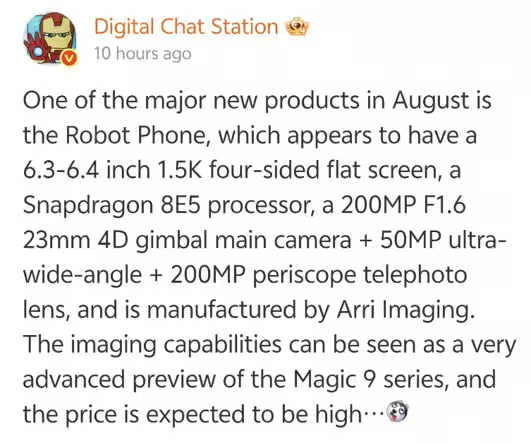
As per popular tipster Digital Chat Station on Weibo, an upcoming Xiaomi flagship featuring a 6.3-inch display and dual 200-megapixel cameras is currently under development. Although the tipster has not revealed the exact model name, the leak is widely believed to be linked to Xiaomi’s next-generation smartphones.

The standard Xiaomi 18 and Xiaomi 18 Pro are expected to maintain a compact form factor, similar to the Xiaomi 17 and 17 Pro. However, the Pro variant is likely to receive the most significant camera upgrades. Based on this, it is believed that the Xiaomi 18 Pro could debut with a dual 200-megapixel camera setup.

Xiaomi may also continue its approach of closely matching hardware between its Pro and Pro Max models. Both the Xiaomi 18 Pro Max could feature the same dual 200-megapixel camera configuration. The Pro Max variant is expected to stand apart with different camera sensors, a larger display, and a bigger battery.

Alongside the primary sensors, a 50-megapixel ultra-wide camera is also tipped to be part of the setup. Both the Xiaomi 18 Pro and Xiaomi 18 Pro Max are also said to feature a more functional secondary display on the rear panel.

In earlier leaks, Digital Chat Station had suggested that the standard Xiaomi 18 may finally get a periscope telephoto camera. This would replace the current telephoto lens and offer improved optical zoom performance.

Xiaomi 18 Series – What Else We Know So Far?

The entire Xiaomi 18 lineup including the Xiaomi 18, Xiaomi 18 Pro, and Xiaomi 18 Pro Max is expected to be powered by the Snapdragon 8 Elite Gen 6 chipset. Meanwhile, the Xiaomi 18 Ultra could launch with a more powerful Snapdragon 8 Elite Gen 6 Pro variant.

Xiaomi 18 series is tipped to debut in China around September, while the Ultra model may arrive at a later date.

FAQs

Q1. What major camera upgrade is expected in the Xiaomi 18 Pro and Pro Max?

Answer. Both models are tipped to feature dual 200MP cameras, along with a 50MP ultra-wide sensor and a functional secondary rear display.

Q2. How will the Xiaomi 18 Pro Max differ from the Xiaomi 18 Pro?

Answer. The Pro Max may include different camera sensors, a larger display, and a bigger battery compared to the Pro variant.

Q3. When is the Xiaomi 18 series expected to launch and what chipset will it use?

Answer. The Xiaomi 18 lineup is expected to debut in China around September, powered by the Snapdragon 8 Elite Gen 6, while the Ultra variant may use the Pro version of the chipset.

Also Read

https://www.mymobileindia.com/xiaomi-pad-8-pro-global-variant-surfaces-on-geekbench-xiaomi-17-europe-price-and-specs-leaked/

https://www.mymobileindia.com/xiaomi-17-and-xiaomi-17-ultra-india-launch-tipped-for-march-2026-xiaomi-17t-expected-in-april/