
Apple is working to release a more affordable Vision headset.
It will potentially cost around $2,000.
The launch is expected to be by next year.
The cheaper headset will likely feature a less powerful A-series chipset.
Apple will drop the expensive EyeSight feature.
A second-generation Vision Pro is expected to arrive in 2026.
A less costly Apple Vision Headset might arrive by next year. (Image credit – Apple)
A few months ago it was reported in the tech circles that Apple had halted its plans for a cheaper Apple Vision headset. We are now getting an update that it might not be true and Apple is well on track on this front.
Bloomberg’s Apple reporter Mark Gurman in his latest Power On newsletter revealed that Apple is still moving ahead with plans to release a more affordable version of its Vision headset.
Gurman also mentions that a release could happen as early as next year. And if Gurman’s words are to be believed, this lower-end Apple Vision headset model is expected to cost around $2,000.
Cheaper ‘Apple Vision’ headset to cost around $2000; drop EyeSight
Earlier this year, Apple introduced the Apple Vision Pro at a premium price of $3,499.
The launch was headline-grabbing across the tech community. It made Apple fans and critics talk about the Apple Vision Pro and its future possibilities for months. It was immediately in the news that the Cupertino giant was also already working on a successor.
However, it was later suggested that Apple had paused further development of the Vision Pro successor to focus on creating a more budget-friendly version.
This makes sense as the high price of the Vision Pro has made spatial computing out of reach for many potential users.
Gurman reports that the cheaper headset will likely feature a less powerful processor and use more affordable materials.
While the Vision Pro is powered by the M2 chip, the lower-end version could come with an A-series chipset, possibly the A18 Pro, which is roughly equivalent to the M1 in terms of performance.
In terms of design, Apple may replace the Vision Pro’s aluminium and glass construction with more plastic components to cut costs.
Moreover, the lower-cost headset is expected to drop the EyeSight feature. This is a unique but expensive display that allows others to see the wearer’s eyes from the outside. While EyeSight was an interesting innovation, it added significant expense, and Apple has decided to leave it out of the more affordable model.
Apple reportedly anticipates that this cheaper version of the Vision headset will sell twice as well as the Vision Pro. However, given the high price of the Pro model, this might not be a huge sales figure.
Meanwhile, a second-generation Vision Pro is also in the works. As per reports, it is expected to arrive in 2026 and will feature a faster processor.
FAQs
Q1. Is Apple still planning to release a cheaper version of its Vision headset?
Answer. Yes, Apple is moving forward with plans to release a more affordable version of its Vision headset, with a potential release as early as next year.
Q2. What changes to expect in the cheaper Apple Vision headset?
Answer. The cheaper headset will likely feature a less powerful processor, possibly the A18 Pro, use more affordable materials, and will drop the EyeSight feature to cut costs.
Q3. When is the second-generation Vision Pro expected to arrive?
Answer. A second-generation Vision Pro is expected to arrive in 2026 and will feature a faster processor.
Apple is reportedly working on smart glasses and AirPods with cameras.
Expected to launch around 2027.
The new products will most likely use Apple’s visual intelligence technology.
The Vision Pro at an Apple retail store. (Photographer: Victor J. Blue/Bloomberg)
Bloomberg’s trusted Apple reporter Mark Gurman is known for accurately revealing Apple-related news sometimes years ago. In his recent newsletter revealed that Apple is apparently working on some new vision-based products. Gurman suggested that the new products include smart glasses and AirPods with cameras.
However, Gurman also mentions that these products are not expected to launch until at least 2027. And there is also a possibility that we might not see them in stores at all.
Apple smart glasses and AirPods with cameras possibly launching in 2027 Image credit -9 to 5 mac
Gurman in his report suggests that Apple is currently looking to make the most of its multi-billion dollar investment in the visual intelligence technology. This is specifically being developed for the Apple Vision Pro.
However, Apple’s ultimate goal is to extend this tech to more devices.
“The idea is to salvage the billions of dollars spent on the Vision Pro’s visual intelligence technology, which can scan the environment around a user and supply useful data,” Gurman mentions.
A hint of this can already be seen with Apple introducing the visual intelligence features on the iPhone 16’s camera. The obvious next move could be to incorporate this visual intelligence tech into a smart glasses format.
The upcoming smart glasses reportedly will be different from the AR glasses with built-in displays. The rumoured smart glasses would instead focus more on having cameras, speakers and microphones. This sounds quite similar to Meta Ray-Ban glasses.
Meta’s smart glasses have gained popularity and are sold at prices starting at $299. These are also available with pricier options.
Smart glasses are not the only new product with visual intelligence we can expect from Apple in future. In addition to the smart glasses project, Apple is also experimenting with AirPods that feature cameras.
It is not entirely clear how camera-equipped AirPods would work or be a compelling product when we compared it to the concept of smart glasses. But it appears Apple is testing this form factor to explore more ways to use visual intelligence features.
FAQs
Q1. What new vision-based products is Apple reportedly working on?
Answer. Gurman suggested that the new products include smart glasses and AirPods with cameras. However, Gurman also mentions that these products are not expected to launch until at least 2027.
Q2. What is the purpose behind Apple’s development of visual intelligence technology?
Answer. Gurman in his report suggests that Apple is currently looking to make the most of its multi-billion dollar investment in the visual intelligence technology. This is specifically being developed for the Apple Vision Pro. However, Apple’s ultimate goal is to extend this tech to more devices.
Q3. How will the rumoured smart glasses differ from AR glasses?
Answer. The upcoming smart glasses reportedly will be different from the AR glasses with built-in displays. The rumoured smart glasses would instead focus more on having cameras, speakers, and microphones.
Well… we cannot decide for you if you should upgrade to the newly launched iPhone or not but we can surely help you figure out the answer to the second question. So, let’s understand if the newly launched iPhone 16 base model is any different from the previous generation iPhone 15 base model.
Yes, it is time for iPhone 16 vs. iPhone 15. Let’s get started.
iPhone 16 vs. iPhone 15 – Key Specs
Feature
iPhone 16
iPhone 15
Display
6.1-inch Super Retina XDR OLED
Resolution
2556×1179 pixels
2556×1179 pixels
Processor
Apple A18
Apple A16 Bionic
RAM
6 GB RAM
6 GB RAM
Storage options
128GB, 256GB, 512GB
128GB, 256GB, 512GB
Rear Cameras
Dual 48MP + 12MP
Dual 48MP + 12MP
Front Cameras
12MP
12MP
Battery
3349mAh (Speculative)
3240mAh (speculative)
Charging
120W Fast Charging
20W Fast Charging
Operating System
iOS 17
iOS 17
Water Resistance
IP68
IP68
iPhone 16 vs. iPhone 15 – Design
iPhone 16 – DesigniPhone 15 – Design
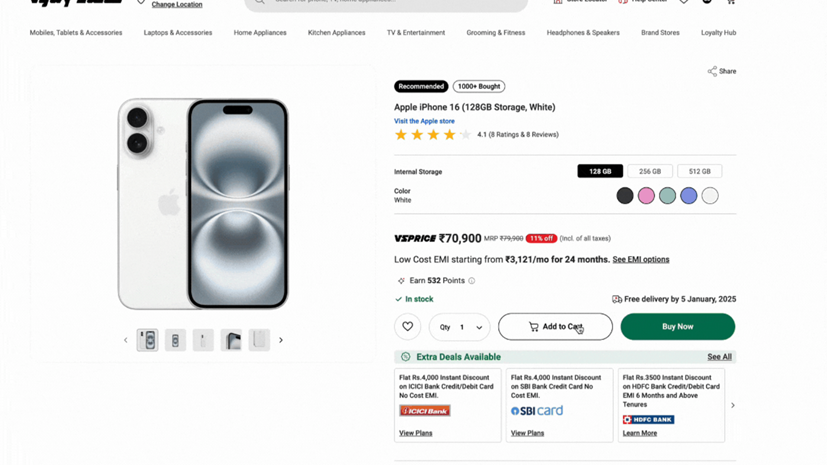
The iPhone 16 has made some useful changes in the overall iPhone design that make it stand out from the previous generation iPhone 15.
One change that has been talked about the most is definitely the new camera module of the iPhone 16.
We have got the vertical alignment of the camera module back after it was last seen in the iPhone 12. There is another aspect of the iPhone 16 that seems to be catching everyone’s attention. It is the Spatial Capture for videos and photos. It allows photos and videos to be viewed with the Apple Vision Pro headset.
Meanwhile, both phones have the same size and squared edges. Both phones have edges slightly curved into the display and back panel. Both iPhone 16 and iPhone 15 also feature aluminium sides and a textured glass back. However, the iPhone 16 comes in brighter and more colourful options.
We also have the Camera Control button in the newly launched iPhone 16. It is located on the lower-right side and can be used as a shutter button for taking photos. It can zoom and focus by sensing scrolling motions.
Both iPhone 16 and iPhone 15 have the Action button.
iPhone 16 vs. iPhone 15 – Price and Colours Available
iPhone 16 Colours AvailableiPhone 15 -Colours Available
Display is where is it hard to find any difference between these two phones. Both iPhone 15 and iPhone 16 share the same 6.1-inch OLED screen with a resolution of 2556 x 1179 and a 60Hz refresh rate.
Both also feature the Dynamic Island at the top of the screen. Moreover, both have the same peak brightness of 1,600 nits and a pixel density of 460 pixels per inch (ppi).
The displays are so identically that the refresh rate also remains the same. Reviewers strongly complain about the slow refresh rate after the iPhone 15 was launched and they are doing the same after iPhone 16.
Basically, no significant difference to compare between the two models when it comes to display.
iPhone 16 vs. iPhone 15 – Camera
iPhone 16- cameraiphone-15 Camera
The actual camera specs of both iPhone 16 and iPhone 16 are nearly identical.
The iPhone 16 has a 48MP f/1.6 main camera that is called the Fusion Camera. Meanwhile, the predecessor iPhone 15 also has the same 48MP f/1.6 main camera that Apple has only given a different name called the Main Camera. Several reviewers have highlighted that specs and performance-wise both cameras are actually the same.
The camera system on the iPhone 16 also has the capability of taking 12MP photos at 2x zoom. But what’s interesting is that the iPhone 15 camera system has the same shooting capability.
Moreover, both phones also have the same 12MP f/2.4 ultra-wide camera and a 12MP f/1.9 TrueDepth front camera.
So as you can see, there is no major difference in terms of hardware in both these phones.
However, one difference that makes the iPhone 16 camera stand out is the new Camera Control feature.
Apple has added a capacitive button on the lower right side of the newly launched iPhone 16. This button works as a camera shutter and gives a unique photography experience. It also provides physical feedback through clicks or haptics and supports touch gestures.
What also makes this interesting is the Camera Control will also be able to activate Visual Intelligence after Apple Intelligence is rolled out along with iOS 18.1 and later updates.
This is where the iPhone 15 might feel inferior with no Camera Control feature. Moreover, the iPhone 15 camera also won’t support Apple Intelligence or Visual Intelligence.
iPhone 16 vs iPhone 15 – Battery
iPhone 15 – BatteryiPhone 16 – Battery
It is well-known that Apple never shares the exact battery details including the charging speed. However, experts usually depend on tests and benchmarks to speculate about iPhone battery capacity and charging speeds.
According to Apple benchmarks, the iPhone 16 can handle up to 22 hours of video playback. Meanwhile, the same test for iPhone 15 reveals around 20 hours of playback.
GSMArena has suggested that the iPhone 16 has a 3,561mAh battery. In comparison, the iPhone 15 comes with a 3,349mAh battery.
As for the charging speed, the most popular speculation says that the iPhone 16 supports 45W charging with the official site mentioning a “30W adapter or higher.” The iPhone 16 also supports 30W or higher MagSafe charging and Qi wireless charging at up to 7.5W.
iPhone 15 on the other hand supports adapters rated 20W or higher, 15W MagSafe chargers and the same 7.5W Qi wireless charging.
iPhone 16 vs iPhone 15 – Verdict
Display: Both have 6.1-inch Super Retina XDR OLED.
Resolution: Same at 2556×1179 pixels.
Processor: iPhone 16 uses Apple A18 and iPhone 15 uses Apple A16 Bionic.
RAM: Both have 6GB.
Storage Options: Same at 128GB, 256GB, 512GB.
Rear Cameras: Both have dual 48MP + 12MP.
Front Camera: Both have 12MP.
Battery: iPhone 16 has 3349mAh and iPhone 15 has 3240mAh.
Charging: iPhone 16 supports 120W Fast Charging and iPhone 15 supports 20W Fast Charging.
Yes, Water resistant (up to 30 minutes in a depth of 6 meter), IP68
Ruggedness
Dust proof
Camera
Camera Setup
Dual
Resolution
48 MP f/1.6 (Wide Angle, Primary Camera)
Ultra-Wide Angle Camera
12 MP f/2.2
Autofocus
Yes, Dual Pixel Phase Detection autofocus
OIS
Yes
Flash
Yes, Dual-color LED Flash
Image Resolution
8000 x 6000 Pixels
Shooting Modes
Continuous Shooting, HDR, Burst mode, Macro Mode
Video Recording
3840×2160 @ 60 fps, 1920×1080 @ 240 fps
Video Features
Slo-motion, HDR, Night Time-Lapse, Macro Video, Action Mode
Battery
Capacity
3561 mAh
Type
Li-ion
Removable
No
Wireless Charging
Yes
Quick Charging
Yes, Fast, 20W: 50% in 30 minutes
USB Type-C
Yes
FAQs
Q1. What processors do the iPhone 16 use?
Answer. The iPhone 16 uses the latest Apple A18 chip.
Q2. What is different in the display sizes of the iPhone 16 and iPhone 15?
Answer. Both the iPhone 16 and iPhone 15 feature a 6.1-inch Super Retina XDR OLED display.
Q3. How much RAM do the iPhone 15 have?
Answer. The iPhone 15 and iPhone 15 Plus are the last iPhones to feature 6 GB of RAM.
Q4. Are the batteries of the iPhone 16 and iPhone 15 the same?
Answer. iPhone never reveals the exact specs of battery and charging. However, benchmarking and industry reports suggest that the iPhone 16 has a 3349mAh battery and the iPhone 15 has a 3240mAh battery.
Q5. What are the main camera specifications for the iPhone 16 and iPhone 15?
Answer. Both iPhone 15 and iPhone 16 feature near identical dual rear camera setup with 48MP + 12MP sensors.
Reliance Retail enters the quick commerce market with JioMart.
Starts offering no-fee delivery in select areas.
To challenge competitors like Blinkit, Swiggy’s Instamart, and BigBasket.
Reliance Retail enters the quick delivery industry, to rival Swiggy and Blinkit. (Image credit – JioMart)
Reliance Retail is entering India’s fast-growing quick commerce market. The group is set to challenge existing players such as Zomato-owned Blinkit, Swiggy’s Instamart and Tata’s BigBasket.
JioMart has already started offering quick delivery services in select parts of Navi Mumbai and Bengaluru. Experts believe JioMart is set to capture a significant share of the quick delivery market in no time.
It appears Reliance is adopting a strategy similar to what Reliance Jio did in the telecom sector. JioMart is setting itself apart from its competitors by offering a no-fee delivery model.
Here’s what JioMart is doing differently –
Free Delivery: No delivery charges, regardless of order size.
No Platform or Surge Fees: Customers won’t be charged extra during peak hours or for smaller orders.
The no-fee approach would definitely be more appealing to price-conscious shoppers or even to people who order more than once times in a week. This will be a good strategy to establish itself in smaller towns and cities where such services are less common.
The no-fee service could also draw in customers currently using Blinkit, Swiggy Instamart and BigBasket. All these platforms currently charge platform fees or delivery fees or sometimes both.
Industry experts believe that the key part of Reliance Retail’s expansion plan is to focus on areas where quick commerce companies have limited or no presence.
According to a report by the Times of India, the company aims to expand to smaller cities and towns covering 1150 cities and over 5000 pin codes across India. JioMart is aiming to gain a significant edge over competitors by targeting these under-served regions.
There is an advantage that Reliance Retail has. It does not have to worry about investing in building new infrastructure such as dark stores or neighbourhood warehouses. The company will reportedly use its existing network of retail stores and leverage its logistics service Grab to handle fast deliveries.
Reliance Retail also has plans to broaden its portfolio as they are preparing to deliver items such as fashion and small electronic products as well in quick delivery as well.
The company already has a network of Reliance Digital and Trends stores to fulfil a wide variety of orders within 10 to 30 minutes.
FAQs
Q1. What strategy is JioMart competing with Blinkit and Swiggy Instamart?
Answer. JioMart is setting itself apart by offering a no-fee delivery model, which means no delivery charges, no platform or surge fees, regardless of order size or time.
Q2. How is Reliance Retail planning to expand JioMart’s quick commerce services?
Answer. Reliance Retail aims to expand JioMart’s quick commerce services to smaller cities and towns, covering 1150 cities and over 5000 pin codes across India, leveraging its existing network of retail stores and logistics services.
Q3. What products JioMart will have in its quick delivery service?
Answer. Apart from groceries, Reliance Retail plans to broaden JioMart’s portfolio to deliver fashion and small electronic products, using its network of Reliance Digital and Trends stores.
Q4.What are the highlights of delivery by JioMart differentiating it from Swiggy , Blinkit ?
Answer •Reliance is not setting up dark stores or neighborhood warehouses.
•It will operate through the existing store network and acquired logistics service, Grab, to deliver orders.
•With a wider product range of 10,000-12,000 stock keeping units, Reliance aims to cover 1,150 cities spanning 5,000 pin codes.
•Reliance will offer zero delivery fees, platform fees, and surge fees, regardless of the order value.
Q5.What are the new product offerings by JioMart?
Answer.JioMart’s quick commerce services initially focus on groceries, Reliance Retail is also preparing to expand its product categories. They may also start delivering fashion and small electronic products in its quick commerce offerings. With its extensive network of retail stores like Reliance Digital and Trends, the company can fulfill a wide variety of orders within 10 to 30 minutes.
Mr Noel Tata has been appointed Chairman of Tata Trusts.
He will oversee the Rs 30 lakh crore Tata Group empire.
Noel Tata has significant experience in Tata companies.
Noel Tata is the new Tata Trusts chairman. (Photo credit – Unknown)
Mr Noel Tata has been named the new Chairman of Tata Trusts. The half-brother of late Mr Ratan Tata will be overseeing the Rs 30 lakh crore Tata Group empire. The decision regarding his appointment was made unanimously at a meeting in Mumbai on Friday following the passing of Mr Ratan Tata on Thursday at the age of 86.
Mr Noel Tata currently serves as Chairman and Non-Executive Director of Tata International Limited. He also chairs Tata Investment Corporation and is a trustee of the Sir Dorabji Tata Trust and the Sir Ratan Tata Trust. Both trusts together hold a 66 per cent stake in Tata Sons, the holding company of the Tata Group.
Noel has played a key role in transforming the Tata group’s retail division called Trent. It went from a single store in 1998 into a successful chain with over 700 stores across India.
Noel Tata has also served as Vice Chairman of both Titan Company and Tata Steel. He has also held the board position at Voltas.
As Managing Director of Tata International Limited, he led the company’s growth and has been often credited for increasing its revenue from $500 million to over $3 billion between 2010 and 2021.
I am deeply honoured and humbled by the responsibility that has been cast on me by my fellow trustees. I look forward to carrying on the legacy of Ratan N Tata and the founders of the Tata Group,’’ Noel Tata said in a statement.
I look forward to carrying on the legacy of Mr. Ratan N. Tata and the Founders of the Tata Group. Founded mor“e than a century ago, the Tata Trusts are a unique vehicle for undertaking social good. On this solemn occasion, we rededicate ourselves to carrying on our developmental and philanthropic initiatives and continuing to play our part in nation building,” Noel Tata said.
More About Mr Noel Tata
Noel Naval Tata appointed as Chairman of all the Trusts that constitute the Tata Trusts and also designated Chairman, Tata Trusts.
Press Release: pic.twitter.com/bwCsTe3Uz0
— Tata Trusts (@tatatrusts) October 11, 2024
Noel was born to Naval Tata and has been closely tied to the Tata family for many years.
His vast experience across different Tata companies and successful stint in leadership roles made him a natural successor to Ratan Tata.
Noel is a graduate of Sussex University in the UK. He has also completed the International Executive Programme from INSEAD.
On the personal front, Noel Tata’s family is also deeply connected to the Tata Group. His wife Aloo Mistry is the daughter of Pallonji Mistry, the man known for being the the largest individual shareholder in Tata Sons.
Their son Neville Tata joined Trent in 2016 and now leads Star Bazaar.His eldest daughter Leah Tata is Vice President at Indian Hotels Company Limited. Meanwhile, his other daughter Maya works at Tata Capital.
FAQs
Q1. What is Noel Tata’s current role within the Tata Group?
Answer. Mr Noel Tata has been named the new Chairman of Tata Trusts. He currently serves as Chairman and Non-Executive Director of Tata International Limited. He also chairs Tata Investment Corporation and is a trustee of the Sir Dorabji Tata Trust and the Sir Ratan Tata Trust.
Q2. What experience does Noel Tata have in the company?
Answer. Noel Tata has significant experience in Tata companies, including serving as Chairman of Tata International Limited, Tata Investment Corporation, and as Vice Chairman of Titan Company and Tata Steel. He is credited for transforming the Tata group’s retail division, Trent, and significantly growing Tata International Limited’s revenue.
Q3. How is Noel Tata’s family connected to the Tata Group?
Answer. Noel Tata’s wife, Aloo Mistry, is the daughter of Pallonji Mistry, the largest individual shareholder in Tata Sons. Their son, Neville Tata, leads Star Bazaar; Leah Tata is Vice President at Indian Hotels Company Limited; and their daughter Maya works at Tata Capital.
Q4.Who is Noel Tata & how is he related to Ratan Tata?
Answer. Noel Tata, an Irish citizen, is known for his simple profile , concentrating on operations rather than focusing on being in the public limelight .
He is on the boards of many Tata Group companies.
Noel is the son of Naval Tata and Simone Tata. Naval was previously married to Soonoo Commisariat, with whom he had two children, Ratan and Jimmy Tata. Noel is married to Aloo Mistry, daughter of the late Pallonji Mistry and sister of the late Cyrus Mistry. The couple has three children: daughters Leah and Maya, and son Neville.
Since 2019, Noel has been on the boards of the Sir Ratan Tata Trust and Sir Dorabji Tata Trust. His children were appointed trustees of various trusts linked to these foundations in 2023.
Q5.What was the current role of Noel Tata?
Answer.Noel is currently the chairman of Trent, Tata International, Voltas, and Tata Investment Corporation. He is also vice chairman of Tata Steel and Titan Company Ltd.
Q6.How did the Noel Tata start his career ?
Answer.He started his career at Tata International and later became managing director of Trent in 1999, where he led the expansion of the Westside retail chain.
Q7.Why is Noel Tata selected to chair Tata Trusts?
Answer.Noel Tata was earlier considered a candidate to head Tata Sons when Ratan Tata was retiring in 2012.
His brother-in-law, Cyrus Mistry, was selected for the role at that time .
In 2016, after a gap between Ratan Tata and Mistry, Mistry was replaced as chairman by Natarajan Chandrasekaran. Mistry died in a car accident in 2022.
Noel Tata was appointed to head Tata Trusts at a meeting in Mumbai.
Poco will shut down its official website and regional sites soon.
It will move all products and services to Xiaomi’s website starting 31 December 2024.
The Poco Store app will also stop working.
Poco India’s website will continue to operate as of now.
Poco announces to shut down its website on December 31st. (Image credit – Poco)
Well, it appears some behind-the-scenes changes are taking place in the smartphone industry. As per recent reports, Poco will soon shut down its official Poco website (po.co) and all its regional sites (like /global, /uk, and /fr).
It might sound alarming initially but let us calm you down and say that Poco is not going away. This is a purely business decision where Poco is reportedly moving all its products and services to Xiaomi’s website.
The change is expected to be smooth and Poco users won’t experience major disruptions.
All customer support, products and services will be seamlessly transferred to Xiaomi’s official website (mi.com/global).
As per the announcement, the change in Poco’s online portfolio is taking place starting 31 December 2024.
Many in the industry have been surprised by the announcement. This is more so because Xiaomi has always highlighted the separation between its different brands including Xiaomi, Redmi and Poco.
Poco Products Moving to Xiaomi’s Website
The transition of Poco products to the Xiaomi website will begin on 21 October 2024. It is being reported that after that customers won’t be able to make any purchases on Poco’s website.
As for those who are part of Poco’s loyalty program, the brand will transfer your Poco Points and other loyalty rewards to Xiaomi’s ecosystem.
Coupons you may have will also be reissued by December 12 ensuring they remain valid.
Moreover, all previous orders, tracking details and user reviews from the Poco site will be moved to Xiaomi’s platform automatically.
Users won’t need to take any extra steps to ensure their data is carried over.
After December 31, anyone trying to Poco’s website will be redirected to the relevant page on Xiaomi’s site.
It is important to note that the standalone Poco Store app will not be part of this migration.The app will stop working once the website shuts down.
Why Poco is Moving to Xiaomi’s Website?
Xiaomi has been working for a while to streamline its online presence. The recent announcement of Poco shifting its portfolio to Xiaomi is also part of the same plan.
Many Poco smartphone models in the market today are very similar to Redmi models.
This transition will most likely not change anything significant for the users.
Importantly, Poco India’s website (poco.in) will continue to operate for now.
FAQs
Q1. When will the transition of Poco products to Xiaomi’s website begin?
Answer. The transition of Poco products to the Xiaomi website will begin on 21 October 2024. Customers won’t be able to make any purchases on Poco’s website after that.
Q2. What will happen to Poco’s loyalty program points and rewards?
Answer. As for those who are part of Poco’s loyalty program, the brand will transfer your Poco Points and other loyalty rewards to Xiaomi’s ecosystem. Coupons will also be reissued by December 12 to remain valid.
Q3. Will the Poco Store app continue to work after the website shutdown?
Answer. The standalone Poco Store app will not be part of this migration. The app will stop working once the website shuts down.
Reliance Jio launches new international calling packs starting at Rs 39.
Available for both prepaid and postpaid users from 10 October 2024.
The new packs are country-specific and calling only.
Jio launches budget-friendly ISD plans starting at just Rs 39. (Image credit – Jio)
International calling is mostly equally expensive no matter which network you choose. Telecom companies time and again introduce new plans to provide relief to their user base from high costs. However, the cost of international packs remains high.
The latest attempt to reduce international pack costs comes from Reliance Jio. Here’s what we know about the latest announcement.
The Telecom giant Reliance Jio has recently introduced new international calling packs. The aim is to offer an affordable way for their customers to stay connected with friends and family abroad. These new country specific International packs now start at just Rs 39.
The plans will be available for both prepaid and postpaid customers.
The company has rolled out seven different ISD packs. The plans depend on the country you’re calling. It is important to note that these plans are for calling only. This means they provide calling minutes only and do not include any data or internet usage benefits.
The Jio International plans will be available from 10 October 10 2024.
Details of Reliance Jio ISD Packs
Reliance Jio announces new country-specific International packs starting at Rs 39
The lowest-priced plan at Rs 39 is available for customers calling anyone in the USA or Canada. It includes 30 minutes of talk time.
For calling the UAE, Saudi Arabia, Kuwait, Turkey and Bahrain, there’s a Rs 99 plan that provides 10 minutes of calling.
For those looking to call Singapore, Thailand, Malaysia or Hong Kong, a Rs 59 pack offers 15 minutes of call time.
Reliance Jio New ISD Plans Announced Starting At Just Rs. 10
Here is the complete list of ISD packs and the countries covered:
Rs 39 pack: 30 minutes for the USA and Canada
Rs 99 pack: 10 minutes for UAE, Saudi Arabia, Kuwait, Turkey, Bahrain
Rs 59 pack: 15 minutes for Singapore, Thailand, Malaysia, Hong Kong
All these packs will especially provide an affordable solution for international calls. They will allow Jio postpaid and prepaid customers to connect with loved ones living abroad without worrying about high costs.
ISD pack
Countries
Benefits (Minutes)
39
USA, Canada
30
49
Bangladesh
20
59
Singapore, Thailand, Malaysia, Hong Kong
15
69
Australia, New Zealand
15
79
UK, Germany, France, Spain
10
89
China, Bhutan, Japan
15
99
UAE, Saudi Arabia, Turkey, Kuwait, Bahrain
10
FAQs
Q1. What is the starting price for Reliance Jio’s new international calling packs?
Answer. The lowest-priced plan at Rs 39 is available for customers calling in the USA or Canada. It includes 30 minutes of talk time.
Q2. Are the new Jio international calling packs available for both prepaid and postpaid users?
Answer. The new plans will be available for both prepaid and postpaid customers. The Jio new International plans will be available from October 10, 2024.
Q3. What are the details of the Rs 99 international calling pack?
Answer. For calling the UAE, Saudi Arabia, Kuwait, Turkey, and Bahrain, there’s a Rs 99 plan that provides 10 minutes of calling.
Best Redmi Phones Under 30K – Redmi Note 13 Pro Plus, Redmi K50i, Mi 11T Pro, Redmi Note 12 Pro and Redmi Note 11 Pro Plus.
Redmi being the sub-brand of Xiaomi has managed to create space for itself with its lineup of entry-level and mid-range devices. The popularity of the brand has grown over time with recent reports suggesting Xiaomi’s shipments grew by 24 per cent annually.
The brand currently has entry-level Redmi phones, mid-range Redmi Note phones and high-end Redmi K phones. If you are wondering what type of mid-rangers Redmi has to offer, we have shortlisted 5 best Redmi phones under ₹30000. This list of phones will give you a quick glimpse at Redmi’s mid-range portfolio and you can have your pick for the October 2024 festive season upgrade.
Xiaomi Redmi Note 13 Pro Plus
Xiaomi Redmi Note 13 Pro Plus (Image – MI)
The highlight of the Redmi Note 13 Pro Plus has to be the flagship-level 200MP main camera. It supports Super QPD for faster and more accurate focusing. There is also complete support of OIS and EIS, which dramatically improves anti-shaking performance and enhances your photography. Moreover, the flagship-level 7P lens with ALD and up to 16-in-1 pixel binning is brilliant. It allows for a maximum pixel size of 2.24μm providing clear and dynamic nighttime imaging.
And the massive 6.67-inch AMOLED display makes sure every photo you take looks extra sharp on the phone screen.
Key Specifications –
67″ (16.94 cm) 120Hz AMOLED Display
MediaTek Dimensity 7200 Ultra Octa-core Processor
200+8+2 MP Rear Camera
16 MP Front Camera
8 GB RAM
256 GB Internal Storage
5000 mAh Battery
120W Fast Charging
Dual SIM: 5G & 5G
Android v13
Xiaomi Redmi Note 13 Pro Plus 5G price in India starts from ₹24,999. The smartphone is available in Fusion White, Fusion Purple and Fusion Black colour.
Xiaomi Redmi K50i
Xiaomi Redmi K50i (Image – MI)
Xiaomi Redmi K50i comes packed with MediaTek Dimensity 8100 processor, which is designed for powerful performance with 5nm Architecture. It scores 822274 on AnTuTu benchmarking. There is also LiquidCool2.0 technology that helps maintain an appropriate temperature even when you multitask or indulge in heavy gaming. It also has an X-axis Vibration Motor for flagship haptics for an enhanced experience. It comes with a 144Hz liquid FFS display and offers a great visual experience.
Key Specifications –
MediaTek Dimensity 8100 Octa-core Processor
6″ (16.76 cm) 144Hz IPS LCD Display
64+8+2 MP Rear Camera
16 MP Front Camera
6 GB RAM
128 GB Internal Storage
5080 mAh Battery
67W Fast Charging
Dual SIM: 5G & 4G
Android v12
Xiaomi Redmi K50i price in India starts from ₹22,999. It is available in Phantom Blue, Stealth Black and Quick Silver colour.
Xiaomi Mi 11T Pro
Xiaomi Mi 11T Pro. (Image credit – MI)
Xiaomi claims 11T Pro offers professional-grade videography capabilities with its pro-grade cameras that enable Pro-grade HDR10+ filming. It also has professional special effects and creative options for users to explore their creativity to endless possibilities. The camera setup also packs a super large image sensor, 2.1μm 9-in-1 Super Pixel and Dual Native ISO.
Moreover, Xiaomi claims the “5nm processor improves CPU performance by 25% and GPU performance by 35% compared to the previous generation. This allows for breakthrough performance and more efficient power consumption.”
Key Specifications
67″ (16.94 cm) 120Hz AMOLED Display
Snapdragon 888 Octa-core Processor
108+8+5 MP Rear Camera
16 MP Front Camera
8 GB RAM
128 GB Internal Storage
5000 mAh Battery
120W Fast Charging
Dual SIM: 5G & 4G
Android v11
Xiaomi Mi 11T Pro 5G 12GB RAM price in India starts from ₹22,999. The phone is available in Celestial Blue, Moonlight White and Meteorite Black colour.
Xiaomi Redmi Note 12 Pro
Xiaomi Redmi Note 12 Pro (Image credit – MI)
Xiaomi Redmi Note 12 Pro packs a 120Hz Pro AMOLED Display that features 1.07 billion colours, HDR10+ support, Dolby Vision and 1920Hz PWM Dimming. It is a perfect phone for a multimedia experience with Dual Stereo Speakers and Hi-Res Audio support. MediaTek Dimensity 1080 5G is good for most tasks including multitasking and heavy gaming. The phone has HyperEngine 3.0, Higher CPU Frequency, 10 5G Band Support and a 6nm process for optimum performance.
Key Specifications
67″ (16.94 cm) 120Hz AMOLED Display
MediaTek Dimensity 1080 Octa-core Processor
50+8+2 MP Rear Camera
16 MP Front Camera
6 GB RAM
128 GB Internal Storage
5000 mAh Battery
67W Fast Charging
Dual SIM: 5G & 5G
Android v12
Xiaomi Redmi Note 12 Pro 5G 12GB RAM price in India starts from Rs. 21,999. The smartphone is available in Onyx Black, Glacier Blue and Stardust Purple colour.
Xiaomi Redmi Note 11 Pro Plus
Xiaomi Redmi Note 11 Pro Plus. (Image credit – MI)
Xiaomi Redmi Note 11 Pro Plus boasts a super smooth huge AMOLED eye-care display. It features a DCI-P3 Color Gamut, 1200 nits peak brightness, 360° light sensor, a reading mode and 4,500,000:1 contrast. Redmi has also partnered with world-class audio brand JBL to provide a great audio experience as well. Moreover, it has a Snapdragon 695 for powerful performance.
The phone features a feature a vapour chamber cooling system that helps keep the phone at normal temperature even during heavy usage. The phone offers extraordinary fast charging capabilities. You will be able to charge your Xiaomi Redmi Note 11 Pro Plus to 100% in only 15 minutes under Boost mode with the lightning-fast 120W HyperCharge. The phone has earned TÜV Rheinland Safe Fast-Charge System Certification.
Key Specifications
67″ (16.94 cm) 120Hz AMOLED Display
Snapdragon 695 Octa-core Processor
108+8+2 MP Rear Camera
16 MP Front Camera
6 GB RAM
128 GB Internal Storage
5000 mAh Battery
67W Fast Charging
Dual SIM: 5G & 4G
Android v11
Xiaomi Redmi Note 11 Pro Plus 5G price in India starts from ₹20,999. It is available in Phantom White, Mirage Blue and Stealth Black colour.
FAQs
Q1. What are the standout features of the Redmi Note 13 Pro Plus?
Answer. The Redmi Note 13 Pro Plus boasts a 6.67-inch AMOLED display with a 120Hz refresh rate, 200MP main camera with OIS, MediaTek Dimensity 7200 Ultra chipset, 5000mAh battery with 120W HyperCharge and IP68 dust/water resistance.
Q2. What makes the Redmi K50i a good choice for gamers?
Answer. The Redmi K50i features a 6.6-inch FFS LCD display with a 144Hz refresh rate, MediaTek Dimensity 8100 chipset, 64MP triple camera and 67W Turbo Charge. Its LiquidCool 2.0 technology keeps the device cool during extended gaming sessions.
Q3. What are the key features of the Mi 11T Pro?
Answer. The Mi 11T Pro comes with a 6.67-inch AMOLED display with a 120Hz refresh rate, 108MP main camera, Snapdragon 888 chipset, 5000mAh battery with 120W charging, and Dolby Vision and Dolby Atmos for enhanced audio and visual experience.
Q4. What are the main features of the Redmi Note 12 Pro?
Answer. The Redmi Note 12 Pro features a 6.67-inch AMOLED display with a 120Hz refresh rate, 50MP Sony IMX766 main camera with OIS, MediaTek Dimensity 1080 chipset, 5000mAh battery with 67W Turbo Charge and IP53 dust/splash resistance.
Q5. What are the standout features of the Redmi Note 11 Pro Plus?
Answer. The Redmi Note 11 Pro Plus includes a 6.67-inch AMOLED display with a 120Hz refresh rate, 108MP main camera, Snapdragon 732G chipset, 5000mAh battery and Dolby Vision for enhanced visual quality.
Boult recently launched the Retro Amp X40 speaker in India.
It uses Bluetooth 5.3 and supports multiple inputs such as auxiliary (AUX), USB and TF card inputs.
Available at the introductory price of ₹2,999.
Homegrown audio brand Boult has been expanding its portfolio for a while now.
It recently unveiled the new Boult Retro Amp X40 speaker that we have managed to get our hands on.
Available at the introductory price of ₹2,999, the speakers are designed to offer users a classic vintage design with strong audio performance.
The new Retro Amp x40 is now available on Flipkart and Boult’s official website. In case you are wondering whether these speakers will suit your requirements, we are sharing our in-depth review of Retro AMP x40 after thorough use. So, without further ado, let’s get to it.
Boult Retro AMP x40 Speaker – Key Features
BoomX Dual Drivers
40W Rated Output
Bluetooth v5.3
EDR Support
Master Panel Control
FM Mode
Multiple Inputs – USB-C, TF Card, Aux, USB
10 Hours Playtime
Universal Compatibility
Boult Retro AMP x40 Speaker Unboxing Video
Boult Retro AMP x40 Speaker – Pros & Cons
Pros
Cons
● Classic retro design with leather body
● Easy-to-use control panel
● Good sound quality
● Good battery life
● Multiple input modes – USB-C, TF Card, Aux, USB
● Bass quality could have been better
● No app support
Boult Retro AMP x40 Speaker – Design and Build Quality
The Boult Retro AMP X40 speakers give a charming vintage vibe. We loved the black and gold colour combination with retro styling.
It has a classic rugged leather body that Boult has clearly designed to give the speakers a more timeless appeal. The copper accents add a touch of elegance. It will definitely stand out in any room.
The overall design is minimalistic and doesn’t feel too busy. Detailing is also very nice.
The Boult branding is subtly placed in the front bottom right corner, blending in nicely without taking away from the retro look.
The master control panel is on the top. The position is easy to access and adds to the classic feel.
It looks and feels sturdy. Despite that, the speaker is lightweight and portable. You wouldn’t face any problem moving around the house with the speakers or taking to outdoors for gatherings as well.
Boult Retro AMP x40 Speaker – Sound Quality
We have to say, the sound quality of the Boult Retro AMP X40 speaker is better than what we expected.
These speakers are meant for regular home and personal use. You can surely stretch the scope and use it for small parties or personal home gatherings.
The studio-quality bass is good for casual listening. Boult claims it has a 40W output, which makes it suitable for small areas.
If you are someone who likes a more balanced sound in your everyday use, these speakers will be perfect for you. However, if you are expecting deep and booming bass then it might feel disappointed as it lacks the extra punch.
We also felt the overall audio loudness could have been better. For those who enjoy cranking up the volume for parties or larger spaces, Retro AMP x40 might feel a bit underwhelming.
But anyhow, for indoor or personal settings, it is a good choice and will get the job done.
Boult Retro AMP x40 Speaker – Features and Connectivity
The Boult has packed Retro AMP X40 speakers with many convenient features.
It comes with Bluetooth v5.3. The connection via Bluetooth is fast and stable. The instant pairing works smoothly and makes it easy to connect any device without any hassle.
The speakers also have multiple input modes. You can connect to it via USB-C, TF card, Aux or regular USB. This makes it super convenient for playing music from different devices. You can use your phone or a memory card or even a laptop.
It also supports EDR to ensure proper data transfer for smoother audio playback.
Another thing that makes this speaker versatile is its universal compatibility.
You can connect Retro AMP x40 to any type of device. Whether it is a laptop, a mobile, a computer, a projector, a gaming console, or even a smart TV. This speaker works seamlessly and has universal compatibility.
It also comes with FM mode adding a nice touch. It is perfect for those who enjoy tuning into their favourite radio stations now and then without needing extra devices.
Boult Retro AMP x40 Speaker – Battery Life
The Boult Retro AMP X40 speakers offer good battery life.
The company claims up to 10 hours of playtime. However, the actual battery performance depends on a lot of factors. As is the case with most speakers, the actual battery performance depends on the volume level.
We have continuously used Retro AMP x40 for days and we have managed to squeeze around 7 hours of playback on an average. This is when we kept the medium. This is still good for a speaker this size.
The battery power is enough to get you through a long day of casual listening. You can also expect the speakers to fully support a small gathering without needing to recharge frequently.
Verdict – Should You Buy Boult Retro AMP x40?
The Boult Retro AMP X40 is a perfect choice of speaker if you are looking for a stylish and vintage-looking speaker that gives a balanced sound for everyday use.
Its classic leather design and portability make it both functional and decorative. It offers a full spectrum of sound that is perfect for home or personal use. It comes with versatile connectivity options and is ideal for multiple devices.
In the end, it’s a solid option for casual listeners who value design and convenience.
Reasons to Buy
Reasons to Buy
Stylish Design
Multiple Input Modes Available
Balanced Sound
Portable
Universal Compatibility
Reasons Not to Buy
Reasons Not to Buy
Underwhelming bass
Loudness is limited
Alternatives to Boult Retro AMP x40 Speaker
Zebronics Sargam
Zebronics Sargam
Key features –
20 Watts Portable Wireless Bluetooth Speaker
Retro Design
5mm Mic Port
Vegan Leather Carry Handle
Dual Drivers
USB
FM Radio
Built-in Rechargeable Battery
Price – ₹1,998
Philips Audio TAS2218/94
Key features –
10W 2.0 Ch Bluetooth Speaker
Retro Wooden Design
Aesthetic Look
Long Lasting Battery Life
Multipoint Connectivity – Bluetooth, USB, FM, Mic Input
Price – ₹2,398
TYNIMO Retro Mini Portable Bluetooth Speaker,
Key features –
TWS Stereo Sound
High Fidelity Speakers
Vintage Classical Music Player – TF/AUX/USB/Type-C
Ideal for Gifting
Price – ₹1,149
FAQ
Q1.What is the Bluetooth version of the Boult Retro AMP X40 speakers?
Answer. The speakers come with Bluetooth v5.3, offering stable connectivity and instant pairing.
Q2. Can I use the speakers with multiple devices?
Answer. Yes, the speakers are universally compatible with laptops, mobiles, gaming consoles, projectors, smart TVs, and more.
Q3. What are the input modes available?
Answer. The Boult Retro AMP X40 supports USB-C, TF card, Aux, and USB inputs, giving you multiple ways to connect.
Q4. How long does the battery last?
Answer. The company claims 10 hours, but in practical use, you can expect around 7 hours depending on the volume level.
Q5. Does it have FM mode?
Answer. Yes, the speaker comes with an FM mode, allowing you to listen to radio stations without extra devices.
Our picks for October 2024 in the best phones under ₹1,00,000 category are now revealed.
It includes – Samsung Galaxy S24 Ultra, Motorola Razr 50 Ultra, Vivo X100 Pro 5G, Apple iPhone 16 Plus and Samsung Galaxy Z Fold 4 5G.
Are you planning to upgrade your smartphone this festive season and can manage to stretch the budget to around ₹100000? The line-up of high-end phones that fall into this category is usually not many.
However, the variety is still enough to confuse you. To help you decide, we have hand-picked for October 2024.
Whether you’re into gaming, photography or just looking for a high-end smartphone upgrade, we’ve got you covered.
Let’s explore our hand-picked best phones under ₹1,00,000.
Samsung Galaxy S24 Ultra
Samsung Galaxy S24 Ultra (Image credit – Samsung)
Galaxy S24 Ultra comes with a new titanium exterior and a 17.25cm flat display. It has a Built-in S Pen taking the legacy of Galaxy Note forward.
A quad camera setup with 200MP Wide-angle & 2x Optical Quality Zoom is one of the biggest highlights of this phone.
The other major highlight is the Galaxy AI, which brings forth several AI-powered features to the smartphone for easy access.
Key Specification –
8-inch (17.27 cm) 120Hz Dynamic AMOLED 2x Display
Snapdragon 8 Gen 3 Octa-core Processor
200+12+10+50 MP Rear Camera
12 MP Front Camera
12 GB RAM
256 GB Internal Storage
5000 mAh Battery
45W Fast Charging
Dual SIM: 5G & 5G
Android v14 OS
Samsung Galaxy S24 Ultra price in India starts from Rs. 98,799. It is available in Titanium Black, Titanium Gray, Titanium Violet, Titanium Blue, Titanium Green and Titanium Yellow colour.
Motorola Razr 50 Ultra
Motorola Razr 50 Ultra (Image credit – Motorola)
Motorola Razr 50 has the largest and most intelligent external display on any flip phone.
The external display also provides easy access to the Google Gemini app. The camera placement on the phone is also a great advantage as it allows you several ways of capturing photos.
The 6.9-inch pOLED display comes with a 165Hz refresh rate. It also comes with Moto Buds+ in the box.
Key Specifications
9″ (17.53 cm) 165Hz P-OLED Display
Snapdragon 8s Gen 3 Octa-core Processor
50+50 MP Rear Camera
32 MP Front Camera
12 GB RAM
512 GB Internal Storage
4000 mAh Battery
45W Fast Charging
Dual SIM: 5G & 5G
Android v14 OS
Motorola Razr 50 Ultra price in India starts from Rs. 89,999. It is available in Spring Green, Peach Fuzz and Midnight Blue colour.
It comes with a great triple camera setup, which includes a ZEISS Telephoto Camera. It comes with an 8T LTPO Eye protection display that provides a smooth and safe viewing experience.
It also has a power consumption control feature to manage effective power consumption.
Key Specifications
78″ (17.22 cm) 120Hz AMOLED Display
MediaTek Dimensity 9300 Octa-core Processor
50+50+50 MP Rear Camera
32 MP Front Camera
16 GB RAM
512 GB Internal Storage
5400 mAh Battery
100W Fast Charging
Dual SIM: 5G & 5G
Android v14 OS
vivo X100 Pro 5G price in India starts from Rs. 89,999. It is available in Asteroid Black colour.
Apple iPhone 16 Plus
Apple iPhone 16 Plus (Image credit – Apple)
The recently launched iPhone 16 series is the first set of iPhones that are specifically designed for Apple Intelligence.
The new iPhone 16 Plus also comes with a Camera Control button that makes it easier to quickly access camera tools with one button. You can simply slide your finger to adjust camera functions like exposure or depth of field and toggle through each lens or use digital zoom to frame your shot
Key Specifications
7″ (17.02 cm) 60Hz Super Retina XDR Display
Apple A18 Hexa Core Processor
48+12 MP Rear Camera
12 MP Front Camera
8 GB RAM
128 GB Internal Storage
4674 mAh Battery
20W Fast Charging
Dual SIM: 5G & 5G
iOS v18
Apple iPhone 16 Plus price in India starts from Rs. 89,900. It is available in Black, Pink, White, Teal and Ultramarine colour options.
Samsung Galaxy Z Fold 4 5G
Samsung Galaxy Z Fold 4 5G (Image credit – Samsung)
The Samsung Galaxy Z Fold 4 5G has a dynamic dual-display design and unmatched multitasking capabilities.
The foldable 7.6-inch main display transforms the phone into a tablet-like device. It also has Flex mode that allows for hands-free viewing and interaction.
It also supports the S Pen and brings note-taking and drawing features to the foldable screen.
Key Specifications
6″ (19.3 cm) 120Hz Dynamic AMOLED 2x Display
Snapdragon 8 Plus Gen 1 Octa-core Processor
50+12+10 MP Rear Camera
10+4 MP Front Camera
12 GB RAM
256 GB Internal Storage
4400 mAh Battery
25W Fast Charging
Dual SIM: 5G & 4G
Android v12L OS
Samsung Galaxy Z Fold 4 5G price in India starts from Rs. 85,675. It is available in Graygreen, Phantom Black, Beige and Burgundy colour.
FAQs
Q1. What is the standout feature of the Samsung Galaxy S24 Ultra’s camera system?
Answer. The Samsung Galaxy S24 Ultra boasts a powerful camera system with a 200+12+10+50 MP rear camera, offering exceptional photography capabilities.
Q2. What makes the Motorola Razr 50 Ultra’s display unique?
Answer. The Motorola Razr 50 Ultra features a 6.9-inch 165Hz P-OLED display, providing a smooth and vibrant visual experience.
Q3. What is the key feature of the vivo X100 Pro 5G’s battery?
Answer. The vivo X100 Pro 5G is equipped with a 5400 mAh battery and supports 100W fast charging, ensuring long-lasting usage and quick recharging.
Q4. What is the main processor used in the Apple iPhone 16 Plus?
Answer. The Apple iPhone 16 Plus is powered by the Apple A18 Hexa Core processor, delivering high performance and efficiency.
Q5. What is the unique selling point of the Samsung Galaxy Z Fold 4 5G’s design?
Answer. The Samsung Galaxy Z Fold 4 5G features a 7.6-inch 120Hz Dynamic AMOLED 2x foldable display, offering a versatile and immersive user experience.