Home Blog Page 62

WhatsApp for iOS Gets Message Reminders, New Business Tools Unveiled At Business Summit In India

0

Highlights

  • WhatsApp for iOS now lets users set reminders on individual messages with preset or custom times.
  • WhatsApp introduced QR code payments, in-app voice calls, AI-powered support, and centralised ad campaigns across Meta platforms at its Business summit.
  • WhatsApp is partnering with state governments like Andhra Pradesh and Tamil Nadu to deliver citizen services via chatbots.
 (Photo by Mariia Shalabaieva on Unsplash)
Caption – (Photo by Mariia Shalabaieva on Unsplash)

WhatsApp is expanding its functionality on iOS with a new update that adds notification reminders for messages, meetings, and deadlines. This update aims to match the experience already available to Android users. At the same time, the company has announced major business-focused features at its annual summit in India. Here’s a quick roundup of latest on WhatsApp.

WhatsApp for iOS – Notification Reminders

 WhatsApp for iOS - Notification Reminders.
WhatsApp for iOS – Notification Reminders. (Image credit – WaBetaInfo)

With the rollout of WhatsApp for iOS version 25.25.74 now available on the App Store, WaBetaInfo has revealed that users can now set reminders directly on individual messages.

The new option, found in the message actions menu, lets users schedule alerts for revisiting specific messages. Preset intervals like two hours, eight hours, or one day are available for quick reminders. For more flexibility, there’s also a custom option to pick the exact date and time, ideal for meetings, tasks, or deadlines.

When a reminder is set, WhatsApp marks the message with a small bell icon. Once the alert triggers, users receive a notification that shows the full message text, media previews, and the chat source. Importantly, all reminders are processed entirely on-device, ensuring that neither WhatsApp nor other chat members can view the reminder content.

After the notification is delivered, the reminder is automatically cleared to keep the chat interface clean and avoid clutter. This addition is particularly useful for busy group chats, helping users avoid missing important details.

WhatsApp Business Summit India 2025 – Key Announcements

 Arun Srinivas, Managing Director & Country Head of Meta India, at the Business Summit in Mumbai.
Arun Srinivas, Managing Director & Country Head of Meta India, at the Business Summit in Mumbai.

In separate news, WhatsApp hosted its second Business Summit in Mumbai and unveiled a suite of tools designed to strengthen its role as a business platform across payments, communication, and marketing.

Speaking at the summit, Managing Director & Country Head of Meta India, Arun Srinivas said, “Every day, businesses of all sizes are leveraging WhatsApp to deliver faster and more impactful customer experiences. With our latest tools and features, we are confident that businesses will unlock stronger ROI, build deeper and more personal connections with customers, and scale successfully.”

New WhatsApp Business Features

Payments on WhatsApp Business App – Small businesses can now share QR codes for instant payments, making transactions faster and easier.

In-app calling and AI integration – Larger businesses can now receive voice calls directly within WhatsApp. Soon, video calls and AI-powered customer support will also be available. WhatsApp is working with third-party AI providers to automate customer service.

Centralised campaigns with Ads Manager – Businesses in India can now run marketing campaigns across WhatsApp, Facebook, and Instagram from a single dashboard, using Meta’s AI tools to optimise budgets and improve results.

Channels and Ads expansion – The Updates tab, used by over 1.5 billion people daily, will now include ads in Status, promoted channels, and paid channel subscriptions.

Furthermore, small businesses can now use both the WhatsApp Business App and Business Platform with a single phone number offering more flexibility.

WhatsApp is also collaborating with state governments to make public services more accessible. For example, Andhra Pradesh’s Mana Mitra chatbot now delivers 700+ services and has already been used by 4 million citizens. Other states like Odisha, Maharashtra, and Tamil Nadu are also working with WhatsApp to launch citizen service chatbots.

Commenting on the collaboration, Srinivas said, “WhatsApp has become an essential part of our daily lives in India, helping people stay connected, shop, learn, and access essential services. Millions of people in India are already using WhatsApp to buy tickets, recharge their metro passes, and pay utility bills. However, there is a need to build an ecosystem where people have access to essential services in each state right at their fingertips. We are excited that more and more state governments across India are partnering with us to unlock access to essential public services for the people.”

FAQs

Q1. What new feature has WhatsApp added for iOS users?

Answer. WhatsApp for iOS now lets users set message-specific reminders with preset or custom times. These reminders are processed entirely on-device for privacy.

Q2. How do WhatsApp message reminders work?

Answer. Users can schedule alerts for individual messages via the actions menu. A bell icon marks the message, and a notification is sent with full content when triggered.

Q3. What business tools were announced at WhatsApp’s India summit?

Answer. WhatsApp unveiled QR code payments, in-app voice calls, AI-powered customer support, and centralised ad campaigns across WhatsApp, Facebook, and Instagram.

Q4. How is WhatsApp helping with public services in India?

Answer. WhatsApp is working with state governments to deliver citizen services via chatbots. Andhra Pradesh’s Mana Mitra bot offers 700+ services and has 4M+ users.

Also Read –

https://www.mymobileindia.com/whatsapp-patches-ios-mac-zero-click-spyware-attack/

https://www.mymobileindia.com/whatsapp-rolls-out-ai-writing-help-tool-with-private-processing-on-ios-and-android/

Meta Unveiled Second-Gen Ray-Ban Meta Smart Glasses and Ray-Ban Display AR Glasses at Connect 2025

0

Highlights

  • Ray-Ban Meta Gen 2 Smart Glasses – Priced from $379, they offer 8-hour battery life, 3K HDR video, 32GB storage, IPX4 rating, and a new conversation focus feature for clearer audio.
  • Ray-Ban Display AR Glasses Debut – Meta’s first AR glasses feature a translucent HUD, gesture control via the Neural Band, and support for chats, media, translations, and more.
  • Gen 2 glasses are now available in 20+ countries; Ray-Ban Display AR glasses launch Sept 30 in select US stores.
- Meta unveils latest wearable tech at Connect 2025. (Image credit - Meta)
Meta unveils latest wearable tech at Connect 2025. (Image credit – Meta)

Meta took the stage at its Connect 2025 event to reveal a fresh lineup of wearable tech. The company introduced its first Ray-Ban Display AR glasses with an in-lens screen and also launched the second-generation Ray-Ban Meta smart glasses, delivering big updates over the 2023 model. Here’s more on both newly launched devices.

Ray-Ban Meta (Gen 2) Smart Glasses Announced

 Ray-Ban Meta Gen 2.
Ray-Ban Meta Gen 2. (Image credit – Meta)

Meta’s second-generation Ray-Ban Meta smart glasses are now official, priced from $379. They improve on the earlier $299 model released in 2023 with several key upgrades.

The battery now lasts up to eight hours with typical use, while the new charging case extends power to 48 hours, up from 32 hours. A quick charge feature powers the glasses to 50% in just 20 minutes.

The glasses are fitted with a 12MP camera and support 3K Ultra HD video recording at up to 60fps with HDR. Meta confirmed that hyperlapse and slow-motion capture will roll out to all AI glasses later this fall. Storage has been doubled to 32GB, and the glasses carry an IPX4 water resistance rating.

A new “conversation focus” feature will improve voice clarity in live environments. This will also come to the first-gen model.

However, a live demo of Meta’s AI assistant stumbled when it skipped recipe steps during a cooking test, with the mishap attributed to “bad Wi-Fi.”

On the style front, the Gen 2 glasses continue with the Wayfarer, Skyler, and Headliner frames, offering lenses in regular, polarized (+$30), transitions (+$80), and prescription options.

Availability

The glasses are now available across the US, Canada, UK, Ireland, France, Italy, Spain, Austria, Belgium, Australia, UAE, Germany, Sweden, Norway, Finland, Denmark, Switzerland, and the Netherlands. Launches in Mexico, India, and Brazil are expected soon.

Meanwhile, the original Gen 1 glasses remain on sale at $299.

Ray-Ban Display AR Glasses with Neural Band

 Meta Ray-Ban Display.
Meta Ray-Ban Display. (Image credit – Meta)

The star of the event was the debut of the Ray-Ban Display AR glasses, priced at $799. These are Meta’s first consumer AR glasses with a built-in translucent heads-up display (HUD). They ship with the Meta Neural Band, an EMG wristband that enables gesture-based control like swipes and finger movements for typing or navigation.

The HUD supports text chats, AI prompts, directions, video calls, media playback, real-time translations, captions, and photo previews. Users can interact using swipes, dictation, emojis, or preset replies.

During the demo, the glasses struggled to answer a phone call but handled other tasks smoothly. Mark Zuckerberg showcased Spotify playback, calendar reminders, photo capture, and live subtitles. He also highlighted the extremely high resolution HUD, offering 42 pixels per degree of field of view, compared to 20 pixels per degree on the Meta Quest 3S.

The glasses deliver six hours of mixed-use battery life and up to 30 hours with the charging case. The Meta Neural Band lasts 18 hours and carries an IPX7 water resistance rating.

Features of the Meta Ray-Ban Display glasses includes the following –

  • Meta AI with visual responses
  • Messages & video calling
  • Camera with viewfinder for photos & videos
  • Navigation for walking
  • Live captions & translation
  • Music controls

Availability

The Ray-Ban Display will launch on September 30 in select US stores, including Best Buy, LensCrafters, Ray-Ban, and Verizon, before expanding to Canada, France, Italy, and the UK in early 2026. They come in black and sand colour options.

Available in standard and large sizes, the Ray-Ban Display will be shipped with Transitions lenses that auto-adjust to lighting conditions.

FAQs

Q1. What upgrades do the Ray-Ban Meta Gen 2 smart glasses offer over the first generation?

Answer. They feature 8-hour battery life, 3K HDR video recording, 32GB storage, IPX4 water resistance, and a new “conversation focus” feature for clearer voice capture.

Q2. What is the Meta Neural Band and how does it work with Ray-Ban Display AR glasses?

Answer. The Neural Band is an EMG wristband that enables gesture-based control like swipes and finger movements for typing, navigation, and interacting with the AR HUD.

Q3. What can users do with the Ray-Ban Display AR glasses?

Answer. They support text chats, AI prompts, directions, media playback, video calls, real-time translations, captions, and photo previews via a translucent heads-up display.

Q4. Where and when will the new Meta smart glasses be available?

Answer. Ray-Ban Meta Gen 2 glasses are available in 20+ countries now. Ray-Ban Display AR glasses launch Sept 30 in select US stores, expanding to Canada, UK, France, and Italy in early 2026.

Also Read –

https://www.mymobileindia.com/meta-ray-ban-display-glasses-leak-ahead-of-meta-connect-2025-show-off-built-in-hud-and-new-design/

https://www.mymobileindia.com/meta-revives-smartwatch-project-with-new-manufacturer-and-possible-camera-features-report/

iPhone 18 Pro Leak Hints at Familiar Design, While Standard iPhone 18 Could Be Delayed

0

Highlights

  • iPhone 18 Pro leak hints at a familiar rectangular camera layout with a possible transparent rear glass and improved thermal management.
  • The iPhone 18 Pro is expected to retain a 6.3-inch screen, while the Pro Max may stick with a 6.9-inch panel.
  • While the iPhone 18 Pro may launch in September 2026, the standard iPhone 18 and budget-friendly iPhone 18e could be delayed until early 2027.
image
Next iPhone series rumours have started surfacing online. (iPhone 17 Pro in image) (Image credit – Apple)

Apple recently unveiled its latest iPhone lineup including the iPhone Air, iPhone 17, iPhone 17 Pro, and iPhone 17 Pro Max. Just weeks later, new leaks about the upcoming iPhone 18 series have started surfacing, giving us an early look at what to expect.

iPhone 18 Pro Prototype Details

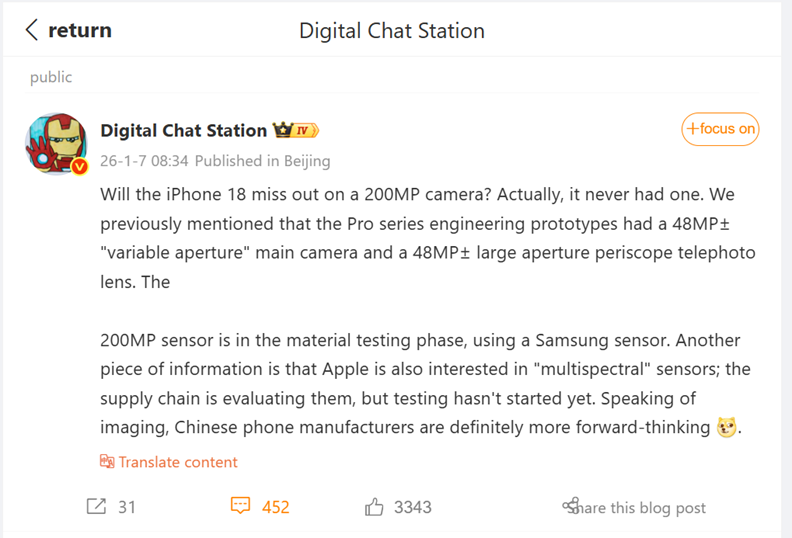
According to a post on Weibo by reliable tipster Digital Chat Station, the engineering prototype of the iPhone 18 Pro features a rectangular camera module with the same lens arrangement as the iPhone 17 Pro models. The leak also claims that the rear glass panel could adopt a subtle transparent finish, adding a fresh visual element.

However, since this information comes from an early prototype, the final design may still change before launch.

image

Caption – Tipster Digital Chat Station’s recent post on Weibo. (Translated via Google Translate)

The leak further suggests that Apple may include a stainless steel vapor chamber in the iPhone 18 Pro, potentially improving thermal management.

In terms of display sizes, the iPhone 18 Pro is expected to stick with a 6.3-inch panel, while the iPhone 18 Pro Max will reportedly feature a 6.9-inch display, both unchanged from the current generation.

iPhone 18 and iPhone 18e Launch Timeline

image

Caption – Tipster Digital Chat Station replied to a comment. (Translated via Google Translate)

In response to a comment on the main post, Digital Chat Station also mentioned that the iPhone 18e is currently in production plans, but the standard iPhone 18 might be postponed. This isn’t the first time such a delay has been reported.

Back in April, reports suggested that Apple could launch the iPhone 18 Pro lineup in September 2026, while the regular iPhone 18 and the more affordable iPhone 18e may not arrive until early 2027.

As of now, Apple has not confirmed any details about the iPhone 18 lineup. Since the leaked information is based on early prototypes, it should be taken with caution.

FAQs

Q1. What design changes are expected for the iPhone 18 Pro?

Answer. Leaks suggest the iPhone 18 Pro may retain the rectangular camera layout from the iPhone 17 Pro but introduce a subtle transparent rear glass and improved thermal management via a stainless steel vapor chamber.

Q2. Will the display sizes change in the iPhone 18 Pro series?

Answer. No major changes are expected. The iPhone 18 Pro will likely keep its 6.3-inch display, while the Pro Max may continue with a 6.9-inch screen, same as the current generation.

Q3. Is there a delay expected for the standard iPhone 18?

Answer. Yes, reports indicate the standard iPhone 18 and budget-friendly iPhone 18e might be delayed until early 2027, while the Pro models could launch in September 2026.

Also Read –

https://www.mymobileindia.com/iphone-fold-and-iphone-18-pro-to-feature-faster-mobile-data-with-a20-chip-and-new-apple-modem/

https://www.mymobileindia.com/iphone-18-series-may-feature-smaller-dynamic-island-but-no-under-display-face-id/

Xiaomi 15T Leak Reveals Key Specs Ahead of September 24 Global Launch

0

Highlights

  • Xiaomi 15T leaked retail unit image reveals its key specs.
  • Feature – 6.83″ 120Hz display, MediaTek Dimensity 8400 Ultra chip, Leica Summilux lenses, 5,500mAh battery, and 67W fast charging.
  • The phone is set for global launch on September 24 with the base model price expected to start at €649.

image

Caption – Xiaomi 15T’s previously leaked image. ((Image credit – Passionate Geekz)

The upcoming Xiaomi 15T series is set to launch globally on September 24. It is being positioned as a more affordable alternative to Xiaomi’s flagship number series while still delivering strong performance. Ahead of the official debut, a fresh leak has given us the clearest look yet at the standard Xiaomi 15T, confirming several major specifications. Here’s what we know so far.

Xiaomi 15T Specs Leak from Retail Unit

image

Caption – Xiaomi 15T leaked image. (Image credit – @yabhishekhd on X)

Tipster Abhishek Yadav @yabhishekhd shared a photo on X (formerly Twitter) showing what appears to be a retail unit of the Xiaomi 15T. The phone appears to be wrapped in the protective plastic sleeve included in the box. Printed on the cover are key hardware details, which align with earlier reports.

According to the leaked photo of the phone, the Xiaomi 15T will feature a 6.83-inch display with a 120Hz refresh rate, powered by a MediaTek Dimensity 8400 Ultra chipset. The phone also packs a 5,500mAh battery with support for 67W fast wired charging, balancing performance with endurance.

While the leaked packaging didn’t reveal specific camera resolutions, it confirms that Leica Summilux lenses are returning with the 15T series. For context, last year’s Xiaomi 14T offered a 50MP main sensor (1/1.56” with OIS), a 50MP 2x telephoto lens (50mm equivalent), a 12MP ultra-wide camera, and a 32MP front-facing shooter. A similar setup possibly with improvements is expected for the 15T.

Xiaomi 15T – Pricing and Availability

The Xiaomi 15T series will be officially unveiled on September 24 with teaser campaigns already live on Xiaomi’s official X account. The brand recently posted a cryptic image that seems to be hinting at a possible T series device.

As for pricing, it is expected to start at €649 for the base Xiaomi 15T. However, no concrete update is out yet and we will have to wait for official details to know more.

Meanwhile, reports suggest Xiaomi will also launch the Xiaomi 15T Pro alongside the standard model. Based on recent Geekbench listings, the Pro model will run on the Dimensity 9400+ processor, the same high-end chip powering the Redmi K80 Ultra, ensuring flagship-grade performance.

FAQs

Q1. What are the key specs of the Xiaomi 15T?

Answer. The Xiaomi 15T features a 6.83-inch display with 120Hz refresh rate, MediaTek Dimensity 8400 Ultra chipset, 5,500mAh battery, and 67W fast wired charging.

Q2. Will the Xiaomi 15T have Leica cameras?

Answer. Yes, the Xiaomi 15T will include Leica Summilux lenses. While exact specs aren’t confirmed, a setup similar to the Xiaomi 14T’s triple-camera system is expected.

Q3. When is the Xiaomi 15T launching and what’s the expected price?

Answer. The global launch is set for September 24. Pricing is expected to start at €649 for the base model, with a Pro variant also rumoured to debut alongside.

Also Read –

https://www.mymobileindia.com/xiaomi-15t-pro-storage-options-and-key-specs-leak-online-ahead-of-launch/

Xiaomi 17 Pro and 17 Pro Max Teasers Confirm Secondary Rear Display, Specs and iPhone 17 Inspirations

iQOO 15 Leak Reveals Stunning Colour-Changing Back, Few Key Specs Leak

0
iQOO 15 Leak Reveals Stunning Colour-Changing Back, Few Key Specs Leak

Highlights

  • A leaked video reveals the iQOO 15’s dynamic back panel that shifts colours between grey and pink depending on the viewing angle.
  • Rumoured features include a 6.85″ QHD OLED Samsung display with 6,000 nits peak brightness, an ultrasonic fingerprint sensor, OriginOS 6, and a massive 7,000–8,000mAh battery with 100W fast charging.
  • The phone is expected to launch by the end of this month.
iQOO 15’s leaked live images.

The upcoming iQOO 15 series is generating buzz ahead of its expected launch later this month in China. The launch is reportedly timed around Qualcomm’s annual summit, scheduled for September 23–25. That event will likely also see the debut of the Snapdragon 8 Elite Gen 5 chipset and iQOO is rumoured to be among the first smartphone brands to ship it in a commercial device. While official details remain scarce, a newly leaked video gives us a closer look at the phone’s design.

iQOO 15 – Colour-Changing Back Design

A short video clip posted online showcases the iQOO 15’s back panel, which shifts colours between grey and pink as the viewing angle changes. The effect creates one of the most dramatic and dynamic finishes seen on a flagship phone in recent years, making the device appear almost like two different smartphones depending on how the light hits it.

image image

Caption – iQOO 15’s colour-changing back.

This video also confirms that the shifting design goes beyond the earlier pink-grey swirl leak, which hinted at the look but failed to capture the moving gradient effect in full.

iQOO 15 – Key Specs (Rumoured)

Beyond the eye-catching aesthetics revealed in the latest leak, the iQOO 15 is expected to pack serious flagship hardware. Reports suggest the phone will sport a flat 6.85-inch QHD OLED display using a Samsung panel, capable of reaching an impressive 6,000 nits peak brightness while dropping as low as 1 nit for comfortable viewing in dark environments. A high refresh rate is also expected, along with an ultrasonic fingerprint sensor for secure unlocking.

On the software side, the iQOO 15 series will reportedly debut with Vivo’s OriginOS 6, offering a refreshed interface and new features out of the box.

Powering the device could be a massive 7,000mAh to 8,000mAh battery, making it one of the largest batteries seen on a flagship phone. Charging won’t be a concern either, as the device is tipped to support 100W fast charging.

In the camera department, leaks suggest the iQOO 15 will feature a 50MP primary camera with a 1/1.5-inch sensor, paired with a 50MP periscope telephoto lens. This setup points to a longer focal length zoom compared to the 2x telephoto lens on the iQOO 13. An ultra-wide camera is also expected, and if past generations are any indication, it could be another 50MP sensor, rounding out a versatile triple-camera system.

FAQs

Q1. What makes the iQOO 15’s design stand out?

Answer. The iQOO 15 features a colour-changing back panel that shifts between grey and pink depending on the viewing angle, creating a dramatic and dynamic visual effect.

Q2. What are the key display and battery specs of the iQOO 15?

Answer. It’s expected to have a 6.85-inch QHD OLED Samsung display with up to 6,000 nits peak brightness and a massive 7,000–8,000mAh battery supporting 100W fast charging.

Q3. What camera setup is rumoured for the iQOO 15?

Answer. Leaks suggest a triple-camera system with a 50MP main sensor, a 50MP periscope telephoto lens for extended zoom, and a 50MP ultra-wide camera.

Also Read –

https://www.mymobileindia.com/iqoo-15-confirmed-to-feature-2k-samsung-amoled-display-rear-design-leaks-online/

https://www.mymobileindia.com/iqoo-15-launch-october-2025-snapdragon-8-elite-gen-5-7000mah/

iPhone Fold and iPhone 18 Pro to Feature Faster Mobile Data with A20 Chip and New Apple Modem

0

Highlights

  • The iPhone Fold and iPhone 18 Pro will debut Apple’s first 2nm A20 chip, offering improved performance and efficiency.
  • This advanced chip may extend to all iPhone models by 2026, with MacBook Pro and Vision Pro also expected to adopt it.
  • Apple’s new in-house C2 modem will bring faster mobile data and mmWave 5G support, addressing past limitations of the C1 and C1X chips.
Caption - A representative image of the future iPhone fold.
A representative image of the future iPhone fold. (Image credit – 9to5Mac)

Apple hasn’t even begun shipping the iPhone 17 lineup, but leaks are already pointing toward next year’s devices. A new report reveals what to expect from the iPhone Fold and iPhone 18 Pro, including details on the A20 chip and a faster in-house Apple modem. Here’s what we know.

A20 Chip Built on 2nm Process

The upcoming iPhone Fold and iPhone 18 Pro are expected to debut with the A20 chip, Apple’s first processor based on the 2-nanometer process. Currently, the iPhone 17 series uses TSMC’s 3nm chips, but Apple is widely expected to move to 2nm technology in 2026.

According to Taiwan’s Commercial Times (via 9to5Mac), the MacBook Pro and Vision Pro will also be next in line to adopt the 2nm processors after the iPhone lineup.

“Next year, the iPhone 18 will adopt the A20 chip, which is made by TSMC’s latest 2-nanometer process, and with WMCM advanced packaging. The supply chain reveals that the M6 chip used in the [MacBook Pro] and the R2 chip of Vision Pro are also expected to follow,” the report says.

Initially, it was unclear if the smaller process would be limited to the Pro models. However, a report earlier this year suggested that all iPhone models in 2026 could receive the 2nm chip. Apple is reportedly leading the way in advanced chip design with recent reports even pointing to attempts to steal its cutting-edge technology.

New C2 Modem Promises Faster Data Speeds

image

Caption – Apple’s current C1 chipset underperforms. (Image credit – Apple)

Alongside the A20 chip, the new iPhones will reportedly feature a C2 Apple modem designed to deliver faster mobile data. Apple’s current C1 chip underperformed compared to Qualcomm’s modems, raising concerns about data speeds on models like the iPhone Air. To address this, Apple introduced the C1X variant, which the company claimed was “up to” twice as fast as the C1.

However, both the C1 and C1X lacked support for mmWave 5G.

The Commercial Times now reports that the C2 modem will add mmWave support, unlocking access to the fastest mobile data standards. The publication notes that this upgrade will be reserved for “high-end models,” meaning it may only be available on the iPhone Fold and iPhone 18 Pro.

Beyond faster data speeds, the iPhone 18 Pro is rumoured to feature in-display Face ID, eliminating the Dynamic Island in favour of a punch-hole front camera. Meanwhile, the iPhone Fold is expected to take a different approach, integrating Touch ID into the side button for biometric security.

FAQs

Q1. What is Apple’s A20 chip, and which devices will feature it?

Answer. The A20 chip is Apple’s first processor built on the 2-nanometer process, promising improved performance and efficiency. It’s expected to debut in the iPhone Fold and iPhone 18 Pro, with future adoption in MacBook Pro and Vision Pro devices.

Q2. How will the new C2 modem improve mobile data speeds?

Answer. Apple’s C2 modem adds support for mmWave 5G, enabling significantly faster mobile data compared to previous C1 and C1X chips. This upgrade is likely reserved for high-end models like the iPhone Fold and iPhone 18 Pro.

Q3. What biometric changes are coming to the iPhone Fold and iPhone 18 Pro?

Answer. The iPhone 18 Pro may introduce in-display Face ID with a punch-hole camera, removing the Dynamic Island. Meanwhile, the iPhone Fold is expected to feature Touch ID integrated into the side button for secure authentication.

Also Read –

https://www.mymobileindia.com/iphone-fold-could-launch-next-year-as-prototypes-move-forward-ipad-fold-delayed-report/

https://www.mymobileindia.com/iphone-18-pro-might-get-a-new-display-design-apple-eyeing-staggered-iphone-18-series-launch-schedule-report/

Apple Could Unveil Touchscreen Macs by 2026, Starting with OLED MacBook Pro

0

Highlights

  • Apple may unveil its first OLED touchscreen MacBook Pro by late 2026.
  • Touch support would bring MacBooks closer to iPads, especially with macOS integrating more iPadOS 26 UI features via the Tahoe update.
  • Apple is reportedly exploring touchscreen support for a second-gen budget MacBook as well.
 MacBooks to soon get touch sensitive.
MacBooks to soon get touch sensitive. (Image credit – Apple)

Apple has resisted touch on Macs for years, even as Windows laptops widely adopted the feature. Touch functionality allows users to scroll, zoom, and navigate directly with their fingers. This is something many younger users who are accustomed to iPhones and iPads expect by default. It turns out the Cupertino giant may finally be preparing to bring touchscreens to its Mac lineup. Here’s everything we know based on recent word from the analyst.

OLED MacBook Pro with Touchscreen in the Works

According to well-known analyst Ming-Chi Kuo, Apple’s supply chain is moving forward with plans for touchscreen Macs. Kuo’s recent post on X (formerly Twitter) confirms that the first model is expected to be an OLED MacBook Pro slated for mass production in late 2026.

While the device could enter production in late 2026, its actual release may slip into early 2027, depending on Apple’s rollout schedule.

This timeline aligns with a prediction made two years ago by Bloomberg’s Mark Gurman, who also suggested that Apple was exploring touch support for its MacBooks.

Touchscreen MacBook Pros are expected to launch by 2027.
Touchscreen MacBook Pros are expected to launch by 2027. (Image credit – Apple)

Currently, Apple sells the M4-powered MacBook Pro models. Based on Apple’s typical release cycle, the company is expected to introduce M5 chip upgrades as early as next year. The OLED MacBook Pro with touchscreen support would then follow in the next refresh, likely powered by the M6 processor.

Introducing touchscreens would bring MacBooks closer in functionality to the iPad, a device that already shares many design and software elements with macOS. Apple’s Tahoe update has further blurred the lines, as it integrates several UI features from iPadOS 26 into macOS.

Touchscreen Beyond MacBook Pro

Kuo also revealed that Apple is considering adding touchscreen support to a second-generation version of its upcoming budget MacBook, which will reportedly use an iPhone A-series chip. If true, this would strongly indicate that MacBook Air models could also gain touch capabilities in the future.

FAQs

Q1. Is Apple planning to launch touchscreen MacBooks?

Answer. Yes, analyst Ming-Chi Kuo reports that Apple is preparing to launch its first OLED touchscreen MacBook Pro, with mass production expected by late 2026.

Q2. Will touchscreen support extend beyond the MacBook Pro?

Answer. Apple is reportedly considering touchscreen functionality for a second-generation budget MacBook, possibly powered by an iPhone A-series chip, hinting at future MacBook Air models with touch.

Q3. How will touchscreen Macs differ from current models?

Answer. Touchscreen Macs will offer direct finger-based navigation, aligning more closely with iPads. The upcoming macOS Tahoe update already integrates several iPadOS UI elements.

Also Read

https://www.mymobileindia.com/apples-oled-macbook-pro-overhaul-could-be-delayed-to-2027-gurman/

https://www.mymobileindia.com/apple-may-launch-a-cheaper-macbook-with-iphone-chip-says-kuo/

Google Unveils AP2 Protocol to Secure AI Agent-Led Payments Across Platforms

0

Highlights

  • Google’s AP2 protocol enables trusted, cross-platform payments by AI agents, ensuring user authorisation, merchant authenticity, and full accountability.
  • Transactions are anchored by cryptographically signed digital contracts (Mandates), creating an immutable audit trail for both real-time and delegated purchases.
  • AP2 supports stablecoins and crypto via A2A x402 with backing from Coinbase and MetaMask.

image

Caption – Google Agent Payments Protocol A2P.

Google has officially launched the Agent Payments Protocol (AP2), an open standard built in collaboration with leading payments and technology companies. The protocol is designed to securely facilitate AI agent-led transactions across multiple platforms, ensuring trust and transparency in the rapidly evolving world of autonomous commerce.

What is AP2?

AP2 extends Google’s Agent2Agent (A2A) and Model Context Protocol (MCP) frameworks, offering a payment-agnostic system that allows users, merchants, and payment providers to carry out transactions seamlessly across different payment types.

Why AP2 is Needed?

As AI agents increasingly handle transactions for users, traditional payment systems designed with human authorisation in mind are no longer sufficient. AP2 addresses this by ensuring –

  • Authorisation – Explicit user permission for each transaction.
  • Authenticity – Confidence for merchants that an agent’s request reflects the user’s true intent.
  • Accountability – Clear responsibility in cases of fraud or errors.
Stavan Parikh, VP/GM of Payments at Google, said AP2 safeguards trust in scenarios where autonomous agents initiate payments, offering consistent, secure, and auditable interactions across payment methods including cards, bank transfers, and even stablecoins.

AP2 Mandates & Verifiable Credentials

The backbone of AP2 lies in Mandates, tamper-proof, cryptographically signed digital contracts verified using verifiable credentials (VCs).

Rao Surapaneni, VP/GM of Business Applications Platform at Google Cloud, explained that these mandates serve as the foundation of each transaction.

Real-time purchases (human present) – A user instructs an agent to find items. The request is logged as an Intent Mandate. Once the cart is ready, a Cart Mandate confirms the exact items and prices, creating an immutable record.

Delegated tasks (human absent) – For pre-authorised tasks like “buy concert tickets when available,” a detailed Intent Mandate sets conditions such as timing and price. The agent then auto-generates a Cart Mandate when conditions are met.

This process ensures a non-repudiable audit trail, linking user intent, cart details, and payment method with full accountability.

Unlocking New Commerce Scenarios

AP2 opens doors for innovative commerce experiences, including –

  • Smarter shopping – Agents can track stock and pricing, making secure purchases automatically.
  • Personalised offers – Merchant agents can deliver time-sensitive, tailored deals to users.
  • Coordinated bookings – Agents can manage multiple services at once such as flights, hotels, tickets, within user-defined rules.

Support for Cryptocurrencies and Stablecoins

AP2 is designed for modern payments, supporting crypto transactions alongside traditional methods.

Google, in partnership with Coinbase, Ethereum Foundation, and MetaMask, has introduced the A2A x402 extension, enabling production-ready crypto payments within AP2 and extending its functionality to the web3 ecosystem.

Industry Collaboration and Ecosystem Growth

image

Caption – Google Cloud Partners Agent Payments Protocol A2P.

Google is working with over 60 organisations including Adyen, American Express, Mastercard, PayPal, Revolut, Salesforce, and ServiceNow, to expand AP2’s adoption.

These partners are building A2A agents with AP2 integration, paving the way for new transactable AI-driven experiences, such as automated scaling of software licenses via Google Cloud Marketplace. Google is also encouraging collaboration with standards bodies to further refine and expand AP2’s capabilities.

Availability of AP2

Developers and businesses can already access AP2 through Google’s public GitHub repository, which hosts technical specifications, documentation, and reference implementations.

The repository will be continuously updated with contributions from Google and the developer community, showcasing the scalability and versatility of AP2 across industries.

FAQs

Q1. What is Google’s Agent Payments Protocol (AP2)?

Answer. AP2 is an open standard designed to securely enable AI agent-led payments across platforms. It ensures user authorisation, merchant authenticity, and transaction accountability.

Q2. How does AP2 handle autonomous transactions?

Answer. AP2 uses cryptographically signed Mandates, Intent and Cart Mandates, to create a verifiable audit trail linking user intent, item details, and payment method, even for delegated tasks.

Q3. Does AP2 support cryptocurrency payments?

Answer. Yes. Through the A2A x402 extension, AP2 supports crypto and stablecoin transactions, with partners like Coinbase, MetaMask, and Ethereum Foundation contributing to its web3 integration.

Also Read –

https://www.mymobileindia.com/viral-nano-banana-ai-trend-google-gemini-surpasses-chatgpt-as-top-app-top-prompts-to-generate-creative-3d-figurines-learn-to-create-instagrams-viral-vintage-saree-ai-photo/

https://www.mymobileindia.com/google-ai-plus-subscription-launches-with-gemini-2-5-pro-and-200gb-storage-in-emerging-markets/

OpenAI Introduces Teen Safety Updates on ChatGPT with Age Prediction and Parental Controls

0

Highlights

  • OpenAI’s teen safety updates for ChatGPT ensure teens are blocked from engaging in flirtatious or self-harm-related conversations.
  • A new system estimates user age to tailor responses and if uncertain, it defaults to teen mode.
  • Parents can link accounts, manage features, set blackout hours, and receive alerts for distress.
(Photo by Jonathan Kemper on Unsplash)

OpenAI has rolled out new safety measures for teenagers using ChatGPT, putting teen protection ahead of privacy and freedom in specific cases. The company announced the changes in a blog post, outlining how these updates are designed to make ChatGPT safer for younger users while also enhancing security and usability for everyone. Here’s everything you need to know about the changes.

OpenAI’s Teen Safety Updates on ChatGPT

ChatGPT conversations are becoming increasingly personal, much like consultations with a doctor or lawyer. OpenAI has strengthened its security to keep user data private, even from employees. However, exceptions remain for cases involving serious misuse, threats to life, or risks of large-scale harm.

Adult users have wide flexibility in how they use ChatGPT. For example, the system can help with creative writing on sensitive topics or engage in mild flirtatious dialogue, as long as it stays within safe limits. As Altman noted, OpenAI aims to treat adults “like adults” while ensuring safety.

For users under 18 (ChatGPT is designed for ages 13+), stricter restrictions are in place. Teens are blocked from engaging in flirtatious conversations or discussions around self-harm, even in fictional or creative contexts. In cases of imminent risk, parents or authorities may be contacted.

OpenAI stressed that these updates are just the beginning, with continuous improvements shaped by expert, advocate, and policymaker feedback. The company noted, “Your voices are shaping this work in ways that will matter for hundreds of millions of people.”

Meanwhile, OpenAI CEO Sam Altman acknowledged that certain company principles may conflict, but clarified that teen safety will always take precedence. Altman noted, “We realise that these principles are in conflict and not everyone will agree with how we are resolving that conflict. These are difficult decisions, but after talking with experts, this is what we think is best and want to be transparent in our intentions.”

Key Teen Safety Tools in ChatGPT

Age Prediction

  • OpenAI is developing an AI-based system to predict whether a user is under or over 18.
  • Teens will get an age-appropriate experience with graphic sexual content blocked and added safeguards for moments of distress.
  • If the system is uncertain, it defaults to treating the user as under 18. Adults can verify their age to regain full access.

Parental Controls

  • Parents will be able to link their accounts with teen accounts (minimum age 13) via email invitation.
  • These controls allow parents to shape ChatGPT’s responses, manage features like memory and chat history, and receive alerts if their teen shows signs of acute distress.
  • In rare emergencies where parents cannot be reached, law enforcement may step in.
  • Parents can also set blackout hours to restrict usage during certain times.
  • For all users, in-app reminders will encourage breaks during extended sessions.

FAQs

Q1. How does OpenAI’s age prediction system work?

Answer. The AI system estimates whether a user is under or over 18 based on usage patterns. If uncertain, it defaults to treating the user as a teen. Adults can verify their age to regain full access.

Q2. What parental controls are available in ChatGPT?

Answer. Parents can link their accounts to teen profiles, manage features like memory and chat history, set blackout hours, and receive alerts if their teen shows signs of distress.

Q3. Can ChatGPT contact authorities in emergencies involving teens?

Answer. Yes. In rare cases where a teen is at imminent risk and parents can’t be reached, ChatGPT may escalate the situation to law enforcement to ensure safety.

Also Read –

https://www.mymobileindia.com/openai-launches-learning-accelerator-in-india-to-distribute-5-lakh-free-chatgpt-licenses/

https://www.mymobileindia.com/openai-introduces-chatgpt-go-plan-in-india-at-rs-399-with-upi-support/

iPhone 17 Brings AI-Powered Adaptive Power Mode with iOS 26 for Smarter Battery Life

0

Highlights

  • iPhone 17’s Adaptive Power Mode with iOS 26 uses AI to learn user habits and adjust background tasks.
  • The feature is enabled by default on iPhone 17 models, while users of older iPhones running iOS 26 must activate it manually.
  • For the smaller iPhone Air, Apple offers Adaptive Power mode plus a new external battery pack.
 iPhone 17 models get a new battery feature.
iPhone 17 models get a new battery feature. (Image credit – Apple)

Turns out Apple’s iPhone 17 lineup has introduced a new battery-saving feature with iOS 26. It is called Adaptive Power mode and it is designed to extend battery life using artificial intelligence. With sales set to begin in just two days, this feature is one of the biggest highlights for those looking to push their iPhone’s battery performance further. Here’s all we know about the feature.

iPhone 17 – Adaptive Power Mode

Apple first unveiled Adaptive Power mode during the launch of iOS 26 at WWDC 2025. As the name suggests, the feature uses AI to analyse user behaviour and daily usage patterns. It then restricts or adjusts certain background tasks to save battery while still maintaining performance where it matters most.

image
iPhone 17 lineup has the iOS 26 Adaptive Power option enabled by default. (Image credit – Apple)

The traditional Low Power Mode had to be manually activated and now Adaptive Power mode is enabled by default on the iPhone 17 series. On other iPhones running iOS 26, however, users will have to turn it on manually.

The feature isn’t designed for all situations. If you’re running heavy apps like the camera, playing intensive games with Game Mode switched on, or multitasking with demanding apps, Adaptive Power mode won’t restrict those functions. Instead, it focuses on background optimisations to maximise efficiency.

Adaptive Power Mode on iPhone 17 – How Does It Work?

Apple has clarified that Adaptive Power mode requires at least seven days of usage to learn and analyse your habits before it can make meaningful adjustments. Once this data is processed, the mode can deliver noticeable improvements in battery performance.

In addition, the classic Low Power Mode will still activate automatically when the iPhone’s battery drops to 20%, giving users another layer of protection against battery drain.

Battery Improvements Across the Lineup

The iPhone 17 lineup also comes with upgraded batteries compared to its predecessors, giving users more power out of the box.

However, there are some concerns regarding the iPhone Air, which has a smaller battery. To counter this, Apple has included Adaptive Power mode in iOS 26 and has also introduced a new external battery pack that will be sold separately.

FAQs

Q1. What is Adaptive Power Mode on the iPhone 17?

Answer. Adaptive Power Mode is an AI-powered feature in iOS 26 that learns user habits over time and optimises background tasks to extend battery life without affecting performance.

Q2. Is Adaptive Power Mode available on older iPhones?

Answer. Yes, but unlike the iPhone 17 series where it’s enabled by default, users with older iPhones running iOS 26 must manually activate the feature.

Q3. How long does Adaptive Power Mode take to start working effectively?

Answer. Apple states it needs at least seven days of usage to analyse behaviour and apply meaningful battery-saving adjustments based on your daily patterns.

Also Read –

https://www.mymobileindia.com/iphone-17-airs-ultra-thin-is-surprisingly-thin-what-does-it-mean-for-apples-next-iphone-lineup/

Xiaomi 17 Pro and 17 Pro Max Teasers Confirm Secondary Rear Display, Specs and iPhone 17 Inspirations