


Highlights
- TRAI and DoT have approved the CNAP feature, which will show the verified name of incoming callers by default on all phones in India.
- CNAP uses SIM registration data and bypasses third-party apps like Truecaller, while users can opt out by contacting their telecom provider.
- It will be a supplementary service managed by telecom operators, not a standalone one.
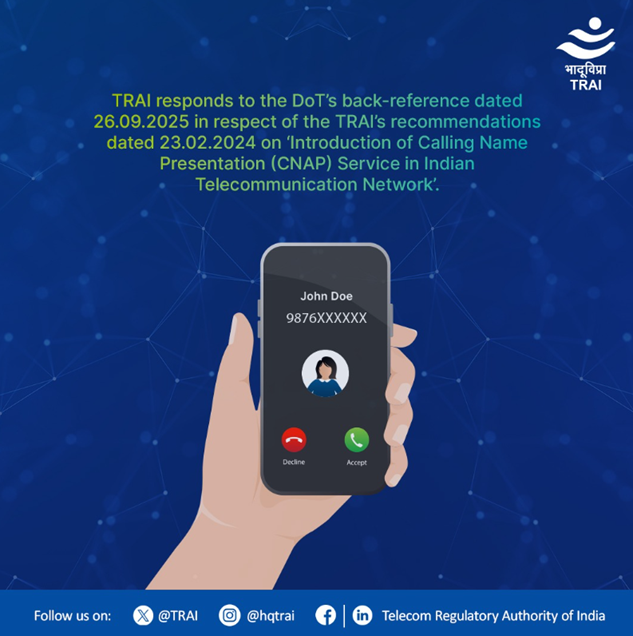
Caption – Roads clear for Calling Name Presentation (CNAP) service in India. (Image credit – @TRAI on X)
The Telecom Regulatory Authority of India (TRAI) has approved a new proposal from the Department of Telecommunications (DoT) that will make it mandatory for the caller’s name to appear by default on the receiver’s phone screen during incoming calls.
The new feature is called Calling Name Presentation (CNAP) and it will use verified information collected during the SIM registration process. This will be offered as a supplementary telecom service. Here are more details on this development.
#TRAI has issued its response to DoT’s back-reference on the proposal to display the caller’s name on phone screens—even if the number isn’t saved. This feature, called Calling Name Presentation (#CNAP), aims to improve caller ID.
Read more: https://t.co/n1fNpdAzCz#DigitalIndia pic.twitter.com/y8HGGTbkTD— TRAI (@TRAI) October 28, 2025
CNAP – Caller ID Feature for All Users
As per the latest update from TRAI, the CNAP feature will be enabled by default for all telecom subscribers in India. However, users who prefer not to use it can opt out by requesting their telecom service provider (TSP) to disable the feature.
Once implemented, CNAP will display the name and verified identity of the caller directly on the receiver’s phone screen, without relying on third-party apps like Truecaller.
This move aims to help users identify callers more accurately and make informed decisions about answering calls. TRAI believes this system will also play a significant role in reducing spam and fraudulent calls.
How the CNAP System Will Work?
Currently, Indian telecom networks only show the mobile or landline number of the caller, referred to as Calling Line Identification (CLI) with no existing mandate for CNAP. Under the new system, each access service provider will create and manage a Calling Name (CNAM) database, linking every subscriber’s verified name with their phone number.
When a call is received, the terminating network will query the Local Number Portability Database (LNPD) to determine which operator originated the call and fetch the corresponding name details from the CNAM database.
Tested for 4G and 5G Networks
Before the nationwide rollout, the DoT conducted pilot tests of the CNAP feature in select cities for 4G and 5G networks. The service was initially meant to be tested on both circuit-switched and packet-switched networks. However, operators encountered technical issues such as unavailable software patches and the need for infrastructure upgrades.
As a result, testing was limited to packet-switched networks.
Rollout and Availability
The CNAP feature will be offered as a supplementary service that operates in conjunction with basic telecom services and may be available across multiple service providers. However, TRAI clarified that CNAP will not be offered as a standalone feature.
This move marks a major step toward enhancing caller transparency and user safety in India’s telecom ecosystem. The new system could significantly reduce spam and scam calls, giving users more confidence in knowing exactly who is calling.
FAQs
Q1. What is CNAP and how will it benefit telecom users in India?
Answer. CNAP (Calling Name Presentation) is a new feature that displays the verified name of incoming callers by default, helping users identify calls and reduce spam or fraud.
Q2. Will CNAP replace third-party caller ID apps like Truecaller?
Answer. Yes, CNAP will function independently of third-party apps by using verified SIM registration data, offering a built-in caller name display managed by telecom operators.
Q3. Can users opt out of the CNAP feature?
Answer. Yes, while CNAP will be enabled by default for all subscribers, users can request their telecom service provider to disable it if they prefer not to use the feature.