Home Blog Page 1218

Xiaomi reports steady revenue and profit growth in Q3

0

Xiaomi Corporation, a consumer electronics and smart manufacturing company with smartphones and smart hardware connected by an Internet of Things (IoT) platform at its core, today announced its unaudited consolidated results for the three and six months ended September 30, 2021.

In the third quarter of 2021, Xiaomi’s total revenue amounted to RMB78.1 billion, representing an increase of 8.2% year-over-year, adjusted net profit for the period was RMB5.2 billion, an increase of 25.4% year-over-year. Impacted by global macro-environment as well as market sentiment towards the technology sector in China in the third quarter, Xiaomi’s long-term investments measured at fair value through profit or loss in the current period have generated unrealized financial losses, which have had a substantial impact on Xiaomi’s net profit. Nonetheless, Xiaomi’s core business profitability maintained steady growth. Xiaomi showcased excellent business model and operation with total revenue and adjusted net profit both maintained solid growths.

Meanwhile, Xiaomi global MIUI 30-day active users has exceeded 500 million as of 22 November, 2021, marking another milestone for Xiaomi’s “Smartphone x AIoT” strategy.

Q3 2021 financial highlights:

  • Total revenue at RMB78.06 billion, up 8.2% YoY;
  • Gross profit at approximately RMB14.29 billion, up 40.6% YoY;
  • Non-IFRS adjusted net profit was RMB5.18 billion, up 25.4% YoY.

Xiaomi Corporation said, “During the third quarter of 2021, we continue to strengthen our core ‘Smartphone × AIoT’ strategy and advance in the premium smartphone market. We ranked 1st in terms of smartphone shipments in 11 countries and regions. We continued to explore and innovate in product and technology to further enhance our competitiveness in the premium market. Our internet services revenue reached a new quarterly high and we remain committed to investing in research and development that underpins our products’ core competitiveness.” As of 22 November, 2021, Xiaomi’s global MIUI 30-day active users exceeded 500 million, marking another milestone for the “Smartphone x AIoT” strategy.

Quarterly Performance Review

Internet services revenue reaching new quarterly high

In the third quarter, Xiaomi’s profitability continued to strengthen as internet services revenue reached RMB7.3 billion, reaching a new quarterly high, representing an increase of 27.1% year-over-year. The gross profit margin of the internet services segment was 73.6%, 13.1 percentage points higher than the same period of last year.

Meanwhile, the Group’s global internet user base continued to expand rapidly in the third quarter. As of November 22, 2021, global MIUI 30-day active users exceeded 500 million for the first time, marking another milestone for Xiaomi’s global expansion. In September 2021, the MAU of MIUI increased 32.0% year-over-year to 485.9 million, among which the number of MAU in Mainland China rose to 127.3 million, a year-over-year increase of 16.4% and a net gain for the fourth consecutive quarter. In September 2021, MAU of Xiaomi’s global smart TV and Xiaomi Box expanded over 33.0% year-over-year. As of September 30, 2021, the Group’s number of TV paid subscribers was 4.7 million, a 13.5% increase on a year-over-year basis.

In the third quarter of 2021, Xiaomi’s advertising revenue reached RMB4.8 billion, up 44.7% year-over-year, primarily due to expanding user base, higher percentage of premium smartphone users and stronger monetization capabilities. Xiaomi’s gaming revenue reached RMB1.0 billion, increasing 25.0% year-over-year due to the strong performance of high-quality new games and higher gaming average revenue per user (“ARPU”) driven by premium and gaming smartphones. Xiaomi’s revenue from other value-added services amounted to RMB1.6 billion in the third quarter. In the second quarter of this year, Xiaomi’s Youpin ecommerce platform rolled out its new consumer brand, Life Element, which offers a wide range of high-quality day-to-day products at competitive prices. Most recently, in November 2021, Youpin also launched its UP paying membership system to consistently improve the online shopping experience of its users.

In the third quarter of 2021, Xiaomi’s overseas internet services revenue increased by 110.0% year-over-year to RMB1.5 billion, accounting for 19.9% of total internet services revenue, setting another quarterly record. Going forward, we will continue to expand and deepen collaborations with the Group’s global business partners and actively explore new internet service offerings in the overseas markets.

Xiaomi remains committed to investing in research and development, which boosts its products’ core competitiveness. In the first three quarters of 2021, the Group’s cumulative research and development expenditures reached RMB9.3 billion, representing an increase of 51.4% year-over-year. In September 2021, Xiaomi introduced Xiaomi Smart Glasses, boasting a visualized information display and interactive features. In November 2021, Xiaomi launched Loop LiquidCool Technology, which improves smartphone heat dissipation under heavy usage. As of September 30, 2021, Xiaomi’s research and development team totaled 13,919 employees, accounting for more than 44% of total employees.

Robust overseas revenue with smartphone shipments ranked No. 1 in 11 countries and regions

Xiaomi’s revenue from overseas markets reached RMB40.9 billion during the third quarter of 2021, accounting for 52.4% of total revenue. Despite the global shortage of key components, Xiaomi solidified its market position by optimizing global market resource allocation and reinforcing its channels in accordance with local market conditions. According to Canalys, Xiaomi’s market share of smartphone shipments in the third quarter ranked No. 1 in 11 countries and regions and among the top five in 59 countries and regions globally.

Xiaomi continued to deepen its global market presence in the third quarter. According to Canalys, in the third quarter of 2021, Xiaomi ranked No. 2 in Europe with a smartphone market share of 21.5%. In Western Europe, Xiaomi smartphone market share reached 17.0% and ranked among the top three in terms of shipments; in Central and Eastern Europe, Xiaomi ranked No.2 with 28.7% smartphone shipment market share. In the third quarter of 2021, Xiaomi sold over 6.8 million smartphones through carrier channels in overseas markets excluding India, representing an increase of over 130% year-over-year. According to Canalys, Xiaomi smartphone market share in Western Europe carrier channels increased from 4.6% in the third quarter of 2020 to 13.0% in the third quarter of 2021.

At the same time, Xiaomi continued to strengthen its competitiveness in emerging markets. According to Canalys, in the third quarter of 2021, Xiaomi market shares in Latin America, the Middle East and Africa reached 11.5%, 16.3% and 7.3%, respectively. In addition, Xiaomi has maintained No. 1 position in smartphone shipments in India for the 16th consecutive quarter.

Q3 smartphone shipments ranked 3rd globally with continuous advancements in the premium market

In the third quarter of 2021, despite the global shortage of key components, the Group’s global smartphone shipments still reached 43.9 million. According to Canalys, in the third quarter of 2021, the Group’s global smartphone shipments ranked No. 3 with a market share of 13.5%. The Group’ smartphone revenue totaled RMB47.8 billion with a gross margin of 12.8%, an increase of 4.4 percentage points year-over-year.

Xiaomi user segmentation strategy and new products allowed the Group to broaden its user base. For many of its new smartphones launched this year, over half of the users are new Xiaomi users. Xiaomi introduced the brand-new Xiaomi Civi Series in September 2021 and was well received by users.

In the first three quarters of 2021, global shipments of Xiaomi’ smartphones priced at or above RMB3,000 in mainland China and EUR300, or equivalent, in overseas markets, totaled approximately 18 million, accounting for more than 12% of total shipments. In overseas markets, total shipments of smartphones priced at or above EUR300, or equivalent, grew by more than 180% year-over-year during the third quarter, mainly in Latin America, Western Europe and the Middle East.

During November’s Singles’ Day Shopping Festival, Xiaomi and Remi brand smartphones together ranked No.1 in sales volume on Tmall.com, JD.com and Suning.com. The Group’s premium smartphones also ranked No.1 among Android smartphones priced above RMB4,000 on Tmall.com and JD.com. In addition, during the shopping festival, total sales volume of Xiaomi’ smartphones from its offline channels increased by more than 110% year-over-year.

“Smartphone x AIoT” strategy continues, new retail growth efforts accelerated

Xiaomi IoT and lifestyle products segment revenue was RMB20.9 billion during the third quarter of 2021, increasing 15.5% year-over-year. Notably, the Group’s overseas IoT and lifestyle products revenue reached a new record high despite the challenges in maritime shipping logistics overseas this quarter.

In the third quarter, against the backdrop of a year-over-year decline in global sales volume of TVs, Xiaomi’s global smart TV shipments reached 3.0 million with a year-over-year revenue increase of 19.5%. According to All View Cloud (“AVC”), Xiaomi’s TV shipments ranked No. 1 in mainland China for the 11th consecutive quarter and among the top five globally in the third quarter of 2021.

In addition, Xiaomi has expanded its premium smart home appliances categories to help users create a healthy and comfortable living environment. In the third quarter, Xiaomi launched smart home appliances including the Xiaomi 550L Four-door Smart Refrigerator and the Xiaomi Mini Washing Machine. Xiaomi’s smart ventilated air conditioners also performed well. During the November’s Singles’ Day Shopping Festival, Xiaomi’s cumulative sales of home appliances ranked No. 3 on JD.com.

Xiaomi’s AIoT platform continues to expand. As of September 30, 2021, the number of connected IoT devices (excluding smartphones, tablets and laptops) on its AIoT platform exceeded the 400 million marks for the first time. The number of users with five or more devices connected to its AIoT platform (excluding smartphones, tablets and laptops) exceeded 8 million.

This year Xiaomi accelerated its new retail growth efforts, further solidified its lead in online channels while rapidly expanding offline channels. As of the date of this announcement, the total number of Xiaomi’s retail stores in mainland China surpassed 10,000. Xiaomi expects the further growth in lower-tier market penetration will allow the Group to serve more users in mainland China.


Pandemic Propels Personal Devices

0

My Mobile delves into the pandemic-induced shift in our preferences for devices that are a part of our daily life

The COVID-19 pandemic has brought about instrumental changes in our lifestyle. While earlier we loved shaking a leg to a large speaker, we now prefer speakers that are portable and can be accessed remotely using a smartphone. Instead of sporting a band for tracking activities, we now largely prefer smartwatches that come with host of health monitors to keep a tab on blood oxygen level, blood pressure and heart rate etc. In fact, the Bluetooth-equipped smartwatches are also swiftly emerging as the future of calling (we discussed about this in our Cover Story, Sep. 2021). We decided to delve into the pandemic-induced shift in our preferences for devices that are a part of our daily life.

Key Points

The key point here has been the focus on minimizing contact, with smartphones being the prime repository of all the access. Not to be mistaken though, smartwatches have taken it a notch further by remotely accessing mobile for calls etc. And it’s not just about streaming music on a speaker through a cellphone, it is also about increased affinity toward devices that are only for personal usage and also about controlling electrical appliances or bulbs at home through the smartphones. The change is evident across segments like audio, wearables and smart consumer technology.

Audio

According to a few industry players, the transformation ushered in by the pandemic has been quite significant and prominent. Talking about the changes, Indian consumer technology brand Crossbeats Co-founder Archit Agarwal said, “The audio segment encompasses consumers across age brackets, geographies or locations, and the pandemic has definitely had a significant impact in terms of the trends in the audio industry. Devices those are smaller, portable and mobile have witnessed surge in demand. Instead of spending a fortune on something that would lay unused most often, buyers now prefer to spend on devices like earbuds, which they do not need to share with anyone and ensures a more immersive experience for both recreation and calls.”

“Instead of spending a fortune on something that would lay unused most often, buyers now prefer to spend on devices like earbuds, which they do not need to share with anyone and ensures a more immersive experience for both recreation and calls”

Archit Agarwal, Co-founder, Crossbeats

He further said that “the demand has also been triggered by the technological advancements in the segment with regard to noise cancellation and true wireless stereo.” When asked how the future of the segment looks like, he added that “the tryst now is to make premium tier features available to mass consumers in an affordable price range. The widespread diversification within the truly wireless earbuds is also something that we should look out for.”

Wearables

Wearable is another segment that has taken strides since its evolution. In the first quarter of 2021, the Indian wearable market witnessed an unprecedented 170% YoY growth as per latest data furnished by the International Data Corporation. Watches were adjudged the fastest growing category in wearables, growing at a phenomenal 463.8%. And the best part is that the brands spearheading the growth were not global but home grown.

Speaking about the surge in the wearable segment, Arnav Kishore, the co-founder of Fire-Boltt, the fastest growing Indian wearable brand as per the IDC report, said that “it is both style quotient and health monitoring capabilities that give an edge to wearables, especially the smartwatches. One of the most sophisticated, affordable and personal devices in recent times, the value of wearables has expanded rapidly. When a smartwatch is powered with features like SpO2 monitor, BP tracker and heart rate tracker, it alleviates the need to spending on multiple devices.”

“We should not be surprised to discover IoT features in our smartwatches in near future, that too in a price range that everyone can afford. While they are already widely used for calling purposes, they would be used for controlling different devices or appliances”

Arnav Kishore, Co-founder, Fire-Boltt

Sharing his insights on what the future of smartwatches would possibly be, Arnav added, “We should not be surprised to discover IoT features in our smartwatches in near future, that too in a price range that everyone can afford. While they are already widely used for calling purposes, they would be used for controlling different devices or appliances.”

Smart Consumer Technology

While smartwatches are slated to offer IoT features pretty soon, the smart consumer technology domain seems to have already taken the stepping stone. According to Achin Gupta, Country Head-India at French lifestyle brand Zoook, which has launched a number of audio and smart devices in the Indian market, “the focal point of transformations triggered by the pandemic has been on making things contact less. The inclination towards making our homes smart is actually an after effect of the pandemic. These devices offer ease of use, are based on DIY mechanism and minimize a lot of contact. For instance, smart LED bulbs that are compatible with Alexa, Google Assistant are more in demand, and so are in demand are WiFi-enabled smart IR blasters and smart plugs that allow one to access multiple electronic appliances and devices from the smartphone.

“Smart LED bulbs that are compatible with Alexa, Google Assistant are more in demand, and so are in demand are WiFi-enabled smart IR blasters and smart plugs that allow one to access multiple electronic appliances and devices from the smartphone”

Achin Gupta, Country Head-India, Zoook

He further said, “The affordability and ease of use of such devices is driving the surge in demand. For connectivity, all these devices and accessories need is a stable WiFi connection or a mobile hotspot. Who wouldn’t want a smart home where they turn the AC on even before entering the home from scorching heat?”

The aforementioned insights and trends sum up how the altered preferences have been in favour of personal devices rather than those for shared usage. Perhaps, it is the era of social distancing that is leading to an evolution of virtual proximity with self.

OnePlus 10 Pro: Specifications, Price, India Launch date leaked

0

OnePlus 10 Pro is one of the biggest flagship smartphones tipped for an early next year launch. Ahead of the release, the device has already seen numerous leaks, and many more details have surfaced since last week.

Now, a new leak has given us some more juicy details about the upcoming flagship OnePlus smartphone, revealing its design, specifications, price, and more. Here’s everything we needed to know about the OnePlus 10 Pro.

OnePlus 10 Pro India launch date

The company has not revealed any details about the OnePlus 10 Pro launch. However, multiple launch dates have been rumored for the upcoming flagship device. One of those hints towards an early launch in 2022, that is – January or February. Some leaks also points out in the second quarter of 2022 launch. The former timeline is expected for the China launch, whereas the latter is for the global launch.

OnePlus 10 Pro Specifications

Design and Display

The implementation of the OnePlus 10 Pro looks similar to the S21 Ultra and will feature a hole-punch cutout at the top left corner of the screen for the 32-megapixel front camera sensor with an LED flash. According to the leaks, OnePlus 10 Pro will come packed with a 6.7-inch curved AMOLED display with a QHD+ resolution and will support a 120Hz refresh rate.

Processor

The upcoming smartphone will come with Qualcomm’s upcoming Snapdragon flagship processor, which is rumored to unveil as the Snapdragon 8 Gen 1, which is tipped to be announced at the Qualcomm Summit later this month.

OnePlus 10 Pro is expected to launch in two storage configurations. The smartphone might offer 8GB to 12GB of RAM. As for the storage, the device may get 128GB to 256GB storage. The device will also come with an IP68 rating for water and dust resistance.

Camera

The leaks suggest that the OnePlus 10 Pro would not be getting any major upgrade in the camera department. It will come with a triple-camera setup on the back along with a 48-megapixel primary camera and a 50-megapixel ultrawide camera.

Battery

Under the hood, OnePlus 10 Pro will boast a 5,000mAh battery. It is also being rumored that the handset could get 125W fast charging support, which could potentially turn out to be the fastest charging device as the current benchmark is set at 120W.

OnePlus 10 Pro India price

There’s no information on the pricing yet, but going by the previous trends, we expect to see a price rise. Following the trend, one can expect the OnePlus 10 Pro to start at a higher price of Rs 69,999.

Also Read: Noise partners with Poorvika Mobiles to expand its presence in south India

Noise partners with Poorvika Mobiles to expand its presence in south India

0

Homegrown connected lifestyle brand Noise has expanded its reach to southern India by joining hands with Chennai-based Poorvika Mobiles, a leading multi-brand retail chain. This partnership with Poorvika Mobiles will help Noise to strengthen its position in south India by making its entire product line available on online and offline platforms in all its retail outlets in Karnataka and Tamil Nadu.

The strategic partnership brings India’s No.1 mobility chain and No.1 smartwatch brand together to serve the customers better in the southern region. As part of the future roadmap, the products will also be available at more stores.

Founded in 2004, Poorvika Mobiles is one of the leading multi-brand retailers for smartphones and gadgets in India. They have around 445+ outlets across Tamil Nadu, Pondicherry, Karnataka, Kerala and Maharashtra. Nosie’ wide range of hearable and wearable products are available in the stores.

Gaurav Khatri, Co-founder, Noise, said, “We are excited to announce our partnership with Poorvika Mobiles, one of the leading retail chains in India. Poorvika has a wide reach in the southern market and has been serving customers for years. This partnership aims to make our products and services more accessible across the country. We are committed to building products that correlate with the spirit of Indian consumers. We are consistently expanding our offline presence with strategic partnership with the leading retail chain, and in the coming month, we will be strengthening our footprint in India further.”

Also Read: “India is a key focus region for MediaTek”

Uvaraj Natarajan, CEO, Poorvika Mobiles, said, “We are glad to onboard Noise on our offline and online platforms. Their diversified range of hearable and wearable has been quite popular amongst the customers. Noise is one of the leading homegrown brands. We are looking forward to a long-term partnership and strengthening our relationship with the brand in the coming days.”

Noise has been expanding its presence in India by partnering with leading retail chains across the nation. Noise is present in over 8000 outlets in India.

Tech NewsWrap: Qualcomm separates Snapdragon as separate brand… and more

0

Qualcomm separates Snapdragon as separate brand

Qualcomm is announcing some big changes to its product and brand identity. The company said it has separated ‘Qualcomm’ and ‘Snapdragon’ brands, introduced new representative colors, and a new naming structure of single-digit series and generation number. In a press statement, the chipmaker said “Snapdragon will be a standalone product brand with specific ties to the Qualcomm brand where appropriate.”

WhatsApp brings new safety features for users in India

WhatsApp has introduced new safety features for its users in India that includes ‘Message Level Reporting’ and ‘Flash Calls’. These features will allow people better security and control over their usage of the Meta owned instant messaging app. Meanwhile, WhatsApp has released the 2.21.24.8 update for its Android users on the beta channel, which reveals the company is working on message reaction notifications for its Android app.

Moto G31 India launch date leaked

Moto G31 India launch date has leaked. Tipster Mukul Sharma claims that the budget smartphone will debut on November 29, 2021. The company is yet to confirm the official launch date of Moto G31 in India. The Indian variant of the handset is said to feature a 50-mehapixel “quad-function camera.” The ultrawide camera is likely to double up as a macro camera in this case. According to the leak, the 4GB RAM and 64GB internal storage model of the Moto G31 will be priced at Rs 14,999.

Infinix Inbook X1 laptop set to launch in India

Infinix, the premium smartphone brand from Transsion group, is all set to launch its first-ever laptop, INBook X1, in India soon. The laptop will be available in three processor variants i3, i5, and i7. As per the Intrigue page on Flipkart, INBook X1 is the lightest laptop which weighs only 1.48 kg and feels ultra-light to carry. It will also be one of the thinnest laptops in the segment with 16.3mm thickness. The Infinix INBook X1 is bound to give its users a premium and stylish feel while using, as it sports, first in segment, full metal body with aircraft grade aluminium finish.

Also Read: Hipi introduces its latest avatar offering world’s first AI based in-video discovery feature

“India is a key focus region for MediaTek”

0

MediaTek is a market leader in developing innovative chips for a range of smart devices including smartphones, home entertainment, connectivity and IoT products. It believes technology democratization is integral to fostering inclusive development, and has aggressive plans to stay ahead of the curve, with regard to the much-talked-about 5G technology in India. Anku Jain, Managing Director, MediaTek India, shares more about the company, its offerings and strategy to be a dominant player in the chipset market, in a conversation with Ramesh Kumar Raja. Excerpts:

Please share details on the 5G portfolio especially in the smartphone category. How does MediaTek plan to maintain this lead in the coming months?

MediaTek is a global market leader in system-on-chip (SoC) innovations. We empower OEMs with powerful chip technologies, which help them build incredible products spanning a broad category of segments like smartphones, voice assistant devices, smart TVs, tablets, and networking & connectivity devices across the connected ecosystem. With 5G gaining momentum in India, the market for 5G smartphones is evolving rapidly as major OEMs focus on rolling out 5G smartphones and devices. MediaTek Dimensity 5G series is at the forefront of this evolution and is setting new benchmarks for 5G smartphones, thanks to the powerful integrated 5G technology that redefines the performance, connectivity, photography, streaming, gaming, and power efficiency in these devices. The 5G series of chipsets including, the flagship MediaTek Dimensity 1200, Dimensity 1000, Dimensity 900, and the recently-released Dimensity 920 and Dimensity 810, have set new benchmarks for 5G smartphones.

Of late, there has been an extensive demand for MediaTek 5G chipsets in India, be it for our flagship MediaTek Dimensity 1200 processor or the latest Dimensity 810 5G processor. Not only highlighting the market potential for 5G smartphones in India but also showcasing the confidence that OEMs and consumers have in our advanced chipset technologies. We plan to build on this confidence and continue our innovations through extensive R&D with a focus on the latest advancements like AI, AR/VR, Wi-Fi 6, IoT, and more. We are constantly in touch with our OEMs and innovating as per their requirements to bring new products to the market and empower end-consumers with incredible experiences. Additionally, to support OEMs address the unique demands from modern-day smartphone consumers, we have launched the MediaTek Dimensity 5G Open Resource Architecture, allowing OEMs and OMDs to have closer-to-metal access – for cameras, displays, graphics, AI processing units, sensors, and connectivity sub-systems to unleash new more customized consumer experiences.

We are also pursuing aggressive marketing activities to generate awareness about MediaTek’s chipset technologies that empower lives and enhance connectivity experiences. In fact, as per a recent industry report, MediaTek emerged as the preferred chipset partner for smartphone OEMs in India.

How do you see the India market evolving when it comes to 5G smartphones? Which price segment do you think will have maximum demand?

The momentum for 5G smartphones in India started in early 2020 and improved significantly over the past few months. Currently, India has over 100 5G smartphones from popular brands and the number is growing steadily.

Market reports state that the adoption of 5G in India will be faster when compared to the previous generation technologies, primarily because 4G networks are at the brim of saturation and there is rising demand for faster networks. The growth of 5G in India will be led by advanced trends like streaming, gaming, vlogging, and other user-centric tech requirements. The reverse is also true: as 5G penetration improves, these trends will also gain popularity. Thus, we foresee 5G smartphones being prevalent among all user groups once the technology is launched in India.

At MediaTek, we believe technology democratization is integral to fostering inclusive development. A smartphone with an impressive data network is no longer a luxury but an imperative in the tech-driven new normal. Thus, we have designed our chipset technologies to serve all market segments.

MediaTek’s Dimensity 5G series offers incredible performances and powers devices across premium, flagship, and broader market demographics. The MediaTek Dimensity series, with its advanced feature sets and incredible performance capabilities, is already emerging as a winner among gamers, vloggers, students, and professionals alike. We are set to democratize 5G technologies across the entire spectrum of society and contribute towards the nation’s mission to digitally empower the citizens and help them connect to the world of opportunities.

“The growth of 5G in India will be led by advanced trends like streaming, gaming, vlogging, and other user-centric tech requirements. The reverse is also true: as 5G penetration improves, these trends will also gain popularity. Thus, we foresee 5G smartphones being prevalent among all user groups once the technology is launched in India”

 4G is already the dominant network technology in India and will continue to play a significant role in the market for some years, even after the launch of 5G. Your comment.

There is no contesting the fact that the high-speed 4G network has played an integral role in enhancing digital connectivity among the mass. In India, major cities have attained saturation in 4G connectivity, while in rural areas, the rise is significant given the massive investment in rural fiber by private and public telecom operators over the past few years. At MediaTek, even as we look forward to the disruptive capabilities of 5G, we are also continuing to expand our extremely popular MediaTek Helio G series chipsets for the 4G market with new additions like MediaTek Helio G96 and G88.

Realistically, we expect the 4G momentum to continue even after the launch of 5G technology. In fact, even after 5G is introduced in the country, it will still require time to attain popularity, vast consumer pick-up and acceptance. Optimal penetration is another variable which will need a significant amount of time. We can confidently say that 4G will stay mainline in non-penetrated areas and continue to complement 5G networks in major cities where adoption is expected at a considerably higher rate.

One of the major segments which will see quicker adoption of 5G is critical applications as this segment requires higher bandwidth, greater connectivity, and lower latency and the immediate change that 5G brings to the ecosystem will be around eMBB. While it is difficult to predict the timeframe wherein 4G will be completely replaced by 5G, it is evident that the rate at which 5G will occupy the telecommunications space in India will be the fastest compared to all previous-generation technologies.

What’s the investment and R&D plan MediaTek has for India?

MediaTek, as a company, is focused on offering customers the innovative solutions they need to lead an uninterrupted and smart life, every day. In line with our vision of technology democratization, our R&D teams are engaged in creating next-gen technologies capable of powering the new normal. As one of MediaTek’s top global markets, India is a key focus region for us. We have a strong R&D team in India, which works on advanced technologies like AIoT, WiFi 6 and Edge/Cloud computing for both smart homes and enterprise segments. We are also keen on further expanding our R&D capabilities, across our centers in Noida and Bangalore, and have announced significant India hiring plans for FY 2022. Regarding the India investment, we cannot share exact figures but suffice to say that MediaTek is, globally, one of the top semiconductor segment spenders when it comes to R&D investment. In fact, in 2021, MediaTek expanded its global R&D budget to over USD 3 billion, eyeing future business growth opportunities.

Also Read: “Indus App Bazaar encourages developers to build local solutions for their audience”

Smart devices are an integral part of the 5G ecosystem today. Which are some of the new segments that you are currently working on?

With the pandemic, the smart device and smart home ecosystems have undergone a revolution. Today, everything from work, education, communication, entertainment, and ordering food and supplies online is being done through smart devices. As people choose a more flexible lifestyle, they are depending on smart technologies to enhance and complement their lives and, with the disruptive capabilities of 5G added to the mix, the entire smart ecosystem is primed for a revamp. MediaTek is a market leader in developing innovative chips for a range of smart devices including smartphones, home entertainment, connectivity and IoT products. Our dedication to innovation has positioned us as a driving market force in several key technology areas, including high power-efficient mobile technologies, automotive solutions and a broad range of advanced multimedia products such as smartphones, tablets, digital televisions, 5G, voice assistant devices (VAD) and wearables.

While we have been working on all these segments, we believe that advanced networks, delivered by 5G, will help accelerate the adoption of these devices across consumer segments. MediaTek is working closely with industry stakeholders to deliver 5G SoC solutions in line with customer demands. Our varied collaborations are expected to bring in a wide range of devices across use cases like wearables, smart homes, industrial IoT, smart healthcare, power and utilities, and more in the emerging 5G era in India. We have also joined hands with Tessolve, a semiconductor engineering solutions provider, to foster innovation in AI and deliver a wide range of IoT devices with Edge-AI capabilities. MediaTek’s AIoT platform enables smart device OEMs/ODMs to deep-differentiate in software and quickly bring newer devices to markets.

“Our dedication to innovation has positioned us as a driving market force in several key technology areas, including high power-efficient mobile technologies, automotive solutions and a broad range of advanced multimedia products such as smartphones, tablets, digital televisions, 5G, voice assistant devices (VAD) and wearables”

What are some of the advanced technologies and computing capabilities that enable a mobile computing device today?

Over a mere decade, mobile computing has evolved from simple voice calling and texting to a full-fledged communication and collaboration platform, which in many aspects, is better than PCs. Smartphones featuring integrated functionalities like cloud storage, location-based applications, and biometric security enhancements have been here for some time. Eventually, more applications will be added to the device ecosystem, especially with new technologies like multimedia intelligence, AI, mobile, ubiquitous multimedia, smart-solutions, mobile sensing, IoT, Edge Computing, AR/VR, mobile crowdsensing, multimodal interfaces, data visualization, spatial searching among others.

In the mobile computing segment, myriads of applications are being developed regularly, enabling futuristic functionalities ranging from Cloud gaming, immersive classrooms, infotainment, AR-driven virtual tours and shopping, movie streaming, UPI apps with multiple levels of security, etc. New-age technologies, like the ones we discussed above, have accelerated research and development across categories. Going ahead, we foresee trends like voice assistants, emotional robots, surveillance, on-the-go medical consultation, AR-enabled live sessions, etc., picking up momentum in the consumer segment. Never in human history has there been such excitement around technology and we have only scratched the surface with mobile computing.

Also Read: iQOO Z5 Review: Good at everything and superb in gaming

Hipi introduces its latest avatar offering world’s first AI based in-video discovery feature

0

India’s extraordinary short video platform and a destination for many talented creators, Hipi raises the curtain on its new revamped look.

Hipi has gone an extra mile this time by providing the world’s first in-video ‘Shop’ button that lets the users discover and shop products from short videos they love. In establishing a new benchmark, Hipi allows users to find style inspiration and save the looks they adore while consuming the video.

With groundbreaking features, Hipi allows users to make videos in few seconds through its revolutionary short video creator section and brings the power of professional editing to users at large via filters, effects, and music. Hipi bundles a power package for creators to unleash their creativity and showcase their sumptuous work to the world.

GBS Bindra, Chief Business Officer of Hipi said, “In-Video discovery is an enormous addition to the most loved app for short videos and entertainment in India. Hipi uses the power of machine learning and computer vision to bring product discovery to the video. Hipi fuels product discovery and leads the seismic shift in consumer behaviour as we know. Unlike other platforms where creators must manually add the products to photos and videos, Hipi is able to do this at scale using technology, saving precious time for creators. The time saved by the creators can be spent honing their craft rather than do manual grunt work of adding products.”

Hipi is the unique short video app that has created a distinguished benefit for its creators and users in the sea of identical short videos apps. It enables creators to showcase their unique talents and gain stardom in its true sense, through various opportunities that Hipi brings being from the house of Zee Entertainment.

Also Read: The Esports Club partners with Intel for TEC challenger series

The Esports Club partners with Intel for TEC challenger series

0

The Esports Club today announced its partnership with Intel announcing the ‘Intel presents TEC Challenger Series’ for Valorant.

The Intel presents TEC Challenger Series is one of the largest Valorant tournaments in South Asia with a massive prize pool of INR 15 Lakhs, with the winner taking home the lion’s share of INR 8 Lakhs.

Ishaan Arya, Co-founder of The Esports Club said, “We are extremely excited to welcome Intel on board as a partner and to be bringing back the iconic TEC Challenger Series. With the joint vision of elevating the esports ecosystem in the region, we look forward to creating bigger and better opportunities for our community with this strategic partnership.”

The tournament is open to participants from India, Pakistan, Bangladesh, Sri Lanka, Maldives and Nepal. Registrations for the Intel Presents TEC Challenger Series are now open on The Esports Club website.

Mansoor ‘Nabu’ Ahmed, Director of Esports, The Esports Club, said, “The response to the TEC Challenger series has been phenomenal in the past. We’re very excited to keep providing opportunities for teams in the region through our world class esports events.”

Also Read: Subscriber base consolidates; RJio leads the growth: Motilal Oswal Financial Services

Subscriber base consolidates; RJio leads the growth: Motilal Oswal Financial Services

0

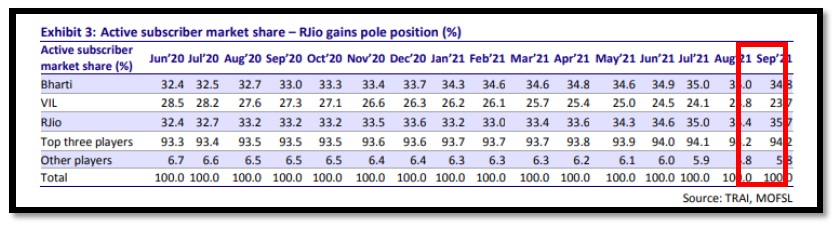
According to the telecom report of Motilal Oswal Financial Services (MOFSL), while active subscribers for both Bharti/VIL remained fairly flat at 347m/236m, RJio continued its strong addition of 4.7m subscribers (4.1m in Aug’21).

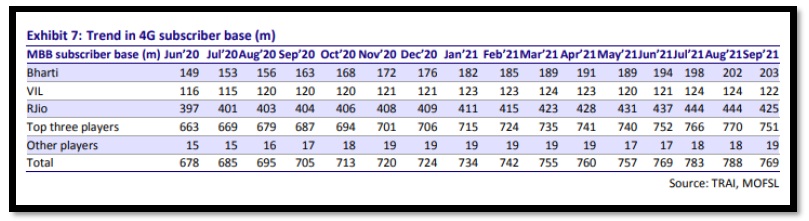
RJio continues to lead, with an active subscriber share of 35.7% when compared to 34.8% for Bharti. As a result, total VLR for RJio improved by 460bp to 83.65% in Sep’21. While gross subscribers for RJio fell steeply (19m) to 425m, it continued its lead in active subscriber additions at 4.7m to 355m, increasing its market share by 30bp to 35.7%. 4G subscribers too declined by 19m.

Telecom Report

The Telecom Regulatory Authority of India (TRAI) released subscriber data for Sep’21 where MOFSL observed that gross subscriber base for the industry fell steeply (20.7m) to 1,166m on account of a 19m decline in RJio’s gross subscriber base due to a cleanup of inactive subscribers. However, active subscribers grew by 3.9m to 996m (2.4m additions in Aug’21).

Telecom Report

Bharti’s gross/active subscribers remained flat at 354m/347m in comparison with average additions of 2-3m in the last couple of months. While its active subscriber share declined by 20bp to 34.8%. 4G subscriber additions too witnessed sluggish growth and grew by 1m to 203m as compare to a steady run-rate of 4m. Bharti’s 4G subscriber base continued to grow, albeit at a slower rate of 1.2m (4m in Aug’21), while the same for RJio/VIL declined by 19m/1.2m.

VIL’s gross/active subscribers continued to decline at 1.1m/0.8m to 270m/236m, albeit at a slightly slower pace. 4G subscriber additions, which grew in May-Jun’21, declined by 1.2m.

4G subscribers for the industry as a whole declined by 18.7m to 769.2m, with 4G subscribers accounting for 77.3% of active subscribers.

Telecom Report

Industry Wired Broadband subscribers remained flat, down a mere 0.1m to 24.4m. RJio/Bharti added 160k/230k subscribers, taking share from BSNL’s 440k decline.

Also Read: ClassMonitor marks impressive growth with 2x exit for angel investors

ClassMonitor marks impressive growth with 2x exit for angel investors

0

Amidst the global pandemic where all industries are severely hit, ed-tech startup ClassMonitor has been consistently witnessing growth as they provided a 2x exit to the early stage investors within 2 years. Existing investors which include Dubai based Calega family office have now purchased an increased holding from the startup’s other early stage angel investors.

ClassMonitor is a home learning platform for early childhood learners and parents, blends traditional teaching with modern methods of learning. Its hybrid learning tool takes children to a learning space that combines real life learning experiences with curated activities. The brand offers integrated annual learning packs which are designed for comprehensive learning, logical thinking and problem solving. The products are designed in such a way that they address the year-long learning requirements for the age group 1-8 years and are very affordably priced.

“This is a big milestone and achievement for us at ClassMonitor. In the past quarter, we have touched over 20,000 customers and helped over 100000 kids so far in shaping their initial learning years. This exit displays our current growth and re-establishes the faith provided by our investors in us and in this ecosystem at large. It gives me a great sense of pride and achievement to see the people who had put their trust in us, exit with good returns,” says Vijeet Pandey, Co-Founder and CEO at ClassMonitor.

The startup has been tracking growth rapidly as it witnessed 20,000 customers in the last 3 months and aims to clock another 40,000 in the next 3 months to garner a total of 1 lakh customers by 2021. The startup currently has an ARR of 10 crore and aims to tap rapid growth and reach to 20 crore in ARR by March 2022. ClassMonitor boasts a PAN India customer base of parents with children in the age group of 1-8 years with Tamil Nadu, Karnataka & Maharastra being the top 3 states.

Currently, the startup has 95% of their total users from India and 5% from abroad and is aiming to increase the ratio to 90% from India and 10% from abroad respectively in the next 6 months. This growth trajectory is followed by the startup’s global expansion recently. Additionally, the startup expects growth in the Philippines, Australia, and the Middle East markets and aims to continue deeper penetration in the tier 1-3 markets. The company is also looking to strengthen their customer base in Uttar Pradesh, Gujarat, and Rajasthan.

ClassMonitor plans to raise a series A investment soon and to date has raised Rs 6 crore since inception in 2016. As part of the angel round, they are backed by renowned investors including Calega Family Office, Piyush Jain, Chief Financial Officer of Al Hajri group, an angel investor who has invested in over 25 start-ups across the globe, Audit Head of Fullerton India, COO of Fullerton India, CFO of Spice Money, PATH India Ltd.

Also Read: GMNG clocks in 300% month-on-month business growth