Realme C100 5G is expected to launch soon in Middle East and Africa, while India launch remains uncertain.
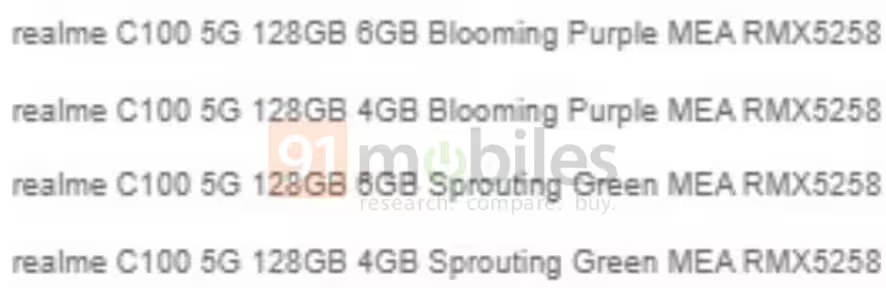
It is tipped to come in 4GB+128GB and 6GB+128GB variants with Blooming Purple and Sprouting Green colour options.
Specs not confirmed but global Realme C100 features a 6.8-inch HD+ LCD, Helio G92 chip, 8,000mAh battery, 50MP rear and 8MP front cameras.
Realme appears to be preparing another affordable smartphone under its C-series lineup. According to a new report, the company is working on the Realme C100 5G and is expected to launch soon in select global markets. While the handset is likely to arrive in the Middle East and Africa (MEA) region first, its India launch remains uncertain at the moment.
Realme C100 5G Memory Variants and Colour Options Leaked
Screenshot by 91Mobiles.
According to an exclusive report by 91mobiles citing industry sources, the Realme C100 5G carries the model number RMX5258 with the MEA suffix indicating that the smartphone is intended for the Middle East and Africa markets.
Based on the leak, the handset is expected to be available in two storage variants such as 4GB RAM + 128GB storage and 6GB RAM + 128GB storage.
The smartphone is also tipped to launch in Blooming Purple and Sprouting Green colour options.
India Launch Remains Unclear
The report suggests that the Realme C100 5G may not launch in India, at least in its current form. Previous Realme smartphones launched in India have generally carried the “IN” suffix in their model numbers, whereas the leaked model number of the Realme C100 5G includes the MEA designation.
Since the standard Realme C100 is already available in markets such as Nigeria, the company is expected to introduce the 5G model in the same region and nearby countries.
However, the possibility of an India launch cannot be ruled out completely. Realme could still be working on a separate India-specific version of the smartphone, although there is currently no confirmation regarding such a model.
Expected Specifications
While the specifications of the Realme C100 5G have not yet been officially revealed, the report references the existing Realme C100 available in Nigeria to provide an idea of what to expect.
The current Realme C100 features a 6.8-inch HD+ LCD display and is powered by the MediaTek Helio G92 processor. It packs a massive 8,000mAh battery, which is one of its biggest highlights. For photography, the smartphone offers a 50-megapixel primary rear camera along with an 8-megapixel front-facing camera for selfies and video calls.
Since the upcoming Realme C100 5G will support next-generation connectivity, it is expected to arrive with a more powerful processor than the 4G version. However, the chipset details have not yet been disclosed.
Realme has not officially announced the Realme C100 5G or revealed its launch timeline. More details regarding its specifications, pricing, and availability are expected to surface in the coming weeks.
Redmi Turbo 6 Max is tipped for a January 2027 launch, possibly rebranded globally as POCO X9 Pro Max.
Expected specs include a 7-inch 2K OLED display, MediaTek Dimensity 9000 series chipset, 10,000mAh battery and IP68/IP69 rating.
Xiaomi has not officially confirmed details yet.
Redmi appears to be working on its next performance-focused smartphone, the Redmi Turbo 6 Max. According to recent leaks, the upcoming handset is expected to launch in January 2027 and could bring several major upgrades over the Redmi Turbo 5 Max. The smartphone is also expected to be rebranded for global markets as the POCO X9 Pro Max. Here’s what we know so far.
Redmi Turbo 6 Max Launch Timeline Tipped
According to the latest leak, the Redmi Turbo 6 Max has been tentatively scheduled for a January 2027 launch. Although the release is still months away, early details have already surfaced online hinting at significant improvements in display, battery, and design.
The leak further suggests that the Redmi Turbo 6 Max could be introduced in global markets under the POCO X9 Pro Max branding. This aligns with Xiaomi’s usual rebranding strategy for Redmi Turbo series devices.
Redmi Turbo 6 Max Expected Specifications
The Redmi Turbo 6 Max is tipped to feature a 7-inch flat OLED display with a 2K resolution, making it one of the largest displays in Redmi’s smartphone lineup.
Under the hood, the device is expected to be powered by a MediaTek Dimensity 9000 series chipset. While the exact processor has not been confirmed, the smartphone is expected to target users looking for high-end gaming and performance.
Battery capacity could be one of the biggest highlights of the device. The leak suggests that the Redmi Turbo 6 Max may pack a massive 10,000mAh battery, representing a notable upgrade over its predecessor.
The smartphone is also expected to feature a horizontal camera module inspired by the iPhone Air’s design along with a premium metal frame. For durability, the handset is tipped to carry IP68 and IP69 ratings for dust and water resistance.
However, Xiaomi has not officially confirmed the upcoming smartphone or any of its details.
Redmi Turbo 5 Max. (Image credit – Redmi)
The early leaks indicate that the Redmi Turbo 6 Max could deliver substantial upgrades compared to the predecessor the Redmi Turbo 5 Max. The predecessor was launched in January with a starting price of CNY 2,499 for the 12GB RAM + 256GB storage variant.
The Redmi Turbo 5 Max features a 6.83-inch AMOLED display and is powered by the 3nm MediaTek Dimensity 9500s chipset. For photography, the smartphone offers a 50-megapixel primary rear camera and a 20-megapixel front-facing camera. One of its standout features is the 9,000mAh battery, which supports 100W wired fast charging and 27W wired reverse charging. The Redmi Turbo 5 Max also comes with IP66, IP68, IP69, and IP69K ratings providing enhanced protection against dust and water.
While Xiaomi has yet to officially announce the Redmi Turbo 6 Max, more details are expected to emerge as its rumoured January 2027 launch approaches.
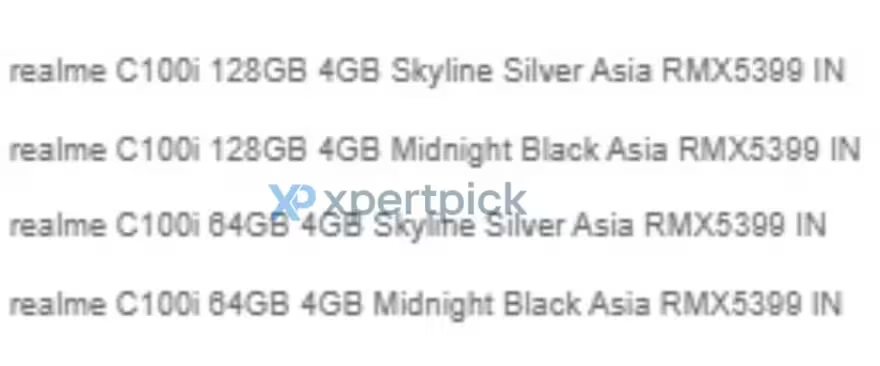
Realme C100i India variant tipped to launch soon with two storage options – 4GB+64GB and 4GB+128GB.
Colour choices include Skyline Silver and Midnight Black.
Global model features a 6.8-inch HD+ 120Hz display, Unisoc T7250 chip, 7,000mAh battery, 8MP rear and 5MP front cameras, but Indian specs are yet to be confirmed.
Realme is expected to expand its budget smartphone lineup in India with the launch of the Realme C100i. Ahead of its official debut, a new report has revealed the Indian variants and colour options of the upcoming smartphone. While Realme has not yet confirmed the launch, the latest leak suggests that the device could arrive in the country soon.
The Realme C100 series has already expanded in several global markets with models such as the Realme C100 5G, Realme C100 4G, Realme C100x, and Realme C100i. In India, however, the company has only introduced the Realme C100x so far.
Realme C100i India Variants and Colour Options
Screenshot by Xperpick.
According to an exclusive report by XpertPick, citing offline retail sources, the Indian version of the Realme C100i will carry the model number RMX5399.
The report claims that the smartphone will be available in two storage variants including 4GB RAM + 64GB storage and 4GB RAM + 128GB storage.
In terms of colours, the handset is expected to launch in Skyline Silver and Midnight Black options.
At present, there is no information regarding the smartphone’s pricing in India.
Realme C100i – Expected Specifications
The Realme C100i has already launched in select global markets with the model number RMX5377, while the Indian variant carries the RMX5399 model number. It is still unclear whether the Indian model will retain the same specifications as its global counterpart.
The existing Realme C100i features a 6.8-inch HD+ IPS LCD display with a 120Hz refresh rate. It is powered by the Unisoc T7250 processor paired with LPDDR4x RAM and eMMC 5.1 storage.
The smartphone packs a 7,000mAh battery with 15W charging support.
For photography, it comes with a 5-megapixel front-facing camera and an 8-megapixel rear camera. Other features include a side-mounted fingerprint scanner and a microSD card slot for storage expansion.
Reports further indicate that Realme may not introduce a GT-series flagship smartphone this year. However, the company has not officially confirmed its future product roadmap, so more updates are expected once Realme makes an official announcement regarding its upcoming launches.
Vivo S2 has appeared on Geekbench with Dimensity 7360 chipset and Android 16, 8GB RAM.
Leak reveals Box MRP of ₹66,999 but launch price is expected around ₹40,000–₹45,000.
Expected specs include a 6.83-inch 1.5K curved POLED 120Hz display, 7,050mAh battery with 44W charging, 50MP + 2MP rear cameras, 32MP front camera and IP68/IP69 ratings.
Vivo S2’s teaser on Amazon India. (Image credit – Vivo)
The Vivo S2 is expected to debut in India soon and new leaks have revealed more details about the upcoming smartphone ahead of its official announcement. The handset has now appeared on Geekbench, giving an early look at its performance. Meanwhile, a well-known tipster has also shared live images of the phone and the settings page alongside revealing the retail box price.
Amidst all the leaks and rumours, Vivo has also started teasing the smartphone in India, hinting that its launch is just around the corner.
Vivo S2 Geekbench Listing Reveals Key Details
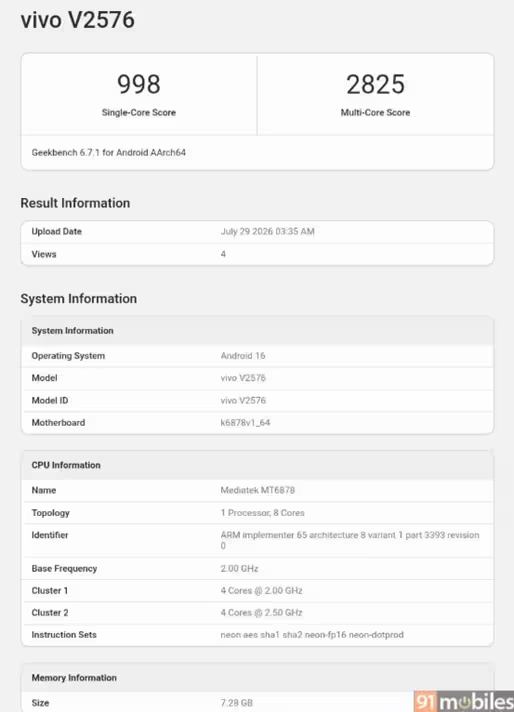
Vivo S2 Geekbench Listing. (Screenhot by 91Mobiles)
According to a recent 91Mobiles report, a Vivo smartphone carrying the model number V2576 has been spotted on the Geekbench benchmarking platform. The listing shows the handset scoring 998 points in the single-core test and 2,825 points in the multi-core benchmark.
The benchmark listing also confirms Android 16, 8GB RAM, and a MediaTek MT6878 chipset featuring four performance cores clocked at 2.5GHz and four efficiency cores running at 2.0GHz. The CPU configuration matches the MediaTek Dimensity 7300 series, supporting earlier reports that the Vivo S2 will be powered by the MediaTek Dimensity 7360 processor.
Vivo S2 Box MRP and Live Images Surface
Vivo S2 live images. (Credit – @saaaanjjjuuu on X)
Separately, well-known Indian tipster Sanju @saaaanjjjuuu on X has shared a live image of the Vivo S2 and the phone’s settings page alongside the Box MRP. The tipster has also revealed more specs about the upcoming device.
According to the leak, the 8GB + 128GB variant carries a box MRP of ₹66,999. However, the tipster claims that the actual launch price is expected to be around ₹40,000 to ₹45,000. Since the Vivo S2 is said to be an offline-focused smartphone, the box MRP is expected to be significantly higher than its actual retail price.
The tipster’s post further reveals that the Vivo S2 will feature a 6.83-inch 1.5K curved POLED display with a 120Hz refresh rate. The smartphone is expected to be powered by the MediaTek Dimensity 7360 chipset and pack a 7,050mAh battery with 44W fast charging support.
For photography, the handset is tipped to include a 50-megapixel Sony IMX852 primary camera accompanied by a 2-megapixel secondary sensor, while the front is expected to house a 32-megapixel selfie camera. The smartphone is also said to come with IP68 and IP69 ratings for dust and water resistance.
Vivo S2 India Launch Officially Teased
Vivo S2 teaser on Amazon India. (Image credit – Vivo)
Vivo has already started teasing the arrival of the Vivo S2 in India through its official channels, although the company is yet to announce an exact launch date. Recent reports have pointed to an August 6 debut but Vivo continues to promote the smartphone with a “coming soon” message.
An Amazon India microsite has also gone live, offering a closer look at the handset’s design. The Vivo S2 appears to borrow design elements from the Vivo X300 FE and offer a premium-looking rear panel with a horizontal dual-camera module and curved edges. The teaser image shows a white colour variant with a matte finish.
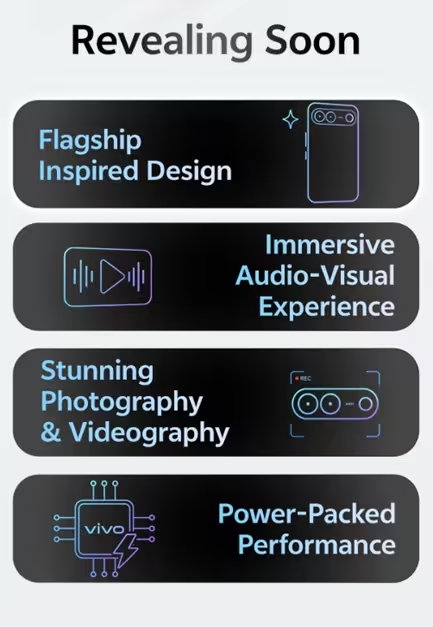
Vivo S2 teaser on Amazon India. (Image credit – Vivo)
Vivo is highlighting four key aspects of the smartphone ahead of launch such as a flagship-inspired design, strong performance, enhanced photo and video capabilities, and an immersive audio-visual experience.
The teaser suggests the company is positioning the Vivo S2 as a premium-looking mid-range smartphone.
Vivo Buds Could Debut Alongside Vivo S2
Tipster Sanju also claims that Vivo may introduce a new pair of Vivo Buds alongside the Vivo S2.
According to the tipster, the upcoming earbuds could feature 10mm dynamic drivers, offer up to 50 hours of total battery life with the charging case, and support Bluetooth 6.1 connectivity. They are also expected to be available in Basalt Black and Nilgiri Green colour options.
As of now, Vivo has not officially confirmed the launch of Vivo Buds.
Anyhow, the increasing number of teasers and leaks on Vivo S2 suggests that the official announcement could be just around the corner.
Vivo is launching a new Fusion Red colour variant of the Vivo T5x 5G in India on July 30, 2026.
The new edition only adds a fresh colour variant while the key features and hardware remain unchanged.
Although not confirmed yet, the price of the new colour variant is expected to match the current models.
Vivo is set to expand the colour options of its Vivo T5x 5G in India with the introduction of a new FusionRed variant. The smartphone was originally launched in the country in March 2026 in Cyber Green and Star Silver colour options. The new edition only brings a fresh colour finish, while the hardware and specifications remain unchanged. Here are more details.
Vivo T5x 5G Fusion Red Launch Date in India
Vivo India has officially confirmed through its X account that the Fusion Red colour variant of the Vivo T5x 5G will launch in India on July 30, 2026, at 12 PM IST.
The fierce vivo T5x, get a new fierce colour, now in Fusion red.
The new colour option is expected to be available via Flipkart, the Vivo India online store, and other authorised retail partners, just like the existing variants.
While Vivo has not yet announced the pricing of the Fusion Red model, it is expected to carry the same price as the current colour options since there are no hardware changes. The company is also yet to reveal whether it will introduce any special launch offers for the new variant.
Vivo T5x 5G Price in India
The vivo T5x 5G is priced at Rs. 24,999 for the 6GB + 128GB model; the 8GB + 128GBmodel costs Rs. 27,999; and the top-end 8GB + 256GB model is priced at Rs. 30,999.
With the arrival of the new Fusion Red edition, buyers will now be able to choose from Fusion Red, Cyber Green, and Star Silver colour options.
Vivo T5x 5G Specifications
Vivo T5x 5G’s new Fusion Red colour variant. (Image credit – Vivo)
The Vivo T5x 5G features a 6.76-inch Full HD+ LCD display with a 1080 × 2344 pixels resolution, a 120Hz refresh rate, and up to 1,200 nits peak brightness. The display also includes Eye Comfort mode and carries TÜV Rheinland Low Blue Light certification to help reduce blue light emissions.
Powering the smartphone is the MediaTek Dimensity 7400 Turbo processor paired with up to 8GB RAM and 256GB of internal storage. It runs Android 16-based OriginOS 6 and supports dual Nano SIM cards.
For photography, the Vivo T5x 5G comes with a dual rear camera setup featuring a 50-megapixel Sony IMX852 primary sensor and a 2-megapixel bokeh camera. On the front, the smartphone houses a 32-megapixel selfie camera for photos and video calls.
Connectivity options include 5G, Bluetooth 5.4, Wi-Fi, GPS, BeiDou, GLONASS, Galileo, QZSS, and a USB Type-C port. The handset also carries IP68 and IP69 ratings for dust and water resistance.
The smartphone packs a 7,200mAh battery with 44W wired fast charging support. Vivo claims the battery can deliver up to 40 hours of video playback, 93 hours of music playback, and 14.5 hours of navigation on a single charge.
The Vivo T5x 5G measures approximately 166 × 78.43 × 8.3mm and weighs 219g.
The newly introduced Fusion Red colour option offers buyers another design choice while retaining all the features of the existing Vivo T5x 5G variants.
OPPO smartphone model PYE110 has appeared on TENAA listing.
It features a 6.57-inch AMOLED display, 2.4GHz octa-core processor, up to 512GB storage, 7,820mAh (marketed as 8,000mAh) battery, 50MP rear camera, 8MP front camera and Android 16 with ColorOS 16.
The device’s identity remains unclear with no official confirmation from OPPO.
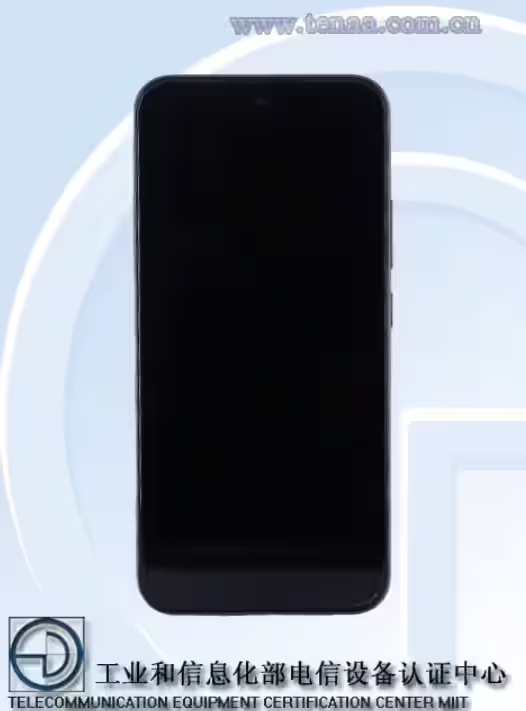
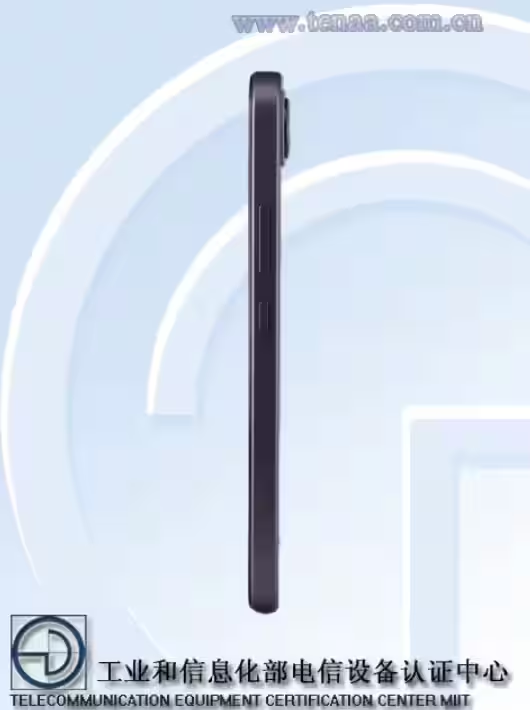
OPPO’s upcoming smartphone with the model number PYE110 has now surfaced on China’s TENAA certification platform, revealing several key specifications. According to a tipster Anvin @ZionsAnvin onX, the handset is likely to be part of the OPPO A7 series, although earlier reports had suggested that the same model could belong to the upcoming OPPO Find X10 series.
The latest TENAA listing and previous MIIT certification indicate that the device is moving closer to its official debut in China. Here’s what we know based on the latest listing.
OPPO PYE110 Spotted on TENAA
As per the tipster’s post, the TENAA listing reveals that the OPPO PYE110 will feature a 6.57-inch AMOLED display with a 2372 × 1080 pixels resolution. The smartphone is also listed with a 2.4GHz octa-core processor, although the chipset name has not yet been disclosed.
The handset is expected to be available in 6GB and 8GB RAM options paired with 128GB, 256GB, or 512GB of internal storage. One of the biggest highlights is its large 7,820mAh rated battery, which is expected to be marketed as an 8,000mAh typical capacity battery. The phone is also tipped to support 80W fast charging, although this has not yet been officially confirmed.
The listing also confirms that the OPPO PYE110 will feature a 50-megapixel rear camera and an 8-megapixel front-facing camera for selfies and video calls.
The smartphone is expected to run Android 16 with ColorOS 16 out of the box. Other listed features include an in-display fingerprint scanner and an IR blaster. The device measures 159.1 × 75.8 × 8.8mm and weighs 206 grams.
Oppo PYE110 has surfaced on TENAA. Seems to be an A7-series phone.
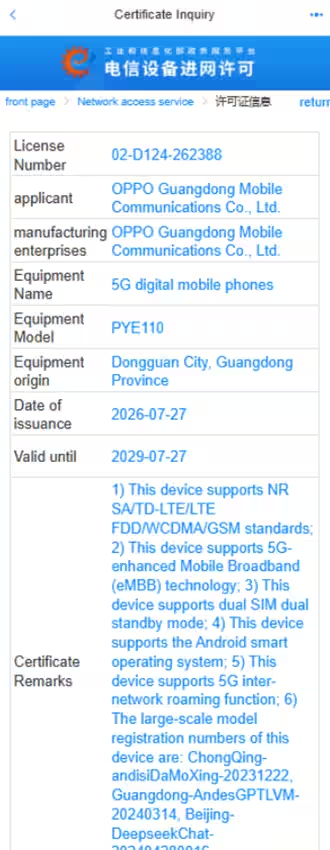
Before appearing on TENAA, the OPPO PYE110 had already received certification from China’s Ministry of Industry and Information Technology (MIIT) indicating that the smartphone is nearing launch.
OPPO PYE110 on China’s MIIT. (Screenshot by @ZionsAnvin on X)
Although the MIIT certification did not reveal hardware specifications or a launch timeline, it confirmed that the smartphone has received official regulatory approval for use on Chinese telecom networks.
The MIIT certification also confirmed support for multiple network standards including NR SA/NSA, TD-LTE, LTE FDD, WCDMA, and GSM. The handset is certified to support 5G eMBB (Enhanced Mobile Broadband) technology, dual SIM dual standby, the Android operating system, and 5G inter-network roaming.
Moreover, the certification lists registration numbers associated with several AI and large language model frameworks including AndesGPTLVM, ChatGLM, WenXinYiYan, YunQue, and PengChengZhiXin.
Is This OPPO A7 Series or Find X10 Series?
The identity of the OPPO PYE110 remains unclear. While the latest tipster claims that the handset could be part of the OPPO A7 series, earlier reports had linked the same model number to the upcoming OPPO Find X10 series.
OPPO has not officially confirmed the marketing name, specifications, or launch timeline of the PYE110. However, with both the MIIT and TENAA certifications now complete, the smartphone is expected to make its official debut in the near future.
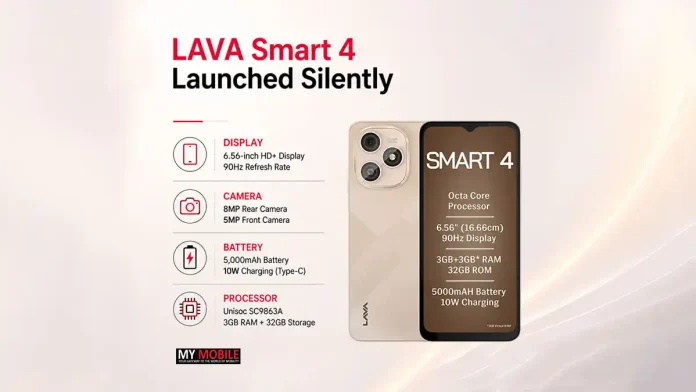
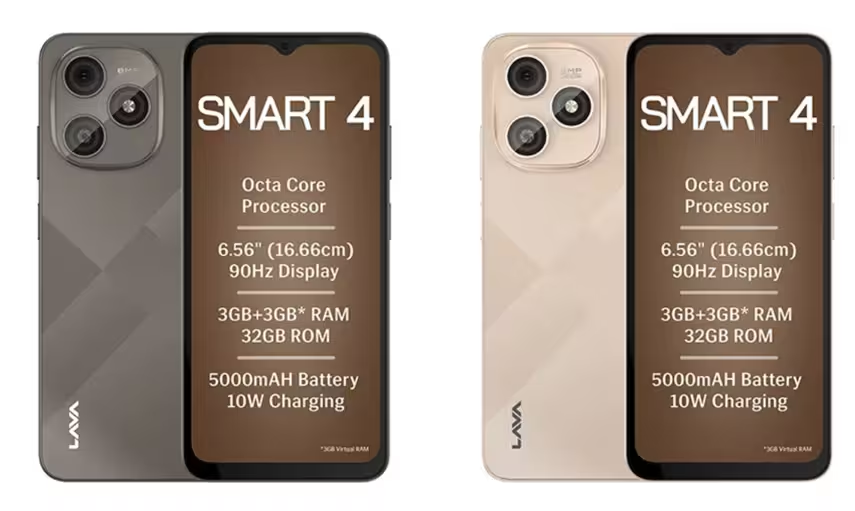
LAVA has launched the Smart 4 silently as a budget smartphone featuring a 6.56-inch 90Hz display, Android Go Edition and 4G support.
It is powered by the Unisoc SC9863A chipset with 3GB RAM, 32GB storage, an 8MP rear camera, 5MP front camera and a 5,000mAh battery with 10W charging via USB Type-C.
Pricing is yet to be announced but the phone is expected to be below ₹9,999.
LAVA has quietly expanded its budget smartphone lineup with the launch of the LAVA Smart 4. The new entry-level smartphone brings features like a 90Hz refresh rate display, 4G connectivity, Android Go Edition, and a 5,000mAh battery. It is aimed at users looking for an affordable smartphone for everydaytasks. Here’s everything you need to know about the new LAVA smartphone.
LAVA has not announced the official price of the LAVA Smart 4 yet.
However, the smartphone is expected to be priced below the LAVA Smart 4 Plus, which is currently available for ₹9,999. More details regarding its pricing and availability are expected to be announced soon.
The phone is available in Ajanta Grey and Konark Gold colour options.
LAVA Smart 4 – Key Features
The LAVA Smart 4 features a 6.56-inch display with a 540 × 1210 pixels resolution and a 90Hz refresh rate, offering smoother scrolling and animations compared to standard 60Hz panels.
Powering the smartphone is the Unisoc SC9863A processor paired with 3GB RAM and 32GB of internal storage. The device runs Android Go Edition, which is designed to deliver a smoother experience on entry-level hardware.
For photography, the smartphone comes with an 8-megapixel rear camera and a 5-megapixel front-facing camera for selfies and video calls.
The LAVA Smart 4 packs a 5,000mAh battery with support for 10W charging and uses a USB Type-C port for charging and data transfer. It also supports 4G connectivity, making it suitable for everyday communication, web browsing, and media streaming.
Redmi Note 17 will officially debut in India on August 6 and will be available via Amazon, Xiaomi’s online store and offline outlets.
Redmi has confirmed an 8,000mAh battery for the upcoming smartphone, offering one of the largest capacities in its segment.
Leak suggests ₹30,000-₹33,000 price range for Note 17, marking a ₹7,000 increase over the Redmi Note 15.
Redmi has officially announced the India launch date of the Redmi Note 17. The series recently debuted in China with the Redmi Note 17 and Redmi Note 17 Pro, although Xiaomi has not yet confirmed whether the Pro variant will also launch in India. The upcoming Note 17 will become the first model from the new Redmi Note 17 series to arrive in India.
Redmi Note 17 India Launch Date Confirmed
Redmi has confirmed that the Redmi Note 17 will launch in India on August 6. The announcement was made through the company’s official X account.
The smartphone will be available for purchase via Amazon India. It is also expected to be sold through Xiaomi’s official online store and offline retail outlets after launch.
8,000mAh Battery Officially Confirmed
Redmi Note 17 teaser. (Image credit – Redmi)
The company has also revealed that the Redmi Note 17 will pack a massive 8,000mAh battery, matching the battery capacity of the Chinese variant.
With such a large battery, the Redmi Note 17 is expected to offer one of the biggest battery capacities in its segment. It will be suitable for users looking for extended battery life and multi-day usage.
While Redmi has not confirmed the charging specifications for the Indian model, the Chinese version supports 45W wired fast charging and 22.5W reverse wired charging, allowing the phone to charge compatible devices.
Expected Price in India
Recent leaks suggest that the Redmi Note 17 5G could be priced at Rs. 30,000 for the 6GB + 128GB variant, while the 8GB + 128GB model may cost Rs. 33,000. If these prices turn out to be accurate, the Redmi Note 17 would represent a notable price increase compared to previous Redmi Note smartphones in India.
For comparison, the Redmi Note 15 was launched in India in January 2026 with a starting price of Rs. 22,999. This means the Redmi Note 17 could debut at a price roughly Rs. 7,000 higher than its predecessor.
The expected price hike aligns with the broader trend in the smartphone industry, where increasing memory costs and strong demand have pushed manufacturers to raise prices. It also suggests that Xiaomi may be positioning the Redmi Note series as a more premium offering in the Indian market.
Upcoming Phone Launches in August 2026 – Vivo S2 5G, Xiaomi Redmi Note 17 5G, Google Pixel 11 Series, POCO M8 Power and More.
August 2026 is shaping up to be an exciting month for smartphone enthusiasts. Several leading brands including Vivo, Xiaomi, Google, POCO, Samsung, and iQOO are expected to introduce new smartphones across different price segments. Here’s a look at the upcoming smartphones expected to launch in August 2026.
Vivo S2 5G
Vivo S2 5G teaser. (Image credit – Vivo)
Vivo is expected to launch the Vivo S2 5G in India on August 6, although the company has not officially confirmed the date. According to recent reports, the smartphone could go on sale from August 11.
The company has already teased the handset on X, offering a glimpse of its rear design. The teaser shows a pill-shaped horizontal camera module with two large circular camera rings and a separate circular light ring beside them. Meanwhile, leaked dummy units have surfaced in Black and Rose Gold colours.
The Vivo S2 is expected to arrive in 8GB + 128GB and 8GB + 256GB storage options. Internal retail listings have hinted at demo prices of Rs. 38,000 and Rs. 42,000, while another listing suggested a price of Rs. 43,000 for the base variant. However, these are believed to be internal figures and may not reflect the final retail pricing.
In terms of specifications, leaks have suggested a 6.59-inch 1.5K OLED display with a 120Hz refresh rate and an in-display fingerprint sensor. There are conflicting reports regarding the processor with some pointing to Qualcomm’s Snapdragon 8 Gen 5, while others claim the phone will use the MediaTek Dimensity 7360 chipset.
The smartphone is also tipped to feature a 50-megapixel primary camera with OIS, an 8-megapixel ultra-wide sensor, and support for 4K video recording from both the front and rear cameras. It is expected to pack a 7,000mAh battery with 80W wired fast charging along with wireless and reverse wireless charging support.
Vivo has yet to officially reveal the launch date, specifications, or pricing.
Xiaomi has officially confirmed that the Redmi Note 17 5G will launch in India on August 6 after making its debut in China earlier this month. Marketed as the “mAhster Edition,” the smartphone focuses on delivering long battery life.
The company has also created a dedicated microsite on its official website and Amazon India, confirming several key features ahead of launch. The biggest highlight is its 8,000mAh battery, which is designed to offer extended usage on a single charge.
The Redmi Note 17 5G is expected to feature a 7-inch AMOLED display with a 120Hz refresh rate and vibrant colour reproduction. It will be available in Light Blue and Purple colour options and features a textured rear panel with a squircle-shaped camera module. The smartphone is expected to be powered by Qualcomm’s Snapdragon 4 Gen 4 processor and may include a 50-megapixel primary camera along with an 8-megapixel front-facing camera.
Following its launch, the Redmi Note 17 5G is expected to go on sale around the middle of August through Amazon India, Xiaomi’s online store, and offline retail outlets.
Google Pixel 11 Series
Google Pixel 11 Series teaser. (Image credit – Google)
Google will unveil the Pixel 11 series during its upcoming Made by Google event on August 12. The lineup is expected to include the Google Pixel 11, Pixel 11 Pro, Pixel 11 Pro XL, and Pixel 11 Pro Fold.
According to recent reports, the standard Pixel 11 may start at USD 899 (around Rs. 87,000) for the 256GB storage variant. This would represent a price increase over the Pixel 10 but it is also expected to ship with double the base storage.
The Pixel 11 Pro is tipped to start at USD 1,099 (around Rs. 1.05 lakh), while the Pixel 11 Pro XL could carry a starting price of USD 1,299 (around Rs. 1.25 lakh). Meanwhile, the Pixel 11 Pro Fold is expected to begin at USD 1,899 (around Rs. 1.82 lakh), making it around USD 100 more expensive than its predecessor.
Leaks suggest the standard Pixel 11 may feature a 6.3-inch OLED display with a 120Hz refresh rate, Google’s next-generation Tensor G6 chipset built on a 2nm process, a 50-megapixel triple rear camera setup, and a 4,985mAh battery. The Pro models are expected to retain 120Hz OLED displays with upgraded camera hardware, while the Pixel 11 Pro Fold could feature a 6.5-inch outer display and enhanced on-device AI capabilities powered by the Tensor G6 processor.
POCO M8 Power
POCO M8 Power launch date confirmed. (Image credit – Poco)
POCO has confirmed that the POCO M8 Power will launch in India on August 4 at 12 PM IST. The announcement was made on X with the tagline “More Power, More Entertainment, More Binge,” indicating that the phone is aimed at users looking for long battery life and multimedia performance.
The smartphone will be sold exclusively through Flipkart.
Official renders reveal an Orange colour option with flat edges and a large rear camera island. The module features two large circular rings, one of which houses the camera sensor while the other appears to integrate the LED flash. The module also includes “50MP” branding, hinting at the primary camera.
POCO has confirmed that the handset will feature a massive 8,000mAh battery, which the company claims can deliver up to three days of usage between charges. It will also sport an AMOLED display, although the screen size and other specifications have not yet been announced.
Rumours suggest the POCO M8 Power could be a rebranded version of the Redmi Note 17, which is also scheduled to launch in India this month.
Samsung Galaxy S26 FE
Samsung Galaxy S25 FE. (Image credit – Samsung)
Samsung may soon introduce the Galaxy S26 FE in India, as the smartphone has appeared on the Bureau of Indian Standards (BIS) certification website. The listing, first spotted by SammyGuru, includes the model number SM-S741B/DS, with the “DS” suffix indicating the Indian dual-SIM version.
The smartphone has also appeared on the WPC and GSMA databases. According to these listings, the Galaxy S26 FE is expected to support a maximum charging load of 5.0W and has reportedly received Qi2 certification. The handset is also expected to ship with Android 17 and 8GB of RAM.
The Galaxy S26 FE has also surfaced on Geekbench, where it was listed with Samsung’s ten-core Exynos 2500 processor clocked at up to 3.30GHz. Benchmark results showed 2,255 points in the single-core test and 7,450 points in the multi-core test.
Although Samsung has not confirmed a launch date, the recent certifications suggest that the smartphone could make its India debut in the near future.
iQOO Z11 5G
iQOO Z11 5G. (Image credit – iQOO)
iQOO is also expected to launch the iQOO Z11 5G in India sometime in August 2026. According to a recent report, the smartphone could become the first device in India to feature MediaTek’s Dimensity 7500 chipset.
The report also claims that the Indian variant may feature a 3D curved display. Tipster Abhishek Yadav had previously shared similar information regarding the chipset.
Interestingly, the iQOO Z11 is already available in other markets with different hardware. The Chinese variant uses the MediaTek Dimensity 8500 processor, while the global version is powered by Qualcomm’s Snapdragon 7s Gen 4 chipset.
Apart from the processor, both versions differ significantly in terms of design and specifications. As a result, it remains unclear whether the Indian model will resemble either of them or arrive with an entirely different hardware package.
iQOO has not officially announced the India launch date or confirmed the specifications of the iQOO Z11 5G. However, more details are expected to emerge as the anticipated launch draws closer.
OPPO K15
OPPO K15. (Image credit – Oppo)
OPPO recently launched the OPPO K15 in China and the smartphone is now expected to arrive in India sometime in August 2026. While the company has not officially announced the India launch date, reports suggest it could make its debut in the coming weeks.
The China version of OPPO K15 features a 6.59-inch 1.5K OLED display with a resolution of 2760 × 1256 pixels, a 120Hz refresh rate, up to 240Hz touch sampling rate, and 1,200 nits peak brightness, promising a smooth and vibrant viewing experience.
Powering the smartphone is MediaTek’s Dimensity 7360 SUPER 4nm chipset with an octa-core CPU clocked at up to 2.5GHz paired with an Arm Mali-G615 GPU. It comes with 12GB LPDDR4X RAM and 256GB UFS 3.1 storage and runs Android 16 with ColorOS 16.
For photography, the OPPO K15 packs a 50-megapixel primary camera with OIS and EIS, alongside a 50-megapixel ultra-wide camera. Both the rear and 50-megapixel front camera support 4K video recording at 30fps. The smartphone also includes an in-display optical fingerprint scanner, infrared sensor, stereo speakers, and USB Type-C audio.
It carries an IP69 rating for dust and water resistance and houses a massive 8,000mAh battery with support for 80W fast charging.
Vivo T5
The Vivo T5 is also expected to launch in India soon, although Vivo has not confirmed an official launch date. Reports suggest it could arrive alongside the iQOO Z11 in August. The smartphone was introduced in Mexico earlier this year and is expected to expand to more markets, including India.
The Vivo T5 is expected to sport a 6.75-inch LCD display with a resolution of 1570 × 720 pixels, a 120Hz refresh rate, and up to 1,250 nits High Brightness Mode, offering smooth scrolling and improved visibility under sunlight.
It is expected to be powered by Qualcomm’s Snapdragon 6s Gen 2 4G processor paired with 8GB LPDDR4X RAM and 256GB UFS 2.2 storage. It also supports up to 8GB of virtual RAM and runs Android 16-based OriginOS 6. Security is handled through a side-mounted fingerprint scanner.
One of the biggest highlights of the Vivo T5 could be the 7,200mAh battery with 44W fast charging. The smartphone also comes with IP68 and IP69 ratings, making it one of the more durable devices in its segment. For cameras, the Vivo T5 is expected to feature a 50-megapixel primary rear camera accompanied by a 2-megapixel secondary sensor, while selfies and video calls are handled by a 32-megapixel front camera.
The Vivo T5 is expected to be priced at around ₹25,990 in India, although the official pricing will be announced at launch.
Tecno Spark 50C 4G tipped to launch globally and is expected to arrive in India rebranded as Spark Go 3 Pro.
It will most likely share design with Spark Go 3 4G and featuring 6.75″ HD+ 120Hz display, 15W charging, an upgraded 6,000mAh battery and Android 16.
Tecno has not made any official announcements yet.
Tecno appears to be expanding its Spark 50 lineup with a new budget smartphone. After launching the Spark 50 series globally, the company is reportedly preparing to introduce the Tecno Spark 50C 4G in select international markets. While the handset is not expected to arrive in India under the same name, reports suggest it could debut in the country as the Tecno Spark Go 3 Pro.
An exclusive report by PassionateGeekz has revealed the first renders and key expected specifications of the upcoming Tecno Spark 50C 4G.
Tecno Spark 50C 4G/Spark Go 3 Pro Expected Specifications
Tecno Spark 50C/ Spark Go 3 Pro 4G renders. (Image credit – PassionateGeekz)
According to the report, the Tecno Spark 50C 4G and the Tecno Spark Go 3 Pro are expected to share the same design and hardware. The only difference between the two devices is likely to be their branding, with Tecno expected to market the smartphone under different names in different regions. The company has followed a similar rebranding strategy with several of its smartphones in the past.
If the report is accurate, the Tecno Spark Go 3 Pro will be positioned as a more premium alternative to the existing Spark Go 3 4G.
The Spark Go 3 4G features a 6.75-inch HD+ display with a 120Hz refresh rate, a Unisoc T7250 processor, a 13-megapixel rear camera, an 8-megapixel front camera, a 5,000mAh battery with 15W fast charging, and 4GB RAM with 64GB of storage.
The upcoming Spark Go 3 Pro, which is expected to be a rebranded version of the Tecno Spark 50C 4G, is tipped to retain the 6.75-inch HD+ 120Hz display and 15W fast charging while offering a larger 6,000mAh battery.
The smartphone is also expected to ship with Android 16 out of the box, making it one of Tecno’s latest budget devices to run the newest Android version.
Launch Timeline
The Spark 50 lineup currently includes the Tecno Spark 50 4G, Tecno Spark 50 5G and Tecno Spark 50 Pro. The addition of the Spark 50C 4G is expected to further strengthen the company’s budget smartphone portfolio.
At present, Tecno has not officially confirmed the Spark 50C 4G or revealed its launch schedule. More information including the complete specifications, pricing, market availability, and launch timeline is expected to emerge in the coming days as the device moves closer to its official debut.