


Highlights
- Geekbench listing reveals Tensor G4 chipset with 4 efficiency, 3 performance, and 1 prime core
- Pixel 9 scores 1653 in single-core and 3313 in multi-core Geekbench tests
- Test unit runs Android 14, with final version expected to ship with Android 15
- Pixel 9 to feature 8GB RAM, with a rumoured 12GB variant
The Geekbench listing for the highly anticipated Google Pixel 9 is finally here and reveals many essential specifications about this device’s performance.
Even so, take note that benchmarking at this stage may not represent the real capability of the Tensor G4 chipset.
This listing confirms the Tensor G4 will pack 4 efficiency cores clocked at 1.95 GHz, 3 performance cores at 2.60 GHz, and 1 prime core, running at an astonishing 3.10 GHz.
Comparing the Scores


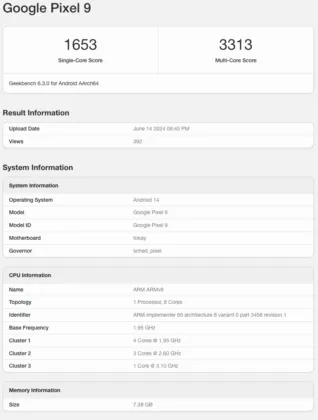
According to the listing, the Pixel 9 scored 1653 in the single-core test and 3313 in the multi-core test.
While the single-core score was an update from that of its predecessor, the Pixel 8, which had 1,045, the multi-core score remained farther back at 3,294.
This would perhaps imply that Tensor G4 still does some catching up to the very best Qualcomm chips that score about 2,300 points on the single-core and an impressive 7,249 points on the multi-core Geekbench tests.


However, it’s worth noting that this could be an early test variant, and the final performance numbers may differ.
Googleprobably will work on the current heat management issues seen with the last few generations of its in-house Tensor chipset, and this might translate into a better-performing Tensor G4.
The upcoming Android 15, the next version of the software that Google is expected to ship with the Pixel 9, will further bring improvements to longer-sustained performance, memory handling, and standby battery life.
Pixel 9’s Specifications

The Geekbench listing further confirmed that the test unit of Pixel 9 is running Android 14, while the final version is most probably going to ship with Android 15 out of the box.
Moreover, it comes with 8GB RAM, much like its predecessor, while rumour has it that Google will introduce a higher 12GB variant as well.
According to reports, the Tensor G4 is fabbed on Samsung’s 4nm process, while next year’s Pixel 10 could feature Tensor G5 based on TSMC’s more efficient 3nm process.
FAQs
What does the Geekbench listing reveal about the Google Pixel 9?
The Geekbench listing reveals key specifications of the Pixel 9, including the Tensor G4 chipset configuration, which has 4 efficiency cores at 1.95 GHz, 3 performance cores at 2.60 GHz, and 1 prime core at 3.10 GHz.
How does the Pixel 9 perform in Geekbench tests?
The Pixel 9 scores 1653 in the single-core test and 3313 in the multi-core test.
These scores indicate an improvement in single-core performance compared to the Pixel 8 but show that the Tensor G4 still lags behind top Qualcomm chips.
What operating system will the Pixel 9 run?
The test unit of the Pixel 9 is running Android 14, but the final version is expected to ship with Android 15, which should bring improvements in performance, memory handling, and battery life.
What are the memory options for the Pixel 9?
The Geekbench listing confirms that the Pixel 9 will come with 8GB of RAM, similar to its predecessor. However, rumors suggest that Google might also introduce a higher 12GB RAM variant.
Also Read: Google To Reportedly Bring Gemini Nano AI Assistance Called Pixie to Upcoming Pixel 9 Series
Also Read: Google Pixel 9 To Reportedly Get Only A Modest Chipset Upgrade Next Year
Also Read: Google Pixel 9 Pro Potentially Revealed in Detailed 5K Renders Months Ahead of Official Launch

