
Home Blog Page 346

HMD Global and Xplora to Collaborate to Make Addiction-free Devices for Young Users

0

Highlights

  • HMD Global and Xplora Technologies are partnering to create responsible devices for young people.
  • HMD will develop feature phones and smartwatches with parental controls.
  • Devices are expected to be released by March 2025.

image
HMD with Xplora to develop children friendly devices. (Image credit – HMD)

HMD Global and Xplora Technologies are coming together to address one of the most pressing concerns parents have about their young children today – technology addiction.

In a press release, both companies announced their strategic partnership “to produce responsible and mindful devices for young people to enable choice and balance with technology.”

Human Mobile Devices (HMD) is Europe’s largest smartphone manufacturer and Xplora is the leading Norwegian company known for producing smartwatches for children.

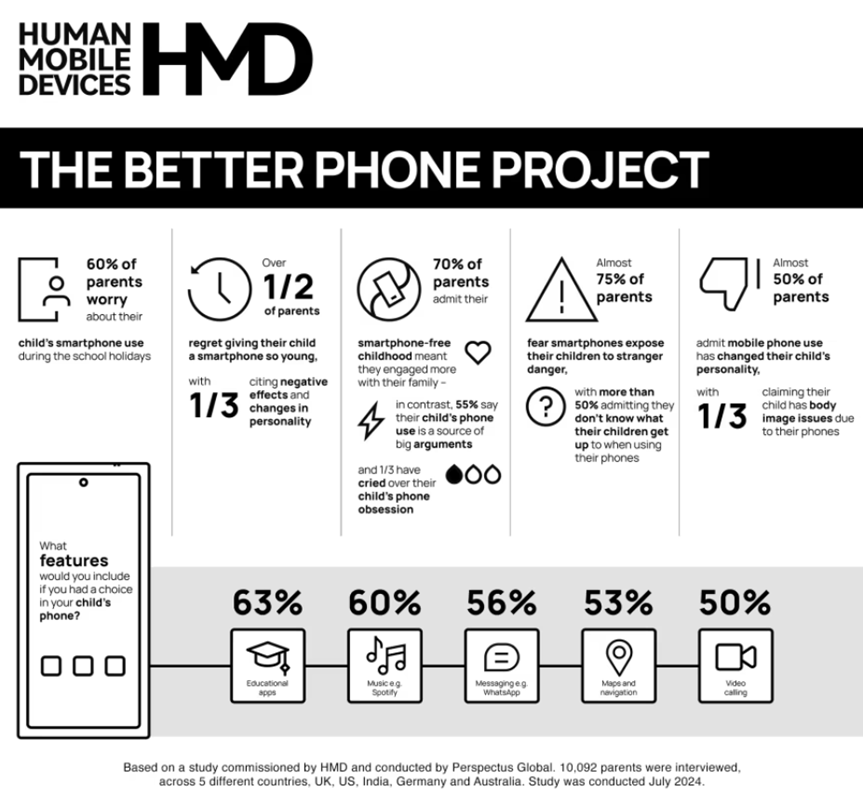
Previously, HMD and Perspectus Global launched “The Better Phone Project” to under the pressing issues parents face today with their young children and technology.

Under the project, they worked together to gather responses from more than 10,000 parents across the UK, US, India, Germany and Australia.

The survey findings revealed that about 60% of parents worry about smartphone overuse among children, 50% regret giving smartphones at an early age and 70% say they had more family interactions growing up without smartphones.
image
HMD and Perspectus Global’s “The Better Phone Project” survey findings. (Image credit – HMD)

HMD is working to develop a range of children friendly feature phones and smartwatches through its collaboration with Xplora.

As per the reports, Xplora will handle the design of these devices and HMD will manage distribution.

Together both companies are aiming to offer alternatives to traditional smartphones that reduce distractions and enhance child safety.

HMD’s “Anti-Addiction” Devices – What to Expect?

HMD and Xplora Technologies collaborate to create new solutions to help families achieve the balanced relationship with technology

Expected to be released at MWC in March 2025, these devices will include parental controls, smart home connectivity and eSIM support.

They are designed to promote healthy digital use allowing parents to oversee screen time and social media access.

HMD CEO Jean-Francois Baril shared his enthusiasm for developing technology with “human” values at the forefront, while Xplora CEO Sten Kirkbak noted that the partnership will enable Xplora to broaden its reach in youth tech and support children’s digital well-being.

image
An HMD Survey reveals that 50% of parents regret giving smartphones to their children at an early age. (Image credit – HMD)

This partnership aims to create safe, distraction-free technology that fosters a healthy relationship with digital devices for young users.

Commenting on the collaboration with Xplora, the CEO and chairman of HMD Jean-Francois Baril said: “We are excited to join forces with Xplora to deliver tech solutions tailored to the unique needs of children and young people. At Human Mobile Devices, putting ‘human’ at the core of everything we do is in our DNA. Our teams oversee the complete development process, from software to hardware, ensuring top-tier quality, certification, and security. This allows us to foster a healthy and positive relationship with technology—providing all the essential features, without any unnecessary distractions.

Meanwhile, Xplora CEO Sten Kirkbak also added in the press release: “We are thrilled to collaborate with HMD in our expansion into the youth market. This partnership not only delivers the best possible tech devices for our customers but also expands our products allowing our customers to continue their journey with Xplora beyond the smartwatch stage.”

FAQs

Q1. What is the goal of the partnership between HMD Global and Xplora Technologies?

Answer. The partnership aims “to produce responsible and mindful devices for young people to enable choice and balance with technology.”

Q2. When are the new children-friendly devices expected to be released?

Answer. Scheduled for a March 2025 release at MWC, these devices will include parental controls, smart home connectivity and eSIM support.

Also Read : Upcoming HMD Sage Images and Specs Leak Online

Also Read : HMD 105 4G and HMD 110 4G Feature Phones with YouTube Shorts Launched in India

Also Read : HMD Barbie Phone: Retro Flip Phone Launched in Partnership with Toy Maker Mattel, But No Access to Social Media Apps

Flipkart Responds After X User Sparks Debate Over Price Difference on Apple and Android for Same Product

0

Highlights

  • An X user highlighted a price difference on Flipkart for Apple and Android users.
  • As per the screenshot shared, the product shows a lower price on Android compared to iOS.
  • Flipkart explained that prices may vary based on the seller’s factors.
  • The post sparked concerns about fairness and transparency in e-commerce pricing.
image
Mokobara cabin suitcase is priced ₹ 4,799 on the iOS app (Left) and ₹ 4,119 on Flipkart’s Android app (Right). (Image credit – @randomusements on X)

An X (previously Twitter) user recently started a discussion about a pricing difference for the same product on e-commerce giant Flipkart.

As per details shared, it appears Flipkart prices vary depending on whether the app was accessed through an Android or iOS device.


User Saurabh Sharma posted screenshots showing the price variation for a Mokobara cabin suitcase, with a noticeable difference between Android and iOS. “Android vs iOS – different prices on Flipkart app.

Same Mokobara cabin suitcase costs ₹ 4,119 on Flipkart’s Android app vs ₹ 4,799 on iOS app,” Mr Sharma shared on X.

The screenshots reveal that the small cabin suitcase from Mokobara is listed at ₹ 4,119 with a 65% discount on Android, while it’s priced at ₹ 4,799 with a 60% discount on an iPhone. Moreover, Android users are offered a no-cost EMI option starting at ₹ 1,373 per month, whereas the EMI begins at ₹ 1,600 per month on iOS.

Expressing his concern, Sharma also wrote, “Apple charges 30% commission on subscriptions etc., so different pricing for iOS makes sense there. But for e-commerce? Very shady and unfair.”


In a follow-up, Sharma also posted a screenshot of his conversation with Flipkart customer support.

Flipkart explained, “Prices may vary since it is determined by the seller based on various factors. However, please don’t worry, our sellers are always trying their best to bring you great deals and discounts. Happy shopping!”

Since Sharma’s post on Wednesday, it has received over 127,000 views and numerous comments.

One user responded, “This is common across multiple apps, mad annoying. I once had a 1 lakh Android device and an old iPhone 7 plus and everything was more expensive on the latter. If I recall correctly, even cab prices.”

Another person commented, “I think that is common knowledge. The price of the product listed varies based on the phone. Even Uber prices change not just during rain- but also when your phone’s battery percentage is low. That’s how companies milk the opportunity.”


A third user stated, “Shady, yes! Check if Amazon or any other does the same, I don’t think so. Flipkart has been shady for a while now. Unfair? Well, as long as they can get away with it. Closed Flipkart a/c long time ago. The platform accepts no responsibility for anything. Risky platform.”

“I have noticed the same in Zepto/Instamart/Blinkit. The difference is negligible there but why the difference is the question,” another user noted.

“Both platforms have different commission rates, so I can accept some differences in the pricing. However, this huge difference could only be an error from the seller,” added a fifth user.

Some users even defended the difference in prices sharing personal experiences.

FAQs

Q1. What did an X user discover about Flipkart’s pricing?

Answer. User Saurabh Sharma posted screenshots showing the price variation for a Mokobara cabin suitcase, with a noticeable difference between Android and iOS. “Android vs iOS – different prices on Flipkart app. Same Mokobara cabin suitcase costs ₹ 4,119 on Flipkart’s Android app vs ₹ 4,799 on iOS app,” Mr Sharma shared on X.

Q2. What explanation did Flipkart provide for the price differences?

Answer. Flipkart explained, “Prices may vary since it is determined by the seller based on various factors. However, please don’t worry, our sellers are always trying their best to bring you great deals and discounts. Happy shopping!”

Also Read : Huge Price Drop Alert: Samsung Galaxy S22 Pre-Diwali Offer Now Available at Half Price on Flipkart

Also Read: Flipkart UPI’s Re 1 Auto Ride Campaign Creates Buzz in Bengaluru Ahead of Big Billion Day Sale

Also Read : Flipkart Big Billion Days vs Amazon Great Indian Festival Sales: Who Is Offering the Best iPhone Deals?

Snapdragon 8 Elite Vs MediaTek Dimensity 9400 – A Detailed Comparison

0

Highlights

  • Snapdragon 8 Elite features custom Oryon cores with a 2+6 setup, 24MB L2 cache and up to 4.32GHz clock speed, enhancing performance.
  • MediaTek Dimensity 9400 uses a 1+3+4 big-core layout, achieving scores over 3 million and supports advanced 3nm 3NE node architecture.
  • Both chips feature advanced GPU, NPU capabilities and 5G modem connectivity.
  • Both chips focus on real-time 3D rendering and on-device AI processing.

The flagship chipsets for 2025 are here. We have Qualcomm’s Snapdragon 8 Elite and MediaTek’s Dimensity 9400 all set to power the upcoming devices. While most phones with these chips will launch in 2025, we already have two smartphones using these powerhouse SoCs — the Realme GT7 Pro with the Snapdragon 8 Elite and the Vivo X200 Pro with the Dimensity 9400.

Before we get to see more smartphones featuring these new and powerful chipsets, let’s do a quick comparison to see which one can come out as a winner.

Snapdragon 8 Elite Vs MediaTek Dimensity 9400 – Specs Comparison

Specs Snapdragon 8 Elite MediaTek Dimensity 9400
Architecture 3nm, TSMC (N3E) 3nm, TSMC (N3E)
Cores 8 8
Core configuration 2x Prime Cores

6x Performance Cores

1x Cortex-X925

3x Cortex-X4

4x Cortex-A720

Max Frequency 4.32GHz 3.62GHz
GPU Adreno 830 Immortalis G925
NPU Hexagon AI Engine MediaTek NPU 890
Memory type LPDDR5X LPDDR5X
Modem Snapdragon X80 5G modem

Up to 10 Gbps Peak Download

Up to 3.5 Gbps Peak Upload

3GPP Release-17 5G

Up to 10 Gbps Peak Download

Up to 3.5 Gbps Peak Upload

Connectivity Wi-Fi 7, Bluetooth 6.0 and UWB Wi-Fi 7, Bluetooth 5.4
ISP ISP       Qualcomm AI ISP fused with Hexagon NPU Imagiq 1090

Snapdragon 8 Elite Vs MediaTek Dimensity 9400 – CPU

image
Snapdragon 8 Elite CPU configuration. (Image credit – Qualcomm)

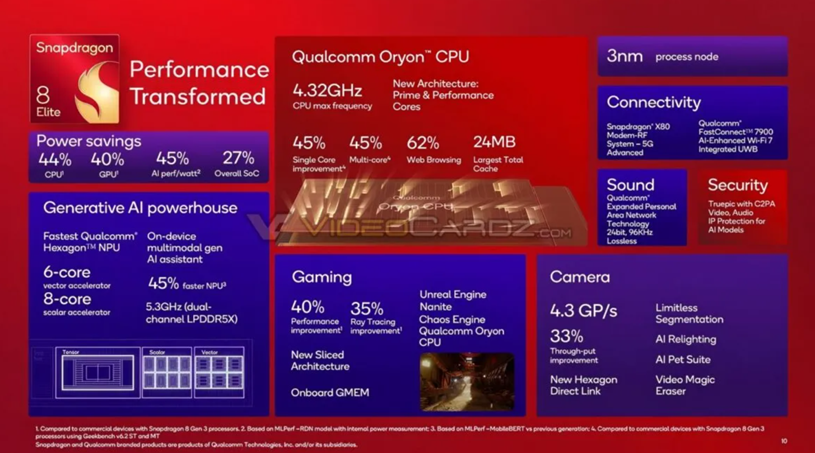
The Snapdragon 8 Elite packs Qualcomm’s second-generation custom Oryon cores in a 2+6 setup, supporting clock speeds of up to 4.32GHz. This high speed gives it a significant boost in both single-threaded and multi-threaded performance. It also features a massive 24MB L2 cache.

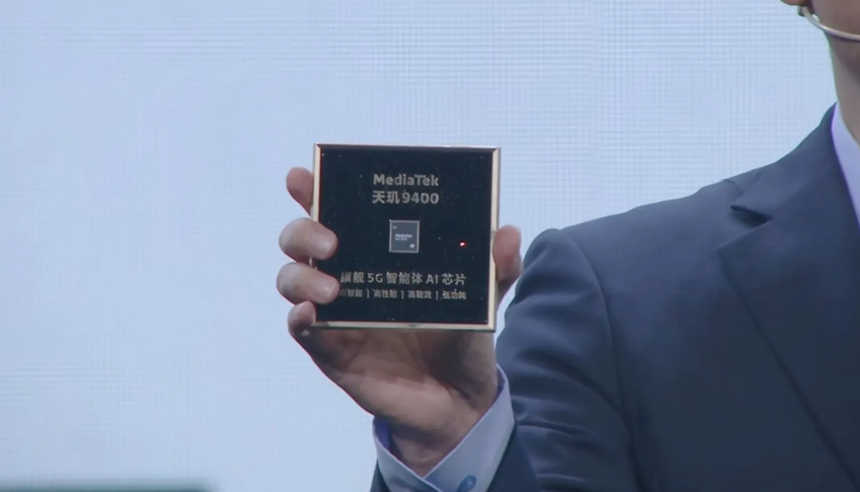
Meanwhile, the MediaTek Dimensity 9400 sports an all-big-core layout with a 1+3+4 configuration using standard ARM cores with a top clock speed of 3.62GHz.

image
MediaTek Dimensity 9400 CPU configuration. (Image credit – MediaTek)

MediaTek claims the Dimensity 9400 achieves scores of over 3 million points, which is the same as Qualcomm’s performance claims for the Snapdragon 8 Elite.

Apart from the custom Oryon cores in Qualcomm’s design and MediaTek’s all-big-core structure, there aren’t any major technical distinctions at the CPU level. Both chips use TSMC’s advanced 3nm 3NE node architecture.

Snapdragon 8 Elite Vs MediaTek Dimensity 9400 – GPU

The Snapdragon 8 Elite is equipped with the Adreno 830, which is based on Qualcomm’s Oryon design. It’s compatible with Unreal Engine 5.3, allowing real-time 3D rendering. The GPU uses a sliced architecture that enhances ray tracing performance by up to 35% with Qualcomm claiming it delivers the best ray tracing performance in any mobile chip.

MediaTek Dimensity 9400 features the Immortalis G925 GPU and a 12-core graphics unit delivering a 40% improvement in ray tracing capabilities. It also supports MediaTek HyperEngine Technology developed in partnership with ARM as well as OMM support for realistic depth and 3D effects during gameplay.

Both the Snapdragon 8 Elite and Dimensity 9400 now support real-time 3D rendering and have advanced ray tracing at the forefront.

Snapdragon 8 Elite Vs MediaTek Dimensity 9400 – NPU

The Snapdragon 8 Elite features Qualcomm’s latest Hexagon NPU known as the Hexagon AI Engine, which supports multimodal generative AI.

This engine can process images, videos, text and audio directly on the device.

It works alongside the ISP in the chipset to enhance photos with natural colours, HDR, bokeh and other effects through AI-powered segmentation

image
Dimensity 9400 MediaTek’s 8th-generation NPU 890. (Image credit – MediaTek)

The Dimensity 9400, on the other hand, includes MediaTek’s 8th-generation NPU 890, which supports LoRA training models, AI-powered video generation and on-device AI processing.

MediaTek’s Dimensity Agentic AI Engine also allows developers to easily integrate the NPU’s capabilities into apps.

Both processors are equipped to support on-device AI capabilities. Qualcomm and MediaTek are collaborating with Google and Meta to enable support for Gemini AI and Meta AI models.

Snapdragon 8 Elite Vs MediaTek Dimensity 9400 – Modem Connectivity

The Snapdragon 8 Elite uses the SnapdragX80 5G modem on with peak download speeds of up to 10Gbps and upload speeds of up to 3.5Gbps. It also features Wi-Fi 7 and Bluetooth 6.0 along with support for NavIC.

image
Snapdragon 8 Elite 5G Modem Specs. (Image credit – Qualcomm)

Meanwhile, the Dimensity 9400 comes with the 3GPP Release-17 5G modem offering similar download and upload speeds as the Snapdragon X80. While it also supports Wi-Fi 7, it’s limited to Bluetooth 5.4 instead of 6.0.

The difference between Bluetooth 5.4 and 6.0 is minimal. The Dimensity 9400 also supports NavIC.

Both modems offer advanced 5G capabilities, covering sub-6GHz and mmWave bands.

Snapdragon 8 Elite Vs MediaTek Dimensity 9400 – Benchmark Performance Comparison

In the past, Qualcomm’s chips have usually been a step ahead of others but MediaTek has been a tough competitor.

image
Snapdragon 8 Elite Vs MediaTek Dimensity 9400 on GeekBench 6 Multi-Core. (Credit – GSMArena)
image
Snapdragon 8 Elite Vs MediaTek Dimensity 9400 on GeekBench 6 Single-Core. (Credit – GSMArena)

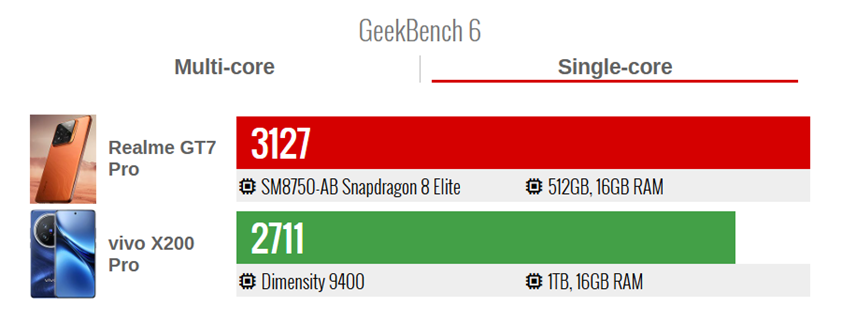
As per a recent GSMArena report, the Snapdragon 8 Elite takes the lead in CPU performance, especially in Geekbench 6.

It scores 10% higher than the Dimensity 9400 in multi-core tasks and 15% higher in single-core tests.

image
Snapdragon 8 Elite Vs MediaTek Dimensity 9400 on AnTuTu 10 Benchmark. (Credit – GSMArena)

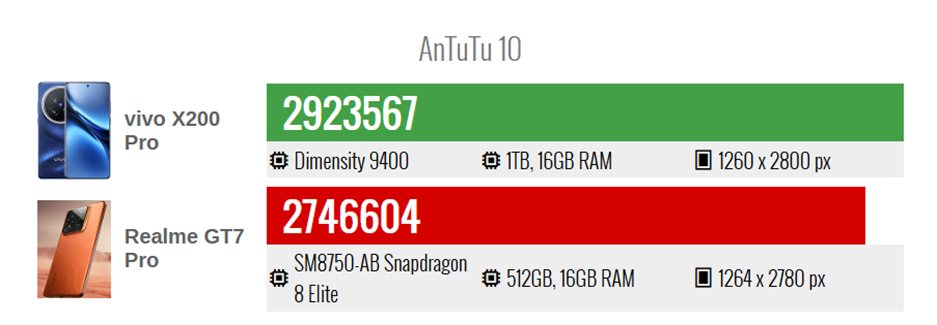
However, in mixed-use benchmarks like AnTuTu 10, the Dimensity 9400 edges out the Snapdragon with a 2923567 score compared to 8 Elite’s 2746604 score. For most users, this difference won’t be noticeable in day-to-day tasks.

image
Snapdragon 8 Elite Vs MediaTek Dimensity 9400 on 3D Mark. (Credit – GSMArena)

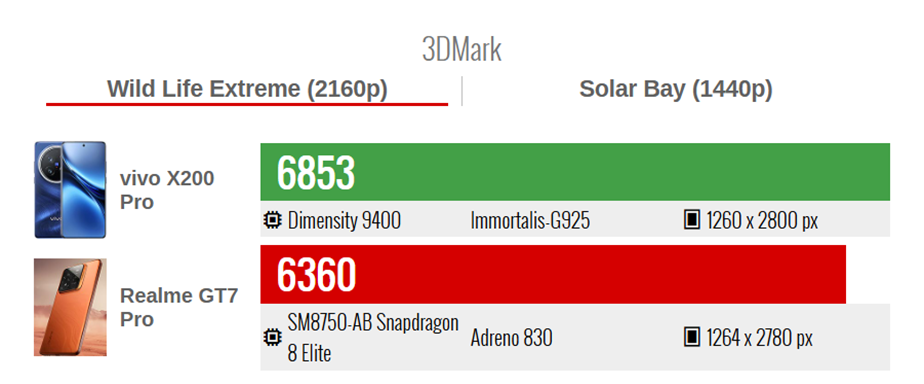
When it comes to graphics-heavy benchmarks like 3DMark’s Wild Life Extreme and Solar Bay, the Dimensity 9400’s Immortalis GPU slightly outperforms the Snapdragon 8 Elite’s Adreno 830 by 7-8%. It’s impressive to see MediaTek’s GPU edge out Qualcomm’s, even by a small margin.

Overall, both the Snapdragon 8 Elite and Dimensity 9400 can handle just about anything you throw at them.

FAQs

Q1. What CPU setup does the Snapdragon 8 Elite feature?

Answer. The Snapdragon 8 Elite packs Qualcomm’s second-generation custom Oryon cores in a 2+6 setup, supporting clock speeds of up to 4.32GHz.

Q2. What is the GPU used in the MediaTek Dimensity 9400?

Answer. MediaTek Dimensity 9400 features the Immortalis G925 GPU and a 12-core graphics unit delivering a 40% improvement in ray tracing capabilities.

Q3. What NPU does the Snapdragon 8 Elite have?

Answer. The Snapdragon 8 Elite features Qualcomm’s latest Hexagon NPU known as the Hexagon AI Engine, which supports multimodal generative AI.

Q4. What modem does the Snapdragon 8 Elite use?

Answer. The Snapdragon 8 Elite uses the Snapdragon X80 5G modem with peak download speeds of up to 10Gbps and upload speeds of up to 3.5Gbps.

Q5. What advanced node architecture do both processors use?

Answer. Both chips use TSMC’s advanced 3nm 3NE node architecture.

Also Read : Qualcomm’s Next-Gen Snapdragon Elite Chipset to Power Xiaomi 15 Series

Also Read : Qualcomm Unveils Snapdragon 8 Elite with Oryon CPU, Boosting Performance and Efficiency

Also Read : MediaTek Unveils Flagship Dimensity 9400 Chipset: Check Out List of Phones Set to Feature It

Apple Commits $1.1 Billion in Satellite Services Deal Expansion With GlobalStar

0

Highlights

  • Apple extends its partnership with iPhone satellite connectivity partner GlobalStar.
  • Commits an extra $1.1 billion to boost satellite service capacity.
  • Also takes a 20% equity stake in the company.
  • Apple extended the free period for satellite connectivity through 2025.
image
 Apple extends partnership with iPhone Satellite Connectivity partner GlobalStar. (Image credit – Apple)

Apple’s partnership with its iPhone satellite connectivity partner Globalstar has been extended, the companies disclosed in recent security filings.

The expansion deal includes Apple committing an extra $1.1 billion in infrastructure payments to boost satellite service capacity.

Apple is also taking a 20% equity stake in GlobalStar, which will be valued at around $400 million.

Globalstar shares jump after expanding $1.1B satellite services deal with Apple, supporting a new MSS network development and launch.

The reports of the extended deal have sent GlobalStar’s stock rising. 

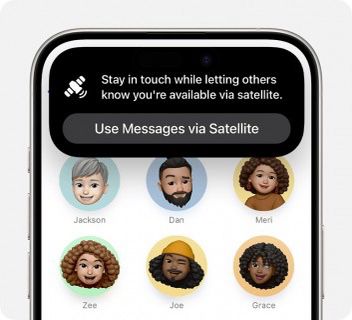
The deal also highlights Apple’s growing interest in satellite-powered iPhone features. For example, with iOS 18, iPhone users can now send texts to friends and family via satellite when they’re outside of cellular or WiFi range.

Apple has been investing heavily to provide satellite capabilities for free to users, even though the company has hinted to eventually charge for this feature.

Apple has bought a 20% percent stake in GlobalStar

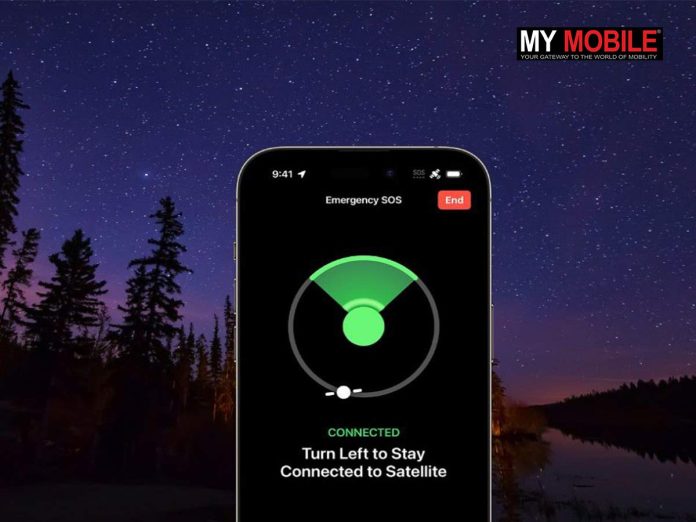
Satellite connectivity was first launched with the iPhone 14 in 2022 specifically for Emergency SOS.

At the time of launch, the service was available for free for two years with experts believing a fee would be applicable around late 2024.

However, Apple recently extended the free period through 2025.

Apple hasn’t disclosed a specific price for satellite services yet. Since features support life-threatening emergencies, there has been speculation that Apple might keep Emergency SOS free while charging for new satellite features, like sharing your location on Find My or sending satellite texts recreationally via iOS 18.

Apple announced two-way satellite messaging via satellite when outside of cellular coverage with iOS 18.

Some reports also suggest that Apple could bundle satellite services with Apple One or offer it as a mobile carrier add-on.

Apple now owns 20% of Globalstar via an equity deal worth $400 million.

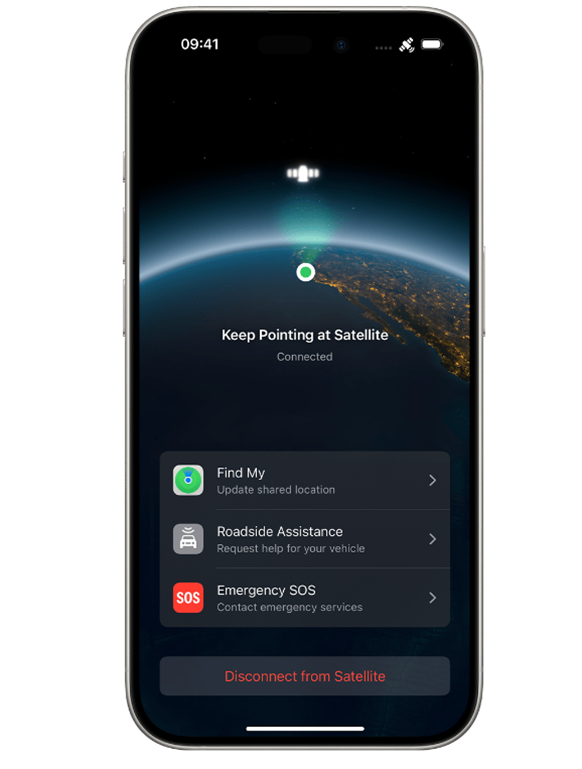
iPhone models from iPhone 14 onward support satellite connectivity, which activates automatically when you’re out of cellular or WiFi range. Apple explains, “With iPhone 14 or later (all models), you can connect your iPhone to a satellite to text emergency services, request roadside assistance, message friends and family, and share your location – all while you’re off the grid with no mobile network and Wi-Fi coverage.”


iPhone 14 or later model users can try a satellite demo by going to Settings -> Emergency SOS -> Emergency SOS via Satellite -> Try Demo.

FAQs

Q1. How much is Apple committing to boost satellite service capacity with GlobalStar?

Answer. Apple is committing an extra $1.1 billion in infrastructure payments to boost satellite service capacity and taking a 20% equity stake in GlobalStar.

Q2. What new feature does iOS 18 offer related to satellite connectivity?

Answer. With iOS 18, iPhone users can send texts to friends and family via satellite when they’re outside of cellular or WiFi range.

Q3. When was satellite connectivity first introduced to iPhones, and for what purpose?

Answer. Satellite connectivity was first launched with the iPhone 14 in 2022 specifically for Emergency SOS.

Q4. How to start an iPhone satellite service demo?

Answer. Users can try a satellite demo by going to Settings -> Emergency SOS -> Emergency SOS via Satellite -> Try Demo.

Q5. When was the iPhone Satellite service launched?

Answer. Satellite connectivity was first launched with the iPhone 14 in 2022 specifically for Emergency SOS. At the time of launch, the service was available for free for two years with experts believing a fee would be applicable around late 2024.

Also Read : Starlink Internet Coming to India: Discover All About Elon Musk’s Satellite Internet Service

Also Read : Apple Introduces Messaging via Satellite in iOS 18: How Much Will It Actually Cost?

Meta AI Surpasses 500 Million Users in One Year, Says Zuckerberg

0

Highlights

  • Meta AI has surpassed 500 million users in just one year.
  • Zuckerberg is confident it will become the most-used AI assistant by the end of 2024.
  • Meta’s Threads app added almost 275 million monthly users.

image

 Meta AI clocking the 500 million user mark, Zuckerberg confirmed. (Image credit – Meta)

Meta CEO Mark Zuckerberg during the Meta Connect last month shared that Meta AI is well on “on track” to become the world’s most-used generative AI assistant. Zuckerberg, in a Threads post, noted that Meta AI integrated with Facebook, Instagram and WhatsApp was getting more than 185 million users weekly and over 400 million users monthly.

Now, according to recent reports, the company has taken a giant leap toward making that goal a reality.

During Meta’s latest earnings call, Zuckerberg reportedly confirmed that Meta AI has surpassed 500 million users. This half-billion user mark comes just a year after Meta first introduced its AI assistant last fall.

Zuckerberg also expressed confidence that Meta AI will become the “most-used” assistant by the end of 2024. Although, he hasn’t specified exactly how this usage will be measured.

Meta CFO Susan Li also expressed confidence on the call. Li was quoted in the media reports, saying, “(Meta AI is) obviously very early in its journey, but it continues to be on track to be the most used AI assistant in the world by end of year.”

Meanwhile, Meta’s AI assistant isn’t the only AI feature boosting the company’s performance.

According to Zuckerberg, improvements in AI-based feeds and video recommendations have increased time spent on Facebook by 8 per cent and on Instagram by 5 per cent this year. Advertisers are also making use of Meta’s generative AI tools, with more than 15 million AI-generated ads created just in the last month.

Zuckerberg reportedly said, “We believe that there’s a lot more upside here.”

Apart from the AI performance, Zuckerberg revealed that Meta’s Threads app is also experiencing strong growth with “almost 275 million” monthly users now.

“It’s been growing more than a million sign-ups per day,” Zuckerberg noted, adding that “engagement is growing too.”

As per reports, Meta has been working on its own search engine designed for Meta AI. It aims to provide users with real-time, conversational interactions on current events.

FAQs

Q1. How many users does Meta AI have as of now?

Answer. Meta AI has surpassed 500 million users.

Q2. Does AI impact the time spent on Facebook and Instagram?

Answer. Improvements in AI-based feeds and video recommendations have increased time spent on Facebook by 8% and on Instagram by 5% this year.

Q3. What is the current growth status of Meta’s Threads app?

Answer. Meta’s Threads app is experiencing strong growth with almost 275 million monthly users now.

Also Read : Here’s how you can use Meta AI on WhatsApp: Translate, Calculate, and More

Also Read : Apple reportedly rejects Meta AI for its chatbot to work with OpenAI and possibly Google

Also Read : Cross WhatsApp, Facebook, and Instagram: What You Need to Know

Bumble Now Allows Users To Match By Interests

0

Highlights

  • Bumble’s new feature lets users search for matches based on shared interests.
  • Aims to connect people based on personality rather than just appearance.
  • Users can filter by interests using the “narrow your search” and “advanced filters” options.
image
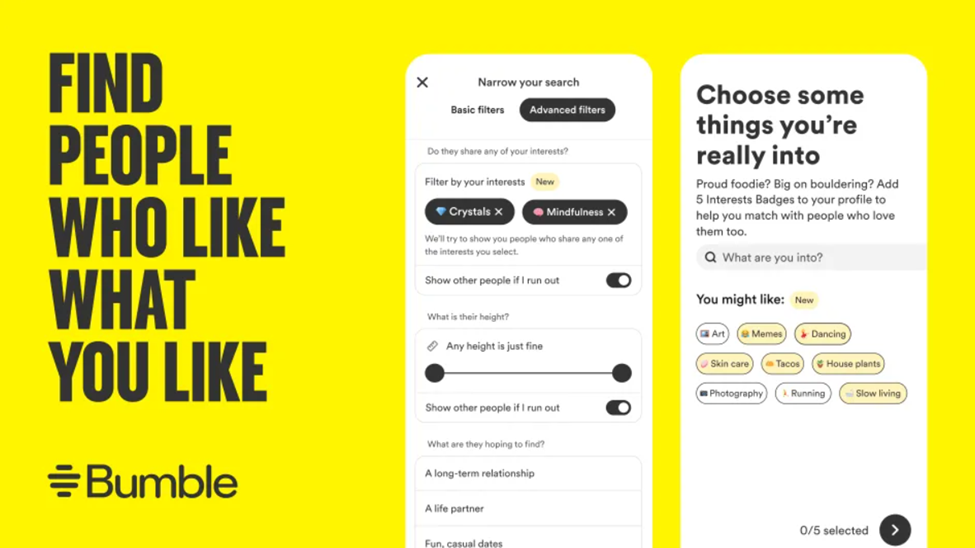
 Bumble’s advanced filters now allow users to match by interest. (Image credit – Bumble)

While apps are supposed to make life easier, dating apps are often a challenge when it comes to finding someone you truly connect with. The focus always seems to be more on physical appearance instead of personality. Moreover, the challenge the coming across the real personality is a whole other challenge altogether.

Bumble, with its online dating cum networking setup, has managed to bridge this gap where people get to know about the personality of the person on the other side of the screen much better than other dating apps we have today.

It appears Bumble is now aiming to work more towards allowing people to connect based on personalities and not only appearance. The app is introducing a new feature that lets users search for matches based on shared interests.

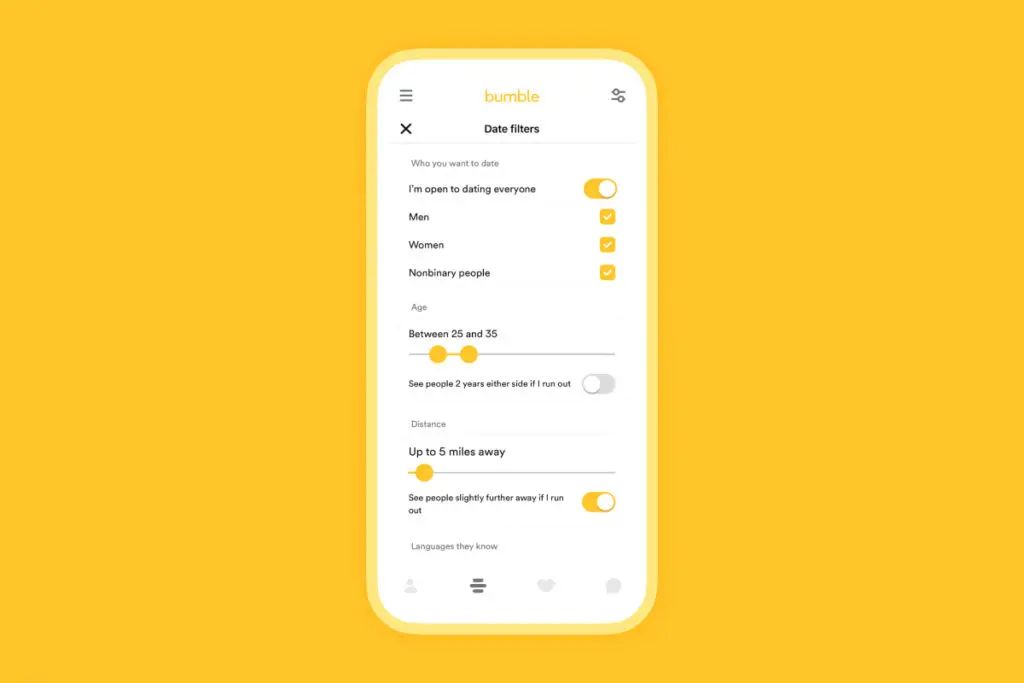
To use this tool, users just need to click “narrow your search,” followed by “advanced filters,” then select “filter by your interests.” Each user can display up to five interests on their profile.

However, there’s a chance a shared interest might not appear if someone hasn’t chosen it for their profile.

Use Bumble Filters to Find the Right Connections

Bumble has recently added over 30 new interest options, so users can be selective rather than choosing them all just to cast a wider net. If no matches are available with those selected interests, users can choose to see other profiles outside their filters.

Many of the interest options are lighthearted like memes, tacos or travelling.

Some, however, offer a deeper glimpse with interests such as mindfulness, slow living and therapy. While it’s not a deep dive into someone’s personality, it offers a bit more insight than just a photo.

Moreover, Bumble is expanding its Opening Moves feature, introduced in April.

The Opening Moves feature allows users to set a specific question for new matches to respond to, instead of crafting a new opener each time. Now, users can set up to three Opening Moves and they can even include images with captions to make the conversation starter more engaging.

FAQs

Q1. How can Bumble users search for matches based on shared interests?

Answer. Users need to click “narrow your search,” followed by “advanced filters,” then select “filter by your interests.”

Q2. What is the maximum number of interests Bumble user can display on their profile?

Answer. On Bumble, each user can display up to five interests on their profile.

Q3. What is the Opening Moves feature on Bumble?

Answer. The Opening Moves feature allows users to set a specific question for new matches to respond to, and now users can set up to three Opening Moves and include images with captions to make the conversation starter more engaging.

Also Read : Bumble Gives Women More Choice to Make the First Move: Check Women First Dating App New Features and Design

Also Read : Bumble Deception Detector: Online Safety

Also Read : Bumble 2024 Dating Trends

WhatsApp Announce Custom List Feature To Help You Track Chats Easily

0

Highlights

  • WhatsApp launched a custom lists feature.
  • It allows users to filter chats by categories like family and friends.
  • Users can add both group and one-on-one chats to any list by tapping the “+” icon.
  • The new tool is based on chat filters and follows updates like adding contacts from any device.
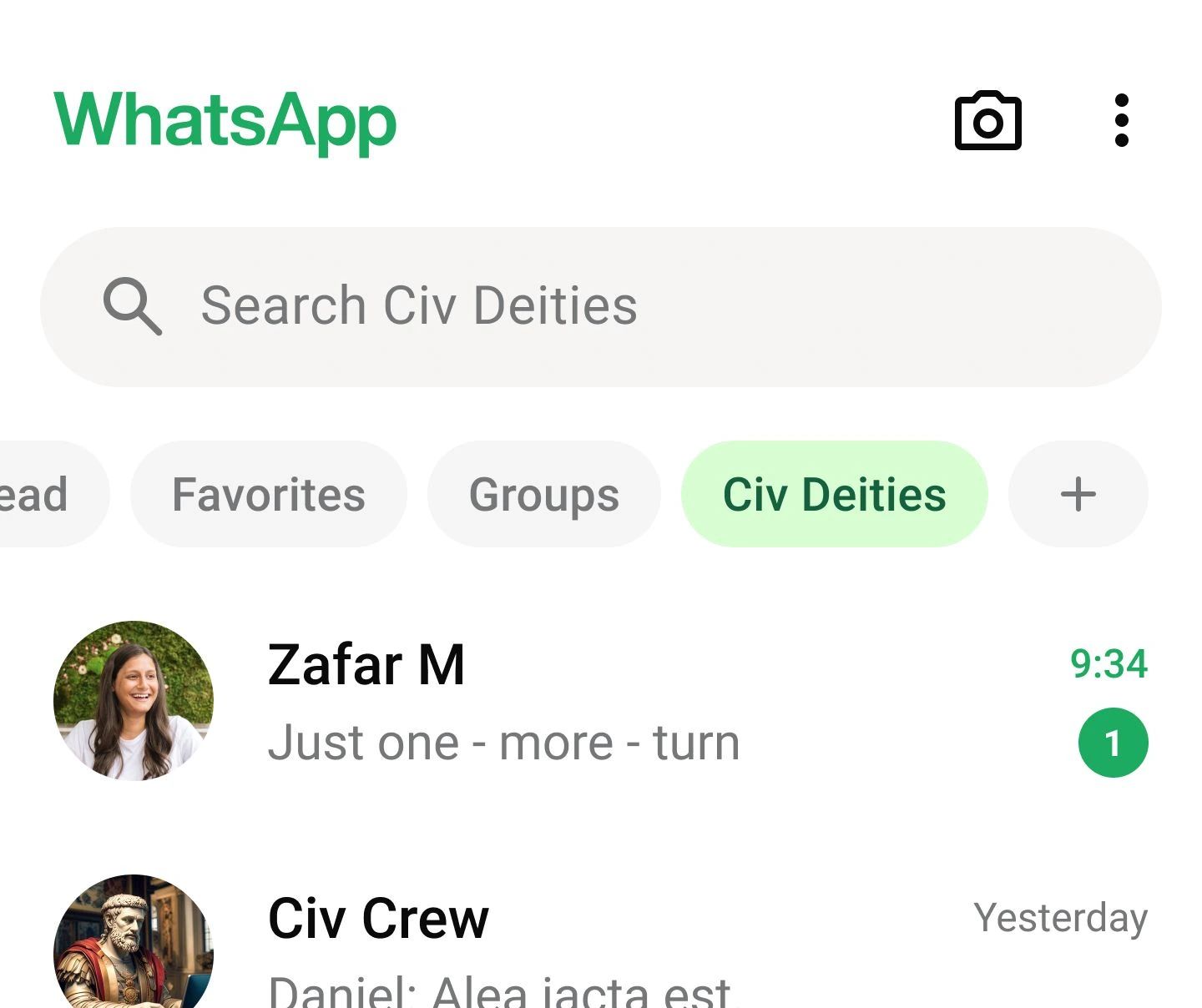
WhatsApp new feature will help you keep track of your chats. (Image credit – WhatsApp)

WhatsApp has introduced a new feature called Custom Lists to help users better manage their busy conversations. This new Lists tool is an improved version of the chat filters feature released earlier this year.

The Meta-owned app shared the details of the new feature in a blog post titled “Focus on What Matters With Custom Lists.”

With Lists, users can filter chats by custom categories, creating separate lists for family, friends, coworkers, neighbours, or anyone else. WhatsApp explains that these lists are designed to “help you focus on the conversations that are most important when you need them.”

WhatsApp explains in a blog post, “Earlier this year we introduced chat filters as a way to find messages faster.

We’ve had great feedback that they help you keep track of your chats, and we’re excited to have quickly evolved them into Lists.

With Lists, you can now filter your chats with custom categories of your choice. Whether that’s a list for family, work or your local neighbourhood, Lists help you focus on the conversations that are most important, when you need them.”

Similar to the Favorites feature, users can add both group and one-on-one chats to any list. To start creating a list, simply tap the “+” icon in the filter bar at the top of the Chats tab.

This update is currently rolling out. However, it may take a few weeks to reach users worldwide.

This feature is the latest in a series of updates to WhatsApp. The platform now also allows users to add contacts from any device, not just the primary smartphone linked to their account.

WhatsApp recently hit 100 million users in the US, though its global user base has grown to a remarkable two billion.

FAQs

Q1. What is the new chat filter feature introduced by WhatsApp?

Answer. WhatsApp has introduced a new feature called custom lists to help users better manage their busy conversations.

Q2. How can users start creating a custom list on WhatsApp?

Answer. To start creating a list, simply tap the “+” icon in the filter bar at the top of the Chats tab.

Q3. When is the WhatsApp Custom list feature rolling out?

Answer. This WhatsApp update with the Custom List feature is currently rolling out. However, it may take a few weeks to reach users worldwide.

Q4. How create custom lists on WhatsApp?

Answer.Creating a custom list is an simple process.
Tap the “+” icon in the filter bar at the top of the Chats tab and assign a name to your new list. Users can then add any chat, both individual and group, to their preferred list. Editing existing lists is just as simple, allowing for dynamic organisation as your communication needs evolve.

Adding chats to custom lists feels similar to how users “favorite” important conversations. Once a list is created, it appears prominently in the filter bar, allowing for quick switching between different chat groups.

Also Read : WhatsApp testing personalised emoji reactions, custom stickers, and more

Also Read : WhatsApp will now allow users to add contacts from any device

Also Read :WhatsApp to introduce music sharing in status updates

Telegram Adds Option to Choose Video Quality for Large Channels

0

Highlights

  • Telegram’s latest update lets users choose video quality up to 1080p in larger channels.
  • Also, adjust playback speed and add media to existing messages.
  • The updates are rolling out now.
image
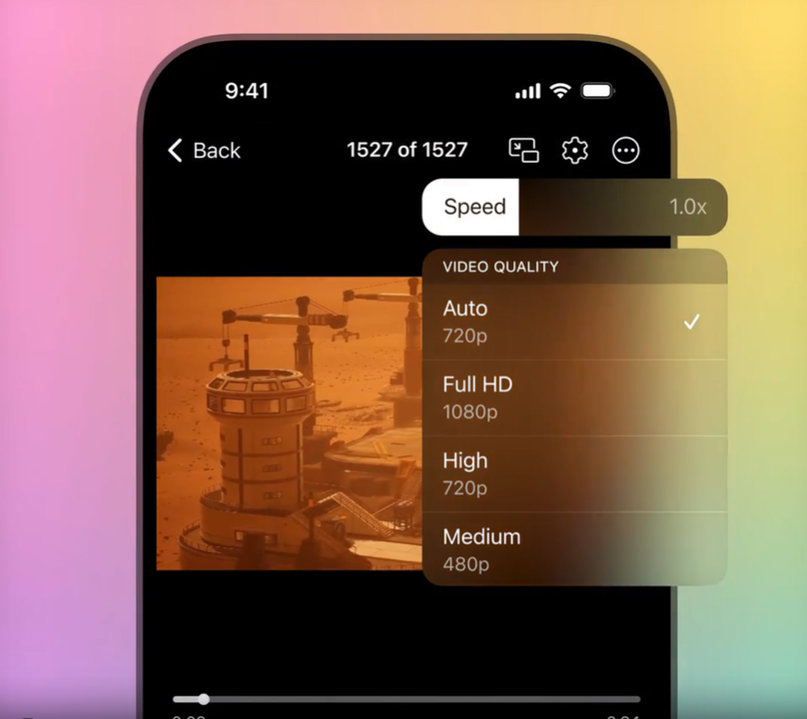
Telegram Large Channels Get Option To Select Video Quality. (Image credit – Telegram)

Telegram videos are getting a major upgrade. Users can now choose the quality of received videos, enable Picture-in-Picture (PiP) and adjust playback speed.

Messaging apps like Telegram and WhatsApp have typically delivered better media quality than standard SMS, and with RCS now widely available, Telegram is pushing to enhance its video experience though it may be somewhat limited.

Telegram – Select Video Quality Manually

In this new update, Telegram introduces a few big changes for video sharing.

First, users in larger channels—those with “thousands of subscribers”—can manually select video quality up to 1080p rather than watching a default compressed version.

“For videos newly uploaded to large channels, the video player now automatically selects a quality level based on your connection to save your data and load videos faster. Users can also manually select their preferred quality level – High, Medium or Low,” Telegram explains in a blog post.

Telegram – Adjusting Playback Speed

For all users, Telegram is adding a speed adjustment feature, allowing them to change playback speed by tapping the settings cog during playback or by pressing down on the right side of the video.


Telegram explained the feature in detail, “For years, videos on Telegram have supported multiple speed settings – and now users can seamlessly speed up videos with new gestures without tapping through settings.”

“Just hold down on the right side of a video to activate 1.5x speed – and slide right gradually to increase the speed to up to 2.5x. Release your finger to return to normal speed,” the announcement further added.

Telegram – Add Media to Sent Messages

Another feature in this update lets users add media to existing messages. This helps when sending a video or photo along with a message, as it ensures the media stays with the text in the same bubble instead of showing up separately.

If you forget to attach your photo, video or file before sending, you can quickly edit the message to add media in just two taps – rather than deleting it and starting over,” Telegram explains.

Telegram adds faster loading, better quality and new speed controls to videos, last edit timestamps, attaching media to sent messages, increased limits for mini apps, new monetization options for developers – and much more.

While the video quality selector is limited to bigger channels, the speed adjustment and media attachment options are available to everyone. It’s hoped the quality selector will eventually be available for all users in future updates.

Telegram says this update is rolling out now.

Last Edit Timestamps for Messages

Edited messages will now display a timestamp indicating when they were last modified. If a message is edited multiple times, the latest edit time will be shown. In small groups and private chats, detailed read receipts will indicate when members opened a message.

Chat-Specific Hashtags

Group and channel owners can now create chat-specific hashtags using the format #hashtag@username. Tapping on a hashtag like #travel will display results from the entire platform, while #travel@durov will show only results from that specific channel. A new menu in public chats makes it easy to add the chat’s username to hashtags.

Telegram Ads in Bots

Bots and mini apps are now able to participate in revenue sharing from Telegram Ads – giving services another way to help support their development.
Telegram Ads are unobtrusive and privacy-conscious – supporting Telegram’s sustainable monetization strategy, while sharing 50% of ad revenue with content creators and bot developers.

Increased Message Limits for Bots

All Telegram bots can send up to 30 messages per second to their users – completely free of charge. To better accommodate large-scale services, bots are now able to enable increased message limits and send up to 1000 messages per second.

Sending messages with increased limits costs just 0.1 Star per message, paid with Telegram Stars from the bot’s balance. Developers can receive Stars from paid content and digital products in their bot.

Exact Reaction Counters

In case you want to know the exact number of heart (or star, or pumpkin) reactions your posts receive, press and hold the counters for more details

FAQs

Q1. What new features are introduced in the latest Telegram update?

Answer. Users can now choose the quality of received videos, enable Picture-in-Picture (PiP) and adjust playback speed.

Q2. What video quality options are available for users in larger channels?

Answer. Users in larger channels—those with “thousands of subscribers”—can manually select video quality up to 1080p rather than watching a default compressed version.

Q3. Are the new features available to all Telegram users?

Answer. The quality selector is limited to bigger channels, while the speed adjustment and media attachment options are available to everyone.

Also Read : Telegram channel under Delhi Police scanner after CRPF school blast incident

Also Read :Telegram introduces phone number verification system for businesses

Also Read: Telegram to share user data with law enforcement, CEO Durov confirms

Kuo Reports Apple iPhone 17 Will Use In-House Wi-Fi and Bluetooth Chip

0

Highlights

  • Apple plans to use in-house Wi-Fi and Bluetooth chips for the iPhone 17
  • The company aims to reduce dependence on Broadcom.
  • The new chips will be made by TSMC’s N7 process and support Wi-Fi 7.
image
iPhone 17 will use Apple’s in-house Wi-Fi and Bluetooth chip. (Image credit – Apple)

Apple’s 2024 launch cycle is almost over, although rumours and speculations about what to expect from its 2025 lineup never stopped throughout the year. We have been constantly getting reports of what Apple is planning for iPhone 17 and later releases even iPhone 16 launch date was still unknown. Now, with the iPhone 16 out and about, reports are in full swing.

A recent report now suggests that Apple is planning to go for the in-house Wi-Fi and Bluetooth chip for the iPhone 17 line. Here’s what we are hearing.

Credible Analyst Ming-Chi Kuo recently shared an update on X (previously Twitter) about how Apple is working on reducing its dependence on Broadcom, which currently supplies Wi-Fi and Bluetooth chips.

Kuo hinted that Apple now plans to use “its own Wi-Fi chips, which will be made by TSMC’s N7 process and support the latest Wi-Fi 7 spec.”

In a subsequent post, Kuo also mentioned that Apple 5G and Wi-Fi chips will be basically two separate chips built using different TSMC processes. This, as per Kuo, means the upcoming iPhone SE4 could have an Apple 5G modem and still incorporate a Broadcom Wi-Fi chip.

What’s interesting about Kuo’s latest update is that even though they highlight the iPhone 17, he mentions ‘new products’, which could very well mean multiple products.

Kuo previously reported that the new Apple-designed 5G chip would first appear in the iPhone SE in the first half of 2025, followed by the iPhone 17 Air in the second half.

This could end in one of two possibilities, either other iPhone 17 models will also receive the new chip or it might also be used in non-iPhone products. It could potentially be integrated into new Apple Watch or iPad models or we might even see the first Macs with cellular capabilities.

Nonetheless, it appears that Apple’s in-house 5G, Wi-Fi and Bluetooth technologies are finally close to launching after years of research and development (and plenty of online rumours).

FAQs

Q1. What is Apple planning for the iPhone 17’s Wi-Fi and Bluetooth chips?

Answer. Credible Analyst Ming-Chi Kuo recently shared an update on X (previously Twitter) about how Apple is working on reducing its dependence on Broadcom. Kuo hinted that Apple now plans to use “its own Wi-Fi chips, which will be made by TSMC’s N7 process and support the latest Wi-Fi 7 spec.”

Q2. When and where could Apple’s in-house 5G chip first appear?

Answer. Kuo previously reported that the new Apple-designed 5G chip would first appear in the iPhone SE in the first half of 2025, followed by the iPhone 17 Air in the second half.

Q3. When is iPhone 17 coming out?

Answer. Apple might release iPhone 17 by the second half of next year.

Also Read : Apple to Use Indian Factory for Early Manufacturing Work of iPhone 17, Says Report

Also Read : iPhone 17 Pro Max to Feature Smaller Dynamic Island

Also Read : iPhone 17 Slim to Launch with Major Design Changes in 2025

OpenAI’s ChatGPT Search is Now Out, Will Provide “Fast, Timely Answers With Links”

0

Highlights

  • OpenAI launched an AI-powered search engine – ChatGPT Search.
  • It provides fast answers with links to web sources, images and real-time updates.
  • The search function uses a conversational interface and includes citations
  • It will be initially available to SearchGPT waitlist, ChatGPT Plus and Team users.
  • Wider access will roll out over time.
image
OpenAI Launches ChatGPT search. (Image credit – OpenAI)

OpenAI has officially launched its new AI-powered search engine called ChatGPT Search. Introduced in a blog post, OpenAI shared details of the new way and “much better way” of search that provides “fast, timely answers with links to relevant web sources.”

ChatGPT Search is now available and designed to answer search queries by providing links to web sources, images and more. The search function works through a conversational and natural language interface.

As OpenAI describes it: “ChatGPT can now search the web in a much better way than before. You can get fast, timely answers with links to relevant web sources, which you would have previously needed to go to a search engine for. This blends the benefits of a natural language interface with the value of up-to-date sports scores, news, stock quotes and more.”

The ChatGPT Search experience includes a list of citations displayed along the right side of the screen, with web links showing exactly where each piece of information is sourced.

Users who were earlier on the SearchGPT” waitlist along with the ChatGPT Plus and Team users will get first access. Moreover, Enterprise and Edu subscribers can expect to gain access in the next few weeks, while free users will have broader access over the coming months.

ChatGPT Search will be available on the web, desktop and mobile apps.

Quoted in the announcement were some industry experts who noted the changing times in the web search landscape.

Pam Wasserstein, President of Vox Media, said, “ChatGPT search promises to better highlight and attribute information from trustworthy news sources, benefiting audiences while expanding the reach of publishers like ourselves who produce premium journalism.”

The CEO & Publisher of Le Monde, Louis Dreyfus said, “We are convinced that AI search will be, in a near future and for the next generations, a primary way to access information, and partnering with OpenAI positions Le Monde at the forefront of this shift. It allows us to test innovations at an early stage while safeguarding journalism’s core values and integrity.”

Moreover, noting Axel Springer’s partnership with OpenAI, SVP Global Strategic Partnerships Axel Springer SE, Mathias Sanchez mentioned, “As AI reshapes the media landscape, Axel Springer’s partnership with OpenAI opens up tremendous opportunities for innovative advancements. Together, we’re driving new business models that ensure journalism remains both trustworthy and profitable.”

image
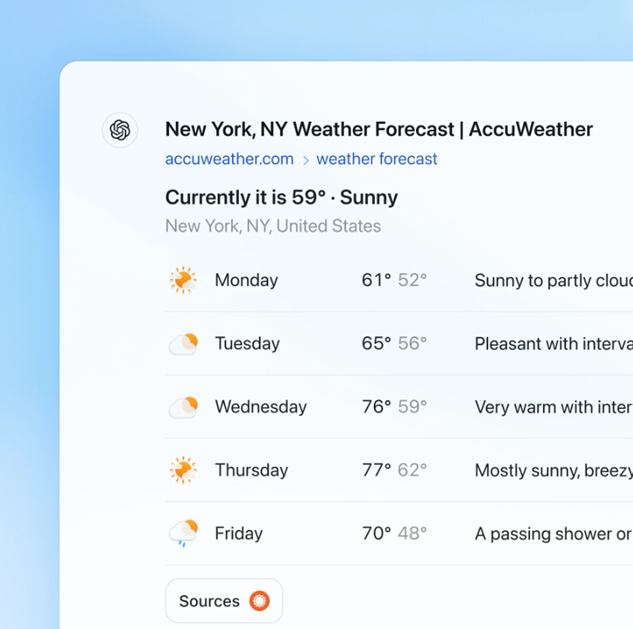
Get real-time weather updates powered by AccuWeather on ChatGPT Search. (Image credit – OpenAI)
image
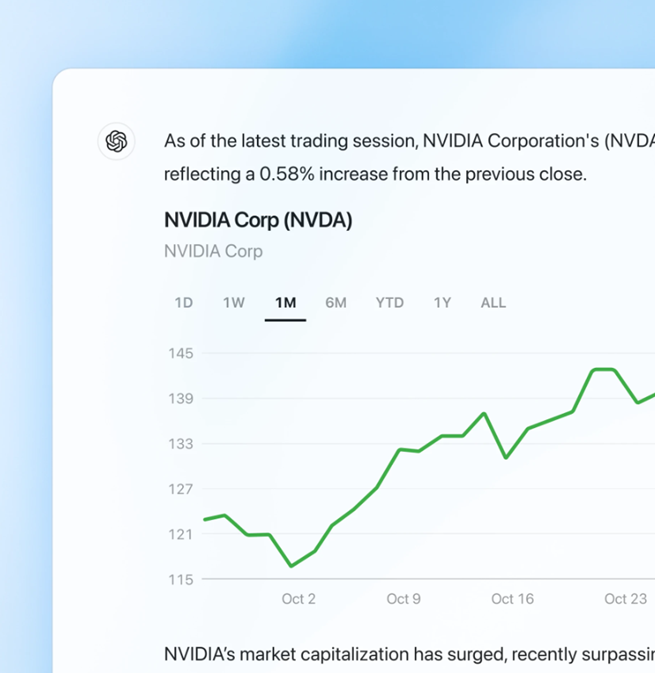
Get real-time stock updates on ChatGPT Search. (Image credit – OpenAI)
image
Get real-time sports scores on ChatGPT Search. (Image credit – OpenAI)
image
Get real-time news on ChatGPT Search. (Image credit – OpenAI)
image
Get real-time maps on ChatGPT Search. (Image credit – OpenAI)

Apart from the general information and web links, ChatGPT Search will provide real-time weather updates (powered by AccuWeather), stock data, sports scores, news and maps.

OpenAI notes that its news content comes after the company “collaborated extensively with the news industry and carefully listened to feedback.”

This announcement comes as reports suggest OpenAI is planning to launch its next major model update in December.

FAQs

Q1: What is ChatGPT Search and how does it work?

Answer. ChatGPT Search is OpenAI’s new AI-powered search engine designed to answer search queries with links to web sources, images, and more, using a conversational and natural language interface.

Q2. Who gets first access to ChatGPT Search?

Answer. Users who were earlier on the “SearchGPT” waitlist along with the ChatGPT Plus and Team users will get first access. Enterprise and Edu subscribers can expect access in the next few weeks, with broader access for free users over the coming months.

Q3. What kind of real-time updates does ChatGPT Search provide?

Answer. ChatGPT Search will provide real-time weather updates (powered by AccuWeather), stock data, sports scores, news, and maps, including content that comes after extensive collaboration with the news industry.

Read More: Apple Not Investing in OpenAI; ChatGPT Subscription Could Cost Double in a Few Years

Read More: ChatGPT to Get Advanced Voice Mode to Initiate Conversations; OpenAI Forms Independent Safety Board to Enhance AI Safety

Read More: ChatGPT Integration with Siri in iOS 18: Key Features and Privacy