
Home Blog Page 184

Oppo Find X8s and X8s Plus Specs and Images Leak Via TENAA Certification Ahead of April 10 Launch

0

Highlights

  • Oppo Find X8s Plus and Find X8s appear in TENAA certification revealing key specs and images.
  • Oppo Find X8s Plus Specs – 6.59-inch AMOLED display, Dimensity 9400 Plus chipset, up to 16GB RAM, 1TB storage, a 6,000mAh battery and a triple 50MP rear camera setup.
  • Oppo Find X8s Specs – 6.32-inch OLED display, Dimensity 9400 Plus chipset, up to 16GB RAM, 1TB storage and a 5,700mAh battery

Oppo is gearing up to launch its new flagship lineup in China on April 10, which includes the Find X8s, Find X8s Plus and the top-end Find X8 Ultra. While the X8 Ultra’s details have already surfaced through a TENAA listing, the Find X8s and X8s Plus have now also appeared on the certification site, giving us a closer look at their specs and design.

The TENAA listing previously revealed that the Find X8 Ultra’s dimensions will be 163.09 x 76.8 x 8.78mm and a weight of 226 grams. It also confirmed display features including a 6.82-inch flat OLED screen with a resolution of 3168 x 1440 pixels (2K+), offering a 120Hz refresh rate.

So, here’s what we know about the smartphone series so far.

Oppo Find X8s Plus – What to Expect?
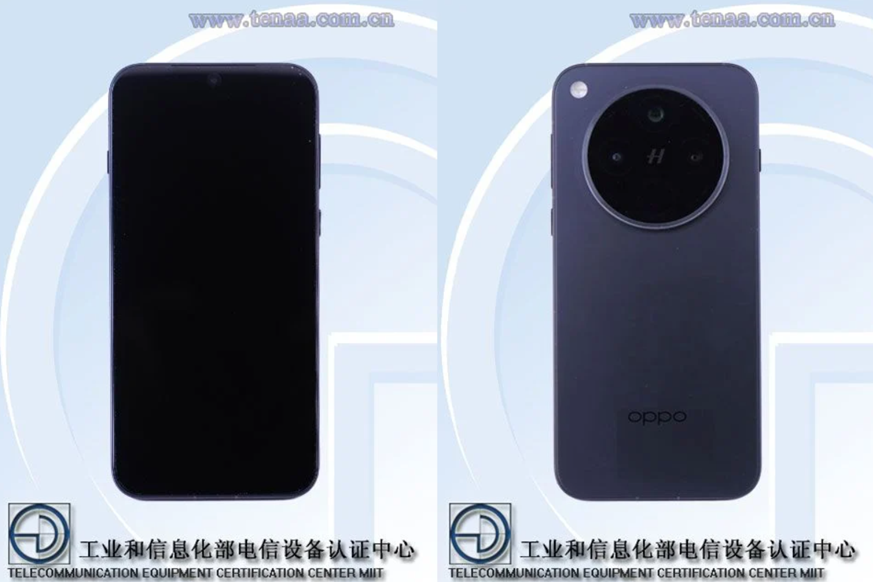
image

Caption – Oppo Find X8s Plus TENAA images. (Image credit – Gizmochina)

The Oppo Find X8s Plus, listed under model number PLB110, is expected to feature a 6.59-inch AMOLED display with a resolution of 2760 x 1256 pixels (1.5K). It’ll be powered by a 3.73GHz chipset, which has been confirmed to be the Dimensity 9400 Plus, which is the same chip that powers the regular X8s.

The phone packs a rated battery capacity of 5,850 mAh, though the typical value could be as high as 6,000 mAh.

In terms of storage and RAM, there will be multiple variants –

  • 8GB / 12GB / 16GB of RAM
  • 256GB / 512GB / 1TB of internal storage

For cameras, expect a 32MP front-facing shooter and a triple 50MP setup on the back. The rear camera system is said to include –

  • A 50MP Sony LYT-700 sensor with OIS
  • A 50MP Samsung S5KJN5 ultra-wide lens
  • A 50MP LYT-600 periscope telephoto camera with 3x optical zoom and OIS

The Find X8s Plus will run ColorOS 15 based on Android 15 and will offer features like an in-display fingerprint scanner, an IR blaster, and a new push-type button replacing the traditional Alert Slider.

Other expected features include –

  • 80W wired charging
  • 50W wireless charging
  • 0809 vibration motor
  • IP68/69 water and dust resistance

It measures 157.53 x 74.51 x 7.95mm and weighs 198 grams. Oppo has confirmed four memory options for the Plus model –

  • 12GB + 256GB
  • 12GB + 512GB
  • 16GB + 512GB
  • 16GB + 1TB

image

Caption – Oppo Find X8s Plus colour variants. (Image credit – Gizmochina)

Colour choices include Moonlight White, Hyacinth Purple and Starry Black.

Oppo Find X8s – What We Know So Far?
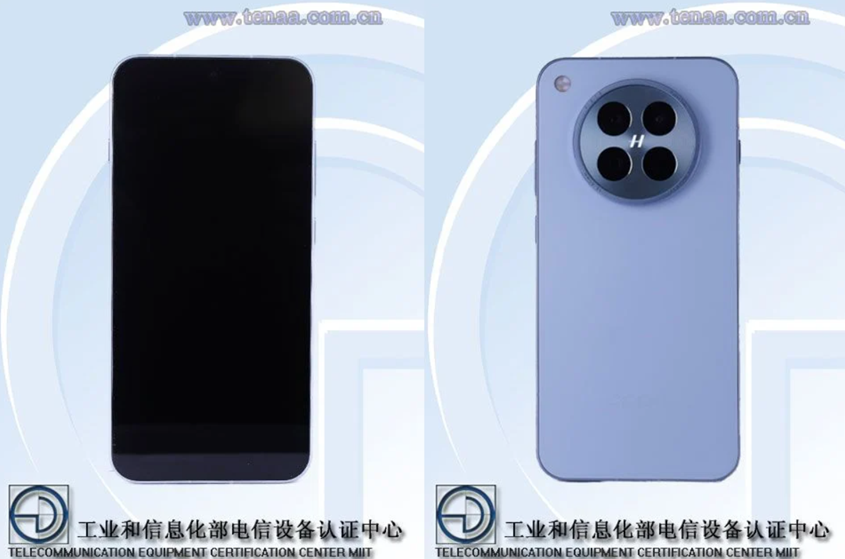
image

Caption – Oppo Find X8s TENAA images. (Image credit – Gizmochina)

The standard Oppo Find X8s (model number PKT110) has also shown up on TENAA, revealing a 6.32-inch OLED screen with a 1.5K resolution of 2640 x 1216 pixels. The listing mentions a 2.36GHz octa-core processor and a 5,060mAh rated battery, though Oppo has officially confirmed it will run the 3.73GHz Dimensity 9400 Plus chip and come with a 5,700mAh battery.

Like the Plus model, the Find X8s is expected to support both 80W wired and 50W wireless charging. It will also be offered in several RAM and storage combinations –

  • 8GB / 12GB / 16GB of RAM
  • 256GB / 512GB / 1TB of storage

For photography, it’ll have a 32MP front camera and a triple 50MP setup at the rear, reportedly made up of –

  • A 50MP Sony LYT-700 main sensor with OIS
  • A 50MP Samsung S5KJN5 ultra-wide lens
  • A 50MP S5KJN5 periscope telephoto lens with 3.5x optical zoom and OIS

The Find X8s also includes an in-display fingerprint scanner, IR blaster, the same new push-type hardware button, and an IP68/69-rated build. It weighs 179 grams and measures 150.59 x 71.82 x 7.73mm.

Oppo has confirmed the Find X8s will be offered in five memory options –

  • 12GB + 256GB
  • 12GB + 512GB
  • 16GB + 256GB
  • 16GB + 512GB
  • 16GB + 1TB

image

Caption – Oppo Find X8s colour variants. (Image credit – Gizmochina)

Colour options include Moonlight White, Island Blue, Cherry Blossom Pink and Starry Black.

 FAQs

Q1. When will the Oppo Find X8s and X8s Plus be launched?

Answer. The Oppo Find X8s and X8s Plus are set to launch in China on April 10, alongside the top-end Find X8 Ultra.

Q2. What are the key features of the Oppo Find X8s Plus?

Answer. The Oppo Find X8s Plus features a 6.59-inch AMOLED display (2760 x 1256 pixels), Dimensity 9400 Plus chipset, up to 16GB of RAM, 1TB of storage, a 6,000mAh battery, and a triple 50MP rear camera setup. It also includes an in-display fingerprint scanner, an IR blaster, 80W wired and 50W wireless charging, and IP68/69 water and dust resistance.

Q3. What specifications does the Oppo Find X8s offer?

Answer. The Oppo Find X8s comes with a 6.32-inch OLED display (2640 x 1216 pixels), Dimensity 9400 Plus chipset, up to 16GB of RAM, 1TB of storage, a 5,700mAh battery, and a triple 50MP rear camera setup. It shares features like an in-display fingerprint scanner, IR blaster, and IP68/69-rated durability with the Plus model.

Q4. What are the color options available for the Find X8s and X8s Plus?

Answer. The Find X8s Plus comes in Moonlight White, Hyacinth Purple, and Starry Black, while the Find X8s is available in Moonlight White, Island Blue, Cherry Blossom Pink and Starry Black.

Q5. What additional features do both models have?

Answer. Both models include a new push-type button replacing the traditional Alert Slider, support for 80W wired and 50W wireless charging, and run ColorOS 15 based on Android 15.

Also Read: OPPO Find X8 Ultra & Find X8s Series Bookings Live in China

Also Read: These OPPO Devices Will Get ColorOS 15 Update in April 2025 – Check Official List

Galaxy S25 Edge New Leak Reveals Steeper Than Expected Price Tag

0

Highlights

  • The Galaxy S25 Edge was spotted listed on an Italian retailer website at higher prices.
  • The listed price reveals €1,362 for the 256GB variant and €1,488 for 512GB, making it over €100 more expensive than the Galaxy S25+ in Europe.
  • The phone has shown promising Geekbench scores but may have cooling system limitations due to its slim design.

image

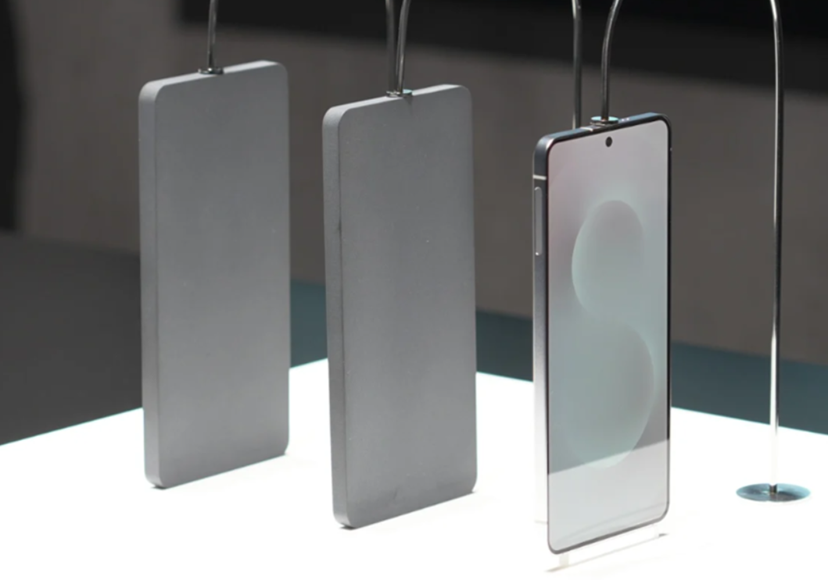
Caption – Upcoming Samsung Galaxy S25 Edge on display. (Image credit – SamMobile)

The Samsung Galaxy S25 Edge has been making headlines for a while now, and it’s finally set to launch on May 13. But a new leak has revealed the expected price of the phone and it might be a bit unexpectedly high.

Before we go to the price, let’s recall what to expect from the phone in terms of specs. According to reports, the S25 Edge comes with just two cameras on the back. It has a sleek and slim design, which might help justify the smaller battery.

But here’s the thing, many new Android phones already offer large batteries, thanks to high-density silicon-carbon (Si/C) battery technology. Samsung could use that same tech to give this phone a bigger battery, even if it adds a bit to the cost.

Galaxy S25 Edge Price Leak

Now, coming back to the recent price leak. It appears the Galaxy S25 Edge is actually priced higher than the almost-perfect Galaxy S25+.

image

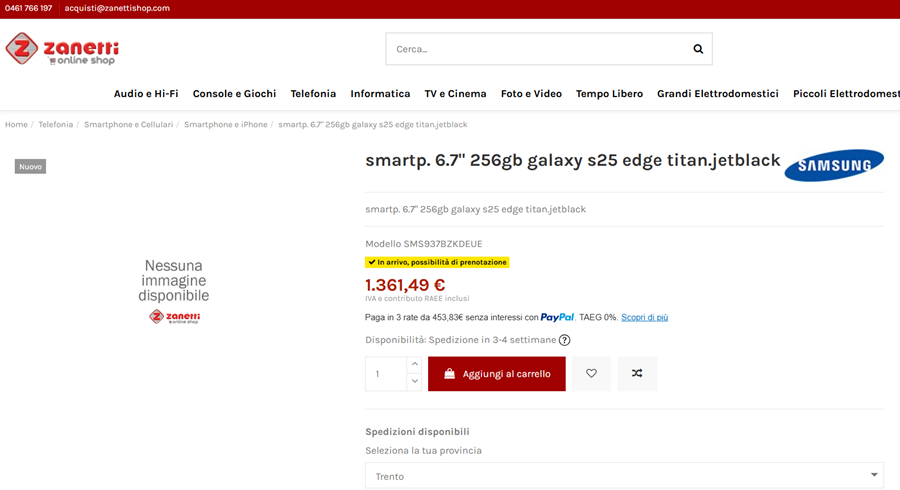
Caption – Galaxy S25 Edge on Italian website listing.

The phone has been spotted on Italian retailer Zanetti’s website, with the 256GB model listed at €1,362 and the 512GB version at €1,488. That’s more than what was originally expected in Europe. For comparison, the S25+ in the same storage options costs €1,247 and €1,372. So, the Edge is over €100 more expensive than the S25+, at least according to this listing.

image

Caption – Galaxy S25 Edge on Italian website listing. (Screenshot credit – Gizmochina)

Of course, prices can change depending on the region, so converting this directly into your local currency won’t give you an exact figure. Still, it offers a good idea of where it stands compared to the rest of the S25 lineup.

On the performance front, the phone has shown improvement over time. In Geekbench CPU tests, it scored 2969 in single-core and 9486 in multi-core performance. But keep in mind that these numbers don’t always tell the full story, especially when it comes to how the phone handles sustained workloads. Given its slim design, the cooling system might not be as capable as the one in the S25+.

So, we’ll have to wait for real-world tests to see how it performs.

On the software side, the S25 Edge is expected to come with One UI 7 pre-installed. The stable version of One UI 7 is also starting to roll out to some older Samsung flagships.

FAQs

Q1. What are the key features of the Samsung Galaxy S25 Edge?

Answer. The Galaxy S25 Edge has a sleek and slim design and two rear cameras and is expected to come with One UI 7 pre-installed. It has a smaller battery compared to other Android phones, although high-density silicon-carbon (Si/C) battery technology could potentially enhance battery capacity.

Q2. How much does the Samsung Galaxy S25 Edge cost?

Answer. According to a leak, the Galaxy S25 Edge is priced at €1,362 for the 256GB model and €1,488 for the 512GB model. This makes it over €100 more expensive than the Galaxy S25+ in similar storage variants in Europe.

Q3. How does the performance of the Galaxy S25 Edge compare?

Answer. The phone scored 2969 in single-core and 9486 in multi-core Geekbench tests, showing improvements in performance. However, due to its slim design, the cooling system may not perform as effectively as the one in the Galaxy S25+, particularly during sustained workloads.

Also Read: Samsung Galaxy S25 Edge now expected to launch on May 13: Specs and pricing leaked

Also Read: Samsung starts rolling out One UI 7: Here’s how to prepare your Galaxy phone

Xiaomi 15S Pro Officially Confirmed, Expected To Feature Xiaomi’s In-House Chip

0

Highlights

  • Xiaomi Co-founder Lin Bin officially confirmed the Xiaomi 15S Pro.
  • Expected Features – 2K quad-curved display, a triple Leica camera setup, a 6,000mAh+ battery, 90W fast charging and UWB support.
  • The phone might debut Xiaomi’s own in-house chip, built on TSMC’s N4P process with an octa-core CPU, IMG DXT72 GPU and custom ISP.

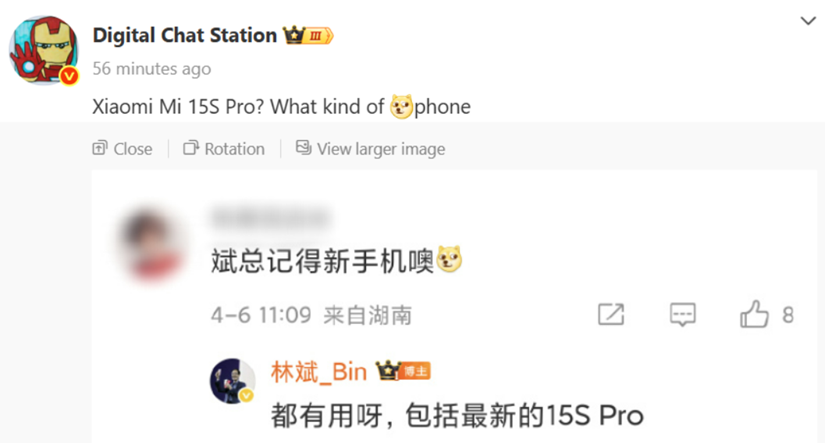
Chinese brand Xiaomi just turned 15 on April 6 and the brand marked the occasion with social media shoutouts from top executives including founder Lei Jun and co-founder Lin Bin. But among all the celebrations, what caught attention was Lin Bin confirming the upcoming Xiaomi 15S Pro during an interaction with fans.

This is the first official mention of the phone, even though Xiaomi hasn’t released any teasers or promo content yet. Later, tipster Digital Chat Station was quick to spot and share the news, putting the spotlight on what could be Xiaomi’s next big flagship. So, here’s what we know so far.

image

Caption – Xiaomi 15s Pro officially confirmed by Xiaomi co-founder Lin Bin. (Screenshot credit – Gizmochina)

Xiaomi 15S Pro – What To Expect?

The Xiaomi 15S Pro will mark the return of Xiaomi’s S-series flagships after a long gap. The last one, the Xiaomi 12S, launched almost three years ago.

Leaks suggest that the 15S Pro will carry forward the design of the Xiaomi 15 Pro, including a 2K quad-curved display and a triple-camera setup with Leica lenses. But this time, the battery could be a major upgrade, with rumors pointing to a massive 6,000mAh+ battery and 90W fast charging based on 3C certification details.

The phone may bring back UWB (Ultra-Wideband) support, a feature Xiaomi last used on the MIX 4. UWB enables precise location tracking, ideal for things like unlocking Xiaomi’s electric car, the SU7 EV. Given Xiaomi’s growing interest in smart vehicles, this move makes a lot of sense.

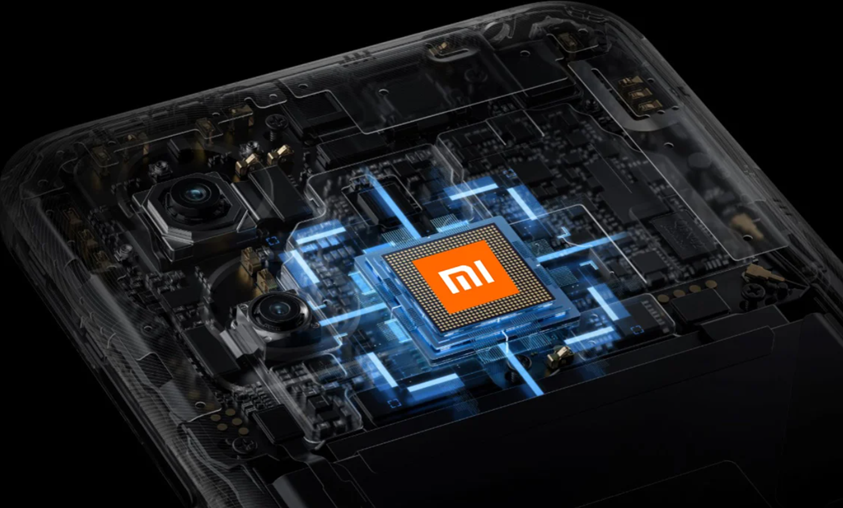
The most exciting part is the possibility that the Xiaomi 15S Pro might be powered by Xiaomi’s own in-house chipset.

image

Caption – Xiaomi’s in-house chip might support the upcoming Xiaomi 15S Pro. (Image credit – Xiaomi)

Xiaomi In-House Chip – What We Know?

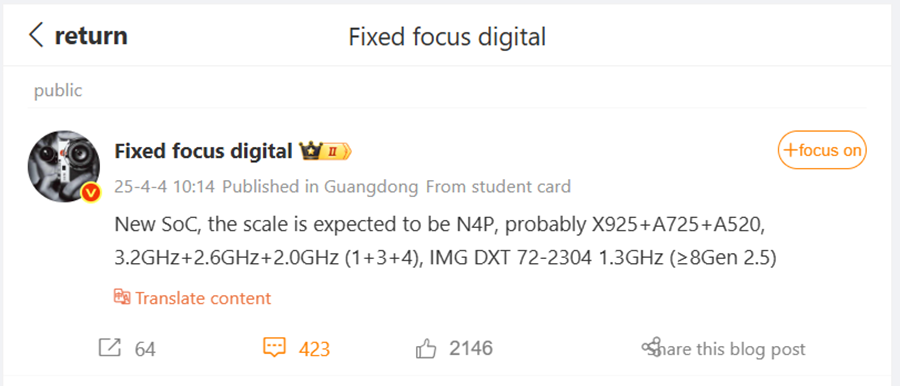
While early rumours suggested a Xiaomi’s in-house chip will be a cutting-edge 3nm chip, recent info from tipster Fixed Focus Digital shared via Jukanlosreve on X (formerly Twitter) points to something a bit different. According to Fixed Focus Digital, the chip will be built on TSMC’s N4P process, which is a more mature and cost-effective option.

image

Caption – Tipster Fixed Focus Digital’s recent post on Weibo. (Translated via Google Translate)

This new chip is expected to be based on Arm’s v9 architecture, with an octa-core CPU in a 1+3+4 layout:

  • 1x Cortex X925 at 3.2GHz
  • 3x Cortex A725 at 2.6GHz
  • 4x Cortex A520 at 2.0GHz

It’s not designed to beat the top flagship chips, but it could be a great fit for upper mid-range phones. This chip might first appear in the rumoured Xiaomi 15S expected sometime in 2025.

For graphics, it’s said to include an Imagination Technologies IMG DXT72 GPU running at 1.3GHz. Early leaks even suggest it could outperform the Adreno 740 found in Qualcomm’s Snapdragon 8 Gen 2.

Moreover, Xiaomi is also expected to include its own custom ISP (Image Signal Processor). As for other parts like the 5G modem or DSP, these might come from MediaTek, Synopsys, or even Huawei, depending on availability and supply chain constraints.

FAQs

Q1. What is the Xiaomi 15S Pro, and why is it significant?

Answer. The Xiaomi 15S Pro is an upcoming flagship officially confirmed by co-founder Lin Bin, marking the return of Xiaomi’s S-series after a three-year hiatus.

Q2. What are the rumoured key features of the Xiaomi 15S Pro?

Answer. Expected features include a 2K quad-curved display, triple Leica camera setup, a 6,000mAh+ battery, 90W fast charging and UWB (Ultra-Wideband) support.

Q3. What is notable about Xiaomi’s in-house chip for the Xiaomi 15S Pro?

Answer. Xiaomi’s in-house chip, based on TSMC’s N4P process, may debut with the Xiaomi 15S Pro. It includes an octa-core CPU, IMG DXT72 GPU and a custom ISP.

Also Read: Xiaomi unveils Watch S4, Buds 5 Pro, Smart Band 9 Pro, and Electric Scooter 5 Max at MWC 2025

Samsung Starts Rolling Out One UI 7 – Here’s How to Prepare Your Galaxy Phone!

0

Highlights 

  • Samsung’s One UI 7 update is rolling out first to the Galaxy S24 series, Z Fold 6 and Z Flip 6.
  • Other Galaxy phones will receive the UI update later this month.
  • Users should free up at least 10GB of space, back up data, update apps and system software and ensure their phone is charged.
image
Samsung One UI 7 has started rolling out. (Image credit – Samsung)

The One UI 7 update is now officially rolling out for Samsung users. While it’ll first be available in select countries, it’s still a major step forward, especially after months of waiting and delays.

Samsung has confirmed that the update will start with the Galaxy S24 series, Galaxy Z Fold 6 and Galaxy Z Flip 6. Other Galaxy phones will start getting the update later this month. At the time of writing, the update hasn’t gone live just yet, but it’s expected to drop in a few hours. While you wait for that update notification, now’s a good time to prepare your phone.

Here are some of the things you should do before installing One UI 7 –

Free up storage space

One UI 7 is a big update with about 5GB or more. Samsung recommends having at least 10GB of free space to make sure everything installs smoothly.

To clear up space, go to Settings > Device care > Storage. Delete any old files, unused apps, or large videos you’ve already backed up.

Back up your data

This is the most important step. Backing up your data keeps you safe in case anything goes wrong during the update like a failed install (it’s rare, but it can happen).

Using cloud backup is the easiest way to do it. You can try free options like Google Cloud or Mega, but if your files are too large, you might need a paid plan.

If you’re sticking with Samsung’s ecosystem, Samsung Cloud is a great choice — it has no storage limit, but your backup stays available for only 30 days, so make sure to restore your data within that time.

Install all pending updates

Before installing One UI 7, make sure your apps and system software are up to date. Updated apps are less likely to have issues after the upgrade.

Use the Galaxy Store for Samsung apps and the Google Play Store for everything else. Also, check for pending system updates under Settings > Software update > Download and install.

Charge your phone

Big updates can take a while and drain a good chunk of battery. It’s best to have your phone charged to at least 30% before starting.

If your device shuts down during the update, it could lead to corrupted files or bugs.

Check Community forums for feedback

Even stable updates can sometimes cause issues. Before you install One UI 7, head over to the Samsung Community forums or Reddit to see how the update is performing on your specific model.

If users are reporting major bugs, it might be a good idea to wait a few days until a more stable version rolls out.

FAQs

Q1. Which devices are receiving the One UI 7 update first?

Answer. The update will first roll out to the Galaxy S24 series, Galaxy Z Fold 6, and Galaxy Z Flip 6. Other Galaxy phones will receive it later this month.

Q2. How much storage space is required to install One UI 7?

Answer. Samsung recommends having at least 10GB of free space for smooth installation, as the update itself is around 5GB or more.

Q3. What should users do before installing the One UI 7 update?

Answer. Users should free up storage, back up their data, update all apps and system software, and ensure their phone is charged to at least 30%.

Also Read: Samsung One UI 7 Update: Rollout Schedule, Delays, and New AI Features Explained

Also Read: Samsung One UI 6.1 Update

Redmi Turbo 4 Pro Launch Reportedly Delayed After Fatal Xiaomi SU7 Crash

0

Highlights

  • Redmi Turbo 4 Pro launch in China may be postponed due to public scrutiny following the fatal Xiaomi SU7 EV crash.
  • Redmi Turbo 4 Pro rumoured specs – 6.83-inch OLED LTPS screen, Snapdragon 8s Gen 4 chip, 7,550mAh battery and a 50MP + 8MP dual-camera setup.
  • Xiaomi formed a team to investigate the Xiaomi SU7 crash, citing concerns over autonomous driving technology and system limitations in recognising obstacles.

Redmi was reportedly planning to launch the Redmi Turbo 4 Pro in China on April 17, but that may now be pushed back. The reason could be that the tragic accident involving a Xiaomi SU7 electric car has sparked nationwide attention in China. Given the public scrutiny and sensitivity around the incident, reports suggest that Redmi may delay the Turbo 4 Pro launch, although no official confirmation has been made.

Redmi Turbo 4 Pro – What We Know? (Rumoured)

image

Caption – Redmi Turbo 4 for representation. (Image credit – Redmi)

According to reports, the Redmi Turbo 4 Pro will sport a 6.83-inch OLED LTPS screen that offers a 1.5k resolution, a Snapdragon 8s Gen 4 chip, a 7,550mAh battery with 90W charging and a 50-megapixel + 8-megapixel dual-camera setup.

The phone is expected to feature a metal middle frame, a short-focus optical in-screen fingerprint sensor and an IP68/69-rated body among other features.

Fatal Xiaomi SU7 Crash – What Happened?

image

Caption – Xiaomi SU7 crashed in China. (Image credit – Gizmochina)

A Xiaomi SU7 Standard, the base model in Xiaomi’s EV lineup, crashed on the Dezhou-Shangrao Highway near Tongling in Anhui province on March 29. The accident claimed the lives of three young female university students who were on their way to Chizhou for a civil service exam.

The incident marks the first reported fatal crash involving Xiaomi’s electric vehicle, and it’s raised serious concerns about autonomous driving technology and EV safety.

The car involved was delivered in October 2024 and relied on Xiaomi’s vision-based Navigate on Autopilot (NOA) system. Unlike the higher-end Pro and Max models, the Standard variant does not come with LiDAR sensors.

image

Caption – Xiaomi SU7 crashed in China. (Image credit – Gizmochina)

The crash happened in a section of highway that was under repair. Narrowed lanes and possible construction debris may have contributed to the collision.

Here’s a brief breakdown of the crash timeline based on Xiaomi’s internal data:

  • 10:27:17 PM: NOA activated, car moving at 116 km/h (72 mph)
  • 10:44:24 PM: System detected obstacles, issued warnings, and began to slow down
  • 10:44:25 PM: Driver took over, steered left and applied brakes (31%)
  • 10:44:26 PM: Steering adjusted right, braking increased to 38%
  • 10:44:26–10:44:28 PM: Car hit a concrete guardrail at 97 km/h (60 mph) and caught fire

image

Caption – Social media posts about the accident. (Screenshot credit – Gizmochina)

Social media posts including one from a victim’s mother on Douyin claimed the car doors locked automatically after the crash, trapping the passengers inside as the vehicle caught fire. Xiaomi said it couldn’t verify that claim but pointed out there is an emergency unlock button, though its effectiveness in such situations remains uncertain.

“There is no precise conclusion currently as to whether the car door was able to be opened at the time of the accident,” Xiaomi said

Xiaomi’s Response

Xiaomi formed a special investigation team on March 30, visited the crash site, and submitted vehicle data to the police by March 31. CEO Lei Jun expressed regret and promised full transparency. Lei Jun reportedly said the company would support the victims’ families.

In a late-night statement on his Weibo account, Lei Jun said that “at this point, I feel that I should not wait any longer, I must stand up and promise on behalf of Xiaomi: no matter what happens, Xiaomi will not evade.”

Xiaomi also noted that the AEB (automatic emergency braking) system didn’t activate because the obstacle, reportedly a water barrier that wasn’t currently recognised by the system. The company believes the fire likely started in the cabin, not the battery, and the full cause is still under investigation.

They also clarified that Xiaomi hasn’t been allowed access to the wrecked vehicle yet and dismissed rumours that it was secretly taken to Beijing.

FAQs

Q1. Why might the Redmi Turbo 4 Pro launch be delayed?

Answer. The launch may be postponed due to public scrutiny following the fatal Xiaomi SU7 EV crash, which has attracted nationwide attention in China.

Q2. What are the rumoured specifications of the Redmi Turbo 4 Pro?

Answer. The phone is expected to feature a 6.83-inch OLED LTPS screen, Snapdragon 8s Gen 4 chip, a 7,550mAh battery with 90W charging, and a 50MP + 8MP dual-camera setup.

Q3. What details have been revealed about the Xiaomi SU7 crash?

Answer. The crash involved Xiaomi’s EV, highlighting concerns over its autonomous driving technology. The car collided with a concrete guardrail, resulting in fatalities, and Xiaomi is investigating the incident.

Also Read: Redmi Unveils Its First Kids Smartwatch Featuring 1.68-inch Display, Video Calls, and Safety Features

Also Read: Xiaomi SU7 Ultra Debuts with Xiaomi Pilot, High-Tech Luxury Interior, 1.98s 0-100 Km/h, and 620km

New Smartphones Launching in India (April 7th – April 12th 2025) – Vivo V50e, iQOO Z10 Series, Realme Narzo 80 Lineup and More

0

Highlights

  • Smartphone Launches This Week in India – Realme Narzo 80 Pro 5G, Vivo V50e, OPPO Find X8 series, and iQOO Z10

It’s another exciting week for smartphone enthusiasts! Several big brands like Realme, OPPO, Vivo and iQOO are all set to launch new phones in India and globally. From midrange devices to powerful flagships, here’s a quick look at the smartphones arriving this week, along with what they’re expected to bring.

Realme Narzo 80 Pro 5G and Narzo 80x 5G

image

Caption – Realme Narzo 80. (Image credit – Realme)

Launch Date: April 9 in India

Expected Price:

  • Narzo 80 Pro 5G: Under ₹20,000
  • Narzo 80x 5G: Under ₹13,000

Narzo 80 Pro 5G will feature a 120Hz display (size not yet revealed) with up to 4,500 nits peak brightness, powered by the MediaTek Dimensity 7400 5G chip. It’ll come with a 50MP Sony IMX882 main camera, 6,000mAh battery, and support 80W fast charging. It’s likely to run Android 15 with Realme’s custom UI.

image

Caption – Narzo 80x 5G. (Image credit – Realme)

Narzo 80x 5G will also get a 120Hz screen and come with IP69 dust and water protection. It will pack the Dimensity 6400 chip, a dual camera setup (details still under wraps), and a 6,000mAh battery with 45W fast charging.

Vivo V50e

Launch Date: April 10 in India

Expected Price: Between ₹25,000 and ₹30,000

image

Caption – Vivo V50e. (Image credit – Vivo)

The Vivo V50e is tipped to come with a 6.77-inch 1.5K quad-curved AMOLED display with a 120Hz refresh rate. It’s likely to be powered by the Dimensity 7300 chipset, and feature a 50MP front camera, along with a 50MP + 8MP dual camera setup at the back. The phone is expected to pack a 5,000mAh battery with 90W fast charging, and run Android 15-based Funtouch OS 15.

OPPO Find X8 Ultra, Find X8s, and Find X8+

Launch Date: April 10 in China

Expected Price: Yet to be announced

Find X8 Ultra is expected to offer a 6.82-inch 2K AMOLED screen with an ultrasonic fingerprint sensor. It could run on the Snapdragon 8 Elite chipset, with up to 16GB RAM, and a quad 50MP camera setup (including 3x and 6x zoom lenses). It’ll have a 6,100mAh battery and support 100W fast charging.

Find X8s might get a 6.3-inch 1.5K AMOLED display, the new Dimensity 9400+ chip, and a 50MP + 50MP periscope dual camera setup. A 5,700mAh battery with 80W fast charging is expected.

Find X8+ could feature a 6.6-inch 1.5K AMOLED screen, powered by the Dimensity 9400+, and house a 6,000mAh battery with the same 80W fast charging. Camera details are still unknown.

iQOO Z10 and iQOO Z10x

Launch Date: April 11 in India

Expected Price:

  • iQOO Z10: Starting at ₹21,999
  • iQOO Z10x: Under ₹15,000

image

Caption – iQOO Z10. (Image credit – iQOO)

The iQOO Z10 will come with a quad-curved AMOLED display and up to 5,000 nits peak brightness. It’s powered by the Snapdragon 7s Gen 3 chip, with a 50MP main camera, a 32MP selfie shooter, and a 7,300mAh battery supporting 90W charging. It will likely run Android 15.

As for the iQOO Z10x, it’ll be powered by the Dimensity 7300 chipset and come with a 6,500mAh battery. Display and camera specs are yet to be confirmed, but it’s expected to launch with Android 15 as well.

FAQs

Q1. Which smartphones are launching in India between April 7–12, 2025?

Answer. Smartphones like Realme Narzo 80 Pro 5G, Vivo V50e, OPPO Find X8 series, and iQOO Z10 series are set to launch during this period.

Q2. What are some key features of the Realme Narzo 80 Pro 5G?

Answer. The Narzo 80 Pro 5G features a 120Hz display, Dimensity 7400 chipset, a 50MP Sony IMX882 main camera, a 6,000mAh battery, and 80W fast charging.

Q3. Which chipset powers the iQOO Z10 Pro?

Answer. The iQOO Z10 Pro is powered by the Snapdragon 7s Gen 3 chipset, offering robust performance with a 7,300mAh battery and 90W fast charging.

Also Read: OPPO Reno 14 Pro Render Reveals Sleek Redesign and Key Upgrades

Also Read: iQOO Pad 3 Pro 3C Certified in China: Dimensity 9400, 66W Charging

iQOO Z10 Turbo Series Unveiled in Orange Colour, Pre-Bookings Now Open in China

0

Highlights

  • The iQOO Z10 Turbo series introduces a striking Orange colour with a glossy flame-like pattern and a squircle-shaped camera module
  • Customers who pre-book the iQOO Z10 Turbo series can enjoy perks worth up to ¥2,100.
  • The series includes two models, Z10 Turbo with Dimensity 8400 and Z10 Turbo Pro featuring Snapdragon 8s Gen 4.

image

Caption – iQOO Z10 Turbo Series’ new colour variant revealed. (Image credit – iQOO)

The iQOO Z10 Turbo series has officially been revealed and recently a new Orange colour options appeared in an official poster. Pre-bookings are now live on Vivo China’s website, giving us our first look at the phone’s design and early offers. Here’s what we know.

iQOO Z10 Turbo Series – Special Pre-Booking Offers

Customers who pre-book the Z10 Turbo series will get a bunch of limited-time perks worth up to ¥2,100. These include:

  • A stylish iQOO x Nián Nián Bù dual shoulder bag
  • 1-year extended warranty
  • 1-year screen protection
  • 3-year battery protection
  • 1-year post-sales support
  • Up to ¥500 in internet benefits for activating the phone
  • A trade-in subsidy of up to ¥1,000 for your old device

iQOO Z10 Turbo Series – First Look at the Design

image

Caption – iQOO Z10 Turbo Series new marketing poster in China. (Image credit – iQOO)

The official image confirms that the Z10 Turbo series takes design cues from last year’s Z9 Turbo but adds a much bolder touch. The new Orange colour variant features a glossy, flame-like pattern that reflects light in a dynamic and eye-catching way.

There’s a large squircle-shaped camera module in the top-left corner, housing dual lenses with sleek metallic rings. It offers a clean and symmetrical look, and the iQOO logo is neatly placed at the bottom in a soft silver finish.

iQOO Z10 Turbo and Z10 Turbo Pro (Rumoured Specs)

According to leaks, the Z10 Turbo series will include two models, the standard Z10 Turbo and the Z10 Turbo Pro.

Both phones are expected to feature:

  • A 6.78-inch flat OLED LTPS display
  • 5K resolution
  • 144Hz refresh rate
  • Android 15 with OriginOS 5
  • Plastic frame

Z10 Turbo (Standard):

  • Dimensity 8400 chipset
  • 50MP + 2MP dual camera with OIS
  • 7,600mAh battery
  • 90W fast charging

Z10 Turbo Pro:

Meanwhile, just after Qualcomm introduced its Snapdragon 8s Gen 4 chipset in China, iQOO confirmed that the iQOO Z10 Turbo Pro will be the first phone in the world to use this new chip. Now, the company has shared more details including pre-order benefits and a closer look at the phone itself.

Other features –

  • 50MP + 8MP (ultra-wide) dual camera with OIS
  • 7,000mAh battery
  • 120W fast charging

With a fresh design, powerful specs, and a strong set of launch offers, the iQOO Z10 Turbo series is shaping up to be an exciting new release, especially if you’re looking for performance without compromising on style.

FAQs

Q1. What are the pre-booking perks for the iQOO Z10 Turbo series?

Answer. Pre-booking offers include perks worth up to ¥2,100, such as extended warranties, a dual shoulder bag, screen and battery protection, and trade-in subsidies.

Q2. What design features does the iQOO Z10 Turbo series have?

Answer. The series debuts a bold Orange colour with a glossy flame-like pattern, a squircle-shaped camera module, and a clean, symmetrical aesthetic.

Q3. What are the key specifications of the iQOO Z10 Turbo Pro?

Answer. The Z10 Turbo Pro features the Snapdragon 8s Gen 4 chipset, a 50MP + 8MP dual camera with OIS, a 7,000mAh battery, and 120W fast charging.

Also Read: iQOO Z9 Turbo Long Battery Life Edition with Snapdragon 8s Gen 3, 6400mAh Battery Launched

Also Read: iQOO Z10 Turbo Tipped for India with 7000mAh Battery, Turbo Pro Model to Bring 120W Charging

Google Pixel 9a Gets Teardown, Scores 7.5/10 for Repairability

0

Highlights

  • The Google Pixel 9a received a score of 7.5/10 from PBKreviews in a recent teardown.
  • The battery removal process appears tricky due to strong adhesive and non-traditional pull tabs.
  • Replacing the screen is straightforward with easy access to the display cable without needing to open the back.

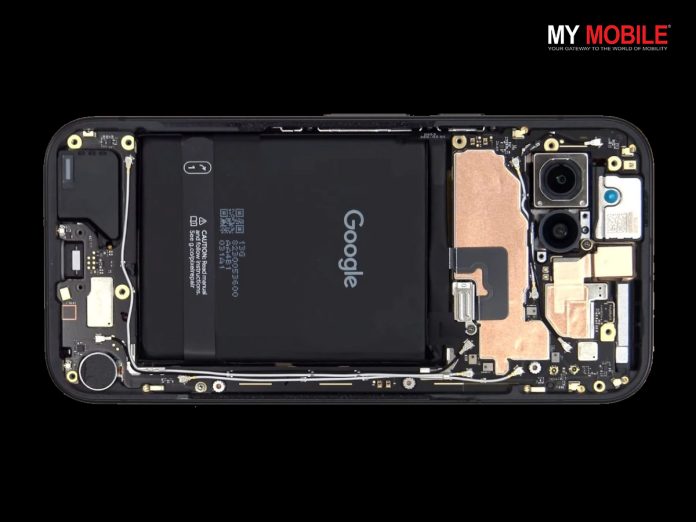
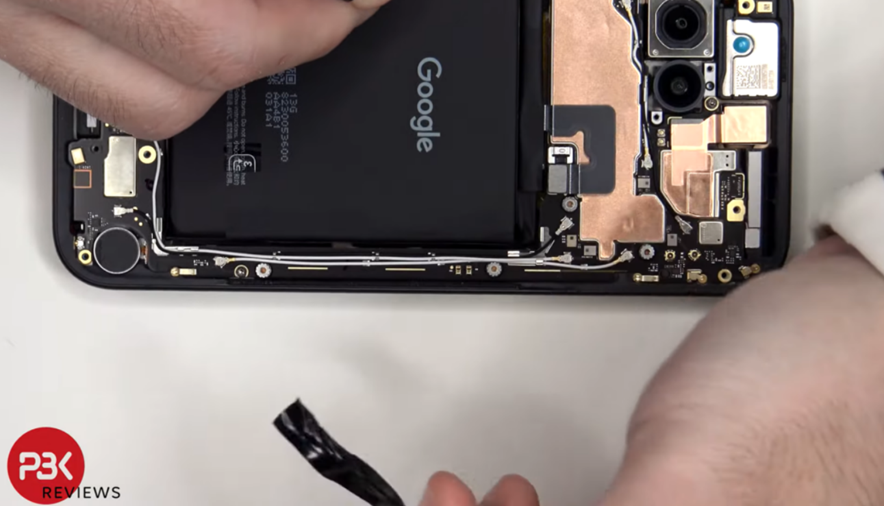
image

Caption – Google Pixel 9a appears in a recent PKBreview’s teardown video. (Image credit – PKBReviews on YouTube)

Google announced the Pixel 9a last month, but its release got delayed due to some unknown issue. Now, the phone is finally expected to hit the stores on April 10. In the meantime, YouTuber PBKreviews managed to get his hands on a unit and took it apart in one of his classic teardown videos. Here’s how it faired.

Google Pixel 9a Teardown

PBKreviews gave the phone a repairability score of 7.5 out of 10, where 10 means easiest to repair and 0 means the hardest. The Pixel 9a scored full 2 out of 2 marks for its internal design, parts availability and ease of screen replacement.

But it didn’t do quite as well in other areas. Replacing the battery only got it 1 out of 2, and replacing smaller internal parts proved to be more difficult, scoring just 0.5 out of 2.

Google Pixel 9a Repairability

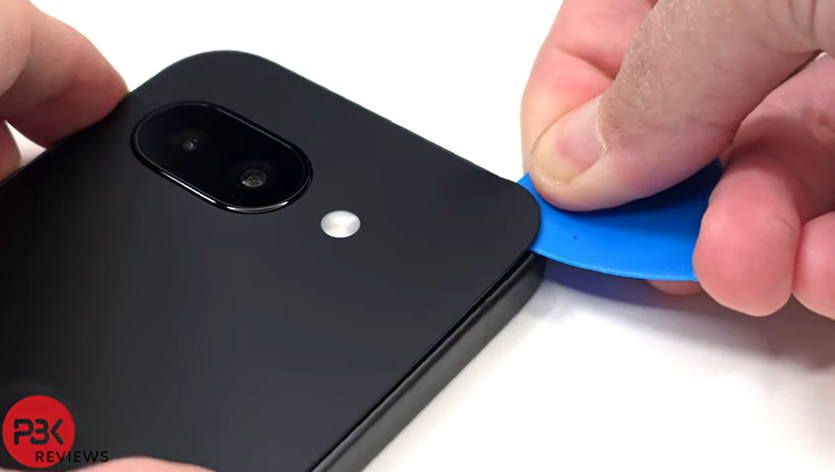
image

Caption – Google Pixel 9a teardown video reveals a plastic back panel. (Image credit – PKBReviews on YouTube)

The most common smartphone repairs are usually the screen, battery and back panel. In the case of the Pixel 9a, the back is made of plastic, so it’s unlikely most people will ever need to replace it. If you do, removing it is fairly standard and need just heat and a suction cup similar to the older Pixel models.

As for the battery removal process, it is where things get tricky.

According to the PKBreviews teardown, Google uses a different kind of pull tab here. You need to slide it back and forth to slice through the adhesive. Unfortunately, the adhesive is so strong that the pull tab often breaks. When that happens, you’ll need to apply a solvent like isopropyl alcohol to loosen the glue. Even then, prying is still required, which risks damaging the soft battery covering.

In the worst cases, it could even cause a fire, which is something older Samsung phones used to struggle with before switching to traditional pull tabs.

Meanwhile, the teardown reveals that replacing the screen of the Pixel 9a is relatively simple. You only need to pry off the screen and the display cable can be disconnected from the board without opening the back, which is a nice touch. The heat dissipation system also looks solid, meaning the Tensor G4 chip should perform well with everyday tasks.

Check out the full teardown video below –

FAQs

Q1. What repairability score did the Pixel 9a receive from PBKreviews?

Answer. The Pixel 9a received a repairability score of 7.5 out of 10, excelling in screen replacement and internal design.

Q2. Why is the battery replacement process challenging for the Pixel 9a?

Answer. The battery replacement is difficult due to strong adhesive and unconventional pull tabs, requiring additional tools and careful handling.

Q3. What makes screen replacement easier for the Pixel 9a?

Answer. The screen can be replaced easily as the display cable is accessible without opening the back, reflecting a well-thought-out design.

Also Read: Google to Develop Android OS In Private: Report

Also Read: Pixel 9a Early Unboxing Video Reveals Downgraded Modem, Goes For Sale In Dubai Before Official Launch

Vivo X200 Pro Tops AnTuTu’s March 2025 Rankings, Dimensity 9400 Shines

0

Highlights

  • Vivo X200 Pro Satellite Edition powered by Dimensity 9400 ranked first in AnTuTu’s March 2025 flagship rankings.
  • Four of the top ten devices use Dimensity 9400 with Snapdragon 8 Gen 3 is still competing strongly.
  • The Dimensity 9400+ will debut soon in devices like the Realme GT 7, Vivo X200S and the OnePlus Ace.

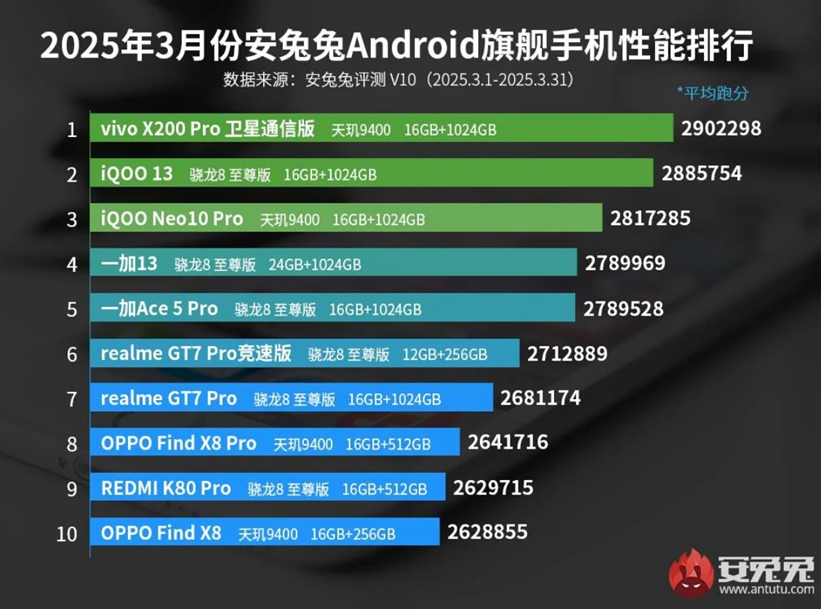
AnTuTu has just released its list of the top-performing Android flagship phones for March 2025. Leading the pack is the Vivo X200 Pro Satellite Edition powered by the Dimensity 9400 with an impressive average score of 2,902,298.

Coming in a close second is the iQOO 13 with 2,885,754 points, just 16,544 points behind Vivo’s flagship. Meanwhile, the third spot goes to the iQOO Neo 10 Pro, another Dimensity-powered device scoring 2,817,285.

image

Caption – Antutu’s Top 10 Flagship Smartphones for March 2025. (Image credit – AnTuTu)

Snapdragon 8 Gen 3 devices still hold their own, with OnePlus 13 and OnePlus Ace 5 Pro taking fourth and fifth places respectively, both offering strong performance numbers.

Antutu’s Top 10 Flagship Smartphones – March 2025

AnTuTu Ranking Smartphone Chipset Score
1 Vivo X200 Pro Satellite Communication Edition Dimensity 9400 2,902,298
2 iQOO 13 Snapdragon 8 Gen3 2,885,754
3 iQOO Neo 10 Pro Dimensity 9400 2,817,285
4 OnePlus 13 Snapdragon 8 Gen3 2,789,969
5 OnePlus Ace 5 Pro Snapdragon 8 Gen3 2,789,528
6 Realme GT 7 Pro Speed Edition Snapdragon 8 Gen3 2,712,889
7 Realme GT 7 Pro Snapdragon 8 Gen3 2,681,174
8 OPPO Find X8 Pro Dimensity 9400 2,641,716
9 Redmi K80 Pro Snapdragon 8 Gen3 2,629,715
10 OPPO Find X8 Dimensity 9400 2,628,855


The AnTuTu rankings are based on over 1,000 valid test results gathered in China between March 1 and March 31.

All in all, four of the top ten devices are using Dimensity 9400, showing just how well MediaTek’s chip is doing in the high-end market. And there’s more to come as its refreshed version, the Dimensity 9400+, is on the way. Phones like the Realme GT 7 (launching in April), Vivo X200S, and the next OnePlus Ace are all expected to feature this new chip in the first half of 2025.

FAQs

Q1. Which smartphone topped AnTuTu’s flagship rankings in March 2025?

Answer. The Vivo X200 Pro Satellite Edition, powered by Dimensity 9400, ranked first with a score of 2,902,298.

Q2. How did the Dimensity 9400 perform in the rankings?

Answer. Four of the top ten devices were powered by Dimensity 9400, showcasing MediaTek’s strong performance in the high-end market.

Q3. What upcoming devices are expected to feature the Dimensity 9400+?

Answer. Devices such as the Realme GT 7, Vivo X200S, and the next OnePlus Ace are expected to feature the refreshed Dimensity 9400+ chipset.

Also Read: Vivo X200 Pro Mini Set to Launch in India Soon – A Look At Expected Price and Features

Also Read: iQOO 13 Sales Starts in India with Exciting Offers, CEO Nipun Marya Discusses Performance

Apple Might Be Planning A New iPhone 19 Pro Design For iPhone’s 20th Anniversary In 2027

0

Highlights

  • Apple is planning significant updates for the iPhone’s 20th anniversary in 2027.
  • Plans reportedly include a foldable iPhone and a bold new Pro model.
  • The new Pro model aims to realise Jony Ive’s vision of a phone appearing as a single sheet of glass, marking a return to sleeker designs.

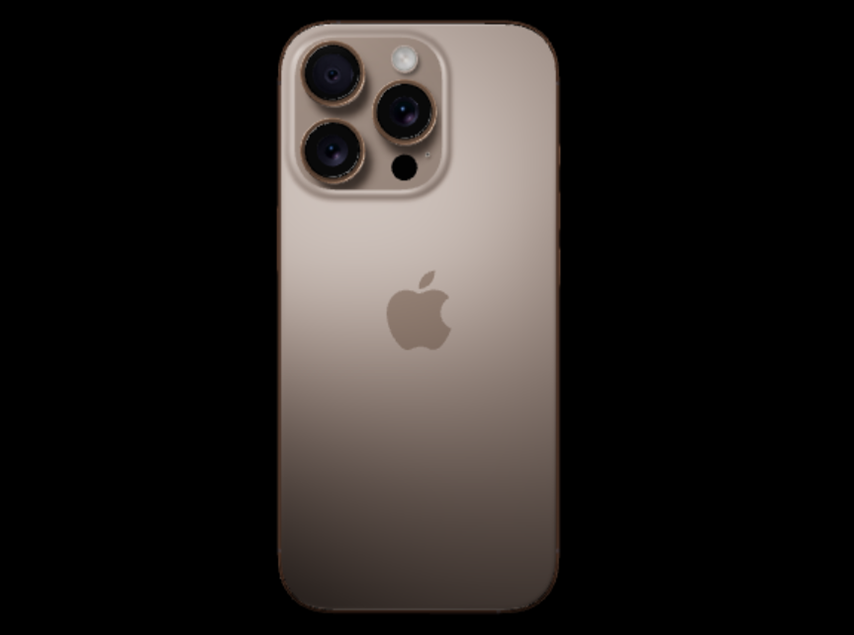
image

Caption – Apple to introduce bold new iPhone design on iPhone’s 20th Anniversary. (Image credit – Apple)

The criticism of Apple not really innovating when it comes to iPhone design has been constant in the last few iPhone series launches. It seems the Cupertino Giant is now keen on changing that and introducing some bold new designs for future iPhones.

According to the latest update from Bloomberg’s Mark Gurman, Apple is gearing up for a big change to mark the iPhone’s 20th anniversary next year. One of the most exciting updates could be the launch of the first-ever foldable iPhone. But that’s not all, Apple is also said to be working on a “bold new Pro model.”

If everything goes according to plan, this new Pro iPhone could finally bring to life the vision Jony Ive had for the iPhone. He had always imagined a phone that would “appear like a single sheet of glass,” something Apple started leaning into with the iPhone X.

In his Power On newsletter, Gurman writes, “But the company is preparing a major shake-up for the iPhone’s 20-year anniversary, including a foldable version and a bold new Pro model that makes more extensive use of glass.”

In recent years, Apple’s iPhones have become a bit thicker and less sleek. But now, the company seems to be returning to Jony Ive’s original idea. That shift starts this year with the introduction of the ultra-thin iPhone 17 Air and will likely continue next year with the 20th anniversary Pro model.

A design with even more glass might sound like a nightmare for durability and repairs, but honestly, it feels exactly like something Apple would go for, especially to celebrate a major milestone like the iPhone’s 20th birthday.

Gurman has also previously said that the iPhone 17 Air is just the beginning of Apple’s push toward ultra-thin designs. So it’s possible that the iPhone 19 Pro could combine both a super slim build and a glass-heavy design bringing Apple closer than ever to making an iPhone that truly looks like a single sheet of glass.

As for the details, Gurman hasn’t revealed much beyond the fact that more glass is involved. For now, we’ll just have to imagine what Apple has in store.

FAQs

Q1. What are Apple’s plans for the iPhone’s 20th anniversary in 2027?

Answer. Apple plans to introduce a foldable iPhone and a bold new Pro model to celebrate the iPhone’s 20th anniversary.

Q2. What design vision is Apple pursuing for the new Pro model?

Answer. The new Pro model aims to embody Jony Ive’s vision of a phone that looks like a single sheet of glass, emphasizing a glass-heavy and sleek design.

Q3. How is Apple progressing toward ultra-thin iPhone designs?

Answer. The shift began with the ultra-thin iPhone 17 Air, with future models like the iPhone 19 Pro potentially combining slim builds and extensive glass usage.

Also Read: Foldable iPhone and Another New iPhone Design Expected in 2026, Reports Gurman

Also Read: Future iPhones May See RAM Upgraded to 12 GB from 2025