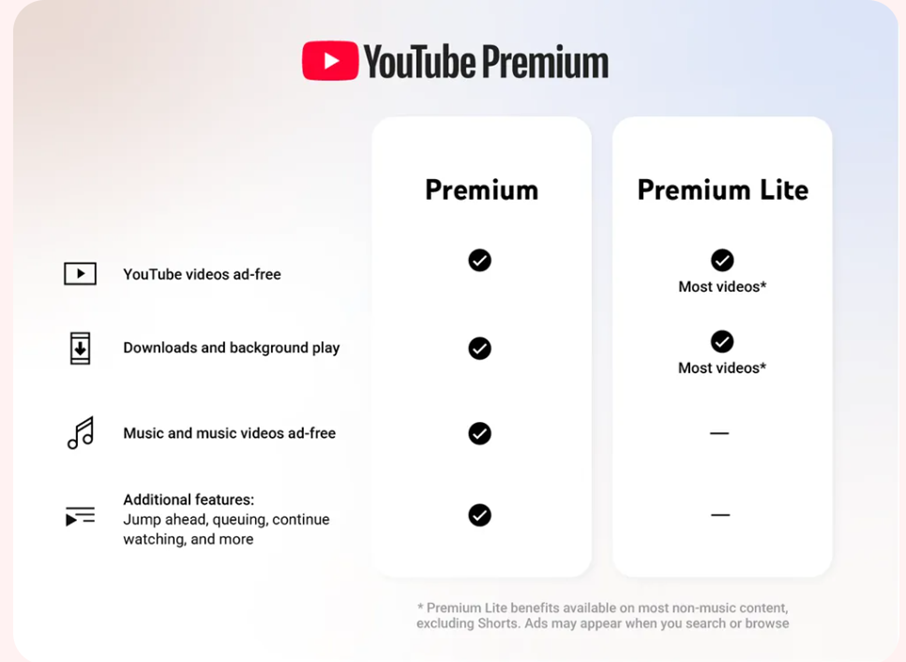
YouTube Premium Lite in India now supports background play and offline downloads.
The plan remains at ₹89 per month, the same as the student plan for full Premium, making it a budget-friendly option.
Rollout is expected in the next few weeks.
(Photo by NordWood Themes on Unsplash)
YouTube has introduced two major upgrades to its YouTube Premium Lite plan in India and other regions. The company confirmed that subscribers to the more affordable tier will soon gain access to background play and offline downloads. Here’s everything you need to know about the Premium Lite plan upgrade.
YouTube Premium Lite – What’s New?
In a recent blog announcement, YouTube revealed that Premium Lite users in India can now play videos in the background. This means subscribers can continue listening to podcasts, interviews, music videos, and long-form discussions even when their screen is turned off or while using other apps.
Secondly, the platform has also enabled offline downloads for Premium Lite members. Users can now download videos over Wi-Fi or mobile data and watch them later without requiring an active internet connection. This feature is particularly beneficial for commuters, travellers and users in areas with unreliable network coverage.
YouTube Premium Lite gets background play and downloads. (Image credit – YouTube Blog)
Until now, the Premium Lite plan mainly offered an ad-reduced experience but lacked support for background playback and downloads. The addition of these features significantly enhances the plan’s overall value. YouTube noted that the rollout of these updates will take place over the next few weeks.
Premium Lite does not include all the benefits offered under the standard YouTube Premium subscription.
YouTube Premium Lite Price in India
In India, the YouTube Premium Lite subscription is priced at Rs. 89 per month. This is the same price as the student plan for the full YouTube Premium subscription. YouTube has not announced any pricing changes following the addition of background play and offline downloads.
The standard Individual plan costs Rs. 149 per month and is also available as an annual subscription priced at Rs. 1,490. Meanwhile, the Family plan allows adding up to five members and is priced at Rs. 299 per month. There is also a two-member plan available at Rs. 219 per month.
YouTube Premium Lite now become a more attractive budget-friendly alternative for users who want essential premium features at a lower monthly cost.
FAQs
Q1. What new features have been added to YouTube Premium Lite in India?
Answer. Subscribers now get background play and offline downloads, allowing them to listen with the screen off and save videos for later viewing.
Q2. How much does YouTube Premium Lite cost in India?
Answer. The plan is priced at ₹89 per month, the same as the student plan for full YouTube Premium.
Q3. How does Premium Lite differ from the standard YouTube Premium plan?
Answer. Premium Lite now offers ad-reduced viewing, background play, and downloads, but it still lacks some benefits like full music streaming and family sharing options.
The OnePlus 16 is rumoured to feature ultra-thin bezels under 1mm.
The device may also skip a built-in active cooling fan and capacitive gaming shoulder triggers, focusing instead on a sleeker build.
Rumoured specs – a 200MP periscope telephoto camera, 50MP primary sensor, Snapdragon 8 Elite Gen 6 chipset and a massive 9,000mAh battery.
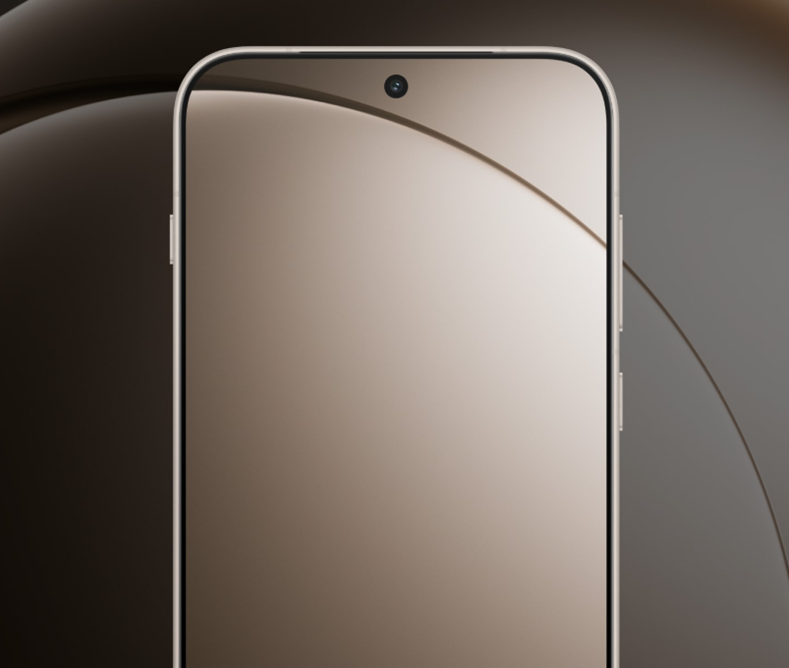
OnePlus 15 in the picture for reference. (Image credit – OnePlus)
While the official launch is still months away, early leaks about the rumoured OnePlus 16 have already begun circulating online. A recent report suggested that the upcoming device could feature a massive 9,000mAh battery. Now, a new tip claims the handset will arrive with significantly slimmer bezels around its display. Here are more details.
OnePlus 16 May Feature Ultra-Thin Bezels
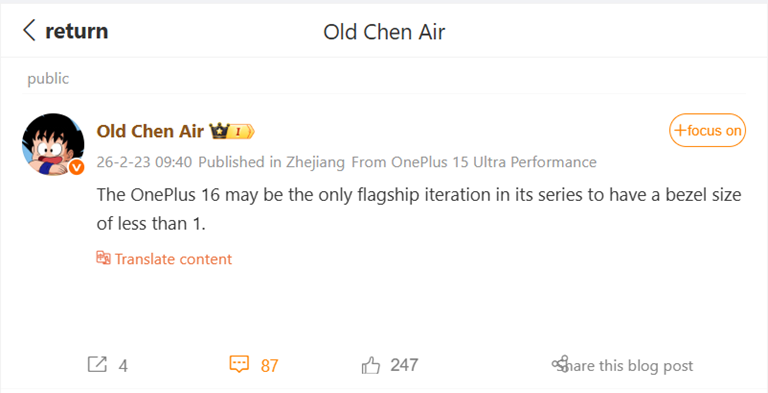
Tipster’s post on Weibo. (Translated via Google Translate)
According to a tipster named Old Chen Air on Weibo, the OnePlus 16 could feature bezels measuring less than 1mm in thickness. The leaker claims it may be the only flagship smartphone this year to offer sub-1mm bezels. If accurate, this would mark a noticeable improvement over the OnePlus 15.
It would enhance the immersive viewing experience and potentially give the OnePlus 16 one of the most refined front designs among 2026 flagship smartphones.
For reference, the OnePlus 15 sports a 6.78-inch QHD+ AMOLED display with 1.15mm-thick bezels.
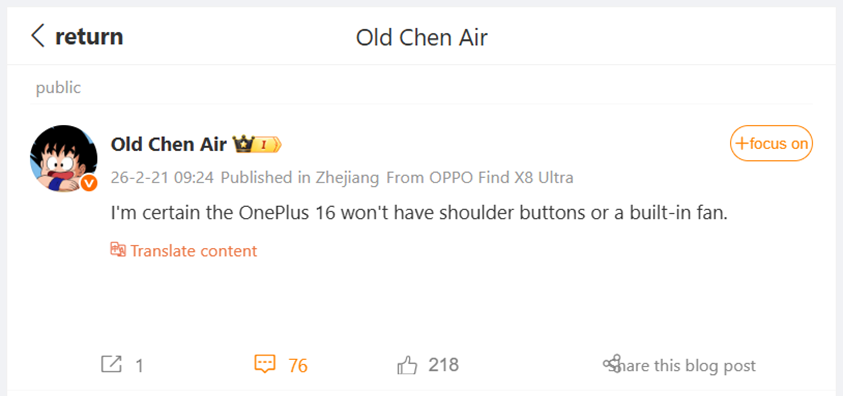
Tipster’s post on Weibo. (Translated via Google Translate)
In a separate post, the same tipster suggested that the OnePlus 16 will not include a built-in active cooling fan for thermal management during heavy gaming or demanding tasks. Additionally, the phone is said to skip capacitive shoulder triggers designed for gamers.
OnePlus 16 – What Else We Know? (Rumoured)
Earlier reports indicate that the OnePlus 16 could launch later this year with a 200-megapixel periscope-style telephoto camera. It may also include a 50-megapixel primary rear sensor paired with a 2-megapixel multispectral sensor aimed at improving colour accuracy and overall image quality.
The device is also rumoured to pack a substantial 9,000mAh battery. Under the hood, it could be powered by Qualcomm’s upcoming Snapdragon 8 Elite Gen 6 chipset.
However, these specifications remain unconfirmed and OnePlus has yet to officially comment on them.
Just to recall, the OnePlus 15 features a 6.78-inch QHD+ (1,272×2,772 pixels) AMOLED display with up to a 165Hz refresh rate. It is powered by Qualcomm’s Snapdragon 8 Elite Gen 5 processor an houses a 7,300mAh battery. The model was launched in India at a starting price of Rs. 72,999 for the 12GB RAM and 256GB storage variant.
As for the launch timeline, we have no official update at present. OnePlus 15 was introduced in India in November 2025 and we can only expect a similar last-quarter launch for the successor based on that.
FAQs
Q1. What is the biggest design change rumoured for the OnePlus 16?
Answer. The OnePlus 16 may feature ultra-thin bezels measuring less than 1mm, making it one of the slimmest-bezel flagships of 2026.
Q2. Will the OnePlus 16 include gaming-focused hardware like cooling fans or triggers?
Answer. Leaks suggest the device will skip a built-in active cooling fan and capacitive shoulder triggers, focusing instead on a sleeker design.
Q3. What other major specifications are rumoured for the OnePlus 16?
Answer. It could pack a 9,000mAh battery, a 200MP periscope telephoto camera, a 50MP primary sensor, and Qualcomm’s Snapdragon 8 Elite Gen 6 chipset.
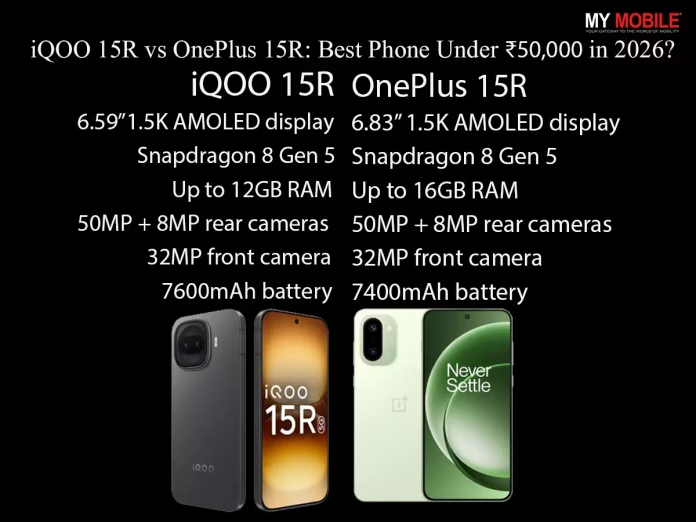
Both iQOO 15R and OnePlus 15R run on Snapdragon 8 Gen 5 with AMOLED displays, 50MP dual rear cameras, and 32MP front cameras.
iQOO 15R leads with a 7,600mAh battery and 100W fast charging, while OnePlus 15R packs a 7,400mAh battery with 80W SuperVOOC charging.
iQOO 15R starts at ₹44,999 with better entry-level value while OnePlus 15R starts at ₹47,999.
OnePlus 15R (left) and iQOO 15R (right).
iQOO has recently launched the iQOO 15R, powered by the Snapdragon 8 Gen 5 chipset, in India. The phone stands out for its massive 7,600mAh battery, AMOLED display and dual rear cameras among other features. Interestingly, it competes with the OnePlus 15R in the Indian market. Now, the OnePlus 15R is not a new phone for Indian as it debuted last year and has become a strong contender in the value flagship segment.
So, considering the presence of the OnePlus 15R in the segment, where does the new iQOO 15R really stand? For a customer planning to buy a smartphone under ₹50,000 in India, it can become difficult to make a choice between these two devices. So, here’s a detailed comparison covering every aspect of both devices including price, design and features.
iQOO 15R vs OnePlus 15R – Key Features Compared
Features
iQOO 15R
OnePlus 15R
Display
6.59-inch 1.5K AMOLED
6.83-inch 1.5K AMOLED
Processor
Snapdragon 8 Gen 5
Snapdragon 8 Gen 5
RAM
8GB / 12GB LPDDR5X Ultra
12GB LPDDR5X Ultra
Storage
256GB / 512GB UFS 4.1
256GB / 512GB UFS 4.1
Rear Camera
50MP primary (OIS) + 8MP ultra-wide
50MP primary (OIS) + 8MP ultra-wide
Front Camera
32MP sensor
32MP sensor
Video Recording
Up to 4K 60fps (Rear & Front)
Up to 4K 120fps (Rear) / 4K 30fps (Front)
Battery
7,600mAh
7,400mAh
Charging
100W fast charging
80W SuperVOOC
Operating System
Origin OS 6.0 (Android 16)
OxygenOS 16 (Android 16)
IP Rating
IP68, IP69
IP66, IP68, IP69, IP69K
iQOO 15R vs OnePlus 15R – Price Comparion in India
The iQOO 15R is available in three configurations, which includes a 8GB RAM + 256GB storage variant for ₹44,999, a 12GB RAM + 256GB storage variant for ₹47,999 and a 12GB RAM + 512GB storage variant for ₹52,999.
Meanwhile, the OnePlus 15R starts at ₹47,999 for the 12GB RAM + 256GB storage variant. The top-end model with 12GB RAM and 512GB storage is priced at ₹52,999.
iQOO 15R vs OnePlus 15R – Display Comparison
The iQOO 15R sports a 6.59-inch AMOLED display with 1.5K resolution and protection from Schott Xensation Alpha glass. The screen delivers an impressive 5,000 nits of peak brightness and 1,800 nits in High Brightness Mode (HBM).
It also supports a 144Hz refresh rate during gaming and automatically lowers the refresh rate during regular usage.
In comparison, the OnePlus 15R features a slightly larger 6.83-inch 1.5K AMOLED display protected by Corning Gorilla Glass 7i. It offers a higher 165Hz adaptive refresh rate aimed at gamers, along with 1,800 nits HBM brightness.
Additionally, it includes a dedicated touch response chip that enables 3200Hz touch sampling for ultra-fast response.
iQOO 15R vs OnePlus 15R – Performance and Software Comparison
Both smartphones are powered by the Snapdragon 8 Gen 5 Mobile Platform. The iQOO 15R is paired with an Adreno 826 GPU, while the OnePlus 15R features the Adreno 840 GPU.
In terms of memory and storage, both devices offer up to 12GB LPDDR5X Ultra RAM and up to 512GB UFS 4.1 internal storage.
On the software side, the iQOO 15R runs on Android 16-based Origin OS 6. Meanwhile, the OnePlus 15R operates on OxygenOS 16. Both brands promise four years of Android OS updates and six years of security patches.
iQOO 15R vs OnePlus 15R – Camera Capabilities Comparison
The iQOO 15R comes equipped with a dual rear camera setup that includes a 50MP Sony LYT-700V primary sensor with OIS and an 8MP ultra-wide lens. For selfies and video calls, it houses a 32MP front camera. Both the rear and front cameras support 4K video recording at 60fps.
The OnePlus 15R also features a 50MP primary Sony IMX906 sensor, which is the same camera used in the OnePlus 15 along with OIS and an 8MP ultra-wide camera. It offers a 32MP front camera capable of recording 4K video at 30fps, while the rear camera supports 4K recording at up to 120fps. The device also integrates OnePlus’ Detail Max Engine and supports autofocus on the selfie camera.
iQOO 15R vs OnePlus 15R – Battery and Charging Specs Comparison
When it comes to battery, the iQOO 15R slightly takes the lead with its 7,600mAh battery and 100W fast charging support.
The OnePlus 15R, on the other hand, packs a 7,400mAh battery with 80W wired fast charging.
For durability, the iQOO 15R carries IP68 and IP69 ratings for dust and water resistance. The OnePlus 15R goes a step further with the addition of an IP69K rating.
iQOO 15R vs OnePlus 15R – Which Phone Should You Buy in 2026?
To understand which phone you should buy, let’s start with the price. iQOO 15R seems to be more aggressively pricedcompared to the OnePlus 15R, making it appealing for value-conscious buyers. The iQOO 15R starts at ₹44,999 for the 8GB + 256GB variant, moving up to ₹47,999 for 12GB + 256GB and ₹52,999 for 12GB + 512GB. In contrast, the OnePlus 15R provides only two memory choices. It begins at a slightly higher ₹47,999 for 8GB + 256GB model and also has a 12GB + 512GB model at ₹52,999.
Both phones share the same flagship processor, but the iQOO 15R offers a larger battery with faster charging at a lower starting price, making it the better value for heavy users. On the other hand, the OnePlus 15R edges ahead in display refresh rate and camera sensor quality, appealing to those prioritising visuals and photography.
FAQ
Q1. What processors power the iQOO 15R and OnePlus 15R?
Answer. Both smartphones are powered by the Snapdragon 8 Gen 5 chipset, paired with Adreno GPUs (826 on iQOO, 840 on OnePlus).
Q2. How do the displays differ between iQOO 15R and OnePlus 15R?
Answer. The iQOO 15R has a 6.59-inch AMOLED with 144Hz gaming refresh and 5,000 nits peak brightness, while the OnePlus 15R offers a larger 6.83-inch AMOLED with 165Hz adaptive refresh and 3,200Hz touch sampling.
Q3. Which phone has the bigger battery and faster charging between iQOO 15R and OnePlus 15R?
Answer. The iQOO 15R leads with a 7,600mAh battery and 100W fast charging, compared to the OnePlus 15R’s 7,400mAh battery and 80W SuperVOOC charging.
Q4. How do the prices compare in India for iQOO 15R and OnePlus 15R?
Answer. The iQOO 15R starts at ₹44,999 for its base variant, while the OnePlus 15R starts at ₹47,999. At the top tier, OnePlus offers 16GB RAM at ₹52,999, the same price as iQOO’s 12GB + 512GB model, giving OnePlus stronger value at the premium end.
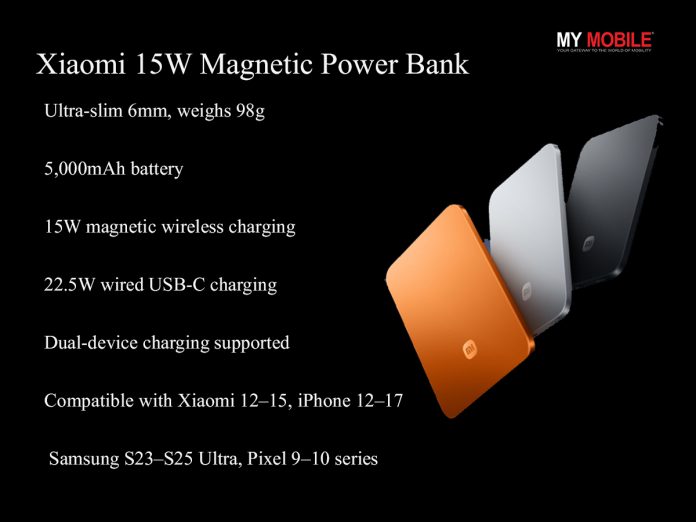
Xiaomi’s UltraThin Magnetic Power Bank 5000 15W is now available in markets like Australia, Singapore and Japan.
It has a slim 6mm body, weighs 98g, packs a 5,000mAh battery, supports 15W magnetic wireless charging, 22.5W wired charging and dual-device charging.
It works with Xiaomi 12–15 series, iPhone 12–17, Samsung Galaxy S23–S25 Ultra and Pixel 9–10 series.
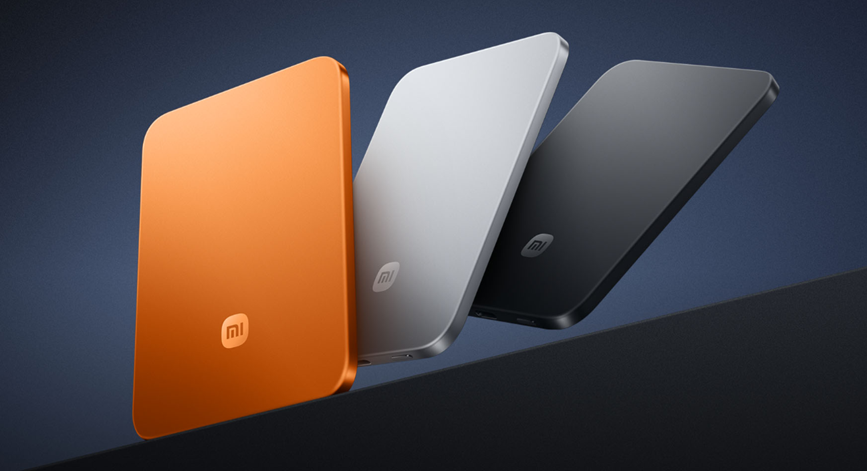
Xiaomi UltraThin Magnetic Power Bank 5000 15W now available in global market. (Image credit – Xiaomi)
Xiaomi has expanded the global availability of its UltraThin Magnetic Power Bank 5000 15W. Built for devices that support magnetic wireless charging, the power bank is compatible with select Xiaomi, Apple, Samsung, and Google smartphones. It is positioned as a competitor to Apple’s MagSafe Battery Pack, while offering a thinner profile.
Reports suggest the OnePlus 15R may see a price increase in India from March 1.
The 12GB + 256GB variant could rise to ₹51,999, while the 12GB + 512GB model may increase to ₹56,999.
The phone was launched at ₹47,999 and ₹52,999 in December 2025.
OnePlus 15R. (Image credit – OnePlus)
If the latest reports are to believe OnePlus 15R could soon see a price hike in the Indian market. The smartphone debuted in India in December 2025 as the brand’s latest performance-driven offering below its flagship lineup. It was initially launched in the under INR 50,000 segment but fresh leaks suggest that a Market Operating Price (MOP) revision may change that as early as March. Here are more details.
OnePlus 15R Price Hike Tipped
According to tipster Abhishek Yadav @yabhishekhd on X (formerly Twitter), a price revision for the OnePlus 15R is in the pipeline. In a follow-up update, the tipster revealed the revised pricing details, citing sources.
As per the claim, the 12GB RAM + 256GB storage variant of the OnePlus 15R could soon be priced at INR 51,999. Meanwhile, the higher-end 12GB RAM + 512GB storage configuration may see its price revised to INR 56,999.
🚨 EXCLUSIVE: OnePlus 15R New MOP Pricing Confirmed (From March 1, 2026)
While we couldn’t verify this update, tipster Debayan Roy @Gadgetsdata echoed similar figures as well. In a post on X, a tipster stated that the device’s price could increase by approximately Rs. 3,000 to Rs. 4,000.
🚨 OnePlus 15R is very likely to get a price hike 📈
The price hike is ~3-4K and will come in effect ~ 2 weeks
So if you’re planning to buy it , you may need to hurry
A suggestion,
If you’re ok with compact📱with slightly smaller🔋then OnePlus 13s is also a good option
As per reports, the updated MOP for the mid-flagship smartphone is reportedly expected to come into effect from March 1 across sales channels.
OnePlus 15R – Current Pricing and Launch Offers
OnePlus 15R. (Image credit – OnePlus)
OnePlus 15R was originally introduced in India at Rs. 47,999 for the 12GB + 256GB variant. The 12GB + 512GB model, on the other hand, carried a launch price of Rs. 52,999. Compared to the OnePlus 13R, the OnePlus 15R had already seen a price jump of around Rs. 5,000 at launch. This increase was partly attributed to the ongoing global shortage of memory components.
At present, customers can also avail themselves of bank discounts on Axis Bank and HDFC Bank cards. These offers reduce the effective selling price of the handset to Rs. 44,999 for the base model and Rs. 47,999 for the higher storage variant.
As of now, there has been no official confirmation from OnePlus regarding a price hike. Buyers may want to keep an eye on developments ahead of March.
FAQs
Q1. When is the OnePlus 15R price hike expected to take effect?
Answer. Reports suggest the revised Market Operating Price (MOP) will come into effect from March 1, 2026, across sales channels in India.
Q2. What will be the new prices of the OnePlus 15R variants?
Answer. The 12GB + 256GB variant may rise to ₹51,999, while the 12GB + 512GB model could increase to ₹56,999, about ₹3,000–₹4,000 higher than current prices.
Q3. What is the current pricing and available offers for the OnePlus 15R?
Answer. At launch, the 12GB + 256GB model was priced at ₹47,999 and the 12GB + 512GB at ₹52,999. With Axis Bank and HDFC Bank discounts, buyers can currently get them for ₹44,999 and ₹47,999, respectively.
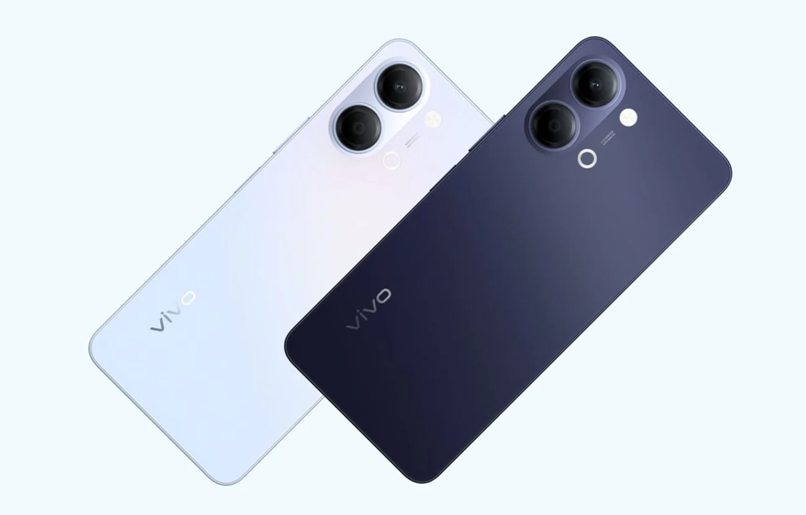
It will be available in Black and Blue colour options.
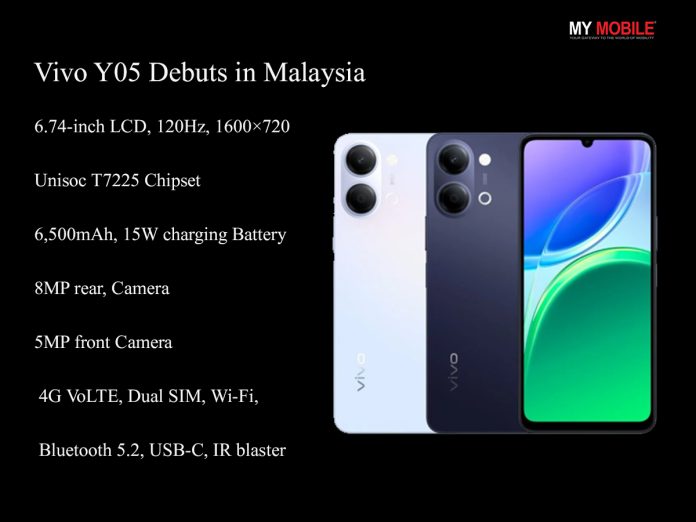
Key Features – 6.74-inch LCD with 120Hz refresh rate, Unisoc T7225 chipset, 4GB RAM (+4GB extended), 64GB storage, OriginOS 6.0 (Android 16) and 6,500mAh battery with 15W charging.
Vivo Y05 has been launched in Malaysia and Saudi Arabia. (Image credit – Vivo)
Vivo has officially introduced the Vivo Y05 in Malaysia and Saudi Arabia. Positioned as an entry-level offering, the new smartphone targets budget buyers looking for a smooth display experience and long-lasting battery life. Here’s a detailed look at the Vivo Y05’s specifications, features, and pricing.
Vivo Y05 – Price and Availability
The Vivo Y05 is priced at RM 399 (approximately $100) in Malaysia. In Saudi Arabia, the smartphone is available for $109.
It comes in two colour options, which are Black and Blue.
Vivo Y05 – Key Features
The Vivo Y05 sports a 6.74-inch LCD display with a resolution of 1600 × 720 pixels. It supports up to a 120Hz refresh rate, offering smoother scrolling and animations compared to standard 60Hz panels. The screen delivers a pixel density of 260ppi and can reach up to 1200 nits High Brightness Mode (HBM). For security, the device includes a side-mounted fingerprint sensor.
Powering the smartphone is the Unisoc T7225 chipset, built on a 12nm process. The processor is paired with 4GB of LPDDR4X RAM and 64GB of eMMC 5.1 internal storage. Vivo also offers support for an additional 4GB of extended RAM. Storage can be expanded up to 2TB using a microSD card.
One of the key highlights of the Vivo Y05 is its large 6,500mAh Li-ion battery, designed to deliver extended usage on a single charge. The device supports 15W charging.
On the software front, the smartphone runs OriginOS 6.0 based on Android 16.
For photography, the Vivo Y05 features an 8-megapixel rear camera with an f/2.0 aperture and LED flash. On the front, it includes a 5-megapixel selfie camera with an f/2.2 aperture.
In terms of connectivity, the device supports 4G VoLTE, dual SIM functionality, Wi-Fi (2.4GHz and 5GHz), Bluetooth 5.2, USB Type-C, and an infrared blaster. The handset carries an IP65 rating for dust and water resistance. It measures 167.40 x 77.10 x 8.39 mm and weighs 209 grams.
FAQs
Q1. Where has the Vivo Y05 been launched and what is its price?
Answer. The Vivo Y05 debuted in Malaysia at RM 399 (about $100) and in Saudi Arabia at around $109.
Q2. What are the display features of the Vivo Y05?
Answer. It has a 6.74-inch LCD screen with 1600 × 720 resolution, 120Hz refresh rate, 260ppi density, and up to 1200 nits brightness.
Q3. How powerful is the Vivo Y05’s battery?
Answer. The smartphone packs a large 6,500mAh battery with 15W charging support, designed for extended usage.
Q4. What cameras does the Vivo Y05 offer?
Answer. It features an 8MP rear camera with LED flash and a 5MP front camera for selfies.
Q5. Does the Vivo Y05 have durability and connectivity features?
Answer. Yes, it carries an IP65 rating for dust and water resistance, supports 4G VoLTE, dual SIM, Wi-Fi (2.4GHz/5GHz), Bluetooth 5.2, USB Type-C, and includes an infrared blaster.
The iPhone 18 Pro and Pro Max are expected to retain the Dynamic Island, but in a smaller form factor.
Apple is reportedly working on camera miniaturisation tech with the front-facing camera, Face ID dot projector and infrared sensor still housed within the Dynamic Island.
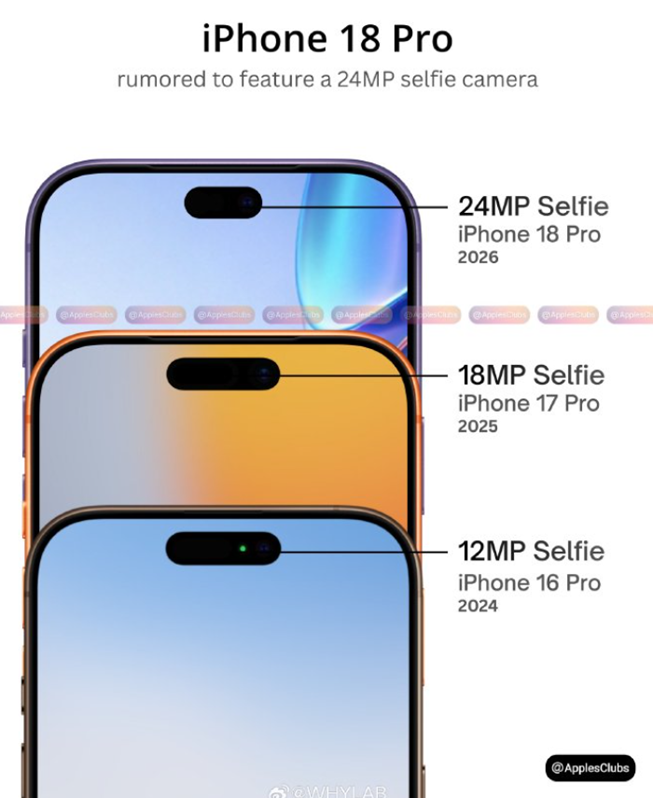
The lineup may debut in September 2026 with a 24MP selfie camera upgrade.
iPhone 17 Pro displays in the picture. (Image credit – Apple)
Apple’s upcoming iPhone 18 Pro lineup is once again surfacing in some fresh leaks. Previous speculation was that Apple might completely remove the Dynamic Island in favour of a hole-punch camera with under-display Face ID. However, the latest reports indicate that the feature is here to staybut will get smaller. That’s not all. A Chinese tipster has also revealed that the handset will launch with an enhanced front camera.
iPhone 18 Pro Models Dynamic Island Likely to Stay, But Shrink in Size
In addition to Bloomberg’s report, multiple well-known leakers have claimed that Apple plans to shrink the Dynamic Island rather than eliminate it altogether.
iPhone 17 Pro. (Image credit – Apple)
Interestingly, similar rumours surfaced last year about a smaller Dynamic Island on the iPhone 17 Pro. However, when the device launched, the Dynamic Island remained unchanged in size.
Now, to achieve a smaller Dynamic Island for iPhone 18 Pro, Apple is rumoured to move the Face ID dot illuminator beneath the display. At the same time, the company is reportedly working on new camera miniaturisation technology to reduce the size of the front-facing camera module.
Despite these changes, the front-facing camera, Face ID dot projector, and infrared camera are still expected to remain housed within the Dynamic Island and not fully under the display.
Apple is said to be working toward an eventual goal of an iPhone that is essentially a slab of glass without any visible cutouts. That milestone could arrive with the 20th anniversary iPhone expected in 2027. However, such a design is unlikely to debut with the iPhone 18 Pro models in fall 2026.
iPhone 18 Pro Could Get 24MP Selfie Camera
Image credit – Whylab on Weibo.
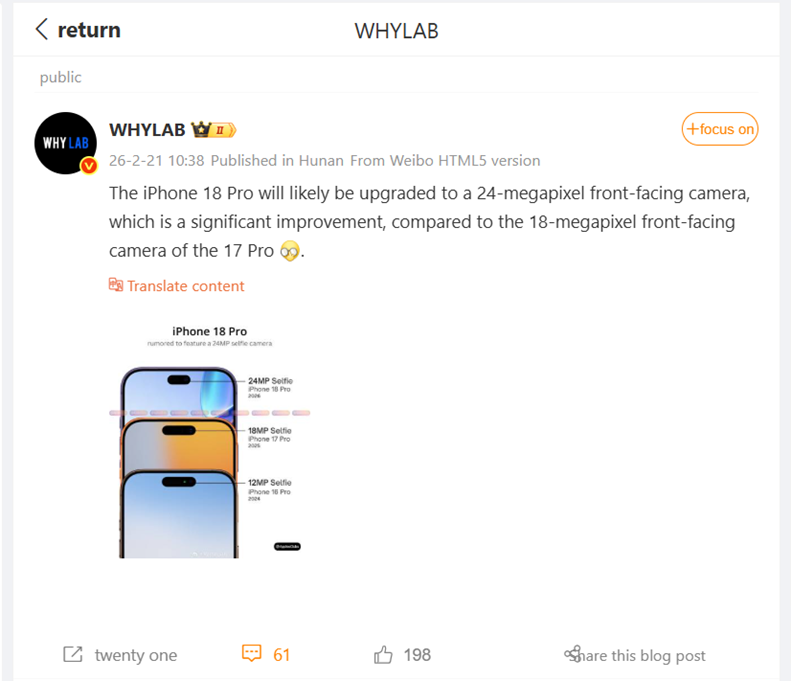
In a separate development, Weibo user Whylab claims that the rumoured iPhone 18 Pro will feature a 24-megapixel front-facing camera for selfies and video calls.
For reference, the iPhone 17 series is equipped with an 18-megapixel selfie camera along with Center Stage support. However, the leak does not clarify whether the iPhone 18 Pro will retain Center Stage functionality.
The front camera is expected to remain centrally positioned within the smaller Dynamic Island. This aligns with previous reports that both the iPhone 18 Pro and iPhone 18 Pro Max will continue to feature a centred front camera placement.
Whylab’s latest post on Weibo.
There are also claims that the Face ID sensor could be repositioned toward the left side of the display. As of now, Apple has not officially confirmed any of these changes, so the details should be taken with caution.
This latest wave of leaks follows reports that the iPhone 18 Pro lineup has entered the production testing phase. Apple is widely expected to unveil the iPhone 18 Pro series in September 2026. At the same event, the company may also introduce its first foldable iPhone.
FAQs
Q1. Will the iPhone 18 Pro models still have the Dynamic Island?
Answer. Yes, leaks suggest the Dynamic Island will remain but shrink in size, with some Face ID components moved under the display to achieve a smaller cutout.
Q2. What upgrades are expected for the iPhone 18 Pro’s front camera?
Answer. The iPhone 18 Pro is tipped to feature a 24MP selfie camera, an upgrade from the iPhone 17’s 18MP sensor, though Center Stage support is not yet confirmed.
Q3. When is the iPhone 18 Pro lineup expected to launch?
Answer. Apple is widely expected to unveil the iPhone 18 Pro and Pro Max in September 2026, alongside possible announcements like its first foldable iPhone.
Apple is planning a touchscreen OLED MacBook Pro for late 2026.
It will feature the iPhone-style Dynamic Island instead of the notch, plus a hole‑punch camera cutout.
A redesigned macOS will add touch-friendly controls and gestures, enabling seamless switching between touch, trackpad and mouse input.
MacBook Pro. (Image credit – Apple)
Apple is reportedly preparing a major overhaul of its MacBook Pro lineup with a touchscreen OLED model expected to arrive in 2026. According to a new report from Bloomberg, the upcoming MacBook Pro will introduce the iPhone’s Dynamic Island design along with a hole-punch camera cutout.
Dynamic Island to Replace the Notch
The redesigned MacBook Pro display is said to drop the existing notchin favour of the Dynamic Island, similar to what Apple introduced on the iPhone. The feature will free up additional screen space for content while offering interactive functionality.
Much like on the iPhone, the Mac’s Dynamic Island will dynamically expand and adapt depending on the app or feature being used. It is expected to provide contextual controls and real-time information, creating a more immersive and flexible user experience.
macOS to Become More Touch-Friendly
Alongside the hardware changes, Apple is reportedly reworking macOS to better support touch interactions. Users will be able to tap or click on on-screen elements with interface controls adjusting based on the method of input.
For example, tapping a menu bar item will bring up a larger, touch-optimised control set. Touch-based functionality will be integrated system-wide and macOS is expected to support iPad-style gestures such as pinch-to-zoom and fast scrolling. These enhancements aim to make touch navigation feel natural without compromising traditional mouse and trackpad workflows.
First Mac With Full Touch Display Support
The 2026 MacBook Pro will mark the first Mac to officially support touch gestures directly on its display. This move represents a notable shift in Apple’s long-standing stance against touchscreen Macs.
Apple previously experimented with touch functionality through the OLED Touch Bar on earlier MacBook Pro models. However, the feature was eventually discontinued after receiving mixed feedback and limited adoption.
This time, Apple reportedly does not plan to position the MacBook Pro as a touch-first device like the iPad. Instead, users will be able to seamlessly switch between touch and traditional input methods for all tasks.
MacBook Pro. (Image credit – Apple)
OLED Display and Refined Design
In addition to touchscreen capabilities, the new MacBook Pro models are expected to feature OLED display technology. It will deliver improved contrast, deeper blacks, and better overall visual quality.
Design-wise, Apple may introduce a slimmer chassis while retaining the familiar MacBook Pro look. The keyboard and trackpad will remain intact, and display sizes are expected to stay the same. OLED versions are reportedly planned for both the 14-inch and 16-inch MacBook Pro variants.
M5 Chipset in Spring, M6 Chipset for OLED Models
Apple is also preparing processor upgrades across its MacBook Pro lineup. The company is expected to introduce updated models powered by M5 Pro and M5 Max chips this spring.
However, the OLED touchscreen MacBook Pro models launching later will reportedly run on next-generation M6 Pro and M6 Max chips. These processors are said to be built using Apple’s advanced 2-nanometer manufacturing process.
With the OLED models anticipated to debut toward the end of 2026, Apple is effectively planning two MacBook Pro refresh cycles in the same year. One upgrade will be focused on chip upgrades and another will bring a significant design and display transformation.
FAQs
Q1. When is Apple expected to launch the touchscreen OLED MacBook Pro?
Answer. Apple is reportedly planning to release the redesigned MacBook Pro with a touchscreen OLED display and Dynamic Island in late 2026.
Q2. How will macOS change to support the new touchscreen MacBook Pro?
Answer. macOS is being reworked to become more touch-friendly, adding larger touch-optimised controls, iPad-style gestures like pinch-to-zoom and fast scrolling, while still supporting traditional mouse and trackpad input.
Q3. What processors will power the upcoming MacBook Pro models?
Answer. Apple will first introduce MacBook Pro models with M5 Pro and M5 Max chips in spring 2026, followed by the OLED touchscreen versions later that year, which will run on next-generation M6 Pro and M6 Max chips built on a 2-nanometer process.
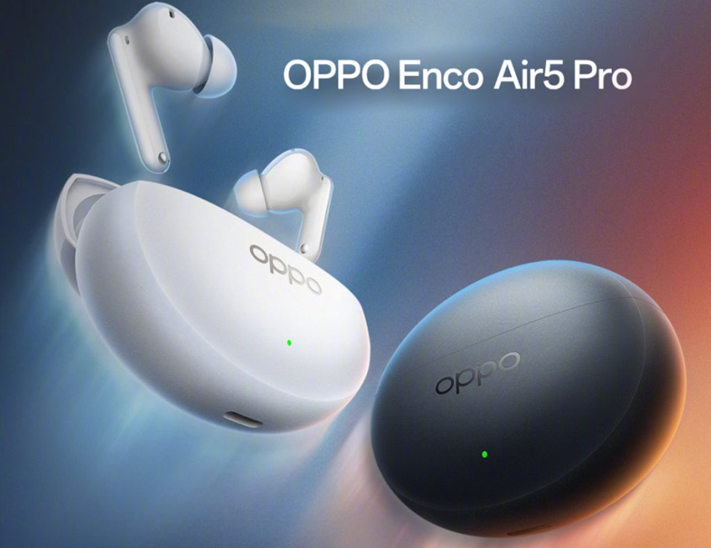
OPPO Enco Air 5 Pro earbuds have been officially launched in China.
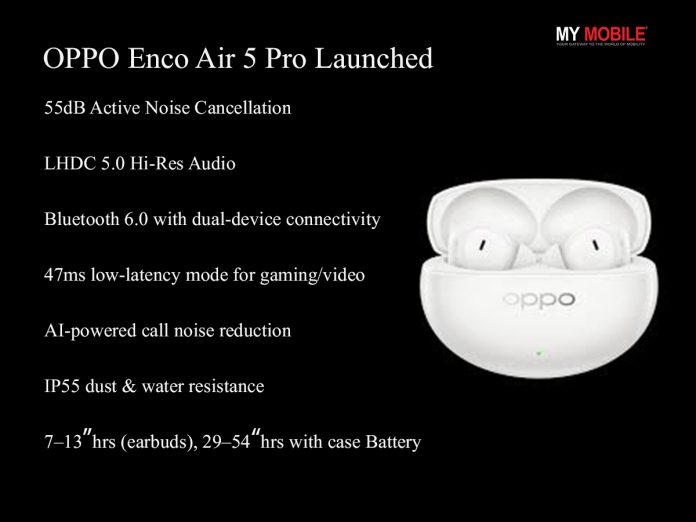
Key features include 55dB ANC, LHDC 5.0 Hi-Res Audio, Bluetooth 6.0 with dual-device connectivity, 47ms low-latency mode, AI-powered call noise reduction, and IP55 rating.
The earbuds are priced at 329 yuan (about $47.6) and will be available from March 2.
OPPO Enco Air 5 Pro Launched in China. (Image credit – Oppo)
OPPO has officially introduced the OPPO Enco Air 5 Pro in China, expanding its Enco audio portfolio with a new generation of true wireless earbuds. The latest model succeeds the OPPO Enco Air 4 Pro and brings notable upgrades in active noise cancellation (ANC), connectivity and battery performance. Here’s more on the new Oppo earbuds.
OPPO Enco Air 5 Pro – Price and Availability
The OPPO Enco Air 5 Pro is offered in Moonstone White and Midnight Black colour options. It is priced at 329 yuan (approximately USD 47.6/ INR 4,330 approx).
Sales in China are scheduled to begin on March 2.
OPPO Enco Air 5 Pro – Key Features
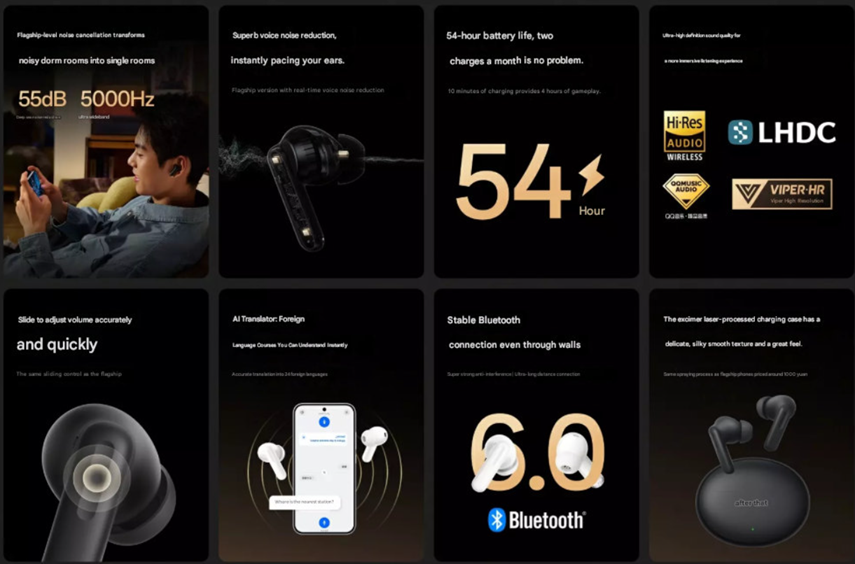
The OPPO Enco Air 5 Pro delivers up to 55dB of active noise cancellation with a frequency range extending to 5,000Hz. This marks an improvement over its predecessor, which offered 49dB ANC and coverage up to 4,000Hz.
The earbuds are equipped with a 12mm bass driver and support a wide 20Hz to 40kHz frequency response range. They continue to offer LHDC 5.0 Hi-Res Audio support, enabling wireless transmission speeds of up to 1Mbps. In addition, the earbuds are compatible with AAC and SBC audio codecs.
The Enco Air 5 Pro runs on Bluetooth 6.0 and supports dual-device connectivity, allowing users to stay connected to two devices simultaneously. For gamers and video streaming enthusiasts, OPPO has included a 47ms low-latency mode to ensure synchronised audio and visuals.
Touch gesture controls are integrated into the earbuds, including slide gestures for adjusting volume levels.
For voice calls, OPPO has implemented a three-microphone setup combined with AI-powered call noise reduction technology. This system enhances voice clarity while minimising background disturbances.
The earbuds also feature an intelligent wind noise reduction algorithm, designed to maintain call quality in outdoor conditions with wind speeds of up to 25 km/h. Additionally, AI translation support is included as an extra functionality.
In terms of battery capacity, each earbud houses a 62mAh battery, while the charging case packs a 530mAh battery.
With ANC enabled, users can expect up to 7 hours of playback on the earbuds alone and up to 29 hours with the charging case. When ANC is turned off, playback time increases to 13 hours on the earbuds and up to 54 hours in total with the case.
The OPPO Enco Air 5 Pro carries an IP55 rating for dust and water resistance. Each earbud weighs 4.4 grams, while the charging case weighs 43 grams. The case dimensions measure 63.37 × 50.03 × 24.74mm, and each earbud measures 30.91 × 17.06 × 19.93mm.
FAQs
Q1. What is the key upgrade in ANC for the OPPO Enco Air 5 Pro?
Answer. The earbuds deliver up to 55dB active noise cancellation with coverage up to 5,000Hz, an improvement over the Enco Air 4 Pro’s 49dB and 4,000Hz range.
Q2. What audio features do the Enco Air 5 Pro support?
Answer. They include a 12mm bass driver, LHDC 5.0 Hi-Res Audio (up to 1Mbps wireless transmission), AAC and SBC codec support, and a wide 20Hz–40kHz frequency response.
Q3. How do OPPO Enco Air 5 Pro perform in terms of connectivity and gaming?
Answer. They run on Bluetooth 6.0, support dual-device connectivity, and offer a 47ms low-latency mode for synchronised audio during gaming or video streaming.
Q4. What is the battery life of the OPPO Enco Air 5 Pro?
Answer. With ANC on, playback lasts 7 hours on earbuds and 29 hours with the case. With ANC off, it extends to 13 hours on earbuds and up to 54 hours total.
Q5. What is the price and availability of the OPPO Enco Air 5 Pro?
Answer. The earbuds are priced at 329 yuan ($47.6) and will be available in Moonstone White and Midnight Black starting March 2 in China.
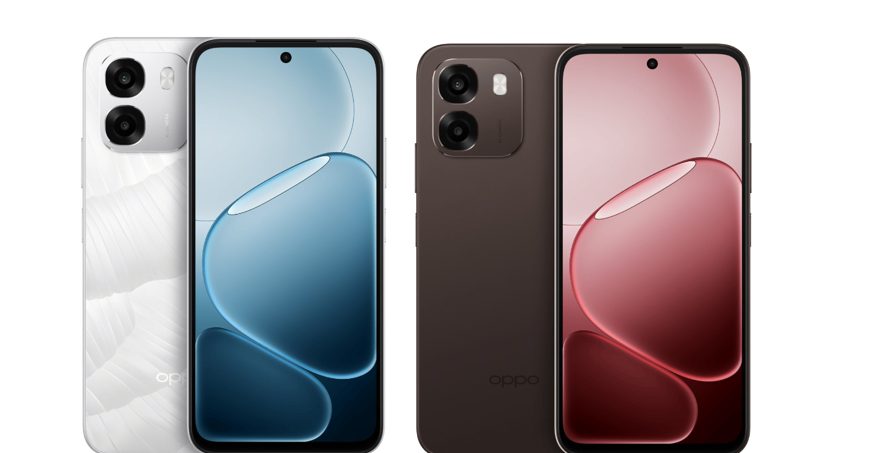
Oppo has launched four new A6 series smartphones, Oppo A6, A6s, A6i+, and A6v.
The Oppo A6 stands out with a 6.57-inch AMOLED display, 7,000mAh battery, and 80W SuperVOOC charging, while the A6s and A6i+ retain LCD panels and slower charging.
The Oppo A6v is essentially serving as a rebranded Oppo A6t with minor tweaks.
Oppo Expands A6 Series. (Image credit – Oppo)
Oppo has further expanded A6 lineup with the launch of four new smartphones, the Oppo A6, Oppo A6s, Oppo A6i+ and Oppo A6v, in China. These newly introduced variants bring a mix of updated specifications and rebranded hardware to the portfolio. Here’s everything we know about these phones so far.
Oppo A6 (Model PLS120) – AMOLED Display and 80W Charging
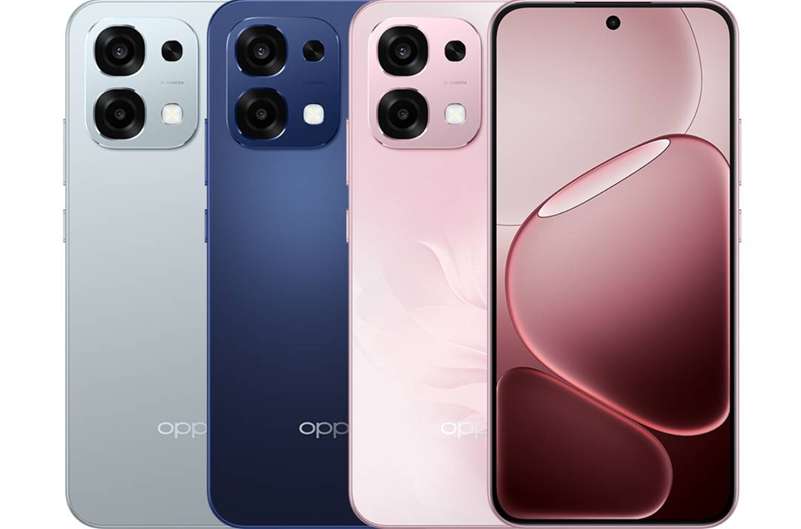
Oppo A6 is available in Velvet Grey, Blue Ocean Glow and Pink Dream Blossoms colour options. (Image credit – Oppo)
The new Oppo A6 (model number PLS120) differs from the previously released global version. It features a slightly smaller 6.57-inch 1080p+ AMOLED display, offering an upgrade over the 6.75-inch 720p+ IPS LCD panel found on the global A6. The AMOLED screen also integrates an optical under-display fingerprint sensor, replacing the side-mounted scanner on the earlier model.
One of the biggest highlights remains the massive 7,000mAh battery. However, the new version improves charging speeds, supporting 80W SuperVOOC and 44W PPS charging. This is an upgrade over the global A6’s 45W SuperVOOC and 33W PPS support.
Oppo A6 key features. (Image credit – Oppo)
The device continues to run on the MediaTek Dimensity 6300 chipset. It is available in 8GB + 256GB, 12GB + 256GB, and 12GB + 512GB configurations, paired with LPDDR4X RAM and UFS 2.2 storage. A microSD card slot is also included for expandable storage.
In terms of durability, the phone retains IP68 and IP69 ratings for advanced water and dust resistance. For photography, it offers a 50MP primary rear camera along with a 2MP secondary sensor. The front camera has been upgraded to 16MP from the previous 8MP unit. Despite the improvement, video recording remains capped at 1080p at 60fps.
Oppo A6s – Familiar Hardware With Key Downgrades
Oppo A6s available in Twilight Blue, Seashell White and Dawn Gold colour options. (Image credit – Oppo)
The new Oppo A6s mirrors much of the hardware seen in the global A6s but introduces some changes. It uses the same 6.75-inch 720p+ LCD panel as the global A6s. However, the selfie camera has been reduced to 8MP from 16MP.
The 7,000mAh battery remains, though charging speed is limited to 45W SuperVOOC, compared to the 80W charging available on the global A6s.
Powering the device is the same Dimensity 6300 processor. It is offered in 8GB + 256GB and 12GB + 256GB variants with LPDDR4X RAM and UFS 2.2 storage. A microSD slot is also retained.
While the distinctions between this new A6s and the global A6 without the “s” branding are somewhat unclear, Oppo has positioned it as a separate model within the series.
Oppo A6i+ – Rebranded Variant
Oppo A6i+ is available in Glacier White and Chestnut Brown colours. (Image credit – Oppo)
The Oppo A6i+ introduces a new name but not new hardware. It is essentially the same as the global A6, which itself shares similarities with the newly launched A6s. Notably, the A6s and A6i+ carry the same model number PLT120, indicating identical specifications.
Oppo A6v – Slight Tweaks With Smaller Battery
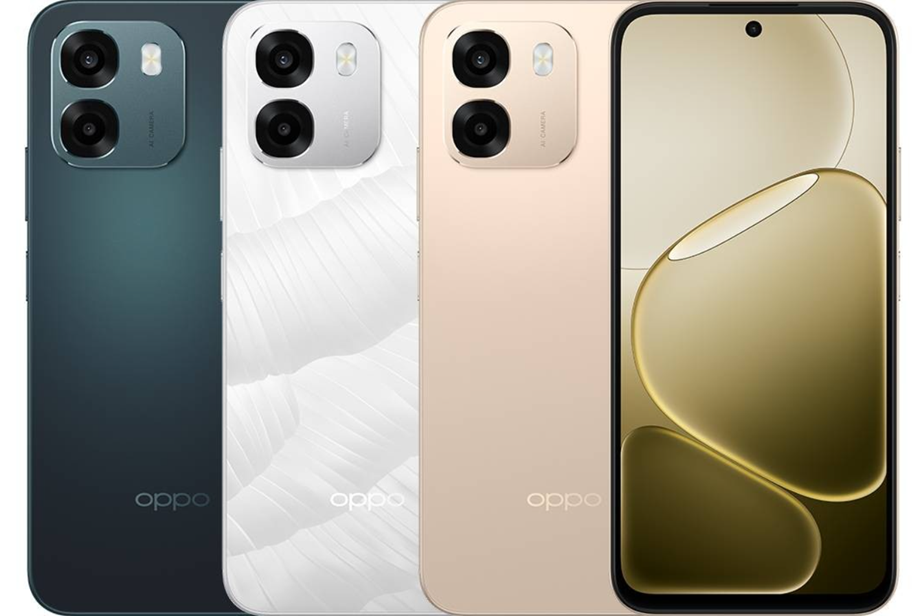
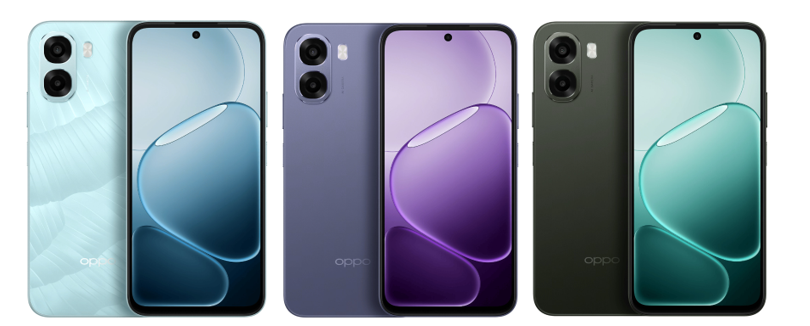
Oppo A6v in Glacier Blue, Titanium Purple and Wilderness Green. (Image credit – Oppo)
Lastly, the Oppo A6v (model number PLT130) makes minor changes compared to the A6s and A6i+. It comes with a 5MP front camera instead of the 8MP unit, a smaller 6,500mAh battery with 45W SuperVOOC charging (down from 7,000mAh), and an IP64 rating instead of IP68/IP69.
However, this model is not entirely new either, as it is essentially the same device as the Oppo A6t with rebranded naming.
Pricing
The model and variant-wise prices for China are as follows –
Oppo A6
Oppo A6i+
Oppo A6v
8/256GB
¥1,600 ($232)
¥1,500 ($217)
¥1,200 ($174)
12/256GB
¥1,900 ($275)
¥1,600 ($232)
–
12/512GB
¥2,100 ($304)
¥1,800 ($261)
–
FAQs
Q1. What new models has Oppo added to the A6 series?
Answer. Oppo has launched four new smartphones in China, Oppo A6, Oppo A6s, Oppo A6i+, and Oppo A6v, expanding its mid-range lineup.
Q2. What are the standout features of the Oppo A6 (PLS120)?
Answer. It offers a 6.57-inch AMOLED display, 7,000mAh battery with 80W SuperVOOC charging, IP68/IP69 durability, and a 50MP rear camera with a 16MP front camera.
Q3. How does the Oppo A6s differ from the A6?
Answer. The A6s retains a 6.75-inch LCD panel and 7,000mAh battery, but has slower 45W charging and a downgraded 8MP selfie camera compared to the A6.
Q4. What changes are seen in the Oppo A6v compared to other models?
Answer. The A6v features a smaller 6,500mAh battery, 5MP front camera, and IP64 rating, making it a slightly downgraded, rebranded version of the Oppo A6t.