Home Blog Page 485

Huawei Mate 70 Series Launched with Kirin 9020 Chipset and Pro-Level Features to give tough competition to the iPhone with latest tech & cost effective pricing

0

Highlights

  • Huawei Mate 70 series has been officially launched.
  • The series includes the Mate70, Mate70 Pro, Mate70 Pro+ and the ultra-premium Mate70 RS Ultimate.
  • Huawei Mate 70 series price starts at 5,499 yuan (USD 757 / Rs. 64,025).
image
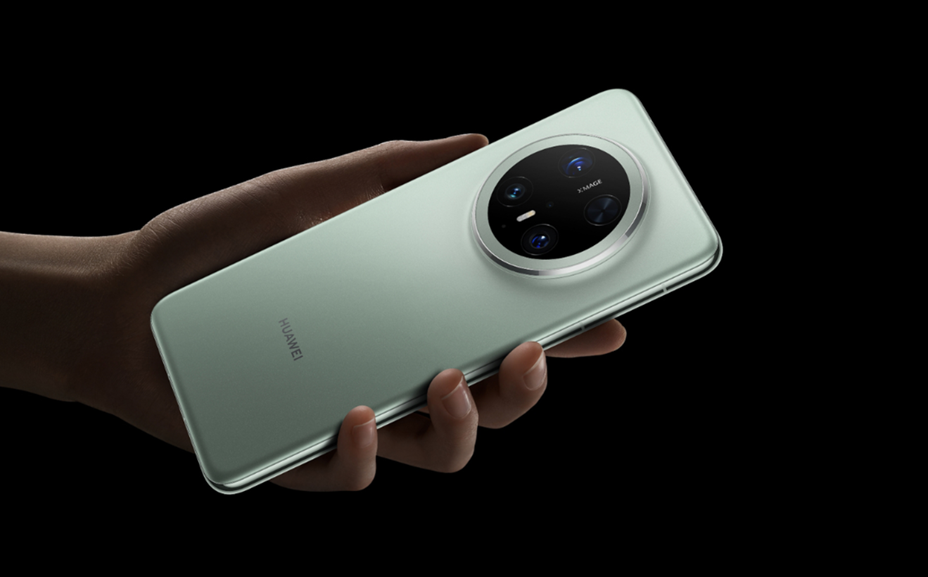
Huawei Mate 70 series launched. (Image credit – Huawei)

Huawei has officially unveiled its Mate 70 series at the recent Huawei Mate Brand Ceremony.

This flagship lineup, which many experts believe can challenge iPhones, includes four models – the Mate70, Mate70 Pro, Mate70 Pro+ and the ultra-premium Mate70 RS Ultimate. Here’s everything you need to know about the new smartphones.

Huawei Mate 70 Series – Availability

The HUAWEI Mate 70 series is now available for pre-order in China. The shipping dates are:

  • HUAWEI Mate 70 and Mate 70 Pro – Starts December 4, 2024.
  • HUAWEI Mate 70 Pro+ and Mate 70 RS Ultimate- Starts December 19, 2024.

HUAWEI has not announced any international release plans for the Mate 70 series.

Huawei Mate 70 Series – Pricing

Model Pricing
HUAWEI Mate 70 (12GB RAM / 256GB Storage) 5,499 yuan (USD 757 / Rs. 64,025)
HUAWEI Mate 70 (2GB RAM / 512GB Storage) 5,999 yuan (USD 826 / Rs. 69,850)
HUAWEI Mate 70 (12GB RAM / 1TB Storage) 6,999 yuan (USD 964 / Rs. 81,490)
HUAWEI Mate 70 Pro (12GB RAM / 256GB Storage) 6,499 yuan (USD 895 / Rs. 75,670)
HUAWEI Mate 70 Pro (12GB RAM / 512GB Storage) 6,999 yuan (USD 964 / Rs. 81,490)
HUAWEI Mate 70 Pro (12GB RAM / 1TB Storage) 7,999 yuan (USD 1,102 / Rs. 93,135)
HUAWEI Mate 70 Pro+ (16GB RAM / 512GB Storage) 8,499 yuan (USD 1,170 / Rs. 98,955)
HUAWEI Mate 70 Pro+ (16GB RAM / 1TB Storage) 9,499 yuan (USD 1,308 / Rs. 1,10,600)
HUAWEI Mate 70 RS (16GB RAM / 512GB Storage) 11,999 yuan (USD 1,653 / Rs. 1,39,710)
HUAWEI Mate 70 RS (16GB RAM / 1TB Storage) 12,999 yuan (USD 1,790 / Rs. 1,51,350)

Before we get to each of the models individually, let us share some info on the chipset.

Kirin 9020 Chipset Powering the Mate 70 Series

As always Huawei shared limited details about the chipset during the launch of the Mate 70 Series.

However, images posted on Weibo have now confirmed that the Kirin 9020 powers the series.
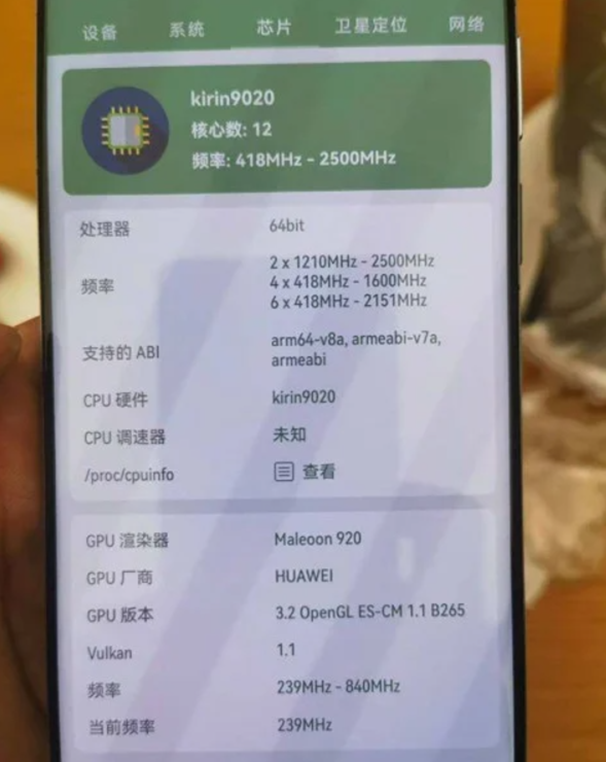
image
Image posted on Weibo confirming the Kirin 9020 Chipset is powering the Mate 70 Series. (Image credit – Weibo)

Following in the footsteps of its predecessor, the Kirin 9010 is the new chipset featuring a 12-core CPU with two prime cores clocked at 2.5GHz, six mid-range cores at 2.1GHz and four efficiency cores at 1.6GHz.

This design could involve hyperthreading, where a physical core can support two logical cores. For example, the Kirin 9010 had a 1+3+4 physical core setup but used hyperthreading to achieve a logical core design of 2+6+4.

The Kirin 9020 is expected to use a similar technique.

Now, let’s get to each of the Mate 70 models and understand what each is offering.

Huawei Mate 70 – Key Features
image
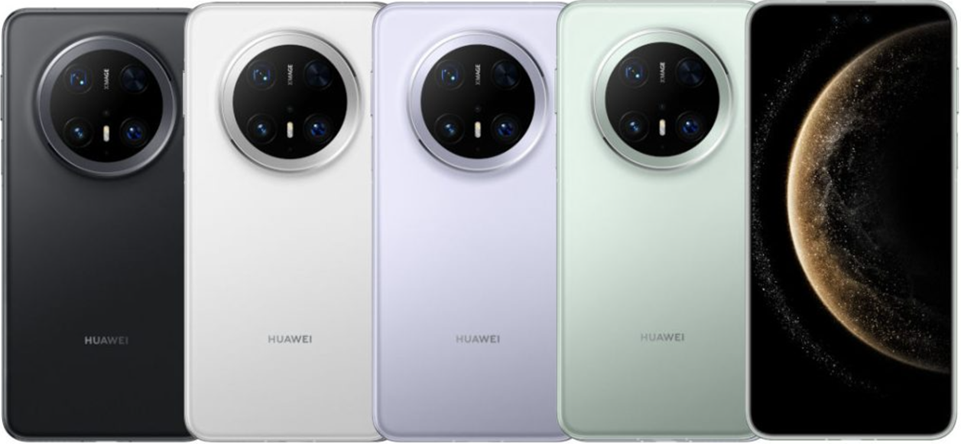
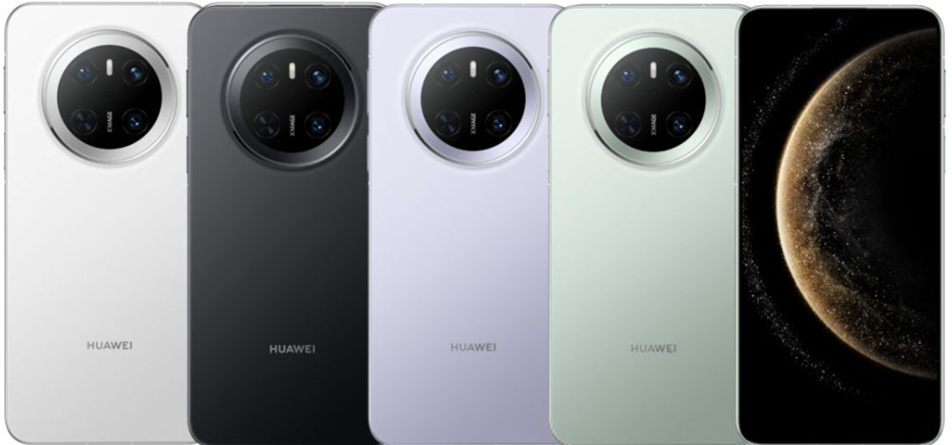
Huawei Mate 70 colour variants. (Image credit – Huawei)

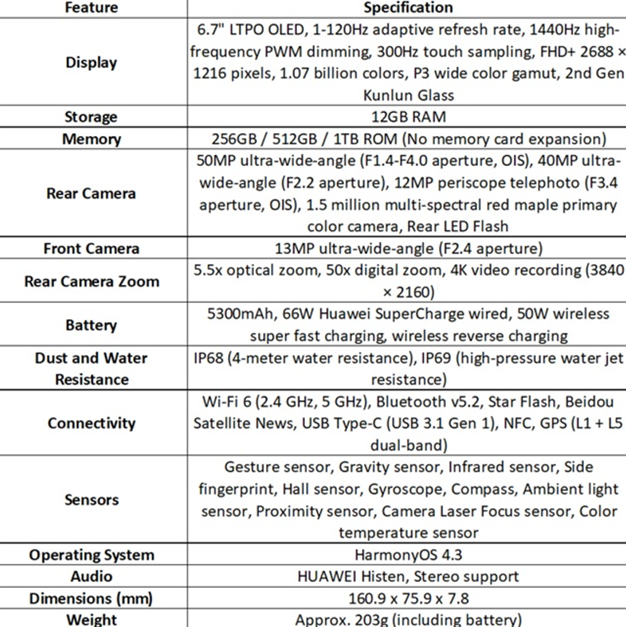
The Mate 70 comes with a 6.7-inch FHD+ display (2688 × 1216 pixels) featuring a 1–120Hz dynamic refresh rate and second-generation Kunlun glass for durability. It’s IP68/69 rated for dust and water resistance and packs a 5300mAh battery supporting 66W wired and 50W wireless fast charging.
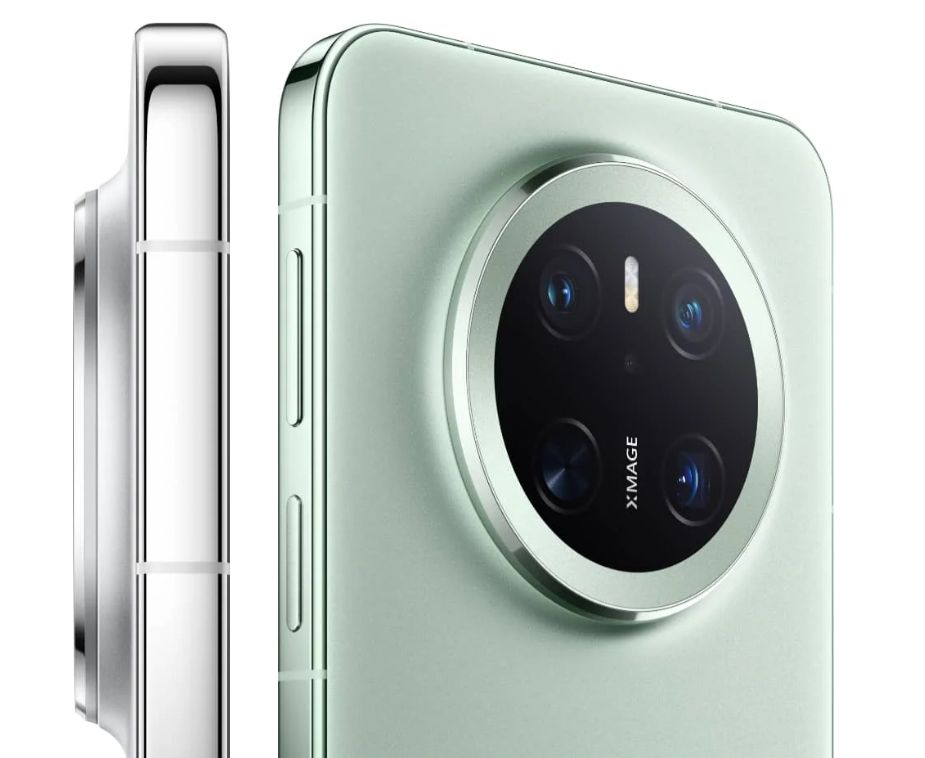
Huawei Mate70

For photography, the Mate70 includes a 50MP main sensor with variable aperture (f/1.4–f/4.0, OIS), a 12MP periscope telephoto lens with OIS, and a 40MP ultra-wide-angle camera. On the front, there’s a 13MP ultra-wide selfie camera.
image
Huawei Mate 70 detailed specification.

Huawei Mate 70 Pro – Key Features

imageHuawei Mate 70 Pro colour variants. (Image credit – Huawei)

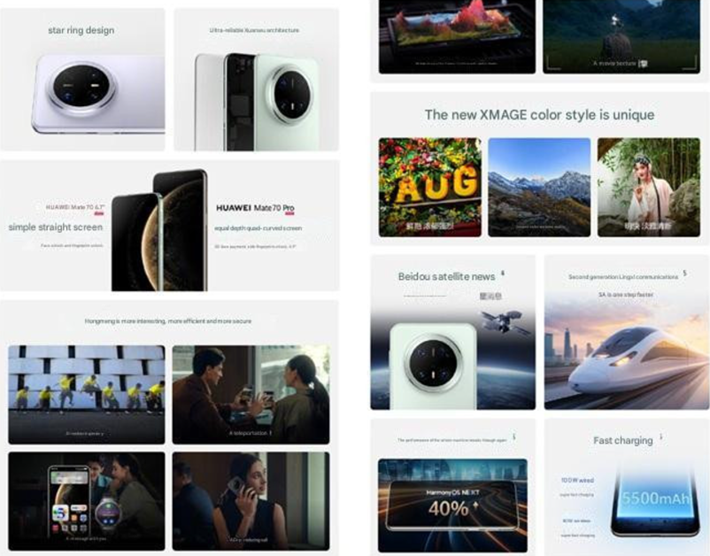
The Mate70 Pro builds on the base model, adding Wi-Fi 7 and satellite communication with a 120° ultra-wide satellite aiming angle. Its 5G capabilities are significantly improved, offering a 68% boost in peak rates over its predecessor.
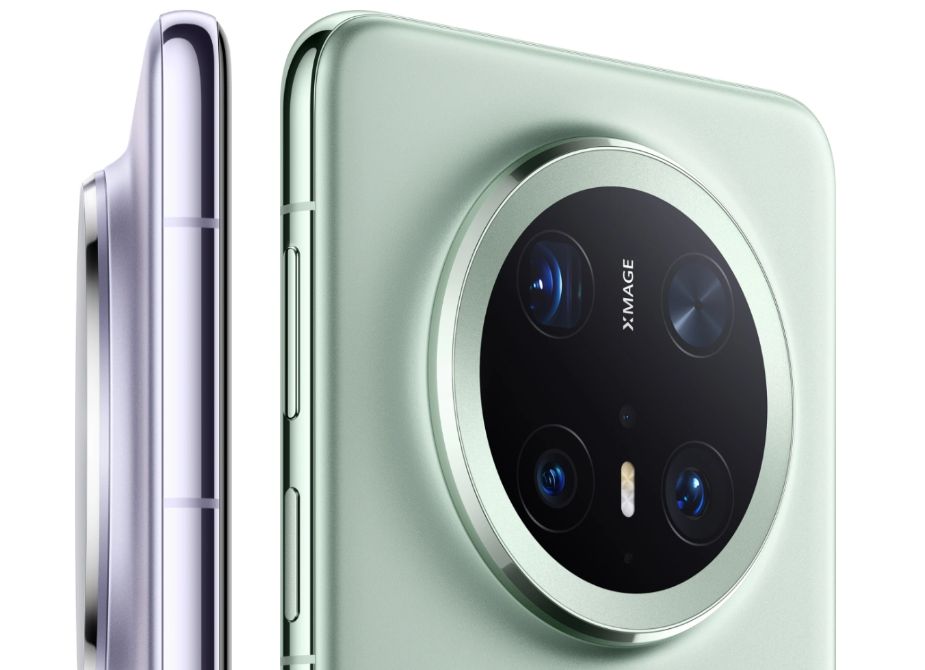
Huawei Mate70 pro

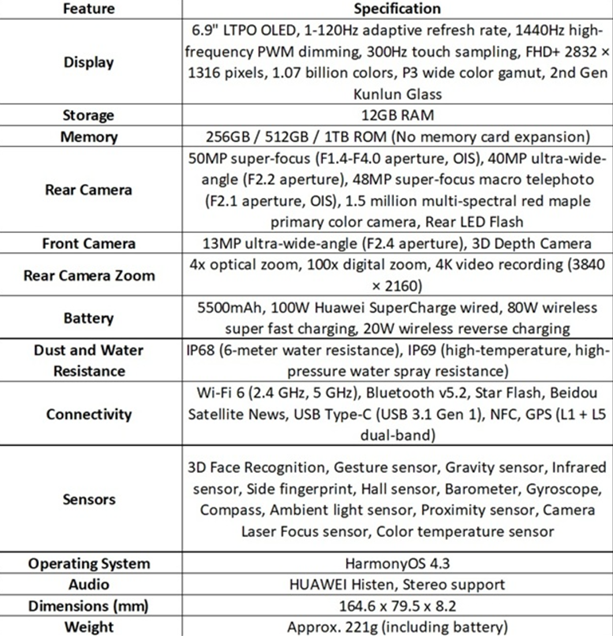
It features a larger 6.9-inch FHD+ display and an upgraded rear camera system that includes 50MP super-focus main camera (f/1.4–f/4.0 aperture, OIS), 40MP ultra-wide-angle camera (f/2.2 aperture), 48MP macro telephoto camera (f/2.1 aperture, OIS) and 13MP ultra-wide selfie camera.

The Pro also supports faster 100W wired charging, 80W wireless fast charging, and 20W reverse wireless charging.
image
Huawei Mate 70 Pro key features. (Image credit – Huawei)


image
– Huawei Mate 70 Pro detailed specifications.

Huawei Mate 70 Pro+ – Key Features

image
Huawei Mate 70 Pro+ colour variants. (Image credit – Huawei)

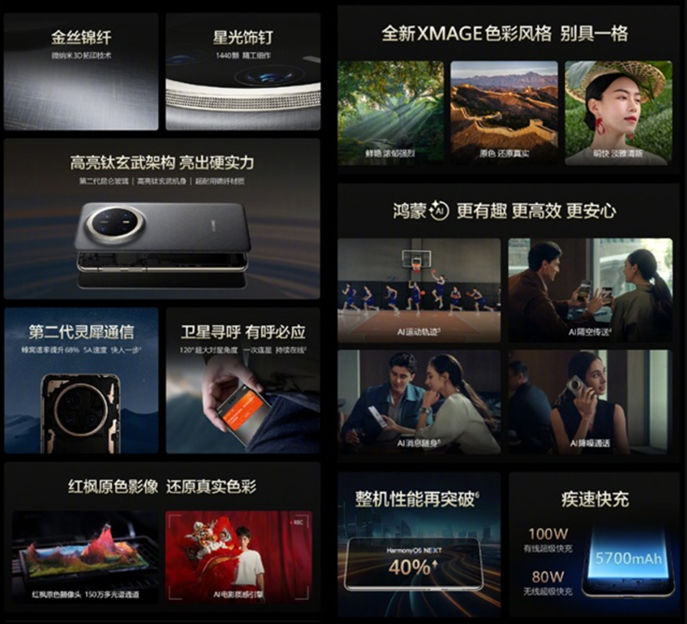
The Mate 70 Pro+ shares most features with the Pro model but stands out with an RYYB sensor for its telephoto and ultra-wide-angle cameras, ensuring better light sensitivity and colour accuracy. It also introduces AI dynamic photos for more advanced photography.

The camera setup includes a 50MP super-focus main camera (f/1.4–f/4.0 aperture, OIS), 40MP ultra-wide-angle camera (f/2.2 aperture), 48MP macro telephoto camera with 4x optical zoom (f/2.1 aperture, OIS) and 13MP selfie camera.
image
Huawei Mate 70 Pro+ key features. (Image credit – Huawei)
image
Huawei Mate 70 Pro+ detailed specifications.

Huawei Mate 70 RS Ultimate – Key Features
image
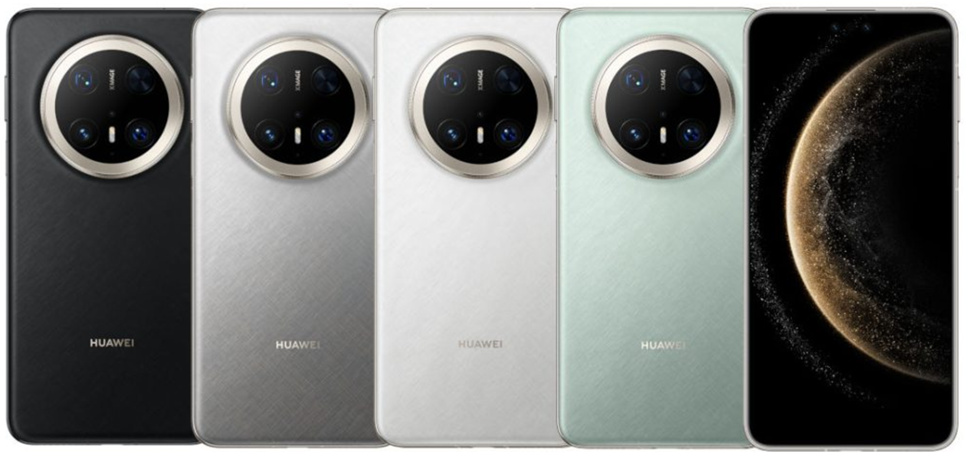
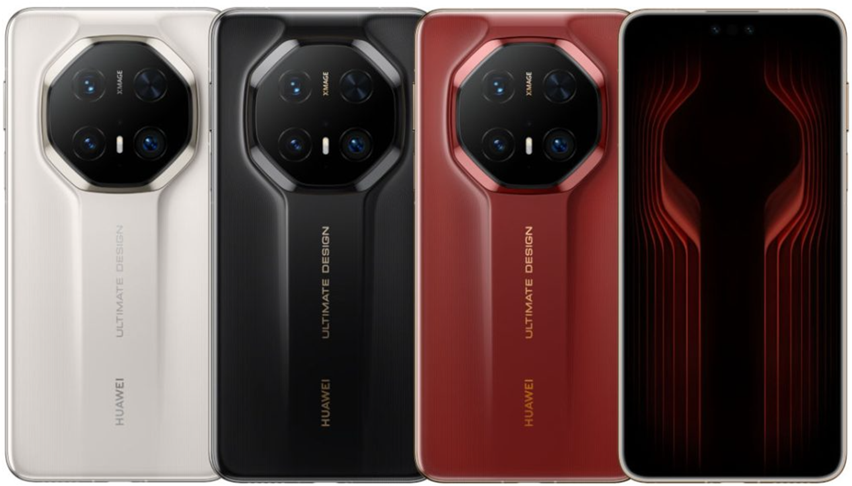
Huawei Mate 70 RS Ultimate colour variants. (Image credit – Huawei)

The Mate70 RS Ultimate is the most premium model, featuring a high-gloss titanium frame and a brocade material back cover. While it shares the same specs as the Pro+, its luxurious design and materials set it apart.
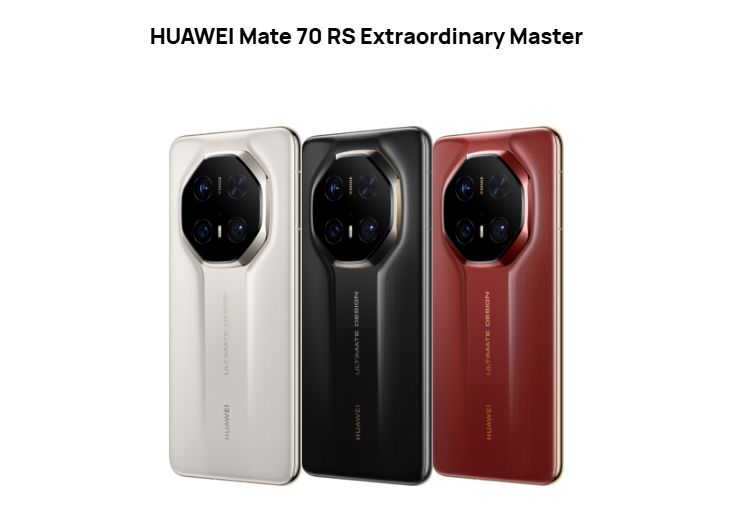
Huawei Mate70 RS Ultimate

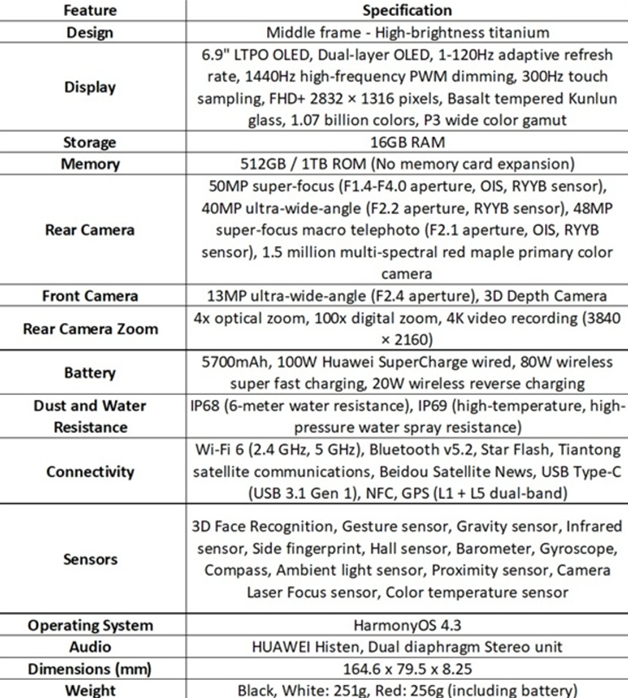
Despite its titanium build, the phone maintains a similar thickness at 8.25mm but weighs around 251g. The Mate 70 series will initially be available in China, offering four stylish colour options.

image
Huawei Mate 70 RS Ultimate key features. (Image credit – Huawei)
image
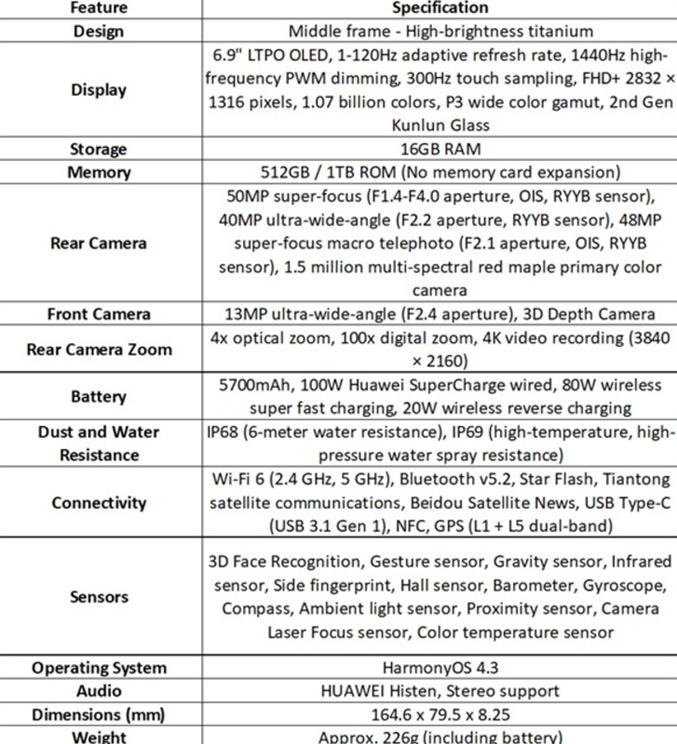
HUAWEI Mate 70 RS detailed specifications. (credit – Huawei)
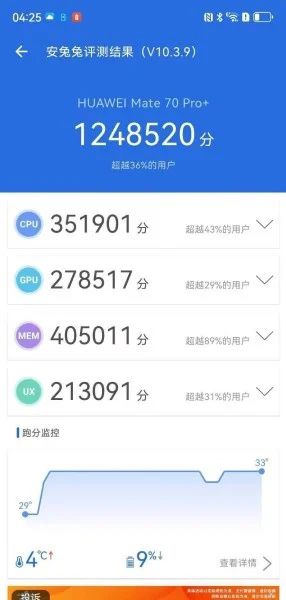
AnTuTu scores for the Mate 70 Pro+ reveal a total of 1,248,520 points.

FAQs

Q1. What are the models included in the Huawei Mate 70 series?

Answer. The Huawei Mate 70 series includes four models: the Mate70, Mate70 Pro, Mate70 Pro+ and the ultra-premium Mate70 RS Ultimate.

Q2. Which chipset powers the Huawei Mate 70 series?

Answer. The Huawei Mate 70 series is powered by the Kirin 9020 chipset, featuring a 12-core CPU with two prime cores clocked at 2.5GHz, six mid-range cores at 2.1GHz and four efficiency cores at 1.6GHz.

Q3. What are the core features of the Huawei Mate 70?

Answer. The Mate70 features a 6.7-inch FHD+ display with a 1-120Hz dynamic refresh rate, second-generation Kunlun glass, a 5300mAh battery with 66W wired and 50W wireless fast charging, and a camera setup including a 50MP main sensor, 12MP periscope telephoto lens and 40MP ultra-wide-angle camera.

Q4. How does the Huawei Mate 70 Pro differ from the base model?

Answer. The Mate70 Pro adds Wi-Fi 7, satellite communication, improved 5G capabilities, a larger 6.9-inch FHD+ display, an upgraded rear camera system, and supports faster 100W wired charging, 80W wireless fast charging and 20W reverse wireless charging.

Q5. What makes the Huawei Mate 70 RS Ultimate stand out?

Answer. The Mate70 RS Ultimate features a high-gloss titanium frame and a brocade material back cover and shares the same specs as the Pro+ model but with a luxurious design and premium materials.

Read More: HUAWEI Mate 70 Pro Live Images Leaked Online

Read More: HUAWEI’s Tri-Foldable Phone Spotted on a Plane Being Used by Richard Yu, Could Launch Soon
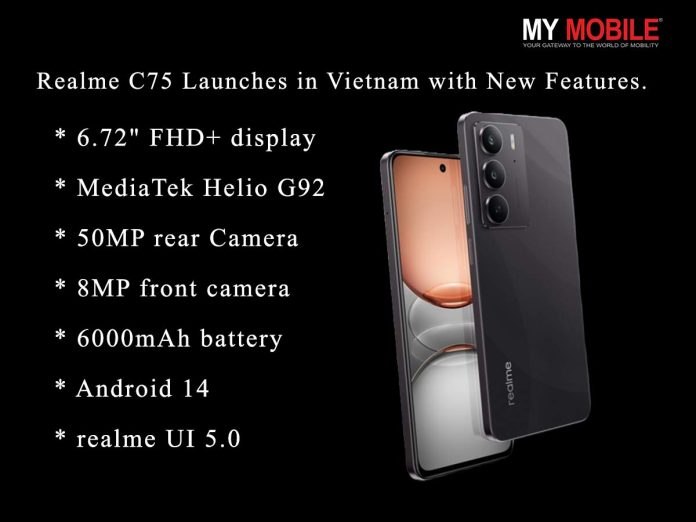
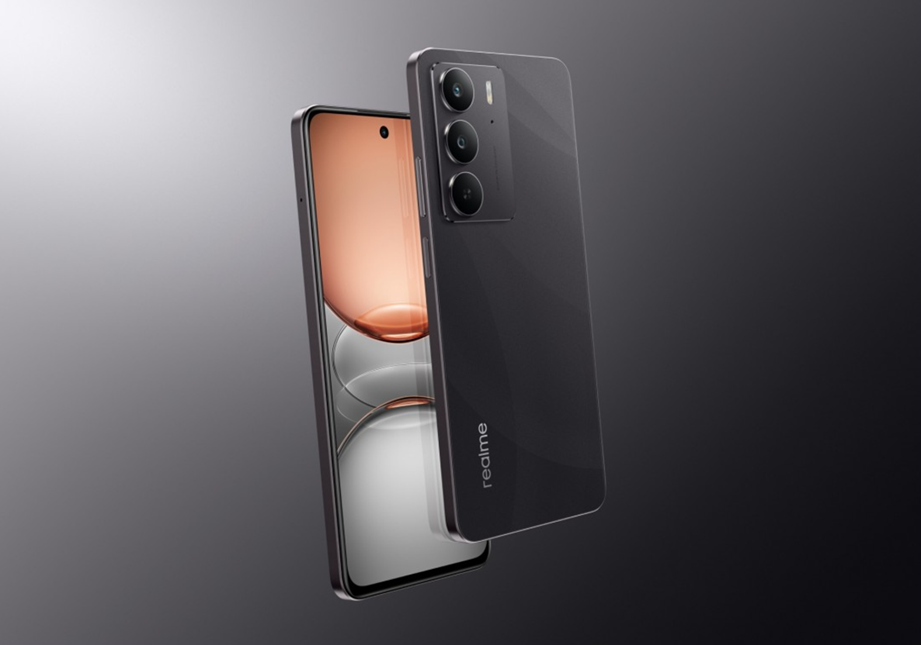
Realme C75 Debuts in Vietnam with Helio G92 Max Chipset, 50MP Camera and 6,000mAh Battery

0

Highlights

  • Realme introduced the budget-friendly Realme C75 in Vietnam.
  • The phone comes at a starting price of 5,690,000 Vietnamese Dongs (approximately $223 or ₹18,900).
  • Key Features – 6.72-inch FHD+ IPS LCD display, MediaTek Helio G92 Max chipset, 50MP main camera, 8MP front camera and a 6,000mAh battery with 45W wired charging.
image
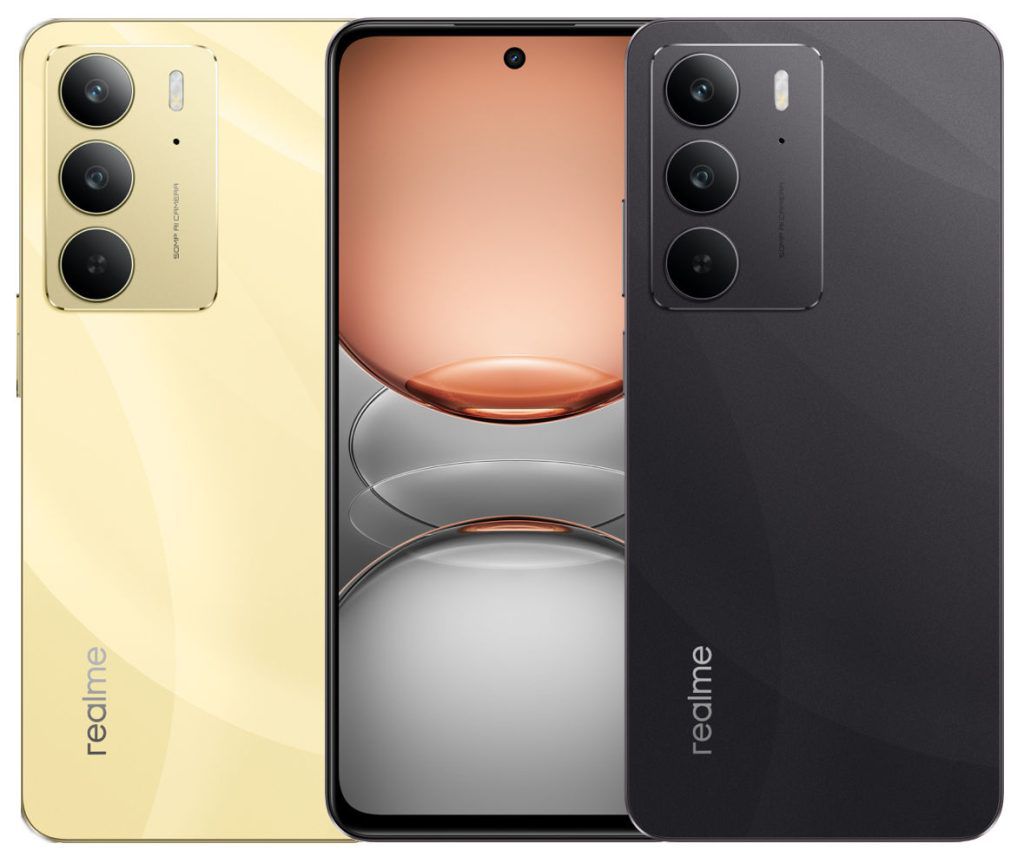
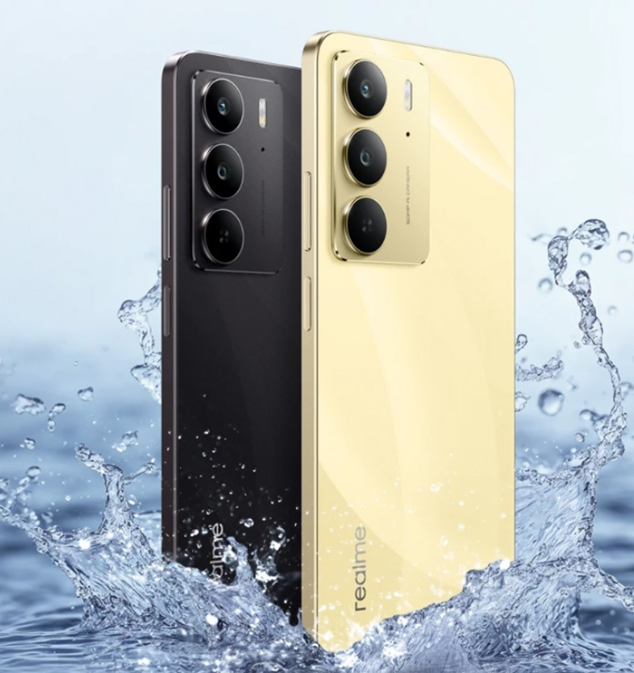
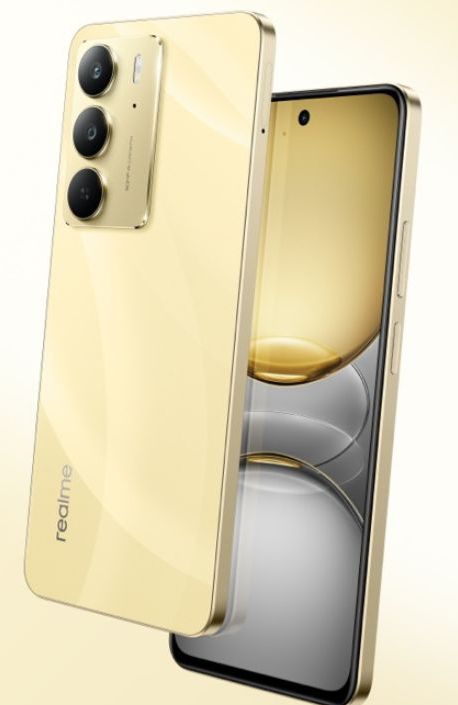
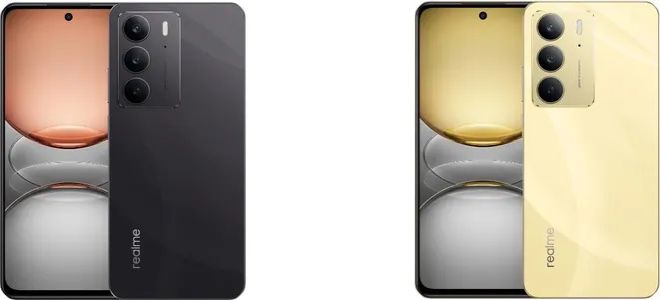
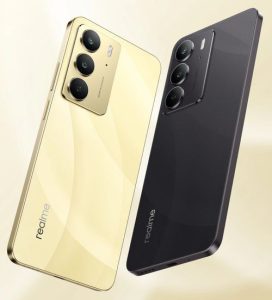
Realme C75 introduced in Vietnam. (Image credit – Realme)

While Realme GT 7 Pro had its launch in India, Realme also introduced the latest addition to its budget-friendly C-series – the Realme C75 – in Vietnam.

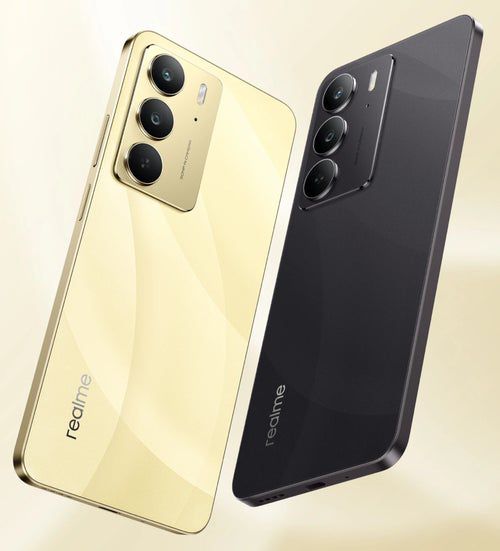
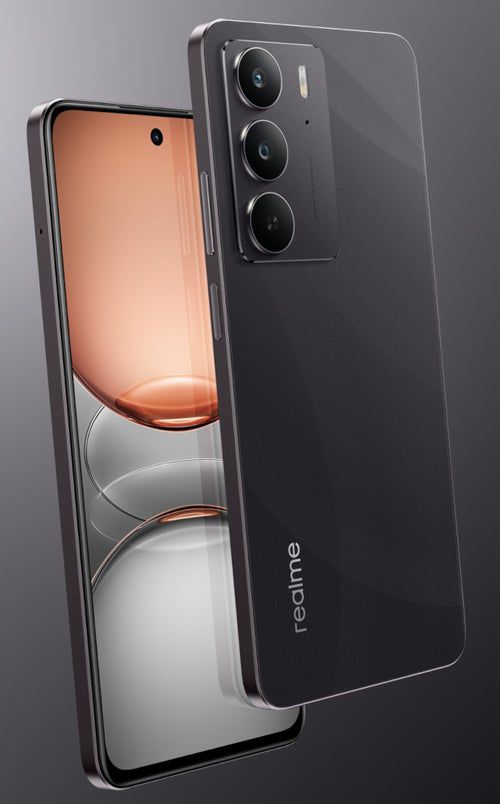
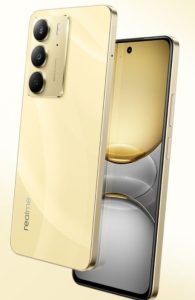
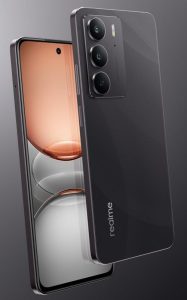
Available in Lightning Gold and Black Storm Night.

The smartphone will be available in two colour choices including Lightning Gold and Black Storm Night.

While pricing details were initially under wrap, it has now been confirmed that the phone starts at 5,690,000 Vietnamese Dongs (approximately $223 or ₹18,900).

Pre-orders are open now and the device is set to officially launch on December 1.

Here’s everything we know about the recently introduced smartphone.

Realme C75 – Key Features

Realme C75 – Key Features

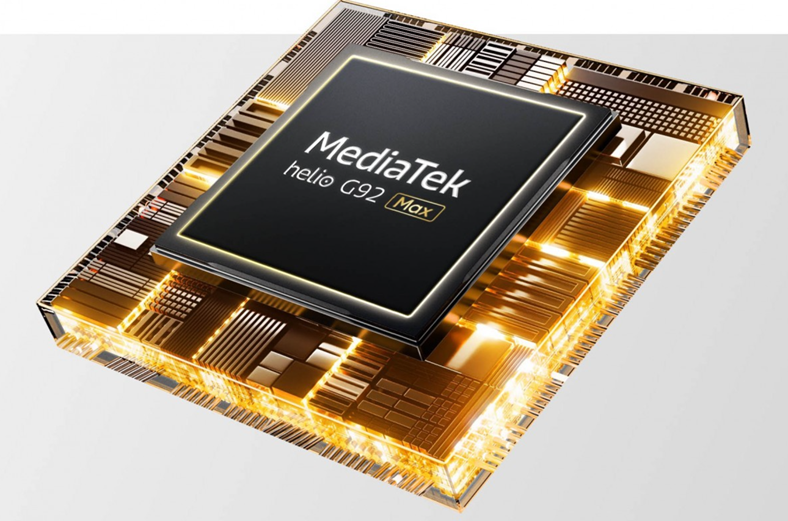
The phone features a 6.72-inch FHD+ IPS LCD display with a smooth 90Hz refresh rate and is the first to launch with MediaTek’s new Helio G92 Max chipset.

image
Realme C75 introduced with MediaTek’s new Helio G92 Max chipset. (Image credit – Realme)

The Helio G92 Max is a 4G-only processor that is believed to be a revamped version of the Helio G91 with slight enhancements. Other notable specs include a 50MP main camera, an 8MP front-facing camera and IP69 water plus dust resistance.

image
Realme C75 introduced with IP69 rating. (Image credit – Realme)

It appears Realme has designed the C75 with durability in mind.

The phone has been developed with a shockproof body design along with an impact-absorbing structure and ArmorShell Tempered glass for screen protection.

The device also boasts a MIL-STD-810H military-grade shock resistance rating, making it a robust choice for users who prioritise durability.

As for the software of the phone, the C75 runs Realme UI 5.0 based on Android 14.

image
Realme C75 comes with a 6000mAh battery capacity. (Image credit – Realme)
image
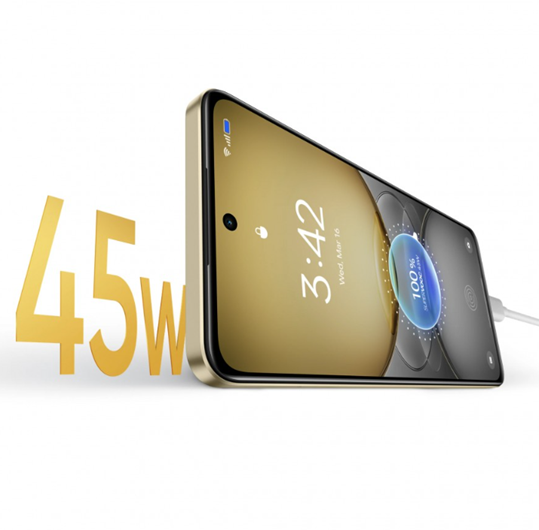
Realme C75 supports 45W wired charging. (Image credit – Realme)

The phone is powered by a 6,000mAh battery that supports 45W wired charging. It also doubles as a portable power bank allowing users to reverse charge other devices via its USB-C port.

The C75 is expected to roll out in more markets soon.

Apologies for the misunderstanding. Here’s the realme C75 specifications in the exact format you requested:

realme C75 specifications

realme C75 specifications

6.72-inch (2400 x 1080 pixels) FHD+ IPS LCD screen with 90Hz refresh rate, 180Hz touch sampling rate, up to 690 nits peak brightness

Octa Core MediaTek Helio G92 Max 12nm processor (Dual 2GHz Cortex-A75 + Hexa 2GHz 6x Cortex-A55 CPUs) with ARM Mali-G52 2EEMC2 GPU

8GB RAM with 128GB / 256GB / 512GB (eMMC 5.1) storage, expandable memory up to 1TB with microSD

Dual SIM (nano + nano + microSD)

Android 14 with realme UI 5.0

50MP rear camera, secondary sensor, LED flash

8MP front camera

Side-mounted Fingerprint sensor

Ultra linear bottom-ported speaker

Dimensions: 165.69 x 76.22 x 7.99mm; Weight: 196g

Dual 4G VoLTE, Wi-Fi 802.11 ac (2.4GHz + 5GHz), Bluetooth 5.1, GPS + GLONASS, USB Type-C

6000mAh battery with 45W SuperVOOC fast charging

WhatsApp Image 2024-11-27 at 12.30.40 PM
WhatsApp Image 2024-11-27 at 12.30.13 PM
WhatsApp Image 2024-11-27 at 12.31.15 PM
WhatsApp Image 2024-11-27 at 12.30.40 PM
WhatsApp Image 2024-11-27 at 12.31.16 PM
WhatsApp Image 2024-11-27 at 12.30.40 PM WhatsApp Image 2024-11-27 at 12.30.13 PM WhatsApp Image 2024-11-27 at 12.31.15 PM WhatsApp Image 2024-11-27 at 12.30.40 PM WhatsApp Image 2024-11-27 at 12.31.16 PM

FAQs

Q1. What is the starting price of the Realme C75 in Vietnam?

Answer. The Realme C75 starts at 5,690,000 Vietnamese Dongs (approximately $223 or ₹18,900).

Q2. What are the key display and chipset features of the Realme C75?

Answer. The phone features a 6.72-inch FHD+ IPS LCD display with a 90Hz refresh rate and is powered by MediaTek’s Helio G92 Max chipset.

Q3. What are the main camera specifications of the Realme C75?

Answer. The Realme C75 includes a 50MP main camera and an 8MP front-facing camera.

Q4. What special design and durability features does the Realme C75 have?

Answer. The phone has a shockproof body design with ArmorShell Tempered glass, MIL-STD-810H military-grade shock resistance and IP69 water plus dust resistance.

Q5. What is the battery capacity and charging capability of the Realme C75?

Answer. The Realme C75 is powered by a 6,000mAh battery that supports 45W wired charging and can also reverse charge other devices via its USB-C port.

Xiaomi Rolls Out HyperOS 2 Based on Android 15 To Xiaomi 14

0

Highlights

  • Xiaomi has begun rolling out HyperOS 2 based on Android 15 to Xiaomi 14.
  • It features HyperCore for enhanced performance and HyperConnect for seamless data transfer.
  • The OS update includes end-to-end encryption, a Trusted Execution Environment, dynamic wallpapers, a 3D weather system and AI-powered tools for improved productivity.
image
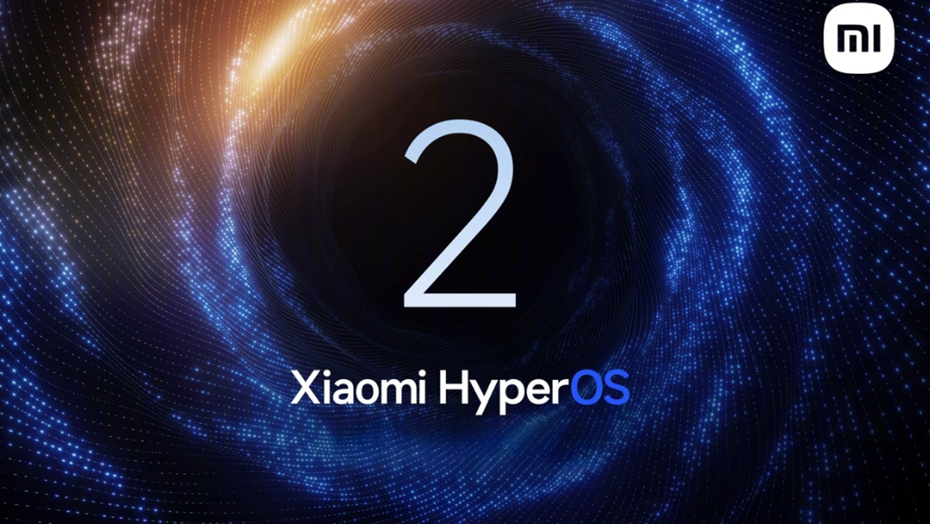
Xiaomi Starts Rolling Out HyperOS 2 Based on Android 15. (Image credit – Xiaomi)

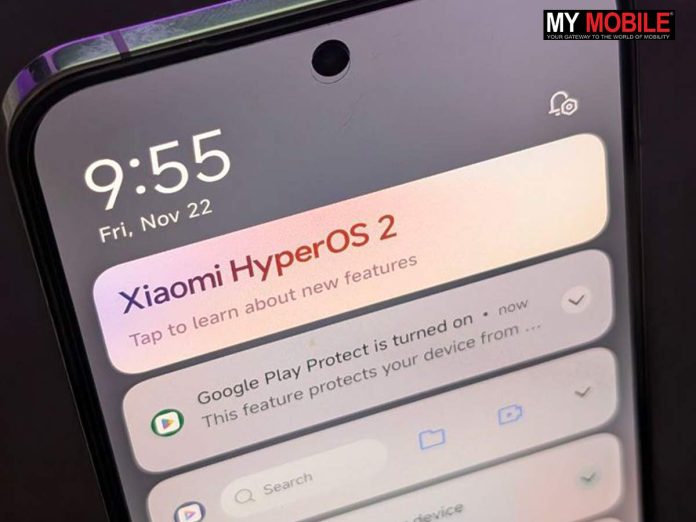
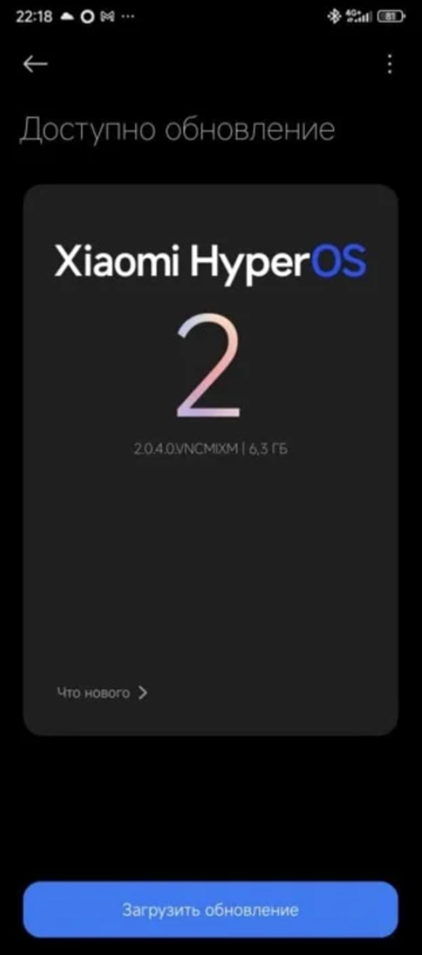
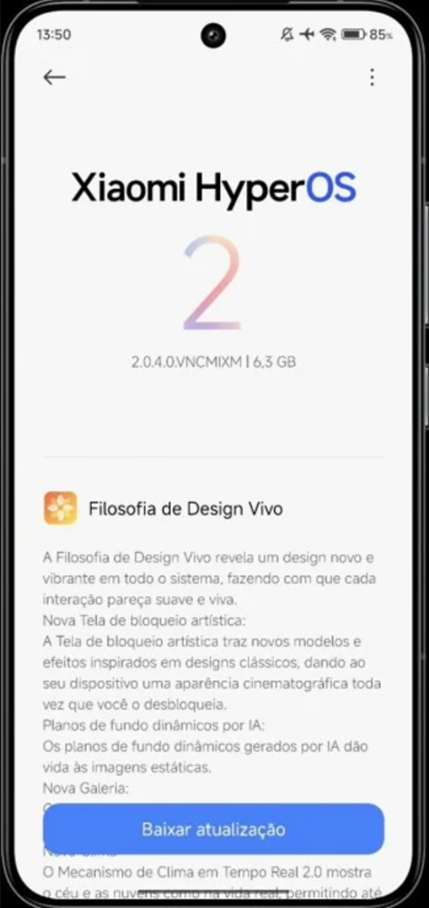
Xiaomi has officially started rolling out its latest operating system HyperOS 2 based on Android 15 to Xiaomi 14. The OS update version number OS2.0.4.0.VNCMIXM is sized at 6.3 GB and is now available for international users of the flagship device. Here’s everything you need to know about the new OS update.

HyperOS 2 Based on Android 15

The new HyperOS 2 runs on HyperCore, Xiaomi’s proprietary kernel designed to boost performance, reduce CPU idle time and enhance graphics capabilities. The standout feature in the system is HyperConnect, which enables seamless data and app transfers between Xiaomi devices and even supports file sharing with Apple products in China.

image
Xiaomi starts the rollout of HyperOS 2 with Xiaomi 14. (Screenshot credit – Gizmochina)

Privacy and security are also key focuses of HyperOS 2.

The new OS update includes end-to-end encryption for secure communication and a Trusted Execution Environment (TEE) to safeguard sensitive data. Users can also expect improved control over their data through Xiaomi’s Xiao Ai assistant.

The HyperOS 2 update introduces offers several exciting features including a redesigned interface that includes dynamic wallpapers and a customisable desktop layout. It also adds a 3D weather system offering more detailed and visually appealing forecasts.

image
HyperOS 2’s version number is OS2.0.4.0.VNCMIXM and it is 6.3 GB in size. (Screenshot credit – Gizmochina)

Moreover, the update incorporates AI-powered tools such as writing and translation assistants, voice-to-text transcription, and real-time translation, enhancing productivity and accessibility.

For those wanting to explore more of HyperOS 2’s features, Xiaomi has shared additional resources online.

Here’s a quick recap of everything new the OS update will be offering –

  • UI changes – Redesigned multitasking, new layout of desktop, new animations for smoother and easier use.
  • AI tools – Advanced AI capabilities with real-time translations, cinematic lock screens and an improved AI camera for better photography.
  • Performance improvements – Enhanced memory management and battery optimisation.
  • Customisation options – New layouts of desktop, widgets and folder designs.

According to the reports, the Xiaomi 13 and Redmi K60 series will most likely be the next phones to receive the new OS update.

New Xiaomi Mid-Ranger With 7000mAh Battery

Xiaomi HyperOS 2 Global version is finally rolling out

In completely separate news, it is being reported that Xiaomi is working on a mid-range smartphone with a 7000mAh battery.

While the exact model has not been confirmed, it is rumoured to belong to the Redmi lineup possibly as the Redmi Turbo 4 Pro or the Redmi K90.

This device will be reportedly powered by the Qualcomm Snapdragon 8s Elite (SM8735) chipset and will support 90W wired fast charging, though it might not include wireless charging.

Xiaomi is also scheduled to unveil its K80 series in China. The lineup includes two models – the K80 and K80 Pro.

Both models reportedly feature a 6500mAh battery with 120W fast charging, a premium 2K AMOLED display, a peak brightness of 1800 nits and TÜV Rheinland eye protection certification.

FAQs

Q1. What is the latest operating system update that Xiaomi is rolling out to Xiaomi 14?

Answer. Xiaomi is rolling out HyperOS 2 based on Android 15, with the update version number OS2.0.4.0.VNCMIXM, sized at 6.3 GB, is now available for international users of Xiaomi 14.

Q2. What are some key features of the HyperOS 2 update?

Answer. Key features include HyperCore for enhanced performance, HyperConnect for seamless data transfer, end-to-end encryption, Trusted Execution Environment, dynamic wallpapers, 3D weather system, and AI-powered tools like writing and translation assistants.

Q3. Which Xiaomi devices are expected to receive the HyperOS 2 update next?

Answer. The Xiaomi 13 and Redmi K60 series are most likely the next phones to receive the new HyperOS 2 update.

Read More: Xiaomi CEO Lei Jun Confirms Global Rollout Schedule for HyperOS 2, Shares Eligible Devices

Read More: Xiaomi 15 Series and HyperOS 2.0 Official Launch Date Announced

More Leaked Images Share Early Look Of Samsung Galaxy S25 Ultra and One UI 7 Features

0

Highlights

  • New leaked images of the Samsung Galaxy S25 Ultra surface online.
  • Images reveal a rounded corner design, USB-C port, SIM slot, speaker grille and S Pen slot.
  • The images also show thin and uniform bezels.
  • Leaked screenshots of One UI 7 reveal features including a split notification panel, updated app icons and a new battery indicator.
  • One UI 7 will launch alongside the Galaxy S25 series in early 2025.

Leaks and rumours about the upcoming Samsung Galaxy S25 Ultra are coming out more frequently as we approach the smartphone launch.

Just hours after a video was leaked on Reddit showing the Samsung Galaxy S25 Ultra, a new report has not revealed some exclusive images of what is being claimed as the Galaxy S25 Ultra.

Here’s everything you need to know.

Galaxy S25 Ultra Leaked Images

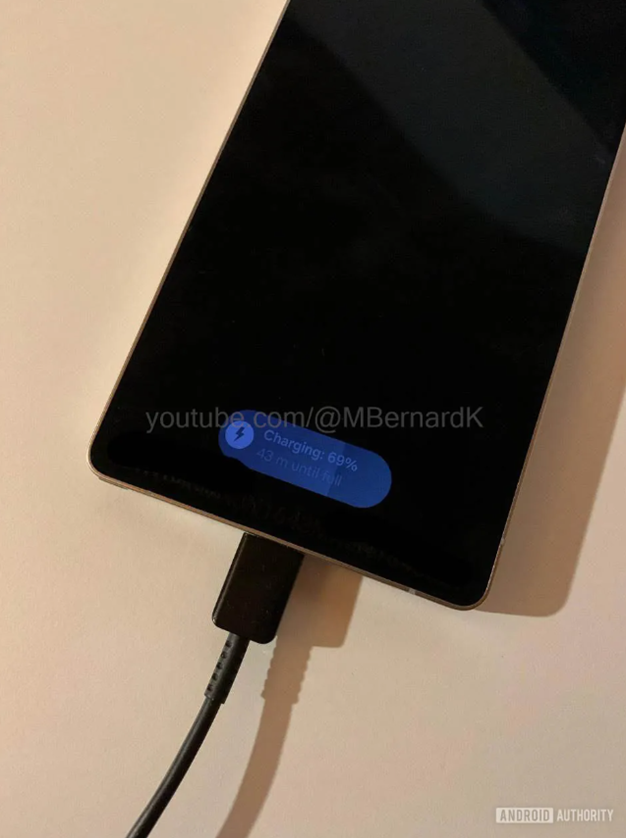
The recently leaked video clip was intriguing as it didn’t reveal the entire phone. However, now Android Authority has managed to obtain exclusive images of the same device that offer a closer look.

image
Samsung Galaxy S25 Ultra leaked image. (Image credit – u/GamingMK/Android Authority)
image
Samsung Galaxy S25 Ultra leaked image. (Image credit – u/GamingMK/Android Authority)
image
Samsung Galaxy S25 Ultra leaked image. (Image credit – u/GamingMK/Android Authority)

According to Android Authority, the leaked images were shared by Reddit user u/GamingMK, who got them from the original leaker. Unfortunately, the original leaker has since deleted their Reddit account.

This means details about the phone’s origins remain unclear even though the recent leaked images match the earlier video making it highly likely they’re of the same device.

Galaxy S25 Ultra – Design Details Revealed

The earlier leaked video didn’t show the phone’s bottom.

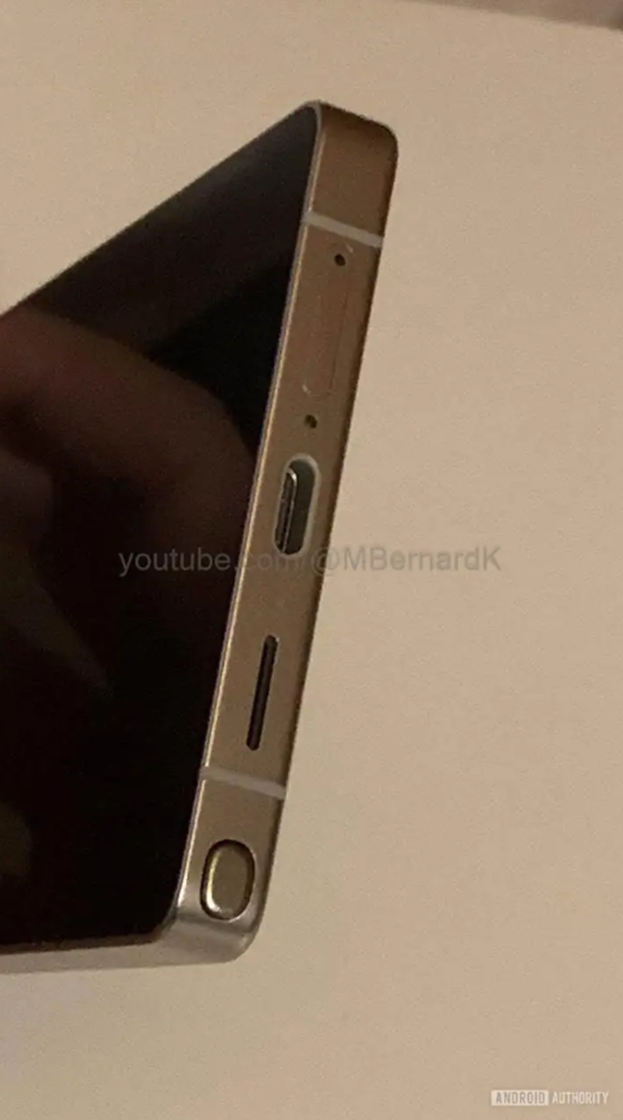
However, these new images reveal it in detail. We can see from the image that there is a USB-C port, a SIM slot, a speaker grille and an S Pen slot.

The S Pen slot remains on the left side just like on the Galaxy S24 Ultra.

However, this contradicts some previous rumours that suggested that Samsung might move it to the other side. Even early renders of the S25 Ultra had left the S Pen’s position unclear.

One of the photos also shows the phone plugged in and charging along with a new charging notification, which is reportedly a feature of Samsung’s upcoming One UI 7.

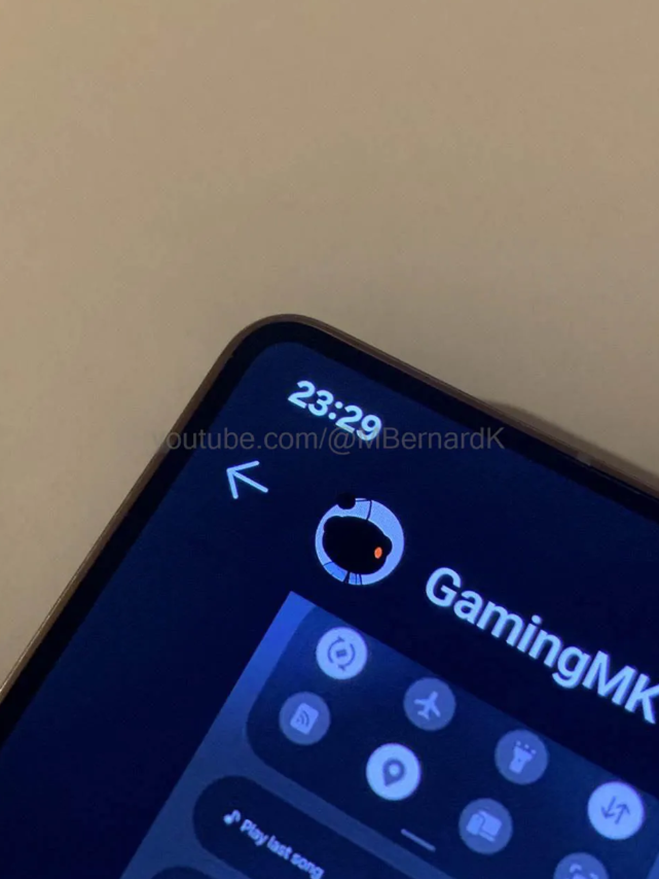
Another image offers a close-up of the phone’s corner bezel revealing thin and uniform bezels that will presumably give the phone a premium look.

The leaked image includes proof of ownership by u/GamingMK, with their Reddit profile visible on the device.

One UI 7 – Screenshots Leaked

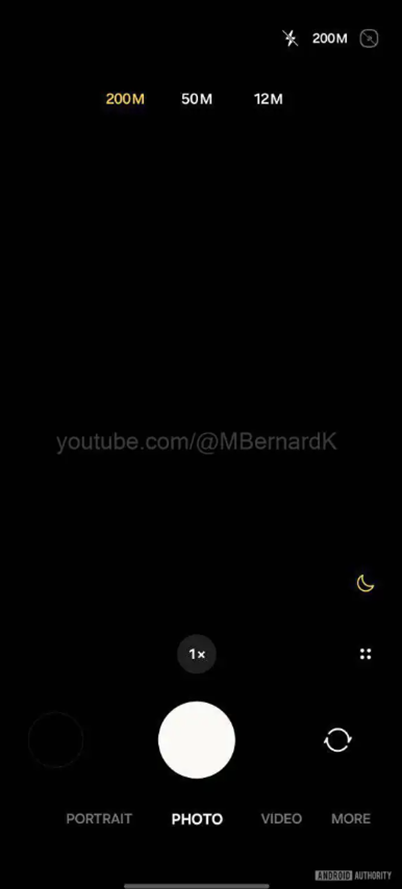
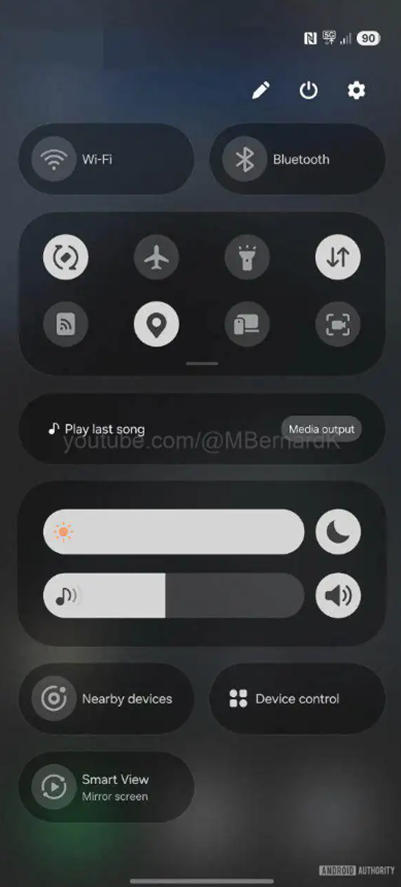
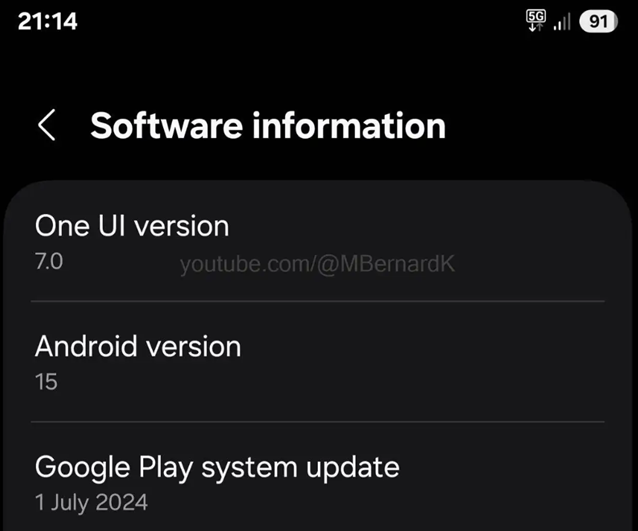
Apart from the leaked device images, the Android Authority report has shared screenshots of One UI 7 – Samsung’s latest software based on Android 15.

image
One UI 7 – Screenshots Leaked (Credit – Android Authority)
image
One UI 7 – Screenshots Leaked (Credit – Android Authority)
image
One UI 7 – Screenshots Leaked (Credit – Android Authority)
image
One UI 7 – Screenshots Leaked (Credit – Android Authority)
image
One UI 7 – Screenshots Leaked (Credit – Android Authority)

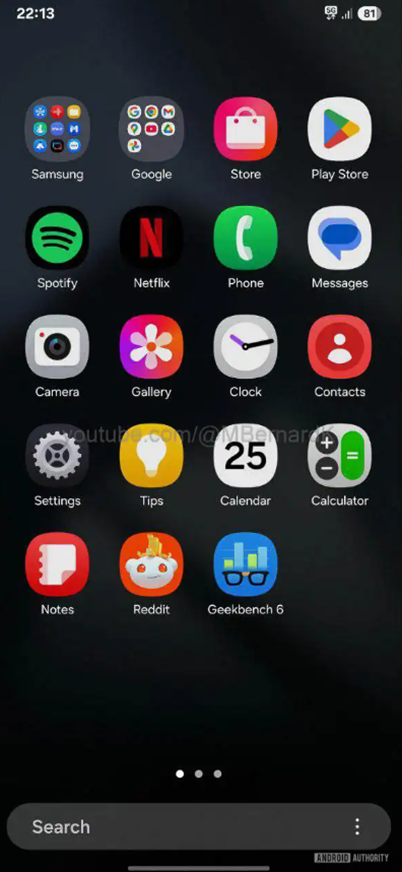
While these screenshots don’t introduce anything groundbreaking, they confirm a few updates including a Split notification panel where notifications appear on one side, while system controls are on another.

The screenshots also show updated app icons with subtle design tweaks in the app drawer and a new battery indicator icon in the top-right corner.

Samsung has already confirmed that One UI 7 will launch alongside the Galaxy S25 series, which is expected to launch in early 2025. A public beta testing phase for One UI 7 is likely to begin before the year ends.

FAQs

Q1. What design details are revealed from the Samsung Galaxy S25 Ultra leaked images?

Answer. The images reveal a rounded corner design, a USB-C port, a SIM slot, a speaker grille and an S Pen slot, along with thin and uniform bezels.

Q2. What new feature is shown in the leaked images related to One UI 7?

Answer. The images confirm new One UI 7 features, including a Split notification panel where notifications appear on one side, while system controls are on another.

Q3. Who shared the leaked images of the Samsung Galaxy S25 Ultra?

Answer. The leaked images were shared by Reddit user u/GamingMK, who obtained them from the original leaker, whose account has since been deleted.

Q4. When is One UI 7 expected to be launched?

Answer. One UI 7 will launch alongside the Galaxy S25 series in early 2025, with a public beta testing phase likely to begin before the end of the year.

Read More: Samsung Galaxy S25 Ultra Hands-On Video Leak Shows Rounded Design and Reveals New Features

Read More: New Leak Reveals Samsung Galaxy S25 Ultra Colours

Taking Cue From Google Tensor, Xiaomi to Develop Its In-House Mobile Chipset by 2025

0

Highlights

  • Report says Xiaomi is developing its own mobile chipsets for smartphones in 2025.
  • Mass production will reportedly start in 2025.
  • The move will contribute to Xiaomi’s ambitions for electric vehicles.
image
Xiaomi developing its own mobile chipset. (Photo by Alexandre Debiève on Unsplash)

More and more companies are realising the importance of having in-house hardware production capabilities and the trend seems to be catching up.

After Google and Apple, we now getting reports of another popular brand working to develop its own chips. Here’s what the report says.

Xiaomi Developing Its Own Chip

Xiaomi’s 3nm Custom Chip Arriving in 2025?

According to a recent report, Xiaomi is reportedly gearing up to develop its own mobile chipsets following Google’s lead with its Tensor chips for Pixel smartphones.

Most Android phones today run on chipsets from either Qualcomm or MediaTek. Qualcomm’s Snapdragon processors dominate the flagship segment, while MediaTek powers many mid-range and budget devices.

Samsung, on the other hand, uses its in-house Exynos chips and lower-end devices in some regions.

A notable exception has been Google’s Tensor chip, introduced with the Pixel 6 series in 2021. The Tensor lineup currently based on Samsung’s Exynos architecture is set to switch to TSMC for manufacturing in 2025 with plans for a fully custom design.

Now reports are hinting that Xiaomi appears to be on a similar path.

According to a report from Bloomberg, Xiaomi aims to launch smartphones in 2025 powered by its in-house chip. The company plans to begin mass production of these processors in the same year.

This will mark a significant move away from Xiaomi’s current reliance on Qualcomm and MediaTek.

The company’s entry into custom silicon could signal a new era of differentiation in the competitive Android market.

Xiaomi’s venture into custom silicon could signal a new era of differentiation in the competitive Android market.

The report states:

“Xiaomi Corp. is preparing a self-designed mobile processor for its upcoming smartphones in an effort to reduce its reliance on foreign suppliers Qualcomm Inc. and MediaTek Inc. The processor may help Xiaomi be more self-sufficient and stand out in an Android market led by Qualcomm customers. Mass production of the chip designed in-house is expected to begin in 2025.”

Xiaomi’s efforts in chip design may also contribute to its ambitions for electric vehicles.

It is still clear how the new Xiaomi chips will be different from Qualcomm’s Snapdragon processors since Xiaomi has a long-standing partnership with Qualcomm. For example, Xiaomi’s latest flagship lineup the Xiaomi 15 series was among the first to feature the new Snapdragon 8 Elite chipset.

FAQs

Q1. What is Xiaomi planning to develop by 2025?

Answer. Xiaomi is developing its own mobile chipsets and aims to launch smartphones powered by these chips in 2025.

Q2. When will Xiaomi begin mass production of its in-house processors?

Answer. Xiaomi plans to begin mass production of its in-house processors in 2025, marking a significant move away from its reliance on Qualcomm and MediaTek.

Q3. How could Xiaomi’s new chips impact the market?

Answer. Xiaomi’s development of custom silicon could signal a new era of differentiation in the competitive Android market and contribute to Xiaomi’s ambitions for electric vehicles.

Read More: Qualcomm’s Next-Gen Snapdragon Elite Chipset to Power Xiaomi 15 Series

Read More: Xiaomi Snapdragon 8 Gen 4 Launch

Samsung Galaxy S25 Ultra Hands-On Video Leak Shows Rounded Design and Reveals New Features

0

Highlights

  • A new video on Reddit shows a prototype of the Samsung Galaxy S25 Ultra.
  • The video reveals a new rounded corner design and a glossy metallic finish.
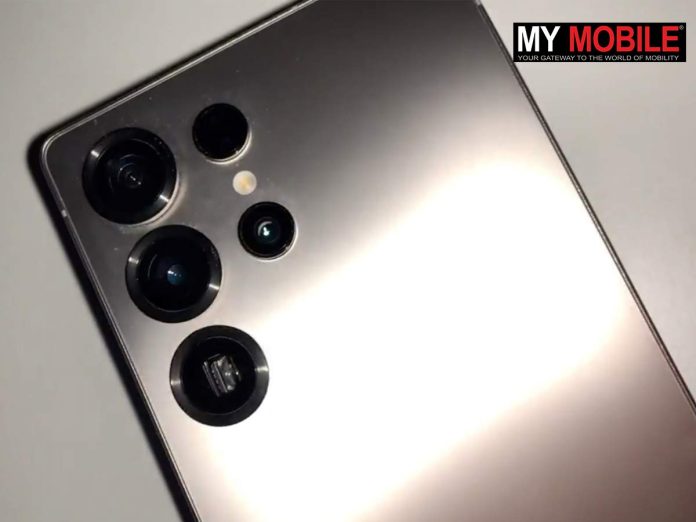
  • The device features Samsung’s signature camera setup but no camera rings around the lenses.
  • The Galaxy S25 Ultra will reportedly come in three special finishes: Titanium Blue/Black, Titanium Jade Green and Titanium Pink/Silver.

The highly anticipated launch of the Samsung Galaxy S25 Ultra is just a few months away now.

And as the time comes closer, we will have more details coming out from both official and unofficial sources. This update is about an unofficial source.

Last week, we had viral photos of a dummy unit of Galaxy S25 Ultra and now a new hands-on video has surfaced.

The video posted on Reddit shows what appears to be a working prototype of the phone.

Here’s everything you need to know.

image
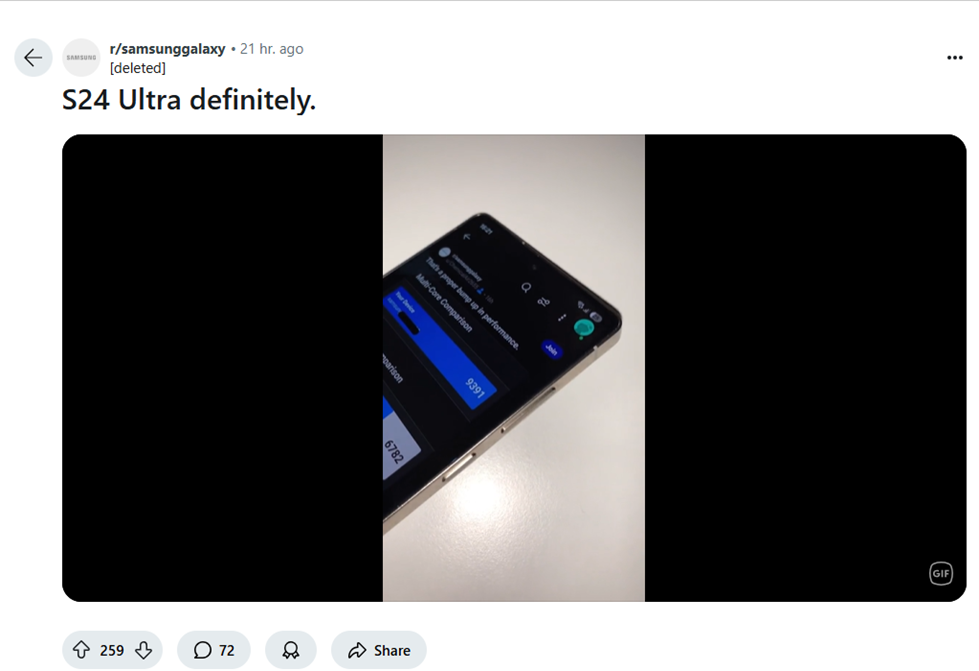
Reddit post shared a hands-on video of the upcoming Samsung Galaxy S25 Ultra.

Samsung Galaxy S25 Ultra Hands-On Video Leak

The hands-on video was shared on Reddit in a post titled “Galaxy S24 Ultra definitely.” The device shown in the clip shows the rumoured rounded corner design of the Galaxy S25 Ultra.

Famous tipster Ice Universe confirmed on X that the device in the video is indeed the Galaxy S25 Ultra.

Another reliable Samsung leaker, @chunvn8888, also supported the claim, stating the prototype is “Can confirm this is the real Galaxy S25 Ultra. Big oopsie for OP.”

The phone in the video features a glossy metallic finish with noticeably rounded corners.

This appears to be quite different from the sharp and pointy design of the current Galaxy S24 Ultra.

The change will complement the new One UI 7, which features more rounded design elements.

At the back, Samsung’s signature camera setup is visible. However, the rumoured camera rings around the lenses are missing. These camera rings were seen in previous leaks featuring dummy units of the Galaxy S25 Ultra. At that time, Ice Universe mentioned that the final design of the phone could differ significantly from those dummy units.

While the video offers a glimpse of the device, it doesn’t reveal much about the phone’s user interface or features.

Reports suggest that it’s likely another prototype and not the final version set to launch in January.

Phrases like “Multi-Core Comparison” and “proper bump up in performance” can be seen on the screen along with the number 9391, which aligns with earlier Geekbench listings for the device.

Samsung Galaxy S25 Ultra – Colour Options

According to earlier leaks by Ross Young, the Galaxy S25 Ultra will come in three special finishes.


The Samsung Galaxy S25 Ultra colours include –

  • Titanium Blue/Black
  • Titanium Jade Green
  • Titanium Pink/Silver

Apart from these, Technizo Concept also released some renders that showcased a striking orange colour.

In any case, we are expected to have more clarity as the launch timeline approaches.

FAQs

Q1. What design changes are seen in the leaked Samsung Galaxy S25 Ultra prototype?

Answer. The leaked prototype of the Samsung Galaxy S25 Ultra features a rounded corner design and a glossy metallic finish.

Q2. What are the special colour options for the Samsung Galaxy S25 Ultra?

Answer. According to earlier leaks, the Samsung Galaxy S25 Ultra will come in Titanium Blue/Black, Titanium Jade Green, Titanium Pink/Silver and possibly a striking orange colour.

Q3. What are the camera features of the Samsung Galaxy S25 Ultra prototype?

Answer. The device in the video has Samsung’s signature camera setup but the rumoured camera rings around the lenses are missing, which were seen in previous leaks featuring dummy units.

Read More: New leak reveals Samsung Galaxy S25 Ultra colours

Read More: Samsung Galaxy S25 Ultra case reveal: Rounded corners, improved ergonomics

iPhone 17 Air Will Be Thinner Than We Thought, Prototypes Between 5 and 6mm Thick: Report

0

Highlights

  • Reports reveal iPhone 17 Air prototypes are between 5 and 6mm thick.
  • To achieve this thinnest design, the iPhone 17 Air will have only one earpiece speaker, a single rear camera and Apple’s in-house 5G modem.
  • The iPhone 17 Air is in early production trials at Foxconn.
image
The current iPhone 16 standard model is 7.80mm thick. (Image credit – Apple)

It was revealed long ago that Apple is working on some bold new designs with the iPhone 17 Air and is aiming to create the thinnest iPhone we have seen yet. Now, the latest report suggests the bold design choices are actually bolder than we earlier thought.

According to a report from The Information, prototypes for the iPhone 17 Air are between 5 and 6 millimetres thick, a massive reduction compared to the 7.8mm thickness of the iPhone 16.

However, this ultra-thin design is creating significant challenges for Apple’s engineers.

The report highlights some compromises Apple is making to achieve this level of thinness. It notes that Apple engineers are “finding it hard to fit the battery and thermal materials into the device.”

To save space, the iPhone 17 Air will feature only one earpiece speaker. The report explains, “Apple is compromising on other aspects of the slim iPhone’s design to ensure its thinness. For instance, the thin iPhone will only have a single speaker in its earpiece because there is no room for a second speaker at the bottom, which is standard in other models, one person said.”

The iPhone 17 Air will have just one rear camera housed in a “large, centred camera bump.”

If Apple succeeds, the iPhone 17 Air would dethrone the iPhone 6 as the company’s thinnest phone, which measured 6.9mm. It would also rival Apple’s thinnest devices overall, such as the 11-inch iPad Pro (5.4mm) and the 13-inch iPad Pro (5.1mm).

iPhone 17 Air: The thinnest iPhone yet.

The iPhone 17 Air will be “among the first iPhones” to feature Apple’s in-house 5G modem.

However, the report highlights some limitations, stating: “However, Apple’s in-house modem doesn’t perform as well as Qualcomm’s. Its peak speeds are lower and its ability to stay connected to cellular networks is slightly less reliable, the person said. And Apple’s in-house modem lacks support for millimetre wave, a technology introduced in the iPhone 12 that allows for higher cellular speeds in certain areas.”

The ultra-thin design also means engineers haven’t yet figured out how to include a physical SIM card tray.

While Apple has phased out SIM trays in many regions although China still requires them.

The report quotes the Head of Chinese technology, telecom and software research at Jefferies, Edison Lee: “The Chinese telcos don’t support eSIM for mobile phones owing to the risk that this system would not allow the telcos to be able to verify the personal identity of each user. China is enforcing a real-name registration system for all mobile users, and thus the telcos don’t generally support eSIM except for Apple Watch and iPad.”

The iPhone 17 Air is currently in early production trials at Foxconn and recently had its advanced from proto-1 to proto-2 status.

FAQs

Q1. How thin will the iPhone 17 Air be compared to previous models?

Answer. Prototypes for the iPhone 17 Air are between 5 and 6mm thick, which is a massive reduction compared to the 7.8mm thickness of the iPhone 16.

Q2. What compromises is Apple making to achieve the thin design of the iPhone 17 Air?

Answer. To save space, the iPhone 17 Air will feature only one earpiece speaker and a single rear camera housed in a large, centred camera bump.

Q3. What challenges are Apple engineers facing with the iPhone 17 Air’s design?

Answer. Apple engineers are finding it hard to fit the battery and thermal materials into the device due to the ultra-thin design.

Read More: iPhone 17 Air Won’t Get 5X Optical Zoom: LG Innotech Upgrades Production Unit for iPhone 17 Pro Cameras

Read More: iPhone 17 Air Rumored to Be Apple’s Thinnest iPhone at Only 6mm Thickness

HMD goes Bold – launches HMD Fusion with Two Smart Outfits at a special launch price of 15,999 on Amazon

0

Highlights

  • HMD introduces the game-changing HMD Fusion, offering a customizable experience with innovative “Smart Outfits,” advanced camera capabilities, and Gen2 reparability for user-friendly maintenance.
  • Powered with 108MP dual main camera and 50MP selfie camera, HMD Fusion equips users with an immersive photography experience.
  • HMD Fusion is much more than a smartphone, as it boasts Gen 2 reparability design, 8+256GB memory variant and Snapdragon® 4 Gen 2 processor.

Human Mobile Devices (HMD) introduced the HMD Fusion, a sleek smartphone that combines raw industrial chic with cutting-edge features.

Equipped with a powerful 108MP rear camera and a 50MP selfie camera, but what truly sets this phone apart is its versatility: the device can transform its identity and functionality with attachable Smart Outfits— These include Casual Outfit, Flashy Outfit, and Gaming Outfit aligning with the numerous utility and aesthetic factor for the users.

Gaming outfit

Introducing: HMD Fusion Flashy and HMD Fusion Gaming Outfits.

HMD Fusion brings a symbiotic bond between smartphone and Outfit using six specialised smart pins, these Outfits—that look like phone cases instantly transform both the hardware and software, adapting the smartphone to meet your needs.

Key Highlights of HMD Fusion:

Flashy outfit back
  1. Captivating Photography: The HMD Fusion brings photography to life with a 108MP dual main camera and an impressive 50MP front-facing camera. Advanced features like Night Mode 3.0, gesture-based selfie feature, Flash Shot 2.0 with tracking focus, and tone control allow for lifelike portraits and exceptional low-light images.
  2. Smart Outfits for Customization: Tailor the HMD Fusion to any situation with versatile outfits. The Fusion “Gaming Outfit” offers enhanced gameplay controls, while the “Flashy Outfit” provides a foldable RGB LED flash ring for perfect selfies, offering 16 Million colour combination options.
  3. Right to Repair – Gen2: The HMD Fusion boasts HMD’s second-generation repairability design, allowing users to easily replace the display, battery, or charging port using only a screwdriver. This feature reduces e-waste and extends the lifespan of the device.
  4. Smooth Performance: Equipped with a powerful Snapdragon® 4 Gen 2 processor, users will experience impressive multitasking capabilities thanks to the device’s 8GB RAM, expandable storage up to 256GB, and HMD’s virtual memory extension technology.
  5. Long-Lasting Battery Life: HMD Fusion’s 5000mAh battery supports over 800 cycles and is comes with an in-box 33W fast charger.
  6. Software & Security Updates: HMD Fusion will offer 2 Years of OS updates & three years of Security updates to keep your devices updated & secure.
  7. Vibrant Display: The 6.56” HD+ HID display with a 90Hz refresh rate ensures an immersive visual experience, perfect for streaming, gaming, and more.

To further enhance the HMD Gaming Outfit experience, HMD has ventured into an exclusive partnership with Digital Turbine and Aptoide in India.

This collaboration brings the Aptoide game store to HMD Fusion, offering users access to the world’s leading mobile games.

Commenting on the new launch, Ravi Kunwar, CEO & VP, India & APAC, HMD, said: “The HMD Fusion is designed for consumers who seek high performance, a seamless experience, and sustainable innovation in one device. We call it ‘much more than just a smartphone’ because it effortlessly adapts to your lifestyle. Whether you’re a gamer or a content creator, the Fusion evolves with you—transforming with a simple change of its ‘outfits’ to match your needs and passions. At HMD, we believe in, humanize technology, and we will continue to do so.”

In addition, the Aptoide store will have a dedicated section for “Play with your HMD Gaming outfit” for users to download the controller-specific games. With Digital Turbine’s SingleTap™ technology, HMD users can enjoy a seamless game discovery experience and frictionless installation.

DT and Aptoide have been collaborating since 2022, leveraging each company’s technology to build new and innovative distribution products for mobile operators, OEM, and app developer clients.

Paired with the HMD Fusion Gaming Outfit, featuring physical buttons and joysticks for precise gameplay, this partnership transforms the device into a haven for gaming enthusiasts.

The HMD Fusion runs on Android 14, ensuring that users enjoy the latest features and security updates from Google.

Priced at INR 17999 the HMD Fusion is available in Tech block concept and offers HMD Casual outfit, HMD Flashy Outfit, and HMD Gaming Outfit worth INR 5999 as complimentary.

While the regular price is INR 17,999, the special limited period launch price is INR 15,999 (All Banks) on Amazon only. The sale starts on 29th Nov at 12.01 pm. Also available on HMD.com.

HMD Fusion specifications

Hmd Fushion
  • 6.56-inch (720 x 1612 pixels) HD+ LCD screen with 90Hz refresh rate, up to 600 nits peak brightness
  • Octa Core Snapdragon 4 Gen 2 4nm Mobile Platform (2.2 GHz x 2 A78-based +2GHz x 6 A55-based Kryo CPUs) with Adreno 613 GPU
  • 8GB LPDDR4x RAM, 256GB (UFS 2.2) storage, expandable memory up to 1TB with microSD
  • Dual SIM
  • Android 14, 2 OS updates, 3 years of security updates.
  • 108 MP rear camera, EIS, 2MP portrait camera with f/2.4 aperture, LED flash
  • 50MP front-facing camera
  • Side-mounted fingerprint sensor
  • Dimensions: 164.15×75.5×8.32g; Weight: 202.5g
  • Dust and water resistant (IP54)
  • 5G SA/NSA, Dual 4G VoLTE, Wi-Fi 802.11 ac (2.4GHz + 5GHz), Bluetooth 5.1, GPS/ GLONASS/ Beidou, USB Type-C
  • 5000mAh battery with 33W fast charging (wall charger not included)
WhatsApp Image 2024-11-26 at 5.11.13 PM
WhatsApp Image 2024-11-26 at 5.11.14 PM
WhatsApp Image 2024-11-26 at 5.11.12 PM
WhatsApp Image 2024-11-26 at 5.11.13 PM WhatsApp Image 2024-11-26 at 5.11.14 PM WhatsApp Image 2024-11-26 at 5.11.12 PM

Faq’s

Q1. What is the price of HMD Fusion?

Answer: The HMD Fusion is priced at INR 17,999, with an introductory offer of INR 15,999.

Q2. What are the launch offers on HMD Fusion?

Answer: Buyers will also receive complimentary Smart Outfits worth INR 5,999.

Q3. What is the availability of HMD Fusion?

Answer: The phone will be available on Amazon and HMD’s official website starting November 29, 12:01 PM. The device is also available in the European market priced at 249 Euros.

Q4. Is HMD Fusion worth buying?

Answer: The phone supports HMD’s Right to Repair – Gen2, making it easier for users to replace components like the battery, display, or charging port.
HMD has partnered with Digital Turbine and Aptoide to enhance mobile gaming.
The standout feature of the HMD Fusion is its compatibility with Smart Outfits.
All these features make the phone a good purchase.

Read More: HMD Crest 5G and Crest Max 5G Go on Sale in India: Price, Availability, Features, Reasons to Buy the Phone

Read More: HMD Crest and Crest Max Launched in India Featuring High-Performance 5G and Advanced Camera Capabilities

Read More: HMD New Direction – Human Mobile Devices at MWC

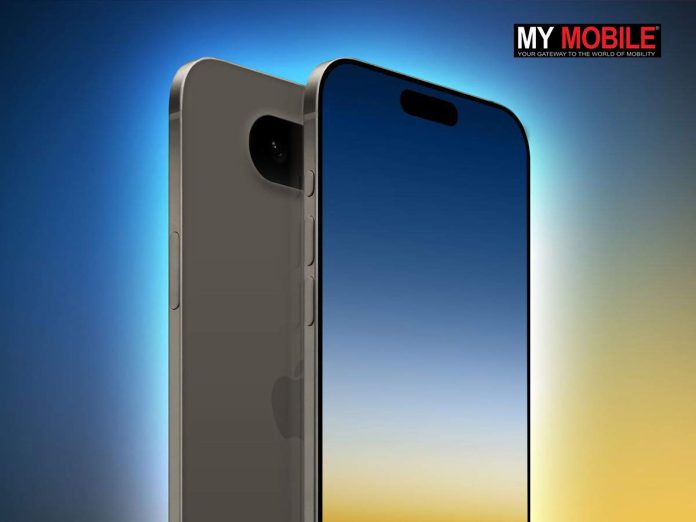
Apple’s iPhone 17 Pro To Use Aluminium Instead of Titanium As Its Big Design Changes

0

Highlights

  • Apple’s iPhone 17 lineup including the Pro and Pro Max models will reportedly switch to aluminum frames.
  • The iPhone 17 Pro and Pro Max will feature larger rectangular aluminium camera bumps.
image
The latest report reveals new design details about the iPhone 17 lineup. (Image credit – Apple)

It appears Apple has some really interesting things planned for its upcoming iPhone 17 lineup.

First, there were the reports of the thinnest iPhones and now more recently we are getting updates on the other model iPhone 17 Pro.

Here’s a quick recap of the most recent report on iPhone 17 that has surfaced online.

According to a recent report in The Information, Apple is gearing up for some major design updates with the iPhone 17 series set to launch in 2025.

While much attention has been on the rumoured iPhone 17 Air, new reports suggest significant changes across the entire lineup particularly for the iPhone 17 Pro and Pro Max models.

Wayne Ma and Qianer Liu revealed in The Information report: “Apple’s other iPhone models will also undergo significant design changes next year. For instance, they’ll all switch to aluminium frames from stainless steel and titanium, one of the people said. The back of the Pro and Pro Max models will feature a new part-aluminum, part-glass design. The top of the back will comprise a larger rectangular camera bump made of aluminium rather than traditional 3D glass. The bottom half will remain glass to accommodate wireless charging, two people said.”

So, the major updates expected in the iPhone 17 Lineup are –

  • Aluminum Frames for All Models: The entire iPhone 17 lineup will switch to aluminium frames, although Apple hasn’t explained the reasoning behind this move.
  • New Camera Design for Pro Models: The Pro and Pro Max will feature larger, rectangular camera bumps made of aluminium, signalling a focus on enhanced camera features.
  • Impact on Wireless Charging: Shifting away from an all-glass back could affect wireless charging capabilities.

This marks a notable departure from Apple’s recent push towards titanium frames in its Pro models, which had been marketed as a premium feature.

9to5Mac in its latest report raised questions about Apple’s strategy of moving to aluminium.

Is Apple planning a complete shift in materials to streamline production and manage costs? There could also be a possibility that Apple might be reserving titanium for future high-end models.

In any case, the Pro models’ larger aluminium camera bumps hint at a stronger focus on photography and videography.

FAQS

Q1. What material will the iPhone 17 lineup use for its frames?

Answer. The entire iPhone 17 lineup will switch to aluminium frames, moving away from stainless steel and titanium.

Q2. What design change is expected for the iPhone 17 Pro models?

Answer. The iPhone 17 Pro and Pro Max will feature larger, rectangular aluminium camera bumps, focusing on enhanced camera features.

Q3. How might the new design affect wireless charging for the iPhone 17 Pro models?

Answer. The part-aluminum, part-glass design could impact wireless charging with the bottom half remaining glass to accommodate this feature.

Read More: iPhone 17 Pro Max to Feature Smaller Dynamic Island

Read More: Apple to Introduce New Teal Titanium Colour for iPhone 17 Pro

Read More: Rumour: iPhone 17 Pro May Combine Action and Volume Buttons

Meta’s Threads Testing Default Feed For Users To Choose Feed Preference

0

Highlights

  • Meta’s Threads is testing a feature that allows users to choose their default feed.
  • There will be three options (For You, Following, or custom) when opening the app.
  • The feature is currently in testing mode for limited users.
image
Threads users will soon be able to set a default feed. (Photo by Dave Adamson on Unsplash)
Meta’s Threads is doing everything it can to ensure users feel more in control of their experience on the app.

After the recent updates and feature testing reports, we are now getting an update on another feature that will make the app more customisable. Here’s a recent update.

It appears Threads is finally letting users choose which feed they want to see first when opening the app.

Meta CEO Mark Zuckerberg announced the feature in a post on the App revealing that users can select from the For You, Following, or any custom feeds they’ve created. According to Zuckerberg, Threads is currently “testing” the feature and aims to make different feeds “more visible” in the app.


View on Threads


How to Set Your Threads Default Feed?

As confirmed by Zuckerberg, the feature is currently in testing mode, which means it is not available to a larger group. However, if you’re part of the test group, here’s how you can simply set your preferred default feed –

  • Open the Threads app.
  • Tap and hold any feed name at the top.
  • Select “Edit feeds.”
  • Drag your favourite feed to the top spot.
  • The feed you place first will automatically appear when you open the app.

This change comes after over a year of waiting for users to gain more control over their Threads experience.

The move addresses common frustrations, especially among those who’ve asked for the Following feed to be a default option.

Threads has been ramping up improvements in response to growing competition from Bluesky, which recently surpassed 20 million users.

Some of the latest updates include a revamped “For You” feed that prioritizes posts from accounts you follow instead of suggested content, a more useful search feature and support for landscape videos.

Last week, the platform rolled out changes to the ‘For You’ algorithm, surfacing more content from accounts you follow.

While many tech experts welcomed the change, there was a section of users who expressed frustration while demanding more customisation options such as setting the Following feed as default.

Meta seems to be focused on keeping its Threads audience engaged by listening to feedback and offering more personalisation as more and more users increasingly explore alternatives like Bluesky.

The new features mentioned here are currently rolling out to select users, a Meta spokesperson informed TechCrunch.

FAQs

Q1. What new feature is Meta’s Threads testing for user customisation?

Answer. Meta’s Threads is testing a feature allowing users to choose their default feed (For You, Following, or custom) when opening the app.

Q2. How can users set their preferred default feed in Threads?

Answer. To set your preferred default feed, open the Threads app, tap and hold any feed name at the top, select “Edit feeds,” and drag your favourite feed to the top spot.

Q3. What recent updates have been made to the For You feed in Threads?

Answer. The For You feed now prioritises posts from accounts you follow instead of suggested content, with additional updates such as a more useful search feature and support for landscape videos.

Read More: Threads Tests Advanced Search Features, Rolls Out Landscape Video Mode on App

Read More: Meta’s Threads Taking Cues from Bluesky to Start Prioritising Accounts You Follow

Read More: Threads Roll Out Custom Feeds Globally for Personalised Experience