Instagram’s video editing app Edits’ release is postponed to March 31, 2025.
Edits will offer comprehensive creative tools for video enthusiasts.
It includes cropping, combining clips, adding sound, creating subtitles and more.
The launch of Edits aligns strategically with the banning of TikTok and CapCut in the U.S.
Instagram Edits gets a new launch date. (Image credit – Instagram)
Instagram’s upcoming video editing app Edits won’t be launching as planned. According to an updated listing on the App Store, the editing app is now expected to arrive on March 31, 2025 instead of its previously announced launch date, which was March 13.
In case you are wondering why, Meta hasn’t shared a reason for the delay.
While we wait for any official word or clarity, here’s all about the Edits app.
What is Instagram Edits?
First announced by Instagram CEO Adam Mosseri, Edits is designed for users who are “passionate about making videos” on their phones.
Explaining the app in detail, Mosseri wrote, “Edits is more than a video editing app, it’s a full suite of creative tools. There will be a dedicated tab for inspiration, another to keep track of any early ideas you might have, a much higher quality camera which I used to record this video, all the editing tools you’d expect, the ability to share drafts with friends and other creators, and, if you decide to share your videos on Instagram, powerful insights on how those videos do.”
View on Threads
The app promises to be a “full suite of creative tools” with features such as –
A dedicated inspiration tab
A space to track ideas
A “much higher quality camera” for video recording
“All the editing tools you’d expect”
The ability to share drafts with friends and other creators
Easy export to Instagram and insights for Reels performance
From what we’ve seen in screenshots, Edits will let users crop videos, combine clips, add sound and voiceovers, create subtitles and more. It will also support direct video recording with customisable resolution, frame rate and colour settings.
Moreover, videos exported from Edits won’t have a watermark unlike some competitors.
Interestingly, Instagram announced Edits on the same day that TikTok and CapCut were banned in the U.S. Since Instagram already competes with TikTok via Reels, launching a dedicated video editor makes strategic sense.
The app will launch first for iPhone with an Android version coming later.
FAQs
Q1. When is the new expected launch date for Instagram’s Edits app?
Answer. The Edits app is now expected to arrive on March 31, 2025, instead of its previously announced launch date, which was March 13.
Q2. What are some of the features of Instagram’s Edits app?
Answer. Edits promises to be a “full suite of creative tools” with features such as a dedicated inspiration tab, space to track ideas, “much higher quality camera” for video recording, editing tools, share drafts, and easy export to Instagram.
Q3. Why does the launch of Instagram’s Edits app make strategic sense?
Answer. Instagram announced Edits on the same day that TikTok and CapCut were banned in the U.S. Since Instagram already competes with TikTok via Reels, launching a dedicated video editor makes strategic sense.
The Infinix ZERO Series Mini Tri-Fold was unveiled, revealing a new concept phone.
It features a triple-folding mechanism, transforming between a smartphone, fitness tool and compact camera.
The phone adapts to different modes for hands-free calls, workout tracking, navigation and portable camera use.
Infinix ZERO Series Mini Tri-Fold – a concept device. (Image credit – Infinix)
Infinixhas introduced the ZERO Series Mini Tri-Fold, a concept device that transforms between a smartphone, a hands-free fitness tool and a compact camera. Here’s what we know so far.
Unlike traditional foldables, this device features a triple-folding mechanism with dual hinges that allows it to fold vertically into itself. According to Infinix, “This concept brings a fresh perspective on how smart devices integrate into modern lifestyles.”
Infinix describes the ZERO Series Mini Tri-Fold as “a bold reimagination of how technology enhances everyday life evolving seamlessly between different forms.” The design enables multiple uses including –
Attaching to gym equipment for workout tracking
Clipping onto a backpack to capture action shots
Folding into a compact smartphone for everyday use
Infinix ZERO Series Mini Tri-Fold – Hands-Free Functionality
Infinix ZERO Series Mini Tri-Fold easily attaches to gym gear, bike handlebars or car dashboards. (Image credit – Infinix)
Unlike regular foldables that focus on larger screens, this device adapts effortlessly to different modes. It can stand upright for hands-free calls, entertainment, or quick access to notifications.
With a strap accessory, it can be attached to gym gear, bike handlebars, or car dashboards for hands-free navigation, workout tracking or guided exercises. When clipped onto a surface or bag strap, it transforms into a portable camera.
Infinix ZERO Series Mini Tri-Fold – Outward-Folding and Camera Features
Infinix calls ZERO Series Mini Tri-Fold an all-in-one gadget. (Image credit – Infinix)
Its outward-folding design unlocks unique capabilities, which include a dual-screen setup that enables smooth multilingual conversations by displaying translated text to both users.
It also comes with a more powerful camera system using the main camera for high-quality shots while the screen assists with framing selfies.
Infinix ZERO Series Mini Tri-Fold – Compact and User-Friendly
Once folded, the ZERO Series Mini Tri-Fold becomes a sleek, lightweight smartphone. Infinix emphasises that it has a stylish finish, a comfortable grip and easy one-handed usability, merging the convenience of a phone with the versatility of a multi-functional gadget.
Infinix believes that young users want more than just bigger screens, they need devices that adapt to their lifestyle and replace multiple tools. The company describes this concept as a blend of cutting-edge engineering and stylish, practical design.
“It is a testament to Infinix’s commitment to redefining the mobile experience and empowering users to explore new possibilities with every fold,” says the company.
Infinix ZERO Series Mini Tri-Fold – Still a Concept for Now
While the ZERO Series Mini Tri-Fold is an exciting innovation, it remains a concept device meaning it may never hit the market. Infinix hasn’t shared details on specs, size or pricing.
More information is expected to be revealed at MWC 2025though nothing is confirmed yet.
FAQS
Q1. What is the unique feature of the Infinix ZERO Series Mini Tri-Fold?
Answer. The Infinix ZERO Series Mini Tri-Fold features a triple-folding mechanism with dual hinges, transforming between a smartphone, a hands-free fitness tool and a compact camera.
Q2. What are some hands-free functionalities of the Infinix ZERO Series Mini Tri-Fold?
Answer. It can stand upright for hands-free calls, entertainment, or notifications, attach to gym gear or bike handlebars for workout tracking, and clip onto a surface for portable camera use.
Q3. Is the Infinix ZERO Series Mini Tri-Fold available for purchase?
Answer. No, the Infinix ZERO Series Mini Tri-Fold is currently a concept device and may never hit the market. More information is expected at MWC 2025.
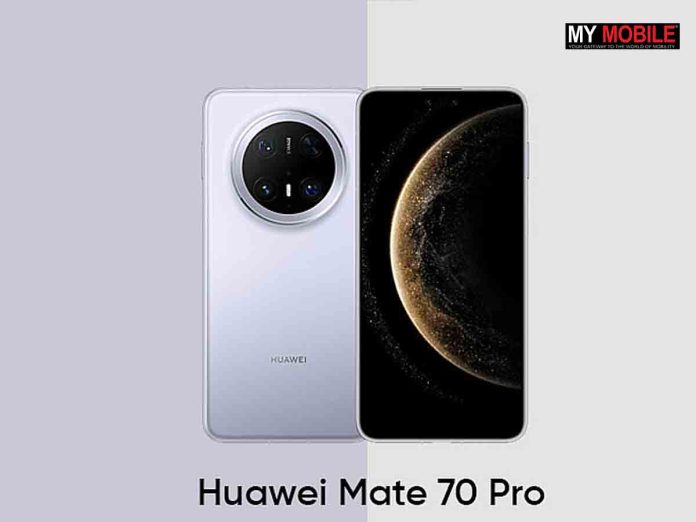
Huawei has officially introduced the Huawei Mate 70 Pro Premium Edition, which is set to go on sale in China from March 5. The company shared the details through its official channels, revealing the pricing, storage variants and availability. Here’s a closer look.
Huawei Mate 70 Pro Premium Edition – Price and Availability
The phone will be available in China through Huawei’s official store, Experience Stores, authorised e-commerce platforms and retail partners. It will be sold in Spruce Green, Hyacinth Purple, Snow White, and Obsidian Black colour options.
As for the pricing, the Premium Edition comes in three storage options, which include the following –
12GB+256GB – 6,199 Yuan (approx $850 or INR 74,280)
12GB+512GB – 6,999 Yuan (approx $960 or INR 83,892)
12GB+1TB – 7,699 Yuan (approx $1,055 or INR 92,194)
This makes the premium edition 3,000 Yuan (approx $410 or INR 35,829) more expensive than the standard Huawei Mate 70 Pro, which starts at 6,499 Yuan (approx $890 or INR 77,775).
Huawei Mate 70 Pro Premium Edition – Features and Specifications
In terms of design, the Premium Edition looks the same as the standard Mate 70 Pro.
It features a 6.9-inch OLED display with a 2832 x 1316 resolution, a 1-120Hz LTPO adaptive refresh rate, 1440Hz high-frequency PWM dimming and a 300Hz touch sampling rate.
The rear camera setup includes –
50MP ultra-sensing main camera (OIS-enabled, f/1.4-f/4.0 variable aperture)
40MP ultra-wide camera
48MP periscope telephoto camera
For selfies, there’s a 13MP ultra-wide front camera along with a ToF 3D sensor for facial recognition and biometrics.
The device is backed by a 5,500mAh battery supporting 100W wired charging and 80W wireless charging.
How Is Huawei Mate 70 Pro Premium Edition Different From Mate 70 Pro?
The biggest difference is the chipset. The Premium Edition is powered by a down-clocked version of the Kirin 9020 processor with a CPU configuration of 1 x 2.40GHz + 3 x 2.00GHz + 4 x 1.60GHz. In comparison, the standard Mate 70 Pro runs at 1 x 2.50GHz + 3 x 2.15GHz + 4 x 1.60GHz.
The Premium Edition runs on HarmonyOS NEXT, which is Huawei’s pure HarmonyOS ecosystem. It also offers an IP69 rating for dust and water resistance.
FAQs
Q1. When will the Huawei Mate 70 Pro Premium Edition be available in China?
Answer. The Huawei Mate 70 Pro Premium Edition will be available in China from March 5.
Q2. What are the storage options for the Huawei Mate 70 Pro Premium Edition and their prices?
Answer. The Premium Edition comes in three storage options – 12GB+256GB – 6,199 Yuan (approx $850), 12GB+512GB – 6,999 Yuan (approx $960) and 12GB+1TB – 7,699 Yuan (approx $1,055).
Q3. What is the display specification of the Huawei Mate 70 Pro Premium Edition?
Answer. It features a 6.9-inch OLED display with a 2832 x 1316 resolution, a 1-120Hz LTPO adaptive refresh rate, 1440Hz high-frequency PWM dimming and a 300Hz touch sampling rate.
Q4. What are the camera specifications of the Huawei Mate 70 Pro Premium Edition?
Answer. The rear camera setup includes a 50MP ultra-sensing main camera (OIS-enabled, f/1.4-f/4.0 variable aperture), a 40MP ultra-wide camera, and a 48MP periscope telephoto camera. For selfies, it has a 13MP ultra-wide front camera and a ToF 3D sensor for facial recognition.
Q5. How is Huawei Mate 70 Pro Premium Edition different from the standard Mate 70 Pro?
Answer. The Premium Edition is powered by a down-clocked version of the Kirin 9020 processor and runs on HarmonyOS NEXT, offering an IP69 rating for dust and water resistance.
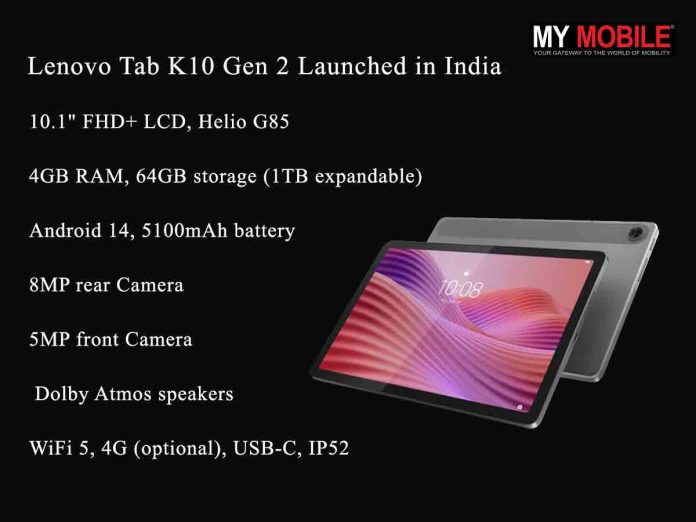
Lenovo Tab K10 Gen 2 launched in India with a 10.1-inch TFT LCD display, MediaTek Helio G85 chipset and options for WiFi-only and WiFi + 4G variants.
It is powered by 4GB RAM, 64GB storage (expandable to 1TB), 5100mAh battery, Dolby Atmos dual speakers and runs Android 14.
Additional Announcements – Legion Blade 9000K 2025 gaming PC and brand’s first 240Hz OLED gaming monitor.
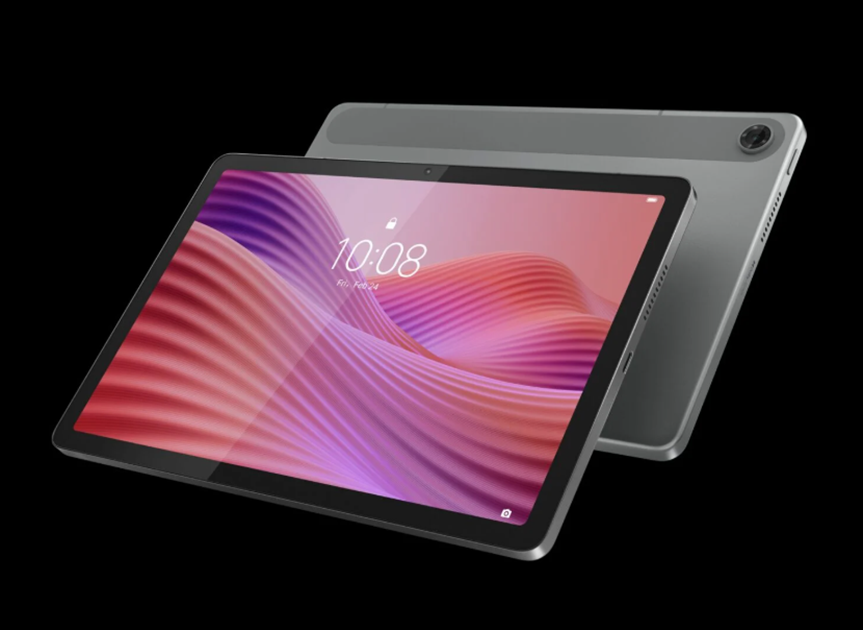
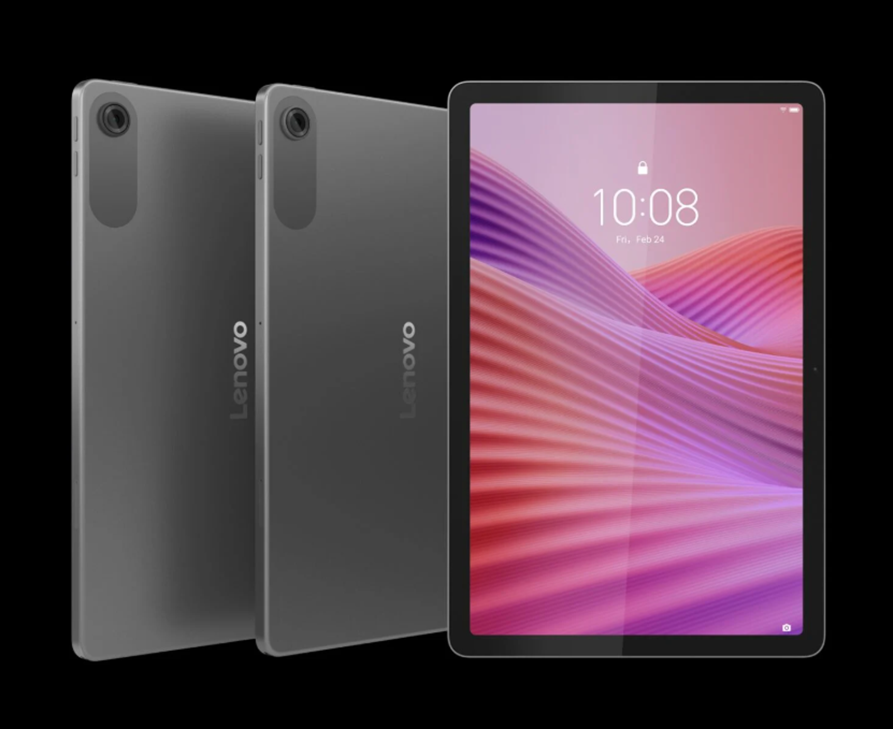
Lenovo Tab K10 Gen 2 officially launched in India. (Image credit – Lenovo)
Lenovois expanding its tablet lineup in India with the announcement of the Lenovo Tab K10 Gen 2. Launched on February 24, the tablet comes in WiFi-only (TB311FU) and WiFi + 4G (TB311XU) variants and shares the same specs as its global counterpart.
Here’s more about the newly launched tab.
Lenovo Tab K10 Gen 2 – Specs and Features
The tablet features a 10.1-inch TFT LCD display with a 1920×1200 resolution, 400 nits brightness and 10-point touch support, though it’s limited to a 60Hz refresh rate.
Under the hood, the MediaTek Helio G85 chipset and ARM Mali-G52 GPU power the device, paired with 4GB LPDDR4x RAM and 64GB eMMC 5.1 storage, which can be expanded up to 1TB via microSD.
It runs Android 14 out of the box.
Lenovo Tab K10 Gen 2 sports a 10.1-inch TFT LCD display. (Image credit – Lenovo)
The 5100mAh battery supports 20W fast charging, while an 8MP rear camera and 5MP front camera handle photos and video calls. Audio is enhanced with Dolby Atmos-tuned dual speakers and a mono microphone.
For connectivity, the tablet includes WiFi 5, GPS, GLONASS, Galileo, BeiDou, USB-C and a 3.5mm headphone jack. It weighs 425g, has a 7.5mm slim profile (9.4mm at the camera bump), and comes in a Luna Grey finish. It also carries an IP52 rating for dust and water resistance.
Sensors include an accelerometer, a hall sensor and a virtual light sensor.
Lenovo Tab K10 Gen 2 – Pricing
Lenovo hasn’t revealed the India pricing yet but in the UK, the tablet is priced at around £140 (including VAT).
Other Lenovo Announcements
Alongside the Tab K10 Gen 2, Lenovo has introduced the Legion Blade 9000K 2025 gaming PC, featuring an Ultra 9 285K processor, RTX 5080 GPU and liquid cooling.
The company has also unveiled its first 240Hz OLED gaming monitor, designed for high-performance gaming.
Lenovo Tab K10 Gen 2 – Key Specifications
Feature
Specification
Display
10.1-inch TFT LCD, 1920×1200 resolution, 400 nits, 10-point touch support
Chipset
MediaTek Helio G85, ARM Mali-G52 GPU
RAM & Storage
4GB LPDDR4x RAM, 64GB eMMC 5.1 (Expandable up to 1TB)
Operating System
Android 14
Battery
5100mAh, 20W fast charging
Rear Camera
8MP
Front Camera
5MP
Audio
Dolby Atmos dual speakers, mono microphone
Connectivity
WiFi 5, GPS, GLONASS, Galileo, BeiDou, USB-C, 3.5mm headphone jack
Build & Design
425g weight, 7.5mm thickness (9.4mm at camera bump), IP52 rating, Luna Grey finish
Variants
WiFi-only & WiFi + 4G
FAQs
Q1. What display does the Lenovo Tab K10 Gen 2 have?
Answer. The Lenovo Tab K10 Gen 2 features a 10.1-inch TFT LCD display with a 1920×1200 resolution, 400 nits brightness and 10-point touch support.
Q2. What chipset powers the Lenovo Tab K10 Gen 2?
Answer. The tablet is powered by the MediaTek Helio G85 chipset and ARM Mali-G52 GPU.
Q3. What is the battery capacity and charging capability of the Lenovo Tab K10 Gen 2?
Answer. The Lenovo Tab K10 Gen 2 has a 5100mAh battery that supports 20W fast charging.
Q4. What are the camera specifications of the Lenovo Tab K10 Gen 2?
Answer. The tablet has an 8MP rear camera and a 5MP front camera for photos and video calls.
Q5. What connectivity options does the Lenovo Tab K10 Gen 2 offer?
Answer. The tablet includes WiFi 5, GPS, GLONASS, Galileo, BeiDou, USB-C, and a 3.5mm headphone jack, and it comes in WiFi-only and WiFi + 4G variants.
Microsoft’s Copilot AI app is now available on the Mac App Store with full keyboard shortcut support.
The app only works on Apple silicon Macs (M1 chip or later) running macOS 14.0 or higher.
Copilot offers tools for text and image generation, writing assistance, research, multilingual translation, photo editing and content creation.
The app is now available for download on the Mac App Store.
Now Mac users can download the Microsoft AI assistant Copilot App. (Image credit – Microsoft)
Microsoft has officially launched its Copilot AI app on the Mac App Store, bringing its AI-powered assistant to macOS users. While it was previously available only on iPhone and iPad, Copilot now has a dedicated macOS app with full support for keyboard shortcuts. This will make it easier for Mac users to access Microsoft’s AI assistant on their device.
However, using the app on Mac won’t be that straightforward.
Copilot only works on Macs with Apple silicon (M1 chip or later) running macOS 14.0 or higher. That means Intel-based Macs won’t be able to run the app. While a version of Copilot did work on Macs last year, it was actually the iPad version running on macOS. Microsoft later removed it but now, Copilot is back with a proper Mac app.
Copilot on Mac – What Can It Do?
According to Microsoft, Copilot is designed to be an AI companion for everyday life, offering tools for text and image generation, writing assistance, research help and much more.
Some key features you can expect are as follows –
AI-powered chat for answering questions, brainstorming ideas, and refining thoughts
Text generation and editing including composing emails, resumes, and cover letters
Multilingual translation and proofreading across hundreds of languages
AI image generation, allowing users to turn text prompts into high-quality visuals
Photo editing tools, including background removal and custom image creation
Content creation for social media, branding and even children’s book illustrations
Film and video storyboard visualisation for creatives and filmmakers
Copilot is designed to provide “straightforward answers to complex questions” and help users “achieve more with AI.”
Microsoft also highlights its ability to summarise text, generate creative content and provide AI-powered insights.
Download Copilot Now on Mac
Copilot for Mac is now available for download on the Mac App Store.
FAQs
Q1. Which Macs can run the Copilot AI app?
Answer. Copilot only works on Macs with Apple silicon (M1 chip or later) running macOS 14.0 or higher.
Q2. What AI capabilities does Copilot offer on Mac?
Answer. Copilot offers tools for text and image generation, writing assistance, research help, multilingual translation, photo editing and content creation.
Q3. Where can I download the Copilot AI app for Mac?
Answer. Copilot for Mac is now available for download on the Mac App Store.
OpenAI introduces GPT-4.5 with improved accuracy, fewer hallucinations and better emotional intelligence.
However, the company maintains that it’s not the most advanced model.
GPT-4.5 is more conversational, concise and natural-sounding, encouraging dialogue rather than just providing answers.
Initially available to Pro users with wider access planned for ChatGPT Plus, Team subscribers, Enterprise and Education users soon.
OpenAI Unveils its smarter and more Conversational model, GPT-4.5. (Image credit – Open AI on X)
OpenAIhas officially launched GPT-4.5, its latest and most refined ChatGPT model yet. While it brings better accuracy, fewer hallucinations and improved emotional intelligence, OpenAI clarifies that GPT-4.5 is not its most advanced model for now.
Today we’re releasing a research preview of GPT-4.5—our largest and best model for chat yet.
Rolling out now to all ChatGPT Pro users, followed by Plus and Team users next week, then Enterprise and Edu users the following week. pic.twitter.com/br5win5OEB
— OpenAI (@OpenAI) February 27, 2025
Announcing the new mode and acknowledging that it is different, Open AI CEO Sam Altman wrote on X (formerly Twitter), “this isn’t a reasoning model and won’t crush benchmarks. it’s a different kind of intelligence and there’s a magic to it i haven’t felt before. really excited for people to try it!”
GPT-4.5 is ready!
good news: it is the first model that feels like talking to a thoughtful person to me. i have had several moments where i’ve sat back in my chair and been astonished at getting actually good advice from an AI.
bad news: it is a giant, expensive model. we…
— Sam Altman (@sama) February 27, 2025
Here’s all we know so far.
GPT-4.5 – Smarter, More Natural Model
OpenAI acknowledges that its model lineup can be confusing and GPT-4.5 doesn’t change that. While it’s the newest model, OpenAI’s o3 reasoning model remains its most powerful. The company describes GPT-4.5 as a research preview rather than a frontier model.
A bigger change is expected later this year with the release of GPT-5, which aims to combine fast chat responses with deeper reasoning without switching models.
OpenAI new model GPT-4.5. (Image credit – Open AI on X)
For now, GPT-4.5 replaces GPT-4o, bringing more accuracy, fewer hallucinations and better emotional intelligence. OpenAI highlights that GPT-4.5 is more conversational, it may encourage dialogue rather than just providing answers. It’s also more concise and natural-sounding, making conversations flow better.
For now, GPT-4.5 is available to Pro users on the $200/month plan. However, more users will get access soon. The plans with the timeline are as follows –
Next week: ChatGPT Plus ($20/month) & Team subscribers
Following week: Enterprise & Education users
Check out Live Stream –
Ex-OpenAI Leaders Are Building New AI Startups
While OpenAI continues to push forward, several of its former key figures have left to create their own AI startups, many of which are attracting massive investments.
One of the most notable ventures is Thinking Machines Lab, founded by Mira Murati, OpenAI’s former Chief Technology Officer. She has brought along more than 30 AI experts from OpenAI, Meta, and Google DeepMind. Co-founders include Lilian Weng, who previously served as OpenAI’s Vice President of AI Safety, and John Schulman, a former researcher at Anthropic.
Describing its focus areas, Thinking Machines Lab mentions, “While AI capabilities have advanced dramatically, key gaps remain. The scientific community’s understanding of frontier AI systems lags behind rapidly advancing capabilities. Knowledge of how these systems are trained is concentrated within the top research labs, limiting both the public discourse on AI and people’s abilities to use AI effectively. And, despite their potential, these systems remain difficult for people to customize to their specific needs and values. To bridge the gaps, we’re building Thinking Machines Lab to make AI systems more widely understood, customizable and generally capable. […] Emphasis on human-AI collaboration. Instead of focusing solely on making fully autonomous AI systems, we are excited to build multimodal systems that work with people collaboratively.”
“More flexible, adaptable, and personalized AI systems. We see enormous potential for AI to help in every field of work. While current systems excel at programming and mathematics, we’re building AI that can adapt to the full spectrum of human expertise and enable a broader spectrum of applications,” it further adds.
The company is focused on multimodal AI with practical applications and is reportedly raising $1 billion at a $9 billion valuation.
Another major startup is Safe Superintelligence (SSI), co-founded by Ilya Sutskever, OpenAI’s former Chief Scientist. He is joined by Daniel Levy, an ex-OpenAI researcher, and Daniel Gross, who previously led Apple’s AI projects. SSI raised $1 billion in September 2024 and is now reportedly seeking another $1 billion at a staggering $30 billion valuation.
SSI explains its purpose: “Building safe superintelligence (SSI) is the most important technical problem of our time. We have started the world’s first straight-shot SSI lab, with one goal and one product: a safe superintelligence. It’s called Safe Superintelligence Inc.”
“SSI is our mission, our name, and our entire product roadmap, because it is our sole focus. Our team, investors, and business model are all aligned to achieve SSI. […] We approach safety and capabilities in tandem, as technical problems to be solved through revolutionary engineering and scientific breakthroughs. We plan to advance capabilities as fast as possible while making sure our safety always remains ahead,” it adds.
Meanwhile, Eureka Labs was founded by former OpenAI scientist and Tesla AI director Andrej Karpathy, and is working on an AI-native educational platform. Karpathy, a founding member of OpenAI, has been developing Eureka Labs since 2024, aiming to reshape the future of AI-driven education.
Announcing its mission, Eureka Labs writes, “How can we approach an ideal experience for learning something new? For example, in the case of physics one could imagine working through very high quality course materials together with Feynman, who is there to guide you every step of the way. Unfortunately, subject matter experts who are deeply passionate, great at teaching, infinitely patient and fluent in all of the world’s languages are also very scarce and cannot personally tutor all 8 billion of us on demand.”
With these former OpenAI leaders branching out, the competition to define the next wave of AI advancements is more intense than ever.
FAQS
Q1. What improvements does GPT-4.5 bring over previous models?
REDMI Book Pro 16 & Pro 14 (2025) launched in China feature Intel’s second-gen Core Ultra processors, up to 32GB RAM and high-refresh-rate displays.
Long Battery Life – Up to 30 hours of use for the Pro 16 with a 99Wh battery and 31 hours for the Pro 14 with an 80Wh battery.
Both include Thunderbolt 4, USB-C, Dolby Vision & Atmos support and are powered by Xiaomi’s AIPC engine for enhanced AI capabilities.
REDMI Book Pro 16 & Pro 14 (2025) officially launched in the Chinese market. (Image credit – Redmi)
Xiaomihas introduced the 2025 REDMI Book Pro 14 and REDMI Book Pro 16 laptops in China, launching them alongside the Xiaomi 15 Ultra. The new laptops feature Intel’s second-gen Core Ultra processors, high-refresh-rate displays and powerful AI capabilities.
REDMI Book Pro 16
REDMI Book Pro 16. (Image credit – Redmi)REDMI Book Pro 16 key features. (Image credit – Redmi)
The REDMI Book Pro 16 sports a sleek 15.9mm metal body and weighs 1.88kg. It features a 3.1K LCD screen (3072×1920) with a 165Hz refresh rate, 500 nits brightness and 100% DCI-P3 color accuracy. The VESA HDR 400 certification ensures vibrant and accurate colors.
Powering the laptop are two processor options:
Intel Ultra 5 225H (14 cores, 4.9GHz)
Intel Ultra 7 255H (16 cores, 5.1GHz)
Performance sees a 21.6% single-core and 29.5% multi-core boost over last year’s model. It comes with 32GB LPDDR5X RAM and a 1TB PCIe 4.0 SSD with an extra M.2 slot for expansion.
A massive 99Wh battery delivers up to 30 hours of use, while the 140W GaN USB-C charger charges the laptop to 54% in just 30 minutes. The cooling system features dual 12V fans, three heat pipes, and improved thermal conductivity (63.4% better than before).
Storage: 1TB PCIe 4.0 SSD with additional M.2 slot
Graphics: 7Xe Intel Arc | 8Xe Intel Arc
Battery: 80Wh, up to 31 hours, 100W GaN fast charging
45 kg
REDMI Book Pro 14
REDMI Book Pro 14. (Image credit – Redmi)REDMI Book Pro 14 key specifications. (Image credit – Redmi)
The REDMI Book Pro 14 maintains the 15.9mm thickness but is lighter at 1.45kg. It features a 2.8K LCD (2880×1800) with a 120Hz refresh rate, 500 nits brightness, and 100% sRGB color accuracy, also VESA HDR 400 certified.
Like its bigger sibling, it offers the Intel Ultra 5 225H and Ultra 7 255H processors, with 16GB or 32GB LPDDR5X RAM. It delivers an 18.5% single-core and 28.2% multi-core boost over the previous model. Storage includes a 1TB PCIe 4.0 SSD with an extra M.2 slot.
The 80Wh battery lasts up to 31 hours, with the 100W GaN charger reaching 51% in 30 minutes. The cooling system has dual 12V fans and two heat pipes, supporting up to 70W performance.
Storage: 1TB PCIe 4.0 SSD with additional M.2 slot
Graphics: 7Xe Intel Arc | 8Xe Intel Arc
Battery: 99Wh, up to 30 hours, 140W GaN fast charging
88 kg
REDMI Book Pro 16 & Pro 14 (2025) – Common Features And AI Capabilities
Both laptops run Windows 11 (Chinese version) and are powered by Xiaomi’s AIPC engine, offering 96 TOPS AI computing power. This results in a 200% boost in large-model performance and a 120% improvement in local image processing tasks.
Connectivity includes Thunderbolt 4, USB-C, HDMI 2.1, two USB-A 3.2 Gen1 ports, and a 3.5mm audio jack. Other features include Xiaoai voice assistant, HyperConnect for cross-device sharing, 1080P cameras, and Dolby Vision & Atmos support.
Ο Xiaoai’s assistant handles voice commands, translates documents and answers screenshot questions.
The HyperConnect allows sharing between devices, including Apple devices.
Common features –
VESA HDR 400 certification
Delta E ≈ color accuracy 0,33
TÜV Rheinland certified eye protection features
AI brightness adjustment
“Hurricane Cooling” with dual 12V fans (200 blades) and thermal grease with a conductivity of 8,5W/MK (63,4% better than last year).
Thunderbolt 4, USB-C, HDMI 2.1, USB-A 3.2 Gen 1, and 3,5mm audio jack
Windows 11 (Chinese version)
Xiaomi AIPC Engine for enhanced AI capabilities
Both laptops feature a 1,3mm key travel keyboard with auto-brightness, a fingerprint power button, a large touchpad, dual speakers with Dolby Vision and Atmos and a 1080p webcam.
REDMI Book Pro 16 & Pro 14 (2025) – Pricing And Availability
There’s no word yet on a global launch for these laptops. However, Xiaomi’s global launch event for the Xiaomi 15 series including the 15 Ultra is set for March 2.
Redmi Book Pro 16 & Pro 14 (2025) Key Spec:
Feature
Redmi Book Pro 16
Redmi Book Pro 14
Display
3.1K (3072×1920), 165Hz, 500 nits, 100% DCI-P3
2.8K (2880×1800), 120Hz, 500 nits, 100% sRGB
Processor
Intel Ultra 5 225H / Ultra 7 255H
Intel Ultra 5 225H / Ultra 7 255H
RAM
32GB LPDDR5X
16GB / 32GB LPDDR5X
Storage
1TB PCIe 4.0 SSD (M.2 slot)
1TB PCIe 4.0 SSD (M.2 slot)
Graphics
7Xe Intel Arc / 8Xe Intel Arc
7Xe Intel Arc / 8Xe Intel Arc
Battery
99Wh, up to 30 hours, 140W fast charging
80Wh, up to 31 hours, 100W fast charging
Weight
1.88 kg
1.45 kg
Thickness
15.9mm
15.9mm
Ports
Thunderbolt 4, USB-C, HDMI 2.1, USB-A 3.2 Gen1, 3.5mm jack
Thunderbolt 4, USB-C, HDMI 2.1, USB-A 3.2 Gen1, 3.5mm jack
OS
Windows 11 (Chinese)
Windows 11 (Chinese)
AI Features
Xiaomi AIPC, 96 TOPS AI power, HyperConnect
Xiaomi AIPC, 96 TOPS AI power, HyperConnect
Price
¥6,499 – ¥7,499 (₹78,216 – ₹90,189)
¥5,699 – ¥6,999 (₹68,516 – ₹84,246)
FAQs
Q1. What processors are available in the REDMI Book Pro 16 and Pro 14 (2025)?
Answer. The laptops feature Intel’s second-gen Core Ultra processors, specifically the Intel Ultra 5 225H and Ultra 7 255H.
Q2. What is the display specification of the REDMI Book Pro 16?
Answer. The REDMI Book Pro 16 has a 3.1K LCD screen (3072×1920) with a 165Hz refresh rate, 500 nits brightness, and 100% DCI-P3 color accuracy.
Q3. How long does the battery last on the REDMI Book Pro 14 and Pro 16?
Answer. The Pro 14 has an 80Wh battery lasting up to 31 hours, while the Pro 16 has a 99Wh battery lasting up to 30 hours.
Q4. What AI capabilities do the REDMI Book Pro 16 and Pro 14 offer?
Answer. Both laptops are powered by Xiaomi’s AIPC engine, offering 96 TOPS AI computing power, resulting in a 200% boost in large-model performance and a 120% improvement in local image processing tasks.
Q5. What are the connectivity options for the REDMI Book Pro 16 and Pro 14?
Answer. The laptops include Thunderbolt 4, USB-C, HDMI 2.1, two USB-A 3.2 Gen1 ports, and a 3.5mm audio jack.
Xiaomi SU7 Ultra launched boasting 0-100 km/h in 1.98 seconds with a top speed over 350 km/h powered by a Super Three-Motor System delivering 1,548 PS.
The vehicle features 5m² Alcantara upholstery, carbon fiber accents, graphene heated sports seats and a 25-speaker surround sound system.
Equipped with a 93.7kWh CATL Qilin 2.0 battery, it offers 620 km range and 10% to 80% charge in 11 minutes.
Xiaomihas officially launched the Xiaomi SU7 Ultra in China, a high-performance electric sedan priced at 529,900 yuan (approx $72,988 or INR 63,79,685). With a blazing-fast 0-100 km/h time of just 1.98 seconds and a top speed of over 350 km/h, it claims the title of the fastest four-door production car.
Here’s everything we know about the new-age vehicle.
Xiaomi SU7 Ultra – Specs And Performance
The Xiaomi SU7 Ultra is powered by Xiaomi’s Super Three-Motor System, featuring a dual V8s + V6s all-wheel-drive setup that delivers an insane 1,548 PS of peak power. The V8 motor spins at up to 27,200 rpm, ensuring lightning-fast acceleration.
Xiaomi SU7 Ultra features a dual V8s + V6s all-wheel-drive setup. (Image credit – Xiaomi)
It can go from 0-200 km/h in just 5.86 seconds and complete a quarter-mile in 9.23 seconds.
To keep things stable at high speeds, the SU7 Ultra comes with a carbon fiber rear wing, an active rear diffuser and U-shaped wind blades for enhanced aerodynamics. Braking is handled by a carbon-ceramic system with six-piston front calipers and four-piston rear calipers.
The Nürburgring-tuned chassis and adjustable coilover suspension further refine its handling dynamics.
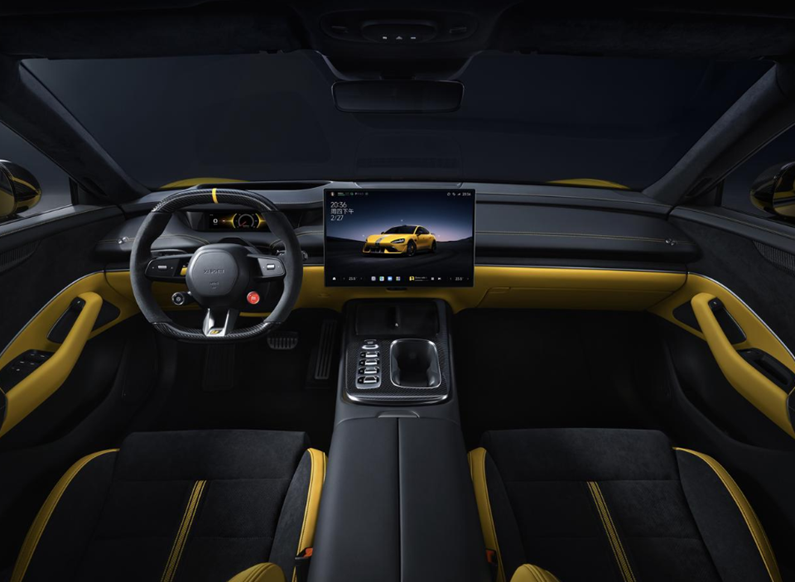
Xiaomi SU7 Ultra comes with premium interiors. (Image credit – Xiaomi)
Inside, the SU7 Ultra offers a premium, high-performance cabin with 5m² of Alcantara microfiber upholstery and carbon fiber accents. The sports seats come with graphene heating and massage functions, adding comfort to the speed-focused sedan.
To complete the experience, a 25-speaker surround sound system with active noise cancellation provides immersive audio.
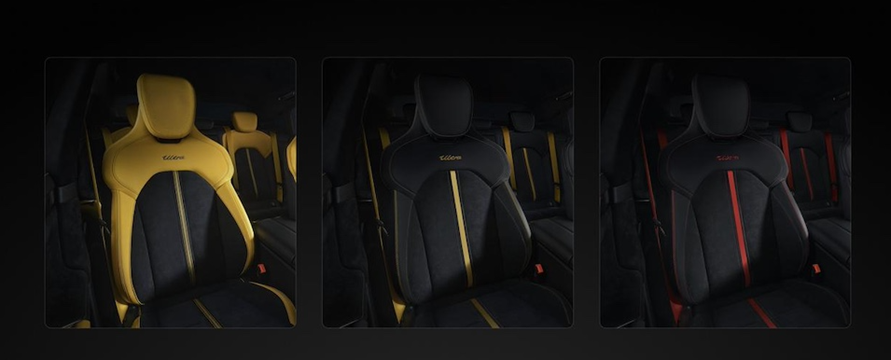
Xiaomi SU7 Ultra features racing-inspired cabin. (Image credit – Xiaomi)
Buyers can choose from bold and vibrant Bright Yellow (Yellow/Black), sleek Black/Yellow, or subtle yet sophisticated Black/Red interiors.
Xiaomi specifies, “For enhanced comfort, Xiaomi SU7 Ultra’s front seats are equipped with ventilation, massage functionality, and graphene heating for both rows. The seats have also been redesigned with improved contours, upgraded padding, and higher side bolsters, delivering superior support and an elevated level of comfort for every journey.”
Xiaomi SU7 Ultra – Smart Tech And AI-Driven Autonomy
Running on Xiaomi HyperOS, the SU7 Ultra seamlessly integrates smart devices, AI-powered navigation, and autonomous driving features. The Xiaomi Pilot system, backed by two Orin X AI chips, enables real-time navigation, adaptive lane changes and intelligent parking assistance.
Xiaomi SU7 Ultra – Blazing-Fast Charging & Long Range
With an 897V high-voltage charging system, the SU7 Ultra can charge from 10% to 80% in just 11 minutes. It features CATL’s Qilin 2.0 battery with a 93.7kWh capacity, offering a 620 km CLTC range. The car also supports 5.2C ultra-fast charging, making it practical for daily use.
Xiaomi SU7 Ultra – Colours And Customisation Option
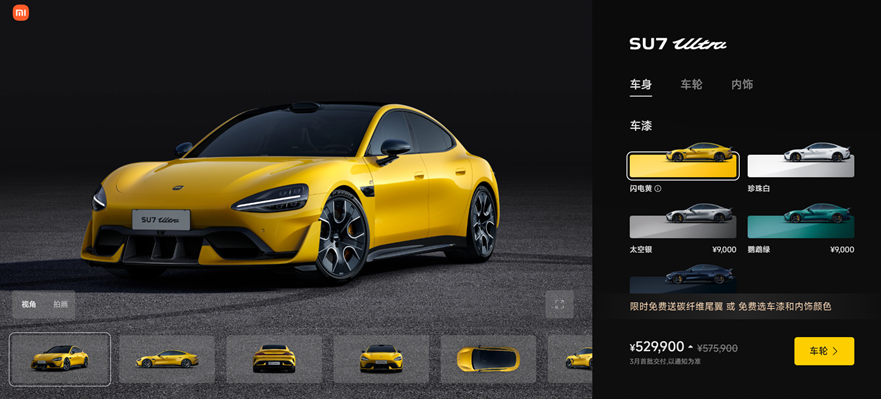
Xiaomi SU7 Ultra comes in five colours grouped into Classic, Luxury and Sports theme. (Image credit – Xiaomi)
The Xiaomi SU7 Ultra is available in five striking colours grouped into Classic, Luxury and Sports themes. These colour groups are as follows –
Classic: Obsidian Black, Pearl White
Luxury: Space Silver, Parrot Green
Sports: Lightning Yellow
Xiaomi SU7 Ultra – Pricing, Availability and Configuration
Xiaomi SU7 Ultra price starts at 529,900 yuan (approx $73,000 or INR 63,79,685). (Image credit – Xiaomi)
The Xiaomi SU7 Ultra is now officially available for configuration. The model, which went up for pre-sale last October, now allows buyers to customise their vehicle before finalising their order.
The entry-level SU7 Ultra starts at 529,900 yuan (approx $73,000 or INR 63,79,685), while the fully loaded version goes up to 814,900 yuan (approx $112,000 or INR 97,88,010). The top-tier configuration delivers 1,526 hp and an incredible 0-100 km/h time of just 1.98 seconds.
It also comes equipped with CATL’s Qilin 2.0 battery (93.7 kWh), offering a 620 km range on a single charge.
Xiaomi’s CEO, Lei Jun, confirmed that the company has already received over 6,900 new orders (excluding pre-sale bookings). Xiaomi aims to deliver 10,000 units starting in April.
The SU7 series has already proven to be a massive success, with Xiaomi shipping over 150,000 units, far exceeding expectations. The company is now targeting 300,000 units in 2025.
FAQs
Q1. What is the 0-100 km/h acceleration time for the Xiaomi SU7 Ultra?
Answer. The Xiaomi SU7 Ultra can accelerate from 0-100 km/h in just 1.98 seconds.
Q2. What is the power output of the Xiaomi SU7 Ultra’s motor system?
Answer. The Xiaomi SU7 Ultra’s Super Three-Motor System delivers a peak power of 1,548 PS.
Q3. What is the interior upholstery of the Xiaomi SU7 Ultra made of?
Answer. The SU7 Ultra features a high-performance cabin with 5m² of Alcantara microfiber upholstery and carbon fiber accents.
Q4. How long does it take to charge the Xiaomi SU7 Ultra from 10% to 80%?
Answer. The SU7 Ultra can charge from 10% to 80% in just 11 minutes with its 897V high-voltage charging system.
Q5. What is the range of the Xiaomi SU7 Ultra on a single charge?
Answer. The Xiaomi SU7 Ultra offers a 620 km range on a single charge with its 93.7kWh CATL Qilin 2.0 battery.
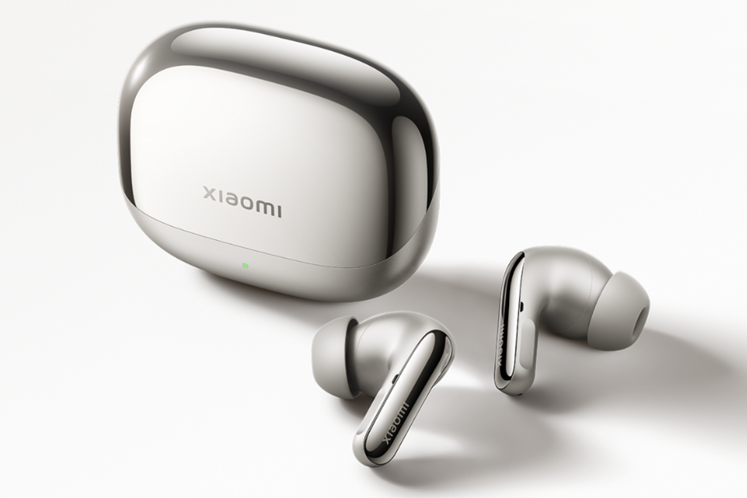
The Xiaomi Buds 5 Pro launched with an industry-first dual-amplifier triple-driver system and Qualcomm’s aptX Lossless codec for high-resolution audio.
It features 55dB ultra-wideband ANC, 3-mic AI noise reduction system, up to 40 hours of battery life and smart AI features.
Xiaomi Buds 5 Pro comes at the starting price of 1,299 yuan (approx $178 or INR 15,549).
Xiaomi Buds 5 Pro launched in China. (Image credit – Xiaomi)
Xiaomi has unveiled the Buds 5 Pro series alongside its Xiaomi 15 Ultra flagship smartphone and SU7 Ultra EV. These earbuds introduce an industry-first dual-amplifier triple-driver system promising high-fidelity audio with minimal distortion.
Here’s a closer look at the key features and pricing.
Xiaomi Buds 5 Pro – Features & Specs
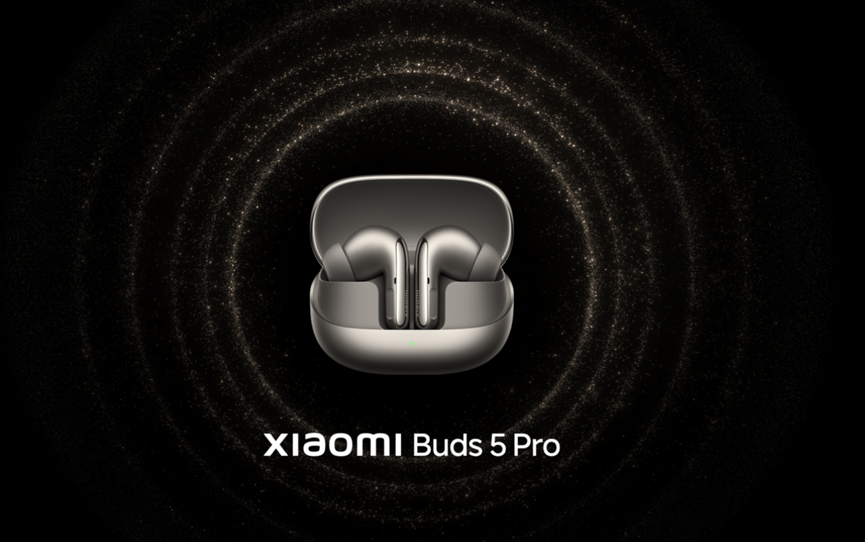
Xiaomi Buds 5 Pro. (Image credit – Xiaomi)
The Buds 5 Pro come with a coaxial triple-driver setup including an 11mm dual-magnetic dynamic driver and a planar diaphragm unit. This combination covers a wide frequency range of 15Hz to 50kHz, ensuring crisp highs, detailed mids and deep bass.
For high-resolution audio, Xiaomi has included Qualcomm’s aptX Lossless codec capable of transmitting 48kHz/24-bit audio at speeds of up to 2.1Mbps. Additionally, the earbuds are Harman-tuned and offer an exclusive “Harman Master” sound profile for a refined listening experience.
The Wi-Fi edition takes things up a notch with next-generation Wi-Fi audio transmission, reaching speeds of 4.2Mbps, which is twice as fast as standard Bluetooth. When paired with compatible Xiaomi devices like the 15 Ultra, this allows for studio-quality lossless audio.
Xiaomi Buds 5 Pro key features. (Image credit – Xiaomi)
The Buds 5 Pro feature 55dB ultra-wideband adaptive noise cancellation covering a 5kHz range for effective background noise reduction. For calls, Xiaomi has integrated a 3-mic AI noise reduction system that suppresses up to 100dB of background noise, ensuring clear voice transmission. The earbuds also offer wind noise resistance up to 15m/s, making them perfect for outdoor use.
Xiaomi has included an independent spatial audio system with dynamic head-tracking, creating a 360-degree surround sound experience. The earbuds also support personalised spatial audio calibration, fine-tuning the sound based on the listener’s ear structure.
On the smart features side, the Buds 5 Pro introduce AI-powered real-time speech-to-text conversion with an impressive 98.7% accuracy. They also support face-to-face translation and simultaneous interpretation, making multilingual communication easier.
Xiaomi Buds 5 Pro. (Image credit – Xiaomi)
The Buds 5 Pro come with a USB-C charging case. The standard Bluetooth version packs a 53mAh battery per earbud and a 570mAh charging case, offering 8 hours of playback per charge and up to 40 hours with the case.
The Wi-Fi edition has a larger 64mAh battery per earbud, providing 10 hours of standalone playback while keeping the same 570mAh charging case and 40-hour total battery life.
Xiaomi Buds 5 Pro – Pricing & Availability
Xiaomi Buds 5 Pro colour variants. (Image credit – Xiaomi)
The Xiaomi Buds 5 Pro are available in Snow Mountain White and Titanium Gold colour options, while the Wi-Fi edition comes in Phantom Black colour.
Xiaomi Buds 5 Pro (Bluetooth version) – 1,299 yuan (approx $178 or INR 15,549)
Xiaomi Buds 5 Pro (Wi-Fi edition) – 1,499 yuan (approx $206 or INR 17,995)
Xiaomi Buds 5 Pro – Key Specs
Feature
Details
Audio
Dual-amplifier, aptX Lossless
ANC
55dB ultra-wideband ANC
Battery
Up to 40 hours total playback
AI Features
Speech-to-text, Translation
Price
From 1,299 yuan (~$178 / ₹15,549)
FAQs
Q1. What is the audio system in the Xiaomi Buds 5 Pro?
Answer. The Buds 5 Pro feature an industry-first dual-amplifier triple-driver system, including an 11mm dual-magnetic dynamic driver and a planar diaphragm unit.
Q2. What codec is used for high-resolution audio in the Buds 5 Pro?
Answer. The Buds 5 Pro use Qualcomm’s aptX Lossless codec, capable of transmitting 48kHz/24-bit audio at speeds of up to 2.1Mbps.
Q3. How effective is the noise cancellation in the Buds 5 Pro?
Answer. The Buds 5 Pro offer 55dB ultra-wideband adaptive noise cancellation and a 3-mic AI noise reduction system that suppresses up to 100dB of background noise.
Q4. What is the battery life of the Xiaomi Buds 5 Pro?
Answer. The standard Bluetooth version offers up to 8 hours of playback per charge and up to 40 hours with the charging case, while the Wi-Fi edition provides 10 hours of standalone playback with the same 40-hour total battery life.
Q5. What smart AI features do the Buds 5 Pro include?
Answer. The Buds 5 Pro introduce AI-powered real-time speech-to-text conversion with 98.7% accuracy, face-to-face translation, and simultaneous interpretation.
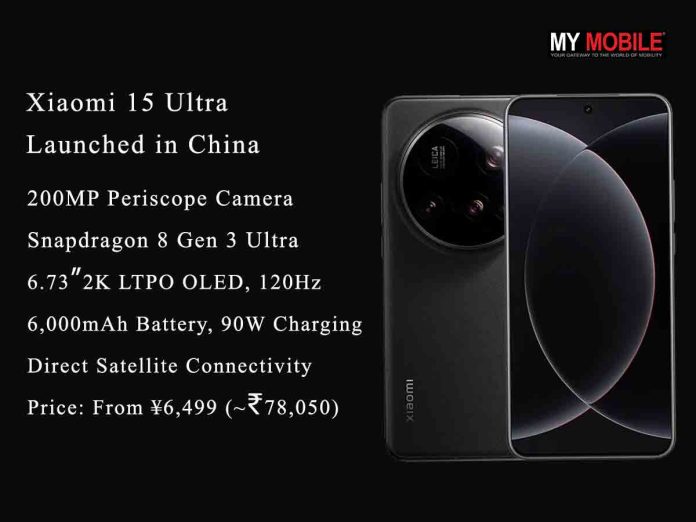
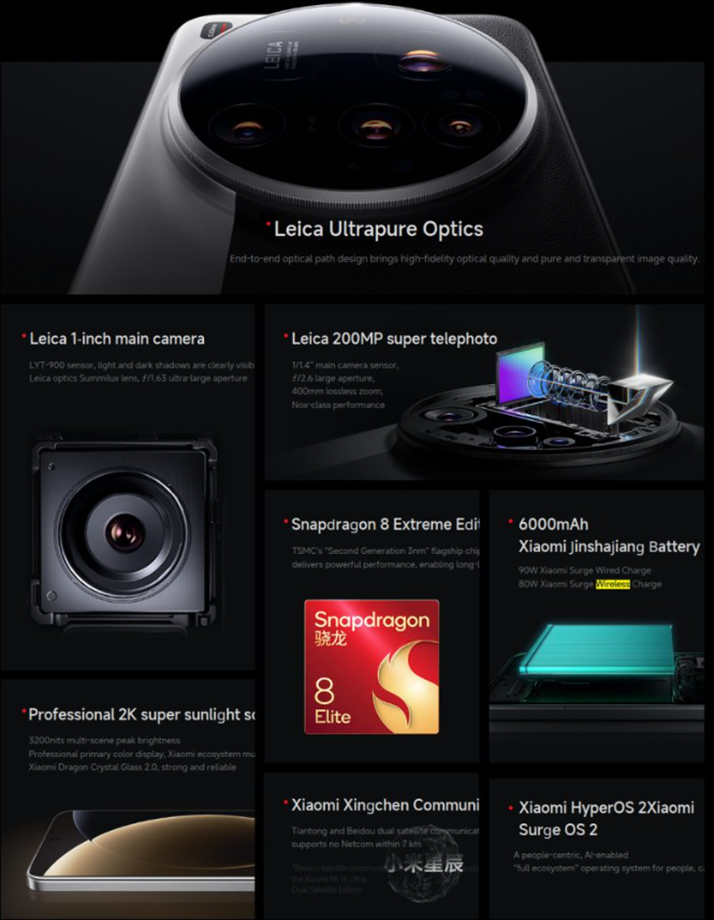
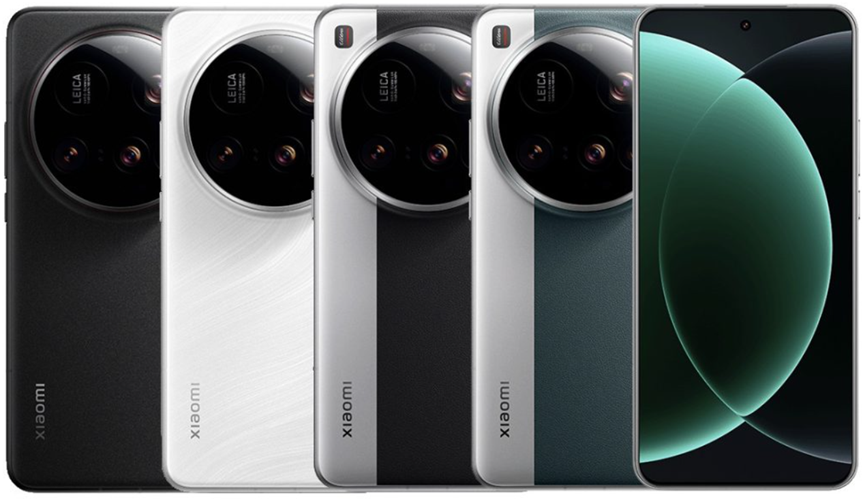
Xiaomi 15 Ultra officially launched in China at the starting price of 6,499 yuan (approx $893 / ₹78,050).
It features a 6.73-inch 2K LTPO OLED display, Snapdragon 8 Gen 3 Ultra Edition, Leica Co-engineered Cameras, 6,000mAh battery with 90W wired charging and Industry-first direct satellite communication with Starlink and TianTong satellites.
Available for pre-order now and will go on sale in China from March 3rd.
While it is scheduled to go on sale in China from March 3rd, here’s a look at everything we know about the phone.
Xiaomi 15 Ultra is available for pre-order now in China. (Image credit – Xiaomi)
Xiaomi 15 Ultra – Key Features
The Xiaomi 15 Ultra boasts a 6.73-inch 2K LTPO OLED display with a peak brightness of 3,200 nits, ensuring great visibility even in bright outdoor conditions. The TCL C9 panel supports a 120Hz adaptive refresh rate, HDR10+ and Dolby Vision for smooth visuals and vibrant colors.
Xiaomi has also included 1920Hz PWM dimming and Ceramic Glass 2.0 protection for durability.
Under the hood, the Qualcomm Snapdragon 8 Gen 3 Ultra Edition powers the device, delivering top-notch performance and efficiency. It comes with up to 16GB of LPDDR5X RAM and 1TB of UFS 4.1 storage. To keep things cool during heavy usage, Xiaomi has added a dual-channel vapor-liquid separation cooling system.
The phone runs on Xiaomi HyperOS 2.0, which is designed to improve power efficiency and introduce AI-driven features. It includes AI Portrait Dynamic Wallpapers and even offers seamless integration with Apple’s ecosystem, allowing LAN-based file sharing between Xiaomi and Apple devices.
The 6,000mAh battery supports 90W wired fast charging and 80W wireless charging. It even includes reverse wireless charging, letting you power up accessories like earbuds on the go.
Xiaomi 15 Ultra – Powerful Leica Camera System
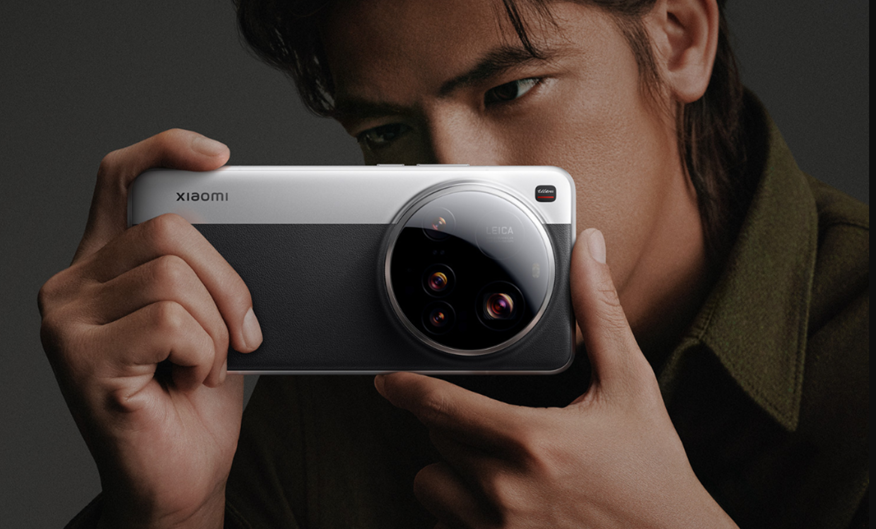
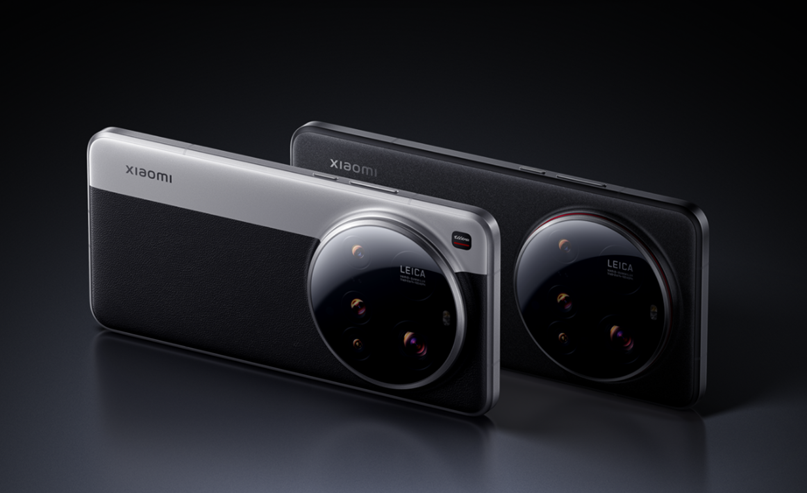
Xiaomi 15 Ultra features Leica Camera System. (Image credit – Xiaomi)
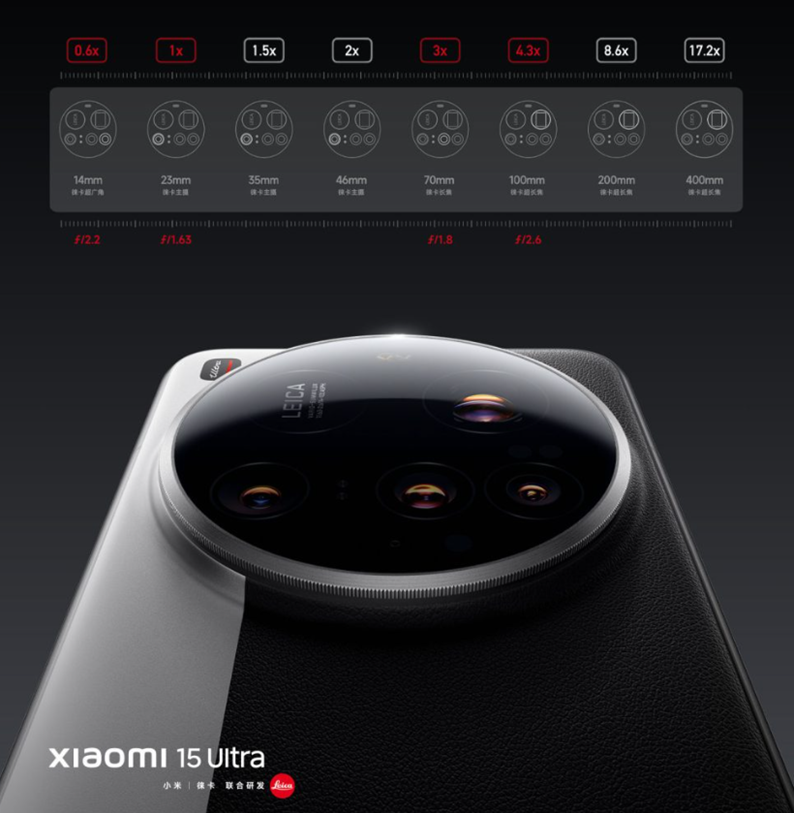
Xiaomi has packed the 15 Ultra with a quad-camera system co-engineered with Leica, promising pro-level photography. Here’s what you get:
50MP main camera with a 1-inch sensor, 14EV dynamic range and OIS for crisp and detailed shots.
50MP ultra-wide camera with a 115° field of view and 5cm macro support for landscapes and close-ups.
50MP telephoto lens with 3x zoom, perfect for capturing distant subjects with clarity.
200MP periscope telephoto camera featuring a 1/1.4-inch HP9 sensor and 4.3x optical zoom for high-quality zoomed-in shots.
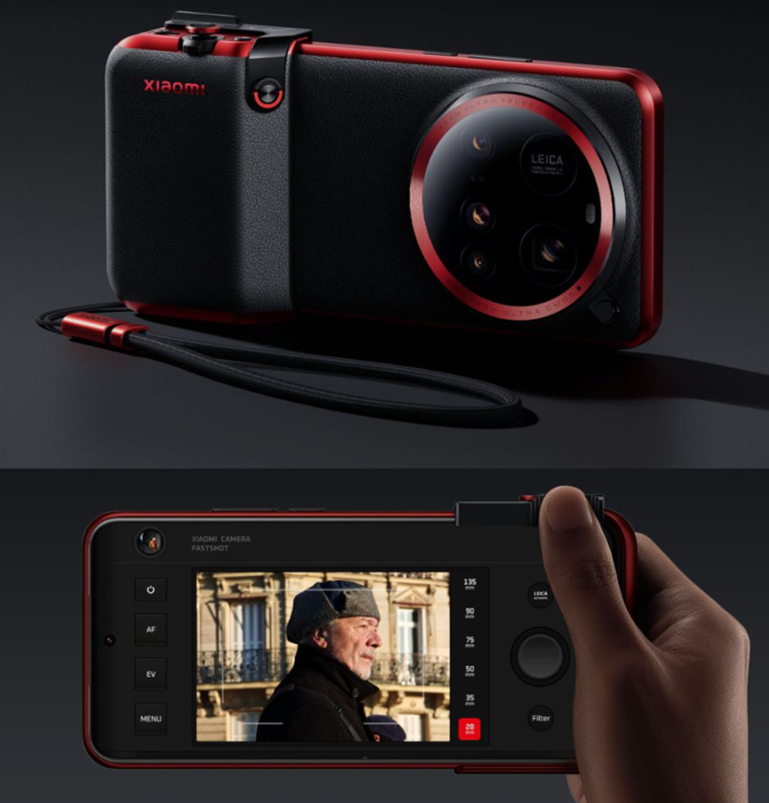
Xiaomi 15 Ultra comes with a professional imaging kit accessory. (Image credit – Xiaomi)
For video, the phone introduces ACES LOG cinematic mode allowing 8K video recording with cinema-grade colours. Xiaomi has also added UIS stabilisation with horizon-level correction for smoother, professional-looking footage.
Xiaomi 15 Ultra – Industry-First Satellite Connectivity & Other Features
One of the biggest highlights of the Xiaomi 15 Ultra is its direct satellite data communication support. It works with Starlink and TianTong satellites, allowing off-grid calls with a 7km two-way range, a first for any smartphone.
Other features include:
In-display ultrasonic fingerprint sensor
Stereo speakers with Dolby Atmos
Wi-Fi 7 & Bluetooth 6.0
Infrared sensor
IP68 water & dust resistance
Moreover, Xiaomi has introduced a Professional Imaging Kit, which includes a detachable shutter button, metal grip and an extra 2,000mAh battery extending the total battery capacity to 8,000mAh.
Professional Imaging Kit – 999 yuan (approx $137 / ₹11,995)
The phone is available for pre-order now and will go on sale in China from March 3rd. The global launch is set for March 2nd with India’s launch happening later in March.
Q1. What is the display specification of the Xiaomi 15 Ultra?
Answer. The Xiaomi 15 Ultra features a 6.73-inch 2K LTPO OLED display with a peak brightness of 3,200 nits, supporting a 120Hz adaptive refresh rate, HDR10+ and Dolby Vision.
Q2. Which chipset powers the Xiaomi 15 Ultra?
Answer. The Xiaomi 15 Ultra is powered by the Qualcomm Snapdragon 8 Gen 3 Ultra Edition chipset.
Q3. What is unique about the Xiaomi 15 Ultra’s camera system?
Answer. The Xiaomi 15 Ultra includes a quad-camera setup co-engineered with Leica, featuring a 50MP main camera, a 50MP ultra-wide camera, a 50MP telephoto lens and a 200MP periscope telephoto camera with 4.3x optical zoom.
Q4. What kind of battery and charging capabilities does the Xiaomi 15 Ultra have?
Answer. The phone has a 6,000mAh battery that supports 90W wired fast charging, 80W wireless charging and reverse wireless charging.
Q5. What is the industry-first feature of the Xiaomi 15 Ultra?
Answer. The Xiaomi 15 Ultra offers direct satellite communication support, working with Starlink and TianTong satellites for off-grid calls.