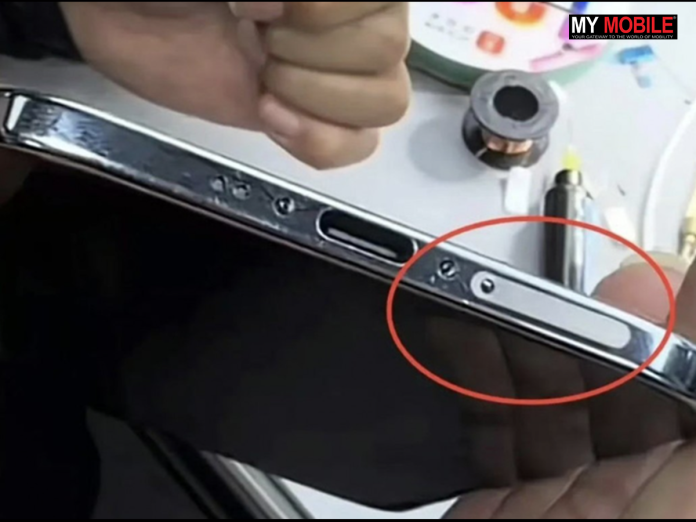
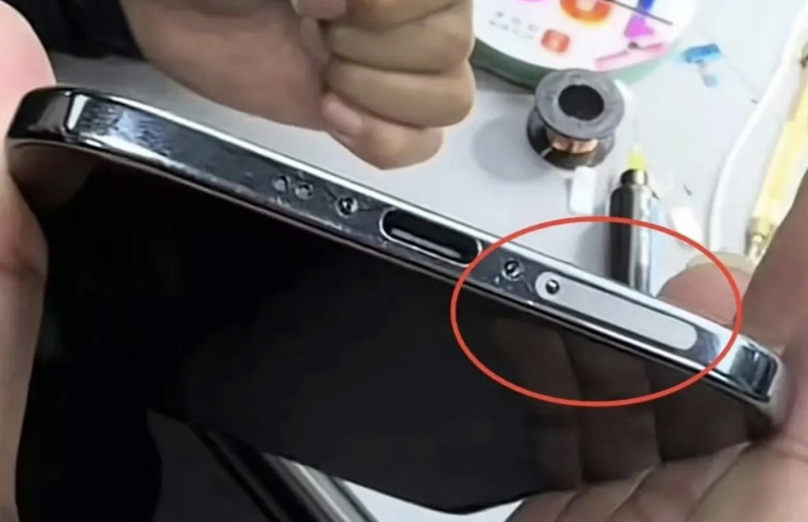
A Chinese electronics store modified the eSIM-only iPhone Air to include a physical SIM slot.
The Taptic Engine vibration motor was removed and replaced with a smaller one to free space.
The modified device reportedly supports 5G mobile data, phone calls, and IP68 water resistance
Modified iPhone Air with physical SIM slot spotted online.
The iPhone Air is Apple’s first smartphone to be sold worldwide as an eSIM-only device. But now a new report from China suggests that a physical SIM slot can still be added through hardware modification. Images shared online show a modified iPhone Air featuring a SIM tray placed next to the USB-C port. Here’s more on that.
Modified iPhone Air with SIM Slot
Details about the project remain limited and we haven’t been able to verify the original source the viral images related to the project. But it is said to have been carried out by an electronics store located in Shenzhen’s Huaqiangbei market. Some of the project images were shared by famous tipster Ice Universe @UniverseIce on X.
Viral images show a modified iPhone Air with a physical SIM slot.
To make room for the physical SIM slot, the iPhone Air’s original Taptic Engine vibration motor had to be removed. In its place, the modifier reportedly installed a much smaller vibration motor.
By removing the standard Taptic Engine, enough internal space was freed up to accommodate a physical SIM tray. The modification also included connecting a SIM card reader, allowing the physical SIM slot to function normally.
B R E A K I N G!🙀
Yes, you’re seeing this right. The iPhone Air now has a SIM card slot.
This is a modified iPhone Air created by tech enthusiasts. They installed a physical SIM card tray, allowing the phone to use a physical SIM, make calls, and access mobile data normally. pic.twitter.com/v6S71jcn4O
One of the images shows the modified iPhone Air using a China Telecom SIM card, while another image captures the device placing a phone call. The report claims that the phone is able to access 5G mobile data without issues. Even more notably, the device is said to have retained its IP68 ingress protection rating despite the hardware changes.
iPhone Air
Apple iPhone 17 series has been released as eSIM-only in the US, while markets such as Europe continue to receive models with physical SIM card slots. The iPhone Air, however, stands out as the only iPhone that is eSIM-only across all global markets.
The modification suggests that Apple could have included a physical SIM slot in the iPhone Air without major design hurdles, aside from the impact on the vibration motor. That trade-off appears to be the key compromise in this setup. Since the modified device has not been tested hands-on, it remains unclear how much weaker the smaller vibration motor is compared to the original Taptic Engine.
FAQs
Q1. What makes the iPhone Air unique compared to other iPhones?
Answer. The iPhone Air is Apple’s first globally eSIM-only device, unlike other iPhones that still ship with SIM slots in some regions.
Q2. How was the physical SIM slot added to the iPhone Air?
Answer. Modifiers in Shenzhen’s Huaqiangbei market removed the original Taptic Engine and replaced it with a smaller vibration motor to free space for a SIM tray and card reader.
Q3. Does the modified iPhone Air still function normally after the change?
Answer. Yes, reports show it can place calls, access 5G mobile data, and retain IP68 water resistance, despite the hardware modification.
Oppo Find N6 appeared on UAE’s TDRA, Singapore’s IMDA, and TUV listings.
These appearances confirm global launch plans and connectivity support including 5G, NFC, GPS, and eSIM.
TUV certification revealed 80W wired fast charging,
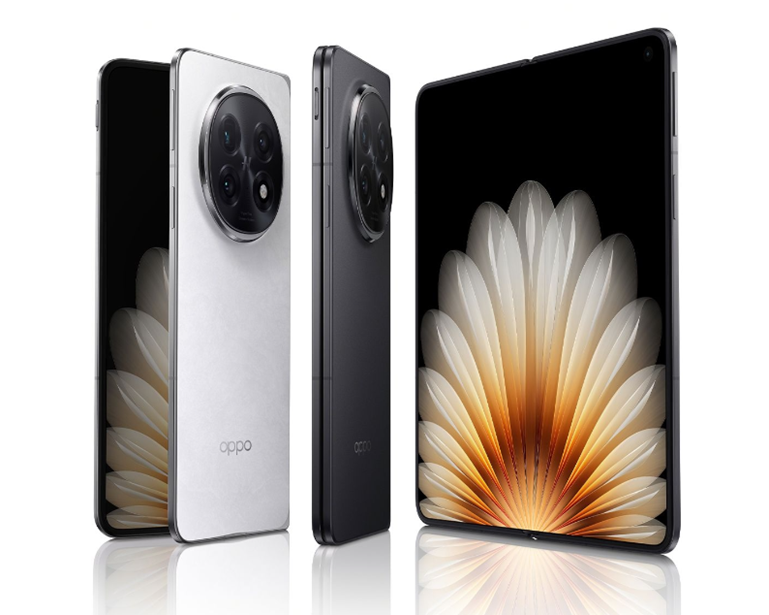
Oppo Find N6 in the picture for reference. (Image credit – Oppo)
Oppo Find N6 has been listed on multiple international certification databases in the last few days. The device has surfaced on the UAE’s TDRA and Singapore’s IMDA websites, indicating that Oppo may be gearing up to launch the Find N6 in these markets. In addition, a TUV certification listing has revealed further details about the phone’s charging capabilities. Here’s a quick roundup of everything we know based on recent appearances.
Oppo Find N6 Appears on TDRA, IMDA and TUV platforms
Oppo Find N6 global variant spotted on TDRA. (Screenshot by TheTechOutlook)
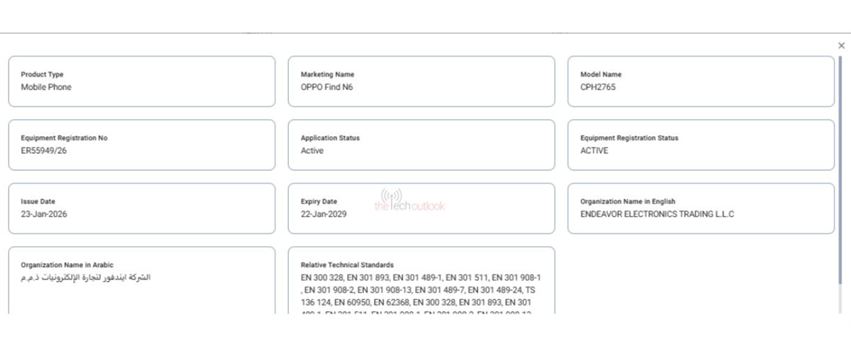
According to the UAE’s TDRA database, the device is listed under the product type “Mobile Phone” with the marketing name OPPO Find N6. It carries the model number CPH2765 and has been assigned the equipment registration number ER5549/26.
The certification was issued on January 23, 2026 and will remain valid until January 22, 2029.
Oppo Find N6 spotted on IMDA. (Screenshot by TheTechOutlook)
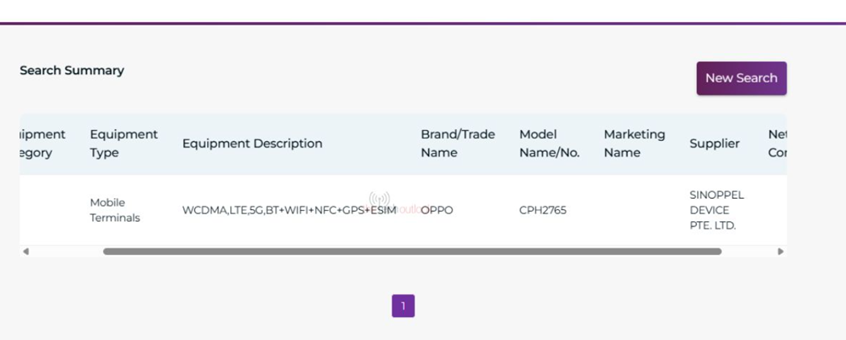
The Singapore IMDA listing also includes the same model number, CPH2765, under the equipment type “Mobile Terminals” and the brand name OPPO. This certification confirms support for WCDMA, LTE, 5G, Bluetooth, Wi-Fi, NFC, GPS, and eSIM. Although the device name is not explicitly mentioned in the IMDA entry, the listing points toward a potential launch in Singapore.
Oppo Find N6 Global Variant spotted on TUV confirming 80W charging specs. (Screenshot by TheTechOutlook)
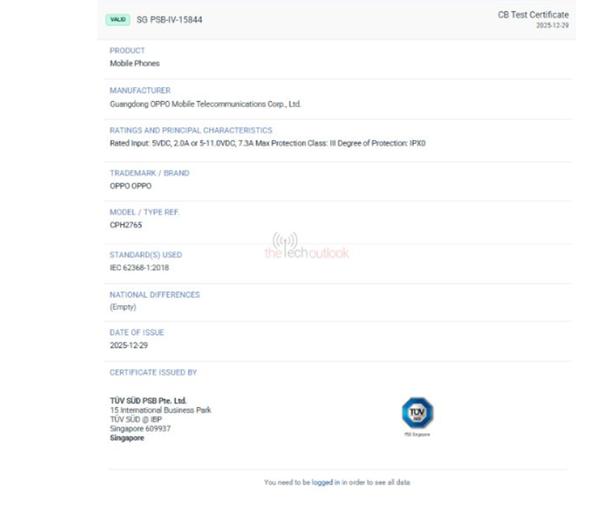
The Oppo Find N6 has additionally been spotted on the TUV certification platform with certificate number SG PSB-IV-15844. This listing mentions a rated input of 5VDC, 2.0A or 5–11VDC, 7.3A Max, which confirms 80W wired fast charging. This aligns with the earlier 3C certification, suggesting that both the Chinese and global variants of the device are likely to offer the same charging specifications.
Oppo Find N6 – Expected Specifications and Launch Timeline
Based on previous reports, the Oppo Find N6 is expected to be powered by the Snapdragon 8 Elite Gen 5 processor. It may feature a battery capacity of around 6,000mAh and include a 200MP multispectral camera. The device is also tipped to weigh approximately 225 grams and could support an AI stylus.
As of the launch timeline, famous Weibo tipster Digital Chat Station (DCS) revealed that the phone is mostly getting announced in China after the Chinese Spring Festival. For those unaware, the Chinese Spring Festival takes place from February 17 to March 3, 2026, which makes a March launch more probable.
For context, the Oppo Find N5 was announced on February 20, 2025. It was unveiled globally on the same day as its China launch. If Oppo follows a similar strategy this year, the Find N6 could also debut globally alongside its official launch in China.
FAQs
Q1. Where has the Oppo Find N6 been spotted recently?
Answer. The device appeared on UAE’s TDRA, Singapore’s IMDA, and TUV certification platforms, confirming global launch preparations.
Q2. What charging capability does the Oppo Find N6 support?
Answer. TUV certification revealed 80W wired fast charging, aligning with earlier 3C certification details.
Q3. What are the expected key specifications of the Oppo Find N6?
Answer. It may feature a Snapdragon 8 Elite Gen 5 processor, 6,000mAh battery, 200MP multispectral camera, and support for an AI stylus.
Google Photos’ Me Meme tool uses generative AI to insert a user’s photo into popular meme templates with editable captions.
Users select a portrait in Google Photos, choose or upload a template, and the AI generates a meme-style image; the feature is optional and manual.
It is currently rolling out in the US only.
(Photo by Rubaitul Azad on Unsplash)
Google has started rolling out a new Google Photos feature that allows users to create personalised memes using artificial intelligence. The “Me Meme” tool uses generative AI to place a user’s photo into popular meme formats along with captions. Here’s more on that.
Google Photos Adds Me Meme – AI-Powered Personalised Memes
Google officially announced the new feature on a support page, where a community manager confirmed the rollout. The AI-powered tool works by taking a selected photo of a person and inserting it into well-known meme templates, complete with humorous or relatable text.
Users can choose from a library of preset meme styles or upload their own templates, and they can also edit the captions to better match the intended joke or message.
Me Meme is part of a wider push to bring AI-assisted creation tools into Google Photos. It aims to give users access to stylised edits, quick enhancement suggestions, and automated creations.
At the moment, the feature is only available in the US.
How Does Me Meme Feature Work?
To create a meme, users need to select a portrait or image of themselves in Google Photos, tap the “Create” or “Meme” option, and then choose a template or add a custom one. The AI then generates a meme-style image, placing text above and below the photo in the familiar meme layout.
According to Google, the templates and captions are designed to be fun, shareable, and respectful of the original meme formats commonly seen on social media.
Google has also clarified that Me Meme is entirely optional and only works on photos that users manually select. The feature does not generate memes automatically, and all AI processing remains within the Photos app unless the user decides to save or share the result.
As of now, there is no confirmation on whether the generated memes will count toward Google Photos storage limits. However, several reports noted that existing policies suggest that newly created items will be counted as new files.
Me Meme expands Google Photos’ growing set of AI-powered tools, which already includes features like Create with AI, Photo to video, Remix, Collage, and more.
FAQS
Q1. What is the Me Meme feature in Google Photos?
Answer. It’s an AI-powered tool that lets users place their own photos into popular meme templates with editable captions.
Q2. How do users create memes with Me Meme?
Answer. By selecting a portrait in Google Photos, tapping “Create” or “Meme,” and then choosing or uploading a template; the AI generates the meme layout with text.
Q3. Where is the Me Meme feature available right now?
Answer. The rollout has started in the US only, as part of Google Photos’ expanding set of AI creation tools.
Apple may partner with Intel for future iPhone chips starting in 2028 using Intel’s 14A process.
Apple to continue to design the chips and TSMC remains the main supplier.
Intel could also produce low-end M-series chips for Macs and iPads by 2027 with its 18A process.
(Photo by Luan Gjokaj on Unsplash)
Apple is once again rumoured to be considering a renewed partnership with Intel for chip production, although the processors themselves would still be designed by Apple. Instead of chip design, Intel’s role would reportedly be limited to manufacturing.
According to a research note by GF Securities analyst Jeff Pu, as reported in a recent MacRumors report, Intel is expected to start supplying certain Apple chips using its upcoming 14A manufacturing process. This process is said to be on track for mass production in 2028.
Pu had previously stated that Intel could secure a chip supply agreement with Apple for some non-Pro iPhone models beginning in 2028. If this timeline holds, Intel may manufacture a portion of future A21 or A22 chips for iPhones. However, TSMC is still expected to remain Apple’s main chipmaking partner.
The report suggests that Intel would not be involved in the design of iPhone chips. Its role would be restricted to fabrication, marking a clear departure from the Intel Mac era, when Apple relied on Intel-designed x86 processors. Apple started moving away from Intel processors in its Mac lineup in 2020.
Intel has worked with Apple before in other areas as well, having supplied cellular modems for select iPhone models ranging from the iPhone 7 to the iPhone 11.
Beyond iPhones, Apple’s renewed ties with Intel could also extend to Mac and iPad chips. Last year, Tianfeng Securities analyst Ming-Chi Kuo said Intel might begin shipping Apple’s lowest-end M-series chip for certain Mac and iPad models as early as mid-2027. For those chips, Apple is reportedly planning to use Intel’s 18A process. Kuo did not reference iPhone chips in that prediction.
A partnership with Intel could help Apple diversify its supply chain at a crucial time. Nvidia has reportedly overtaken Apple as TSMC’s largest customer, increasing competition for chip manufacturing capacity, particularly for AI servers and consumer devices. At the same time, working with Intel could support Apple’s efforts to expand U.S. manufacturing, aligning with the Trump administration’s push to boost domestic production.
FAQs
Q1. Is Intel designing future iPhone chips?
Answer. No, Apple will continue to design its own processors. Intel’s role would be limited to manufacturing them.
Q2. When could Intel start making chips for iPhones?
Answer. According to analyst Jeff Pu, Intel may begin supplying chips for some non-Pro iPhone models in 2028 using its 14A process.
Q3. Will Apple still rely on TSMC?
Answer. Yes, TSMC remains Apple’s primary chipmaking partner, with Intel expected to handle only a portion of future production to diversify Apple’s supply chain.
WhatsApp is testing a feature for new group chat members to see previous group messages.
The option appears when adding someone to a group, is off by default, and shows alerts before sharing.
It is expected to roll out gradually to more users with no official stable release date yet.
(Photo by Eyestetix Studio on Unsplash)
WhatsApp is working on solving a long-standing issue for group chats by allowing newly added members to view earlier messages. Yes, it is reportedly working on a feature that will give the new group chat members a better context about the group.
The feature has been spotted in a recent WhatsApp for iOS update released through Apple’s TestFlight beta program, according to WABetainfo. Here’s more on that.
New WhatsApp Feature for Group Chats
According to WABetaInfo, the upcoming feature is designed to let new members receive messages that were sent before they joined a group. This will help users understand the purpose of the group and follow ongoing discussions without feeling lost. At present, WhatsApp only allows users to see messages sent after they become part of a group, unlike platforms such as Telegram that already support chat history access.
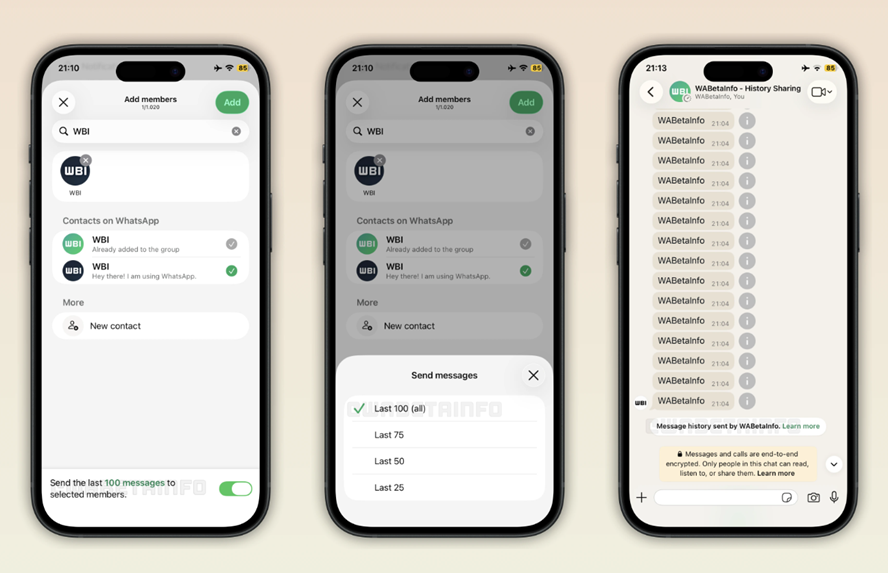
The feature has been spotted in a recent WhatsApp for iOS update. (Screenshot by WABetainfo)
As per the report, new members can receive up to 100 recent messages shared in the group over the past 14 days. These shared messages will appear in a different colour, making it easy to distinguish them from new conversations.
WhatsApp will also notify existing group members when chat history is shared with a new participant. In addition, the app will display a message in the group chat mentioning the name of the user who shared the past messages.
The option to share chat history will appear while adding a new member to a group. After tapping on the ‘Add member’ option, users should see a new setting at the bottom of the screen that allows them to share recent messages. They can choose to send up to 100 messages or limit it to fewer messages, depending on their preference.
By default, the feature will remain turned off and WhatsApp will not automatically send previous messages to new members. The app will also show alerts when users attempt to share chat history. These alerts are expected to appear up to three times and from the fourth attempt onwards, messages will be shared once the user confirms the action.
Availability
The feature was earlier hinted at for WhatsApp on Android, but the latest development suggests that the Meta-owned messaging platform is now preparing to roll it out more broadly, starting with iOS users.
Currently, the feature is only available to WhatsApp for iOS users who have installed the beta update via the TestFlight app. The rollout is expected to be gradual. As of now, there is no official timeline yet for a stable release.
FAQs
Q1. What does the new WhatsApp group chat feature do?
Answer. It lets newly added group members receive up to 100 past messages from the previous 14 days, with those messages shown in a different colour to distinguish them from new conversations.
Q2. How is WhatsApp group chat history shared and controlled?
Answer. The share history option appears when adding a member; it is off by default, lets the adder choose how many messages (up to 100) to share, shows alerts before sharing (up to three times), and notifies existing members while naming who shared the history.
Q3. When and where will the new WhatsApp group chat feature be available?
Answer. It was spotted in the WhatsApp for iOS TestFlight beta; rollout will be gradual, there’s no official stable release date yet, and the feature was previously hinted at for Android.
Camera phones under ₹25k – OnePlus Nord CE 5 5G, Xiaomi Redmi Note 15, Motorola Edge 60 Fusion, iQOO Z10 and Nothing Phone 3a Pro.
Looking for a smartphone that delivers impressive photography without stretching your budget? The midrange segment under ₹25,000 is a sweet spot for camera-focused devices. We have today in the market smartphones in this segment that offer high-resolution sensors, versatile multi-lens setups, and advanced AI features once reserved for premium flagships.
From crisp low-light shots to smooth 4K video recording, these phones balance performance and affordability. These are ideal for content creators, social media enthusiasts, and everyday users alike.
Here are some of the best midrange camera phones under ₹25k that prove you don’t need to spend big to capture stunning photos and videos.
OnePlus Nord CE 5 5G
The OnePlus Nord CE 5 5G is equipped with a triple rear camera setup, featuring a 50MP main wide sensor with PDAF, an 8MP ultra-wide lens, and a 2MP macro lens for close-up shots. This combination allows users to capture detailed photos, expansive landscapes, and creative macro images.
For video, the device supports 4K recording at 30fps and 1080p at 30/60fps, offering flexibility for high-resolution or smoother footage.
On the front, it houses a 16MP selfie camera with HDR, ensuring clear and vibrant portraits and video calls. Together, these specs make the Nord CE 5 5G a well-rounded mid-range smartphone for versatile photography and everyday content creation.
Key Features –
77″ (17.2 cm) 120Hz AMOLED Display
MediaTek Dimensity 8350 Apex
50+8 MP Rear Camera
16 MP Front Camera
8 GB RAM
128 GB Storage
7100 mAh Battery
80W Fast Charging
Android v15
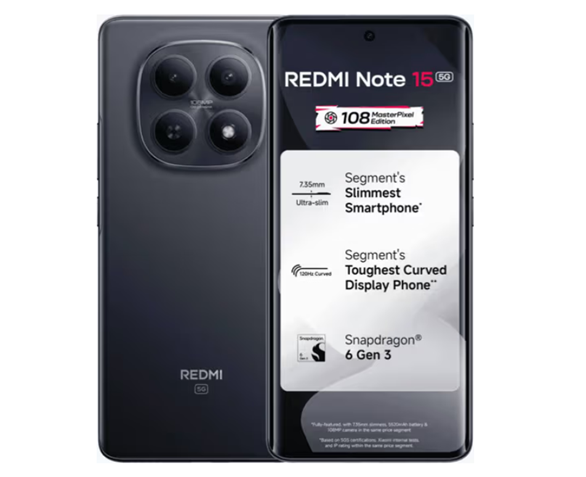
Xiaomi Redmi Note 15
The Xiaomi Redmi Note 15 is equipped with a powerful camera system tailored for versatile photography. It features a 108MP main sensor that delivers high-resolution images with excellent detail and dynamic range, supported by an 8MP ultra-wide lens for capturing expansive landscapes and group shots, and a 2MP macro lens for close-up photography.
On the video side, the device supports 4K recording at 30fps and 1080p at 30/60fps, giving users flexibility for both cinematic and smoother footage.
For selfies and video calls, the phone includes a 20MP front camera with HDR, ensuring clear and vibrant portraits.
Together, these specs make the Redmi Note 15 a strong mid-range contender, offering a balance of high-resolution imaging, wide-angle versatility, and reliable video performance for everyday content creation.
Key Features –
77″ (17.2 cm) 120Hz AMOLED Display
Snapdragon 6 Gen 3 Octa core
108+8 MP Rear Camera
20 MP Front Camera
8 GB RAM
128 GB Storage
5520 mAh Battery
45W Fast Charging
Android v15
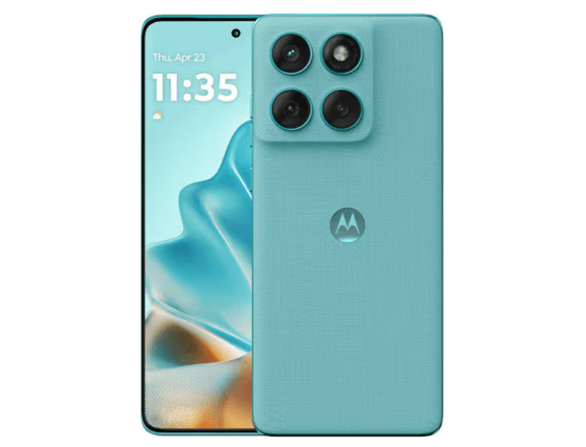
Motorola Edge 60 Fusion
The Motorola Edge 60 Fusion offers a dual-camera setup designed to balance detail and versatility. It features a 50MP main sensor that captures sharp, high-resolution images with strong dynamic range, paired with a 13MP ultra-wide lens for expansive shots and group photos. This combination allows users to switch seamlessly between detailed close-ups and wide-angle perspectives.
On the video front, the device supports 4K recording at 30fps and 1080p at multiple frame rates, making it suitable for both cinematic and smooth video capture.
For selfies and video calls, the phone includes a 32MP front camera, ensuring crisp and vibrant portraits with HDR support. Altogether, the Edge 60 Fusion’s camera system delivers a well-rounded experience, offering reliable performance for everyday photography, creative wide-angle shots, and high-quality video recording.
Key Features
67″ (16.94 cm) 120Hz P-OLED Display
MediaTek Dimensity 7400 Octa core SoC
50+13 MP Rear Camera
32 MP Front Camera
8 GB RAM
256 GB Storage
5500 mAh Battery
68W Fast Charging
Android v15
iQOO Z10
The iQOO Z10 is equipped with a dual-camera setup that balances high-resolution imaging with practical versatility. On the rear, it features a 50MP main sensor for sharp, detailed shots and a 2MP secondary lens for depth or macro support, enabling clear portraits and creative close-ups. The phone supports 4K video recording at 30fps and 1080p at 30/60fps, giving users flexibility for both cinematic and smoother video capture.
On the front, the device houses a 32MP selfie camera with HDR, ensuring crisp and vibrant portraits as well as reliable video call quality.
Together, these specs make the iQOO Z10 a solid mid-range option, offering dependable everyday photography, high-resolution video recording, and social-media-ready selfies.
Key Features –
77″ (17.2 cm) 120Hz AMOLED Display
Snapdragon 7s Gen 3 Octa core Processor
50+2 MP Rear Camera
32 MP Front Camera
8 GB RAM
128 GB Storage
7300 mAh Battery
90W Fast Charging
Android v15
Nothing Phone 3a Pro
The Nothing Phone 3a Pro comes equipped with a versatile triple-camera system that emphasises detail and flexibility. On the rear, it features dual 50MP sensors, a primary wide lens for sharp, high-resolution shots and an ultra-wide lens for expansive landscapes, alongside a secondary supporting sensor for depth or macro photography.
For video, the device supports 4K recording at 30fps and 1080p at multiple frame rates, ensuring smooth and cinematic footage. On the front, the phone houses a 50MP selfie camera, delivering clear, vibrant portraits and reliable video call quality.
Altogether, the Nothing Phone 3a Pro’s camera capabilities combine flagship-level resolution with practical versatility, making it a strong mid-range option for everyday photography and content creation.
Q1. What are the camera specs of the OnePlus Nord CE 5 5G?
Answer. It has a 50MP main wide sensor with PDAF, an 8MP ultra-wide lens, and a 2MP macro lens, plus a 16MP HDR selfie camera.
Q2. How is the rear camera resolution of Xiaomi Redmi Note 15?
Answer. The Xiaomi Redmi Note 15 with its 108MP main sensor, supported by an 8MP ultra-wide and 2MP macro lens.
Q3. What front camera does the Motorola Edge 60 Fusion feature?
Answer. It comes with a 32MP HDR selfie camera, paired with a 50MP main sensor and 13MP ultra-wide lens on the rear.
Q4. What are the video recording capabilities of the iQOO Z10?
Answer. The iQOO Z10 supports 4K video at 30fps and 1080p at 30/60fps, with a 50MP main + 2MP secondary rear setup and a 32MP front camera.
Q5. What makes the Nothing Phone 3a Pro stand out in camera specs?
Answer. It features dual 50MP rear sensors (wide + ultra-wide) with an extra supporting lens, and a 50MP front camera, offering flagship-level resolution.
Google’s AI Mode in Search now integrates Gmail and Google Photos to deliver customised, context-aware answers.
It can suggest products based on past purchases and create tailored travel itineraries by referencing booking details and personal photos.
The opt-in feature is limited to Google AI Pro and Ultra subscribers in the US.
Google AI Mode for More Personalised Search Answers. (Image credit – Unknown)
Google is rolling out Personal Intelligence to AI Mode in Google Search after introducing the same capability within the Gemini app. With this update, AI Mode can draw on a user’s personal context to surface deeper insights and deliver more relevant and customised search results.
As part of this enhancement, AI Mode can now connect with Gmail and Google Photos during searches, allowing it to generate personalised responses based on a user’s data and activity.
What Google’s Personal AI Search Can Do?
As an example, Google highlighted how the updated AI Mode can improve shopping-related searches by factoring in past purchases. By analysing shopping history, the feature can suggest products that better align with individual preferences.
Robby Stein, VP of Product, Google Search, shared a personal example in a blog post, saying, “I was looking for a new pair of sneakers, and AI Mode noticed a brand I’d just bought and suggested a new style I hadn’t seen yet. The recommendation was spot on — I bought them instantly!”
The company also explained how AI Mode can assist with travel planning by referencing booking details stored in Gmail and past travel photos saved in Google Photos. This allows the tool to create tailored itineraries rather than generic lists of suggestions.
The tech giant explained, “Say you’re looking for things to do and places to eat that the whole family would enjoy ahead of your upcoming getaway. With Personal Intelligence, AI Mode can reference your hotel booking in Gmail and travel memories in Google Photos, to suggest an itinerary with something for everyone.”
“You’ll see tailored recommendations like an interactive museum perfect for the kids or an old-timey ice cream parlor, because it recalls the many ice-cream selfies captured in your pictures. It’s not just a generic list of restaurants and activities; it’s a personalized starting point for your next great weekend,” the company added.
Privacy and Rollout Details
Google has clarified that Personal Intelligence is an opt-in feature. Users must manually connect their Gmail and Google Photos accounts to Search if they want AI Mode to deliver these personalised experiences.
On the privacy front, Google says AI Mode does not directly train on users’ Gmail inboxes or Google Photos libraries. According to the company, training is restricted to limited information within specific prompts and the model’s responses with the goal to“improve functionality over time.”
The rollout is currently happening through Search Labs and is limited to Google AI Pro and Ultra subscribers in the US. The feature is only available for personal Google accounts and is not supported for Workspace business, enterprise, or education users.
FAQs
Q1. What new capability has Google added to AI Mode in Search?
Answer. Google has introduced Personal Intelligence, allowing AI Mode to connect with Gmail and Google Photos for more personalised search answers.
Q2. How can AI Mode use personal data to improve search results?
Answer. It can analyse shopping history from Gmail to suggest products, or reference travel bookings and photos to create tailored itineraries.
Q3. Is the Personal Intelligence feature available to all users?
Answer. No, it’s opt-in and currently limited to Google AI Pro and Ultra subscribers in the US, for personal accounts only.
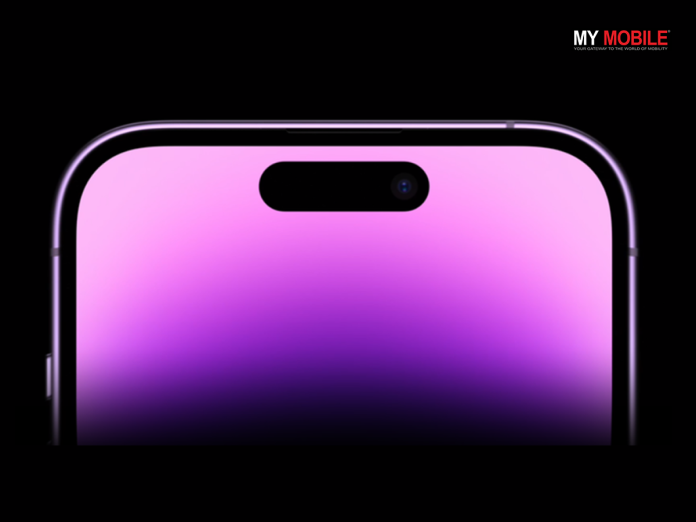
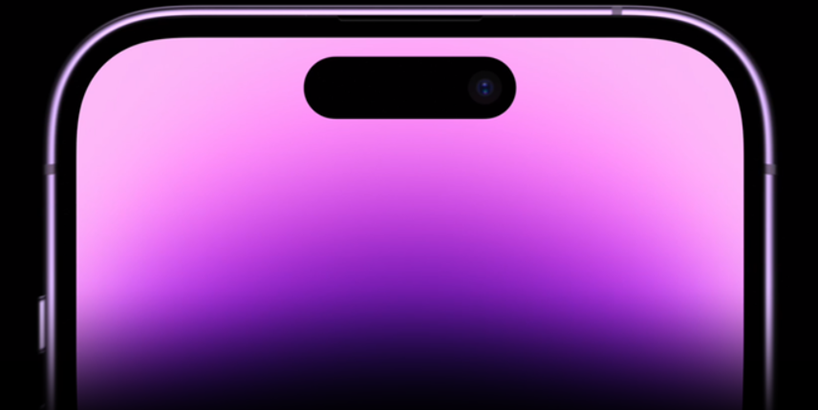
The iPhone 18 Pro and Pro Max are rumoured to feature a redesigned Dynamic Island that is about 35% narrower.
Reports suggest Apple may move only the Face ID flood illuminator under the display.
Analysts expect the slimmer Dynamic Island design to remain until at least 2027.
More details appeared about the iPhone 18 Pro dynamic island. (Image credit – Apple)
Leaks around Apple’s next-generation iPhone 18 Pro lineup continue to surface, with fresh claims now shedding light on the size of its redesigned Dynamic Island. Recent rumours have consistently pointed to a smaller cutout on the iPhone 18 Pro and iPhone 18 Pro Max. Now, a new leak has offered specific measurements.
iPhone 18 Pro Dynamic Island Details Leaked
iPhone 18 Pro Dynamic Island mockup. (Image credit – Ice Universe on X)
According to well-known tipster Ice Universe @UniverseIce on X, the Dynamic Island on the iPhone 18 Pro models will be around 35 percent narrower compared to the one found on the iPhone 17 Pro series. The leaker claims the new cutout will measure roughly 13.5mm in width, down from about 20.7mm on current models.
A mock-up image was also shared to illustrate how the slimmer Dynamic Island could appear on the display.
The Dynamic Island cutout width on the iPhone 18 Pro and iPhone 18 Pro Max has been reduced from 20.76 mm to 13.49 mm, representing a reduction of approximately 35%. pic.twitter.com/dLnUdCts7z
These dimensions reportedly refer to the default appearance of the Dynamic Island when the display is active. This includes the surrounding black pixels that frame the actual cutouts for the Face ID sensors and the front-facing camera. As seen on existing iPhones, the Dynamic Island is expected to temporarily expand when showing Live Activities, alerts, or other on-screen information.
Earlier reporting from The Information suggested that Apple planned to introduce under-display Face ID on the iPhone 18 Pro models. That report claimed the phones would feature only a hole-punch selfie camera positioned in the top-left corner, eliminating the familiar pill-shaped cutout.
However, newer information indicates that only the Face ID flood illuminator may be moved beneath the display this year. As a result, Apple may reduce the size of the Dynamic Island rather than remove it entirely.
Display industry analyst Ross Young has also weighed in, stating that the smaller Dynamic Island design is expected to remain in place through at least 2027. This suggests that a fully seamless,uninterrupted iPhone display could still be several years away.
While Ice Universe has previously shared accurate information about iPhone dimensions, the leaker’s track record is not flawless. Still, the new details add weightto ongoing speculation about Apple’s gradual approach to redesigning the front of its flagship devices.
Apple will most likely announce the iPhone 18 Pro and iPhone 18 Pro Max in September 2026.
FAQs
Q1. How much smaller will the Dynamic Island be on the iPhone 18 Pro models?
Answer. Leaks suggest it will be about 35% narrower, measuring roughly 13.5mm compared to 20.7mm on the iPhone 17 Pro series.
Q2. Will Apple completely remove the Dynamic Island on the iPhone 18 Pro?
Answer. No, reports indicate only the Face ID flood illuminator may move under the display, reducing the cutout size but not eliminating the Dynamic Island entirely.
Q3. When is the iPhone 18 Pro expected to launch?
Answer. Apple is most likely to announce the iPhone 18 Pro and Pro Max in September 2026.
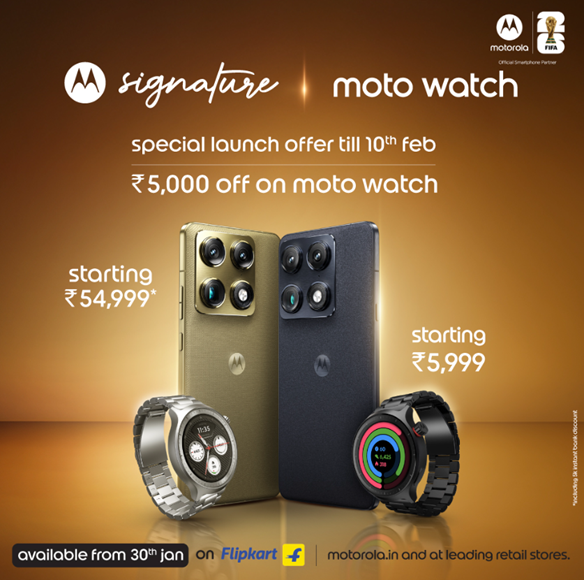
Motorola Signature launched as an ultra-premium flagship smartphone in India with 6.8-inch AMOLED display, Snapdragon 8 Gen 5, up to 16GB RAM/1TB storage, triple 50MP cameras and 5,200mAh battery.
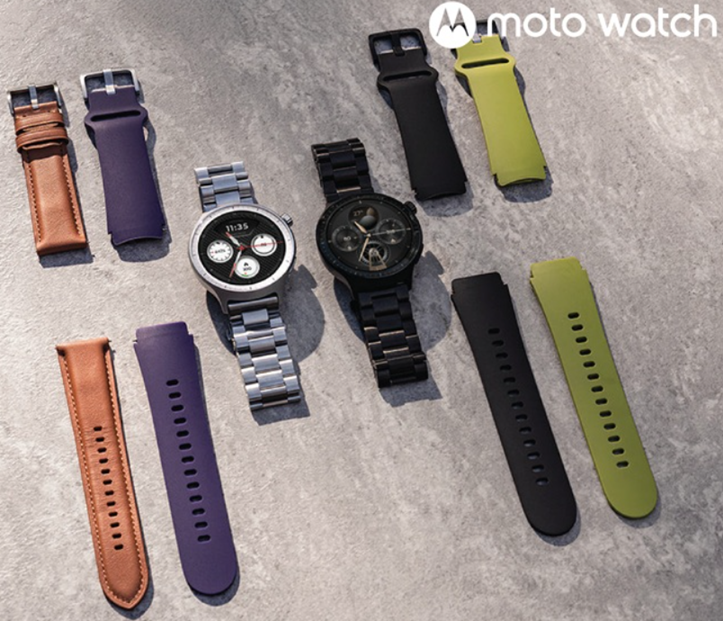
Moto Watch runs on Polar platform with a 1.4-inch OLED display, health tracking (heart rate, SpO2, sleep), dual-frequency GPS and 13-day battery life.
Both devices go on sale in India starting January 30.
Motorola Signature Ultra-Premium Smartphone and Moto Watch in India. (Image credit – Motorola)
Motorola has expanded its premium product lineup in India with the launch of the Motorola Signature smartphone and the Moto Watch smartwatch. Positioned as the brand’s ultra-premium flagship, the Motorola Signature is joined by the Moto Watch, Motorola’s latest smart wearable that runs on the Polar platform. With these launches, Motorola is strengthening its premium ecosystem in the Indian market, taking on offerings from competing Chinese brands.
Commenting on the launch, T.M. Narasimhan, Managing Director, Motorola India, said, “With the Motorola Signature, we are creating a new benchmark for ultra-premium smartphones in India, one that goes far beyond specifications. This launch reflects our commitment to combining world-class innovation, refined design, and meaningful experiences that truly elevate everyday living. By bringing together breakthrough camera technology rated for gold standards by DXOMARK, flagship performance, exclusive Signature Club privileges first time in Indian smartphone industry, and a wellness-focused ecosystem with the Moto Watch powered by Polar, we are delivering a holistic premium offering crafted for consumers who seek distinction, performance, and purpose in everything they choose.”
Motorola Signature – Key Features
Motorola Signature. (Image credit – Motorola)
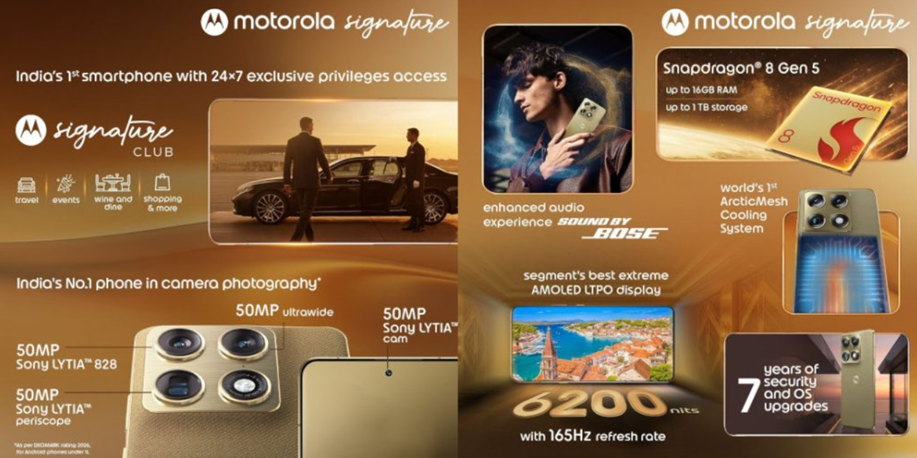
The Motorola Signature is a dual-SIM smartphone that runs on Android 16 with Motorola’s Hello UI on top. It features a large 6.8-inch Super HD (1,264×2,780 pixels) LTPO Extreme AMOLED display with up to a 165Hz refresh rate. The panel supports 100 percent DCI-P3 colour gamut, delivers up to 6,200 nits of peak brightness, offers a pixel density of 450ppi, and comes with Dolby Vision and HDR10+ support. Additional display features include a 20:9 aspect ratio, SGS Blue Light Reduction and Motion Blur Reduction certifications, and Smart Water Touch, which allows the phone to be used with wet or damp fingers.
Powering the handset is Qualcomm’s octa-core Snapdragon 8 Gen 5 chipset, built on a 3nm process. The Motorola Signature is available with up to 16GB of LPDDR5x RAM and up to 1TB of UFS 4.1 internal storage.
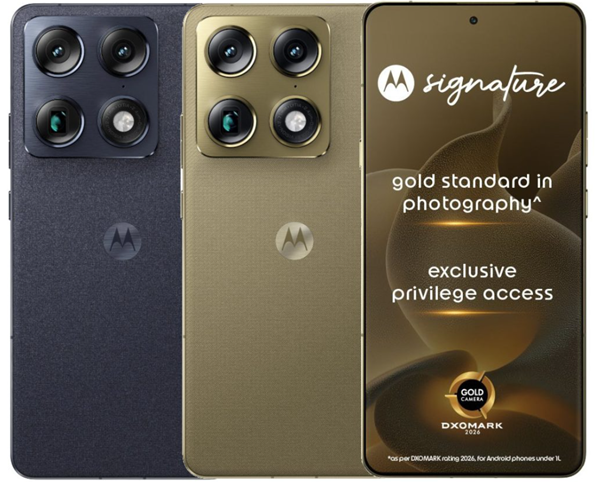
Motorola says the phone comes with IP68 and IP69 ratings for dust and water resistance, MIL-STD 810H military-grade certification, and Corning Gorilla Glass Victus 2 protection for the display. It also features an aluminium frame and a linen-inspired or twill-inspired back finish, depending on the colour option.
For photography, the Motorola Signature sports a triple rear camera setup led by a 50-megapixel Sony LYT 828 primary sensor with an f/1.6 aperture and optical image stabilisation (OIS). It is paired with a 50-megapixel ultrawide camera and a 50-megapixel Sony LYT 600 periscope telephoto lens that supports 3x optical zoom, up to 100x hybrid zoom, and OIS.
On the front, the device gets a 50-megapixel Sony LYT 500 selfie camera. The smartphone supports video recording at up to 8K at 30fps.
The handset is backed by a 5,200mAh silicon-carbon battery with support for 90W wired fast charging and 50W wireless fast charging. It also offers 10W wireless and 5W wired reverse charging. Motorola claims the device can deliver up to 41 hours of battery life.
Connectivity options include 5G, 4G LTE, Wi-Fi 7, Bluetooth 6.0, USB Type-C, GPS, GLONASS, and Galileo. Sensors onboard include a proximity sensor, ambient light sensor, accelerometer, gyroscope, and e-compass. The phone measures 162.1×76.4×6.99mm and weighs around 186g.
Motorola Signature – Price and Availability in India
The Motorola Signature will be available in Pantone Carbon and Pantone Martini Olive colour options.
The phone is priced starting at Rs. 59,999 for the 12GB RAM + 256GB storage variant. The 16GB RAM + 512GB storage model costs Rs. 64,999, while the top-end 16GB RAM + 1TB storage version is priced at Rs. 69,999. Buyers can avail of an instant discount of Rs. 5,000 using HDFC Bank or Axis Bank cards, or opt for an exchange bonus of up to Rs. 5,000.
The smartphone will go on sale in India starting January 30 via Flipkart.
Moto Watch – Key Features
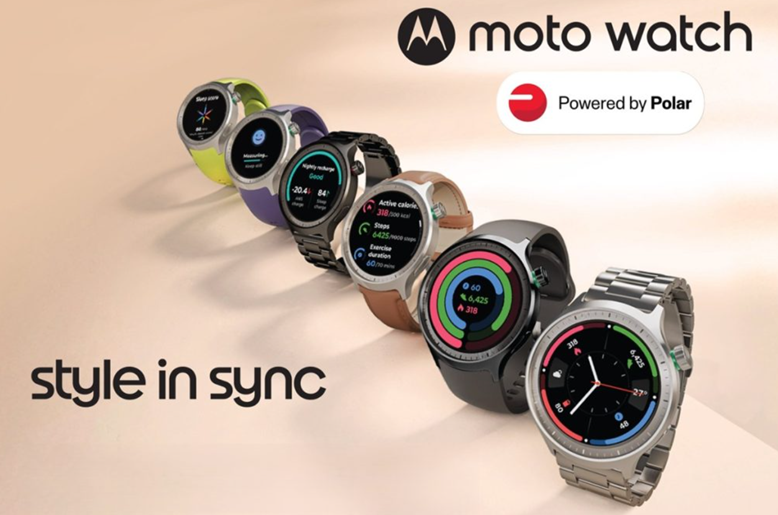
The Moto Watch features a round dial design with a 1.4-inch OLED display protected by Corning Gorilla Glass 3. It comes with 4GB of eMMC storage and supports dual-frequency GPS along with Bluetooth 5.3 connectivity.
In terms of health and fitness tracking, the smartwatch offers heart rate monitoring, recovery tracking, hydration reminders, blood oxygen (SpO2) monitoring, step and calorie tracking, and sleep analysis with a dedicated sleep score. The Moto Watch is compatible with devices running Android 12 or later.
The wearable is equipped with an accelerometer, gyroscope, PPG sensor, SpO2 sensor, ambient light sensor, and an e-compass. Motorola claims the Moto Watch can deliver up to 13 days of battery life, while just five minutes of charging is said to provide enough power for a full day of use.
It comes with an IP68 rating for dust and water resistance and offers water resistance up to 1 ATM. The smartwatch measures 47x47x12mm and weighs approximately 35g.
Moto Watch – Price and Availability in India
The silicone strap version of the new Moto Watch is available in Pantone Herbal Garden, Pantone Volcanic Ash, and Pantone Parachute Purple colours. The leather strap model comes in a Pantone Mocha Mousse finish, while the stainless steel band variant is offered in Matte Black and Matte Silver colourways.
The Moto Watch is priced at Rs. 5,999 for the silicone strap variant. The leather and metal strap options are priced at Rs. 6,999.
Sales will begin in India on January 30 through the Motorola India website.
FAQs
Q1. What products did Motorola recently launch in India?
Answer. Motorola introduced its ultra-premium flagship smartphone, the Motorola Signature, along with the Moto Watch smartwatch.
Q2. What are the standout features of the Motorola Signature smartphone?
Answer. It offers a 6.8-inch AMOLED display with 165Hz refresh rate, Snapdragon 8 Gen 5 chipset, up to 16GB RAM/1TB storage, triple 50MP rear cameras, and a 5,200mAh battery with 90W wired and 50W wireless charging.
Q3. How much does the Motorola Signature cost in India?
Answer. The phone starts at ₹59,999 for the 12GB+256GB variant, ₹64,999 for the 16GB+512GB model, and ₹69,999 for the 16GB+1TB version.
Q4. What health and fitness features does the Moto Watch include?
Answer. It tracks heart rate, SpO2, hydration, recovery, steps, calories, and sleep analysis with a dedicated sleep score.
Q5. When will the Motorola Signature and Moto Watch go on sale in India?
Answer. Both devices will be available starting January 30 via Flipkart (smartphone) and Motorola India’s website (smartwatch).
The Galaxy S26+ surfaced on Geekbench with the Exynos 2600 chipset, Xclipse 960 GPU, Android 16, and 12GB RAM.
It is also certified on China’s 3C platform, which reveals the device supports 45W fast charging with a 4,900mAh battery, while the Ultra variant may feature 60W charging.
Samsung is tipped to unveil the Galaxy S26 series (S26, S26+, S26 Ultra) at Galaxy Unpacked on February 25 with global availability expected from March 11.
Samsung Galaxy S25+ in the picture for reference only. (Image credit – Samsung)
Ahead of the official launch in India and global markets, the alleged Samsung Galaxy S26+ has surfaced on Geekbench and China’s Compulsory Certification (3C) platform, revealing key details related to performance, software, and charging capabilities. Here’s what we know so far based on all recent appearances and leaks.
Samsung Galaxy S26+ Appears on Geekbench
Samsung Galaxy S26+ Appears on Geekbench. (Screenshot by @yabhishekhd on X)
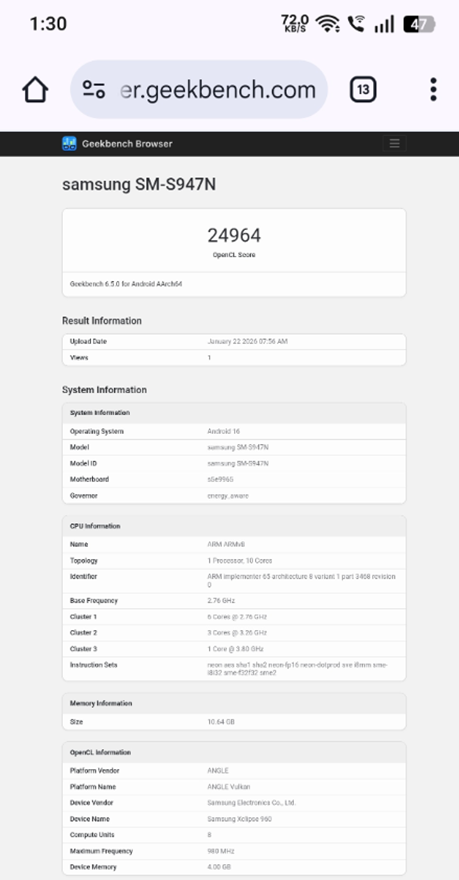
A Samsung smartphone carrying the model number SM-S947N has been listed on Geekbench, as first highlighted by tipster Abhishek Yadav @yabhishekhd on X (formerly Twitter). Based on the model number and hardware details, the device is believed to be the South Korean variant of the Samsung Galaxy S26+.
The Geekbench listing shows an octa-core processor builton ARMv8 architecture with a base clock speed of 2.76GHz. The CPU configuration reportedly includes one prime core clocked at 3.80GHz, three performance cores running at 3.26GHz, and three efficiency cores operating at 2.76GHz.
As per speculation, this chipset is Samsung’s upcoming Exynos 2600, which is said to be manufactured using a 2nm GAA process.
Samsung Galaxy S26 Plus (SM-S947N) — South Korea variant 🇰🇷
Confirmed to feature Samsung’s in-house Exynos 2600, built on the 2nm GAA process.
CPU (10 cores) configuration:
– 1× C1 Ultra (3MB L2) @ 3.80GHz
– 3× C1 Pro @ 3.26GHz
– 6× C1 Pro @ 2.76GHz
🎮 GPU: Xclipse 960
🍭… pic.twitter.com/MQL3nIhLfU
For graphics, the SoC is tipped to be paired with an Xclipse 960 GPU. The listing also suggests the phone comes with around 10.64GB of RAM, which is expected to be marketed as 12GB. The device is shown running Android 16 and could ship with One UI 8.5 on top. The motherboard identifier listed is “s5e9965.”
In terms of performance, the Galaxy S26+ recorded an OpenCL score of 24,964 points on Geekbench 6.5.0 for Android AArch64. For reference, the Galaxy S25+ reportedly scores around 18,000 points in the same test indicating a notable generational improvement.
Galaxy S26+ Charging Speed Revealed via 3C Certification
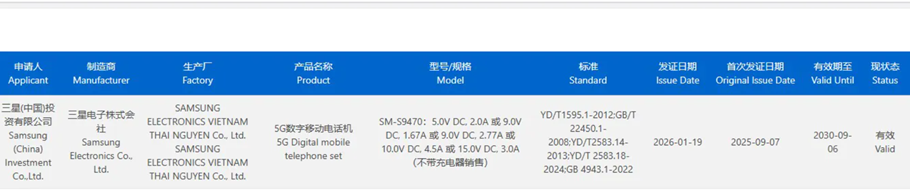
The listing for the Samsung Galaxy S26+ on China’s 3C database (Screenshot via Gadgets360)
The Samsung Galaxy S26+ has also appeared on China’s 3C certification website with the model number SM-S9470. According to the listing, the phone will support 45W wired fast charging (4.5A or 15.0V DC), which is in line with the Galaxy S25+.
Samsung has not bundled chargers with its smartphones since the launch of the Galaxy S21 in January 2021, following a similar move by Apple a year earlier. The 45W charging support suggests the Galaxy S26+ will charge faster than the standard Galaxy S26, which is rumoured to support 25W charging. Meanwhile, the Galaxy S26 Ultra reportedly cleared 3C certification in December 2025 with support for a 60W charger.
The Galaxy S26+ is rumoured to pack a 4,900mAh battery and could be powered by either the Snapdragon 8 Elite Gen 5 or the Exynos 2600 chipset, depending on the market. The device has also previously appeared on the BIS database with the model number SM-S947B/DS.
Certifications Confirm Multiple Regional Variants
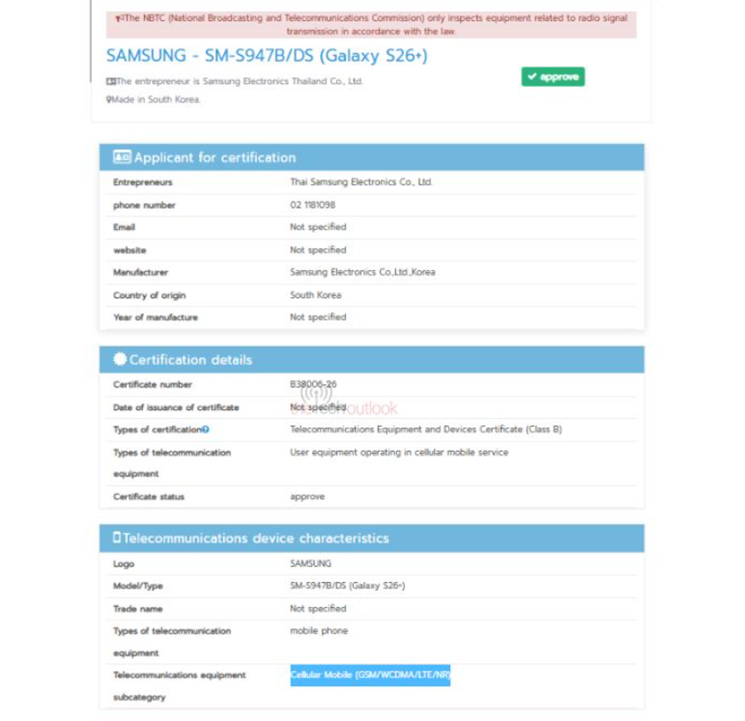
Samsung Galaxy S26+ spotted on NBTC. (Screenshot by TheTechOutlook)
Previously, the Galaxy S26+ was spotted on the NBTC certification platform, confirming the model number SM-S947B/DS. The device has also appeared on TUV and BIS databases.
The TUV listing reportedly revealed multiple regional variants including SM-S947B (India and international markets), SM-S947B/DS (dual-SIM), SM-S947N (South Korea), SM-S947U (US carrier-locked), SC-52G (Japan NTT DOCOMO), SCG38 (Japan au/KDDI), SM-S947Z (South-East Asia and Oceania), SM-S9470 (China), SM-S947U1 (US factory unlocked), and SM-S947W (Canada).
Samsung Galaxy S26+ – Expected Specifications
Leaks suggest the Galaxy S26+ will feature a 6.7-inch QHD display with up to a 120Hz adaptive refresh rate. It is expected to launch with 12GB of RAM as standard and be offered in 256GB and 512GB storage variants.
On the camera front, the phone is tipped to feature a triple rear camera setup consisting of a 50-megapixel primary sensor, a 12-megapixel ultra-wide camera, and a 10-megapixel telephoto lens with 3x optical zoom. A 12-megapixel front-facing camera is also expected for selfies and video calls.
Samsung Galaxy S26 Series Launch Timeline (Leaked)
Separately, well-known Tipster Ice Universe @UniverseIce has claimed on X (formerly Twitter) that Samsung will host its next Galaxy Unpacked event on February 25. This is when the Galaxy S26, Galaxy S26+, and Galaxy S26 Ultra are expected to be officially unveiled.
According to the leak, pre-orders for the Galaxy S26 series may begin on February 26 and run until March 4. This could be followed by a pre-sale period from March 5 to March 10 with full retail availability starting on March 11.
The leaked schedule is said to be based on the South Korean market and launch timelines for India and other global regions may vary slightly. Even so, the information offers a fairly clear indication of what to expect from Samsung’s upcoming flagship launch.
FAQs
Q1. What key performance details were revealed about the Galaxy S26+ on Geekbench?
Answer. The listing showed the Exynos 2600 chipset built on a 2nm GAA process, paired with an Xclipse 960 GPU, 12GB RAM, and running Android 16 with One UI 8.5.
Q2. What charging capabilities does the Galaxy S26+ support?
Answer. According to China’s 3C certification, the Galaxy S26+ supports 45W wired fast charging with a 4,900mAh battery, while the Ultra variant may support 60W charging.
Q3. When is the Galaxy S26 series expected to launch?
Answer. Leaks suggest Samsung will unveil the Galaxy S26, S26+, and S26 Ultra at Galaxy Unpacked on February 25, with retail availability starting March 11.