Samsung has confirmed the Galaxy F70e India launch on February 2 with sales via Flipkart and Samsung’s online store.
The phone is tipped to be priced under ₹15,000.
Rumoured specs include a 6.7-inch HD+ 120Hz display, MediaTek Dimensity 6300 chip, 6GB RAM, 128GB storage, 50MP dual rear camera, 6,000mAh battery with 25W charging, IP54 rating, and One UI 8 (Android 16).
Samsung Galaxy F70e India launch confirmed. (credit – Samsung)
Samsung Galaxy F70 series India launch has been officially confirmed now. While the company has not officially revealed the launch date or model names yet, a leaked render and tipped specifications of the Samsung Galaxy F70e have surfaced online. The upcoming Galaxy F70 series is expected to include two smartphones, with one positioned in the mid-range segment and the other aimed at budget buyers. Here’s everything we know about the upcoming phones so far.
Samsung Galaxy F70e India Launch and Price
Samsung has confirmed that the Galaxy F70e will be revealed in India on February 2. The smartphone is confirmed to go on sale via Flipkart and the Samsung India online store.
One of the Galaxy F70 series models is expected to be priced under Rs. 30,000, while the other handset is tipped to fall in the Rs. 10,000 to Rs. 15,000 price bracket.
Meanwhile, tipster Sanju Choudhary @saaaanjjjuuu on X has revealed that the Samsung Galaxy F70e will be priced in India under Rs. 15,000. It will be positioned as the more affordable option in the lineup.
Exclusive ✨
Samsung F70e to launch on 2nd February:
The tipster also leaked a render of the Galaxy F70e in the same post. The image suggests a waterdrop-style notch on the front, likely housing the selfie camera. The handset appears to feature relatively thick bezels and places the power button and volume controls on the right side.
The phone is shown in a black colour option and is said to come with a vegan leather back panel, offering a distinctive finish in the budget segment.
Samsung Galaxy F70e – Key Specs (Rumoured)
In the same post, the tipster also revealed that the Samsung Galaxy F70e is tipped to feature a 6.7-inch HD+ display with a refresh rate of up to 120Hz. It is expected to be powered by the MediaTek Dimensity 6300 chipset and could offer up to 6GB of RAM along with up to 128GB of internal storage.
For photography, the Galaxy F70e is said to sport a dual rear camera setup comprising a 50-megapixel primary sensor and a 2-megapixel secondary camera. On the front, it may feature an 8-megapixel camera for selfies and video calls.
The smartphone is reportedly backed by a 6,000mAh battery with support for 25W wired fast charging. Additional features are expected to include a side-mounted fingerprint scanner, microSD card support for storage expansion, and an IP54 rating for dust and splash resistance. The Galaxy F70e is said to run on One UI 8, based on Android 16.
With the official launch expected later today, more details about the Galaxy F70e and the rest of the Galaxy F70 series should be revealed soon.
FAQs
Q1. When will the Samsung Galaxy F70e launch in India?
Answer. The Galaxy F70e is confirmed to launch in India on February 2, with sales via Flipkart and Samsung’s online store.
Q2. What is the expected price of the Galaxy F70e?
Answer. The Galaxy F70e is tipped to be priced under ₹15,000, making it the more affordable option in the Galaxy F70 series lineup.
Q3. What are the key specifications of the Galaxy F70e?
Answer. Rumoured specs include a 6.7-inch HD+ 120Hz display, MediaTek Dimensity 6300 chipset, up to 6GB RAM and 128GB storage, 50MP dual rear camera, 8MP front camera, 6,000mAh battery with 25W charging, IP54 rating, and One UI 8 based on Android 16.
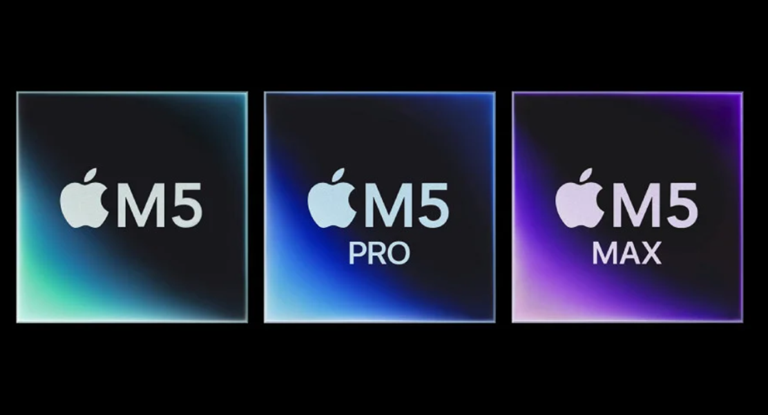
Apple is expected to launch new MacBook Pro models with M5 Pro and M5 Max chips during the macOS 26.3 release cycle.
M5 Pro and M5 Max chips availability may be delayed until March.
Production challenges at TSMC and Apple’s advanced SoIC packaging technology may be causing delays.
New MacBook Pro models’ launch time gets a new hint. (Image credit – Apple)
Apple is reportedly preparing to introduce updated MacBook Pro models powered by the M5 Pro and M5 Max chips with the launch expected to align with the macOS 26.3 release cycle. According to Bloomberg’s Mark Gurman, the faster MacBook Pro variants are tied to Apple’s upcoming software update.
“Apple’s faster MacBook Pros are planned for the macOS 26.3 release cycle,” Gurman wrote in his Power On newsletter. He further added, “I’m told the new models — code-named J714 and J716 — are slated for the macOS 26.3 software cycle, which runs from February through March.”
macOS 26.3 Beta Timeline
While macOS 26.3 is currently in beta testing, a public rollout is widely expected in February. Gurman did mention March as a possibility. However, that scenario would likely depend on delays in the beta cycle or if Apple chooses to pair the hardware launch with macOS 26.3.1 or a later update.
As things stand, the macOS 26.3 Release Candidate is anticipated in the first half of February, suggesting that a MacBook Pro announcement could happen soon.
This timeline aligns with earlier reporting from October, when AppleInsider’s Marko Zivkovic stated that MacBook Pro models featuring the M5 Pro and M5 Max chips.
“After the M5 MacBook Air, we’ll see the arrival of Apple’s high-end M5 Pro and M5 Max MacBook Pro configurations. They will be available in 14-inch and 16-inch sizes, much like the current M4-based line. All variants of the J714 and J716 MacBook Pros are expected to ship with macOS 26.3,” Zivkovic explained.
With multiple sources now echoing similar claims, the launch window appears increasingly credible.
No Major Design Changes Expected for M5 MacBook Pros
Chip upgrades are probably the only expected changes we will get to see in the upcoming MacBook Pro models. (Image credit – Apple)
Aside from the chip upgrades, no major hardware changes are expected for these MacBook Pro models. Looking further ahead, Apple is said to be planning a significant redesign in late 2026 or 2027.
Rumoured upgrades include an OLED display with touch support, new M6 Pro and M6 Max chips, a slimmer chassis, and built-in cellular connectivity.
M5 Pro and M5 Max Chip Launch Delayed Until March
Meanwhile, a separate report suggests that Apple’s M5 Pro and M5 Max chips themselves may not debut before March. The delay is notable, as the previous M4 Pro and M4 Max chips launched in November 2024, placing Apple well outside its usual release window.
Latest post of Weibo tiptser named “Fixed Focused Digital Cameras.” (Screenshot by Gizmochina)
Weibo tipster Fixed-focus digital claims the new chips could be unveiled about a month from now, though no clear reason for the delay has been provided.
Supply-side challenges could be a contributing factor. Apple’s manufacturing partner TSMC is reportedly facing constraints that may have slowed chip production. There are also indications that Apple’s advanced SoIC (System-on-a-Chip) packaging technology may have encountered manufacturing hurdles.
SoIC Packaging Could Improve Costs and Thermal Performance
According to the same leak, the M5 Pro and M5 Max chips could end up being slightly cheaper to produce, although the reduction is expected to be modest. Even so, any cost savings would be meaningful amid ongoing DRAM supply pressures across the industry.
SoIC packaging could also help Apple manage thermal performance more effectively. Previous reports have suggested that the standard M5 chip can reach temperatures of up to 99 degrees Celsius under sustained workloads. Improved packaging in the Pro and Max variantsmay help address these heat-related concerns.
Additionally, SoIC may enable Apple to separate CPU and GPU blocks on the chip die, potentially allowing for more flexible configurations tailored to different performance needs rather than a single, uniform design.
As always, these details should be taken with caution, as Apple is known to revise its plans without notice.
FAQs
Q1. When will the new MacBook Pro models with M5 Pro and M5 Max chips launch?
Answer. They are expected to arrive during the macOS 26.3 release cycle, likely between February and March 2026, though the chips themselves may not debut until March.
Q2. Will the upcoming MacBook Pros feature any major design changes?
Answer. No, aside from the chip upgrades, no major hardware changes are expected. A significant redesign with OLED displays, touch support, slimmer chassis, and cellular connectivity is planned for 2026–2027.
Q3. Why might the launch of M5 Pro and M5 Max chips be delayed?
Answer. Reports suggest supply-side challenges at TSMC and hurdles with Apple’s advanced SoIC packaging technology may have slowed production, though the new packaging could improve costs and thermal performance.
Apple is reportedly considering a clamshell-style foldable iPhone as part of its future product roadmap, even as details around its first foldable device remain unclear. According to Bloomberg’s Mark Gurman, the company is currently evaluating a “square, clamshell-style foldable phone.” Although he notes that the concept is still in the early stages and is “far from guaranteed to reach the market.”
Clamshell- Style Foldable iPhone
Gurman’s report indicates that Apple appears optimistic about the prospects of its first foldable iPhone, which is rumoured to launch later this year. The company is said to be preparing follow-up concepts in advance, aiming to capitalise on potential demand if the initial foldable proves successful.
“Apple is betting that its first foldable iPhone will be successful enough to generate real demand for the category and that customers will want additional shapes and sizes, much as they have with traditional slab-style iPhones,” said Gurman said in the most recent Power On newsletter.
If Apple eventually moves forward with a smaller foldable iPhone, it would place the company in direct competition with existing flip-style foldables such as Samsung’s Galaxy Z Flip 7 and Motorola’s redesigned Razr lineup.
The move would signal Apple’s confidence in its ability to differentiate its foldable offering in an already competitive segment.
This is not the first time reports of a clamshell foldable iPhone have surfaced. A previous report from The Information claimed that Apple had already developed prototypes using a flip-style form factor. At the same time, Gurman’s Power On newsletter has mentioned that Apple is also exploring a larger foldable device that opens like a book.
In earlier reports, Gurman suggested that Apple had considered an even larger foldable device, closer in size to an iPad. However, development challenges with such a large foldable reportedly slowed progress, with a potential launch now said to be pushed as far out as 2029.
FAQs
Q1. Is Apple developing a clamshell-style foldable iPhone?
Answer. Yes, reports suggest Apple is evaluating a square, clamshell-style foldable iPhone. However, the concept is still in early stages and not guaranteed to reach the market.
Q2. When is Apple expected to launch its first foldable iPhone?
Answer. Apple’s first foldable iPhone is rumoured to launch later this year. The company is preparing additional concepts in advance to capitalise on potential demand if the initial foldable proves successful.
Q3. How would a clamshell-style foldable iPhone position Apple in the market?
Answer. If Apple moves forward, it would directly compete with existing flip-style foldables like Samsung’s Galaxy Z Flip and Motorola’s Razr lineup, signalling confidence in differentiating its foldable offering in a competitive segment.
Union Budget 2026 focuses on boosting India’s tech, energy, and digital ecosystem through incentives for renewable energy, semiconductor manufacturing, data centres, cloud services, and emerging technologies.
The government announced major customs duty rationalisation and tax benefits, including lower personal import duties, extended exemptions for lithium-ion battery manufacturing, and long-term tax holidays for foreign cloud and data centre companies until 2047.
Strong emphasis has been placed on the creator and AVGC economy, agriculture-focused AI tools like Bharat Vistar, and skill development.
(Union Budget 2026)
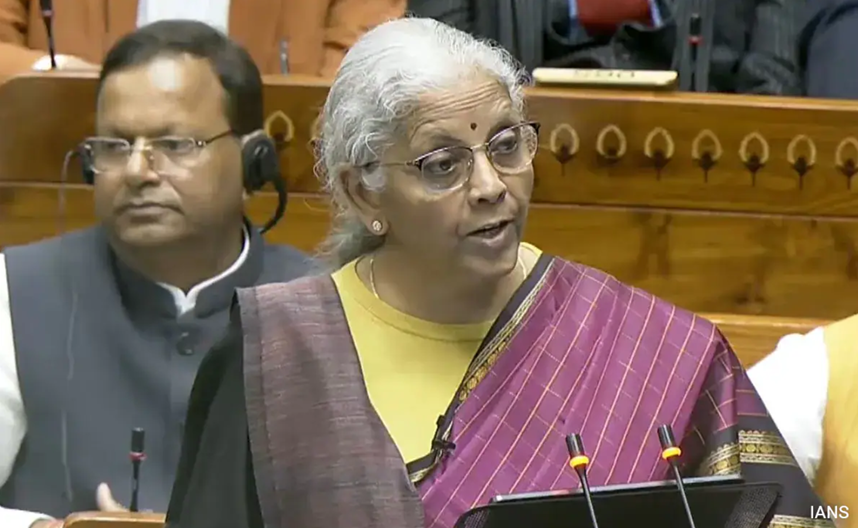
Finance Minister Nirmala Sitharaman presented the Union Budget 2026-27 in the Lok Sabha on Sunday, February 1. In this year’s budget, the Government of India unveiled a wide-ranging set of fiscal measures aimed at strengthening domestic energy security, streamlining customs duties, and accelerating the expansion of India’s technology and digital infrastructure.
The proposals place strong emphasis on energy transition, personal import tariffs, semiconductor manufacturing, and fresh tax incentives for data centres and cloud service providers. Technology, artificial intelligence, and the fast-growing creator economy also feature prominently in the announcements.
Focus on Energy Transition and Energy Security
One of the central themes of Union Budget 2026-27 is the push towards renewable energy and domestic manufacturing of energy storage solutions. To support India’s clean energy goals, the government has proposed extending the basic customs duty exemption on capital goods used for manufacturing lithium-ion cells for batteries, a benefit that was introduced in last year’s budget. This extension is aimed at reducing production costs for battery storage systems, which are critical for large-scale renewable energy adoption.
The budget also proposes a basic customs duty exemption on the import of sodium antimonate, a key raw material used in the production of solar glass, to further boost the solar energy sector.
In the consumer electronics space, the government has proposed exempting basic customs duty on certain parts used in the manufacturing of microwave ovens. This step aligns with the broader objective of promoting higher value addition and local manufacturing within the domestic appliances industry.
Finance Minister Nirmala Sitharaman during the Union Budget 2026 Live Speech. (Credit – IANS)
Tax Incentives for Data Centres and Cloud Services
To strengthen India’s position as a global digital services hub, the budget introduces major tax benefits for the cloud computing and data centre ecosystem.
Foreign companies offering cloud services to global customers through data centres located in India will be eligible for tax holidays extending until 2047. This long-term incentive is intended to attract sustained foreign investment into India’s digital infrastructure.
Additionally, related entities providing data centre services from India will now qualify for a “safe-harbour” margin of 15 percent on cost. This measure is designed to offer tax certainty, reduce transfer pricing disputes, and simplify compliance for multinational technology companies operating in the country.
Customs Duty Rationalisation Under ‘Ease of Living’
As part of the government’s ‘Ease of Living’ initiative, the budget proposes a major simplification of the customs duty framework for individuals. The tariff rate on all dutiable goods imported for personal use is set to be reduced from 20 percent to 10 percent.
The move aims to simplify the duty structure while lowering costs for individuals importing goods for personal consumption.
India Semiconductor Mission 2.0 Announced
Building on the groundwork laid under India Semiconductor Mission (ISM) 1.0, the government has announced the launch of ISM 2.0. While the first phase focused on establishing initial semiconductor capabilities, the second phase aims to expand the ecosystem more comprehensively.
ISM 2.0 will focus on three major pillars: encouraging domestic production of semiconductor equipment and materials, developing full-stack Indian intellectual property to move beyond assembly into design, and strengthening supply chain resilience. The mission will also prioritise industry-led research and training centres to build proprietary technologies and develop a skilled workforce to meet growing industry demand.
(Photo by Vishnu Mohanan on Unsplash)
Electronics Components Manufacturing Scheme Gets a Boost
The Finance Minister highlighted the strong response from industry to the Electronics Components Manufacturing Scheme, launched in April 2025 with an initial outlay of ₹22,919 crore. According to the budget speech, investment commitments under the scheme have already reached double the original targets.
To capitalise on this momentum, the government has proposed increasing the total outlay to ₹40,000 crore. The additional funding is expected to further accelerate domestic electronics component manufacturing, reduce reliance on imports, and strengthen India’s overall electronics ecosystem.
Welcoming the budget, India Cellular and Electronics Association (ICEA) said in a statement that, “the sustained focus on electronics manufacturing, the launch of India Semiconductor Mission (ISM) 2.0, and the significant expansion of the Electronics Component Manufacturing Scheme (ECMS) reaffirm the government’s long-term commitment to building resilient domestic supply chains and strengthening India’s position in global value chains.”
ICEA also welcomed “the announcement of a tax holiday till 2047 for foreign companies offering global cloud services using India-based data centres, describing it as a forward-looking measure that provides long-term policy certainty, anchors global digital infrastructure in India, and enhances the country’s credibility as a trusted hub for data, cloud, and AI-led services. Long-term predictability as provided in this measure will be a sure win for our nation.”
According to the statement issued by the ICEA, “additional measures such as the five-year income tax exemption for foreign suppliers of capital equipment in bonded zones, the Safe Harbour framework for non-resident component warehousing, customs decriminalisation, and extended validity of advance rulings are expected to improve ease of doing business, reduce compliance friction, and strengthen investor confidence.”
Talking about the budget, Pankaj Mohindroo, Chairman, ICEA, said, “Budget 2026-27 reinforces the government’s commitment to manufacturing-led growth, particularly in electronics and semiconductors, through continuity, scale, and targeted reforms. Measures such as the expansion of ECMS, support for ISM 2.0, and long-term incentives for cloud and data infrastructure send a strong signal of strategic intent and policy stability.”
Push for New Technologies and AI Innovation
The government reiterated its commitment to emerging technologies through initiatives such as the AI Mission, National Quantum Mission, Anusandhan National Research Fund, and the Research and Development and Innovation Fund (RDI). These programmes are aimed at advancing research, fostering innovation, and building a skilled workforce capable of supporting next-generation technologies.
Bharat Vistar – AI-Powered Support for Agriculture
A notable new announcement in Budget 2026-27 is Bharat Vistar, an AI-based multilingual tool designed for farmers. Integrated with the Agristack portal and ICAR agricultural resources, the platform will provide personalised advisory services to help farmers make better decisions, improve productivity, and reduce risks. The initiative reflects the government’s focus on applying AI to transform key sectors such as agriculture.
Investing in the Orange Economy
For the first time, the government has formally recognised the Orange Economy as a significant contributor to India’s GDP. This sector includes areas such as live events, animation, gaming, and digital content creation.
In her speech, the Finance Minister underlined the employment potential of the sector, stating that ‘India’s AVGC sector is growing fast, and to keep this growth going, the country needs to train enough people to fill about two million jobs by 2030.’
Institutional Support for the Creator Economy via Content Creator Labs
Under the Union Budget 2026, the government announced support for the Indian Institute of Creative Technologies in Mumbai to establish AVGC content creator labs in 15,000 secondary schools and 500 colleges across the country.
These labs will provide students with access to high-performance tools required for animation and digital storytelling. The Finance Minister noted that the initiative is intended to democratise access to professional-grade creative and computing tools. “We are seeing a clear shift from people treating creativity as a hobby to building it as a professional industry,” a senior official said, backing the government’s vision for the sector.
Strategic Cloud Infrastructure and Long-term Tax Certainty
To offset the high operational costs associated with rendering and creative workloads, the government has announced a landmark tax holiday until 2047 for foreign cloud service providers setting up data centres in India.
Explaining the move, the Finance Minister said, ‘“To support the intensive data needs of our creative industries and encourage global tech leaders to make in India, we are offering a long-term tax certainty. This will ensure our local creators have access to global-standard computing power at competitive costs.”
Targeting Global AVGC Leadership by 2030
The government has set an ambitious target of making India a global hub for the AVGC industry by 2030. The budget outlines a long-term talent pipeline strategy that identifies and nurtures creative talent from a young age, ensuring a steady supply of skilled professionals to meet the projected demand for two million jobs and making the creative economy a pillar of national prosperity.
Will Smartphones and Electronics Become Cheaper?
With these announcements, many consumers are wondering whether smartphones, TVs, and other electronic devices will see price cuts. While the changes appear consumer-friendly at first glance, the impact is more complex. The Finance Minister clarified in the Lok Sabha that the intent behind the customs duty changes is to promote local manufacturing and reduce import dependence, particularly for materials used in lithium-ion cells and microwave oven components.
This change is expected to lower electric vehicle battery costs, support India’s green energy goals, encourage local battery manufacturing, and attract greater investment into clean energy production.
Lower duties could help manufacturers reduce production costs, which may eventually translate into lower prices for some electronics. However, such reductions are unlikely to be immediate or guaranteed.
Finance Minister Nirmala Sitharaman said, “To provide further impetus to green mobility and energy security, we have extended the basic customs duty exemption on capital goods for manufacturing lithium-ion cells to include those used for battery energy storage systems.” She added that “these steps, alongside the launch of India Semiconductor Mission 2.0, will support jobs, innovation, and help build a resilient domestic supply chain, making our industries more globally competitive.”
Industry experts note that duty exemptions on battery materials and electronic components do help reduce manufacturing costs. However, analysts caution that lower costs do not automatically result in sharp retail price cuts. “Price changes depend on how domestic makers and importers adjust their pricing,” industry insiders said.
FAQs
Q1. What are the key priorities of the Union Budget 2026?
Answer. The budget focuses on energy transition, technology growth, semiconductor manufacturing, AI, and digital infrastructure.
Q2. How does the Union Budget 2026 support renewable energy and EVs?
Answer. It extends customs duty exemptions on lithium-ion battery manufacturing and energy storage systems, making clean energy solutions cheaper.
Q3. What benefits are offered to data centres and cloud service providers in the Union Budget 2026?
Answer. Foreign cloud companies setting up data centres in India get tax holidays until 2047 and relaxed safe-harbour norms.
Q4. Will smartphones and electronics become cheaper after Budget 2026?
Answer. Union Budget 2026 initiatives will definitely reduce manufacturing costs, but immediate price cuts for consumers are not guaranteed.
Q5. What is the government’s plan for the creator and AVGC economy as per the Union Budget 2026?
Answer. The budget supports AVGC labs in schools and colleges and aims to create about two million jobs by 2030.
iQOO 15 Ultra will feature 29 adaptive antennas, N79 5G support, AI Esports Signal Engine 2.0 for stronger Wi-Fi, and the Universe Metro Gaming Network.
Other features include Snapdragon 8 Gen 5 Elite with Q3 gaming chip, up to 24GB RAM and 1TB storage, 2K LTPO display, and Ice Dome Air Cooling with an integrated fan.
The launch is scheduled for February 4th.
iQOO 15 Ultra image from the latest teaser. (Image credit – iQOO)
iQOO is preparing to unveil the iQOO 15 Ultra at an upcoming launch on February 4th event in China. The company has been actively teasing the handset on Weibo, revealing key hardware details in stages. We already know the model has been designed for mobile gamers and will be positioned as a performance-focused top-tier gaming smartphone with advanced visuals and connectivity capabilities.
In its latest official teaser, iQOO has highlighted the phone’s connectivity upgrades and signal optimisation features.
iOOO 15 Ultra – Network Specs Teased
According to the brand’s latest Weibo post, the iQOO 15 Ultra will be equipped with 29 surround antennas that dynamically adapt based on how the phone is held. The device supports the N79 5G band and features the AI Esports Signal Engine 2.0, which is designed to improve Wi-Fi signal penetration through up to four walls
iQOO has also confirmed the inclusion of the Universe Metro Gaming Network, a dedicated solution aimed at delivering low-latency ranked gaming even in subway environments.
iQOO 15 Ultra – What Else We Know?
On the performance front, the iQOO 15 Ultra is expected to be powered by Qualcomm’s Snapdragon 8 Gen 5 Elite chipset, paired with the company’s in-house Q3 gaming chip. The smartphone will support up to 24GB of RAM and up to 1TB of internal storage. Gaming-centric features include native 2K resolution upscaling, 120fps frame interpolation, and full-scene ray tracing at maximum settings.
The device will sport a 6.85-inch flat LTPO display with 2K resolution, sourced from Samsung. iQOO claims the phone can run Honor of Kings at 144fps with Ultra image quality and enhanced map details.
The phone will sport a bold design offered in 2077 Black and 2049 Silver colour options.
Thermal management is handled by the Ice Dome Air Cooling System, which includes an integrated cooling fan. Additional gaming hardware includes capacitive shoulder triggers, an improved gyroscope, and highly responsive touch controls.
In terms of cameras, the iQOO 15 Ultra will feature a triple rear camera setup with three 50-megapixel sensors, including a 3x periscope telephoto lens. On the front, it is expected to house a 32-megapixel selfie camera. The phone packs a large 7,400mAh battery with support for both 100W wired and wireless charging.
Other confirmed features include stereo 1115 coaxial speakers with Dolby Atmos, advanced haptic feedback, support for 144fps livestreaming and an ultrasonic fingerprint sensor.
FAQs
Q1. What special network features will the iQOO 15 Ultra offer?
Answer. The phone will include 29 adaptive antennas, N79 5G band support, AI Esports Signal Engine 2.0 for stronger Wi-Fi penetration, and the Universe Metro Gaming Network for low-latency gaming in subway environments.
Q2. What performance and gaming-focused hardware is expected in the iQOO 15 Ultra?
Answer. It is tipped to run on Snapdragon 8 Gen 5 Elite with Q3 gaming chip, support up to 24GB RAM and 1TB storage, and deliver features like 2K resolution upscaling, 120fps interpolation, ray tracing, and Ice Dome Air Cooling with an integrated fan.
Q3. What other key specifications and features of iQOO 15 Ultra are confirmed?
Answer. The iQOO 15 Ultra will sport a 6.85-inch 2K LTPO display, triple 50MP rear cameras with periscope telephoto, a 32MP selfie camera, 7,400mAh battery with 100W wired/wireless charging, Dolby Atmos stereo speakers, advanced haptics and ultrasonic fingerprint sensor.
PlayStation Plus subscribers can claim four diverse titles from 3 Feb to 2 Mar.
These include Undisputed, Subnautica: Below Zero, Ultros, and Ace Combat 7.
January’s free games remain available until 2 Feb for PlayStation Plus members.
PlayStation Plus February Games. (Images credit – Sony)
Sony has officially revealed the PlayStation Plus games lineup for February, bringing a diverse mix of genres for subscribers. The new selection includes four titles ranging from boxing and survival adventure to psychedelic action and aerial combat.
These games will be available to claim starting Tuesday, 3 February and will remain accessible until Monday, 2 March.
The February lineup features games playable on both PS5 and PS4, offering variety for players who enjoy realistic simulations, action-heavy combat, or exploration-driven experiences.
Undisputed on PS5
The headline title for PS5 subscribers this month is Undisputed, a boxing simulation that aims to deliver an authentic and realistic portrayal of the sport. The game boasts detailed visuals, fluid and lifelike animations, and a roster of more than 70 officially licensed fighters.
Players can customise their playstyle using dozens of attributes and traits that shape each boxer’s strengths and weaknesses. A dedicated career mode lets players rise from amateur fights to championship-level bouts, while a comprehensive character creator allows users to design a custom boxer with personalised looks and gear.
Subnautica: Below Zero on PS5, PS4
Subnautica: Below Zero will be available on both PS5 and PS4, catering to fans of survival and exploration games. Set in a frozen region of the alien planet 4546B, the game tasks players with surviving extreme conditions while investigating a mystery tied to a missing family member.
Players must gather resources, craft equipment, and build shelters to stay alive. The hostile environment features unfamiliar creatures and harsh weather, making exploration both visually striking and constantly dangerous.
Ultros on PS5, PS4
Ultros offers a more unconventional experience, mixing fast-paced melee combat with quieter moments focused on growth and discovery. The game stands out with its vibrant, psychedelic art style and atmospheric soundtrack, set within a strange cosmic environment known as The Sarcophagus.
Alongside combat against bizarre alien creatures, players can cultivate plant life to unlock new paths and abilities. A looping gameplay structure allows certain sections to be replayed,revealing hidden areas and encouraging experimentation with upgrades and progression choices.
Ace Combat 7: Skies Unknown on PS4
Completing the February lineup is Ace Combat 7: Skies Unknown for PS4. The flight combat game puts players behind the controls of advanced fighter jets, featuring fast-paced dogfights and large-scale aerial missions.
With a selection of real-world-inspired and futuristic aircraft, players can customise their jets and engage in increasingly challenging battles, combining precise flying skills with strategic use of weapons.
Claim January PlayStation Plus Games
PlayStation Plus members still have a short window to add January’s free titles to their libraries. Need for Speed Unbound, Disney Epic Mickey: Rebrushed, and Core Keeper will remain available until Monday, 2 February.
FAQs
Q1. What games are included in the PlayStation Plus February 2026 lineup?
Answer. The lineup features Undisputed (PS5), Subnautica: Below Zero (PS5/PS4), Ultros (PS5/PS4), and Ace Combat 7: Skies Unknown (PS4).
Q2. When can subscribers claim the February PlayStation Plus games?
Answer. The games will be available to claim starting Tuesday, 3 February, and remain accessible until Monday, 2 March.
Q3. What genres and experiences do PS Plus February 2026 linupoffer?
Poco X8 Pro Max is tipped to feature a massive 8,500mAh battery with 100W fast charging.
Standard Poco X8 Pro may come with a 6,500mAh battery and the same charging support.
Both models are believed to be rebranded versions of the Redmi Turbo 5 series with slightly smaller batteries than their Chinese counterparts.
Poco X8 Pro Max is rumoured to be a rebranded Redmi Turbo 5 Max (in the picture here). (Image credit – Redmi)
A fresh leak has shed light on key battery and charging details of Xiaomi’s upcoming Poco smartphones. The information points to large-capacity batteries for both the Poco X8 Pro and the Poco X8 Pro Max.
Poco X8 Pro Max Battery and Charging Details
According to supply chain inputs and code analysis, tipster PaperKing13 @paperking13 on X shared that the Poco X8 Pro Max is expected to feature a huge 8,500mAh battery. This would be the largest battery ever seen on a Poco smartphone. The device is also tipped to support 100W wired fast charging, which should help users top up quickly despite the large battery size.
With this setup, the phone is expected to comfortably deliver up to two days of usage on a single charge, making it suitable for heavy users, gamers, and frequent travellers.
Based on current information, the Poco X8 Pro Max is believed to be a global rebranded version of the Redmi Turbo 5 Max. The Redmi model was launched in China recently with an even larger 9,000mAh battery. The slightly smaller capacity on the Poco variant is likely due to regional safety standards and certification requirements. Even so, the Poco X8 Pro Max would still sit ahead of most competitors in terms of battery size.
Poco X8 Pro Battery Capacity Surfaces
In a previous post, the same tipster also shared that the standard Poco X8 Pro is said to come with a comparatively smaller 6,500mAh battery. Like the Pro Max variant, it is also expected to support 100W wired fast charging.
Recent developments have also seen the Poco X8 Pro appear across multiple global certification platforms with reports suggesting that a Poco X8 Pro Iron Man Edition is also in development.
Leaks indicate that the Poco X8 Pro may be based on the Redmi Turbo 5, while the Poco X8 Pro Max could be derived from the Redmi Turbo 5 Max.
Poco X8 Pro and Poco X8 Pro Max – Specifications (Expected)
If the Poco phones are indeed rebranded versions of the Redmi Turbo series, the Poco X8 Pro could feature a 6.59-inch AMOLED display with a resolution of 1268×2756 pixels, a 120Hz refresh rate, 3,840Hz PWM dimming, and peak brightness of up to 3,500 nits.
It is expected to be powered by the MediaTek Dimensity 8500 chipset, paired with 12GB or 16GB of RAM and 256GB or 512GB of internal storage. Camera hardware could include a 50-megapixel main sensor with OIS, an 8-megapixel ultrawide lens, and a 20-megapixel front camera.
The Poco X8 Pro Max, meanwhile, is tipped to sport a larger 6.83-inch AMOLED display with a resolution of 1280×2772 pixels, along with a 120Hz refresh rate, 3,840Hz PWM dimming, and peak brightness of up to 3,500 nits. It could be powered by the MediaTek Dimensity 9500s chipset and offer the same RAM, storage, and camera configurations as the Poco X8 Pro.
More details about the Poco X8 Pro and Poco X8 Pro Max are expected to emerge as the official launch draws closer.
FAQs
Q1. What battery capacities are expected for the Poco X8 Pro and X8 Pro Max?
Answer. The Poco X8 Pro is tipped to feature a 6,500mAh battery, while the Poco X8 Pro Max may come with a massive 8,500mAh battery, the largest ever on a Poco phone.
Q2. What charging support will these upcoming Poco smartphones offer?
Answer. Both the Poco X8 Pro and X8 Pro Max are expected to support 100W wired fast charging, enabling quick top-ups despite their large battery sizes.
Q3. Are the Poco X8 Pro and X8 Pro Max original designs or rebranded models?
Answer. Leaks suggest they are rebranded versions of the Redmi Turbo 5 and Redmi Turbo 5 Max, with slightly smaller batteries than their Chinese counterparts due to regional standards.
Xiaomi Pad 8 Pro global variant on Geekbench reveals Snapdragon 8 Elite, 8GB RAM and Android 16 with HyperOS 3.
A European retailer listing suggests the Xiaomi 17 could launch globally at EUR 1,099 (about ₹1,21,000) for the 512GB variant.
The European Xiaomi 17 may feature a smaller 6,330mAh battery, 6.3-inch 1.5K OLED display, Snapdragon 8 Elite Gen 5 and Leica-tuned triple 50MP rear cameras.
Xiaomi Pad 8 Pro (left) and Xiaomi 17 (right).
The Xiaomi Pad 8 Pro debuted in China last year and may soon make its way to global markets. The global variant of the tablet has now been spotted on Geekbench, suggesting that its international launch could be around the corner.
Separately, a Xiaomi executive has confirmed that the Xiaomi 17 Ultra will arrive in select global markets soon. While the company has not officially acknowledged plans for the standard Xiaomi 17, the handset has reportedly appeared on a European retailer’s website. The listing revealed its expected price and key specifications.
As per the latest report, the Xiaomi Pad 8 Pro is tipped to arrive in select international markets alongside the Xiaomi 17.
Xiaomi Pad 8 Pro Global Variant on Geekbench
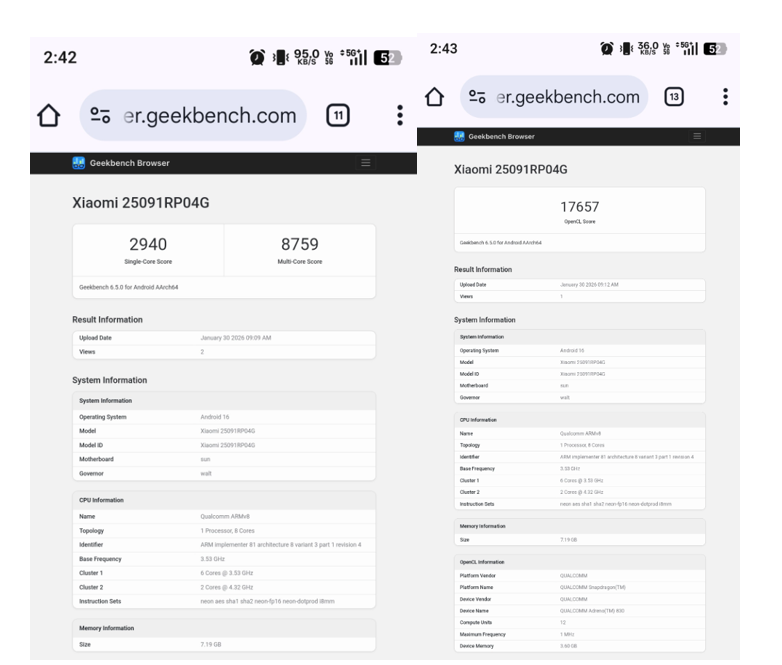
Xiaomi Pad 8 Pro Global Variant on Geekbench.
Tipster Abhishek Yadav @yabhishekhd on X has reportedly spotted the global variant of the Xiaomi Pad 8 Pro on Geekbench. The tablet appeared with the model number 25091RP04G, offering insights into its chipset, RAM, and performance scores.
According to the listing, the tablet runs on Android 16 and should ship with HyperOS 3. The tablet will most likely come with 8GB of RAM.
The benchmark details point to an octa core Qualcomm Armv8 chipset featuring six efficiency cores clocked at 3.53GHz and two performance cores reaching up to 4.32GHz. The tipster claims these specifications correspond to the Snapdragon 8 Elite chipset, the same processor used in the Chinese variant of the Xiaomi Pad 8 Pro.
In terms of performance, the tablet reportedly achieved a single core score of 2,940 points and a multicore score of 8,759 points on Geekbench. It also recorded an OpenCL score of 17,657 points.
For context, the Xiaomi Pad 8 Pro was launched in China in September 2025 with a starting price of CNY 2,999 (roughly Rs. 34,500) for the base 8GB RAM and 128GB storage variant. It is available in Soft Light and regular versions in the domestic market.
The Chinese model features an 11.2-inch 3.2K (3,200×2,136 pixels) LCD display with a pixel density of 345ppi, a refresh rate of up to 144Hz, peak brightness of up to 800 nits, and TUV Rheinland low blue light certification. It is powered by the Snapdragon 8 Elite chipset, paired with up to 16GB of RAM and up to 512GB of internal storage, and packs a 9,200mAh battery with support for 67W fast charging.
Xiaomi 17 Europe Price and Specifications Leak
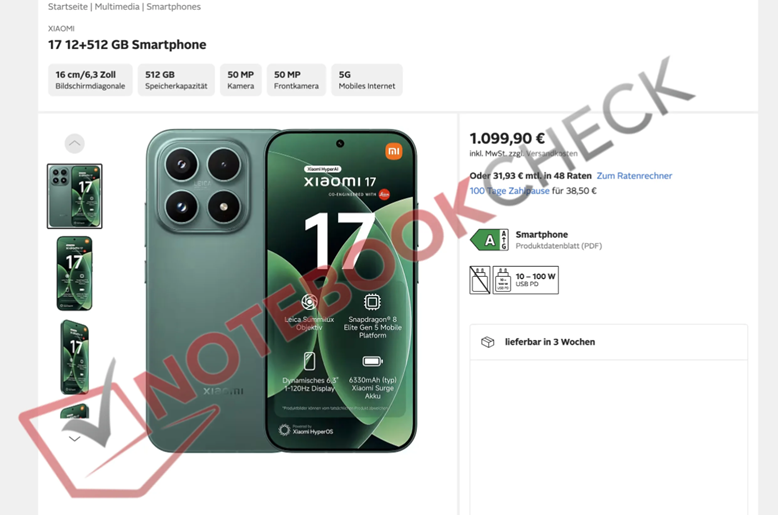
According to a report by Notebookcheck, citing a briefly live listing on Germany’s Eurozone retailer website, the Xiaomi 17 could launch globally at a starting price of EUR 1,099 (approximately Rs. 1,21,000) for the 512GB storage variant. If accurate, this would mark a notable increase compared to its China pricing, where the phone starts at CNY 4,799 (around Rs. 60,000) for the 12GB+512GB version and goes up to CNY 4,999 (roughly Rs. 62,000) for the 16GB+512GB option.
The same listing suggests that the global variant of the Xiaomi 17 may ship with a smaller battery than the Chinese model. While the China version is powered by a 7,000mAh battery, the European variant is shown with a 6,330mAh cell. Apart from this difference, the design and other features appear to remain unchanged.
In China, the Xiaomi 17 sports a 6.3-inch 1.5K (2,656×1,220 pixels) OLED display with up to 120Hz refresh rate, up to 300Hz touch sampling rate, peak brightness of up to 3,500 nits, a 19.6:9 aspect ratio, HDR10+ support, and Dolby Vision.
The smartphone is powered by Qualcomm’s flagship octa core 3nm Snapdragon 8 Elite Gen 5 chipset, paired with up to 16GB of LPDDR5x RAM and up to 512GB of UFS 4.1 storage.
For photography, the Chinese variant features a Leica-tuned triple rear camera setup consisting of a 50-megapixel primary sensor, a 50-megapixel telephoto lens, and a 50-megapixel ultrawide camera. On the front, it houses a 50-megapixel selfie camera and comes with an IP68 rating for dust and water resistance.
FAQs
Q1. When is the Xiaomi Pad 8 Pro expected to launch globally?
Answer. The global variant of the Xiaomi Pad 8 Pro has appeared on Geekbench, suggesting its international launch is imminent, likely alongside the Xiaomi 17.
Q2. What are the key specifications of the Xiaomi Pad 8 Pro global variant?
Answer. It is tipped to run Android 16 with HyperOS 3, feature 8GB RAM, and use the Snapdragon 8 Elite chipset. Geekbench scores include 2,940 (single-core) and 8,759 (multi-core).
Q3. What price and battery differences are reported for the Xiaomi 17 in Europe?
Answer. The Xiaomi 17 may launch at EUR 1,099 (~₹1,21,000) for the 512GB variant, with a smaller 6,330mAh battery compared to the 7,000mAh cell in the Chinese model.
Apple plans to prioritise production and shipment of high-end iPhones.
Rising memory chip and material costs along with complex manufacturing processes are driving Apple to optimise resources.
Apple has not officially commented on the latest report yet.
iPhone 17 Pro models. (Image credit – Apple)
Apple is reportedly planning to prioritise the production and shipment of its top-tier iPhone models in 2026. This also means the Cupertino giant will be pushing back the launch of its standard iPhone models and we may get to see a shift in marketing strategy and ongoing supply-chain challenges.
According to a recently published Nikkei Asia report, the company will focus on its premium lineup amid rising component costs, citing four people familiar with the matter.
As per the report, the US-based tech giant will centre its flagship launch in the second half of 2026around three high-end iPhones. These are said to include Apple’s first-ever foldable iPhone, along with two non-folding models that will feature upgraded cameras and larger displays. Meanwhile, the standard iPhone 18 is now expected to be shipped in the first half of 2027 instead of launching alongside the premium variants.
This strategy is reportedly aimed at optimising resources and boosting revenue and profit margins from higher-priced devices, especially at a time when the cost of memory chips and other materials continues to climb. The move is also said to help Apple reduce production risks associated with the complex manufacturing processes and new technologies required for its first foldable iPhone.
“Supply chain smoothness is one of the key challenges for this year, and the marketing strategy change also played a part in the decision (to prioritize premium models),” an executive at an iPhone supplier with direct knowledge of the plan told Nikkei Asia.
The report comes shortly after Apple delivered a strong quarterly performance driven by robust iPhone demand. Apple CEO Tim Cook told Reuters that demand for the latest iPhone models was “staggering.“
The latest report could not be independently verified. Moreover, several media reports suggest Apple is immediately responding to a request for comment on the latest report.
FAQs
Q1. Why is Apple prioritising premium iPhone models in 2026?
Answer. Apple is focusing on high-end models due to rising memory chip and material costs, aiming to optimise resources, boost profits, and reduce risks tied to complex manufacturing of its first foldable iPhone.
Q2. What iPhones are expected to launch in the second half of 2026?
Answer. Apple plans to release three premium iPhones, including its first-ever foldable iPhone and two non-folding models with upgraded cameras and larger displays.
Q3. When will the standard iPhone 18 be available?
Answer. The standard iPhone 18 is now expected to ship in the first half of 2027, instead of launching alongside the premium variants in 2026.
Oppo Find X9s and Find X9 Ultra are expected to debut in select international markets in Q2 this year.
Oppo Find N6 foldable could launch earlier in March.
Find X9s may come in Titanium, Orange, and Blue; the Find X9 Ultra in Orange, Black, and Brown; and the Find N6 foldable in Orange and Titanium.
OPPO Find X9 Pro in the picture. (Image credit – Oppo)
Oppo could be preparing to expand its Find X9 lineup globally with the launch of two new smartphones in the coming months. A fresh leak suggest that the company is planning to introduce the Oppo Find X9s and Oppo Find X9 Ultra in select international markets. This would be alongside its next-generation foldable smartphone, the Oppo Find N6. The expected launch timelines and colourways of all three devices have also been revealed online.
According to tipster Yogesh Brar @heyitsyogesh on X, the Oppo Find X9s and Oppo Find X9 Ultra are expected to debut globally in select markets in the second quarter (Q2) of this year. Moreover, the X post also reveals that the company’s upcoming foldable smartphone, the Oppo Find N6, could arrive earlier than expected. Tipster hints at a possible launch timeline set for March.
The tipster has also revealed the colour options planned for these upcoming Oppo smartphones.
As per the leak, the Oppo Find X9s may be offered in Titanium, Orange, and Blue colourways. The Oppo Find X9 Ultra, on the other hand, could be available in Orange, Black, and Brown shades.
Meanwhile, the Oppo Find N6 foldable is said to launch in Orange and Titanium colour options.
Notably, Oppo has not officially confirmed any details related to the launch or specifications of these devices.
Oppo Find X9s, Oppo Find X9 Ultra, Oppo Find N6 – What We Know About This Devices So Far?
The latest leak follows a recent report that claimed the Oppo Find X9s will feature a 6.3-inch flat display with 1.5K resolution.
In terms of hardware, the Oppo Find X9s is tipped to sport a triple rear camera setup comprising a 200-megapixel primary sensor, a 200-megapixel telephoto lens, and a 50-megapixel ultrawide camera. The smartphone is expected to be powered by a MediaTek Dimensity 9500+ chipset.
The Oppo Find X9 Ultra is rumoured to feature a larger 6.82-inch flat AMOLED display with 2K resolution and a refresh rate of up to 120Hz. It could be powered by Qualcomm’s octa-core Snapdragon 8 Elite Gen 5 chipset, built on a 3nm manufacturing process. For photography, it may include a 200-megapixel main camera, a 200-megapixel telephoto shooter, a 50-megapixel secondary telephoto camera, and a 50-megapixel ultrawide lens. On the front, the device could feature a 50-megapixel selfie camera.
Oppo Find N5.
As for the upcoming Oppo Find N6 foldable, it could become the first foldable smartphone to run on the Snapdragon 8 Elite Gen 5 chipset. Reports suggest that Oppo may equip the foldable with a 200-megapixel primary rear camera.
FAQs
Q1. When are the Oppo Find X9s, Find X9 Ultra, and Find N6 expected to launch globally?
Answer. The Find X9s and Find X9 Ultra are tipped to debut in select international markets in Q2 this year, while the Find N6 foldable could launch earlier in March.
Q2. What colour options will these upcoming Oppo smartphones offer?
Answer. The Find X9s may come in Titanium, Orange, and Blue; the Find X9 Ultra in Orange, Black, and Brown; and the Find N6 foldable in Orange and Titanium.
Q3. What are the key leaked specifications of Oppo Find X9 Ultra?
Answer. The Find X9 Ultra could include a 6.82-inch 2K AMOLED display, Snapdragon 8 Elite Gen 5, quad rear cameras, and a 50MP selfie shooter. The Find N6 foldable is expected to run on Snapdragon 8 Elite Gen 5 with a 200MP primary rear camera.