Home Blog Page 117

Pixel 10 Pro and Pro XL Full Specs Leak Ahead of Launch – Here’s Everything We Know

0

Highlights

  • Pixel 10 Pro will reportedly feature a 6.3″ OLED LTPO display, while the Pro XL has a 6.8″ OLED LTPO panel.
  • Both models are powered by the Tensor G5 chip, with 16GB RAM, and feature a 42MP front camera and triple rear cameras (50MP main, 48MP ultra-wide, 48MP 5x telephoto).
  • Pixel 10 Pro has a 4870mAh battery with 29W charging, while the Pro XL offers 5200mAh with 39W charging.

The Pixel 10 series is expected to be announced on August 20 and go on sale starting August 28. However, we will not have to wait that long to know more about the phones getting launched under the series.

The full specifications for the upcoming Google Pixel 10 Pro and Pixel 10 Pro XL have leaked, thanks to a new report from AndroidHeadlines. While both models share most of their features, there are a few notable differences when it comes to screen size, base storage, battery capacity, and charging speed. So, here’s what we know.

Google Pixel 10 Pro and Google Pixel 10 Pro XL – What to Expect?

image

Caption – Google Pixel 10 Pro CAD render. (Image credit – OnLeaks/AndroidHeadlines)

According to the recent leak, the Pixel 10 Pro will come with a 6.3-inch OLED LTPO display (2856 x 1280 resolution), 128GB base storage and a 4,870mAh battery that supports 29W wired charging.
image

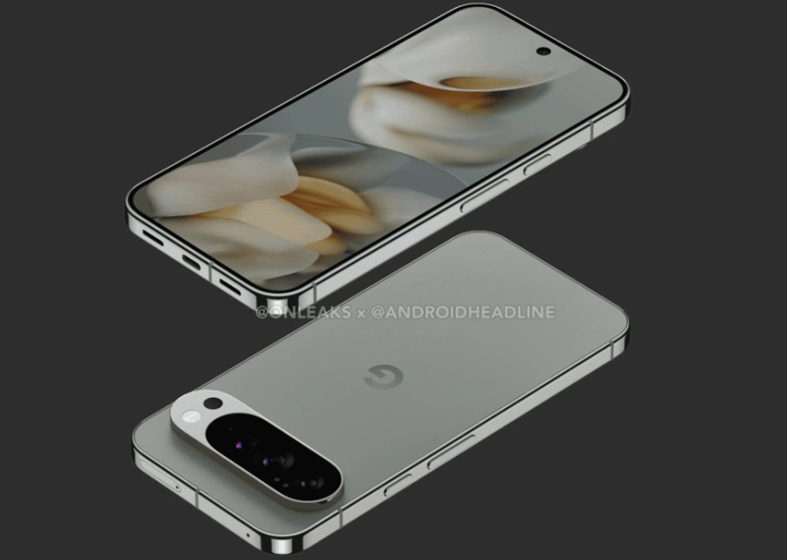
Caption – Google Pixel 10 Pro XL CAD render. (Image credit – AndroidHeadlines/OnLeaks)

In contrast, the Pixel 10 Pro XL is said to feature a larger 6.8-inch OLED LTPO panel with a 2992 x 1344 resolution, 256GB starting storage and a 5,200mAh battery with 39W wired charging.

Both phones will support adaptive refresh rates from 1Hz to 120Hz and peak brightness up to 3000 nits. For selfies, they’re expected to include a 42MP front camera. On the back, you’ll find a triple-lens setup: a 50MP main sensor, a 48MP ultra-wide lens and a 48MP periscope telephoto camera with 5x optical zoom.

Under the hood, both models will be powered by Google’s next-gen Tensor G5 chip paired with 16GB of RAM. Storage options will include 256GB, 512GB, and 1TB. They’re also set to support 15W wireless charging based on the Qi2 standard.

An interesting detail is that the Pixel 10 Pro might have a slightly smaller battery than the standard Pixel 10, reportedly because of the addition of a vapour chamber cooling system, which the base model lacks.

FAQs

Q1. What are the main differences between the Pixel 10 Pro and Pixel 10 Pro XL?

Answer. The Pixel 10 Pro features a 6.3-inch OLED LTPO display, 128GB base storage, and a 4,870mAh battery with 29W charging, while the Pro XL offers a 6.8-inch display, 256GB base storage, and a 5,200mAh battery with 39W charging.

Q2. What camera setup is expected on the Pixel 10 Pro and Pro XL?

Answer. Both phones are expected to include a 42MP front camera and a triple rear camera setup: a 50MP main sensor, a 48MP ultra-wide lens, and a 48MP periscope telephoto camera with 5x optical zoom.

Q3. What processor and charging features will the Pixel 10 Pro series offer?

Answer. They will be powered by Google’s Tensor G5 chip with 16GB of RAM, and support 15W wireless charging based on the Qi2 standard.

Also Read: Google Pixel 10 May Skip Vapour‑Chamber Cooling (Report)

Also Read: Google Pixel 10 Series Will Likely Bring Gimbal‑Like Camera Stabilisation Feature
Google Photos Update Keeps HDR Quality Intact After Edits, Adds New Ultra HDR Tool

0

Highlights

  • HDR photos in Google Photos will now retain their full dynamic range and metadata after using editing tools like Photo Unblur, Magic Eraser, and Portrait Light.
  • A new Ultra HDR tool offers precise brightness control, while the old HDR tool has been renamed to “Tone” for adjusting light and contrast.
  • Google Photos can now enhance SDR images to HDR, improving brightness, contrast, and clarity for better display on HDR-capable screens.

image

Caption – Google announced new Google Photos Features that will help preserve HDR quality even after editing. (Image credit – Google)

Google Photos is rolling out some new features that make it easier to edit and enhance both HDR and SDR images without losing quality.

“We’ve made improvements to how images are edited in High Dynamic Range (HDR) and Standard Dynamic Range (SDR). Now, HDR photos can keep their full dynamic range and crucial HDR metadata even after editing with features like Photo Unblur, Magic Eraser, and Portrait Light. This means your edited photos will maintain their contrast and highlights to always look their best,” said the company recently in a Google Community post.

One major change is that HDR photos will now keep their full dynamic range and HDR metadata, even after using editing tools like Photo Unblur, Magic Eraser, or Portrait Light. This means your photos will still look bright, detailed, and vibrant on HDR-supported screens, even after you’ve made changes.

Google has also introduced a new “Ultra HDR” tool, which gives you more precise control over brightness. This lets you fine-tune your photos to get exactly the look you’re after. In addition, the older “HDR” tool has been renamed to “Tone” to better reflect its role in adjusting light and contrast.

There’s more good news for SDR photos too. Google Photos can now enhance SDR images to HDR, improving brightness, contrast, and clarity. So, even your older or standard photos will look much better on modern HDR-capable screens.

Google hasn’t confirmed whether these features are arriving via an app update or a server-side rollout, but they’re gradually becoming available for users with HDR-compatible devices.

FAQs

Q1. What happens to HDR photos after editing in the new Google Photos update?

Answer. HDR photos now keep their full dynamic range and crucial HDR metadata even after editing with tools like Photo Unblur, Magic Eraser, and Portrait Light.

Q2. What is the new Ultra HDR tool in Google Photos?

Answer. The Ultra HDR tool gives users more precise control over brightness, allowing them to fine-tune their photos for the exact look they want.

Q3. Can Google Photos enhance SDR images to HDR?

Answer. Yes, Google Photos can now enhance SDR images to HDR, improving brightness, contrast, and clarity for better display on HDR-capable screens.

Also Read: Google Photos Introduces New Updates Feed, Replacing the Sharing Tab

Also Read: Google Photos Enhances HDR Image Editing for Pixel Users, Memories to be Replaced with Timeline Feature

Vivo X200 FE India Launch Confirmed with Dimensity 9300+, 6500mAh Battery and 90W Fast Charging

0

Highlights

  • Vivo has officially teased the X200 FE launch in India with availability in Luxe Grey and Amber Yellow.
  • The exact launch date will be announced soon.
  • The phone features a 6.31″ 1.5K LTPO AMOLED display, Dimensity 9300+ chip, 12GB RAM, and 512GB storage, triple rear camera setup with ZEISS optics, a 50MP selfie camera, a 6500mAh battery with 90W fast charging support and Android 15 with Funtouch OS 15.

image

Caption – Vivo X200 FE India Launch teased. (Image credit – Vivo)

Vivo has officially confirmed that the Vivo X200 FE is set to launch in India soon. The brand has released multiple video teasers on its official social media handles in India.

The phone will be available in two colour options, Luxe Grey and Amber Yellow. Unlike some global markets, India won’t be getting the Blue and Pink versions. The reports suggest the Indian variant will carry the same specs as the Malaysian model that launched recently.

Vivo hasn’t revealed the exact India launch date yet, but it’s expected to be announced soon. Here’s more about the phone.

Vivo X200 FE – Key Features

The X200 FE sports a 6.31-inch 1.5K LTPO AMOLED display with a 120Hz refresh rate, 4320Hz high-frequency PWM dimming and an impressive peak brightness of up to 5000 nits.

Under the hood, it runs on the MediaTek Dimensity 9300+ chip paired with the Immortalis-G720 GPU. It packs 12GB LPDDR5X RAM and 512GB UFS 3.1 storage, promising smooth performance and ample space.

image

Caption – Vivo X200 FE camera features. (Image credit – Vivo)

The phone features a triple rear camera system –

  • A 50MP Sony IMX921 main sensor with OIS
  • An 8MP ultra-wide lens with a 106-degree field of view
  • A 50MP IMX882 periscope telephoto lens with 3x zoom
  • On the front, there’s a 50MP autofocus selfie

The camera system is backed by ZEISS optics and includes Aura Light for better low-light shots.

Powering the phone is a 6500mAh battery with support for 90W fast charging. It runs Android 15 with Funtouch OS 15.

Connectivity includes dual nano SIM slots, 5G (SA/NSA), dual 4G VoLTE, Wi-Fi 7, Bluetooth 5.4, USB Type-C, NFC, and GPS with L1+L5 bands. Audio features include stereo speakers, USB-C audio, and Hi-Res audio support. For security, there’s an in-display optical fingerprint sensor.

The phone has a metal frame and is IP68 and IP69 rated, offering solid protection against dust and water. It weighs 186g and measures 150.83 x 71.76 x 7.99mm.

FAQs

Q1. What are the key performance and display features of the Vivo X200 FE?

Answer. The Vivo X200 FE features a 6.31-inch 1.5K LTPO AMOLED display with a 120Hz refresh rate, 4320Hz PWM dimming, and peak brightness of 5000 nits. It runs on the MediaTek Dimensity 9300+ chip with 12GB LPDDR5X RAM and 512GB UFS 3.1 storage.

Q2. What camera setup does the Vivo X200 FE offer?

Answer. The phone has a triple rear camera system – 50MP Sony IMX921 main sensor with OIS, 8MP ultra-wide lens (106° FoV) and 50MP IMX882 periscope telephoto lens (3x zoom). It also includes a 50MP autofocus selfie camera, ZEISS optics, and Aura Light for better low-light shots.

Q3. What are the battery and charging capabilities of the Vivo X200 FE?

Answer. The Vivo X200 FE is powered by a 6500mAh battery and supports 90W fast charging, offering long-lasting performance and quick top-ups.

Also Read: Vivo X Fold 5 Teased for Launch in India Soon, Featuring Snapdragon 8 Gen 3 and 6000mAh Battery

Also Read: Vivo X200 FE Debuts with 6500mAh Battery, ZEISS Cameras, Compact Build

Vivo X Fold 5 Teased for Launch In India Soon, Featuring Snapdragon 8 Gen 3 and 6000mAh Battery

0

Highlights

  • Vivo has begun teasing the X Fold 5 launch in India with a “Coming Soon” tag on its official microsite.
  • It will be sold via Flipkart and Vivo’s online store.
  • The foldable features an 8.03″ inner and 6.53″ cover display (both LTPO), Snapdragon 8 Gen 3, triple 50MP rear cameras, and dual 20MP front cameras.

Vivo has started teasing the India launch of the Vivo X Fold 5, just days after its debut in China. The teaser comes along with hints at the launch of the Vivo X200 FE, which is also expected to arrive in India soon.

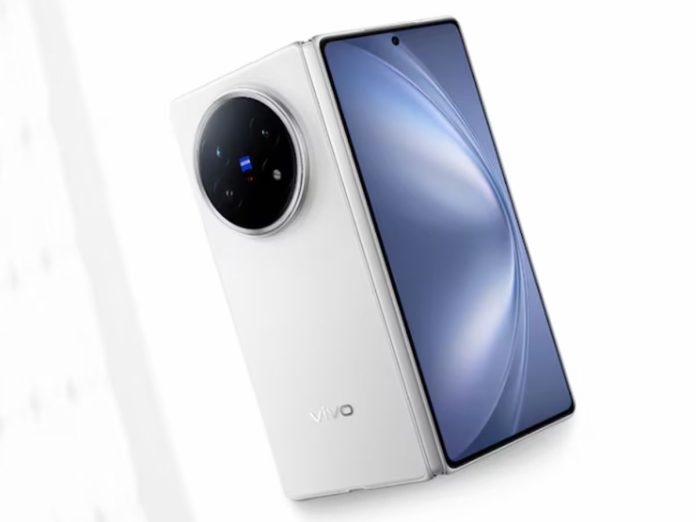
image

Caption – Vivo X Fold 5 glimpse on the official Vivo India microsite. (Image credit – Vivo)

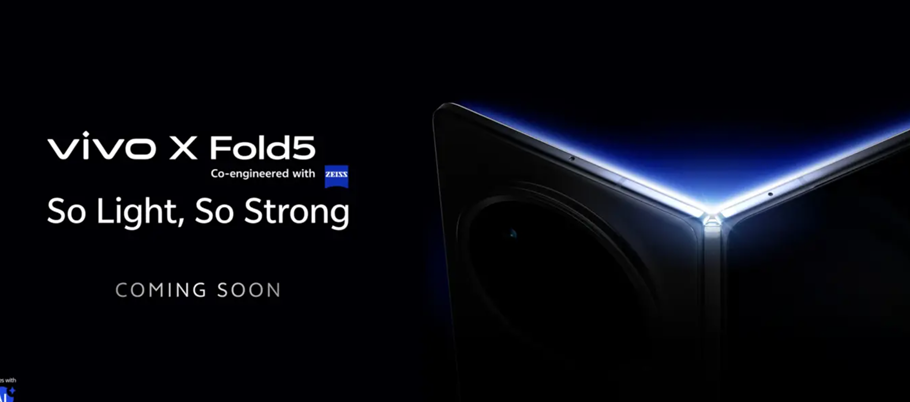
The official Vivo X Fold 5 microsite on Vivo India’s website is now live with a “Coming Soon” tag. The company has also posted teasers on its official social media handles in India.

Vivo has confirmed that the X Fold 5 will be sold via Flipkart and Vivo’s official online store once it launches. While the company hasn’t revealed the exact date yet, it’s expected to announce it in the coming days.

image

Caption – Vivo X Fold 5 teaser on official microsite. (Image credit – Vivo)

Vivo X Fold 5 – Key Features

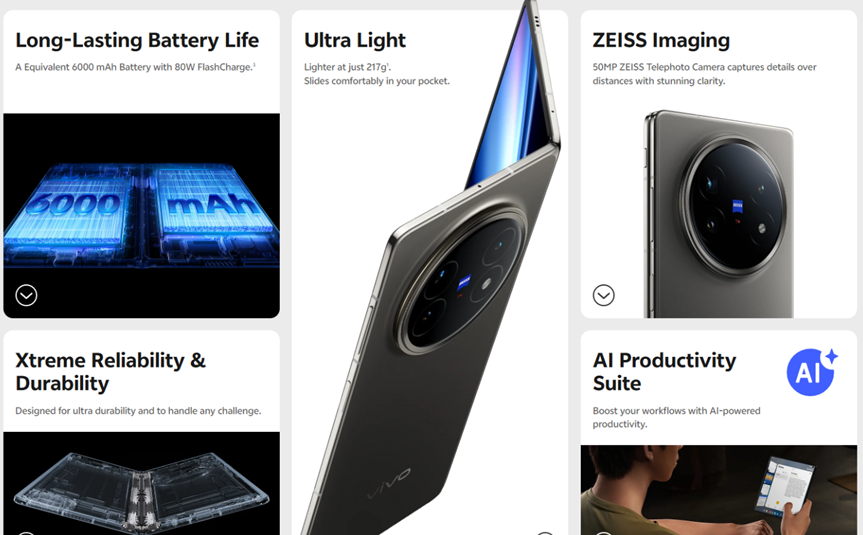
The upcoming foldable features an 8.03-inch flexible inner screen and a 6.53-inch cover display, both come with 8T LTPO technology. As for the design, the X Fold 5 measures 9.2mm when folded and just 4.3mm when unfolded, weighing 217 grams.

Under the hood, the Vivo X Fold 5 is powered by the Snapdragon 8 Gen 3 chipset, offering flagship-level performance. On the back, it sports a triple 50MP camera setup, which includes –

  • A 50MP main camera with Sony IMX921 sensor, f/1.57 aperture, and OIS
  • A 50MP ultra-wide lens
  • A 50MP 3x telephoto lens with Sony IMX882 sensor
  • For selfies, the phone features dual 20MP front cameras, one on the cover display and another inside.

The phone is also built to last. It comes with multiple durability ratings including IPX8 and IPX9 for water resistance, IP5X for dust resistance, and it can withstand extreme cold down to -20°C. The hinge is supported by carbon fibre and has been tested for 600,000 folds.

Powering the device is a 6000mAh dual-cell battery with 80W wired and 40W wireless charging. Vivo has also included a Shortcut Button for quick access to apps and features.

FAQs

Q1. When is the Vivo X Fold 5 launching in India and where will it be available?

Answer. Vivo has started teasing the India launch of the X Fold 5 with a “Coming Soon” tag on its official microsite. It will be sold via Flipkart and Vivo’s official online store.

Q2. What are the key display and performance features of the Vivo X Fold 5?

Answer. The phone features an 8.03-inch flexible inner screen and a 6.53-inch cover display, both with 8T LTPO technology, and is powered by the Snapdragon 8 Gen 3 chipset.

Q3. What are the durability and battery highlights of the Vivo X Fold 5?

Answer. It includes IPX8/IPX9 water resistance, IP5X dust resistance, a carbon fibre hinge tested for 600,000 folds, and a 6000mAh battery with 80W wired and 40W wireless charging.

Also Read: Vivo X Fold 5 Launches with 8.03″ 2K LTPO Display, Biggest 6000mAh Battery, Snapdragon 8 Gen 3 Chipset and IPX9 Rating

Also Read: Vivo X Fold 5 Teased as Lightweight, Could be the World’s Lightest Foldable

Apple May Launch a Cheaper MacBook with iPhone Chip, Says Kuo

0

Highlights

  • Apple may launch a cheaper MacBook powered by the A18 Pro chip, the same processor that has been used in the iPhone 16 Pro.
  • Production could begin in late 2025 or early 2026 with a 13-inch display and colourful finishes like silver, pink, and yellow.
  • The A18 Pro offers performance close to the M1 chip and the laptop is expected to be priced below the $999 MacBook Air.

image

Caption – Apple is reportedly working on a more affordable MacBook with an A19 Pro chip. (Image credit – Apple)

Apple might finally be working on a more affordable MacBook. According to well-known analyst Ming-Chi Kuo, Apple is planning to release a new laptop powered by the A18 Pro chip instead of its usual M-series processors. It is the same chip used in the iPhone 16 Pro lineup.

In a detailed post on X (formerly Twitter), Kuo said that production for this MacBook could begin in late 2025 or early 2026. The new model is expected to feature a 13-inch display, just like the current MacBook Air, but with the A18 chip being the main difference in terms of performance.

The new MacBook might also come in colourful finishes like silver, pink, and yellow, giving it a fresh and more playful look.

As of now, we don’t know the exact price, but the idea is that it would be cheaper than the $999 MacBook Air, which is currently Apple’s most affordable laptop. Kuo reports that Apple is planning to produce around 5–7 million units in 2026, hinting at a competitive price point meant to attract high-volume sales.

While this would be the first time Apple puts an iPhone chip in a Mac, the A18 Pro is still quite powerful. On Geekbench, its single-core score is around 3500, only slightly behind the M4 chip in the latest Mac mini. It does lag more in multi-core performance (8780 vs 15000 for M4), but for everyday tasks, most users likely wouldn’t notice a big difference.

The A18’s multi-core performance is actually close to that of the original M1 chip, which is still used by many people today without any issues.

In the end, the success of this new MacBook will depend on how much cheaper it will be than the MacBook Air. If priced right, it could open up the Mac ecosystem to a whole new group of users.

FAQs

Q1. What processor will the new budget MacBook use?

Answer. Apple is planning to release a new MacBook powered by the A18 Pro chip, the same chip used in the upcoming iPhone 16 Pro, instead of its usual M-series processors.

Q2. When is the new MacBook expected to enter production?

Answer. According to analyst Ming-Chi Kuo, production for the new MacBook could begin in late 2025 or early 2026.

Q3. How will the new MacBook compare in performance and price?

Answer. The A18 Pro’s multi-core performance is close to the original M1 chip, and the new MacBook is expected to be cheaper than the $999 MacBook Air, targeting high-volume sales.

Also Read: MacBook Air M4 vs MacBook Air M3: What’s New?

Also Read: Apple Unveils MacBook Air M4 Starting at ₹99,900 in India, New Colour Also Revealed

Nothing Headphone (1) Full Specs Leak Ahead of July 1 Launch

0

Highlights

  • Nothing Headphone (1) full specs leak reveals 40mm dynamic drivers, “Sound by KEF” tuning, adaptive bass, spatial audio, and support for AAC, SBC, and LDAC codecs.
  • It offers up to 80 hours of playback (ANC off) and 35 hours (ANC on) with a 1,040mAh battery; supports 42dB ANC, transparency mode and fast charging.
  • Smart Features – Google Fast Pair, Microsoft Swift Pair, dual device connection, on-head detection, Find My Device and low-lag mode.

image

Caption – Nothing Headphone (1)’s previously leaked image. (Image credit – EqualLeaks/Reddit)

The full specs of Nothing’s first over-ear headphones, the Nothing Headphone (1), have now surfaced ahead of the official reveal on July 1. Nothing had already confirmed last month that these headphones were coming this summer and a new report from Android Headlines has shared a detailed look at what to expect. Here’s what we know.

Nothing Headphone (1) – Leaked Specs

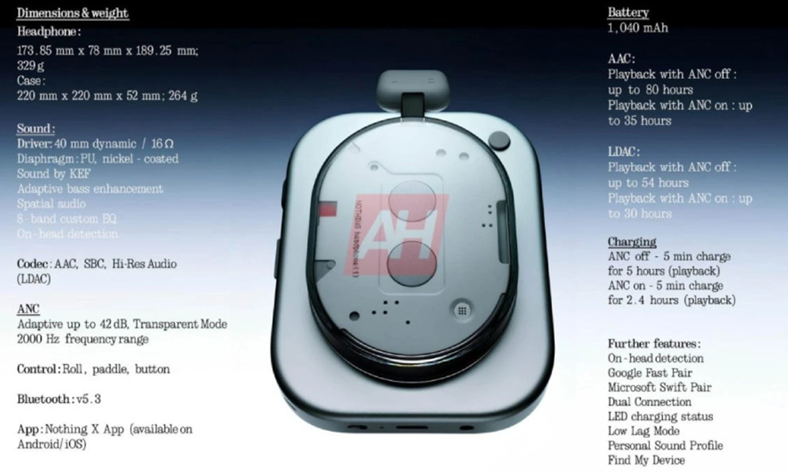
image

Caption – Nothing Headphone (1) leaked specs. (Image credit – Android Headlines)

The Nothing Headphone (1) is fairly large measuring 173.85 x 78 x 189.25 mm and weighing 329g. Even the carrying case is quite bulky at 220 x 220 x 52 mm and 264g.

The headphones use 40mm dynamic drivers with 16-ohm impedance and a PU diaphragm with nickel coating. The audio is “Sound by KEF,” referencing a collaboration with the premium UK audio brand known for its speakers, though it’s unclear how deeply KEF was involved in tuning.

Audio features include Adaptive bass enhancement, Spatial audio, 8-band custom EQ, Support for AAC, SBC, and LDAC codecs.

The headphones offer Active Noise Cancellation (ANC) up to 42dB, with a 2,000Hz frequency range, plus a transparency mode. Physical controls come in the form of a roll mechanism, a paddle, and a button. Connectivity is handled via Bluetooth 5.3, along with support from the Nothing X app on Android and iOS.

Powered by a 1,040mAh battery, Nothing promises up to 80 hours of playback (ANC off, AAC), 35 hours of playback (ANC on, AAC). 54 hours of playback (ANC off, LDAC) and 30 hours of playback (ANC on, LDAC).

A quick 5-minute charge gives you up to 5 hours of playback (ANC off), or 2.4 hours with ANC on.

Other highlights include –

  • Google Fast Pair
  • Microsoft Swift Pair
  • Dual device connection
  • Personal sound profile
  • On-head detection
  • Find My Device support
  • Low-lag mode for gaming or video
  • Charging status LED

FAQs

Q1. What are the key audio features of the Nothing Headphone (1)?

Answer. The headphones feature 40mm dynamic drivers, adaptive bass enhancement, spatial audio, 8-band custom EQ, and support for AAC, SBC, and LDAC codecs.

Q2. How long does the battery last on the Nothing Headphone (1)?

Answer. With its 1,040mAh battery, the headphones offer up to 80 hours of playback (ANC off, AAC) and 35 hours (ANC on, AAC). A 5-minute charge gives up to 5 hours of playback (ANC off).

Q3. What smart features are included in the Nothing Headphone (1)?

Answer. They support Google Fast Pair, Microsoft Swift Pair, dual device connection, on-head detection, Find My Device, low-lag mode, and personal sound profiles.

Also Read: Nothing confirms brand’s first over-ear headphones launch, expected this summer

Also Read: Nothing Phone 3 and Headphone 1 leak reveals colour options and pricing details

Samsung Galaxy A55 Spotted Running Android 16 with One UI 8 on Geekbench

0

Highlights

  • The Samsung Galaxy A55 5G has been spotted on Geekbench running Android 16 with One UI 8.
  • The device scored 1150 on single-core and 3417 on multi-core in early tests, though performance may improve in the final software release.
  • Launched with Android 14, the A55 still has two more major Android updates planned after the testing of Android 16.

image

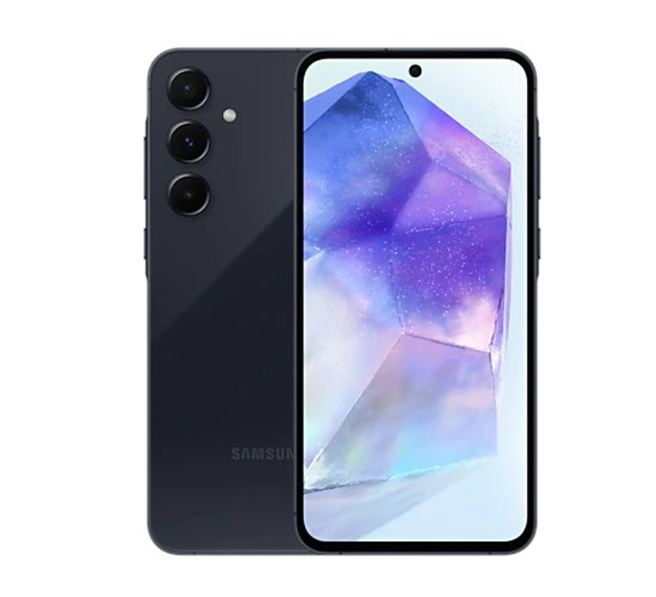
Caption – Samsung Galaxy A55 5G. (Image credit – Samsung)

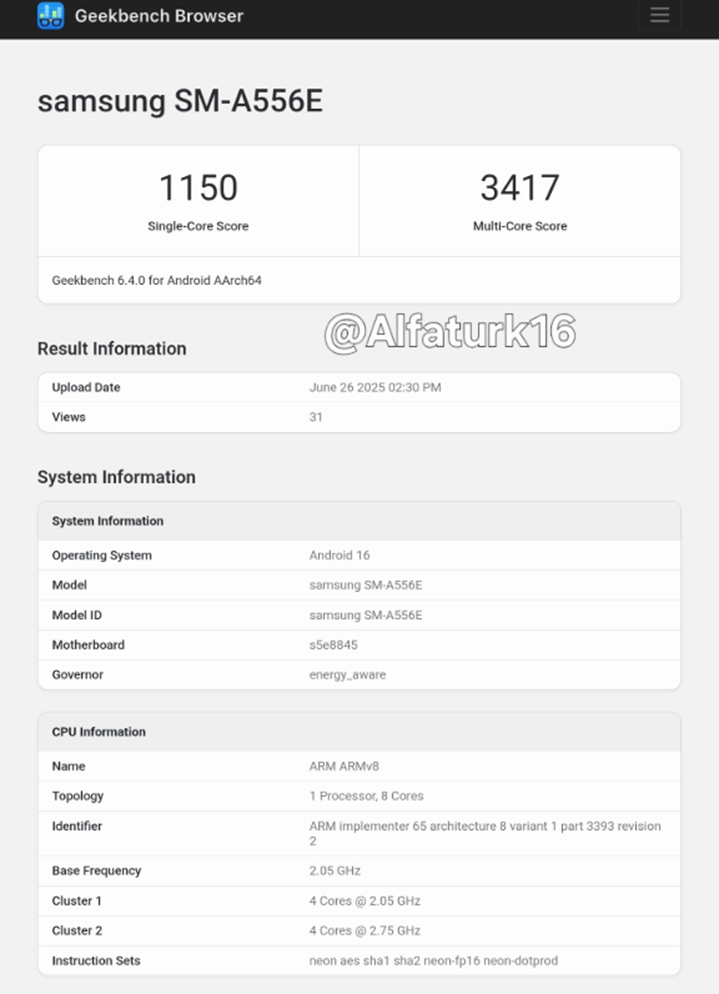
Samsung is already testing One UI 8 based on Android 16 for its Galaxy A55 5G, hinting at a faster update cycle this time around. According to tipster Alfaturk on X (formerly Twitter), the phone was recently spotted on Geekbench with model number SM-A556E, showing it’s currently being tested with the latest software.

The Samsung Galaxy A55 5G scored 1150 in single-core and 3417 in multi-core performance tests. These scores come from an early internal build of One UI 8, so performance may still improve once the final version rolls out.

image

Caption – Galaxy A55 5G spotted on Geekbench featuring Android 16 with One UI 8. (Screenshot credit – Alfaturk on X)

While the Galaxy A55 was launched in March 2024 with Android 14, it has already received the Android 15-based One UI 7. Now, with Android 16 in testing, the phone is on track to receive its second major OS update, and Samsung still plans to give it two more big Android updates in the future.

Samsung has picked up the pace with One UI 8 development across its lineup. The company is already preparing to ship its upcoming foldables on July 9 with One UI 8 pre-installed. Meanwhile, the Galaxy S25 series has joined the Beta Program and more older flagships are also testing Android 16 internally.

Samsung promises that One UI 8 will bring more than just new features. It’s expected to refine the overall user interface and user experience to make it a meaningful upgrade. This version is also very likely to bring deeper AI integration and advanced features tailored for flagship phones.

FAQs

Q1. What software version is currently being tested on the Galaxy A55 5G?

Answer. The Galaxy A55 5G is currently being tested with Android 16 and One UI 8, as spotted on Geekbench with model number SM-A556E.

Q2. What performance scores did the Galaxy A55 achieve on Geekbench with Android 16?

Answer. The phone scored 1150 in single-core and 3417 in multi-core tests using an early internal build of One UI 8.

Q3. How many Android updates is the Galaxy A55 expected to receive?

Answer. The Galaxy A55 launched with Android 14, has received Android 15, is now testing Android 16, and Samsung still plans to give it two more major Android updates.

Also Read: Samsung getting ready to launch One UI 8 based on Android 16 in July with Galaxy Z Fold 7 and Flip 7

Also Read: Samsung begins testing One UI 8 based on Android 16 – Features, release date, and more

OnePlus Watch 3 (43mm) to Launch on July 8 with Smaller Display and New Health Features

0

Highlights

  • The OnePlus Watch 3 (43mm) launches on July 8 in Black Steel and Silver Steel.
  • It will feature a 1.32-inch display, stainless steel body, enhanced “Mind & Body Evaluation” system, real-time barometer that checks fatigue every 30 minutes and tracks daily stress patterns.
  • Wellbeing tools includes guided breathing sessions, real-time feedback and personalised prompts to help reduce stress and improve mental and physical wellbeing.

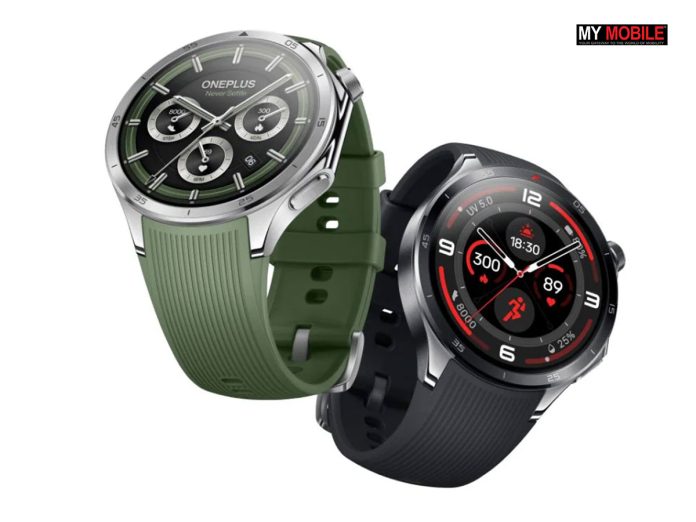
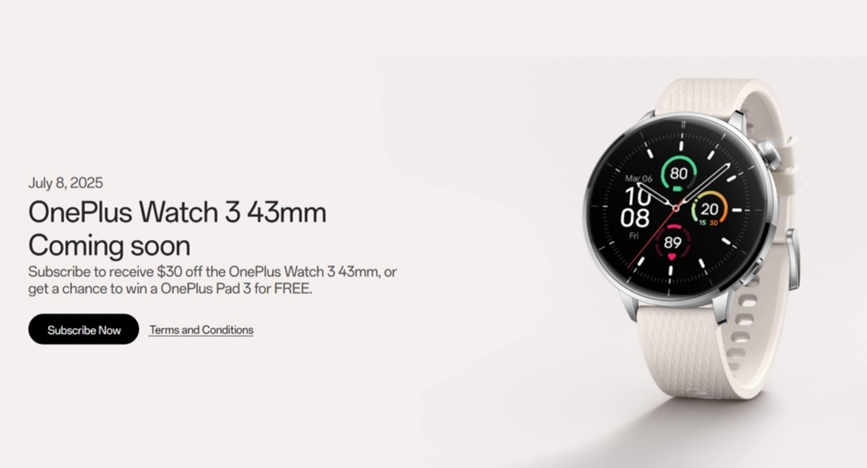
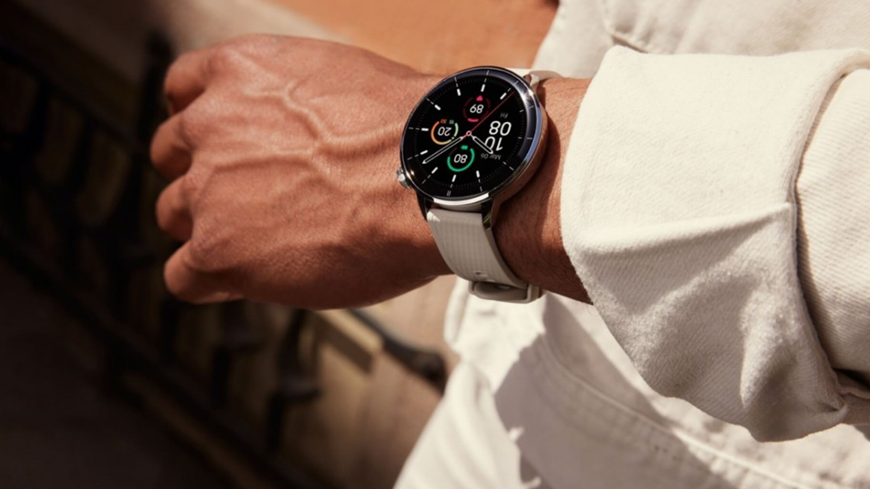
OnePlus is expanding its smartwatch lineup with a new 43mm version of the OnePlus Watch 3, set to launch on July 8. The original 46mm model, which debuted in February, is now getting a more compact variant. OnePlus has already shared some key details.

image

Caption – OnePlus Watch 3 43mm launch teaser. (Image credit – OnePlus)

OnePlus Watch 3 (43mm)

The 43mm Watch 3 will come with a 1.32-inch display, slightly smaller than the 1.5-inch screen on the 46mm version. It’s also lighter, weighing 36.8g (1.3 oz) compared to 49.7g (1.75 oz) on the larger model.

In its press release, OnePlus confirmed that the new Watch 3 will feature a stainless steel body with a crystal cover over the display. It will be available in two sleek finishes, “Black Steel” and “Silver Steel.”

OnePlus also teased an enhanced “Mind & Body Evaluation” feature. According to the brand, the watch will include a “real-time barometer” that can “evaluate your body’s level of fatigue every 30 minutes.”

The press note read, “Health monitoring is a significant feature in smartwatches, enabling users to track health data and support a healthy lifestyle. The OnePlus Watch 3 43mm provides a comprehensive focus on health, encompassing not only physical but also psychological wellbeing via upgraded OnePlus “Mind & Body Evaluation.”

image

Caption – OnePlus Watch 3 43mm. (Image credit – OnePlus)

“The OnePlus Watch 3 43mm includes a real-time barometer, which can evaluate your body’s level of fatigue every 30 minutes, and by extension what that reflects about your mental state. It also tracks your daily stress patterns and helps you identify key factors affecting them.”

“To support stress relief, users can initiate a one-minute guided breathing session, with real-time feedback showing how the body responds to the exercise. In addition, the watch provides daily and weekly trends on your mind and body status, along with personalised prompts to help reduce stress and improve overall wellbeing,” the brand also added.

More details including pricing and availability will be revealed at the official launch on July 8. Until then, you can check out reviews of the OnePlus Watch 3 (46mm) to get an idea of what to expect.

FAQs

Q1. When will the OnePlus Watch 3 (43mm) launch and what are its design features?

Answer. The OnePlus Watch 3 (43mm) will launch on July 8. It features a 1.32-inch display, a stainless steel body with a crystal cover, and comes in Black Steel and Silver Steel finishes.

Q2. What health features does the OnePlus Watch 3 (43mm) offer?

Answer. It includes an upgraded “Mind & Body Evaluation” system with a real-time barometer that evaluates your body’s level of fatigue every 30 minutes and tracks daily stress patterns.

Q3. How does the watch support stress relief and wellbeing?

Answer. The watch offers one-minute guided breathing sessions with real-time feedback, and provides daily and weekly trends along with personalised prompts to help reduce stress and improve overall wellbeing.

Also Read: OPPO Watch X2: Rebadged OnePlus Watch 3 launched with military-grade durability, dual-frequency GPS & more

Also Read: OnePlus Watch 3 renders leaked: To come with ECG monitoring and LTE connectivity

Apple Has 7 Head-Mounted Devices in the Works, Starting with New Vision Pro in 2025, Says Kuo

0

Highlights

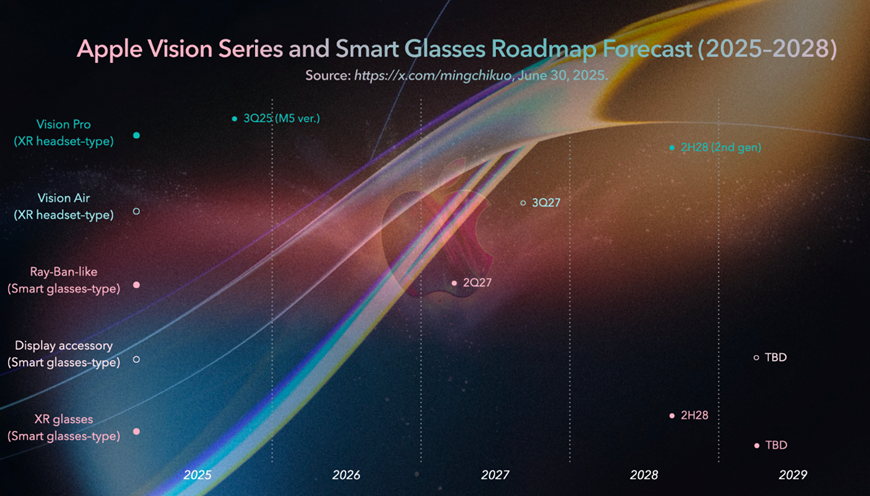
  • Apple is reportedly working on three Vision series headsets and four smart glasses variants with five having confirmed timelines between 2025 and 2028.
  • Vision Pro Roadmap includes the M5 Vision Pro in 2025, a lighter and cheaper Vision Air in 2027.
  • A second-gen Vision Pro in 2028 with a new design and Mac-class processor.
  • Apple’s first smart glasses are expected in 2027 with two XR glasses models to follow in 2028+.

Apple is reportedly working on at least seven head-worn products, according to analyst Ming-Chi Kuo. In a new blog post, Kuo outlined Apple’s roadmap for its headset and smart glasses lineup, with the first new release expected in 2025. Here’s what we know based on Kuo’s latest reveal.

Apple Vision Series and Smart Glasses Roadmap (2025–2028)

image

Caption – The future of Apple Vision Series and Smart Glasses. (Image credit – Analyst Ming-Chi Kuo)

According to Kuo, “Apple views head-mounted devices as the next major trend in consumer electronics. The company currently has at least seven projects in development, comprising three Vision series products and four smart glasses variants. Five of these products have confirmed development timelines, while two remain TBD.”

Vision Pro Roadmap

image

Caption – A still from Apple Vision Pro introduction video. (Credit – Apple)

M5 Vision Pro (2025) –

Apple is said to be preparing a slightly updated Vision Pro, going into mass production in Q3 2025. While the M5 chip will be new, the rest of the hardware will remain the same. Apple is expected to ship around 150,000 to 200,000 units by the end of 2025.

Vision Air (2027) –

A more affordable version of the Vision Pro named Vision Air could arrive in Q3 2027. Kuo says it will be 40% lighter, made of plastic and magnesium alloy instead of the current glass and titanium build. It’s expected to use the “highest-end iPhone processor” but with fewer sensors to cut costs.

2nd-Gen Vision Pro (2028) –

Kuo predicts a major upgrade in 2H 2028. The second-generation Vision Pro is expected to have a new design, a “Mac-class” processor, and be lighter and cheaper than the original.

Apple Glasses Timeline

1st-Gen Apple Glasses (2027)

Despite earlier rumours of a 2026 launch, Kuo now expects Apple’s first smart glasses similar to Meta’s Ray-Ban line to go into mass production in Q2 2027. Around 3–5 million units could ship. Features may include voice and gesture control, photo/video recording, AI environment sensing, and audio support (possibly through AirPods).

Two XR Glasses Models (2028+)

Apple is also working on two smart glasses with built-in displays with the first model expected to begin mass production in 2028. These will likely use Liquid Crystal on Silicon and waveguide display tech, along with gesture and voice controls.

Display Accessory on Hold

Kuo says a wired display accessory for Mac and iPhone, originally planned for Q2 2026, is on hold due to weight issues. The device was supposed to use Birdbath optics, but its future is uncertain.

Meanwhile, Kuo writes, “Apple’s entry is expected to push total market shipments for this category beyond 10 million units in 2027, marking a significant emerging trend.”

“Before Apple launches display-enabled smart glasses, several brands are expected to release similar products to establish early market presence. However, given the ongoing technological and design improvements needed, these products will likely remain niche offerings over the next two years,” Kuo further adds.

FAQs

Q1. How many head-mounted devices is Apple currently developing?

Answer. According to analyst Ming-Chi Kuo, Apple is working on at least seven head-worn products, including three Vision series headsets and four smart glasses variants.

Q2. What is the Vision Air, and when is it expected to launch?

Answer. The Vision Air is a more affordable version of the Vision Pro, expected in Q3 2027. It will be 40% lighter, made of plastic and magnesium alloy, and use the highest-end iPhone processor with fewer sensors to reduce cost.

Q3. When will Apple’s first smart glasses be released, and what features might they include?

Answer. Apple’s first smart glasses are expected to go into mass production in Q2 2027. They may include voice and gesture control, photo/video recording, AI environment sensing, and audio support, possibly through AirPods.

Also Read: Apple’s 18.8-Inch Foldable Prototype Features In-Display Face ID – Not Sure If It’s iPad or MacBook | M4 MacBook Air Gets Dual Display Support

Also Read: Rumour: Apple’s First Foldable Most Likely to Be an iPhone-iPad Hybrid

iQOO 13 Green Edition Launching in India on July 4, Snapdragon 8 Elite and 120W Fast Charging on Board

0

Highlights

  • The iQOO 13 Green Edition will launch in India on July 4 exclusively via Amazon.
  • The phone is powered by the Snapdragon 8 Elite, it features a 6.82″ 2K LTPO display with 144Hz refresh rate, 1800 nits brightness and 2592Hz dimming.
  • Other key features include a 6000mAh battery with 120W fast charging, a 50MP triple camera setup, IP68/IP69 rating and 4 years of Android updates.

The iQOO 13 Green Edition is all set to launch in India on July 4, exclusively via Amazon. According to the latest teaser live on Amazon, this new colour option will join the already available Legend Edition and Nardo Grey variants. The pricing and specs are expected to stay the same as the other versions.

image

Caption – iQOO 13 Green Edition India launch teaser. (Image credit – iQOO)

iQOO 13 – Key Features

The phone is powered by the Snapdragon 8 Elite processor, paired with LPDDR5x Ultra RAM and UFS 4.1 storage for top-tier performance. It sports a 6.82-inch Q10 8T LTPO Ultra Eyecare display with 2K resolution, a smooth 144Hz refresh rate, 1800 nits peak brightness and 2592Hz high-frequency dimming, making it great for both daily use and gaming.

Camera-wise, the iQOO 13 features a triple rear setup with a 50MP Sony IMX921 VCS main sensor, a 50MP Sony telephoto lens, and a 50MP ultra-wide camera. On the front, there’s a 32MP selfie shooter.

Powering the device is a 6000mAh battery that supports 120W flash charging, charging up to 40% in just 10 minutes and reaching full charge in 30 minutes. It runs on Funtouch OS 15 and is promised to get 4 years of Android updates and 5 years of security patches.

Other highlights include a 3D ultrasonic fingerprint sensor, multi-finger gestures, tempered glass screen, circular polarisation technology, and the Q2 chip. There’s also USB 3.2 support, a 7K Ultra VC cooling system and a Monster Halo light with 72 lighting effects.

The phone features bypass charging, Adreno Motion Engine 2.0, and is rated IP68 and IP69 for water and dust resistance.

The Green Edition has already launched in China and the Indian price will be revealed at launch.

FAQs

Q1. When and where will the iQOO 13 Green Edition launch in India?

Answer. The iQOO 13 Green Edition is set to launch in India on July 4, exclusively via Amazon, joining the Legend and Nardo Grey variants.

Q2. What are the key performance and display features of the iQOO 13?

Answer. It is powered by the Snapdragon 8 Elite processor, with LPDDR5x Ultra RAM and UFS 4.1 storage. The phone features a 6.82-inch 2K LTPO display with 144Hz refresh rate, 1800 nits brightness, and 2592Hz high-frequency dimming.

Q3. How fast does the iQOO 13 charge and what is its battery capacity?

Answer. The iQOO 13 has a 6000mAh battery that supports 120W flash charging, reaching 40% in 10 minutes and a full charge in 30 minutes.

Also Read: Realme GT 7 Pro vs iQOO 13: Which is the Best Smartphone Featuring Snapdragon 8 Elite in India?

Also Read: iQOO Launches India’s Fastest Smartphone: The iQOO 13