
Home Blog Page 11

Redmi Note 15 Pro+ and Redmi Note 15 Pro Go on Sale in India – Here’s All You Need To Know

0

Highlights

  • Redmi Note 15 Pro+ 5G and Note 15 Pro 5G are now on sale in India, priced from ₹29,999 to ₹43,999.
  • Both phones feature a 6.83-inch 1.5K AMOLED display, Gorilla Glass Victus 2, and multiple IP ratings for dust and water resistance, running Android 15-based HyperOS 2.
  • The Pro+ packs a Snapdragon 7s Gen 4, 200MP dual rear camera, while the Pro uses Dimensity 7400-Ultra.

Redmi Note 15 Pro+ and Redmi Note 15 Pro Go on Sale in India. (Image credit - Redmi)
Redmi Note 15 Pro+ and Redmi Note 15 Pro Go on Sale in India. (Image credit – Redmi)

The Redmi Note 15 Pro+ 5G and Redmi Note 15 Pro 5G were officially launched for the Indian market on January 29. The series is now available for sale in India across the Xiaomi India website, major e-commerce platforms, and offline retail stores. Here’s all you need to know.

Redmi Note 15 Pro 5G, Note 15 Pro+ 5G – Price and Offers in India

The Redmi Note 15 Pro 5G is priced starting at Rs. 29,999 for the 8GB RAM and 128GB storage variant, while the 8GB + 256GB model costs Rs. 31,999. Buyers can choose from Carbon Black, Mirage Blue, and Silver Ash colour options.

The Redmi Note 15 Pro+ 5G starts at Rs. 37,999 for the 8GB RAM and 256GB storage variant. The 12GB + 256GB version is priced at Rs. 39,999, while the top-end 12GB + 512GB configuration costs Rs. 43,999. It is available in Carbon Black, Coffee Mocha, and Mirage Blue colourways.

Redmi Note 15 Pro Series India launch offers. (Image credit - Redmi)
Redmi Note 15 Pro Series India launch offers. (Image credit – Redmi)

Redmi has announced a special limited stock launch offer where customers purchasing the Redmi Note 15 Pro+ 5G will get the Redmi Watch Move for free. As mentioned, this is a limited-period offer.

Xiaomi is also offering Xiaomi Easy Finance options with lending partner Axio. Customers can own Redmi Note 15 Pro series models now with easy EMIs of only INR 85 per day with zero processing fee.

Separately, there is also an instant discount of up to Rs. 3,000 on purchases made using HDFC Bank, SBI, and ICICI Bank credit cards.

Redmi Note 15 Pro Series – Key Features

Redmi Note 15 Pro+ 5G. (Image credit - Redmi)
Redmi Note 15 Pro+ 5G. (Image credit – Redmi)

Both the Redmi Note 15 Pro+ 5G and Redmi Note 15 Pro 5G are dual-SIM smartphones running Android 15-based HyperOS 2. They feature a 6.83-inch 1.5K AMOLED display with a resolution of 1,280 × 2,772 pixels, up to a 120Hz refresh rate, peak brightness of up to 3,200 nits and Gorilla Glass Victus 2 protection. Redmi claims that both handsets come with IP66, IP68, IP69, and IP69K ratings for dust and water resistance.

The Redmi Note 15 Pro+ 5G is powered by the Snapdragon 7s Gen 4 chipset and offers up to 12GB of RAM and up to 512GB of internal storage. The Redmi Note 15 Pro 5G, on the other hand, is equipped with the MediaTek Dimensity 7400-Ultra SoC and comes with 8GB of RAM and up to 256GB of storage.

Redmi Note 15 Pro 5G. (Image credit - Redmi)
Redmi Note 15 Pro 5G. (Image credit – Redmi)

In the camera department, both phones sport a dual rear camera setup led by a 200-megapixel primary sensor with optical image stabilisation, along with an 8-megapixel ultrawide camera. For selfies, the Redmi Note 15 Pro+ 5G features a 32-megapixel front camera, while the Redmi Note 15 Pro 5G gets a 20-megapixel selfie shooter.

The Redmi Note 15 Pro+ 5G is backed by a 6,500mAh silicon-carbon battery that supports 100W wired fast charging. The Redmi Note 15 Pro 5G houses a slightly larger 6,580mAh battery with 45W wired fast charging. Both smartphones also support 22.5W wired reverse charging.

FAQs

Q1. What are the prices of the Redmi Note 15 Pro and Pro+ in India?

Answer. The Redmi Note 15 Pro 5G starts at ₹29,999 (8GB+128GB), while the Redmi Note 15 Pro+ 5G starts at ₹37,999 (8GB+256GB) and goes up to ₹43,999 (12GB+512GB).

Q2. What are the key specifications of the Redmi Note 15 Pro series?

Answer. Both phones feature a 6.83-inch 1.5K AMOLED display, 200MP + 8MP dual rear cameras, and multiple IP ratings for dust/water resistance. The Pro+ uses a Snapdragon 7s Gen 4 with up to 12GB RAM, while the Pro runs on Dimensity 7400-Ultra with up to 8GB RAM.

Q3. What special launch offers are available for the Redmi Note 15 Pro series in India?

Answer. Buyers of the Redmi Note 15 Pro+ 5G get a Redmi Watch Move free (limited stock). Xiaomi also offers easy EMI options, plus up to ₹3,000 instant discount on HDFC, SBI, and ICICI Bank cards.


Also Read

https://www.mymobileindia.com/redmi-note-15-pro-series-launched-in-india-with-200mp-camera-quad-curved-amoled-display-price-features-and-availability/

https://www.mymobileindia.com/redmi-note-15-pro-5g-series-pre-booking-goes-live-in-india-offers-free-screen-replacement/

Samsung Galaxy Buds 4 and Galaxy Buds 4 Pro Leaked Renders Reveal New Design and Transparent Charging Case

0

Highlights

  • Leaked renders reveal Samsung Galaxy Buds 4 with an open-fit design with no silicone tips and Galaxy Buds 4 Pro with silicone ear tips for better noise isolation.
  • Both models feature a redesigned transparent charging case, horizontal earbud placement and stem-style design with visible microphone cutouts.
  • The earbuds are expected to launch on February 25 alongside the Galaxy S26 series.

image

Samsung Galaxy Buds 4 and Galaxy Buds 4 Pro. (Image credit – Samsung)

Samsung Galaxy Buds 4 and Galaxy Buds 4 Pro have surfaced in newly leaked renders. The images offer a detailed preview of Samsung’s upcoming true wireless earbuds ahead of their official debut. Here’s what we know based on the new leak.

Samsung Galaxy Buds 4, Galaxy Buds 4 Pro – Leaked Renders

According to leaked images shared by Android Headlines, the Galaxy Buds 4 series appears close to launch. The renders show the Galaxy Buds 4 in a black colour option with an open-fit design that skips silicone ear tips.

In contrast, the Galaxy Buds 4 Pro are shown in white and feature silicone ear tips, which are expected to provide a better seal and improved noise isolation.

image

Samsung Galaxy Buds 4 design. (Image credit – Android Headlines)

image

Samsung Galaxy Buds 4 Pro leaked renders. (Image credit – Android Headlines)

A major design change is visible in the charging case. Both models are shown with a redesigned case that features a transparent lid, allowing the earbuds to be visible while charging. The earbuds are placed horizontally inside the case with Samsung branding positioned on the front.

The standard Galaxy Buds 4 appear to have a darker base colour for the case, while the Pro variant is likely to match the colour of the earbuds themselves.

The renders also reveal a familiar stem-style design for both earbuds with microphone cutouts visible along the stems and on the outer surfaces.

The in-ear design of the Galaxy Buds 4 Pro is expected to offer better passive noise isolation, while the open-fit Galaxy Buds 4 may prioritise comfort for users who prefer a lighter, less intrusive fit.

Samsung Galaxy Buds 4, Galaxy Buds 4 Pro – What Else We Know?

Earlier leaks suggest possible new features and hardware upgrades. These include a pinch-and-hold gesture that could activate Interpreter Mode. Battery capacities are tipped to be 42mAh for the Galaxy Buds 4 and 57mAh for the Galaxy Buds 4 Pro, although these details have not been officially confirmed.

Pricing is reportedly set at around EUR 179 (roughly Rs. 19,200) for the Galaxy Buds 4, while the Galaxy Buds 4 Pro could be priced at approximately EUR 249 (roughly Rs. 26,600).

Both the Samsung Galaxy Buds 4 and Galaxy Buds 4 Pro are expected to launch alongside the Galaxy S26 series on February 25.

FAQs

Q1. What design differences exist between the Galaxy Buds 4 and Galaxy Buds 4 Pro?

Answer. The Galaxy Buds 4 feature an open-fit design without silicone tips, while the Galaxy Buds 4 Pro include silicone ear tips for better noise isolation.

Q2. What is new about the charging case design in the Galaxy Buds 4 series?

Answer. Both models come with a transparent charging case lid, horizontal earbud placement, and Samsung branding on the front, offering a fresh look.

Q3. When will the Galaxy Buds 4 and Buds 4 Pro launch, and what are their expected prices?

Answer. They are expected to launch on February 25 alongside the Galaxy S26 series, priced at around EUR 179 (about ₹19,200) for Buds 4 and EUR 249 (about ₹26,600) for Buds 4 Pro.

Also Read

https://www.mymobileindia.com/samsung-galaxy-buds-4-and-buds-4-pro-price-leaks-ahead-of-expected-february-launch/

https://www.mymobileindia.com/samsung-galaxy-buds-4-and-galaxy-buds-4-pro-battery-specs-and-design-leaked/

Apple Xcode 26.3 Introduces Agentic Coding With OpenAI Codex and Claude Agent Support

0

Highlights

  • Xcode 26.3 introduces agentic coding, enabling AI agents like OpenAI Codex and Anthropic Claude Agent.
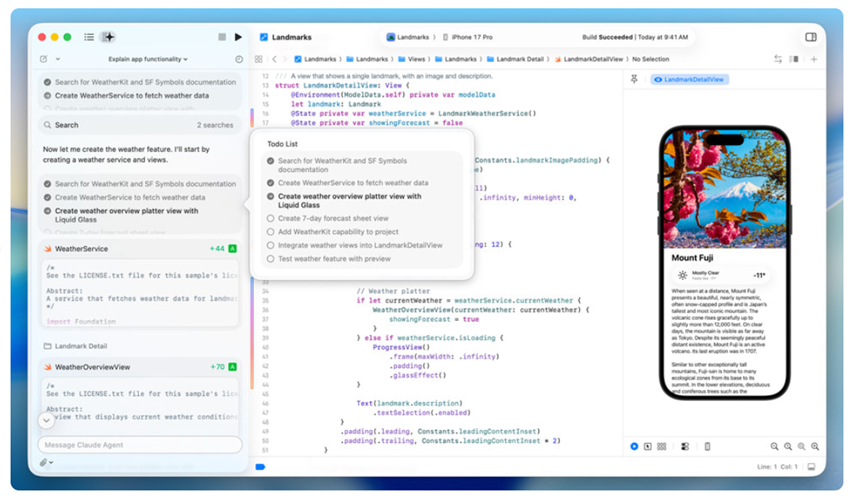
  • These agents can assist in searching documentation, navigating files, updating settings, validating previews, fixing bugs, and iterating codebases.
  • Developers can access agentic coding by signing in with OpenAI or Anthropic accounts or API keys.
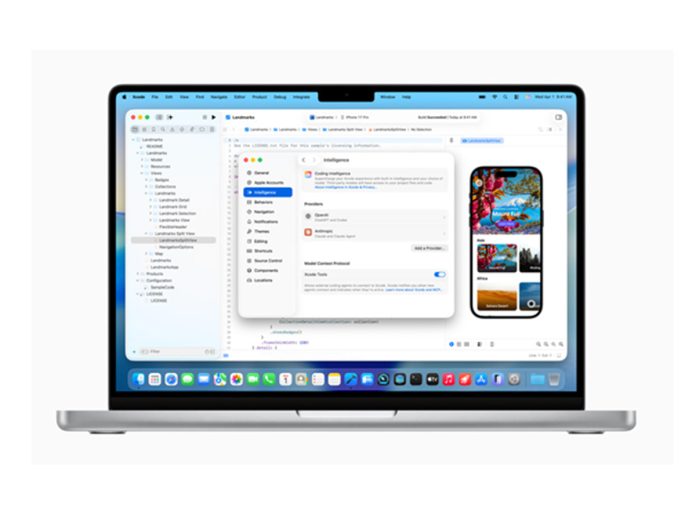
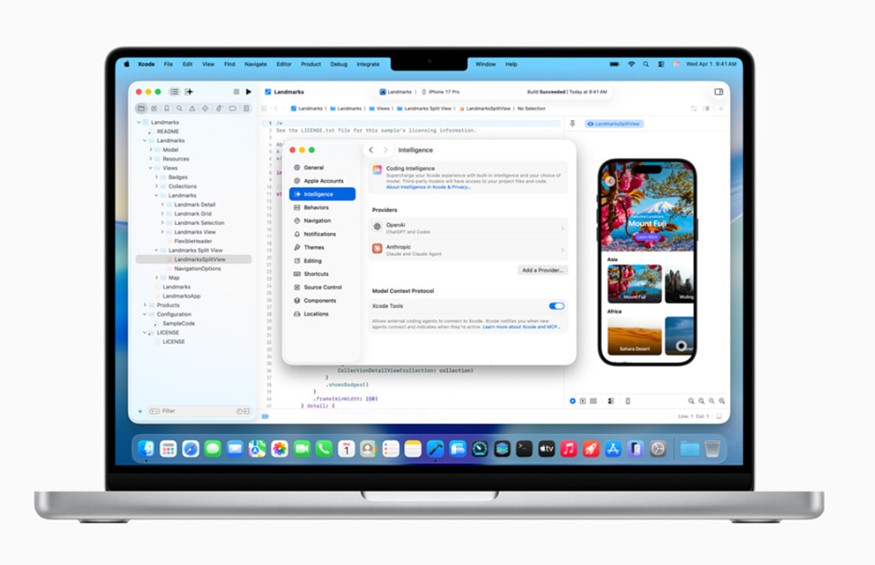
Xcode 26.3 unlocks agentic coding that allows developers to use Anthropic’s Claude Agent and OpenAI’s Codex directly in Xcode. (Image credit - Apple)
Xcode 26.3 unlocks agentic coding that allows developers to use Anthropic’s Claude Agent and OpenAI’s Codex directly in Xcode. (Image credit – Apple)

Apple is expanding artificial intelligence (AI) capabilities in Xcode, its integrated development environment (IDE) for building apps across its platforms. The company has started rolling out the Release Candidate of Xcode 26.3 to developers and one of the most notable additions is support for agentic coding.

With this update, Apple is allowing AI agents to access Xcode and carry out specific tasks, significantly increasing automation within the IDE. At present, the platform supports OpenAI’s Codex and Anthropic’s Claude Agent.

Xcode 26.3 Brings AI Agents to the IDE

In a newsroom post, Apple detailed the new agentic features introduced with Xcode 26.3. The update is currently available to developers via Apple’s developer portal, while a global stable release is expected to arrive on the Mac App Store in the near future.

Apple first announced AI integration in Xcode at last year’s Worldwide Developers Conference (WWDC), when it enabled developers to use ChatGPT or other models for help with coding, debugging, and related tasks. With Xcode 26.3, Apple is now taking a step further by adding support for Anthropic’s Model Context Protocol, an open standard that allows platforms to connect directly with AI agents.

image

OpenAI Codex and Claude Agent Supported

Developers using Xcode 26.3 can currently choose between OpenAI’s Codex and Anthropic’s Claude Agent. According to Apple, these AI agents can collaborate across the entire development lifecycle. Their capabilities include searching documentation, navigating file structures, updating project settings, and validating work by capturing Xcode Previews.

The agents can also iterate on existing codebases and automatically identify and fix bugs, making them useful for both active development and maintenance tasks.

Apple reportedly worked with OpenAI and Anthropic to design and optimise the new agentic coding functionality. Two key areas of focus were improving token utilisation and refining tool-calling mechanisms. Addressing these challenges was essential to deliver a smoother agent-based coding experience while keeping developer costs under control.

How Developers Can Access Agentic Coding?

Before using the new agentic features, developers need to download their preferred AI agent from Xcode’s settings. This can be done in two ways, either by signing in directly to an OpenAI or Anthropic account or by using API keys to access the service.

Apple also allows users to select the specific AI model they want to work with, similar to the options available within Codex or Claude Agent. This flexibility gives developers more control over how AI assists them during the app development process.

FAQs

Q1. What new feature does Xcode 26.3 introduce for developers?

Answer. Xcode 26.3 adds agentic coding support, allowing AI agents to automate tasks within the IDE, including coding, debugging, and project management.

Q2. Which AI agents are currently supported in Xcode 26.3?

Answer. Developers can choose between OpenAI’s Codex and Anthropic’s Claude Agent, both designed to assist across the app development lifecycle.

Q3. How can developers access and use these agentic coding features?

Answer. Developers can enable them via Xcode settings, either by signing in with OpenAI or Anthropic accounts or by using API keys to connect their preferred AI model.

Also Read

https://www.mymobileindia.com/apple-launches-new-bengaluru-education-hub-in-india-to-expand-skill-training-for-supplier-employees/

https://www.mymobileindia.com/india-clears-key-tax-hurdle-for-apple-easing-iphone-manufacturing-expansion-plans/

Next-Gen Xbox Could Arrive Sooner Than Expected as AMD Hints at 2027 Launch Window

0

Highlights

  • AMD CEO Lisa Su hinted that Microsoft’s next-gen Xbox powered by an AMD-designed SoC could align with a 2027 launch window.
  • Microsoft has described the upcoming console as a “premium, high-end” system.
  • The next Xbox will feature full backward compatibility with existing game libraries and is part of Microsoft’s partnership with AMD.
Next-Gen Xbox Could Arrive by 2027. (Image credit - Microsoft)
Next-Gen Xbox Could Arrive by 2027. (Image credit – Microsoft)

Microsoft’s next-generation Xbox console may be closer to launch than previously thought. While the company has not officially announced a timeline, AMD has now hinted that the new Xbox hardware could arrive as early as next year. The indication came from AMD CEO Lisa Su during the company’s latest earnings call.

AMD Hints at Possible 2027 Launch Timeline

While speaking about AMD’s semi-custom chip business, Lisa Su briefly mentioned that development of Microsoft’s next-generation Xbox is progressing smoothly. According to her comments, the console, which will be powered by an AMD-designed system-on-a-chip (SoC), could support a 2027 launch timeframe.

Although this does not confirm that Microsoft has finalised that year, it suggests AMD is aligning its hardware roadmap with a potential 2027 release.

The remarks were reported by publications including PC Mag and were part of a broader discussion around AMD’s semi-custom chip revenue, which currently includes processors used in existing consoles such as the Xbox Series X|S and the PlayStation 5.

Previously, documents that surfaced during the FTC vs Microsoft case had pointed to a potential 2028 launch. However, those documents are believed to reflect older internal plans and may no longer represent Microsoft’s current timeline.

What Microsoft Has Revealed So Far?

Microsoft has yet to officially announce a launch year for its next Xbox console, but it has shared some insight into its vision. Xbox president Sarah Bond previously described the upcoming system as a “very premium” and “high-end” experience.

The company has also hinted that future Xbox hardware could blur the traditional boundaries between consoles and PCs. Reports and statements suggest a hybrid approach, with existing Xbox Ally devices seen as an early step toward that broader ecosystem.

Microsoft has already confirmed that its next-generation Xbox will offer full backward compatibility with existing Xbox game libraries. It will allow users to carry forward their purchased titles without needing to start over.

Microsoft confirmed last year that it had entered into a multi-year strategic partnership with AMD for its future Xbox hardware. At the time, the company said the collaboration would involve co-engineering silicon across a range of devices, including upcoming Xbox consoles and cloud gaming infrastructure.

The partnership also covers Xbox Cloud Gaming, with both companies working together on the next generation of server hardware that powers Microsoft’s game streaming services.

FAQs

Q1. When is the next-generation Xbox expected to launch?

Answer. AMD CEO Lisa Su hinted at a possible 2027 launch window during an earnings call, though Microsoft has not officially confirmed a timeline.

Q2. What has Microsoft revealed about the upcoming Xbox console?

Answer. Microsoft described it as a “premium, high-end” system that may blur boundaries between consoles and PCs, while ensuring full backward compatibility with existing Xbox game libraries.

Q3. What role does AMD play in the development of the new Xbox?

Answer. The console will be powered by an AMD-designed system-on-a-chip (SoC), part of a multi-year partnership covering co-engineered silicon for consoles and cloud gaming infrastructure.

Also Read

https://www.mymobileindia.com/xbox-announces-full-december-2025-game-pass-lineup-indiana-jones-mortal-kombat-1-routine-and-more/

https://www.mymobileindia.com/microsoft-brings-xbox-cloud-gaming-to-india-now-stream-games-without-a-console/

Apple Launches New Bengaluru Education Hub in India to Expand Skill Training for Supplier Employees

0

Highlights

  • Apple has launched a new education hub in Bengaluru with MAHE to expand skill training for supplier employees.
  • The initiative will cover over 25 supplier sites in India, beginning with Tata Electronics.
  • It will offer training in digital literacy, Swift coding, robotics, automation, and smart manufacturing.

image

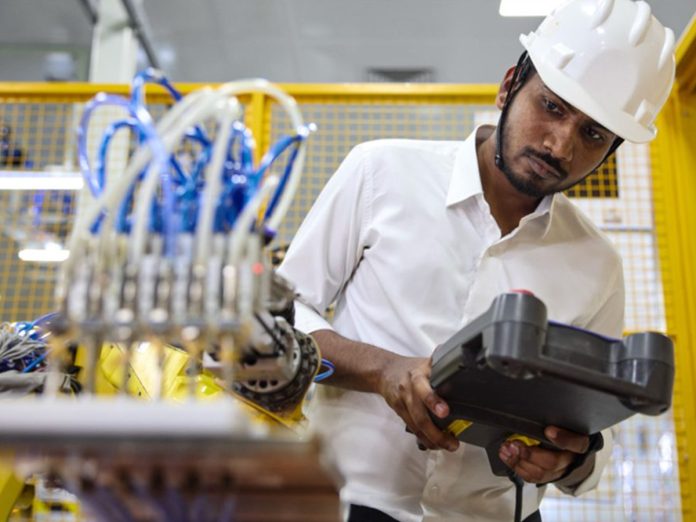
The new Apple Education Hub operates with the Manipal Academy of Higher Education. (Photo credit – Apple

Apple has announced the expansion of its skill-building and training initiatives for employees across its global supplier network, reinforcing its focus on workforce development in key manufacturing regions. As part of this effort, the Cupertino-based company has unveiled a new education hub in India aimed at offering accessible training programmes that go beyond workers’ day-to-day roles.

Apple’s New Education Hub in India

The newly launched education hub has been set up in collaboration with the Manipal Academy of Higher Education (MAHE). According to Apple, the hub will start offering new courses from March and will function as a dedicated space where trainers and students can learn directly from educators specialising in digital literacy and Swift coding.

Commenting on the launch, Sarah Chandler, Apple’s vice president of Environment and Supply Chain Innovation, said, “The same spirit of innovation that drives our products also guides our commitment to supporting people across our global supply chain. We’re thrilled to expand our technical training courses in India, giving thousands of employees the opportunity to learn valuable new skills and explore new paths for career growth.”

Lt. Gen. (Dr.) M.D. Venkatesh, vice chancellor at MAHE, also highlighted the importance of the partnership, stating, “This collaboration brings together Apple’s commitment to its supplier employees and Manipal’s experience in applied education to create meaningful opportunities for growth. Supplier communities sit at the heart of India’s manufacturing ecosystem, and investing in their skills is more important than ever.”

image

(Photo credit – Apple)

Courses, Training Scope, and Supplier Coverage

Under this initiative, faculty members from MAHE will train supplier trainers, who will then deliver these programmes to larger groups of employees. Starting with Tata Electronics, the development courses will be rolled out to supplier employees at more than 25 supplier sites across India.

The curriculum is designed to help workers build expertise in areas such as digital literacy, Swift coding, robotics, automation technology, and smart manufacturing. Apple said these courses are intended to enhance technical capabilities and support long-term career growth within the supplier ecosystem.

Part of Apple’s $50 Million Supplier Development Fund

Apple noted that these new development courses are the latest addition to its global $50 million (roughly Rs. 452.3 crore) Supplier Employee Development Fund. With this expansion, Apple and its partners now provide more than 75 courses for supplier employees in India.

The company also highlighted its robotics training programme, which was introduced in India in December 2024. Following its early success, Apple plans to expand the programme further this year. As part of this effort, factory educators will be trained and certified at robotics labs, allowing them to customise the curriculum and conduct training sessions at their own facilities.

Apple aims to strengthen technical skills through these initiatives across its supplier workforce while supporting India’s growing manufacturing ecosystem.

FAQs

Q1. What is Apple’s new education hub in India and who is it partnered with?

Answer. Apple has launched a new education hub in Bengaluru in collaboration with the Manipal Academy of Higher Education (MAHE) to expand skill training for supplier employees.

Q2. What kind of training will be offered through this new Apple initiative?

Answer. The hub will provide courses in digital literacy, Swift coding, robotics, automation technology, and smart manufacturing, aimed at enhancing technical skills and career growth.

Q3. How does this initiative fit into Apple’s broader supplier development efforts?

Answer. It is part of Apple’s $50 million Supplier Employee Development Fund, which now supports 75+ courses across India, including robotics training programs introduced in 2024.

Also Read

https://www.mymobileindia.com/india-clears-key-tax-hurdle-for-apple-easing-iphone-manufacturing-expansion-plans/

https://www.mymobileindia.com/apple-may-be-exploring-a-clamshell-style-foldable-iphone-report-suggests/

Oppo Find X10 Series Leak Hints at Dual 200MP Cameras, New Selfie Tech, and Next-Gen Dimensity 9500+, Dimensity 9600 Chipsets

0

Highlights

  • The Oppo Find X10 Pro is tipped to feature dual 200MP rear cameras (primary + periscope telephoto), marking a major upgrade over the Find X9 Pro.
  • Oppo may adopt iPhone 17-inspired selfie tech with a 1:1 square sensor enabling auto zoom and rotation, potentially outperforming Apple’s Centre Stage system.
  • The series will reportedly use next-gen MediaTek chipsets like Dimensity 9500+ (3nm) for the standard model and Dimensity 9600 (2nm) for Pro/Pro Max.

image

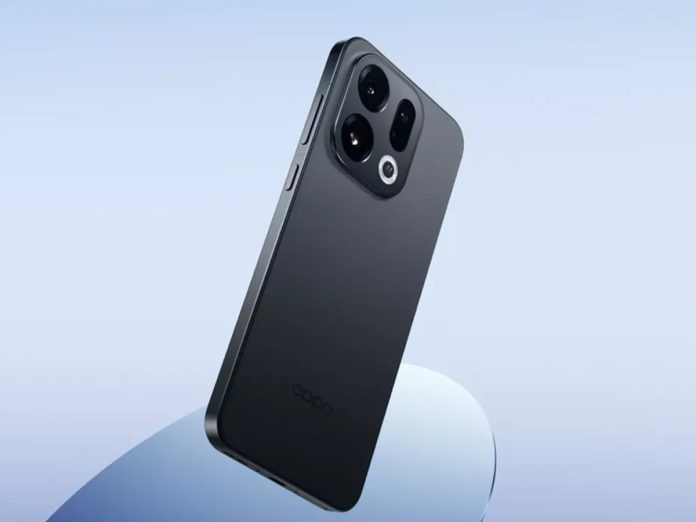
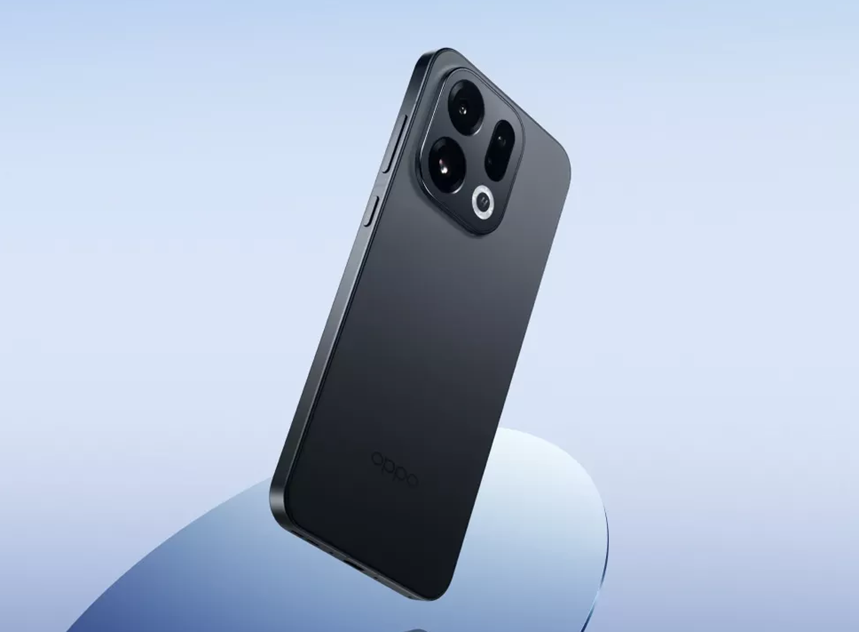
Oppo Find X9 in the picture for reference. (Image credit – Oppo)

Fresh leaks have shed light on Oppo’s upcoming Find X10 series with new details pointing to major camera upgrades, a redesigned selfie camera system, and next-generation chipsets. A tipster has now revealed key information about the rumoured Oppo Find X10 Pro, suggesting notable improvements over the current Find X9 lineup.

Oppo Find X10 Pro Camera Details (Expected)

image

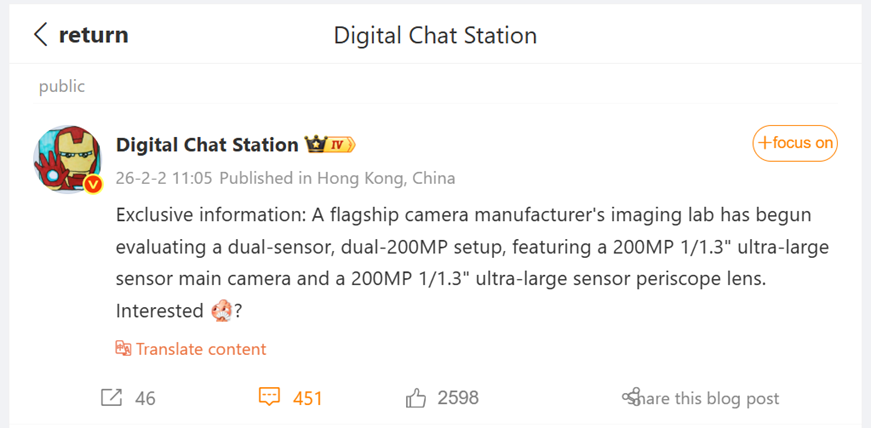
Tipster Digital Chat Station’s recent post on Oppo Find X10 Pro Camera Details. (Translated via Google Translate)

Tipster Digital Chat Station, in a Weibo post, has shared camera specifications of an unidentified flagship smartphone, which are believed to belong to the Oppo Find X10 Pro. The device, expected to launch later this year, is tipped to feature two 200-megapixel rear cameras.

According to the leak, the Oppo Find X10 Pro could come with a 200-megapixel primary camera using a 1/1.3-inch sensor, along with a 200-megapixel periscope telephoto lens that also uses a 1/1.3-inch sensor. Other details such as the chipset, battery size, charging speeds, and display specifications of the smartphone are yet to be revealed.

By comparison, the Oppo Find X9 Pro was launched in India in November 2025 at a starting price of Rs. 1,09,999 for the 16GB + 512GB configuration. It also sports a triple rear camera setup and includes a 200-megapixel telephoto camera. However, the Find X10 Pro is expected to deliver a more advanced camera experience, even though it may reportedly use slightly smaller sensors than its predecessor.

Oppo Find X10 Series May Adopt iPhone 17-Inspired Selfie Camera Tech

In another leak, Digital Chat Station claims that Oppo and Huawei could adopt a selfie camera technology similar to Apple’s Centre Stage system introduced with the iPhone 17 lineup. Apple’s implementation uses an 18-megapixel square sensor that enables auto zoom and auto rotation, keeping subjects centred in the frame.

With this feature enabled, the iPhone camera can automatically zoom out and rotate by cropping into the sensor, allowing users to capture landscape selfies while holding the phone vertically. This feature was widely praised by reviewers as it was considered a more meaningful upgrade than the new 48-megapixel Fusion ultra-wide camera, partly due to its compatibility with third-party apps like WhatsApp and Zoom.

image

Tipster Digital Chat Station’s recent post. (Translated via Google Translate)

According to the tipster, Oppo is exploring a similar 1:1 square sensor for its next-generation flagship lineup, widely referred to as the Oppo Find X10 series. However, the rumoured Find X9 Ultra may continue with imaging features similar to other Find X9 models. The tipster further claimed that Oppo’s version of the square sensor could potentially outperform Apple’s implementation.

Huawei May Bring Similar Tech to Mid-Range Phones

Oppo is not the only brand reportedly inspired by Apple’s Centre Stage technology. In a follow-up post, the tipster added that Huawei is also testing a 1:1 square sensor.

image

Tipster Digital Chat Station’s recent post. (Translated via Google Translate)

Unlike Oppo, which may debut it on flagship devices, Huawei is expected to introduce this feature on its photography-focused mid-range smartphones. While details remain scarce, the upcoming Huawei Nova 16 series is said to be a possible candidate for this technology.

Oppo Find X10 Series Chipset Details Surface

image

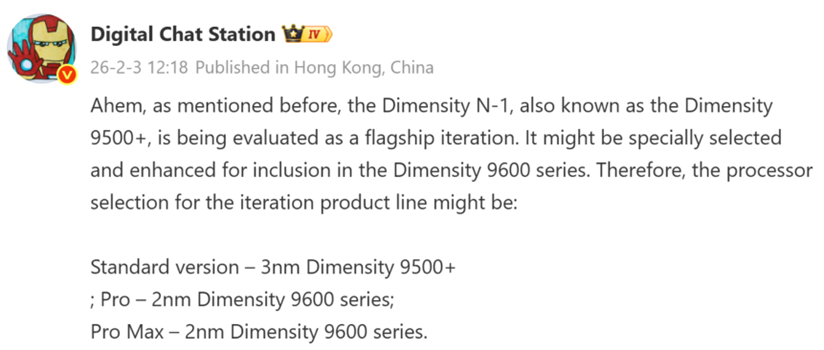
Tipster Digital Chat Station’s recent post on Oppo Find X10 Pro processor details. (Translated via Google Translate)

Digital Chat Station has also shared insights into the chipset strategy for Oppo’s next flagship lineup. The tipster claims that an upcoming series with standard, Pro, and Pro Max models is currently being tested with different MediaTek processors. This aligns with earlier leaks suggesting that the Find X10 family will include the Find X10, Find X10 Pro, and Find X10 Pro Max.

The standard Find X10 is said to be under evaluation with the MediaTek Dimensity 9500 Plus, reportedly built on a 3nm process. Meanwhile, the Pro and Pro Max variants could feature a more advanced 2nm-based Dimensity 9600-series chipset. If accurate, this strategy would allow Oppo to clearly separate performance tiers within the same flagship lineup, rather than relying only on camera or display differences.

Early rumours suggest that the Oppo Find X10 series could launch in China around October. Oppo is also expected to introduce a Find X10 Ultra model a few months later, which may switch to the Snapdragon 8 Elite Gen 6 Pro chipset, continuing the company’s trend of reserving Snapdragon silicon for its top-tier Ultra devices.

Oppo’s focus currently appears to be on immediate launches. Reports indicate that the Find X9 Ultra, Find X9s Pro, and the Find N6 foldable smartphone could debut in China in March. While the Find X9 Ultra and Find N6 are tipped to feature the Snapdragon 8 Elite Gen 5 chipset, the Find X9s Pro is expected to run on the Dimensity 9500.

More details about Oppo’s flagship roadmap are likely to emerge as these launches approach.

FAQs

Q1. What major camera upgrades are expected in the Oppo Find X10 Pro?

Answer. The Find X10 Pro is tipped to feature dual 200MP rear cameras, a primary sensor and a periscope telephoto lens, both using 1/1.3-inch sensors.

Q2. What new selfie camera technology might Oppo introduce in the Find X10 series?

Answer. Oppo is reportedly exploring a 1:1 square sensor inspired by Apple’s Centre Stage, enabling auto zoom and rotation to keep subjects centred in selfies.

Q3. Which chipsets are expected to power the Oppo Find X10 lineup?

Answer. The standard Find X10 may use the Dimensity 9500+ (3nm), while the Pro and Pro Max could feature Dimensity 9600 (2nm). An Ultra variant may later adopt the Snapdragon 8 Elite Gen 6 Pro.

Also Read

https://www.mymobileindia.com/oppo-find-x9s-oppo-find-x9-ultra-and-oppo-find-n6-foldable-global-launch-timeline-and-colour-options-leak/

https://www.mymobileindia.com/oppo-find-n6-spotted-on-tdra-imda-and-tuv-platforms-80w-charging-revealed/

Motorola Razr 70 Global Launch Likely Soon as Foldable Appears on UAE TDRA Certification

0

Highlights

  • The Motorola Razr 70 has appeared on the UAE TDRA certification database.
  • Multiple Motorola devices including the Razr 70 Ultra and Edge 70 Fusion have also surfaced on the same database.
  • The Razr 70 is expected to succeed the Razr 60, bringing incremental upgrades over its predecessor.

image

Motorola Razr 60 Ultra in the picture for reference. (Image credit – Motorola)

Motorola’s next-generation foldable smartphone appears to be edging closer to a global launch. The Motorola Razr 70 has reportedly been spotted on the UAE’s Telecommunications and Digital Government Regulatory Authority (TDRA) certification database. This indicates that the company may soon unveil the device in select international markets. Here’s what we know about this upcoming model so far.

Motorola Razr 70 – UAE TDRA Certification

image

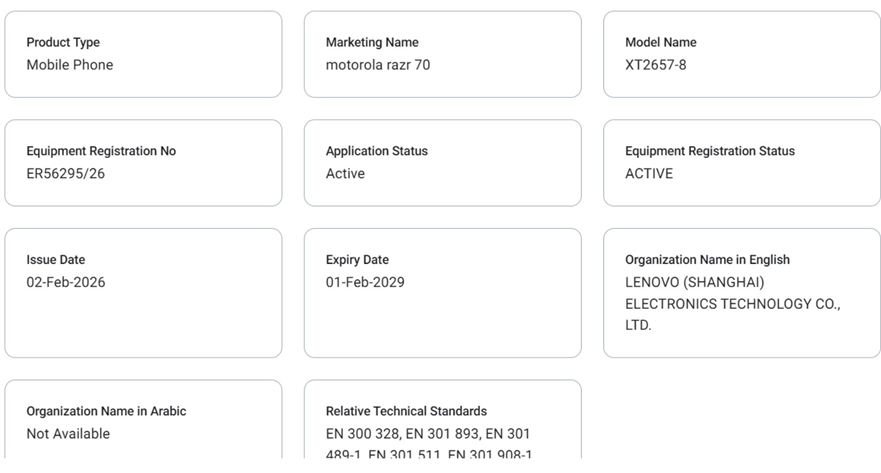
Motorola Razr 70 UAE TDRA Certification.

According to a post shared by tech blogger Anvin @ZionsAnvin on X, the Motorola Razr 70 has appeared on the TDRA database carrying the model number XT2657-8. The listing confirms regulatory clearance in the UAE, suggesting that Motorola could be preparing to launch the foldable smartphone in global markets in the near future.

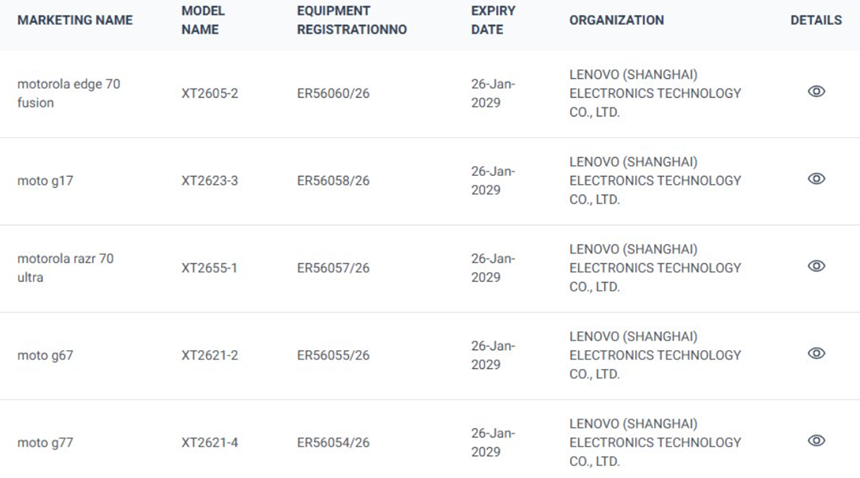
This development follows earlier sightings of multiple Motorola devices on the same database. The Motorola Edge 70 Fusion, Razr 70 Ultra, Moto G17, Moto G67, and Moto G77 were reportedly listed with model numbers XT2605-2, XT2623-3, XT2655-1, XT2621-2, and XT2621-4, respectively.

image

UAE’s TDRA approved other Motorola phones.

Despite these appearances, Motorola has not confirmed the launch plans for any of these models. The certification entries also do not reveal information related to pricing, specifications, features, or launch timelines.

Motorola Razr 70 – What Else We Know?

The Motorola Razr 70 is expected to succeed the Razr 60, which debuted in India at a starting price of Rs. 49,999 for the 8GB RAM and 256GB storage variant. The Razr 60 was offered in Pantone Gibraltar Sea, Pantone Lightest Sky, and Pantone Spring Bud colour options.

While official details of the Razr 70 are still under wraps, it is expected to bring incremental upgrades over its predecessor.

For reference, the Motorola Razr 60 features a 6.9-inch Full-HD+ pOLED LTPO foldable inner display with a 120Hz refresh rate and up to 3,000 nits of peak brightness. It also includes a 3.63-inch pOLED cover display offering a 90Hz refresh rate and up to 1,700 nits of peak brightness.

The Razr 60 is powered by the MediaTek Dimensity 7400X chipset, paired with 8GB of LPDDR4x RAM and 256GB of UFS 2.2 internal storage. It sports a dual rear camera setup consisting of a 50-megapixel primary sensor and a 13-megapixel ultrawide lens, along with a 32-megapixel front-facing camera. The device packs a 4,500mAh battery with support for 30W wired and 15W wireless fast charging.

More concrete details about Motorola’s upcoming foldable smartphone lineup are expected to surface in the coming weeks.

FAQs

Q1. What recent development suggests the Motorola Razr 70 is nearing launch?

Answer. The Razr 70 has appeared on the UAE TDRA certification database with model number XT2657-8, indicating regulatory clearance and a likely global launch soon.

Q2. What other Motorola devices were spotted alongside the Razr 70 on the TDRA database?

Answer. Listings included the Motorola Edge 70 Fusion, Razr 70 Ultra, Moto G17, Moto G67, and Moto G77, though launch details remain unconfirmed.

Q3. What can we expect from the Razr 70 compared to its predecessor, the Razr 60?

Answer. While official specs are not yet revealed, the Razr 70 is expected to bring incremental upgrades over the Razr 60, which featured a 6.9-inch foldable pOLED display, MediaTek Dimensity 7400X chip, dual rear cameras, and a 4,500mAh battery.

Also Read

https://www.mymobileindia.com/motorola-launches-moto-g67-and-moto-g77-specs-features-price-and-availability/

https://www.mymobileindia.com/motorola-signature-ultra-premium-smartphone-and-moto-watch-officially-launched-in-india/

iPhone 18 Series Unlikely to Get Major Design Overhaul, Apple to Focus on A20 Chip

0

Highlights

  • The iPhone 18 series is unlikely to see major design changes.
  • Apple’s focus will be on performance upgrades led by the new A20 and A20 Pro chipsets.
  • The iPhone 18 Pro models will debut later this year with feature upgrades like a smaller Dynamic Island, C2 modem, improved Camera Control, a 24MP front camera and a variable aperture rear camera.
iPhone 17 Pro in the picture. (Image credit - Apple)
iPhone 17 Pro in the picture. (Image credit – Apple)

Apple is not expected to introduce any major visual changes with its upcoming iPhone 18 lineup, according to a new leak. Weibo tipster named Fixed Focus Digital claims that the overall design language of the iPhone 18 models will remain largely unchanged, as Apple is said to be satisfied with the strong sales performance of the iPhone 17 series.

Instead of redesigning the hardware, Apple is reportedly planning to shift attention to performance upgrades, particularly with its next-generation A20 and A20 Pro chipsets. These processors are expected to be Apple’s first 2nm chips and are likely to be a major highlight when the new devices are unveiled later this year.

Historically, Apple has avoided back-to-back flagship redesigns. The iPhone 17 Pro models introduced a noticeable redesign after two years of similar-looking iPhone 15 Pro and iPhone 16 Pro models.

Earlier Pro lineups such as the iPhone 12 Pro, 13 Pro, and 14 Pro also shared nearly identical designs, as did the iPhone X, iPhone XS, and iPhone 11 Pro. As a result, a fresh redesign for the iPhone 18 Pro would be unusual, making it more likely that the upcoming models will closely resemble current-generation devices.

As per existing leaks, the iPhone 18 Pro and iPhone 18 Pro Max are expected to debut later this year with several internal and feature-level upgrades. These include a smaller Dynamic Island, Apple’s C2 modem, a simplified Camera Control system, a 24-megapixel front-facing camera, and an improved main rear camera with variable aperture support.

The standard iPhone 18 is tipped to launch in early 2027 and is also expected to carry many of the same upgrades found on the Pro models. While design changes may be minimal, Apple’s focus on next-gen silicon and camera improvements could define the iPhone 18 generation.

FAQs

Q1. Will the iPhone 18 series feature a major design overhaul?

Answer. No, leaks suggest the iPhone 18 lineup will retain a similar design to the iPhone 17 series, as Apple is satisfied with current sales and typically avoids back-to-back redesigns.

Q2. What is the biggest upgrade expected in the iPhone 18 models?

Answer. The highlight will be Apple’s new A20 and A20 Pro chipsets, its first 2nm processors, promising significant performance improvements.

Q3. What new features are tipped for the iPhone 18 Pro models?

Answer. Expected upgrades include a smaller Dynamic Island, Apple’s C2 modem, a simplified Camera Control system, a 24MP front camera, and a rear camera with variable aperture support.

Also Read

https://www.mymobileindia.com/iphone-18-launch-delayed-to-2027-as-chip-shortages-disrupt-apples-plans-report/

https://www.mymobileindia.com/iphone-18-pro-camera-upgrade-includes-variable-aperture-and-teleconverter/

Redesigned MacBook Pro With OLED Display Tipped to Launch in Q4 2026: Report

0

Highlights

  • Apple is expected to release updated MacBook Pro models with M5 Pro and M5 Max chips soon.
  • A redesigned MacBook Pro is tipped for late 2026, featuring a slimmer chassis, possible touchscreen support and a punch-hole camera cutout.
  • The most significant upgrade will be the shift to OLED displays with Samsung Display set to supply 14-inch and 16-inch panels.

image

Current MacBook Pro model. (Image credit – Apple)

Apple is reportedly preparing to introduce an all-new MacBook Pro design later this year. It will be a fresh supply chain report suggesting a launch in the final quarter. While Apple is expected to roll out updated MacBook Pro models powered by the M5 Pro and M5 Max chips in the near term, the more significant upgrade is said to arrive towards the end of the year with a completely redesigned chassis and a long-awaited display overhaul.

M5 Pro and M5 Max MacBook Pro Launch Expected Soon

image

Apple currently sells the MacBook Pro with the base M5 chip, and reports indicate that more powerful M5 Pro and M5 Max variants could debut as early as this month. These upcoming models are expected to retain the existing design but deliver notable performance gains.

Previous reports have suggested that the M5 Max could post “astounding” Geekbench scores, along with offering greater flexibility in CPU and GPU configurations.

The launch was earlier speculated to coincide with Apple Creator Studio, but that did not materialise. Recent reports now point to a launch alongside macOS 26.3 in the coming weeks.

All-New MacBook Pro Design Tipped for Late 2026

While the upcoming M5 Pro and M5 Max refresh may appeal to users seeking immediate performance upgrades, many are reportedly holding out for the long-rumoured redesigned MacBook Pro. If accurate, this would mark the first major design change to the MacBook Pro lineup in five years.

Leaks and reports suggest that the new design could be slimmer and may replace the current display notch with a punch-hole cutout for the FaceTime camera. There is also speculation that Apple could introduce touchscreen support for the first time on a MacBook Pro, though this remains unconfirmed.

The most anticipated change, however, is Apple’s shift from IPS LCD panels to OLED displays.

OLED MacBook Pro Likely to Launch in Q4

According to a supply chain report from The Elec, Samsung Display is preparing to manufacture OLED panels for the upcoming MacBook Pro models with a launch planned for the fourth quarter of this year.

The report states, Samsung Display will make the first OLED MacBook panel that Apple will launch in the fourth quarter of this year in the A6 line. It was designed as two models, 14 inches and 16 inches. Samsung Display’s shipment target is said to be 2 million units by the end of this year.”

Earlier reports had claimed that Samsung was ahead of schedule with OLED panel development. However, the latest update suggests that while Samsung is ready to produce the displays, some Apple-specific components are still not finalised, which could impact timelines.

If these reports hold true, Apple’s redesigned MacBook Pro with an OLED display could be one of the company’s most significant hardware launches of the year, combining a refreshed design with a major upgrade in display technology.

FAQs

Q1. When will Apple launch the redesigned MacBook Pro with OLED display?

Answer. Reports suggest Apple will introduce the redesigned MacBook Pro with OLED panels in Q4 2026, with Samsung Display supplying 14-inch and 16-inch models targeting 2 million units by year-end.

Q2. What upgrades are expected in the upcoming M5 Pro and M5 Max MacBook Pro models?

Answer. The M5 Pro and M5 Max variants are expected to launch soon, retaining the current design but offering significant performance gains, including “astounding” Geekbench scores and more flexible CPU/GPU configurations.

Q3. What design changes are rumoured for the late 2026 MacBook Pro refresh?

Answer. The redesigned MacBook Pro may feature a slimmer chassis, a punch-hole cutout for the FaceTime camera instead of the notch, and possibly touchscreen support, though the latter remains unconfirmed.

Also Read

https://www.mymobileindia.com/new-macbook-pro-models-tipped-to-launch-with-macos-26-3-m5-pro-and-m5-max-chips-might-not-arrive-before-march/

https://www.mymobileindia.com/rumour-apple-could-be-teasing-high-end-macbook-pro-on-january-28/

SpaceX Acquires xAI in $1.25 Trillion All-Stock Deal, xAI Launches Grok Imagine 1.0

0

Highlights

  • SpaceX acquired xAI in a $1.25 trillion all‑stock deal, combining AI research with space infrastructure. SpaceX valued at $1T, xAI at $250B.
  • Musk plans to deploy up to one million satellites to enable large‑scale AI computing in space.
  • xAI launched Grok Imagine 1.0, an AI video generation platform with text‑to‑video, image‑to‑video, cinematic editing tools, and an API suite.
SpaceX Acquires xAI in $1.25 Trillion All-Stock Deal.

SpaceX has officially acquired artificial intelligence company xAI in an all-stock transaction. The details were disclosed in a statement published on SpaceX’s website and signed by Elon Musk. The move brings AI development together with launch systems, satellite networks, space-based internet, and direct-to-device communications under a single corporate structure.

According to SpaceX, the integration is designed to combine xAI’s AI models and research with SpaceX’s space infrastructure to support large-scale AI computing. Musk noted that most AI development today depends on terrestrial data centres, which are increasingly constrained by power availability and cooling requirements, making it difficult to meet rising global demand using ground-based infrastructure alone.

“This marks not just the next chapter, but the next book in SpaceX and xAI’s mission: scaling to make a sentient sun to understand the Universe and extend the light of consciousness to the stars!” Musk said.

SpaceX’s Plan for Space-Based AI Computing

In the official statement, Musk said large-scale AI computing could become more cost-effective in space within the next two to three years. He highlighted that space-based systems powered by near-continuous solar energy could significantly reduce the operational limitations faced by land-based data centres.

As part of this long-term strategy, SpaceX said it is seeking permission to deploy up to one million satellites. These satellites would support scalable AI model training and large-scale data processing, alongside the company’s existing space launch and connectivity initiatives.

“Current advances in AI are dependent on large terrestrial data centers, which require immense amounts of power and cooling. Global electricity demand for AI simply cannot be met with terrestrial solutions, even in the near term, without imposing hardship on communities and the environment,” Elon Musk wrote in the statement. “In the long term, space-based AI is obviously the only way to scale. To harness even a millionth of our Sun’s energy would require over a million times more energy than our civilization currently uses.”

Deal Valuation and Key Details

Bloomberg reported that the all-stock transaction values the combined SpaceX–xAI entity at $1.25 trillion, citing people familiar with the matter. According to the report, SpaceX is valued at $1 trillion, while xAI is valued at $250 billion. These figures were reportedly shared with employees in an internal memo on Monday.

SpaceX did not disclose valuation details in its public announcement.

Bloomberg further reported the following details related to the deal and SpaceX’s broader operations:

  • The transaction is an all-stock deal with combined share value estimated at $526.59
  • SpaceX is still planning an initial public offering later this year
  • A prior SpaceX share sale was considered at up to $50 billion
  • xAI raised funding in January at a valuation of around $230 billion
  • xAI is spending approximately $1 billion per month
  • SpaceX has filed for regulatory approval to launch up to one million satellites
  • Starlink currently operates more than 9,000 satellites and now generates more revenue than SpaceX’s launch business

The report added that the merger further consolidates Elon Musk’s businesses, following his acquisition of Twitter in late 2022 and its subsequent merger with xAI in a $33 billion deal. While SpaceX remains Musk’s most established company and a key launch provider for NASA and the US Department of Defense, revenue from the Starlink satellite network could help support xAI’s capital-intensive AI operations.

Future developments will depend on regulatory approvals, satellite deployment timelines, and progress toward SpaceX’s proposed public listing.

xAI Launches Grok Imagine 1.0 for AI Video Generation

image

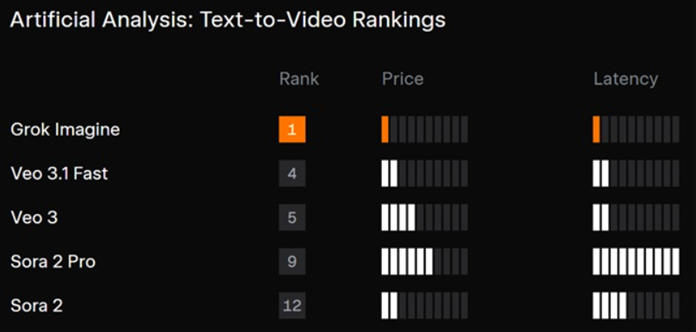
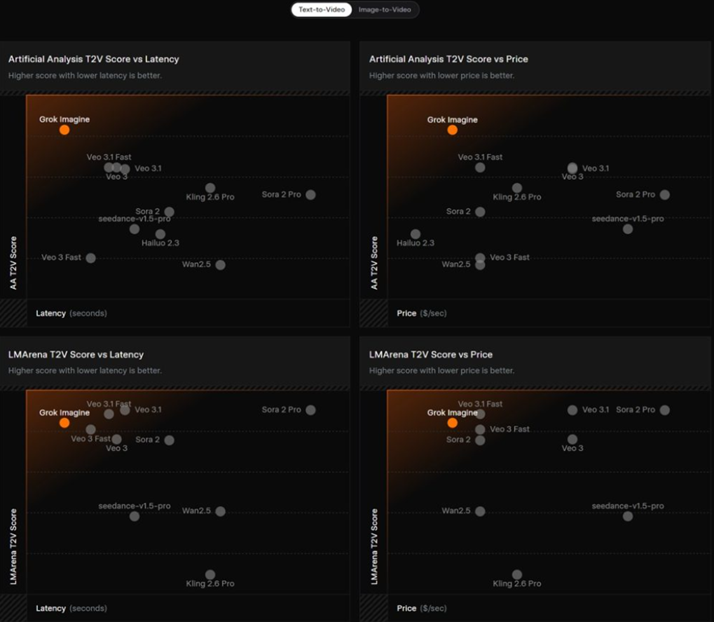
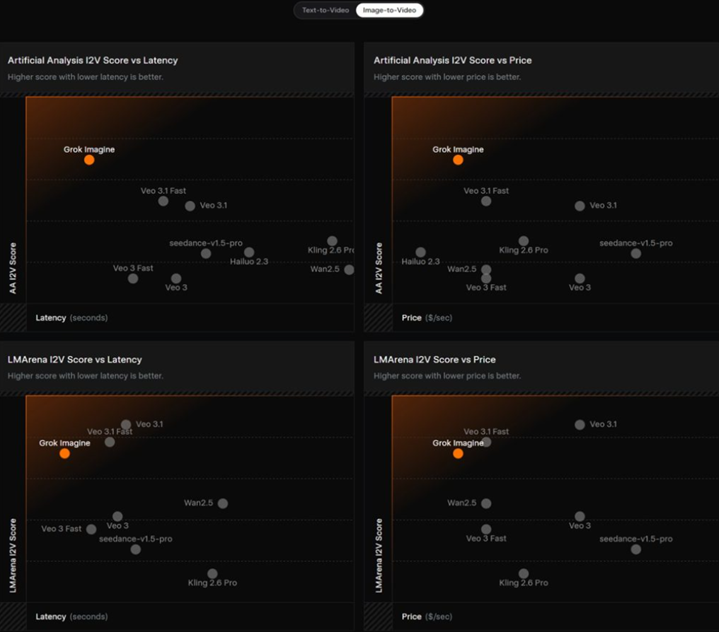
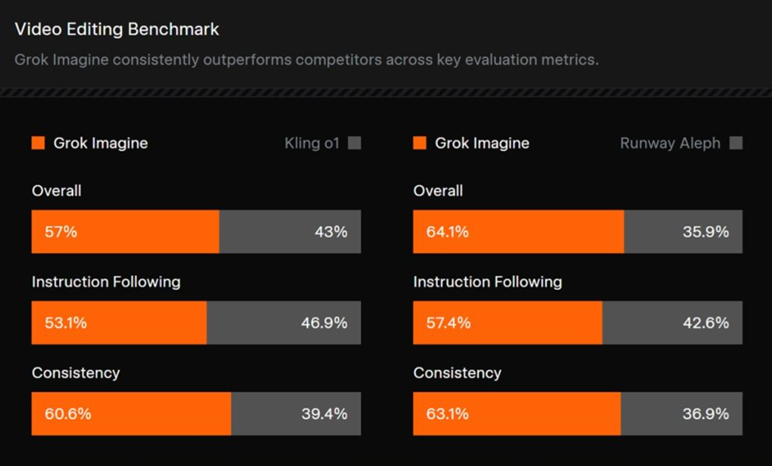
Separately, xAI recently launched Grok Imagine 1.0, a major update to its AI-powered video generation and editing platform. The company said the new version improves video quality, cost efficiency, and latency, while enabling faster iteration for creators and developers.

xAI also claimed that Grok Imagine generated 1.245 billion videos in the past 30 days.

Grok Imagine 1.0 supports video generation of up to 10 seconds at 720p resolution, along with improved audio output. The model allows video creation from text prompts or static images with enhanced motion handling, object interaction, and visual continuity across scenes.

Grok Imagine API and Features

image image image

Alongside the model update, xAI introduced the Grok Imagine API, a unified API suite designed for end-to-end creative workflows. The API combines video and audio generation with video editing tools, allowing users to create or refine content within a single workflow. It supports text prompts, image inputs, and complex cinematic refinements.

Key features include text-to-video and image-to-video generation, cinematic motion with realistic object interaction, visual continuity across frames, flexible clip lengths, and support for multiple aspect ratios.

image

Editing tools allow users to add, remove, or swap objects, transform scenes, control colour and objects, animate characters using user-provided performance, restyle existing footage, and convert sketches into animated visuals. xAI says performance has been optimised for latency, concurrency, and cost with native video-audio generation aligned with industry benchmarks.

Availability and Use Cases

xAI says Grok Imagine is designed for creators and influencers, educators and designers, creative and marketing teams, enterprise video workflows, and general users looking to turn ideas into video content.

The Grok Imagine API is available through partner platforms as well as xAI’s own APIs with SDKs, tutorials and a hosted console for experimentation.

Users can try Grok Imagine at: http://grok.com/imagine

FAQs

Q1. What was the value of SpaceX’s acquisition of xAI?

Answer. SpaceX acquired xAI in an all‑stock deal valued at $1.25 trillion, combining AI research with space infrastructure. SpaceX was valued at $1T and xAI at $250B.

Q2. What is SpaceX’s plan for space‑based AI computing?

Answer. Elon Musk outlined a strategy to deploy up to one million satellites to support large‑scale AI model training and data processing, powered by near‑continuous solar energy.

Q3. What new product has xAI launched after the merger?

Answer. xAI introduced Grok Imagine 1.0, an AI video generation and editing platform with text‑to‑video, image‑to‑video, cinematic editing tools, and a unified API suite.

Also Read

https://www.mymobileindia.com/spacex-is-blocking-apples-satellite-messaging-expansion-report/

https://www.mymobileindia.com/airtel-and-jio-partner-with-spacex-to-bring-starlink-internet-to-india/