


Highlights
- DeepSeek introduced Manifold-Constrained Hyper-Connections (mHC) to improve large language model training efficiency and reduce instability.
- mHC restructures shortcut connections across neural layers, projecting them onto a manifold to keep signals stable and prevent failed training runs.
- Trials on models up to 27B parameters showed improved stability and scalability.

DeepSeek Unveils mHC AI Architecture.
The Chinese artificial intelligence startup, DeepSeek, drew global attention in November 2024 with its R1 AI model. The same company has now introduced a new training architecture designed to make large language model (LLM) development more efficient and reliable.
In a newly published research paper, the company outlines an approach called Manifold-Constrained Hyper-Connections (mHC), which aims to reduce training instability, a common issue that can lead to wasted compute resources and stalled model development.
DeepSeek Introduces a New AI Training Approach
The research paper, published on arXiv and listed on Hugging Face, details how the mHC architecture modifies the way neural network layers communicate during training. According to DeepSeek’s researchers, the method restructures shortcut connections within models to better control how information flows across layers.
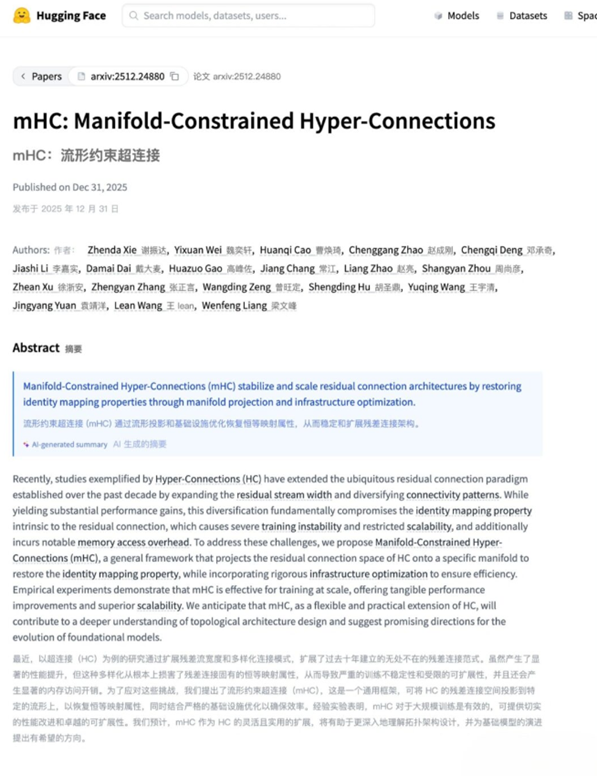
The research paper was published on arXiv and listed on Hugging Face.
Modern large-scale AI models often rely on shortcut pathways that allow data to bypass certain processing stages, helping maintain signal strength across deep networks. However, when these shortcuts are expanded without constraints, they can introduce instability, making large models harder to train end-to-end. DeepSeek’s mHC architecture addresses this by projecting these connections onto a mathematically defined structure known as a manifold, ensuring signals remain stable as they pass through the network.
In simpler terms, large AI models consist of billions of parameters, each influencing how the system responds to a prompt. This is why identical queries can produce slightly different answers across platforms such as ChatGPT, Gemini, or Claude. Training involves carefully adjusting all these parameters to achieve the desired behaviour.
Problems arise when signals within the network either become too strong or fade away too quickly. When this happens, training can fail midway, forcing developers to restart the process. Such interruptions waste time, money, and valuable computer power. The mHC design aims to prevent this by keeping shortcut connections predictable and mathematically well-behaved during training.
Tested Across Multiple Model Sizes
DeepSeek evaluated the new architecture across models of varying scales, including a 27-billion-parameter model trained on a dataset proportional to its size, along with smaller versions. These experiments were intended to understand how dataset size and compute requirements interact with the mHC design. The results showed that the architecture helps maintain stability and scalability even in large models without introducing significant overhead.
While mHC does not directly reduce the power consumption of GPUs or specialised AI accelerators, its key advantage lies in minimising failed training runs. By reducing the need to restart training, the approach can significantly lower the total compute and energy used over an entire training cycle.
Real-world Impact Still To Be Seen
At present, the mHC architecture has not been integrated into any commercial AI models, making it difficult to assess its performance under real-world conditions. However, on paper, it presents a compelling alternative to existing training techniques and could represent a more robust way to build large AI systems.
The broader impact of DeepSeek’s approach will become clearer once independent researchers adopt the architecture, publish comparative results, or subject the paper to peer review and further scrutiny.
FAQs
Q1. What is DeepSeek’s new mHC architecture designed to do?
Answer. The Manifold-Constrained Hyper-Connections (mHC) approach is designed to reduce training instability and make large language model development more efficient.
Q2. How does DeepSeek’s mHC improve AI training compared to traditional methods?
Answer. It restructures shortcut connections across neural layers by projecting them onto a manifold, keeping signals stable and preventing failed training runs.
Q3. Has DeepSeek’s mHC been used in commercial AI models yet?
Answer. No, mHC has only been tested in research settings so far; its real-world impact will be clearer once independent researchers adopt and review it.