


Highlights
- India orders all smartphones to preload the Sanchar Saathi app and later clarifies that users can uninstall the app.
- Sanchar Saathi offers anti‑fraud tools like blocking stolen phones, reporting spam/scam calls, and checking mobile connections.
- Apple plans to oppose the directive over privacy and security concerns.
Caption – Sanchar Saathi app. (Image credit – DoT)
Apple is reportedly preparing to resist India’s latest directive requiring all smartphones sold in the country to come preloaded with the state-owned Sanchar Saathi app. While the government has now clarified that users will be allowed to delete the app, the move does little to address Apple’s broader privacy and security concerns.
India Says Users Can Remove App, But Preloading Still Mandatory
Last week, the Indian government announced that smartphone manufacturers must pre-install or auto-install the Sanchar Saathi app on new as well as existing devices. The app, which the government promotes as a security tool, allows users to report stolen phones, block IMEI numbers and flag spam or scam callers.
Initially, the directive sparked controversy because it appeared to require the app to be non-removable.

Caption – Clarification on the Sanchar Saathi app being optional. (Image credit – DoT)
Following public criticism, the Department of Telecommunications, Govt. of India clarified that the app can indeed be uninstalled and keeping it installed is “completely optional” for users. They further emphasised that Sanchar Saathi will not enable call monitoring or snooping and is focused solely on consumer protection.
#SancharSaathi puts digital safety in your hands. Pre-installed for your protection, but for user its completely optional. So you can decide what stays on your device.#DoT #Telecommunications #CyberSecurity #DoTForDigitalSafety@JM_Scindia @PemmasaniOnX @neerajmittalias… pic.twitter.com/MhDMVuRxNE
— DoT India (@DoT_India) December 2, 2025
However, even with this clarification, the mandate still requires the app to be visibly accessible and fully functional during device setup. The government maintains that while its duty is to introduce the app, users have the freedom to keep or delete it.
उपभोक्ता की सुरक्षा-हमारी सबसे बड़ी जिम्मेदारी।
इसी सोच से संचार साथी बनाया गया है-एक ऐप और एक पोर्टल, जो हर नागरिक को अपने मोबाइल की सुरक्षा अपने हाथों से करने की ताकत देता है।
संचार साथी बताएगा कि आपके फोन का IMEI genuine है या fake। यही वजह है कि देशभर में 1.5 करोड़+ लोग ऐप… pic.twitter.com/u20ox7aVex
— DoT India (@DoT_India) December 2, 2025
Details of the Government Directive
The telecom department’s order includes strict requirements –
- All new devices must come with Sanchar Saathi pre-installed.
- The app must remain visible and enabled during first-time setup.
- Features cannot be disabled or restricted by OEMs.
- Brands have 90 days to implement the directive.
- A compliance report must be submitted within 120 days.
- The app must also be installed on existing phones through OTA updates.
These demands raised concerns from smartphone makers, especially around control over system apps and user choice.
What Is the Sanchar Saathi App?
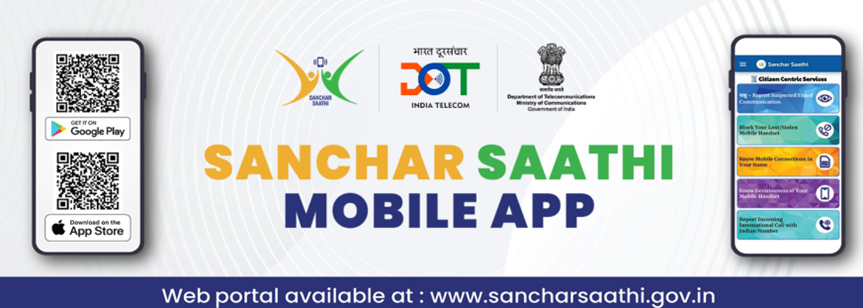
Caption – Sanchar Saathi app. (Image credit – DoT)
The Sanchar Saathi app was launched under the Centre’s Central Equipment Identity Register (CIER) initiative and includes several anti-fraud and anti-theft features.
The app has the following features –
- Chakshu Portal for reporting suspicious calls, SMS, and WhatsApp messages with visible numbers.
- Ability to block or track lost and stolen smartphones across all telecom networks.
- Option to check how many mobile connections are registered under a user’s name.
- Ability to report unknown or unauthorised numbers linked to their identity.
According to Communications Minister Jyotiraditya Scindia, the app has already helped disconnect 1.75 crore fraudulent mobile connections, traced 20 lakh stolen phones and returned 7.5 lakh devices to their owners.
The government says the mandate is part of a broader effort to curb cybercrime, fraud, hacking and online scams across India.
Apple Expected to Push Back Over Privacy & Security Issues
A Reuters report states that Apple has decided to oppose the DoT’s directive but will not take legal action. Instead, the company will communicate concerns around user privacy, data protection, and system-level access required by preloaded apps.
The report reads, “Apple however does not plan to comply with the directive and will tell the government it does not follow such mandates anywhere in the world as they raise a host of privacy and security issues for the company’s iOS ecosystem, said two of the industry sources who are familiar with Apple’s concerns. They declined to be named publicly as the company’s strategy is private.”
This comes at a sensitive time as Apple is increasingly dependent on India for manufacturing diversification away from China. The brand is also dealing with a potential $38 billion antitrust penalty in the country.
As India becomes increasingly vital to Apple’s supply chain and consumer business, the disagreement over the Sanchar Saathi mandate adds to rising regulatory tensions. With Apple unwilling to compromise on its privacy and ecosystem rules and the government pushing for tighter digital security measures, the issue may continue to escalate unless both sides reach a middle ground.
FAQs
Q1. What does India’s directive require smartphone makers to do with the Sanchar Saathi app?
Answer. All new and existing devices must preload the app, keep it visible during setup, and ensure features remain enabled.
Q2. Can users uninstall the Sanchar Saathi app after setup?
Answer. Yes, the government clarified that uninstalling is allowed and keeping the app is optional for users.
Q3. Why is Apple opposing the directive?
Answer. Apple is raising concerns about privacy, data protection, and system‑level access required by preloaded apps, though it won’t pursue legal action.