Highlights
- OpenAI’s first AI smartphone is tipped to enter mass production in H1 2027.
- The company is reportedly working with shipment projections of around 30M units by 2028.
- It is expected to use a custom MediaTek Dimensity 9600 built on TSMC’s N2P process paired with LPDDR6 RAM, UFS 5.0 storage, and a dual NPU architecture.

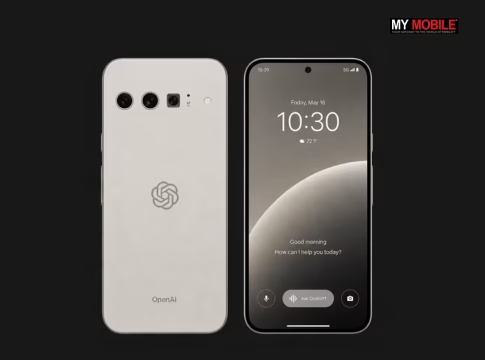
OpenAI is reportedly working on its first smartphone and new leaks have revealed early details about the project. The upcoming device has been described as an “AI agent smartphone” and is expected to enter mass production in the first half of 2027. Here’s more on what we know about the latest development so far.
OpenAI’s First AI Smartphone
According to well-known analyst Ming-Chi Kuo, the OpenAI device is currently in development and could mark a significant shift in how smartphones operate. It will be focusing more on AI-driven interactions rather than traditional app-based usage.
The OpenAI smartphone is tipped to be powered by a custom version of MediaTek’s next-generation chipset likely the Dimensity 9600. MediaTek is said to be the leading contender for supplying the processor, which is expected to launch in Q4 2026.
The upcoming Dimensity 9600 is expected to build on this performance offering improved efficiency and AI capabilities. The chipset used in OpenAI’s smartphone is expected to be based on TSMC’s N2P manufacturing process.
In terms of memory and storage, the device could feature LPDDR6 RAM and UFS 5.0 storage ensuring faster data access and better multitasking performance.
One of the key highlights of the device could be its dual NPU (Neural Processing Unit) architecture designed to handle advanced AI workloads more efficiently. The smartphone is also expected to include security features such as pKVM (protected Kernel-based Virtual Machine) and inline hashing.
Previous reports suggest that OpenAI’s “AI agent smartphone” may function differently from conventional devices. Instead of relying heavily on apps, the phone is expected to execute tasks directly using AI and offering a more seamless and intuitive user experience.
Production Timeline and Expectations
The analyst estimates that shipments of the OpenAI smartphone could reach around 30 million units across 2027 and 2028 combined indicating strong expectations for the device.
The latest and previous leaks provide an interesting look at what OpenAI might be planning. However, it is important to note that the company has not officially confirmed the smartphone. This means all details circulating online should be considered with a pinch of salt for now.
Source –
FAQs
Q1. When is OpenAI’s first AI smartphone expected to enter mass production?
Answer. It is tipped to begin mass production in the first half of 2027, with shipments projected around 30 million units by 2028.
Q2. What chipset will power the OpenAI smartphone?
Answer. The device is expected to use a custom MediaTek Dimensity 9600, built on TSMC’s N2P process, offering improved efficiency and AI capabilities.
Q3. How will the OpenAI smartphone differ from conventional devices?
Answer. Instead of relying heavily on apps, it is expected to function as an AI agent smartphone, executing tasks directly via AI for a more seamless experience.
Also Read –
https://www.mymobileindia.com/openai-smartphone-might-debut-in-2028-reveals-ming-chi-kuo/
https://www.mymobileindia.com/openais-first-audio-wearable-tipped-for-2026-launch/