Highlights
- Snapdragon 8 Elite Gen 6 Pro may debut HPB (Heat Pass Block) cooling, enabling better thermal management and sustained 6GHz performance.
- The Pro variant is tipped to support LPDDR6 RAM, UFS 5.0 storage, and a full GPU, while the standard Gen 6 may stick to LPDDR5X.
- Rising costs of LPDDR6 and advanced silicon could push Ultra flagship phone prices higher with many non-Ultra models likely opting for the cheaper SM8950 chip.
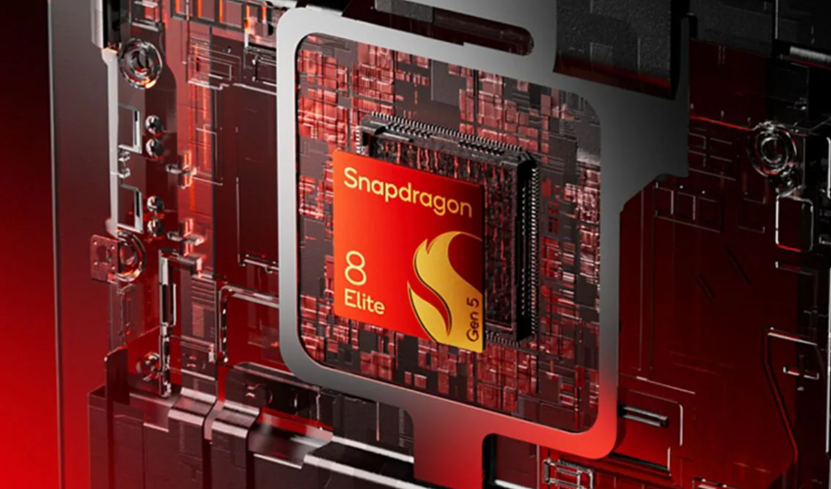
A major leak has surfaced months ahead of Qualcomm’s next flagship chipset launch. It reveals a detailed block diagram of the Snapdragon 8 Elite Gen 6 Pro. Among the two rumoured variants, Qualcomm is expected to reserve LPDDR6 RAM support and a full-fledged GPU exclusively for the Pro model. The latest schematic now suggests that the Pro chip could also debut another key upgrade in thermal management through an HPB design.
Snapdragon 8 Elite Gen 6 Pro May Feature HPB Cooling
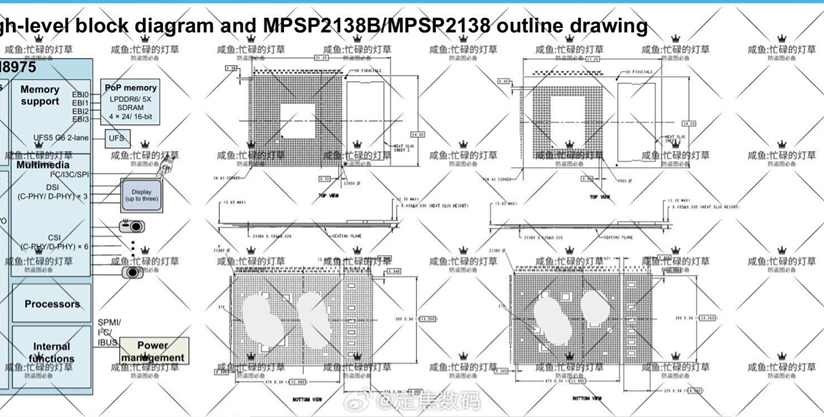
Latest schematic of the Pro chip. (Image credit – Fixed Focus Digital on Weibo)
According to a recent post by tipster Fixed Focus Digital on Weibo, Qualcomm may adopt Heat Pass Block (HPB) technology for the Snapdragon 8 Elite Gen 6 Pro. This is the same cooling approach reportedly used in Samsung’s upcoming Exynos 2600. Unlike conventional layouts, HPB places a dedicated heat-spreading layer directly on top of the chipset package, allowing heat to move away from the silicon more efficiently before it impacts performance.
Recent Qualcomm flagship chips have pushed for extremely high peak clock speeds, and rumours claim the Snapdragon 8 Elite Gen 6 Pro could reach frequencies as high as 6GHz.
Maintaining such speeds has traditionally been difficult due to rising temperatures that force throttling. HPB is designed to address this limitation by providing greater thermal headroom, potentially enabling sustained high performance.
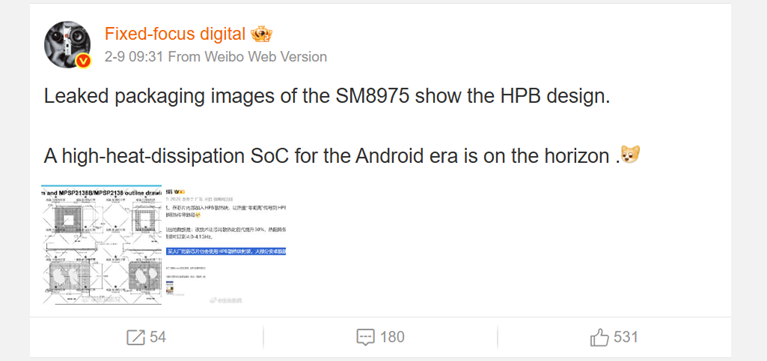
Tispter Fixed Focus Digital’s post on Weibo. (Translated via Google Translate)
Package-on-Package Memory and Storage Support
The leaked schematic also sheds light on the chip’s internal design. The Snapdragon 8 Elite Gen 6 Pro is said to use a Package-on-Package (PoP) memory layout, where RAM is stacked closely with the processor to reduce space usage.
In terms of memory and storage, the chipset reportedly supports both LPDDR6 and LPDDR5X RAM, along with UFS 5.0 storage via two high-bandwidth lanes. Beyond raw power, the leak hints at productivity-focused features such as multi-display support, which could allow smartphones to deliver desktop-like experiences when connected to external monitors.
If accurate, these details suggest Qualcomm is taking a more aggressive approach to thermal design in its most powerful silicon yet. However, it remains unclear whether HPB cooling will be exclusive to the Pro variant, as there is no confirmation that the standard Snapdragon 8 Elite Gen 6 will include the same solution.
Two Flagship Chips, Two Very Different Cost Profiles
Adding to the discussion, well-known leaker Digital Chat Station has shared further insights into Qualcomm’s next-generation flagship lineup. According to the leak, Qualcomm is preparing two chips, identified as the SM8975 and SM8950, both reportedly built on TSMC’s 2nm process.
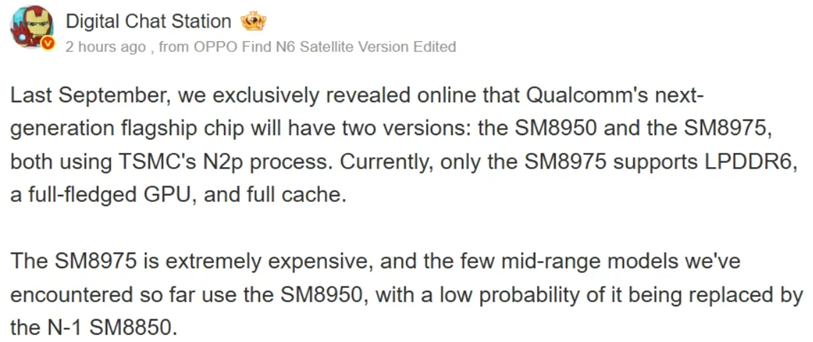
Tipster Digital Chat Station’s post on Weibo. (Translated via Google Translate)
The SM8975 is said to be the only one in the lineup to support LPDDR6, a “full-fledged GPU,” and a complete cache system. However, these upgrades come at a steep cost, with the leaker describing the chip as “extremely expensive.
As a result, some “mid-range” flagship models, likely referring to Pro-tier phones rather than Ultra variants, are expected to opt for the SM8950 instead. There is also a slim chance that some brands may even fall back to the SM8850, which corresponds to the current Snapdragon 8 Elite Gen 5.
A previous leak from the same source mentioned that the upcoming SoCs would feature a 2+3+3 CPU core configuration.
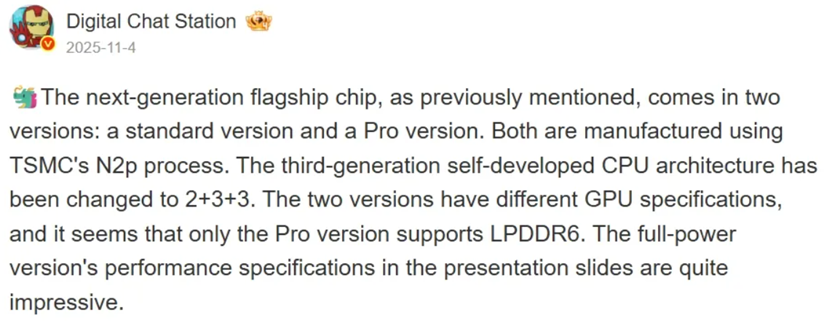
Tipster Digital Chat Station’s post on Weibo. (Translated via Google Translate)
The SM8975 is widely believed to be the Pro version of Qualcomm’s next flagship platform, which could be branded as the Snapdragon 8 Elite Gen 6 Pro if current naming conventions are followed.
Meanwhile, the SM8950 is expected to launch as the Snapdragon 8 Elite Gen 6. So far, there have been no concrete leaks about a non-Elite Snapdragon 8 Gen 6, leaving its existence uncertain.
Rising Costs Could Push Ultra Flagship Prices Higher
If the Snapdragon 8 Elite Gen 6 Pro does turn out to be as expensive as suggested, it could further inflate the prices of Ultra flagship smartphones. While Ultra devices typically enjoy some price elasticity due to buyers prioritising top-tier hardware, there are limits to how much consumers are willing to pay.
The leak already indicates that many non-Ultra flagships may stick with the SM8950 to keep pricing under control. Complicating matters further is the SM8975’s support for LPDDR6 RAM. Although technically impressive, the ongoing global RAM crisis has made LPDDR6 significantly more expensive than previous generations.
For brands planning Ultra flagships, this creates a tough decision. Pairing the SM8975 with LPDDR6 would result in extremely high costs, while opting for LPDDR5 or LPDDR5X could help rein in prices, assuming the chipset allows such flexibility. A combination of the SM8975 and LPDDR6 would likely lead to sharply inflated price tags, which is unwelcome news for Android enthusiasts watching flagship prices climb year after year.
FAQs
Q1. What new cooling technology might the Snapdragon 8 Elite Gen 6 Pro use?
Answer. Leaks suggest it could adopt Heat Pass Block (HPB) cooling, which spreads heat more efficiently to sustain high performance at up to 6GHz.
Q2. What memory and storage support is expected in the Pro variant?
Answer. The Pro chip may support LPDDR6 and LPDDR5X RAM, UFS 5.0 storage, and a Package-on-Package memory layout for better efficiency.
Q3. Why could Ultra flagship phones become more expensive with this chip?
Answer. The Pro variant’s LPDDR6 support and advanced GPU make it costly, and the global RAM shortage could further drive up prices for Ultra devices.