
Highlights
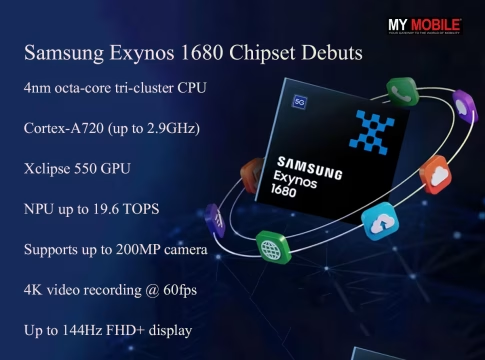
- Samsung’s Exynos 1680 debuts with a 4nm tri-cluster CPU, delivering improved efficiency and speed.
- It is equipped with Xclipse 550 GPU based on AMD RDNA 3, offering 16% better performance, plus an upgraded NPU capable of 19.6 TOPS for advanced on-device AI tasks.
- It supports up to 200MP sensors, 4K 60fps video, LPDDR5X RAM, UFS 4.1 storage, 144Hz displays, Wi-Fi 6E, Bluetooth 6.1 and 5G speeds up to 5.1Gbps.
Samsung has officially introduced its latest mid-range processor, the Exynos 1680, which is expected to power the upcoming Galaxy A57 5G smartphone. Built on a 4nm process, the new chipset brings notable upgrades in CPU, GPU, and AI capabilities. It also supports high-resolution cameras and fast refresh rate displays, and is already in mass production.
Exynos 1680 Features Tri-Cluster CPU Design and GPU Upgrades
The Exynos 1680 comes with an octa-core CPU featuring a tri-cluster architecture. It includes one Cortex-A720 core clocked at 2.9GHz, four Cortex-A720 cores running at 2.6GHz, and three Cortex-A520 cores operating at 1.95GHz.
Compared to its predecessor, Samsung has swapped one efficiency core for an additional mid-core, a move aimed at improving performance while maintaining power efficiency.
For graphics, the chipset is equipped with the Xclipse 550 GPU, based on AMD’s RDNA 3 architecture. It features a 2WGP and 2RB configuration. According to Samsung, this setup delivers up to a 16 percent improvement in GPU performance, which should translate to smoother visuals and enhanced gaming performance.
The chipset supports LPDDR5X RAM and UFS 4.1 storage, and can power full-HD+ displays with refresh rates of up to 144Hz, offering a more fluid user experience.
The Exynos 1680 includes an upgraded NPU capable of delivering up to 19.6 trillion operations per second (TOPS). It also integrates an AI engine supporting 8K MAC, enabling advanced on-device AI tasks such as image processing, live translation, and other intelligent features without relying heavily on cloud processing.
Camera Capabilities and Video Support
On the imaging front, the chipset supports a single camera sensor of up to 200 megapixels. It can also handle a 64-megapixel sensor at 30fps and dual 32-megapixel camera configurations.
The processor supports 4K video recording and playback at 60fps. It is compatible with multiple codecs including HEVC, H.264, VP9, and VP8. Additionally, it features AI-based image processing and improved noise reduction, which should enhance low-light photography.
Connectivity Features
In terms of connectivity, the Exynos 1680 supports Wi-Fi 6E, Bluetooth 6.1, and GNSS. It also offers 5G NR support for both FR1 and FR2 bands, delivering peak download speeds of up to 5.1Gbps on sub-6GHz networks and up to 4.84Gbps on mmWave.
Additionally, the chipset includes LTE Cat.18 support, enabling download speeds of up to 1.2Gbps and upload speeds of up to 211Mbps.
All in all, Samsung is strengthening its position in the mid-range chipset segment with the introduction of the Exynos 1680. The combination of improved performance, advanced AI capabilities and support for high-end camera and display technologies makes it a strong contender for upcoming smartphones.
FAQs
Q1. What is the Samsung Exynos 1680 built on?
Answer. The Exynos 1680 is built on a 4nm process and features an octa-core tri-cluster CPU design for improved performance and efficiency.
Q2. What are the GPU and AI capabilities of the Samsung Exynos 1680?
Answer. It uses the Xclipse 550 GPU based on AMD’s RDNA 3 architecture, offering up to 16% better graphics performance, and an upgraded NPU delivering 19.6 TOPS for advanced AI tasks.
Q3. What camera and display features does the Samsung Exynos 1680 support?
Answer. The chipset supports up to 200MP single camera sensors, 4K video at 60fps, and full-HD+ displays with refresh rates up to 144Hz.
Also Read –
https://www.mymobileindia.com/samsung-exynos-2500-vs-snapdragon-8-gen-4/